서 론
특정학습장애는 신경발달장애의 일종으로 정확하고 유창
한 읽기, 독해, 철자, 작문, 연산, 수학적 추론 같은 기초학습 기술의 습득 지연이 특징이다. 학습장애를 가진 아동은 학습 기회나 지도가 충분히 제공되었음에도 불구하고 뇌의 기능 적인 이상으로 인해 정상적인 학습능력을 발달시키지 못한 다.1) 전 세계적으로 학령기 아동의 특정학습장애 유병률은 5-15%이며, 국내의 경우 1.2-3.8%로 보고되었다.2,3)
난독증은 학습장애의 한 아형으로 정확하고 유창한 단어 재인의 어려움, 해독 및 철자능력의 부족을 특징으로 하는 데, 해독 외에 독해나 구어에 이상이 있는 경우를 제외하는 좁 은 의미의 정의부터 읽기에 문제를 초래하는 다양한 상황을
국내 아동 및 청소년 난독증 진단을 위한 종합학습능력평가도구-읽기의 표준화 연구
유한익1)・정재석2)・이은경1)・강성희3)・박은희3)・최인욱4)
서울뇌과학연구소,1) 서울아이정신건강의학과의원,2) ㈜해피마인드,3) 한동대학교 산업정보디자인학부4)
Standardization of the Comprehensive Learning Test-Reading for the Diagnosis of Dyslexia in Korean Children and Adolescents
Hanik K. Yoo, M.D., Ph.D.
1), Jaesuk Jung, M.D., Ph.D.
2), Eun Kyung Lee, M.A.
1), Sung Hee Kang, M.A.
3), Eun Hee Park, Ph.D.
3), and InWook Choi, M.F.A.
4)1)Seoul Brain Research Institute, Seoul, Korea
2)Seoul Child Psychiatric Clinic, Suwon, Korea
3)Happymind Inc., Seoul, Korea
4)School of Industrial & Media Design, Handong Global University, Pohang, Korea
Objectives: The aim of this study was to develop the computerized Comprehensive Learning Test-Reading (CLT-R) to evalu- ate the cognitive processes and achievements related to their basic reading ability and identify dyslexia in children and adoles- cents in South Korea. We also obtained the normative data and evaluated the reliability and validity of the test.
Methods: We developed the CLT-R, including the word attack/nonword decoding, paragraph reading, sound blending, non- word repetition, rapid automatized naming, letter-sound matching, visual attention, orthography awareness, and digit span tests, for the purpose of diagnosing dyslexia. We investigated the reliability and validity of the tests and gathered the normative data from 399 subjects (male 48.9%), aged 5-14 years, from the last grade in kindergarten to middle school, dwelling in Seoul and Gyeonggi Province, South Korea.
Results: No statistical differences were observed between the means of the tests and retests of the CAT. The mean of the corre- lation coefficient of the test-retest scores was 0.85. According to the construct validity test calculated by principal constant analysis using the oblique rotation method, 4 factors explained 70.0% of the cumulative variances. In addition, the normative data were ob- tained for all of the CLT-R subtests.
Conclusion: The computerized CLT-R can be used as a reliable and valid tool to evaluate the reading achievement and reading related cognitive process in Korean children and adolescents in schools, clinics, and research institutes.
KEY WORDS: DyslexiaㆍReading DisorderㆍReading AchievementㆍCognitive ProcessㆍComputerized TestㆍStandardization.
Date received: January 1, 2016 Date of revision: May 3, 2016 Date accepted: May 9, 2016
Address for correspondence: Hanik K. Yoo, M.D., Ph.D., Seoul Brain Re- search Institute, RN408, Gangbyeon Station Zenith Tower, 10 Gangbyeon- nyeok-ro 4-gil, Gwangjin-gu, Seoul 05116, Korea
Tel: +82.2-452-2100, Fax: +82.2-6280-2163 E-mail: [email protected]
모두 포괄하는 넓은 의미를 포함하고 있다. 원인에 대해서도 다양한 가설이 있으나 현재는 음운처리이상 가설이 널리 받 아들여지고 있고, 뇌영상연구 결과 및 중재연구 결과도 이를 뒷받침하고 있다.4)
난독증의 진단은 지금까지 능력 성취 불일치 모델(discrep- ancy model)과 중재반응(responsiveness to intervention) 모델이 주로 적용되어 왔다. 불일치 모델은 기대 수준과 실제 수행 수준 간에 유의한 차이를 진단 근거로 삼는 모델이다.
즉 자신의 지적능력에 비하여 유의하게 낮은 성취 수준을 보 이면, 학습장애로 진단하며,5) 잠재적 지적 능력은 지능검사 로 측정하고 학업성취 수준은 학습성취도검사를 통하여 측 정한다.6) 중재반응 모델이란 적절한 교육적 중재에 대한 아 동의 반응을 연속적으로 평가하여 학습장애를 진단하는 모 델이다.7) 이 모델에 따르면 효과적인 중재에도 학습능력의 향 상이 없어 결국 또래 아동들에 비하여 현저하게 낮은 학습 수준을 보이는 경우에 학습장애로 진단한다. 이런 중재반응 모델에 근거한 진단은 교육적 측면을 고려할 수 있기 때문에 불일치 모델의 긍정적 대안으로 제시되었다.7) 하지만 불일치 모델은 지능이 지나치게 높거나 낮은 아동에서 진단이 어려운 약점이 있으며,8-10) 중재반응 모델은 제대로 된 중재를 제공하 지 못하는 상황에서는 학습장애로 진단하지 못하거나 충분 한 교육을 받고 나서 진단을 내려야 하므로 치료적 접근이 늦어지는 단점이 있다.11-13)
이런 한계점들을 보완하기 위해 읽기능력과 연관되어 있는 음운처리능력, 표기처리능력, 작업기억력과 같은 읽기 관련 인지처리 과정을 평가하고 이를 중재 계획에 반영하자는 주 장이 제기되어 왔다.14,15) 실제 미국에서는 이런 주장을 바탕 으로 개발한 Comprehensive Test of Phonological Process- ing(CTOPP)이나 Phonological Awareness Test가 널리 사용 되고 있다. 영어권에서는 음운인식능력이 향후 읽기능력의 가장 강력한 예측인자이고, 난독증 아동을 선별할 수 있는 가장 효과적인 변인으로 알려져 있다.16) 음운인식이란 귀로 들은 말소리 속에 들어 있는 소리의 하부단위를 지각하고 인 식할 수 있는 능력이다. 일단 단어를 음절로 나누어 지각할 수 있어야 하고, 더 하부단위인 음소까지도 지각할 수 있어 야 한다. 뿐만 아니라 음소를 생략하고 첨가하고 대치하는 조작도 가능해야 한다. 하지만 한글처럼 낱자와 소리의 대응 이 규칙적이어서 해독능력을 배우는 데 어려움이 적은 언어 에 있어서는 예측력이 매우 떨어지고 대신 빠른이름대기능력 이 더 중요하다는 주장이 있다. 이처럼 한글에서 음운인식능 력의 예측력이 떨어지는 중요한 이유 중 하나는 음운 대치, 탈락, 첨가, 분절, 합성 등 음운조작능력을 평가하는 검사에 서 대부분 이른 나이에 천정효과를 보이기 때문이다.17)
이런 이유로 본 연구에서는 음운인식검사가 국내 난독증 진단에서 크게 변별력이 없을 것으로 예상해서 여러 음운인 식능력 평가방법 중 가장 어려운 비단어의 합성능력만을 포 함하였다. 또한 기존의 면대면 검사보다는 반응속도를 예민하 고 정확하게 측정할 수 있고 같은 목소리 자극을 사용할 수 있는 전산화 방식을 적용하였다.18) 이처럼 본 연구는 기존 연 구 결과를 바탕으로 국내의 난독증 진단 및 평가에 적합한 전산화 평가도구를 개발하고, 국내 아동 및 청소년의 읽기성 취도 및 읽기관련 인지처리 능력의 규준 자료를 얻기 위해 실 시되었다.
방 법
1. 종합학습능력평가도구-읽기(Comprehensive Learning Test-Reading, CLT-R)의 제작
Denckla와 Cutting19)의 읽기능력 설명모델을 기반으로 읽 기성취도와 읽기관련 인지처리능력을 평가하기 위한 9개의 소검사를 제작하였다. 소검사 중 표기인식 검사는 철자능력 의 성취도 검사로 볼 수도 있으나 편의상 인지처리검사에 포 함시켰다. 총 검사시간은 40분 정도가 소요된다.
1) 검사의 내용
(1) 낱말읽기검사(Word attack/nonword decoding test)20) 난독증 선별을 위한 가장 기초적인 검사로서 다빈도로 나 오는 의미단어와 한 번도 본 적이 없는 무의미단어를 소리 내 어 읽는 검사이다. 무의미단어 해독검사는 난독증의 가장 좋 은 선별도구라고 알려져 있는데, 시각적 단서나 기억의 도움 없이 자모합성능력을 이용하여 읽어야 하기 때문이다.21) 검사 에 사용할 무의미단어를 제작할 때 자주 보는 단어의 자모를 일부만 바꿔서 아동이 의미단어로 잘못 읽는 의미화 오류(lex- icalization error)가 나올 가능성이 높도록 제작하였다. 이는 읽기가 정확해지는 나이가 되면 무의미단어 읽기 속도가 난독 증을 진단할 수 있는 유일한 변수일 가능성이 있기 때문이다.
(2) 단락읽기검사(Paragraph reading fluency test)22) 주어진 글을 읽는 정확도와 유창성을 측정하는 검사로서, 유창성은 1분 동안 정확하게 읽은 어절 수로 정의된다.
(3) 음운인식(합성)검사(Sound blending test)23)
주어진 음절 또는 음소를 합성하여 발음하는 능력을 측정 하는 음운인식능력검사의 일종이다. 검사의 난이도를 높이 기 위하여 합성하여 발음하는 단어를 무의미단어로 하였다.
(4) 음운작업기억검사(Nonword repetition test)24) 음운적 작업기억력을 평가하는 검사로 처음 듣는 무의미 한 단어를 똑같이 따라 하는 정확도를 평가한다. ‘ㅈ-ㅉ-ㅊ’
처럼 난독증 학생이 변별하기 어려워하는 것으로 알려진 우리 말 음운의 쌍이 들어간 무의미단어를 제작하여 제시하였다.
(5) 빠른자동이름대기검사(Rapid automatized naming test)25)
무작위로 배열된 50개의 일련의 숫자, 글자, 물체의 이름을 각각 얼마나 빨리 말할 수 있는지를 평가하는 검사이다.
(6) 낱자소리대응검사(Letter-sound matching test)26) 낱자의 소리값을 정확하게 알고 있는지 알아보는 검사이 다. 화면에 보이는 두 상자 중 들리는 소리와 같은 상자를 누 르도록 한다. 변별이 힘든 음소쌍을 중심으로 검사자극이 제 시된다. 자모 낱자의 이름은 알아도 낱자의 소리값은 모르거 나 철자쓰기에 필요한 수준의 정교한 소리값 지식을 가지고 있지 못한 경우를 구별할 수 있다.
(7) 표기인식검사(Orthography awareness test)27) 두 개의 낱말 중 맞춤법에 맞는 낱말을 찾아내는 검사이 다. 학생들이 자주 틀리는 순서로 과제를 선정하였고 대부분 의 낱자를 포함하기 위해 중복을 피했다. 음운작업기억검사 와 낱자소리대응검사와 검사자극 쌍이 대부분 일치하므로 듣기-읽기-쓰기 영역에서 각각 변별이 힘든 자모가 일치하는 지 알아볼 수 있다.
(8) 시각주의력검사(Visual attention test)28,29)
아주 짧은 시간 동안 본 글자를 기억하는 능력을 평가하 는 검사이다. 제시된 다섯 글자를 아주 잠깐만 보고 글자가 없어진 상태에서 밑줄만 제시하고 방금 밑줄 위에 있었던 글 자를 말하도록 한다.
(9) 숫자따라하기검사(Digit span test)30)
청각적 단기기억력과 작업기억력을 평가하는 검사이다. 들 려주는 숫자를 다 듣고, 순서대로 혹은 역순으로 말하게 한다.
2) 검사의 구성
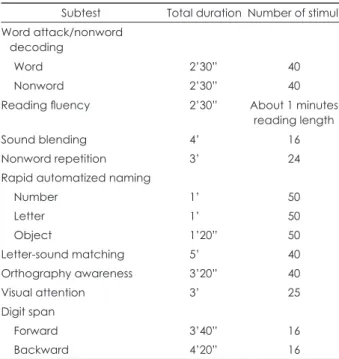
9개 소검사의 구성은 Table 1과 같다.
2. 대 상
본 연구는 연구윤리위원회의 승인 후 진행되었다.
2013년 12월부터 2014년 1월까지 서울 소재 소아청소년 정
신건강의학과 외래에 내원한 유치원생(7세)과 중학교 3학년 에 이르는 아동 및 청소년 20명을 대상으로 신뢰도 연구를 실시하였으며, 연구에 대한 설명을 들은 후 참여자와 보호자 가 동의한 후 연구에 참여했다.
표준화 연구는 같은 기간에 서울과 경기 지역의 평균 수준 의 학업성취 수준을 보이는 유치원(7세), 초등학교, 중학교를 방문하여 실시하였다. 참여자 및 보호자의 동의하에 연구에 참여시켰고, 검사 전 담임교사와의 인터뷰를 통해서 정신지 체, 시력, 청력의 문제가 보고될 경우, 기타 이유로 검사를 실 시할 수 없는 대상들을 파악한 후 연구에서 제외하였다. 결 과적으로 아동 및 청소년 399명을 대상으로 표준화 연구가 실시되었다. 평균 연령은 11.6±2.70세였다. 학년 및 성별 표 준화 집단의 분포는 Table 2와 같다.
3. 검사-재검사 신뢰도 검증
20명의 피험자에게 2주 간격으로 실시한 검사-재검사 신 뢰도는 paired t-test와 Pearson 상관계수를 산출하여 검증 하였다.
4. 구성타당도 검증
구성타당도를 검증하기 위해 사교회전하여 주축요인분석 을 실시하였다.
5. 표준화 자료 수집
소정의 훈련과 실습을 통해 Comprehensive Learning Test-
Table 1. Constitution of the comprehensive learning test-reading Subtest Total duration Number of stimuli Word attack/nonword
decoding
Word 2’30” 40
Nonword 2’30” 40
Reading fluency 2’30” About 1 minutes reading length
Sound blending 4’ 16
Nonword repetition 3’ 24
Rapid automatized naming
Number 1’ 50
Letter 1’ 50
Object 1’20” 50
Letter-sound matching 5’ 40
Orthography awareness 3’20” 40
Visual attention 3’ 25
Digit span
Forward 3’40” 16
Backward 4’20” 16
Reading(CLT-R)의 검사내용, 검사방법 및 채점방법에 관해 숙지한 검사자가 대상 아동 및 청소년에게 검사를 실시하였 다. 검사는 학교에 마련된 별도의 검사실을 이용하여 개별적 으로 시행되었으며, 검사자는 기본적인 환자 정보를 프로그 램에 등록한 후 검사를 시작하여 아동의 연령이나 능력에 따 라 평균 45분 정도가 소요되었다.
6. 통계분석
자료분석은 SPSS 12.0(SPSS Inc., Chicago, IL, USA)을 이 용하였으며, 통계적인 유의수준은 0.05(양측 검정)로 하였다.
결 과
1. 검사-재검사 신뢰도
Paired t-test 결과, 검사 전 영역에서 검사-재검사 간에 유의 한 차이가 관찰되지 않았으며, 검사 평균 상관계수는 0.85였다.
2. 구성타당도
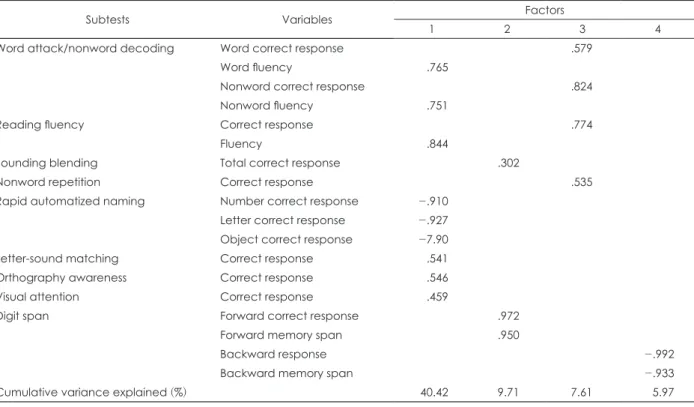
구성타당도를 검증하기 위해 실시한 요인 분석 결과, 모두 4개의 요인으로서 CLT-R 총 분산의 70%를 설명할 수 있는
Table 2. Demographic characteristics of study participants
Male (number) Female (number) Total (number)
Education (mean years±SD) 4.58±2.75 4.62±2.98 4.60±2.86
0 (preschool) 14 17 31
1 19 20 39
2 25 21 46
3 23 21 44
4 18 20 38
5 20 21 41
6 21 18 39
7 22 22 44
8 18 15 33
9 15 29 44
Total 195 204 399
Mean years: mean education years, SD: standard deviation
Table 3. Explanatory factor analysis of the comprehensive learning test-reading
Subtests Variables Factors
1 2 3 4
Word attack/nonword decoding Word correct response .579
Word fluency .765
Nonword correct response .824
Nonword fluency .751
Reading fluency Correct response .774
Fluency .844
Sounding blending Total correct response .302
Nonword repetition Correct response .535
Rapid automatized naming Number correct response -.910 Letter correct response -.927 Object correct response -7.90
Letter-sound matching Correct response .541
Orthography awareness Correct response .546
Visual attention Correct response .459
Digit span Forward correct response .972
Forward memory span .950
Backward response -.992
Backward memory span -.933
Cumulative variance explained (%) 40.42 9.71 7.61 5.97
것으로 나타났다. 요인 1은 속도요인으로 낱말읽기검사의 의 미낱말읽기유창성과 무의미낱말읽기유창성, 단락읽기검사의 유창성, 빠른자동이름대기검사의 숫자/글자/물체, 표기인식 검사, 시각주의력검사 등이 속하였으며 총 분산의 30%를 설 명하였다. 요인 2는 정확도요인으로 낱말읽기검사의 의미낱 말읽기정답률과 무의미낱말읽기정답률, 단락읽기검사의 단 락읽기정답률, 음운작업기억검사정답률 등이 속하였으며 총 분산의 15%를 설명하였다. 요인 3은 기억폭요인으로 음운인 식검사(합성), 낱자소리대응검사, 숫자따라하기검사의 정방 향정답수와 정방향최대기억폭이 속하였으며 총 분산의 14%
를 설명하였다. 요인 4는 집행기능요인으로 숫자따라하기검 사의 역방향정답수와 역방향최대기억폭이 속하였으며 총 분 산의 11%를 설명하였다(Table 3).
3. 표준화 결과
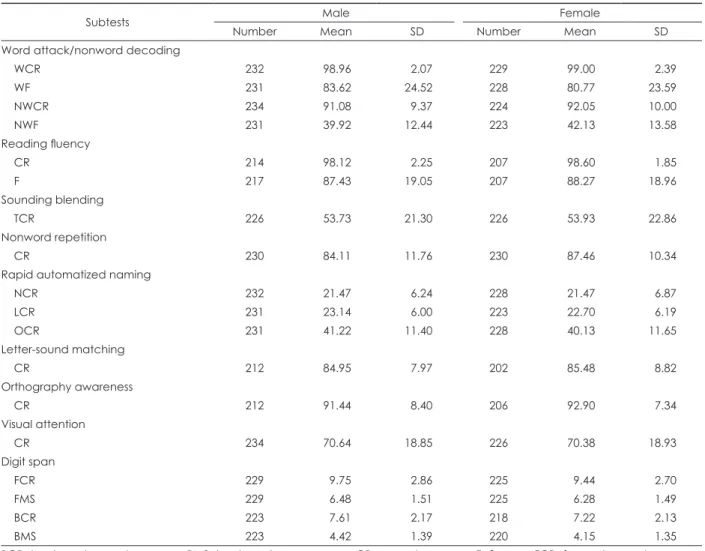
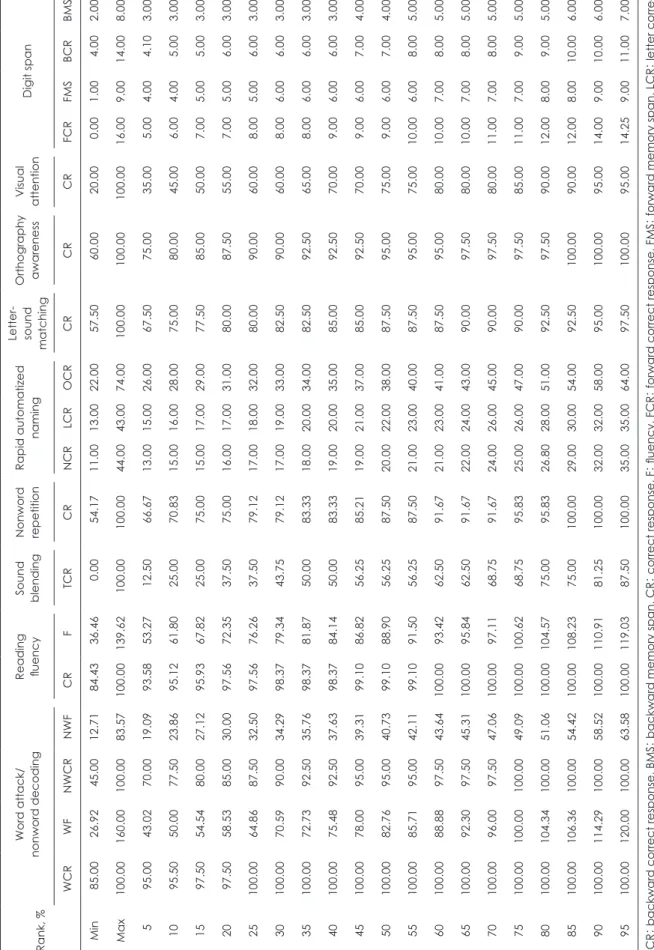
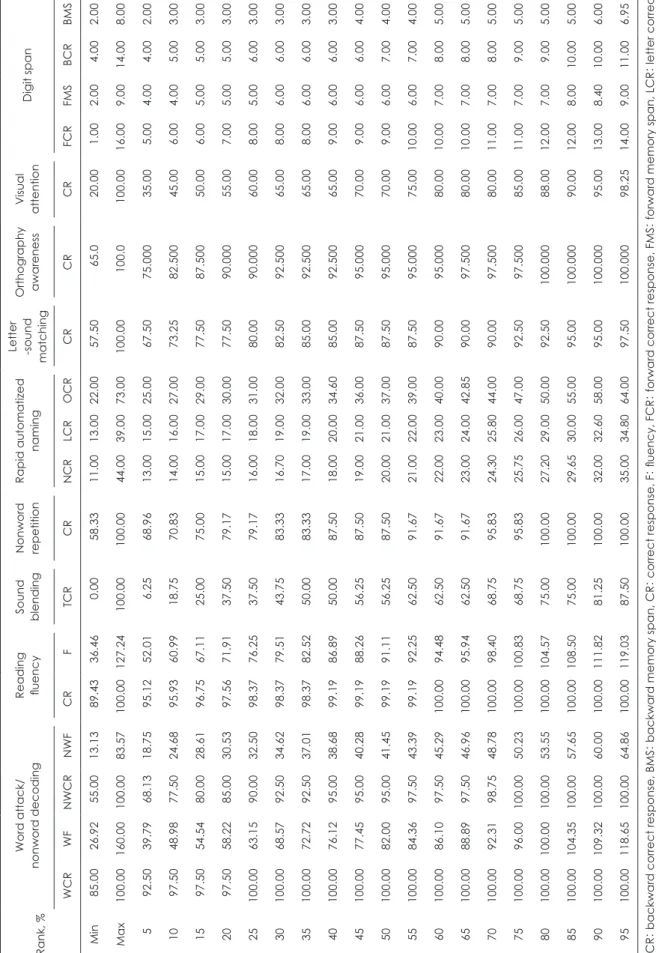
국내 아동 및 청소년을 대상으로 실시한 표준화 연구 결과 는 다음과 같다. 각 소검사의 남녀별 평균과 표준편차 결과 를 Table 4에 제시하였다. 단락읽기검사의 정답률(t=-2.43, p=.016), 음운작업기억검사의 정답률(t=-3.247, p=.001), 숫자 따라하기검사의 역방향최대기억폭 점수(t=2.092, p=.037)에 서만 남녀 간의 평균 차이가 유의하였고, 나머지 변수들에서 는 남녀 간 차이가 유의하지 않았다. 또한 한국 아동 및 청소 년의 남녀별 CLT-R의 정상 규준 자료를 각각 Table 5와 6에 제시하였다. 남녀 정상 규준 자료의 모든 변인에서는 점수가 연령에 따라 증가하는 추세를 보였다.
고 찰
읽기의 목적은 글로부터 의미를 얻는 것이다. 이를 위해서
Table 4. Mean and standard deviation of the comprehensive learning test-reading in the Korean children and adolescents
Subtests Male Female
Number Mean SD Number Mean SD
Word attack/nonword decoding
WCR 232 98.96 2.07 229 99.00 2.39
WF 231 83.62 24.52 228 80.77 23.59
NWCR 234 91.08 9.37 224 92.05 10.00
NWF 231 39.92 12.44 223 42.13 13.58
Reading fluency
CR 214 98.12 2.25 207 98.60 1.85
F 217 87.43 19.05 207 88.27 18.96
Sounding blending
TCR 226 53.73 21.30 226 53.93 22.86
Nonword repetition
CR 230 84.11 11.76 230 87.46 10.34
Rapid automatized naming
NCR 232 21.47 6.24 228 21.47 6.87
LCR 231 23.14 6.00 223 22.70 6.19
OCR 231 41.22 11.40 228 40.13 11.65
Letter-sound matching
CR 212 84.95 7.97 202 85.48 8.82
Orthography awareness
CR 212 91.44 8.40 206 92.90 7.34
Visual attention
CR 234 70.64 18.85 226 70.38 18.93
Digit span
FCR 229 9.75 2.86 225 9.44 2.70
FMS 229 6.48 1.51 225 6.28 1.49
BCR 223 7.61 2.17 218 7.22 2.13
BMS 223 4.42 1.39 220 4.15 1.35
BCR: backward correct response, BMS: backward memory span, CR: correct response, F: fluency, FCR: forward correct response, FMS: forward memory span, LCR: letter correct response, NCR: number correct response, NWCR: nonword correct response, NWF: nonword correct response, OCR: object correct response, SD: standard deviation, TCR: total correct response, WCR: word correct response, WF: word fluency
Table 5. Normative data of the comprehensive learning test-reading in the Korean male children and adolescents Rank, %Word attack/ nonword decoding Reading fluency Sound blending Nonword repetition
Rapid automatized naming
Letter- sound
matching
Orthography awareness
Visual attentionDigit span WCRWFNWCRNWFCRFTCRCRNCRLCROCRCRCRCRFCRFMSBCRBMS Min085.00026.9245.0012.7184.4336.460.0054.1711.0013.0022.0057.5060.00020.000.001.004.002.00 Max100.00160.00100.0083.57100.00139.62100.00100.0044.0043.0074.00100.00100.00100.0016.009.0014.008.00 05095.00043.0270.0019.0993.5853.2712.5066.6713.0015.0026.0067.5075.00035.005.004.004.103.00 10095.50050.0077.5023.8695.1261.8025.0070.8315.0016.0028.0075.0080.00045.006.004.005.003.00 15097.50054.5480.0027.1295.9367.8225.0075.0015.0017.0029.0077.5085.00050.007.005.005.003.00 20097.5058.5385.0030.0097.5672.3537.5075.0016.0017.0031.0080.0087.50055.007.005.006.003.00 25100.0064.8687.5032.5097.5676.2637.5079.1217.0018.0032.0080.0090.00060.008.005.006.003.00 30100.0070.5990.0034.2998.3779.3443.7579.1217.0019.0033.0082.5090.00060.008.006.006.003.00 35100.0072.7392.5035.7698.3781.8750.0083.3318.0020.0034.0082.5092.50065.008.006.006.003.00 40100.0075.4892.5037.6398.3784.1450.0083.3319.0020.0035.0085.0092.50070.009.006.006.003.00 45100.0078.0095.0039.3199.1086.8256.2585.2119.0021.0037.0085.0092.50070.009.006.007.004.00 50100.0082.7695.0040.7399.1088.9056.2587.5020.0022.0038.0087.5095.00075.009.006.007.004.00 55100.0085.7195.0042.1199.1091.5056.2587.5021.0023.0040.0087.5095.00075.0010.006.008.005.00 60100.0088.8897.5043.64100.0093.4262.5091.6721.0023.0041.0087.5095.00080.0010.007.008.005.00 65100.0092.3097.5045.31100.0095.8462.5091.6722.0024.0043.0090.0097.50080.0010.007.008.005.00 70100.0096.0097.5047.06100.0097.1168.7591.6724.0026.0045.0090.0097.50080.0011.007.008.005.00 75100.00100.00100.0049.09100.00100.6268.7595.8325.0026.0047.0090.0097.50085.0011.007.009.005.00 80100.00104.34100.0051.06100.00104.5775.0095.8326.8028.0051.0092.5097.50090.0012.008.009.005.00 85100.00106.36100.0054.42100.00108.2375.00100.0029.0030.0054.0092.50100.00090.0012.008.0010.006.00 90100.00114.29100.0058.52100.00110.9181.25100.0032.0032.0058.0095.00100.00095.0014.009.0010.006.00 95100.00120.00100.0063.58100.00119.0387.50100.0035.0035.0064.0097.50100.00095.0014.259.0011.007.00 BCR
: backward correct response, BMS : backward memory span, CR : correct response, F: fluency, FCR : forward correct response, FMS : forward memory span, LCR : letter
correct response, NCR
: number correct response, NWCR : nonword correct response, NWF : nonword correct response, OCR : object correct response, TCR : total correct response, WCR :
word correct response, WF
: word fluency
Table 6. Normative data of the comprehensive learning test-reading in the Korean female children and adolescents Rank, %Word attack/ nonword decoding Reading fluency Sound blending Nonword repetition
Rapid automatized naming
Letter -sound
matching
Orthography awareness
Visual attentionDigit span WCRWFNWCRNWFCRFTCRCRNCRLCROCRCRCRCRFCRFMSBCRBMS Min85.0026.9255.0013.1389.4336.460.0058.3311.0013.0022.0057.5065.0020.0001.002.0004.002.00 Max100.00160.00100.0083.57100.00127.24100.00100.0044.0039.0073.00100.00100.0100.0016.009.0014.008.00 0592.5039.7968.1318.7595.1252.016.2568.9613.0015.0025.0067.5075.00035.0005.004.0004.002.00 1097.5048.9877.5024.6895.9360.9918.7570.8314.0016.0027.0073.2582.50045.0006.004.0005.003.00 1597.5054.5480.0028.6196.7567.1125.0075.0015.0017.0029.0077.5087.50050.0006.005.0005.003.00 2097.5058.2285.0030.5397.5671.9137.5079.1715.0017.0030.0077.5090.00055.0007.005.0005.003.00 25100.0063.1590.0032.5098.3776.2537.5079.1716.0018.0031.0080.0090.00060.0008.005.0006.003.00 30100.0068.5792.5034.6298.3779.5143.7583.3316.7019.0032.0082.5092.50065.0008.006.0006.003.00 35100.0072.7292.5037.0198.3782.5250.0083.3317.0019.0033.0085.0092.50065.0008.006.0006.003.00 40100.0076.1295.0038.6899.1986.8950.0087.5018.0020.0034.6085.0092.50065.0009.006.0006.003.00 45100.0077.4595.0040.2899.1988.2656.2587.5019.0021.0036.0087.5095.00070.0009.006.0006.004.00 50100.0082.0095.0041.4599.1991.1156.2587.5020.0021.0037.0087.5095.00070.0009.006.0007.004.00 55100.0084.3697.5043.3999.1992.2562.5091.6721.0022.0039.0087.5095.00075.0010.006.0007.004.00 60100.0086.1097.5045.29100.0094.4862.5091.6722.0023.0040.0090.0095.00080.0010.007.0008.005.00 65100.0088.8997.5046.96100.0095.9462.5091.6723.0024.0042.8590.0097.50080.0010.007.0008.005.00 70100.0092.3198.7548.78100.0098.4068.7595.8324.3025.8044.0090.0097.50080.0011.007.0008.005.00 75100.0096.00100.0050.23100.00100.8368.7595.8325.7526.0047.0092.5097.50085.0011.007.0009.005.00 80100.00100.00100.0053.55100.00104.5775.00100.0027.2029.0050.0092.50100.00088.0012.007.0009.005.00 85100.00104.35100.0057.65100.00108.5075.00100.0029.6530.0055.0095.00100.00090.0012.008.0010.005.00 90100.00109.32100.0060.00100.00111.8281.25100.0032.0032.6058.0095.00100.00095.0013.008.4010.006.00 95100.00118.65100.0064.86100.00119.0387.50100.0035.0034.8064.0097.50100.00098.2514.009.0011.006.95 BCR
: backward correct response, BMS : backward memory span, CR : correct response, F: fluency, FCR : forward correct response, FMS : forward memory span, LCR : letter
correct response, NCR
: number correct response, NWCR : nonword correct response, NWF : nonword correct response, OCR : object correct response, TCR : total correct response, WCR :
word correct response, WF
: word fluency
는 크게 해독(decoding)과 이해(독해) 과정이 필요하다. 난독 증은 통상적으로 해독의 문제 때문에 나타나는데, 이 과정에는 음운인식, 음운기억, 음운인출을 포함한 음운처리능력과 철 자지식을 기반으로 한 표기인식능력이 관여한다.31,32) 또한 시 청지각 처리 과정과 작업기억도 중요한 역할을 차지한다.32-34) 본 연구를 통해 읽기 과정에 필요한 이런 다양한 인지능력들 을 평가할 수 있게 되었고, 결국 국내 난독증을 진단하고 교 육적 개입을 위한 자료를 획득할 수 있는 전산화 평가도구가 개발되었다.
본 연구 결과를 통해 볼 때, 국내에서는 음운작업기억검사24) 가 읽기능력에 중요한 영향을 주는 인자일 가능성이 있다. 임 상적으로 국내 난독증 아동은 이중모음이나 받침을 변별하 는 능력이 떨어져 있는데, 음운작업기억검사가 바로 이중모 음과 같은 까다로운 음운들의 변별능력과 언어적 작업기억 폭을 평가하는 검사이다. 본 연구 결과 국내 난독증의 경우 제한된 작업기억폭으로 인해 변별할 음절이 길어지면 정확도 가 떨어지는 것을 확인할 수 있었다. 또한 작업기억폭이 반복 적인 훈련을 통해 어느 정도 상승할 수 있다는 연구 결과35,36) 를 바탕으로, 읽기능력과 음운인식능력의 상호작용, 다시 말 해 읽기를 잘하고 또 많이 읽다 보면 음운인식능력도 좋아지 고 반대로 읽기 기회가 적으면 음운인식능력도 발달하지 못 할 가능성이 있다.
빠른 이름대기는 대상의 명칭을 발음하기 위해 필요한 심 상어휘집의 음운 정보에 빠르게 접근할 수 있는 능력을 말한 다.37) 장기기억으로부터 음운 정보를 인출하는 속도가 빠르 다는 것은 시각정보와 언어정보를 연결하는 피질하 뇌회로 의 연결이 효율적이라는 것을 의미한다.38) 빠른 이름대기 능 력은 읽기정확성보다 속도와 더 관련이 있는 변인으로 알려 져 있는데,37,39) 본 연구 결과도 이를 지지한다. 또한 유치원부 터 중학교 3학년에 이르기까지 빠른 이름대기 능력은 지속적 으로 향상되며, 이는 읽기유창성이 지속적으로 향상된다는 기존 결과와도 일치한다.37) 이는 기존 Kim39)의 BASA 읽기 표준화 연구에서 초등학교 3학년 이후로 유창성 규준이 같 은 것40)과는 상치되는 결과로서 추후 다른 단락을 이용해서 다시 연구해 볼 필요가 있다고 생각된다. 미국의 국가수준 유 창성 규준과 CTOPP의 Rapid Automatized Naming 규준 이 천정 없이 지속적으로 향상되는 것 또한 본 연구의 결과와 일치한다.
영어권에서는 정확하게 읽기 위해 표기인식능력, 즉 철자지 식이 필요하며, 효과적인 철자지식을 획득하려면 먼저 글자 를 소리로 전환시키는 낱자-소리 대응규칙을 배워야 한다.41) 철자지식은 읽기의 어려움을 예측하는 중요한 독립적 변수이 며,42) 음운인식의 영향력을 배제한 후에도 읽기 총변량의 16%
를 설명한다고 알려져 있다.31) 또한 유치원 시기의 철자능력 이 초등학교 1학년 때의 단어읽기능력과 초등학교 4학년과 중학교 1학년의 어휘력 및 읽기 이해력과 상관관계가 있다.43) 흥미로운 것은 늦은 나이에 읽기 부진이 발견된 아이들은 음 운인식 문제는 극복되었지만 철자법의 문제는 그대로 남아 있는 경향이 있다.
작업기억은 인간의 뇌기능 중 고위인지기능에 해당하는 부위로서 여러 가지 인지과제를 수행하는 동안 정보를 일시 적으로 저장하고 조작하는 능력이다.44) 작업기억은 읽기 과 정에서도 매우 중요한데 읽고 이해하려면 읽기와 관련된 정 보를 끊임 없이 기억하고 처리해야 하기 때문이다. 작업기억에 는 청각자극을 처리하는 음운회로(phonological loop)와 시각 자극을 담당하는 시공간잡기장(visuospatial sketchpad), 이 두 체계를 통제하고 조정하는 중앙실행영역(central executive) 으로 구성되어 있다.45,46) 읽기부진 아동에서 작업기억 용량의 부족이 자주 관찰되며, 언어적 작업기억뿐만 아니라 시공간 작업기억도 부족한 경우가 많다.47,48) 글을 읽을 때 우리는 자 모낱자를 자음과 모음의 소리로 일대일 대응시켜 전환한 후 작업기억에 저장한 후 합성하는데, 이 과정에 문제가 있으면 당연히 읽기가 어려워진다.49-51)
읽기장애의 일부에서 음운인식문제 외에 문자열 처리 중 글자나 기호에 주의력을 할당하는 과정에 문제가 관찰되었
다.28,52) 특히 다음절 단어 읽기의 연결주의 다발추적 모델
(connectionist multi-trace model)에 따르면 읽기 체계에 시 각주의 과정이 포함되어 있어 시각주의력 폭이 충분히 넓지 못하면 이후의 음운처리 과정에도 영향을 미치게 되어 읽기 가 어려워진다.50) 본 연구에서는 시각주의력검사28,29)를 통해 아주 짧은 순간 동안의 시각주의력 폭을 측정하였다.
본 연구를 통해 국내 아동 및 청소년의 읽기 정확도와 유 창성의 성취 수준과 읽기관련 인지처리 과정에 대한 신뢰도 높은 규준 자료를 확보하였다. 본 검사의 바탕이 된 Denckla 와 Cutting19)의 영어 읽기능력 설명모델은 한글읽기능력을 예측하는 데도 대부분 유용하였다. 또한 전산화검사방법을 도입하여 읽기와 관련된 인지처리 속도에 대한 정확하고 객 관적인 평가가 가능해졌고, 평가의 민감도와 신뢰도를 높일 수 있게 되었다. 뿐만 아니라 효과적인 난독증 치료 개입을 위한 기초자료를 얻게 되었고, 개입 전후의 호전 정도를 보다 객관적으로 판단할 수 있게 되었다.
본 연구의 제한점은 다음과 같다. 첫째, 서울 및 경기 지역의 유치원 7세반에서 중학교 3학년까지의 아동 및 청소년을 대상 으로 실시하였으므로, 전국적, 연령적 대표성이 부족하다. 이 를 보완하기 위해서는 추후 지방에 거주하는 대상군과 고등학 생 대상군 등을 확장하여 보충할 필요가 있다. 둘째, 임상적인
효용성에 대한 자료가 없다. 따라서 난독증 환자군을 대상으 로 이 검사가 얼마나 임상적으로 유용한 것인지를 검증할 필 요가 있다. 셋째, 공인타당도에 대한 검증이 이루어지지 못했 다. 기존의 읽기학습능력 검사들 간의 연관성 검증이 시행될 필요가 있다. 넷째, 읽기이해 능력을 평가하는 소검사가 없어 해독 요인과 독해력 요인의 관련을 파악할 수가 없다. 향후 보 다 포괄적인 읽기능력의 평가를 위해서 보완할 필요가 있다.
결 론
본 연구를 통해 국내 난독증 아동 및 청소년들의 평가와 진단, 그리고 개입의 효과 검증을 위한 신뢰할만한 전산화검 사도구를 개발하였으며, 표준화 자료를 확보하였다.
중심 단어: 난독증・읽기장애・읽기성취도・인지처리・
전산화검사・표준화.
Conflicts of Interest
The authors have no financial conflicts of interest.
References
1) Jung JS. Specific learning disorder. In: Cho SH, editor. Biological child psychiatry. Seoul: Sigmapress;2014. p.157-175.
2) Lee YS, Hong KY. A pilot study: specific reading disorder in Kore- an elementary school children. J Korean Neuropsychiatr Asso 1985;
24:103-110.
3) National Institute of Special Education. Special education indica- tors of Korea. Seoul: National Institute of Special Education;2002.
4) Jung JS, Yoo HK. Specific learning disorder. In: Hong KY, editor.
Child psychiatry. 2nd ed. Seoul: Hakjisa;2014. p.202-210.
5) Kim DI, Lee DS, Shin JH. Introduction to learning disabilities.
Seoul: Hakjisa;2003.
6) Hallahan DP, Lloyd JW, Kauffman JM, Weiss MP, Martinez EA.
Learning disabilities: foundations, characteristics, and effective teaching. 3rd ed. Needham Heights, MA: Allyn & Bacon;2005.
7) Gresham FM. Responsiveness to intervention: an alternative ap- proach to the identification of learning disabilities. In: Bradley R, Danielson L, Hallahan D, editors. Learning disabilities: research to practice. Mahwah, NJ: Lawrence Erlbaum;2002. p.467-519.
8) Siegel LS. Evidence that IQ scores are irrelevant to the definition and analysis of reading disability. Can J Psychol 1988;42:201-215.
9) Lee DS. Diagnosing and screening learning disabilities: problems of the discrepancy criterion and roles of content-specific basic aca- demic skills. J Emot Behav Disord 2001;17:19-41.
10) Hur SJ. Diagnosis and assessment of learning disabilities: problems of previous models and some suggestions. Korean J Learn Disabil 2005;2:31-53.
11) Rourke BP. Neuropsychology of learning disabilities: past and future.
Learn Disabil Q 2005;28:111-114.
12) Scruggs RP 3rd. Robert Pickett Scruggs III, MD: a conversation with the editor. Interview by William Clifford Roberts. Proc (Bayl Univ Med Cent) 2002;15:391-402.
13) Kim YO. The ideals and pitfalls of the responsiveness to interven- tion model to identify students with learning disabilities. Korean J Spec Educ 2006;41:141-161.
14) Sousa DA. How the special needs brain learns. Thousand Oaks:
Corwin Press;2006.
15) Kim DI, Jung KJ. Exploring an integrated model for identification of learning disabilities: beyond the discrepancy and responsiveness- to-intervention. J Emot Behav Disord 2008;24:133-161.
16) Bishop AG, League MB. Identifying a multivariate screening mod- el to predict reading difficulties at the onset of kindergarten: a lon- gitudinal analysis. Learn Disabil Q 2006;29:235-252.
17) Elliott JG, Grigorenko EL. The dyslexia debate. New York: Cam- bridge University Press;2014.
18) Kettler RJ. Computer-based screening for the new modified alter- nate assessment. J Psychoeduc Assess 2011;29:3-13.
19) Denckla MB, Cutting LE. History and significance of rapid au- tomatized naming. Ann Dyslexia 1999;49:29.
20) Mauer DM, Kamhi AG. Factors that influence phoneme-grapheme correspondence learning. J Learn Disabil 1996;29:259-270.
21) Chard DJ, Osborn J. Phonics and word recognition instruction in early reading programs: guidelines for accessibility. Learn Disabil Res Pract 1999;14:107-117.
22) Meisinger EB, Bloom JS, Hynd GW. Reading fluency: implications for the assessment of children with reading disabilities. Ann Dys- lexia 2010;60:1-17.
23) Majsterek DJ, Ellenwood AE. Phonological awareness and begin- ning reading: evaluation of a school-based screening procedure. J Learn Disabil 1995;28:449-456.
24) Gathercole SE, Willis CS, Baddeley AD, Emslie H. The children’s test of nonword repetition: a test of phonological working memo- ry. Memory 1994;2:103-117.
25) Wolf M. Naming speed and reading: the contribution of the cogni- tive neurosciences. Read Res Q 1991;26:123-141.
26) Ise E, Schulte-Körne G. Spelling deficits in dyslexia: evaluation of an orthographic spelling training. Ann Dyslexia 2010;60:18-39.
27) Grainger J, Ziegler JC. A dual-route approach to orthographic pro- cessing. Front Psychol 2011;2:54.
28) Bosse ML, Tainturier MJ, Valdois S. Developmental dyslexia: the visual attention span deficit hypothesis. Cognition 2007;104:198-230.
29) Lobier M, Zoubrinetzky R, Valdois S. The visual attention span deficit in dyslexia is visual and not verbal. Cortex 2012;48:768-773.
30) Sattler JM. Assessment of children: cognitive applications. 4th ed.
San Diego: J.M. Sattler;2001.
31) Badian NA. Phonological and orthographic processing: their roles in reading prediction. Ann Dyslexia 2001;51:177-202.
32) Wolf M, Bowers PG. The double-deficit hypothesis for the develop- mental dyslexias. J Educat Psychol 1999;91:415-438.
33) Beneventi H, Tønnessen FE, Ersland L, Hugdahl K. Executive working memory processes in dyslexia: behavioral and fMRI evi- dence. Scand J Psychol 2010;51:192-202.
34) Kavale KA, Forness SR. What definitions of learning disability say and don’t say: a critical analysis. J Learn Disabil 2000;33:239-256.
35) Klingberg T. Training and plasticity of working memory. Trends Cogn Sci 2010;14:317-324.
36) Klingberg T, Fernell E, Olesen PJ, Johnson M, Gustafsson P, Dahl- ström K, et al. Computerized training of working memory in chil- dren with ADHD--a randomized, controlled trial. J Am Acad Child Adolesc Psychiatry 2005;44:177-186.
37) Georgiou GK, Stewart B. Is rapid automatized naming automatic?
Presch Prim Educ 2013;1:67-81.
38) Denckla MB, Rudel RG. Rapid “automatized” naming (R.A.N):
dyslexia differentiated from other learning disabilities. Neuropsy- chologia 1976;14:471-479.
39) Kim DI. Basic academic skills assessment: reading. Seoul: Hakjisa;
2000.
40) Ziegler JC, Goswami U. Reading acquisition, developmental dyslex- ia, and skilled reading across languages: a psycholinguistic grain size theory. Psychol Bull 2005;131:3-29.
41) Pennington BF, Lefly DL. Early reading development in children
at family risk for dyslexia. Child Dev 2001;72:816-833.
42) Lervåg A, Bråten I, Hulme C. The cognitive and linguistic founda- tions of early reading development: a Norwegian latent variable longitudinal study. Dev Psychol 2009;45:764-781.
43) Baddeley A. Working memory. Curr Biol 2010;20:R136-R140.
44) Baddeley A. Working memory: theories, models, and controversies.
Annu Rev Psychol 2012;63:1-29.
45) Baddeley AD. Verbal and visual subsystems of working memory.
Curr Biol 1993;3:563-565.
46) Just MA, Carpenter PA. A capacity theory of comprehension: indi- vidual differences in working memory. Psychol Rev 1992;99:122-149.
47) Swanson HL. Short-term memory and working memory: do both contribute to our understanding of academic achievement in chil- dren and adults with learning disabilities? J Learn Disabil 1994;27:
34-50.
48) Baddeley A. Working memory and language: an overview. J Com- mun Disord 2003;36:189-208.
49) Baddeley A, Gathercole S, Papagno C. The phonological loop as a language learning device. Psychol Rev 1998;105:158-173.
50) Georgiou GK, Das JP, Hayward DV. Comparing the contribution of two tests of working memory to reading in relation to phonological awareness and rapid naming speed. J Res Read 2008;31:302-318.
51) Bednarek DB, Saldaña D, Quintero-Gallego E, García I, Grabows- ka A, Gómez CM. Attentional deficit in dyslexia: a general or spe- cific impairment? Neuroreport 2004;15:1787-1790.
52) Ans B, Carbonnel S, Valdois S. A connectionist multiple-trace mem- ory model for polysyllabic word reading. Psychol Rev 1998;105:678- 723.