⋅교신저자 : Kim Yong-Suk, Department of Acupuncture &
Moxibustion, College of Korean Medicine, Kyung Hee
University, Heogi‐dong, Dongdaemun‐gu, Seoul,
130‐701, South Korea, Tel. 82-2-3457-9013, Fax.
82-2-3457-9111, E-mail ; [email protected]
⋅투고 : 2008/12/03 심사 : 2008/12/16 채택 : 2008/12/18
Study protocol for clinical trial to Compare the Effectiveness of ‘Individualized Acupuncture’ with
‘Standardized Acupuncture’ in Korean patients with Knee Osteoarthritis
Lee Seung-Deok
1, Seo Jung-Chul
1, Lee Sang-Hoon
1, Kim Yong-Suk
1,*, Jang Jun-Hyouk
1, Park Hi-Joon
2, Choi Sun-Mi
3, Park Ji-Eun
3, Shin Leem-Hee
4, Hahn Seo-kyung
5, Takahashi Norihito
6, Sumiya Eiichi
6,
Kazunori Itoh
6, Shichidou Toshiyuki
6 and Kawakita Kenji
6
1
KAMS (Korean Acupuncture and Moxibustion Society),
2Kyung Hee University, South Korea,
3Korea Institute of Oriental Medicine, South Korea,
4Department of Biostatistics, College of Medicine, Catholic University of Daegu,
5
Medical Research Collaborating Center, Seoul National University Hospital, Seoul National University College of Medicine, South Korea,
6JSAM (Japan Society of Acupuncture and Moxibustion)
Abstract
Background : One of the characteristics of acupuncture, a popular modality for treating musculoskeletal pain, is a plurality in diagnosis and treatment that can profoundly influence the treatment outcome. This multiplicity in treatment modality has to be considered in any research on the effectiveness of acupuncture.
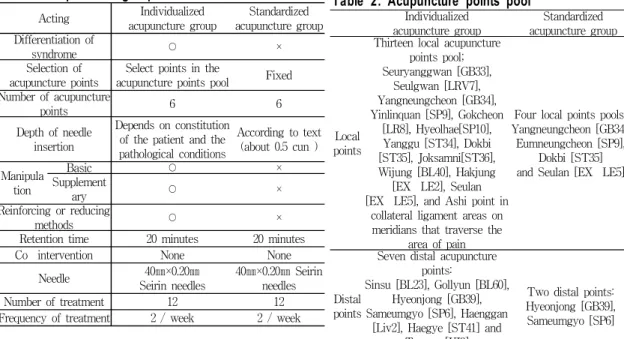
Many practitioners stress the necessity for individualized patient treatment, including acupuncture point selection and manipulation technique. However, the importance of individualization in acupuncture treatment, compared with standardization, has received little attention in clinical trials. The aim of the future study described here is therefore to compare the effectiveness of individualized acupuncture for knee osteoarthritis with standardized acupuncture and no acupuncture in patients with knee osteoarthritis.
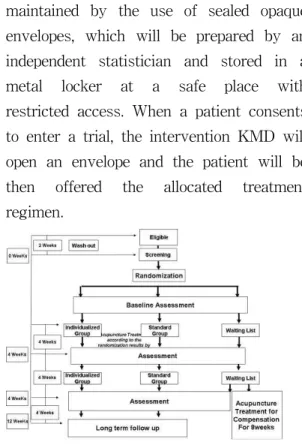
Methods : A total of 195 patients aged 50 years and over with knee pain, will be randomly divided into three treatment groups: individualized acupuncture, standardized acupuncture, and waiting list. Outcome data will be collected through patient‐completed questionnaires before randomization, and at 4, 8 and 12 weeks after randomization. The questionnaires will be investigated demographic details as well as information on pain, movement and function of the affected knee, general health and quality of life.
Discussion : This paper presents details on the rationale, design, and methods of the trial.
Key words : Individualized acupuncture, Standardized acupuncture, Waiting list, Knee Osteoarthritis, Study protocol.
Introduction Osteoarthritis (OA) most frequently
affects the knee joint
1). OA of the knee is
a debilitating disease that affects 52% of
adults over the age of 75 years
2). Knee
OA is common and contributes greatly to
morbidity in the community
3,4). Current