Introduction
Although partial removable dental prosthesis (PRDP) is one of the most reasonable treatment modalities in prosthodontics, secondary caries on abutment are still a concern. If secondary caries are detected and PRDP is clinically accepted, retrofitted surveyed crown is needed. Not only direct techniques but also indirect techniques were introduced to fabricate a retrofit surveyed crown for an existing PRDP.
1-4How- ever, replicating original contours, morphology, rest seats, and guiding plane of the previous abutment were not easy.
With the development of computer-aided design and computer-aided manufacturing (CAD/CAM) technology and with their enhanced application in
dentistry, Marchack et al. introduced the fabrication of an all-ceramic abutment crown under an existing PRDP using CAD/CAM technology.
5Yoon et al.
used patient’s existing cast and chairside CAD/CAM scanner for a retrofitted surveyed crown in tooth sup- ported PRDP.
6This clinical report describes a technique to convert fractured metal-ceramic surveyed crown into a com- plete contour zirconia surveyed crown for an existing PRDP using CAD/CAM.
Case report
A 62-year old man diagnosed with rectal cancer was under anticancer treatments. He wanted an instant and simple treatment plan for fractured metal-ceramic
*Correspondence to: Hyun-Pil Lim
Associate Professor, Department of Prosthodontics, School of Dentistry, Chonnam National University, 33 Yongbong-ro, Buk-gu, Gwangju, 500-757, Republic of Korea
Tel: +82-62-530-5577, Fax: +82-62-530-5639, E-mail: [email protected] Received: October 6, 2014/Last Revision: March 2, 2015/Accepted: March 5, 2015
an alternative method to convert fractured metal ceramic surveyed crown into a complete contour zirconia surveyed crown using caD- caM technology under anticancer treatments: a clinical report
Seon-Ki Lee
1, Hong-So Yang
1, Sang-Won Park
1,2, Kwi-Dug Yun
1, Hyun-Pil Lim
1*
1
Department of Prosthodontics, School of Dentistry, Chonnam National University, Gwangju, Republic of Korea
2
RIS Foundation for Advanced Biomaterials, School of Dentistry, Chonnam National University, Gwangju, Republic of Korea
In this clinical report, a simple and convenient conversion of a fractured metal-ceramic surveyed crown into a complete contour zirconia surveyed crown by using computer-aided design and computer-aided manufacturing technology for an existing partial removable dental prosthesis is described. The duplication of the original contours, morphology, and the rest seat of the existing metal-ceramic surveyed crown, into a complete contour zirconia surveyed crown under anticancer treatments were reported. (J Dent Rehabil Appl Sci 2015;31(1):45-9)
Key words: complete contour zirconia surveyed crown; fractured metal-ceramic surveyed crown; computer-aided manufacturing and computer-aided manufacturing (CAD/CAM) technology; existing partial removable dental prosthesis; anticancer treatments
Copyright© 2015 The Korean Academy of Stomatognathic Function and Occlusion.
It is identical to Creative Commons Non-Commercial License.
cc
ISSN 2233-4084
46 J Dent Rehabil Appl Sci 2015;31(1):45-9
46
surveyed crown (Fig. 1). No fracture was observed in clasp engaging area. The patient did not want a surveyed crown due to a higher risk of fracture or chipping. The fitness between the existing PRDP and fractured metal-ceramic surveyed crown was verified to ensure adequate retention and support.
An elastomeric impression of the fractured metal- ceramic surveyed crown was made using polyvinyl- siloxane (Honigum; DMG., Hamburg, Germany). A preliminary cast was prepared with Type IV dental stone (Suprastone; Kerr Co., Orange, CA, USA).
A definitive impression was made for the complete contour zirconia surveyed crown with polyvinylsilox- ane after old prosthesis removal and abutment prep- aration. A definitive cast was also made with Type IV dental stone.
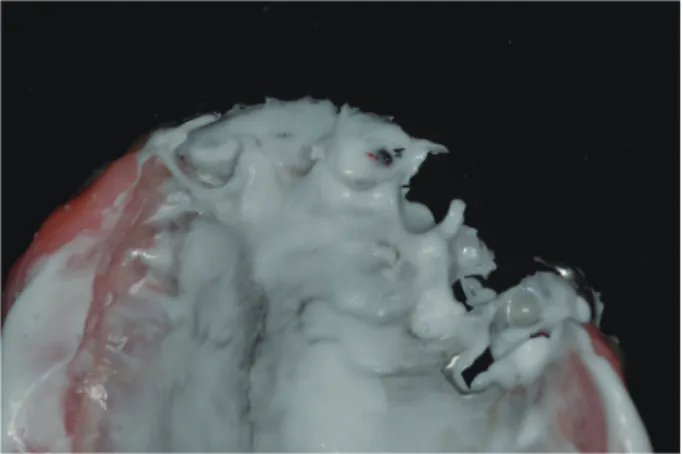
Using a digital scanner (Identica; Medit Co., Seoul, Korea), the preliminary and definitive casts were scanned (Fig. 2). The metal-ceramic surveyed crown shape was duplicated into the complete contour zir- conia surveyed crown by the supplied software (Exo- cad dental CAD; exocad GmbH exocad GmbHExo- cad GmbH., Darmstadt, Germany) (Fig. 3). The design information was transferred to a milling ma- chine (ZENOTEC T1; Wieland Dental., Pforzheim, Germany), and complete contour zirconia surveyed crown was milled from the zirconia block (Zenostar Zr Translucent; Wieland Dental.).
After the completion of the milling procedure, the complete contour zirconia surveyed crown was stained with a coloring solution (Zenostar Color Zr;
Wieland Dental.) and sintered in a furnace (Denta- Star M2 plus; Thermo-Star GmbH., Aachen, Ger- many). The definitive complete contour zirconia sur- veyed crown was adjusted on the cast and polished using a zirconia polishing kit (Zenostar polishing kit;
Wieland Dental.) (Fig. 4).
The definitive complete contour zirconia surveyed crown was evaluated with polyvinylsiloxane fit check- ing paste (GC Fit Checker; GC Dental Industrial Corp., Tokyo, Japan) to verify the fit to the existing PRDP (Fig. 5). The complete contour zirconia sur- veyed crown was luted using a resin-modified glass ionomer cement (Vitremer; 3M Dental Products., St Paul, MN, USA) (Fig. 6). The patient was satisfied
Fig. 1. Adequate fitness between the existing PRDP and fractured metal-ceramic surveyed crown.
Fig. 2. Scanned image of prepared maxillary central incisors from definitive cast.
Fig. 3. Superimposed images of preliminary and definitive casts.
Fig. 4. CAD/CAM complete contour zirconia surveyed crown.
Lee SK, Yang HS, Park SW, Yun KD, Lim HP
with the new complete contour zirconia surveyed crown and existing PRDP for 1 year. No clinical complications were observed during the follow-up period.
Discussion
With CAD/CAM technology, perfect adaptation between the new complete contour zirconia sur- veyed crown and existing PRDP was achieved, and the patient didn’t show any discomfort during 1 year follow-up period.
The advantage of this technique is replicating mor- phology, contours, undercut, and rest seat of the old metal ceramic surveyed crown without composite
resin pattern. While fabrication of composite resin pattern with PRDP adaptation is technique sensitive and needs precise and accurate adjustment, scanning of a cast is a simpler and more precise method. The other advantage of this technique is the prevention of veneering porcelain fracture or chipping. Al- though, in this case where the existing PRDP was a distal extension type and the fractured crown was a distal abutment, complete contour zirconia surveyed crown reduced the risk of fracture and chipping.
However, complete contour zirconia surveyed crown exhibited poor esthetics because of its low translucency. Moreover, possible disadvantage of this technique includes limitation of usage and required modification when ceramic fracture is extended to the contact area of the clasp. In such case, the frac- tured area needs to be restored with composite resin using patient’s PRDP before impression taking.
Conclusion
The conversion of fractured metal-ceramic sur- veyed crown into a complete contour zirconia sur- veyed crown by using CAD/CAM technology for an existing PRDP under anticancer treatments is de- scribed. This technique provided a perfect adaptation between the new complete contour zirconia surveyed crown and existing PRDP. Although low translucen- cy of zirconia calls for more esthetic needs, complete contour zirconia surveyed crown by using CAD/
CAM technology is a potential alternative to retrofit the existing PRDP framework.
References
1. Hansen CA, Russell MM. Making a crown to fit ac- curately under an existing removable partial denture clasp assembly. J Prosthet Dent 1994;71:2:206-8.
2. Macpherson JR, Evans DB. Fabricating crowns to fit existing removable partial dentures: an illustra- tion of two techniques. J Prosthodont 1993;2:199- 205.
3. Jackson AD, Butler CJ. Fabrication of a new crown and provisional to an existing removable partial denture. J Prosthodont 1995;4:200-4.
Fig. 5. Verification of the fit of definitive complete contour zirconia surveyed crown to the existing PRDP.
Fig. 6. Good adaptation between CAD/CAM complete
contour zirconia surveyed crown and existing PRDP.
48 J Dent Rehabil Appl Sci 2015;31(1):45-9
4. Elledge DA, Schorr BL. A provisional and new crown to fit into a clasp of an existing removable partial denture. J Prosthet Dent 1990;63:541-4.
5. Marchack BW, Chen LB, Marchack CB, Futatsuki Y. Fabrication of an all-ceramic abutment crown under an existing removable partial denture using
CAD/CAM technology. J Prosthet Dent 2007;98:
478-82.
6. Yoon TH, Chang WG. The fabrication of a CAD/
CAM ceramic crown to fit an existing partial re- movable dental prosthesis: a clinical report. J Pros- thet Dent 2012;108:143-6.
Lee SK, Yang HS, Park SW, Yun KD, Lim HP
*교신저자: 임현필
(500-757) 광주광역시 북구 용봉로 33 전남대학교 치의학전문대학원 보철학교실 Tel: 062-530-5577|Fax: 062-530-5639|E-mail: [email protected] 접수일: 2014년 10월 6일|수정일: 2015년 3월 2일|채택일: 2015년 3월 5일
항암치료 중인 환자에서 파절된 금속-도재관을 CAD/CAM으로 제작된 complete contour zirconia surveyed crown(완전한 윤곽을 가진 지르코니아 써베이드 전장관) 보철 수복: 증례 보고
이선기
1, 양홍서
1, 박상원
1,2, 윤귀덕
1, 임현필
1*
1