- 95 -
◆ 증 례
CAD/CAM을 이용한 다운 증후군 환자의 구강 재건
정현진1∙심준성2∙최병재1∙이제호1*
1연세대학교 치과대학 소아치과학교실
2연세대학교 치과대학 치과보철학교실
APPLICATION OF CAD/CAM FOR ORAL REHABILITATION IN A PATIENT WITH DOWN SYNDROME
Hyunjin Chung
1, Joon-Sung Shim
2, Byung-Jai Choi
1, Jae-Ho Lee
1*
1
Department of Pediatric Dentistry, College of Dentistry, Yonsei University
2
Department of Prosthodontics, College of Dentistry, Yonsei University
Due to hypodontia, poor oral hygiene, and significantly more prevalent periodontal disease, patients with Down syndrome show higher incidence of edentulism. Oral rehabilitation of such patients is imperative but challenging as high rates of prosthesis failure are reported due to malocclusion, high masticatory force, and parafunctional habits. As CAD/CAM(Computer-Aided Design and Computer Aided Manufacturing) is the re- cent trend in prosthodontics, this report discusses the application of CAD/CAM in a Down syndrome patient.
A 25-year-old patient with Down syndrome was presented to the Department of Pediatric Dentistry, Yonsei University Dental Hospital for oral examination. 5 maxillary teeth were missing, 3 were fully impacted, and 4 had grade III mobility. The patient underwent general anesthesia for extraction of impacted and mobile teeth, implant surgery, and final impression for prosthesis. Afterwards, CAD/CAM was used to design and manufac- ture a 10-unit zirconia bridge. However the bridge was fractured after 18 months due to the patient’ s bruxism and high masticatory force. Final impression taking, bite registration, cast fabrication, cast scanning, and pros- thesis designing were not needed as CAD/CAM data remained. Previous CAD/CAM design was used to reman- ufacture the zirconia bridge.
Down syndrome patients have malocclusion, high masticatory force, and parafunctional habits which increase the possibility of prosthesis fracture. CAD/CAM is beneficial for Down syndrome patients as previous digital records can be utilized for prosthesis repair or remake. In detail, application of CAD/CAM in remanufacturing decreases patient’ s discomfort of impression taking, shortens and simplifies dental laboratory procedures, and re- duces clinician’ s effort of taking detailed final impressions or accurate bite registration. In conclusion, oral reha- bilitation using CAD/CAM provides not only satisfactory levels of comfort, stability, and esthetics, but also easier repair or remake compared to conventional prostheses. [ J Korean Dis Oral Health Vol.13, No.2: 95-98, December 2017]
Key words : Oral rehabilitation, CAD/CAM, Down syndrome Abstract
*Corresponding author : Jae-ho Lee
50-1 Yonsei-ro, Seodaemun-gu, Seoul, 03772, Korea
Department of Pediatric Dentistry, College of Dentistry, Yonsei University Tel: +82-2-2228-3178, Fax: +82-2-392-7420
E-mail: [email protected]
Received: 2017.06.08 / Revised: 2017.06.19 / Accepted: 2017.06.20
https://doi.org/10.12655/KADH.2017.13.2.95 J Korean Dis Oral Health 13(2) 2017
ISSN (print): 1738-8813 ISSN (online): 2287-7134
J Korean Dis Oral Health 13(2) 2017
- 96 -
Ⅰ. 서 론
다운 증후군은 21번 염색체가 삼배성을 나타내는 유전성 질환으로 700명 당 1명의 빈도로 나타난다
1). 이 환자들은 잦은 감염, 발작, 수면 무호흡증, 시력 및 청력 장애, 갑상선 기능저하증 및 정신지체 등의 전신질환을 동반한다
2).
다운 증후군 환자들의 구강 내 특징은 치아 결손, 구호흡, 구강 건조증, 과도한 치아 마모를 포함하며 치주질환의 유병 률은 일반인에 비해 월등하게 높다
3). 이들은 선천적 치아 결 손률이 높을 뿐만 아니라 구강 위생 관리가 어려워 치주질환 을 포함한 치과질환의 유병률이 높아 결손 치아가 많다
4).
다수의 치아 결손은 저작 기능 상실로 인한 영양의 불균 형, 수직 고경 상실 및 이로 인한 하악 전돌, 측두하악관절 의 변위 및 저작 시 통증을 유발할 수 있으므로 보철 치료를 이용한 구강 재건이 불가피하다. 하지만 부정교합, 강한 저 작력, 이갈이 및 다른 구강 악습관은 임플란트 보철 수복의 금기증에 해당되며 이는 다운 증후군 환자들과 같이 지적 장애가 있는 환자들에서 흔히 나타난다. 따라서 다운 증후 군 환자들에서는 보철물 파절 및 실패의 위험성이 크다
5).
무치악 또는 부분 무치악을 재건하기 위해 임플란트의 사 용이 최근 증가되고 있으며 다운 신드롬 환자들에서의 임플 란트 식립에 대한 보고 또한 증가하고 있다
5). 또한 보철물 제작에는 컴퓨터 소프트웨어를 이용해 디자인 및 가공하는 CAD/CAM (Computer Aided Design/Computer Aided Manufacturing) 시스템이 최근에 많이 사용되며 이는 변 연 적합도 증가뿐만 아니라 신속하고 간편한 보철물의 제작 및 재제작을 허용한다
6).
본 증례는 보철물 실패의 위험이 높은 다운 증후군 환자 의 구강 재건을 위해 CAD/CAM을 이용한 결과를 보고하 고자 한다.
Ⅱ. 증 례
만 25세 여환이 구강검진을 주소로 연세대학교 치과병원 소아치과에 내원하였다. 임상 및 방사선학적 검사 결과, 상 악 4전치와 상악 좌측 제1소구치가 상실된 상태였고 상악 좌∙우측 견치 및 상악 우측 제1소구치가 완전 매복되어있 었으며 상악 우측 유견치, 상악 좌∙우측 제2소구치 및 하 악 우측 중절치는 3도의 동요도를 보였다(Fig. 1).
본 증례의 환자는 다수의 치과치료가 필요하여 내원 횟수 를 줄이고 치과의사가 효과적으로 치료할 수 있도록 전신마 취 하 치과치료를 진행했다. 완전 매복되었던 3개의 치아와 3도의 동요도를 보인 4개의 치아를 발치하고 상악 좌∙우측 전치 및 소구치 부위에 4개의 임플란트를 즉시 식립했다 (Fig. 2). 또한 환자의 협조도가 부족하여 전신 마취된 상태 에서 보철물을 위한 최종 인상 및 교합 채득하였고 이후
CAD/CAM을 사용하여 10본 지르코니아 고정성 가공의치 를 디자인 및 가공했다(DWX-50, Roland, DG Corporation, Shizuoka, Japan)(Fig. 3).
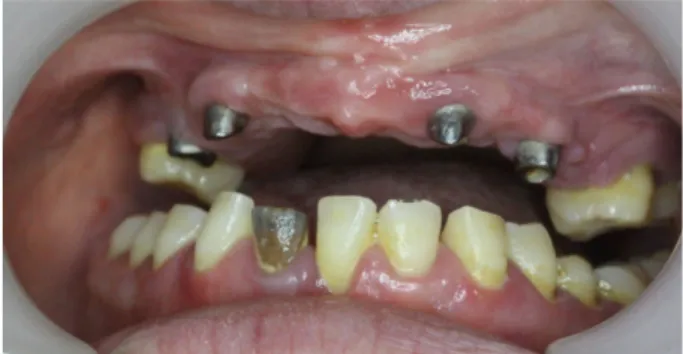
하지만 18개월 후, 본 환자의 부정교합, 이갈이 습관 및 강한 저작력으로 인해 브릿지가 파절되어 재내원했다(Fig.
4). 이번에는 처음 보철물 제작 시 생성한 CAD/CAM 데이 터가 있기 때문에 기존 디자인을 이용하여 보철물 밀링만 시행하여 보철물을 빠른 시일 내에 재제작할 수 있었다 (Fig. 5, 6).
Fig. 1. Pre-operative panoramic view. Missing teeth (#11,12,21, 22,24), fully impacted teeth (#13,14,23), teeth with mobility grade III (#53,15,25,41).
Fig. 3. Panoramic view after 10-unit Zirconia bridge delivery.
Fig. 2. Panoramic view after implant surgery under general anes-
thesia.
J Korean Dis Oral Health 13(2) 2017
- 97 -
Ⅲ. 고 찰
다운 증후군과 같이 지적 장애가 있는 환자들에서는 부정 교합과 강한 저작력이 흔히 관찰되며 Lo′ pez-Pe′ rez 등에 의 하면, 42%의 다운 증후군 환자들이 이갈이 습관을 가진다
7). 따라서 이러한 환자들에서는 보철물 파절 및 실패의 위험성 이 크며
8)치과의사는 이러한 잠재적인 문제 예방법을 고민 해야 한다. 본 증례에서는 보철물 제작 시 모형 상에서 교합 간섭이 없음을 확인했으며 저작능이 적은 전치부 보철물이 기 때문에 최소한의 교합만 이루어지도록 조정했다.
그럼에도 불구하고, 환자의 강한 저작력과 악습관으로 인 해 보철물의 파절이 발생했다. 따라서 보철물 파절 및 실패 의 문제 예방법뿐만 아니라 문제 발생 시 효율적인 보철물 재제작 방법을 고민해야 할 필요성이 있다.
본 증례에서는 CAD/CAM을 이용하여 보철물을 디자인 및 가공했다. 최종 인상 및 교합 관계 채득을 채득한 후 석 고 모형 제작을 제작했다. 기존의 기공 과정에서는 이후 왁 스업을 진행하지만, 본 증례에서는 석고 모형을 스캔하여 디지털 데이터를 형성한 후 CAD 소프트웨어로 보철물을 디자인했다
9). 그 후 보철물을 밀링 후 딜리버리했다. 보철물 을 재제작하게 됐을 때에는, 기존의 CAD/CAM 데이터가 있었기 때문에 인상채득을 포함한 앞의 5가지 과정을 생략 하고 기존 디자인을 이용하여 보철물을 재제작하였다.
기존의 기공방법에 비해 CAD/CAM시스템을 이용 시, 더 짧은 기간 내에 더 향상된 질의 보철물을 제작할 수 있 다. 고정성 보철물 평가 시 가장 중요한 요소 중 하나는 변 연 적합성이다. American Dental Association에 의하면 보철물의 변연 간극은 50μ m 이하여야 하며 Leinfelder 등 은 100μ m 이상의 변연 간극이 있을 경우, 접착제 실패가 관찰된다고 보고했다
10). 최근 연구들에 의하면, CAD/CAM 시스템을 이용해 제작한 보철물은 변연 간극이 100μ m 이하 인 적절한 변연 적합성을 보인다
11,12). 이뿐만 아니라, 여러 단계로 이뤄진 기존의 시스템에 비해 CAD/CAM 시스템 이용 시, 교차감염의 위험성이 줄어든다
13).
보 철 물 파 절 로 인 해 불 가 피 하 게 재 제 작 할 경 우 CAD/CAM 시스템의 가장 큰 장점은 새로운 인상채득으로 인한 환자의 불편감을 없앨 수 있다는 점이다. 또한 협조도 가 떨어지는 환자에서 채득하기 어려운 최종인상과 교합관 계 인기를 다시 하지 않아도 되며 정밀한 최종인상을 채득 하기 위한 치과의사의 노력이 생략된다. 결과적으로 기공과 정이 최소화되고 딜리버리 또한 빠른 시일 내에 이뤄질 수 있다는 점이 CAD/CAM을 이용한 보철치료의 장점이다.
본 증례에서는 다운 증후군 환자에서의 고정성 보철물 제 작을 다뤘으나, 이러한 환자에서의 총의치 등 가철성 보철 물 제작 시 CAD/CAM 시스템 사용의 장점을 보고한 논문 들 또한 발표되었다
14). 이에는 환자 내원 횟수의 감소, 아크 릴릭 레진 블락의 사용으로 인한 보철물의 강도 증가, 그리 고 미생물 증식 확률의 감소로 인한 감염 최소화가 포함된 다.
Ⅳ. 요 약