누룩으로부터 맥아당 이용능과 에탄올 생산성이 우수한 효모의 분리와 특성
최다혜1, 최영환2, 여수환3, 김명동1*
1강원대학교식품생명공학과
2국순당
3농촌진흥청국립농업과학원농식품자원부발효식품과
Received: October 23, 2015 / Revised: December 12, 2015 / Accepted: December 25, 2015
서 론
우리나라의전통주는주로찹쌀이나멥쌀을주원료로사 용하고발효제로누룩을사용하는병행복발효방식으로생
산되고있다[6, 27]. 발효제로사용되는누룩은밀, 쌀등의
곡류원료를사용하여자연의미생물을번식시킨것으로서
곰팡이, 효모, 젖산균등의다양한미생물이존재한다[26].
전통주 제조의원료에 함유된 전분은 Aspergillus oryzae, Rhizopus oryzae, Monascus purpureus 등의곰팡이에의하 여 당화되고[2, 12], Saccharomyces sp., Pichia kudriavzevii, Saccharomycopsis fibuligera, Absidia idahoensis 등의 효
모에 의하여 에탄올로 전환된다[1, 7, 16]. Leuconostoc mesenteroides, Pediococcus pentosaceus, Lactobacillus sp., Weissella sp. 등의젖산균은젖산, 구연산, 초산등의유기 산을생산하여전통주의맛과향을형성하는데기여한다[17, 24]. 국내대부분의지역에서는보리, 밀, 쌀등이원료로사 용된누룩을사용하여전통주를생산하였으나, 강원도는지 리적특성상쌀이나밀을포함한곡류보다는옥수수, 콩, 감 자, 팥, 귀리, 호밀등의잡곡을사용하여누룩을제작하였다
[9, 19]. 또한강원도지역에서는다른지역과달리누룩이
외에엿기름(맥아)을전통주제조에많이사용하였는데[19], 이는타지역에서제조된누룩과비교하여전분의당화력이 상대적으로낮은것에서기인한것으로추정된다. 강원도지 역에서엿기름을사용하여생산된전통주로서는옥수수술, 옥수수엿술, 옥로주등이있다[19]. 옥수수엿술의경우누룩 의양을상대적으로적게사용하고발아된옥수수를이용하 Isolation and Characterization of Saccharomyces cerevisiae from nuruk for Production of Ethanol from Maltose
Da-Hye Choi1, Yeong-Hwan Choi2, Soo-Hwan Yeo3,and Myoung-Dong Kim1*
1Department of Food Science and Biotechnology, Kangwon National University, Chuncheon 24341, Republic of Korea
2Kooksoondang Bldg 110-3, Samsung-Dong, Seoul 06083, Republic of Korea
3Fermented Food Science Division, Department of Agrofood Resources, National Academy of Agricultural Science, RDA, Wanju 55365, Republic of Korea
Wild-type yeast strains were isolated from nuruk, a type of microbial starter culture used for fermenting grains to produce alcoholic products, that was collected from different areas in Korea. Strains were identi- fied based on the analysis of 18S rRNA sequences. Fifty strains shared the highest sequence similarity with Saccharomyces cerevisiae and were designated MBYK1−MBYK50. Among these S. cerevisiae isolates, MBYK45 produced 44.0± 0.3 g of ethanol from 200 g maltose after incubation at 30oC for 48 h. Maximum eth- anol production of 110.80± 0.81 g/l with productivity of 3.79 ± 0.14 g-1 l-1 h-1 was obtained at optimum culture conditions of pH (6.0), maltose (200 g/l), and temperature (35°C). This study indicates that the MBYK45 strain of S. cerevisiae, isolated from nuruk, might be suitable for traditional liquor production from malts.
Keywords: Saccharomyces cerevisiae, nuruk, ethanol, maltose
*Corresponding author
Tel: +82-33-250-6458, Fax: +82-33-259-5565 E-mail: [email protected]
© 2016, The Korean Society for Microbiology and Biotechnology
여제조하는데[10], 이또한당화력이낮은누룩의당화력을 높이기위한방법으로추정된다. 강원도의지역적및기후적 특성상누룩의발효온도가국내다른지역보다상대적으로 낮아누룩에분포하는미생물의종류및밀도가다른지역 의누룩과상이하여전통주를제조하는방법상차이를가져 온것으로판단된다[3].
본 연구에서는 전통주 제조에 사용하는 누룩으로부터 Saccharomyces cerevisiae 균주를분리하여엿기름을구성
하는주요성분인맥아당(maltose) 이용능과에탄올생산성
이우수한균주를선발하고균체성장과에탄올생산특성을 분석하여옥수수를주원료로사용하는전통주생산에적합 한균주를확보하고자하였다.
재료 및 방법
누룩수집 및 효모균주 분리
강원도를비롯한전국 8개지역의재래시장에서판매되는 누룩과농가에서직접제조한누룩 11점을수집하였다. 분 쇄한누룩 1 g을펩톤수 9 ml에현탁한후, 10-1−10-5 희석배 수까지 단계적으로 희석하고 chloramphenicol(100 mg/l, Sigma-Aldrich, St. Louis, MO, USA)이 함유된 YEPD (yeast extract 10 g/l, peptone 20 g/l, glucose 20 g/l, pH 6.8) 평판배지에도말하였다[7]. 도말한 배지는 30oC에서 48시간동안배양한후단일집락을분리하였고, 분리된균 주중탄소원으로서자일로스(xylose)를이용하지못하는균 주를 Saccharomyces 속균주로추정하였다[4].
균주동정
분리한균주는 YEPD 배지를사용하여 30oC에서 24시간 동안 배양한 후 GenExTM genomic Sx(GeneAll, Seoul, Korea)를 사용하여 염색체 DNA를 추출하였다. ITS1(5'- TCCGTAGGTGAACCTGCGG-3')과 ITS4(5'-TCCTCCGCT TATTGATATGC-3') 프라이머[8]를사용하여 18S rRNA 유 전자의 Internal transcribed spacer 영역을증폭하였다. 중 합효소연쇄반응(Polymerase Chain Reaction, PCR)은 94oC 에서 30초(denaturation), 58oC에서 30초(annealing), 72oC 에서 1분(extension)간총 35회(cycles) 반복수행하였으며, 전기영동을통하여약 650 bp의 PCR 반응산물을확인하
였다. 정제한 PCR 산물을㈜마크로젠에의뢰하여염기서
열을 확보하였으며 National Center for Biotechnology Information(NCBI, MD, USA)의 BLAST(Basic Local Alignment Search Tool, http://www.ncbi.nlm.nih. gov/
BLAST/) 프로그램[7]을사용하여확보한상동성을근거로
균주를동정하였다.
배양조건
분리한효모균주의맥아당이용능및에탄올생산성을측 정하기위하여단일집락을 10 ml의 YEPD 배지에접종하고 30oC에서 200 rpm의교반속도로 12시간동안전배양하였 다. 전배양액은멸균수로세척한후 10 ml의 YEPM(yeast extract 10 g/l, peptone 20 g/l, maltose 200 g/l, pH 6.8) 배지가포함된시험관에세포흡광도(OD600)가 0.1이되도록 접종하고 30oC에서 200 rpm의교반속도로 48시간동안배 양한후맥아당을이용한세포성장과에탄올생산을조사 하였다. 에탄올생산량은 g/l의단위로표시하였으며, 에탄 올생산성은에탄올생산량을배양시간으로 나누어계산하 였다.
맥아당이용능이우수한균주로선발된균주의균체성장
및에탄올생산성을조사하기위하여 200 ml의 YEP(yeast
extract 10 g/l, peptone 20 g/l) 배지에맥아당을 20%(w/v) 첨가하고 30oC에서 48시간동안 200 rpm의교반속도로진 탕배양하면서배양액을취하여균체성장및에탄올생산량 을측정하였다. 연구용효모균주로널리사용되고있는 S.
cerevisiae BY4742[20]를대조구로사용하였다.
배양온도에따른효모균주의성장및에탄올생산성을조
사하기위하여 2%(w/v)의맥아당을탄소원으로첨가한 200
ml의 YEP 배지에균주를접종한후다양한배양온도(25, 30, 35, 37oC)에서 48시간동안 200 rpm의교반속도로배양하였 다. 맥아당농도에따른균체성장및에탄올생산을조사하기 위하여 200 ml의 YEP배지에맥아당을 5, 10, 20, 30%(w/v) 의농도로각각첨가한후 35oC에서 48시간동안 200 rpm의 교반속도로배양하였다. 배지의 pH에따른균체성장및에탄
올생산을조사하기위하여인산염완충액(100 mM)으로 pH
가 3, 4, 5, 6, 7, 8로조정된 YEP 배지에맥아당을 20%(w/v) 의농도로첨가한후균주를각각접종하고 35oC에서 48시
간동안 200 rpm의교반속도로배양하였다.
분석방법
균체성장은흡광광도계(Ultrospec 6300 pro, GE healthcare,
Sweden)를사용하여 600 nm에서흡광도를측정하여결정
하였다. 맥아당및에탄올농도는굴절률검출기(RID-10A,
Shimadzu, Japan)가장착된고성능액체크로마토그래프
(HPLC 20A-Series, Shimadzu)를사용하여측정하였다. 컬 럼은 Rezex ROA-Organic Acid H+(Phenomenex, Torrance, CA, USA)를사용하였으며, 이동상으로 0.005 N 황산용액을 0.6 ml/min의유속으로사용하였다.
통계처리
모든측정은 3회반복하였으며평균값과표준오차는 IBM
SPSS Statistics 21(IBM, NY, USA)를 사용하여 결정하 였다.
결과 및 고찰
효모균주의 분리 및 동정
전국에서수집한 11점의누룩으로부터효모균주 100점을 분리하였다. 분리된균주중오탄당인자일로스를대사하지 못하는 균주를 우선적으로 선별한 후, 동정하여 표준 Saccharomyces cerevisiae 균주의 18S rRNA 유전자와 99%
이상의상동성을보인균주 50점을확보하였다.
에탄올 생산성이 우수한 S. cerevisiae 균주 선정
S. cerevisiae로동정된 50점의균주는맥아당을탄소원으 로사용한배지에서의균체성장및에탄올생산성을비교하
였다. 고농도맥아당(200 g/l) 조건에서균체성장이다른균
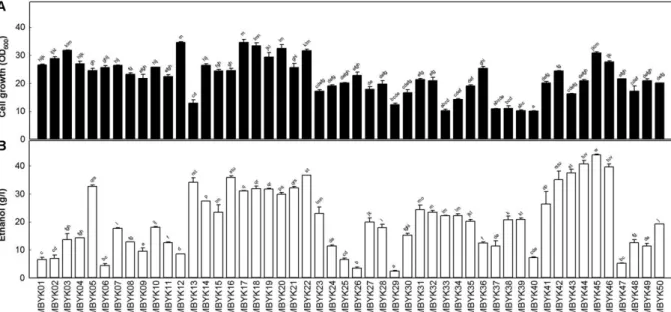
주들에비해상대적으로우수한균주로서 MBYK12로명명 된균주 외 6점을 선발하였으며 그중 MBYK12 균주가 48시간배양후균체성장이가장우수하였다(Fig. 1A). 그러 나 MBYK12 균주의에탄올생산량은 8.53±0.10 g/l로서다 른균주와비교하였을때상대적으로낮은수준이었다(Fig.
1B). 한편 MBYK45로명명된균주는 200 g/l의맥아당으로 부터 44.00±0.28 g/l의에탄올을생산하여에탄올생산성이 가장우수하였고, MBYK44 균주는약 40.80±1.13 g/l의에 탄올을생산하였다. 맥아당으로부터에탄올생산성이가장 우수한 MBYK45 균주는 48시간배양후균체농도가 OD600=
30.80±0.50로서맥아당이용능도우수한것으로판단되었다. 맥아당을탄소원으로사용하여에탄올생산성이우수한균 주로선정된 MBYK45 균주와대조구인 S. cerevisiae BY4742 균주를배양온도 30oC에서균체성장및에탄올생산성을비
Fig. 1. Comparison of cell growth (A) and ethanol production (B) by S. cerevisiae strains isolated from nuruk. Maltose (20%) was used as carbon source at 30oC and pH 6.8. Averages and standard errors obtained from three independent experiments are shown.
Different letters indicate significant difference between means (p < 0.05).
Fig. 2. Profiles of cell growth (●), maltose utilization (▲), and ethanol production (○) in shake flasks cultivation of S.
cerevisiae BY4742 (A) and MBYK45 (B) at 30oC and pH 6.8.
Averages and standard errors obtained from three independent experiments are shown.
교하였다(Fig. 2). 맥아당이 20% 첨가된배지에서초기생육 기간에는유의적인차이가없었으나, 대수기에는누룩으로
부터분리된 MBYK45 균주가대조구효모균주에비해균체
성장 및 맥아당 소모속도가 우수하였다. 발효 종료 후 MBYK45 균주에의하여생산된에탄올은 71.33±0.34 g/l로 서대조구효모균주의에탄올생산량인 64.18±0.51 g/l에비 해유의적으로우수하였다. 이러한결과는 10 ml 규모의배 양부피를기준으로에탄올생산성을평가하였던 Fig. 1의결 과와는차이가있었으나, 시험관과플라스크의교반및통기 조건의차이에서발생한것으로판단된다. 위의실험결과를 바탕으로맥아당을이용한균체성장과에탄올생산성이우
수한균주로서 MBYK45 균주를최종선정하였다.
배양조건이 MBYK45 균주의 성장과 에탄올 생산에 미치는 영향 배양온도에따른 MBYK45 균주의성장과에탄올생산성 변화를조사하였다(Table 1). 균체성장은 25oC에서상대적 으로가장우수하였고, 배양온도가높아질수록균체성장이 유의적으로감소하였으며 39oC에서는균체가성장하지않았 다. 그러나에탄올생산은 35oC에서상대적으로가장우수
하였으며맥아당농도를 20 g/l로주입하였을때에탄올생
산성은 1.30±0.12 g-1l-1h-1, 수율은 0.58±0.01 g/g으로서 다른배양온도에비해우수한결과를나타내었다.
이러한결과는 35oC에서최대에탄올생산을보인이등 [21]의보고와유사하였다. 균체성장의경우 MBYK45 균주 는 25oC에서 가장 우수하였던 이 등[20]이 보고한 S.
cerevisiae NK28 균주와는상이한특성을나타내었다. 김등 [14]이보고한 S. cerevisiae 균주는 40oC에서 20%의포도당 으로부터약 9.8%(w/v)의에탄올을생산하였으며, 백등[23]
은 NaCl 적응과정에의한 S. cerevisiae 균주의고온내성과 고온에서의발효성능과의관련성을보고한바있다. 또한박 등[25]은효모의성장속도와에탄올생산속도를위한최적 온도가다르다는결과를보고하였다.
YEP 배지에맥아당을 5, 10, 20, 30%(w/v)의농도로첨가
하여맥아당농도에따른 MBYK45 균주의성장과에탄올생
산성을비교하였다(Table 2). 균체의성장은 10%의맥아당 을첨가한배지에서가장우수하였으나, 에탄올생산량, 생 산성및수율은 20%의맥아당을첨가한실험구가가장우 수하였다. 에탄올생산량은 20%의맥아당을첨가한실험구 가 110.55±1.65 g/l로서 5%의맥아당을첨가한실험구에비 해약 4.8배이상우수한결과를나타내었다. 에탄올생산성 또한 20%의맥아당이첨가된실험구가 3.71±0.10 g-1l-1h-1로 서 5%의맥아당을첨가한실험구에비해약 2 배이상우수 하였다. 따라서균체성장및에탄올생산을위한최적맥아 당농도는 20%로판단되었다.
김등[13] 및이등[21]은 S. cerevisiae 균주를이용한에 탄올생산은 10%의포도당에서가장우수하였다고보고하 였으며, 이등[20]은키위로부터분리된 S. cerevisiae 균주를 이용한에탄올생산연구에서최적포도당농도를 20%(w/v) 로보고하였으며, 차등[5]은단수수착즙액을이용한에탄 올생산연구에서최대에탄올생산성확보를위한최적당
Table 1. Effects of temperature on cell growth and ethanol production by S. cerevisiae MBYK45.
Temperature (oC)
Cell growth (OD600)
Ethanol concentration (g/l)
Ethanol productivity (g-1 l-1 h-1)
Ethanol yield (g/g)
25 20.37±0.21 10.95±0.57 0.68±0.03 0.46±0.03
30 12.83±0.51 10.23±0.56 0.77±0.03 0.47±0.02
35 11.63±0.32 11.15±0.24 1.30±0.12 0.58±0.01
37 11.07±0.95 10.52±0.04 0.19±0.00 0.54±0.00
*Each value is the average±standard error from three independent batch cultivations performed for 48 h with an initial maltose concentration of 2%(w/v) at pH 6.8. Ethanol productivity was determined at an exponential growth phase.
Table 2. Effects of initial maltose concentration on cell growth and ethanol production by S. cerevisiae MBYK45.
Maltose (%, w/v)
Cell growth (OD600)
Ethanol concentration (g/l)
Ethanol productivity (g-1 l-1 h-1)
Ethanol yield (g/g)
5 21.67±0.29 23.13±0.46 1.84±0.14 0.48±0.01
10 32.49±0.21 50.60±1.09 3.09±0.05 0.48±0.03
20 30.20±0.20 110.55±1.65 3.71±0.10 0.55±0.02
30 21.33±0.86 95.88±1.06 2.75±0.24 0.30±0.03
*Each value is the average±standard error from three independent batch cultivations performed for 48 h at 35oC and pH 6.8. Eth- anol productivity was determined at an exponential growth phase.
농도를보고하였다.
맥아당농도 20% 및배양온도 35oC 조건에서배지의초
기 pH 변화에따른 MBYK45 균주의성장및에탄올생산을
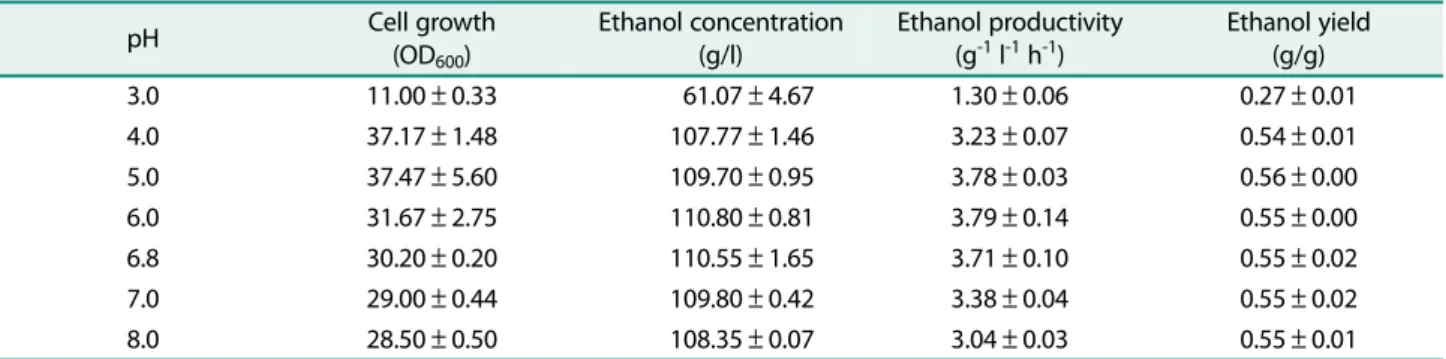
조사하였다(Table 3). MBYK45 균주는 pH 3을제외한조건
에서 100 g/l 이상의높은에탄올생산량을나타내었다. 균
주의 성장은 pH 5.0에서 가장 우수하였으며, 109.70±
0.95 g/l의에탄올이생산되었다. 그러나에탄올생산량은배
지의초기 pH가 6.0일때 110.80±0.81 g/l로가장우수하였 으며, 에탄올생산성은 3.79±0.14 g-1 l-1 h-1이었다. 에탄올 생산량및에탄올생산성을기준으로하였을때배지의 pH 가 6.0일때에탄올생산에보다유리한것으로판단되었다. 에탄올발효공정에서요구되는균주의바람직한특성은발 효속도가빨라야하며, 고온과높은기질농도에서도우수한 성장속도를나타내는것등이다[22]. 원등[18]은에탄올생 산성이균체의초기농도및초기탄소원농도에영향을받 는다고보고하였으며, 김등[15]은첨가제와가교제를첨가 하였을때, 에탄올생산성이증가되었다고보고하였다. 에탄 올생산량뿐만아니라에탄올생산성의향상은에탄올생 산공정에있어생산비용을절감시킬수있는중요한요소로
작용한다[11]. 높은맥아당농도에서균체성장과에탄올생
산속도가우수한 MBYK45 균주는맥아를이용한전통주생
산에적용가능성이높은균주로사료된다.
요 약
전국에서수집한누룩으로부터 50점의 S. cerevisiae 균주
를분리하고 18S rRNA 유전자영역중 ITS 단편의염기서
열분석을통하여동정하였다. 누룩에서분리한 S. cerevisiae
균주중 MBYK45로명명된균주는대조구균주및누룩에
서분리한다른균주들에비해맥아당을이용한균체성장및 에탄올생산성이우수하였다. MBYK45 균주는맥아당농도 20%, 배지 pH 6.0, 배양온도 35oC 조건에서에탄올생산성
이 3.79±0.14 g-1l-1h-1로가장우수하였고 110.80±0.81 g/
l 에탄올을생산하였다. 본연구를통하여맥아를원료로하
는 전통주 제조에 적합한 것으로 사료되는 S. cerevisiae
MBYK45 균주를누룩으로부터분리하였으며균체성장및에
탄올생산을위한최적배양조건을설정하였다.
Acknowledgments
This research was financially supported by the Ministry of Trade, Industry and Energy (MOTIE) and Korea Institute for Advancement of Technology (KIAT) through the Promoting Regional specialized Indus- try (Project No. R0002423).
References
1. Baek SY, Lee YJ, Kim JH, Yeo SH. 2015. Isolation and characteriza- tion of wild yeasts for improving liquor flavor and quality. Micro- biol. Biotechnol. Lett. 43: 56−64.
2. Baek SY, Yun HJ, Choi HS, Hong SB, Yeo SH. 2010. Screening and characterisics of useful fungi for brewing from commercial Nuruk in chungcheong provinces. Korean J. Microbiol. Biotechnol. 38:
373−378.
3. Bal J, Yun SH, Song HY, Yeo SH, Kim JH, Kim JM. 2014. Microflora dynamics analysis of Korean traditional wheat-based nuruk. J.
Microbiol. 52: 1025−1029.
4. Barnett JA. 1976. The utilization of sugars by yeasts. Adv. Carbo- hydr. Chem. Biochem. 32: 126−228.
5. Cha YL, Park YR, Kim JK, Choi YH, Moon YH, Bark ST. 2015. Optimi- zation of fermentation conditions for the ethanol production from sweet sorghum juice by Saccharomyces cerevisiae using response surface methodology. New & Renewable Energy 7: 3−9.
6. Chang KJ, Yu TJ. 1981. Studies on the components of sokokju and commercial yakju. Korean J. Food Sci. Technol. 13: 307−313.
7. Choi DH, Park EH, Kim MD. 2014. Characterization of starch-utiliz- ing yeast Saccharomycopsis fibuligera isolated from Nuruk.
Korean J. Microbiol. Biotechnol. 42: 407−412.
Table 3. Effects of initial pH on cell growth and ethanol production by S. cerevisiae MBYK45.
pH Cell growth
(OD600)
Ethanol concentration (g/l)
Ethanol productivity (g-1 l-1 h-1)
Ethanol yield (g/g)
3.0 11.00±0.33 61.07±4.67 1.30±0.06 0.27±0.01
4.0 37.17±1.48 107.77±1.46 3.23±0.07 0.54±0.01
5.0 37.47±5.60 109.70±0.95 3.78±0.03 0.56±0.00
6.0 31.67±2.75 110.80±0.81 3.79±0.14 0.55±0.00
6.8 30.20±0.20 110.55±1.65 3.71±0.10 0.55±0.02
7.0 29.00±0.44 109.80±0.42 3.38±0.04 0.55±0.02
8.0 28.50±0.50 108.35±0.07 3.04±0.03 0.55±0.01
*Each value is the average±standard error from three independent batch cultivations performed for 48 h with an initial maltose concentration of 20%(w/v) at 35oC. Ethanol productivity was determined at an exponential growth phase.
8. Guillamón JM, Sabaté J, Barrio E, Cano J, Querol A. 1998. Rapid identification of wine yeast species based on RFLP analysis of the ribosomal internal transcribed spacer (ITS) region. Arch. Micro- biol. 169: 387−392.
9. Jung DH. 2012. Science of Nuruk. Yu Han Publishers. Seoul, Korea.
pp. 75.
10. Jung ES. 2010. Makgeolli travel. Korean broadcasting publishers.
Seoul, Korea. pp. 250.
11. Kim HD, Min KH, Hur BK. 1995. Improvement of alcohol produc- tivity by means of repeated batch fermentation. Korean J. Bio- technol. Bioeng. 10: 55−62.
12. Kim HS, Hyun JS, Kim J, Ha HP, Yu TS. 1997. Characteristics of use- ful fungi isolated from traditional Korean Nuruk. J. Korean Soc.
Food Sci. Nutr. 26: 767−774.
13. Kim JH, Kim NM, Lee JS. 1999. Physiological characteristics and ethanol fermentation of thermotolerant yeast Saccharomyces cerevisiae OE-16 from traditional Meju. Korean J. Food Nutr. 12:
490−495.
14. Kim JW, Jin IY, Seu JW. 1995. Isolation of Saccharomyces cerevisiae F38-1, a thermotolerant yeast for fuel alcohol production at higher temperature. Korean J. Appl. Microbiol. Biotechnol. 23:
617−623.
15. Kim SW, Kim EY, Hong YG. 1996. Development of alginate-celite immobilization technique for the improvement of ethanol pro- ductivity. Korean J. Biotechnol. Bioeng. 11: 77−85.
16. Kwon SJ, Ahn TY, Sohn JH. 2012. Analysis of microbial diversity in Makgeolli fermentation using PCR-DGGE. J. Life Sci. 22: 232−238.
17. Kwon SJ, Sohn JH. 2012. Analysis of microbial diversity in Nuruk using PCR-DGGE. J. Life Sci. 22: 110−116.
18. Kyung HM, Kim HD, Hur BK. 1995. Effect of initial condition on the characteristics of ethanol fermentation. Korean J. Appl. Micro- biol. Bioeng. 23: 479−484.
19. Lee HJ. 2009. Korean traditional liquor. Hanyang university press.
Seoul, Korea. pp. 90−91.
20. Lee JS, Park EH, Kim JW, Yeo SH, Kim MD. 2013. Growth and fer- mentation characteristics of Saccharomyces cerevisiae NK28 iso- lated from kiwi fruit. J. Microbiol. Biotechnol. 23: 1253−1259.
21. Lee YB, Shim SK, Han MS, Chung DH. 1995. Screening and etha- nol fermentation of flocculent Saccharomyces cerevisiae CA-1.
Korean J. Appl. Microbiol. Biotechnol. 23: 723−729.
22. Novak M. 1981. Alcoholic fermentation: on the inhibitory effect of ethanol. Biotechnol. Bioeng. 23: 201−211.
23. Paik SK, Yun HS, Sa KH, Kim IS, Rhee IK, Park HD. 2003. Effect of NaCl adaptation on the thermotolerance and alcohol fermenta- tion in Saccharomyces cerevisiae KNU5377. Korean J. Appl. Micro- biol. Biotechnol. 31: 63−68.
24. Park JH, Chung CH. 2014. Characteristics of Takju prepared with Nuruk, and identification of lactic acid bacteria in Nuruk. Korean J.
Food Sci. Technol. 46: 153−164.
25. Park JK, Peck SY, Yoo YJ. 1989. Temperature effects and optimiza- tion for ethanol fermentation. Korean J. Appl. Microbiol. Bioeng.
17: 619−623.
26. Rhee SJ, Lee JT, Kim KK, Lee CH. 2003. Comparison of the tradi- tional (samhaeju) and industrial (cheongju) rice wine brewing in Korea. Korean J. Food Sci. Technol. 12: 242−247.
27. Seo MY, Lee JK, Ahn BH, Cha SK. 2005. The changes of microflora during the fermentation of Takju and Yakju. Korean J. Food Sci.
Technol. 37: 61−66.