Y. W. Kim ( ) ・ H. K. Moon 국립산림과학원 산림생명공학과
(Division of Forest Biotechnology, Korea Forest Research Institute, Suwon, 441-350, Korea)
e-mail: [email protected]
소나무의 체세포배 유도 및 발아에 미치는 ABA, 삼투압제 및 배발생조직 라인 효과
김용욱 ・ 문흥규
Effects of ABA, osmoticum and embryogenic tissue lines for somatic embryo induction and germination in Pinus densiflora
Yong Wook Kim ・ Heung Kyu Moon
Received: 7 May 2012 / Accepted: 25 May 2012
ⓒKorean Society for Plant Biotechnology
Abstract This study was conducted to evaluate effects of somatic embryos (SEs) induction with different kinds and concentrations of osmoticum, with gelrite and SEs germina- tion with different abscisic acid (ABA) and embryogenic tissue lines (ETLs) in Japanese red pine (Pinus densiflora).
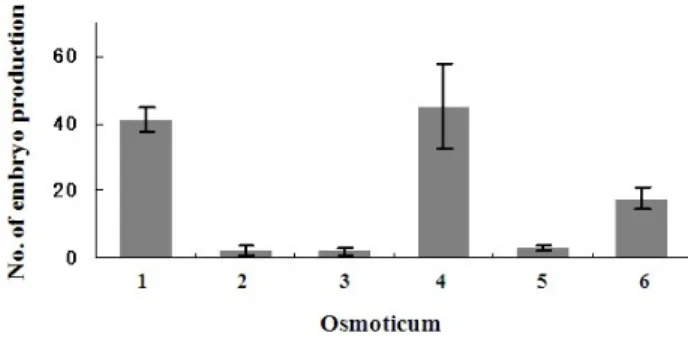
In comparison of somatic embryos induction with different kinds and concentrations of osmoticum, the highest record (45/90 mg FW) was obtained from the treatment of 0.1 M maltose+3.75% PEG 4000. In addition, the higher one was also recorded from 0.2 M maltose (41 SEs), it turned out this treatment was also effective in induction of SEs with previous one. In effects of various gelrite concentrations for SEs production, no SEs were occurred in the treatment of 0.4 or 0.6% gelrite, however, the highest no. of SEs shown in 1.0% gellrite (41 SEs), and some comparable results were also marked with 0.8 (37.3 SEs) or 1.2% (39.7 SEs) gelrite.
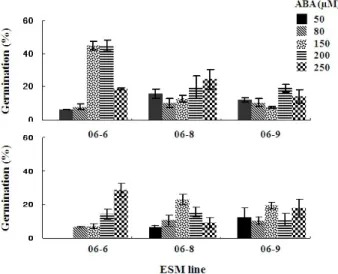
Therefore, SEs can be produced from above 0.8% concen- tration of gelrite. Finally, in comparison of SEs germination with different concentrations of ABA, ETLs, and AC, the best germination rates (45%) were obtained from the SEs derived from both concentrations of 150 and 200 μM ABA in 06-6 ETL and when cultured on germination supplemented with 0.2% AC. When SEs were cultured on germination medium without AC, best germination rate (28.9%) came from the SEs which cultured on 250 μM ABA in 06-6 ETL
Keywords ABA, embryogenic tissue line, Japanese red pine, somatic embryo, gelrite, germination, osmoticum
서 론
우리나라의 향토수종중 하나인 소나무 (적송)는 북부의 고원지대를 제외한 전국의 표고 (標高) 1,300 m 이하에서 자생하고 있으며, 지리적으로는 일본, 우리나라 및 만주 에 분포하는 상록 침엽수림으로 수고 35 m, 직경 180 cm 까지 생장한다. 목재는 재질이 연하고 부드러우며 무늬 가 아름다워 건축용재, 펄프재 등으로 용도가 많으며, 조 경수로도 널리 이용되는 수종이다.
소나무의 국내 조직배양 연구는 1980년대부터 시작되 었고 초기에는 기관유도 (organogenesis)를 통한 식물체 재분화 연구가 주로 이루어졌지만 그 결과는 매우 미진 하였다. 그중 Shim 등 (1986)은 24년생 소나무 접목묘 유 래 종자배의 자엽조직을 배양으로 부정아 및 뿌리를 유 도를 통한 식물체 재분화를 보고 하였으며, 또한 Kim과 Park 등 (1986)은 8, 15 및 26년생 접목묘의 정아배양으로 소수의 부정아 유도 및 신초지 발생을 관찰하였다는 보 고만 있을 뿐이다.
1985년 Hakman 등 (1985)이 독일가문비나무 (Picea abies) 의 체세포배 유도 (somatic embryogenesis)를 최초로 보고 한 이래 많은 침엽수종을 대상으로 재분화 연구가 이루어 졌다. 그중 우리나라 소나무 연구는 Maruyama 등 (2005) 이 체세포배 발생을 통한 식물체 재분화를 최초로 보고 하였고, 또한 Shoji 등 (2006)은 소나무 체세포배 유도 시 영향하는 삼투압제의 종류 및 농도 효과 등에 관해 보고 하고 있다. 국내에서는 김 등 (2011)이 소나무 배발생조 직 라인 별 체세포배 유도 및 그로부터 식물체 재분화에 DOI:http://dx.doi.org/10.5010/JPB.2012.39.2.093
Research Article
1. Mal* 0.2M, 2. Su** 0.2M, 3. Mal 0.1M+Su 0.1M 4. Mal 0.1M+PEG*** 3.75%, 5. Su 0.1M+PEG 3.75%, 6. Su 0.075M+Mal 0.075M+PEG 3.75%
*Maltose, **Sucrose, ***Polyethylene glycol
Fig. 1 Effect of osmoticum kinds or concentrations for somatic embryo induction in P. densiflora. (Data represents mean ± standard error, 10 replicates)
관한 첫 보고가 있을 뿐이다. 이 결과에서는 소나무 15개 배발생조직 라인을 대상으로 조직증식, 체세포배 발생 및 식물체 재분화 비교에 중점연구가 이루어졌으나 체세 포배를 효율적으로 발생시키기 위한 ABA, 삼투압 적정 종류 및 농도 및 체세포배 발아를 위한 구체적인 조건은 구명하지 못했다. 따라서 본 연구는 소나무의 체세포배 유도 시스템을 이용한 묘목 대량생산 기술을 개발하기 위한 일련의 시도로서, ① 삼투압제 종류 및 농도에 따른 체세포배 발생 효율 비교 ② gelrite농도에 따른 체세포배 발생 효율 비교 ③ 체세포배 발아에 영향하는 ABA농도, 배발생조직 라인 및 활성탄 첨가 효과에 따른 발아율 효 과 등을 조사하였다.
재료 및 방법 식물재료
배발생조직은 소나무 미숙종자로부터 유도하였으며, 종 자채취는 7월초 경기 수원에 위치한 국립산림과학원 산 림유전자원부 내 육성중인 12년생 소나무에서 수행하였 다. 종자표면 살균은 70% 에탄올로 1분간 처리 후, 2%
NaClO로 10분정도 재차 살균 한 다음 멸균증류수로 수차 례 세척하였다.
배발생조직 유도 및 증식
배발생조직 유도는 P6 (Teasdale et al. 1986) 배지에 2.0 ㎎/L 2,4-D, 1.0 ㎎/L BA, 1,000 ㎎/L L-glutamine, 3.0% sucrose 및 0.2% gelrite를 첨가하여 반고형 배지로 사용했다. 배양은 11호 수술칼을 이용하여 종피를 벗긴 후 종자배가 포함 된 배유조직 (megagametophyte) 전체를 배지위로 수평으로 치상하였으며, 25℃, 암소에서 8주간 새로운 배지교환 없 이 배양하였다. 유도된 배발생조직의 증식은 ½LM (Litvay et al. 1985)에 2.0 mg/L 2,4-D, 1.0 mg/L BA, 1,000 mg/L L-glutamine, 2.0% sucrose 및 0.4% gelrite로 조성된 배지로 이식하였으며, 조직이 약 0.5 cm 이상 크기로 생장하면 동일조성의 새로운 배지로 2-3주 마다 옮겨줌으로써 체 세포배 발생에 필요한 양까지 증식시켰다.
체세포배 발생
체세포배 발생은 1/2LM 배지에 2% sucrose가 첨가된 액 체배지에 배발생조직을 현탁배양 후 5.5 cm 크기의 종이 필터 (Whatman)위로 세포농도가 90 mg정도 포함된 3 ml 정도의 세포현탁액을 깔아준 후 약 5초간 진공펌프를 이 용하여 액체배지를 제거하였다. 그 후 배발생조직이 치상
된 종이필터를 1/2LM 배지에 여러 농도의 ABA (배지 열 소독 후 첨가), 삼투압제 및 gelrite가 첨가된 반고형 배지위 로 치상하여 체세포배를 발생시켰다. 배양조건은 25℃, 암 소에서 8주간 새로운 배지의 교환 없이 연속 배양하였다.
체세포배 발아
체세포배 발아는 배발생조직으로부터 유도된 자엽단계 체세포배만을 분리하여 1/2LM 배지에 2.0% sucrose, 0.2%
활성탄 및 0.2%의 gelrite를 첨가한 발아배지 위로 수평으 로 배양하였으며, 발아조건은 25±1℃, 18/6 광주기를 가 진 광조건 (50 μEm-2s-1, Philips, F40 CW, 40 watt) 하에서 이루어졌다.
삼투압제 종류 및 농도에 따른 체세포배 발생 효과 비교 본 실험은 Figure 1에서와 같이 삼투압제 처리구에 따른 체세포배 유도 비교를 위해 수행되었다. 삼투압제 처리 구는 0.2 M sucrose 혹은 maltose, 그리고 0.1 M maltose+0.1 M sucrose, 0.1 M maltose+3.75% polyethylene glycol (PEG, Sigma, MW 4000) 등 6 조합으로 이루어졌다. 배양 8 주 후에 각 처리구에 따른 체세포배 발생 수를 각각 조사하였고, 배 양반복 수는 각 처리구 (삼투압제 농도, 종류 별 처리구) 당 10 반복 (페트리디시) 배양하였다. 체세포배 유도는 1/2LM 배지에 삼투압제 6종류, 1,000 mg/L L-glutamine (배 지열소독 후 첨가) 및 1.0% gelrite로 조성된 배지를 이용 하였다.
Gelrite 농도에 따른 체세포배 발생 효과 비교
본 실험은 Figure 2에서와 같이 gelrite 농도 별 처리구에 따른 체세포배 발생 비교를 위해 수행되었다. 본 실험에
Fig. 2 Effect of the gelrite concentrations for somatic embryo induction in P. densiflora. (Data represents mean ± standard error, 10 replicates)
Fig. 3 Effect of various ABA concentrations, AC** addition for somatic embryo germination with 3 embryogenic lines in P.
densiflora.
*Upper row : 0.2% AC added, Below row: No AC added. (Data represents mean ± standard error, 10 replicates)
**Activated charcoal
서는 0.4%부터 1.2% 등 5 조합으로 이루어졌으며, 배양 8 주 후에 각 처리구에 따른 체세포배 발생 수를 각각 조 사하였고, 배양반복 수는 각 처리구 (gelrite 농도 별 처리 구) 당 10 반복 (페트리디시) 배양하였다. 체세포배 유도는 1/2LM 배지에 상기한 gelrite 5종류, 1,000 mg/L L-glutamine (배지열소독 후 첨가) 및 0.2 M maltose로 조성된 배지를 이용하였다.
ABA 농도, 배발생조직 라인 및 활성탄 첨가에 따른 체세포배 발아 효율 비교
본 실험은 Figure 3에서와 같이 5종류의 ABA 농도, 3종류 의 배발생조직 라인별 처리구로 부터 유도된 체세포배 발아율 비교를 위해 수행되었다. 체세포배 유도 8주 후 각 처리구로부터 발생된 체세포배를 0.2% 활성탄 첨가
혹은 무첨가된 발아배지로 이식시켜 발아율을 각각 조사 하였고, 배양반복 수는 각 처리구 (ABA 농도 및 조직라 인 별) 당 10 반복 (페트리디시) 배양하였으며, 페트리디 시 당 체세포배를 10개씩 발아 유도하였다. 체세포배의 발아는 1/2LM 배지에 2.0% sucrose 및 0.2%의 gelrite로 조 성된 배지를 이용하였다.
결과 및 고찰
삼투압제 종류 및 농도에 따른 체세포배 발생 효과 비교 침엽수종의 체세포배를 효율적으로 유도하기 위해서 고 려해야할 요인 중 하나가 삼투압제 종류 및 농도의 설정 이다. 따라서 Figure 1은 삼투압제 종류 및 농도에 따른 체세포배 발생 효과 비교에 관한 것으로서 최대 체세포 배 유도 수는 0.1 M maltose+3.75% PEG 4000처리구에서 45개 (/90 mg FW)로 나타났으며 (Fig. 4a), 0.2 M maltose처 리구에서 또한 41개의 체세포배가 유도되어 효과가 있 었다. 그러나 sucrose, sucrose+maltose 및 sucrose+PEG처리 구에서는 2~3개정도의 극소수 체세포배 만이 유도되어 위에 언급한 세 종류의 처리구는 소나무의 체세포배 유 도에 효과가 거의 없었다 (Fig. 1). Maruyama (2005)등은 Pinus densiflora의 체세포배 유도에서 6% maltose+10% PEG 8000첨가로 최대의 체세포배 유도를 보고하고 있고, Shoji 등 (2006)또한 6.0% maltose+7.5% PEG 4,000 처리구에서 가장 양호한 체세포배 유도를 보여 본 연구결과와 유사 함을 보여주고 있어 maltose+PEG처리구가 소나무의 체 세포배 유도에 가장 효과적인 것으로 보였다. 이것은 maltose가 sucrose보다는 서서히 배지 내에서 분해되어 체 세포배 발생에 필요한 삼투압을 지속적으로 유지시키며 (Yildirim et al. 2006), 또한 sucrose는 maltose에 비해 세포 내에서 저산소증(hypoxia)을 유발시켜 결국 에탄올 축적 을 초래함으로써 세포활력에 불리한 조건을 가져올 가 능성이 높은 것으로 보고하고 있다 (Scott et al. 1995). Li 등 (1998)은 P. taeda의 체세포배 발생 시 sucrose와 maltose 첨가로 유도된 체세포배의 형태비교에 관해서 보고하 고 있는데, sucrose 첨가유래 체세포배의 특징은 전체 길 이가 짧고 하배축 부위가 팽창하는 경향을 보인 반면, maltose첨가 시에는 하배축이 보다 길고 덜 팽창하였으 며, 특히 근단조직이 잘 발달된 특징을 보여 maltose첨가 가 유리함을 보고하고 있다. PEG 첨가 또한 소나무류 체 세포배 유도에 효과적인 것으로 보고되고 있는데, PEG 는 세포막 비침투성이고 비대사분해성 고분자물질로서 체세포배 발생에 유리한 부분탈수 환경을 조성하는것으 로 잘 알려져 있다. Picea glauca 체세포배 유도의 경우 PEG첨가로 세포내 ABA농도를 증가시켜 체세포배 유도
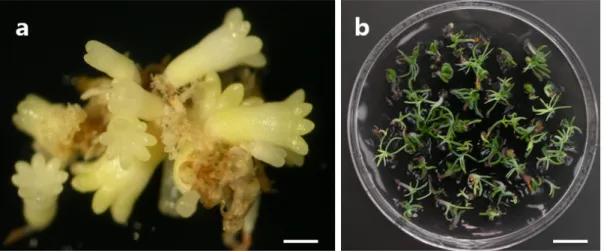
Fig. 4 Somatic embryo induction and germination in P. densiflora. a, Cotyledonary somatic embryos maturing on 1/2LM medium with 1.0% gellan gum, 0.1 M maltose+3.75% PEG 4000 and 250 μM ABA (bar = 0.4 mm). b, Some germinants from the cotyledonary somatic embryos after 4 weeks of culture (bar = 1.4 cm).
에 도움을 준다고 보고하고 있다 (Kong and Yeung. 1995).
그러나 Zhang 등 (2007)은 Pinus bungeana의 체세포배 유도 에는 5.0% sucrose 단독첨가가 효과적인 반면 PEG첨가는 별 효과가 없음을 보고하고 있어 수종에 따른 최적 삼투 압제 종류 및 농도는 매우 다양하게 나타나 최적의 조 건을 밝히는 게 필수적이다.
Gelrite 농도에 따른 체세포배 발생 효과 비교
소나무류 체세포배 유도 시 배지 내의 고농도의 gelrite를 첨가함으로써 고빈도의 체세포배 유도가 가능함을 보고 하고 있는데, 그중에서 Pinus strobus (Garin et al. 2000;
Klimaszewska et al. 2000), P. monticola (Percy et al. 2000), 및 P. pinaster (Ramarosandratana et al. 2001a,b) 등의 수종 에서 이 효과에 대한 연구가 보고되고 있다. 따라서 Figure 2 는 gelrite 농도에 따른 체세포배 발생효과를 비교한 결과 인데 0.4 및 0.6%의 농도에서는 전혀 체세포배가 유도되 지 않았고 0.8% 이상의 농도부터 체세포배가 유도되었 다. 최대 체세포배 유도 수는 1.0% gelrite에서 41개로 가 장 높은 수를 보였으나 0.8 혹은 1.2%농도에서 또한 37.3 및 39.7개로 높은 유도수를 보여 0.8%이상의 고농도 gelrite 첨가 시 체세포배 유도 효과가 있는 것으로 나타 났다. 이러한 고농도 gelrite효과는 특히 침엽수종 중 소나 무류의 체세포배 유도의 경우 그 효과가 매우 뚜렷하게 나타나는데, 이것은 배발생조직이 배지로부터 수분공급 이 제한되면서 세포내의 ABA농도 증가 및 부분 탈수효 과와 병행되어 체세포배 발생의 자극으로 이어진 결과이 며 특히 고농도의 삼투압제와 함께 처리하면 더욱 효과 적인 것으로 알려져 있다. (Klimaszewska et al. 2000). 대개 사용된 gelrite농도는 다양하게 보고하고 있는데 P. brutia (Yildirim et al. 2006), P. strobus (Garin et al. 2000), 및 P.
monticola (Percy et al. 2000) 등에서는 1.0%를, P. pinaster (Ramarosandratana et al. 2001a)에서는 0.9%가 최적임을 보 였는데, 특히 0.45%의 저농도 gelrite 유래 체세포배의 형 태는 0.9% 유래 체세포배 보다 짧은 형태를 보였으며, 차 후 발아과정에서도 0.45% gelrite 유래 체세포배는 전혀 발아가 이루어지지 않아 고농도의 gelrite 첨가가 차후 정 상적인 발아가 가능한 체세포배 발생에 필수적인 것으로 나타났다. 그리고 Kim 등 (2007)은 Pinus rigida×P. taeda의 경우 1.2% gelrite의 농도에서 또한 고빈도의 체세포배 유 도를 보고하고 있어 소나무류 체세포배 유도과정에는 1.0%이상의 고농도 gelrite가 필수적인 것으로 보인다. 그 러나 낙엽송의 체세포배 유도 (Kim and Moon 2007)의 경 우 0.8%가 최적인 반면 1.0%이상의 농도에서는 저해되는 현상이 관찰되어 소나무류 이외의 침엽수종에서는 다소 저농도의 gelrite가 필요함을 보였다.
ABA 농도, 배발생조직 라인 및 활성탄 첨가에 따른 체세포배 발아 효율 비교
Figure 3은 체세포배 발생 시 농도 별로 첨가된 ABA, 배 발생조직 라인 별 및 활성탄 첨가에 따른 체세포배의 발 아 효과를 비교한 것으로서, 최대 발아율은 활성탄 첨가 의 경우 06-6 라인, 150 및 200 μM ABA 첨가 유래 체세포 배에서 45%의 동일하게 나타났다. 06-8라인의 경우 최대 발아율은 250 μM ABA 처리구 유래 체세포배에서 24.8%
로 나타났으며 (Fig. 4b), 06-9라인의 경우 또한 19.4%의 발아율을 보인 200 μM의 고농도 ABA 처리구에서 였다.
반면 활성탄 무첨가 경우 최대 발아율은 06-6라인, 250 μ M ABA 유래 체세포배에서 28.9%로 가장 높았고, 다음으 로는 06-8라인, 150 μM ABA 유래 체세포배 발아가 23.1%
로 나타났다 (Fig. 3). 그러나 06-6라인의 경우 50 μM
ABA 처리구유래 체세포배는 전혀 발아가 이루어지지 않 아 높은 발아율 획득을 위해서는 고농도 ABA처리가 필 수적인 것으로 나타났으며, 배발생조직라인에 따른 체세 포배의 발아율은 매우 다양하게 나타나고, 또한 고농도 의 ABA첨가구 유래 체세포배일수록 그 발아율은 높아지 는 경향을 볼 수 있다. 그리고 0.2%의 활성탄이 첨가된 발아배지가 무첨가보다는 대체로 높은 발아율을 보였다 (Fig. 3). 본 실험의 경우 고농도의 ABA첨가로 정상적인 체세포배의 형성이 이루어졌지만 고농도 ABA첨가배지 유래 체세포배의 세포는 고수위의 ABA 잔존영향으로 인 해 체세포배 발아가 정상적으로 이루어지지 않을 때가 많다. 이를 해결하기 위해 발아배지에 활성탄을 첨가해 서 잔존 ABA를 흡수한다든지 혹은 발아배지의 gelrite농 도를 낮춰서 배지와 체세포배 간의 수분흐름을 높여 발 아를 촉진하기도 한다. 소나무류 체세포배 유도의 경우 ABA농도와 발아효과에 관한 비교실험은 매우 적은 반면 발아배지 내 활성탄 첨가 및 탈수 등의 처리로 발아율을 높이는 보고는 다수 있다. Pinus densiflora 의 체세포배 발 아의 경우 100 μM ABA에서 유래한 체세포배를 0.5%의 활성탄첨가 배지에서 30%의 발아율을 보여 본 실험과 유사한 결과를 보였고 (Maruyama et al. 2005), P. radiata (Montalbán et al. 2010, 2011) 체세포배의 발아 경우 0.2%
에서, 특히 Salajova와 Salaj (2005)는 P. nigra 의 체세포배 발아 시 2~3주 정도 부분 탈수과정을 거친 후 1.0% 활성 탄 첨가 배지에서 최대의 발아율을 이루었다는 다양한 보고가 있어 수종에 따라 적정농도가 다소 다름을 보여 주었다.
이상의 결과는 소나무의 최적의 ABA, 삼투압제 처리 및 체세포배 발아를 위한 적정 조건들을 구명함으로써 고빈도의 체세포배 발생 및 식물체 재분화율을 달성하여 클론식물체 대량생산뿐만 아니라 형질전환을 통한 신품 종의 개발연구에도 널리 활용될 수 있을 것이다.
적 요
본 연구는 소나무의 삼투압제 종류 및 농도, gelrite 농도 에 따른 체세포배 발생 및 abscisic acid (ABA) 농도, 배발생 조직 라인에 따른 체세포배 발아 효과를 조사하기 위해 수행되었다. 삼투압제 종류 및 농도에 따른 체세포배 발생 비교에서 최대의 체세포배 유도 수는 0.1 M maltose+3.75%
polyethylen glycol (PEG) 4000 처리구에서 45개 (/90 mg FW) 로 나타났으며, 0.2 M maltose 처리구 또한 41개로 효과 가 있었다. Gelrite 농도에 따른 체세포배 발생비교에서 0.4 및 0.6%의 농도에서는 전혀 체세포배가 유도되지 않 았으며, 0.8% 이상의 농도부터 체세포배가 발생되는 경 향을 보였다. 최대 체세포배 유도 수는 1.0% gelrite에서
41개로 가장 높은 유도 수를 보였으며, 0.8 혹은 1.2%에서 의 농도에서 또한 각각 37.3 및 39.7개로 높은 유도수를 보여 0.8% gelrite 이상에서 체세포배 유도 효과가 있었다.
ABA농도, 배발생조직 라인 및 활성탄 첨가에 따른 체 세포배 발아율 비교에서 06-6조직라인의 경우 150 혹은 200 μM ABA 처리구 유래 체세포배를 0.2% 활성탄첨가 배지에서 배양한 경우 45%의 최대 발아율을 보였다. 활 성탄 무첨가 배지의 경우 최대 발아율은 06-6라인, 250 μM ABA 처리구 유래 체세포배에서 28.9%로 나타났다.
인용문헌
Kim YW, Shin HN and Moon HK (2011) Somatic embryogenesis and plant regeneration with embryogenic tissue lines in Pinus densiflora. J Kor For Soc 100:499-504
Garin E, Bernier-Cardou M, Isabel N, Klimaszewska, Plourde A (2000) Effect of sugar, amino acids, and culture technique on maturation of somatic embryos of Pinus strobus on medium with two gellan gum concentrations. Plant Cell Tiss Org Cult 62 27-37
Hakman I, Fowke LC, von Arnold S, Eriksson T (1985) The development of somatic embryos in tissue cultures initiated from immature embryos of Picea abies (Norway spruce).
Plant Sci 38:53-59
Kim JH, Park JI (1986) Shoot formation in culture of mature Pinus densiflora. The Res Rep Inst For Gen 23:123-127
Kim YW, Moon HK (2007) Regeneration of plant by somatic embryogenesis in Pinus rigida×P. taeda. In Vitro Cell Dev Biol-Plant 43:335-342
Kim YW, Moon HK (2007) Enhancement of somatic embryo- genesis and plant regeneration in Japanese larch (Larix leptolepis). Plant Cell Tiss Org Cult 88:241-245
Kong L, Yeung EC (1995) Effects of silver nitrate and polyeth- ylene glycol on white spruce somatic embryo development:
enhancing cotyledonary embryo formation and endogenous ABA content. Physiol Plant 93:298-304
Klimaszewska K, Bernier-Cardou M, Cyr DR, Sutton BCS (2000) Influence of gelling agents on culture medium gel strength, water availability, tissue water potential, and maturation response in embryogenic cultures of Pinus strobus L. In Vitro Cell Dev Biol-Plant 36:279-286
Li YY, Huang FH, Murphy JB, Gbur EE (1998) Polyethylene glycol and maltose enhance somatic embryo maturation in loblolly pine (Pinus taeda L.). In Vitro Cell Dev Bio-Plant 34:22-26
Litvay JD, Verma DC, Johnson MA (1985) Influence of a loblolly (Pinus taeda L.) culture medium and its components on growth somatic embryogenesis of the wild carrot (Darcus carota L.). Plant Cell Rep 4:325-328
Maruyama E, Hosoi Y, Ishii K (2005) Somatic embryo production and plant regeneration of Japanese black pine (Pinus thunbergii). J For Res 10:403-407
Montalbán IA, De Diego N, Igartua EA, Setién A, Moncaleán P (2011) A combined pathway of somatic embryogenesis and organogenesis to regenerate radiata pine plants. Plant Biochem Rep 5:177-186
Montalbán IA, De Diego N, Moncaleán P (2010) Bottelnecks in Pinus radiata somatic embryogenesis: improving maturation and germination. Trees 24:1061-1071
Percy RE, Klimaszewska K, Cyr DR (2000) Evaluation of somatic embryogenesis for clonal propagation of western white pine.
Can J For Res 30:1867-1876
Ramarosandratana A, Harvengt L, Bouvet A, Calvaytac R, Pâques M (2001a) Effects of carbohydrate source, polyethylene glycol, and gellan gum concentration on embryonal-suspensor mass (ESM) proliferation and maturation of maritime pine somatic embryos. In Vitro Cell Dev Bio-Plant 37:29-34 Ramarosandratana A, Harvengt L, Bouvet A, Calvaytac R, Pâques
M (2001b) Influence of the embryonal-suspensor mass (ESM) sampling on development and proliferation of maritime pine somatic embryos. Plant Sci 160:473-479
Salajova T, Salaj J (2005) Somatic embryogenesis in Pinus nigra:
embryogenic tissue line initiation, maturation and regenera- tion ability of established cell lines. Bio Plant 49:333-339 Scott P, Lyne RL, Rees TA (1995) Metabolism of maltose and
sucrose by microspores isolated from barley (Hordeum vulgare). Planta 197:435-441
Shim ST, Park JI, Lee SK, Kim JH (1986) Micropropagation of Pinus densiflora S. ET Z. by embryo and needle fascle culture.
Proc the 5th Int‘l Conf SABRAO. pp 137-145
Shoji M, Sato H, Nakagawa R, Funada R, Kubo T, Ogita S (2006) Influence of osmotic pressure on somatic embryo maturation in Pinus densiflora. J For Res 11:449-453
Teasdale RD, Dawson PA, Woolhouse HW (1986) Mineral nutrient requirements of a loblolly pine (Pinus taeda) cell suspension culture. Plant Physiol 82:942-945
Yildirim T, Kaya Z, Iʂik K (2006) Induction of embryogenic tissue and maturation of somatic embryos in Pinus brutia TEN.
Plant Cell Tiss Org Cult 87:67-76
Zhang CX, Li Q, Kong L (2007) Induction, development and maturation of somatic embryos in Bunge’s pine (Pinus bungeana Zucc. ex Endl.). Plant Cell Tiss Org Cult 91:273-280