서 론
급성 호흡기바이러스 감염은 외래 전체 내원 환자 수의 30%–
50%를 차지할 정도로 소아에서 가장 흔한 감염성 질환으로 전세계
적으로 이로 인해 매년 수백만 명의 소아들이 사망하기도 한다.1,2 특히 3세 전 소아, 저체중 출생아이거나 어린이집에 다니는 것과 같 은 위험 요인이 있는 경우에는 호흡기 바이러스 감염이 폐렴 또는 모세기관지염 등의 하부 호흡기 질환으로 진행되어 입원을 하는 경 Allergy Asthma Respir Dis 5(6):320-325, November 2017 https://doi.org/10.4168/aard.2017.5.6.320 ORIGINAL ARTICLE
Correspondence to: Man Yong Han https://orcid.org/0000-0002-9077-5779 Department of Pediatrics, CHA University School of Medicine, 59 Yatap-ro, Bundang-gu, Seongnam 13496, Korea
Tel: +82-31-780-6262, Fax: +82-31-780-5239, E-mail: [email protected]
Received: February 28, 2017 Revised: September 13, 2017 Accepted: September 15, 2017
© 2017 The Korean Academy of Pediatric Allergy and Respiratory Disease The Korean Academy of Asthma, Allergy and Clinical Immunology This is an Open Access article distributed under the terms of the Creative Commons Attribution Non-Commercial License
호흡기 바이러스의 연령별, 성별, 계절별에 따른 유병률 변화:
단일기관에서 10년 동안 호흡기 질환으로 입원한 소아 환자를 중심으로
이승진,1 이신혜,1 하은교,1 신윤호,2 성명순,3 정영호,1 이경석,1 지혜미,1 한만용1
차의과학대학교 1분당차병원, 2강남차병원, 3구미차병원 소아청소년과
Prevalence of respiratory virus infection with regard to age, sex, and
seasonality factors: A single center experience against children hospitalized during the 10 years
Seung Jin Lee,1 Shin Hae Lee,1 Eun Kyo Ha,1 Youn Ho Sheen,2 Myong Soon Sung,3 Young-Ho Jung,1 Kyung Suk Lee,1 Hye Mi Jee,1 Man Yong Han1
1Department of Pediatrics, Bundang CHA Medical Center, CHA University School of Medicine, Seongnam; 2Department of Pediatrics, CHA Gangnam Medical Center, CHA University School of Medicine, Seoul; 3Department of Pediatrics, CHA Gumi Medical Center, CHA University School of Medicine, Gumi, Korea
Purpose: It is well known that respiratory viral infection has epidemiological characteristics, including season. This study aimed to investigate the patterns of the prevalence of common respiratory viruses during a period of 10 years with regard to age, sex, and season in Korean children.
Methods: From June 2006 to November 2016, we obtained 11,798 specimens from patients aged less than 18 years who were ad- mitted with lower respiratory infections. Ten respiratory viruses were detected using multiplex reverse transcription-polymerase chain reaction.
Results: Of 11,798 specimens, at least 1 virus was detected in 4,845 (41.1%). Respiratory syncytial virus (RSV, 18.9%) was the most common virus detected, followed by human rhinovirus (HRV, 14.8%), adenovirus (9.5%), and human bocavirus (HBoV, 7.4%). The detection rate of HRV was higher in male subjects (male 60.0% vs. female 40.0%, P= 0.004), but the other viruses had no significant differences with regard to sex. The subjects who were positive for RSV test were youngest (median, 10.5 months; interquartile range, 3.0–25.0 months), followed by human coronavirus (median, 13.0 months), HRV (median, 14 months), and parainfluenza (median, 14 months). HBoV was most commonly detected in spring (29.3%), enterovirus in summer (25.8%), HRV in fall (22.6%), and RSV in Oc- tober and winter (22.6%).
Conclusion: We found that the prevalence of respiratory viruses in Korean children during a period of 10 years was associated with age, sex, and season when the infection occurred. Further nationwide data is warranted to infer clinical implication of our results.
(Allergy Asthma Respir Dis 2017;5:320-325)
Keywords: Respiratory virus, Prevalence, Seasonality, Child
2017-03-16 https://crossmark-cdn.crossref.org/widget/v2.0/logos/CROSSMARK_Color_square.svg
우가 많다.3,4 지난 10년 동안 호흡기 바이러스의 진단은 polymerase chain reaction (PCR) 기법을 이용한 간단한 검사로5,6 임상에서 많 이 활용되고 있다. 특히 최근 보카바이러스(human bocavirus, HBoV),7,8 메타뉴모바이러스(human metapneumovirus, hMPV)9,10, 엔테로바이러스(human enterovirus, hEV)11,12가 가능해져서 호흡 기 감염의 다양한 원인들을 분석할 수 있게 되었다. 호흡기 바이러 스는 계절적 변동이 있어 A형 인플루엔자(influenza virus A)는 겨 울,13 메타뉴모바이러스는 봄(4월),14,15 RS 바이러스(respiratory syncytial virus, RSV)는 늦가을에서 초겨울(11–12월)16 유행한다 는 것은 잘 알려져 있다. 그러나 앞에 언급한 보카바이러스,7,8 메타 뉴모바이러스9,10, 엔테로바이러스11,12의 월별 변동에 대한 통합적 연구는 아직 부족한 실정이다. 그리고 이로 인해 호흡기 질환의 원 인을 빠르게 유추하고 이에 대응하기가 쉽지 않다.
따라서 저자들은 지난 10년 동안 단일기관 대학병원에서 하부 호흡기 질환으로 입원하여 호흡기 바이러스검사를 시행한 소아 환 자들을 대상으로 바이러스의 양성률을 알아보고자 하였다. 동시 에, 월별 분포, 나이별, 성별에 따른 차이 또한 조사하여 시기에 따 른 호흡기 질환의 원인 바이러스 변동에 대비하고자 하였다.
대상 및 방법
이 연구는 2006년 7월부터 2016년 11월까지 분당차병원 소아청 소년과에 하부 호흡기 질환(급성기관지염, 모세기관지염, 폐렴)으 로 입원하여 호흡기 바이러스검사를 시행한 18세 미만 소아 총 11,798명을 대상으로 하였다. 입원 기록을 후향적으로 분석하여, 연구 대상자의 성별과 나이, 검체물 채취를 시행한 시기와 바이러 스검사 결과를 조사하였다.
이 연구는 분당차병원 임상시험윤리위원회의 심의 (IRB No.
2017-06-006)를 거쳐 대상자의 의무기록을 후향적으로 조사하였다.
입원한 환자의 바이러스검사는 입원 당일 또는 다음날 비강에 생리식염수를 분사한 후 카테터를 넣고 음압을 주어 세척액을 채취 하는 비강 내 흡입법으로 진행하였다.17 채취 후 모든 검체는 처리되 기 전까지 4°C 냉장고에 보관하였다.1 검사 항목은 연도에 따라 차 이가 있었는데, 2006년 7월부터 2008년 5월까지는 아데노바이러스 (adenovirus), A와 B형 인플루엔자, 메타뉴모바이러스, 코로나바이 러스 3형(corona 229E, OC43, NL63형) (human coronavirus), 파 라인플루엔자 3형(1형, 2형, 3형) (parainfluenza virus)과 RS바이러 스(A형과 B형) 검사가 포함된 12종 검사(Seeplex RV detection kit, SeeGene, Seoul, Korea)를 시행하였다. 이후 2008년부터 6월부터 2015년 9월까지는 RS 바이러스, 아데노바이러스와 A와 B형 인플 루엔자, 메타뉴모바이러스와 라이노바이러스(human rhinovirus), 파라인플루엔자바이러스가 포함된 7종 검사(Seeplex RV7 Detec- tion kit)를 시행하였다. 2015년 10월부터 2016년 11월까지는 아데
노 바이러스, A형과 B형 인플루엔자, 메타뉴모바이러스, 라이노바 이러스, 코로나바이러스(229E형, OC43형, NL63형), 보카바이러 스, 엔테로바이러스, RS 바이러스(A형과 B형), 파라인플루엔자 바 이러스(1형, 2형, 3형과 4형) 16종 바이러스검사(Anyplex II RV16 detection kit, SeeGene)를 시행하였다. 이 모든 바이러스 검출은 Multiplex RT-PCR 검사법(real time-polymerase chain reaction, RT-PCR Seegene, Seoul, Korea)5,15을 이용하였다.
아형이 있는 파라인플루엔자, RS 바이러스, 코로나바이러스는 한 종류형 이상이 양성 반응을 보이면 감염 양성으로 판정하였고 A형과 B형 인플루엔자는 각각의 유병률을 분석하였다.
통계 분석은 IBM SPSS Statistics ver. 22.0 (IBM Co., Armonk, NY, USA)을 이용하였다. 바이러스는 월별, 연도별 양성률을 계산 하였다. 평균 나이는 정규분포를 따르지 않아 중앙값(median)과 사분위범위(interquartile range)로 기술하였다. 각 바이러스 양성 률의 남녀 간의 차이는 카이제곱검정을 이용하였다. 각각의 바이러 스뿐만 아니라 전체 바이러스 양성률 또한 월별, 연도별로 분석하 였다. 연령에 따른 호흡기 바이러스 양성률은 1세 미만, 1세, 2세, 3–4세, 5–7세, 8–17세로 분류하여 분석하였다. P값이 0.05 미만인 경우 통계학적으로 유의한 것으로 판단하였다.
결 과
1. 바이러스별 양성률과 성별 차이
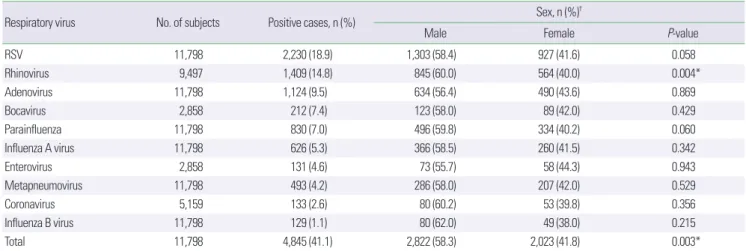
10년 동안 총 11,798명의 소아가 호흡기 바이러스검사를 시행하 였다. 이 중 남아는 6,682명(56.6%)이었고 연령 중앙값은 20개월(사 분위범위, 8.0–40.0개월)이었다. 총 11,798명 중 바이러스 양성이 확 인된 것은 4,845명(41.1%)이며, 단일 바이러스에 양성을 보인 환자 는 3,565명(30.2%)이었다. 각 바이러스에 대한 양성률은 RS바이러 스의 양성률이 18.9%로 가장 높았고, 그 다음이 라이노바이러스 (14.8%) 순이었다. 인플루엔자 B는 1.1%로 양성률이 가장 낮았다.
성별 간 분석에서는 남아가 바이러스 양성률이 더 높았고(58.3%, P= 0.003), 라이노바이러스가 남아에서 의미 있게 양성률이 높았 다(60.0%, P= 0.004) (Table 1).
2. 계절별 변화율
바이러스검사를 시행한 빈도와 양성률은 월별로 차이가 있었다 (Table 2). 월별로 11월에 호흡기 바이러스검사를 가장 많이 시행하 였고(n=1,357) 바이러스 양성률은 계절별로 보았을 때 겨울에 높 았으며 월별로는 12월에 55.3%로 가장 높았다. 각 바이러스의 양성 률을 계절적으로 분석했을 때 봄은 보카바이러스(29.3%), 파라인 플루엔자바이러스(19.1%), 메타뉴모바이러스(15.4%)와 B형 인플 루엔자바이러스(6.9%) 순으로 높은 양성률을 보였다. 그리고 여름 은 엔테로바이러스(25.8%)와 아데노바이러스(17.5%), 가을은 라이
노바이러스(22.3%), 겨울은 코로나(7.4%)와 A형 독감바이러스 (13.2%)였다. RS 바이러스는 10월부터 발생률이 증가하기 시작해 서 겨울 기간(12–2월) 동안 높은 양성률을 보였다.
3. 연령별 검출률
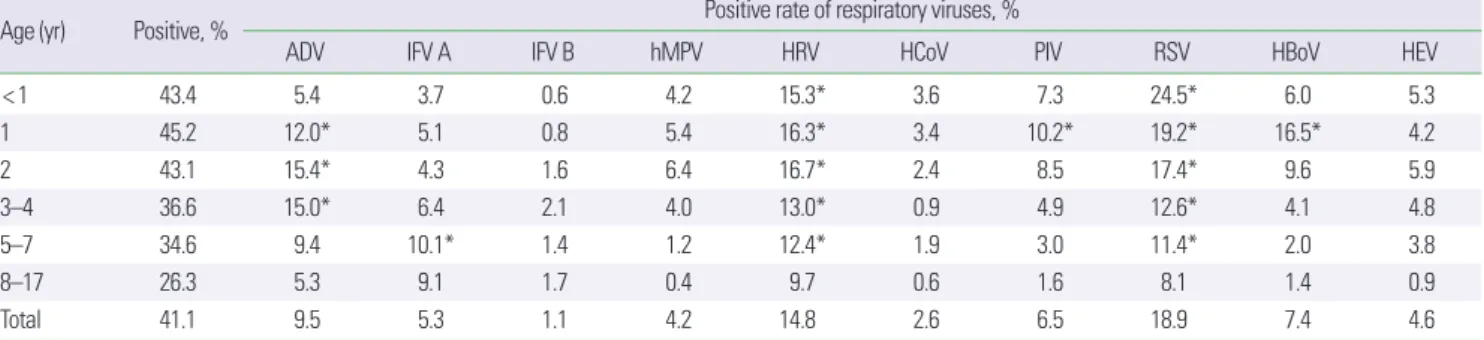
연령별 검사 양성률은 각각 1세 미만에서 43.4% (2,037/4,697명), 1세에서 45.2% (1,107/2,447명), 2세에서 43.1% (601/1,394명), 3–4 세에서 36.6% (562/1,537명), 5–7세에서 34.6% (353/1019명), 8–17세 에서 26.3% (185/704명)였다(P<0.001). 바이러스검사 대상자 중 각 나이군에서 10종 바이러스 양성률은 Table 3과 같다. 10종 바이 러스 양성 환자들 중 바이러스별 각 연령군에 따른 양성 분포도를
보면 5세 이후에 나이에 따라 발생 분포가 증가하는 것은 A형과 B 형 인플루엔자바이러스였다. 중앙값 나이가 가장 어릴 때 바이러스 양성은 RS바이러스(중앙값, 10.5개월; 사분위범위, 3.0–25.0개월) 였으며 그 다음으로 코로나바이러스(중앙값, 13개월; 사분위범위, 4.5–25.0개월), 라이노바이러스(중앙값, 14.0개월; 사분위범위, 4.5–
31.0개월)와 파라인플루엔자(중앙값, 14.0개월; 사분위범위, 6.0–
25.0개월)순이었다(Fig. 1).
4. 연도별 변화율
10종 바이러스의 연도별 발생 빈도를 10년간 누적하여 계산한 빈도는 Table 4와 같다. 연도에 따라 검사를 시행한 바이러스의 종 Table 1. Detection rate of respiratory viruses and sex distribution of total 11,798 patients hospitalized during the study period
Respiratory virus No. of subjects Positive cases, n (%) Sex, n (%)†
Male Female P-value
RSV 11,798 2,230 (18.9) 1,303 (58.4) 927 (41.6) 0.058
Rhinovirus 9,497 1,409 (14.8) 845 (60.0) 564 (40.0) 0.004*
Adenovirus 11,798 1,124 (9.5) 634 (56.4) 490 (43.6) 0.869
Bocavirus 2,858 212 (7.4) 123 (58.0) 89 (42.0) 0.429
Parainfluenza 11,798 830 (7.0) 496 (59.8) 334 (40.2) 0.060
Influenza A virus 11,798 626 (5.3) 366 (58.5) 260 (41.5) 0.342
Enterovirus 2,858 131 (4.6) 73 (55.7) 58 (44.3) 0.943
Metapneumovirus 11,798 493 (4.2) 286 (58.0) 207 (42.0) 0.529
Coronavirus 5,159 133 (2.6) 80 (60.2) 53 (39.8) 0.356
Influenza B virus 11,798 129 (1.1) 80 (62.0) 49 (38.0) 0.215
Total 11,798 4,845 (41.1) 2,822 (58.3) 2,023 (41.8) 0.003*
*P< 0.05, statistically significant. †Percentage of males and females in subjects who were tested positive for each virus by polymerase chain reaction test.
Table 2. Monthly incidence of respiratory virus isolation
Season Month No. Positive
cases, n (%)
Positive cases of respiratory viruses, n (%)
ADV IFV A IFV B hMPV HRV HCoV PIV RSV HBoV HEV
Spring Mar 900 332 (36.9) 56 (6.2) 50 (5.6) 62 (6.9)* 82 (9.1) 103 (14.8) 11 (2.5) 18 (2.0) 110 (12.2) 28 (11.5) 0 (0)
Apr 1,224‡ 428 (35.0) 130 (10.6) 95 (7.8) 46 (3.8) 188 (15.4)* 164 (14.8) 13 (2.5) 84 (6.9) 75 (6.1) 66 (25.3) 2 (0.8) May 1,166 424 (36.3) 161 (13.8) 36 (3.1) 4 (0.3) 109 (9.3) 186 (19.9) 12 (2.6) 223 (19.1)* 37 (3.2) 68 (29.3)* 12 (5.2)
Summer Jun 756 262 (34.7) 93 (12.3) 6 (0.8) 0 (0) 30 (4.0) 123 (20.0) 10 (3.1) 141 (18.7) 7 (0.9) 20 (11.3) 23 (13)
Jul 635 219 (34.5) 43 (6.8) 3 (0.5) 1 (0.2) 12 (1.9) 104 (20.4) 3 (1.0) 102 (16.1) 16 (2.5) 2 (1.1) 48 (25.8)*
Aug 782 221 (28.3) 137 (17.5)* 3 (0.4) 0 (0) 4 (0.5) 73 (11.9) 2 (0.5) 76 (9.7) 37 (0.7) 4 (1.6) 21 (8.6)
Fall Sep 996 263 (26.5) 137 (13.8) 21 (2.1) 0 (0) 4 (0.4) 120 (15.8) 2 (0.5) 67 (6.7) 97 (9.7) 0 (0) 6 (3.0)
Oct 1,198 514 (42.9) 114 (9.5) 48 (4.0) 0 (0) 11 (0.9) 207 (22.3)* 12 (1.9) 59 (4.9) 271 (22.6) 9 (2.5) 13 (3.6) Nov 1,357‡ 725 (53.4)† 98 (7.2) 89 (6.6) 0 (0) 5 (0.4) 121 (11.9) 12 (1.8) 30 (2.2) 555 (40.9) 2 (0.6) 5 (1.5)
Winter Dev 1,050 580 (55.3)† 54 (5.1) 55 (5.2) 1 (0.1) 2 (0.2) 97 (9.8) 26 (7.4)* 10 (1.0) 477 (45.4)* 1 (0.4) 0 (0)
Jan 967 533 (55.1)† 67 (6.9) 128 (13.2)* 5 (0.5) 15 (1.6) 58 (7.2) 22 (6.6) 9 (0.9) 347 (35.9) 5 (2.9) 0 (0)
Feb 767 342 (44.6) 34 (4.4) 92 (12.0)* 10 (1.3) 31 (4.0) 53 (8.1) 8 (2.9) 11 (1.4) 201 (26.2) 7 (4.3) 1 (0.6)
Total 11,798 4,118 (34.9) 1,124 (9.5) 626 (5.3) 129 (1.1) 493 (4.2) 1,409 (14.8) 133 (2.6) 830 (7.0) 2,230 (18.9) 212 (7.4) 131 (4.6) Numbers in parenthesis is the positive percentage of each viruses.
No., number of respiratory aspirations collected; ADV, adenovirus; IFV A, influenza virus A; IFV B, influenza virus B; hMPV, human metapneumovirus; HRV, human rhinovirus;
HCoV, human coronavirus; PIV, parainfluenza virus; RSV, respiratory syncytial virus; HBoV, human bocavirus; HEV, human enterovirus.
*Month when the prevalence of disease caused by respiratory virus was highest. †Month when the isolation of respiratory virus was highest. ‡Month when the number of col- lected samples were highest.
류와 개수가 달라 일괄적으로 비교하기에는 어려움이 있지만, 16종 바이러스검사를 모두 시행한 2016년의 바이러스 양성률이 가장 높 았다(58.7%). RS바이러스의 양성률은 2010년에(43.3%) 가장 높았 으며 아데노바이러스 양성률은 2016년도(23.2%)가 가장 높았다.
라이노바이러스는 2010년부터 2014년까지 낮은 양성률을 보이다 가 2015년도와 2016년도에 높아졌다.
고 찰
이 연구에서 지난 10년간 호흡기 바이러스검사 양성률은 41.1%
였고, 이중 RS바이러스와 라이노바이러스 순으로 양성률이 높았 다. 라이노바이러스 양성률만이 통계적으로 유의하게 남아에서 높 았다. 검출된 바이러스 중에 A형과 B형 인플루엔자바이러스가 차 지하는 비율은 나이가 증가하면서 증가하였다. 10종 바이러스는 유행하는 시기가 모두 달랐는데, 기존에 보고된 것8과 유사한 경향 Fig. 1. Distribution of age groups for each respiratory viruses. ADV, adenovirus;
IFV A, influenza virus A; IFV B, influenza virus B; hMPV, human metapneumovirus;
HRV, human rhinovirus; HCoV, human coronavirus; PIV, parainfluenza virus; RSV, respiratory syncytial virus; HBoV, human bocavirus; HEV, human enterovirus.
Table 4. Annual number of the respiratory viruses isolated from children with acute respiratory tract infection
Year No. Positive
cases, n (%)
Positive cases of respiratory viruses, n (%)
ADV IFV A IFV B hMPV HRV HCoV PIV RSV HBoV HEV
2006 607 182 (30.0) 14 (2.3) 2 (0.3) 0 (0) 0 (0) - 10 (1.6) 47 (7.7) 129 (21.3) - -
2007 1,303 319 (24.5) 136 (10.4) 51 (3.9) 1 (0.1) 73 (5.6) - 15 (1.2) 104 (8.0) 152 (11.7) - -
2008 853 366 (42.9) 27 (3.2) 34 (4.1) 24 (2.8) 16 (1.9) 41 (8.9) 12 (3.1) 45 (5.3) 254 (29.8) - -
2009 1,503 708 (47.1) 151 (10.0) 324 (21.6) 0 (0) 73 (4.9) 239 (15.8) - 131 (8.7)† 316 (21.0) - -
2010 654 347 (53.7)* 48 (7.3) 47 (7.2) 8 (1.2) 25 (3.8) 81 (12.4) - 31 (4.7) 283 (43.3)† - -
2011 367 146 (39.8) 8 (2.2) 15 (4.1) 1 (0.3) 14 (3.8) 51 (13.9) - 22 (6.0) 109 (29.7) - -
2012 414 210 (50.7)* 20 (4.8) 26 (6.3) 5 (1.2) 16 (3.9) 39 (9.4) - 29 (7.0) 154 (37.2) - -
2013 652 258 (39.6) 50 (7.7) 12 (1.8) 0 (0) 16 (2.5) 52 (8.0) - 36 (5.5) 211 (32.4) - -
2014 1,438 431 (30.0) 37 (2.6) 5 (0.3) 1 (0.1) 83 (5.8)† 105 (7.3) - 96 (6.7) 334 (23.2) - -
2015 1,809 582 (32.2) 122 (6.7) 49 (27)† 15 (0.8) 79 (4.4) 310 (17.1) 27 (4.1) 146 (8.1) 228 (12.6) 8 (1.2) 15 (2.3) 2016 2198 1,290 (58.7)* 511 (23.2)† 61 (2.8) 74 (3.4)† 98 (4.5) 492 (22.4) 69 (3.1) 143 (6.5) 60 (2.7) 204 (9.3) 116 (5.3)
Total, % 34.9 9.5 5.3 1.1 4.2 14.8 2.6 7.0 18.9 7.4 4.6
ADV, adenovirus; IFV A, influenza virus A; IFV B, influenza virus B; hMPV, human metapneumovirus; HRV, human rhinovirus; HCoV, human coronavirus; PIV, parainfluenza virus;
RSV, respiratory syncytial virus; HBoV, human bocavirus; HEV, human enterovirus.
*Year when the isolation of respiratory virus were highest. †Year when the prevalence of disease caused by respiratory virus were highest.
Table 3. Positive rate of respiratory viruses in each age group
Age (yr) Positive, % Positive rate of respiratory viruses, %
ADV IFV A IFV B hMPV HRV HCoV PIV RSV HBoV HEV
< 1 43.4 5.4 3.7 0.6 4.2 15.3* 3.6 7.3 24.5* 6.0 5.3
1 45.2 12.0* 5.1 0.8 5.4 16.3* 3.4 10.2* 19.2* 16.5* 4.2
2 43.1 15.4* 4.3 1.6 6.4 16.7* 2.4 8.5 17.4* 9.6 5.9
3–4 36.6 15.0* 6.4 2.1 4.0 13.0* 0.9 4.9 12.6* 4.1 4.8
5–7 34.6 9.4 10.1* 1.4 1.2 12.4* 1.9 3.0 11.4* 2.0 3.8
8–17 26.3 5.3 9.1 1.7 0.4 9.7 0.6 1.6 8.1 1.4 0.9
Total 41.1 9.5 5.3 1.1 4.2 14.8 2.6 6.5 18.9 7.4 4.6
Total of positive rates may be smaller than the sum of positive rate of each virus due to coinfection.
ADV, adenovirus; IFV A, influenza virus A; IFV B, influenza virus B; hMPV, human metapneumovirus; HRV, human rhinovirus; HCoV, human coronavirus; PIV, parainfluenza virus;
RSV, respiratory syncytial virus; HBoV, human bocavirus; HEV, human enterovirus.
*Positive rate of 10% and above.
≥ 8 yr 5-7 yr 3-4 yr 2 yr 1 yr
< 1 yr
Distribution of positive respiratory viruses
100%
50%
0%
ADV IFV A IFV B hMPV HRV HCoV PIV RSV HBoV HEV
을 보였다. 최근에 알려진 보카바이러스는 4월과 5월에, 엔테로바 이러스는 7월에 유행하였다. 연도에 따라 바이러스검사 항목에 차 이가 있으므로 정확한 비교는 어려우나, 2016년도는 아데노바이러 스 양성률이 높았으며 보카바이러스와 엔테로바이러스 양성률은 5% 내외였다.
호흡기 바이러스의 계절적 차이는 잘 알려져 있다.18 이번 연구에 서 저자들은 기존 연구와 같이 독감은 겨울에 유행하였고, 메타뉴 모바이러스는 봄,14 RS바이러스는 늦가을과 겨울에 유행한 점16을 재차 확인할 수 있었다. 또한 보카바이러스와 코로나바이러스, 엔 테로바이러스도 계절적 변이가 있다는 점도 확인할 수 있었다. 호흡 기 바이러스가 계절적 변이를 일으키는지의 원인은 아직 잘 알려져 있지 않다.19 그러나 인플루엔자바이러스의 연구가 가장 많이 이루 어졌는데 인플루엔자바이러스는 온도와 습도가 낮을수록 전파력
이 높고,20,21 낮은 습도에서 바이러스가 온전하게 보존되기 때문에
겨울철에 더 유행한다고 보고되었다.22 가을철 천식 악화의 원인으 로 잘 알려져 있는 라이노바이러스는23 겨울철에 감염률이 적은데 이 또한 라이노바이러스는 50% 이상의 습도에서 잘 전파한다는24 것으로 설명된다. 이 외에도 바이러스 변이 증가,25 Vitamin D의 영 향,26 매개체 밀도의 증가27 등의 다양한 이유로 제시되고 있으나 이 러한 동인들이 이번 연구에서 10개 바이러스가 일년 내내 월별을 바꾸며 유행하는 것을 모두 설명할 수는 없다. 따라서 향후 매달 유 행하는 호흡기 바이러스의 계절적 변이의 동인들에 대한 추가적인 연구가 필요할 것으로 보인다.
호흡기 증상으로 입원한 소아에서 남아가 통계적으로 유의하게 라이노바이러스 양성률이 높았다. RS바이러스와 파라인플루엔자 는 통계적인 차이는 없었지만 경향성은 있었다. 이러한 결과 RS바 이러스에 의한 감염률은 성별 차이가 없으나 감염에 의한 입원율 은 남자 아이에서 높다는 연구 결과와 일치한다.28 연구에 따르면 여성이 라이노바이러스의 적응면역(adaptive immune)에 더 잘 반 응하여 양성률이 낮으며29 천명음 또는 천식 유병률이 사춘기 전에 남자 아이에서 높아 남아의 라이노바이러스 입원율이 높다는 라 이노바이러스 감염과 성별의 차이에 대한 연구가 있다.30 따라서 이 번 연구에서도 성별에 따라 바이러스 감염의 위험 요인이 다를 수 있다는 것을 추정할 수 있다.
나이에 따라 면역 반응이 다르기에 호흡기 바이러스 반응에도 차이가 날 수 있다.3 어린 연령에 RS바이러스와 면역 시스템에 대한 연구에 따르면, 어머니에게서 아기에게로 넘어간 IgG는 1개월에 73% 정도 양성이고 3개월이면 6%로 떨어진다.31 그러므로 이때 감 염이 노출되면 증상이 발생할 수 있다. 감염 후 IgG는 감염 후 10일 정도 후에 나타나며 3–4주에 최고농도에 이르지만 1년 후 IgG는 사라지거나 아주 낮은 수치를 보이기에 재감염이 높아진다.32
RS바이러스 감염이 병적 상태를 의미하지만33 라이노바이러스 가 어린 연령에서 양성 소견을 보이는 것이 병적 상태를 의미하는
것은 아닐 수 있다. 건강한 소아에서 비강 내 바이러스 양성률 조사 에서 라이노바이러스는 40%, 엔테로바이러스는 20%, 보카바이러 스는 10% 아데노바이러스는 5% 양성을 보였다.3 이러한 바이러스 양성률은 환자를 대상으로 한 순서와 약간의 차이는 있지만 라이 노바이러스가 병적 상태를 야기하는 균주로 작용했는지는 명확하 지 않다. 그러나 라이노바이러스는 나이와 발생률이 반비례하며34 어린 연령일수록 호흡기 증상과 연관되어 나타날 수 있기에 이것이 원인 균주로 고려가 가능하다. 기존 연구에 따르면 검사 양성이 증 상과 유의미한 연관이 있다고 알려진 바이러스로는 인플루엔자와 RS바이러스, 파라인플루엔자와 메타뉴모바이러스가 제시되었다.6 이런 점을 고려하여 검사 양성과 원인균 간의 관계를 고려해서 해 석해야 할 것이다. 다른 바이러스 또한 나이에 따라 역학 변화가 발 생하였지만 개개 바이러스가 연령에 따라 어떻게 변화하는지 비강 내 바이러스 균총 상태를 파악하는 연구 조사가 필요하다.
이번 연구는 단일기관에서 10년 동안 호흡기바이러스를 조사하 였다. 그러나 검사 시기마다 검사한 바이러스의 종류가 달라 지난 10년 동안 일정하게 검사한 바이러스는 7종이며 양성률은 높지 않 는 점이 이 연구의 제한점이라 하겠다. 또한 단일기관에서 시행하였 기에 이를 국가 또는 지역의 전체 발생률로 대치하기에는 부족한 점 이 있다. 그리고 대조군이 없기에 바이러스가 병적 상태와 연관성 이 있는지도 확인할 수 없었다. 하지만 이 연구를 통하여 10여년 동 안 바이러스 양성률의 변화 추이를 대략적으로 파악할 수 있었고 새롭게 대두된 바이러스의 계절별 변화, 성별 변화와 나이별 양성 률의 차이를 확인할 수 있었다.
결론적으로 지난 10년동안 하부 호흡기 감염으로 입원한 환자들 의 바이러스 검출률은 41.1%였으며, 계절적으로 큰 차이를 보였던 바이러스들은 봄에는 보카바이러스, 여름에는 엔테로바이러스, 겨울에는 인플루엔자바이러스였다. RS바이러스의 유행 시기는 10 월부터 2월까지였으며, 연령이 증가할수록 그 비율이 감소하였다.
또한 라이노바이러스는 남아에서 양성률이 높았으며 바이러스의 양성률은 연령별로 차이를 보였다.
REFERENCES
1. Kim MR, Lee HR, Lee GM. Epidemiology of acute viral respiratory tract infections in Korean children. J Infect 2000;41:152-8.
2. Park JS. Acute viral lower respiratory tract infections in children. Korean J Pediatr 2009;52:269-76.
3. van den Bergh MR, Biesbroek G, Rossen JW, de Steenhuijsen Piters WA, Bosch AA, van Gils EJ, et al. Associations between pathogens in the up- per respiratory tract of young children: interplay between viruses and bacteria. PLoS One 2012;7:e47711.
4. Victora CG, Fuchs SC, Flores JA, Fonseca W, Kirkwood B. Risk factors for pneumonia among children in a Brazilian metropolitan area. Pediat- rics 1994;93(6 Pt 1):977-85.
5. Pillet S, Lardeux M, Dina J, Grattard F, Verhoeven P, Le Goff J, et al. Com-
parative evaluation of six commercialized multiplex PCR kits for the di- agnosis of respiratory infections. PLoS One 2013;8:e72174.
6. Krause JC, Panning M, Hengel H, Henneke P. The role of multiplex PCR in respiratory tract infections in children. Dtsch Arztebl Int 2014;111:
639-45.
7. Allander T, Tammi MT, Eriksson M, Bjerkner A, Tiveljung-Lindell A, Andersson B. Cloning of a human parvovirus by molecular screening of respiratory tract samples. Proc Natl Acad Sci U S A 2005;102:12891-6.
8. Choi EH, Lee HJ, Kim SJ, Eun BW, Kim NH, Lee JA, et al. The association of newly identified respiratory viruses with lower respiratory tract infec- tions in Korean children, 2000-2005. Clin Infect Dis 2006;43:585-92.
9. van den Hoogen BG, de Jong JC, Groen J, Kuiken T, de Groot R, Fouchier RA, et al. A newly discovered human pneumovirus isolated from young children with respiratory tract disease. Nat Med 2001;7:719-24.
10. Williams JV, Harris PA, Tollefson SJ, Halburnt-Rush LL, Pingsterhaus JM, Edwards KM, et al. Human metapneumovirus and lower respiratory tract disease in otherwise healthy infants and children. N Engl J Med 2004;350:443-50.
11. Khetsuriani N, Kazerouni NN, Erdman DD, Lu X, Redd SC, Anderson LJ, et al. Prevalence of viral respiratory tract infections in children with asthma. J Allergy Clin Immunol 2007;119:314-21.
12. Jartti T, Lehtinen P, Vuorinen T, Koskenvuo M, Ruuskanen O. Persistence of rhinovirus and enterovirus RNA after acute respiratory illness in chil- dren. J Med Virol 2004;72:695-9.
13. Shaw Stewart PD. Seasonality and selective trends in viral acute respirato- ry tract infections. Med Hypotheses 2016;86:104-19.
14. Jartti T, van den Hoogen B, Garofalo RP, Osterhaus AD, Ruuskanen O.
Metapneumovirus and acute wheezing in children. Lancet 2002;360:
1393-4.
15. Kim YK, Kim JW, Wee YS, Yoo EG, Han MY. Clinical features of human metapneumovirus and respiratory syncytial virus infection in hospital- ized children. Pediatr Allergy Respir Dis 2009;19:12-9.
16. Weigl JA, Puppe W, Schmitt HJ. Seasonality of respiratory syncytial virus- positive hospitalizations in children in Kiel, Germany, over a 7-year peri- od. Infection 2002;30:186-92.
17. Jeong JW, Hwang YH, Cho KS, Jung MJ, Min SK, Kim SJ, et al. Viral eti- ology and epidemiology of outpatients with acute respiratory illnesses in Busan: 2007-2008. Korean J Pediatr Infect Dis 2010;17:130-6.
18. Monto AS. Epidemiology of viral respiratory infections. Disease-a-Month 2003;49:160-74.
19. Fisman D. Seasonality of viral infections: mechanisms and unknowns.
Clin Microbiol Infect 2012;18:946-54.
20. Mäkinen TM, Juvonen R, Jokelainen J, Harju TH, Peitso A, Bloigu A, et al. Cold temperature and low humidity are associated with increased oc- currence of respiratory tract infections. Respir Med 2009;103:456-62.
21. Lowen AC, Mubareka S, Steel J, Palese P. Influenza virus transmission is dependent on relative humidity and temperature. PLoS Pathog 2007;3:
1470-6.
22. Shaman J, Pitzer VE, Viboud C, Grenfell BT, Lipsitch M. Absolute hu- midity and the seasonal onset of influenza in the continental United States. PLoS Biol 2010;8:e1000316.
23. Xatzipsalti M, Kyrana S, Tsolia M, Psarras S, Bossios A, Laza-Stanca V, et al. Rhinovirus viremia in children with respiratory infections. Am J Respir Crit Care Med 2005;172:1037-40.
24. Hendley JO, Gwaltney JM Jr. Mechanisms of transmission of rhinovirus infections. Epidemiol Rev 1988;10:243-58.
25. Dushoff J, Plotkin JB, Levin SA, Earn DJ. Dynamical resonance can ac- count for seasonality of influenza epidemics. Proc Natl Acad Sci U S A 2004;101:16915-6.
26. Dowell SF. Seasonal variation in host susceptibility and cycles of certain infectious diseases. Emerg Infect Dis 2001;7:369-74.
27. Bi P, Zhang Y, Parton KA. Weather variables and Japanese encephalitis in the metropolitan area of Jinan city, China. J Infect 2007;55:551-6.
28. Shay DK, Holman RC, Newman RD, Liu LL, Stout JW, Anderson LJ.
Bronchiolitis-associated hospitalizations among US children, 1980-1996.
JAMA 1999;282:1440-6.
29. Carroll ML, Yerkovich ST, Pritchard AL, Davies JM, Upham JW. Adaptive immunity to rhinoviruses: sex and age matter. Respir Res 2010;11:184.
30. Tse SM, Rifas-Shiman SL, Coull BA, Litonjua AA, Oken E, Gold DR. Sex- specific risk factors for childhood wheeze and longitudinal phenotypes of wheeze. J Allergy Clin Immunol 2016;138:1561-8.e6.
31. Hacimustafaoglu M, Celebi S, Aynaci E, Sinirtas M, Koksal N, Kucuker- dogan A, et al. The progression of maternal RSV antibodies in the off- spring. Arch Dis Child 2004;89:52-3.
32. Meddens MJ, Herbrink P, Lindeman J, van Dijk WC. Serodiagnosis of re- spiratory syncytial virus (RSV) infection in children as measured by de- tection of RSV-specific immunoglobulins G, M, and A with enzyme- linked immunosorbent assay. J Clin Microbiol 1990;28:152-5.
33. Singleton RJ, Bulkow LR, Miernyk K, DeByle C, Pruitt L, Hummel KB, et al. Viral respiratory infections in hospitalized and community control children in Alaska. J Med Virol 2010;82:1282-90.
34. Blomqvist S. Epidemiology of human rhinoviruses. Helsinki (Finland):
University of Helsinki, 2004:26-33.