CASE REPORT
다이클로로메테인에 의한 수부의 화학 화상: 2예
한송현ㆍ김승민ㆍ김철근ㆍ김순흠ㆍ조동인
건국대학교 의과대학 건국대학교충주병원 성형외과학교실
Dichloromethane-Induced Chemical Burn of the Hand: A Report of Two Cases
Song Hyun Han, M.D., Seung Min Kim, M.D., Cheol Keun Kim, M.D., Soon Heum Kim, M.D., Ph.D. and Dong In Jo, M.D., Ph.D.
Department of Plastic and Reconstructive Surgery, Konkuk University Chungju Hospital, Konkuk University School of Medicine, Chungju Korea
Dichloromethane is widely used as a solvent in paint removers. Unlike inhalation injury, contact injury caused by dichloro- methane is not well known. Two patients who had undergone skin grafting to treat chemical burn of the hand caused by di- chloromethane exposure were evaluated, and a literature review was done. Two healthy men aged 37 and 40 years visited our hospital with chief complaints of pain on the hands due to dichloromethane exposure. The patients had not worn pro- tective clothing. Multiple bullae were initially noted. On the next day, fluctuation in bullae and purulent discharge were ob- served, and central eschar change was noted. On the 18th day after the burn, escharectomy and full-thickness skin graft were performed. Therefore, workers who use dichloromethane should wear protective clothing at workplaces. If exposed to the chemical, the worker should be instructed to do a quick wash and visit the hospital. (J Korean Burn Soc 2019;22:53-57) Key Words: Burns, Chemical, Dichloromethane, Methylene chloride
Received: 2019. 10. 8, Revised: 2019. 11. 13, Accepted: 2019. 11. 22 Corresponding author: Dong In Jo, Department of Plastic and
Reconstructive Surgery, Konkuk University Chungju Hospital, Konkuk University School of Medicine, 82 Gugwon-daero, Chungju 27376, Korea
Tel: 82-43-840-8860, Fax: 82-43-840-9862 E-mail: [email protected]
INTRODUCTION
Burns are a common occupational injury caused by electricity, heat, or chemical exposure. Chemical burns can lead to serious health outcomes, including skin burns that require skin grafting.
The causative agents of chemical burns vary according to population structure, geographical location, and in- dustrial structure, with acids and alkalis being the most common types. In addition, solvents can cause skin burns1).
Dichloromethane is used as a solvent in paint strippers and removers (30%), in adhesives (20%), in the manu-
facture of pharmaceuticals and drugs (10%), as a propel- lant in aerosols (10%), in chemical processing (10%), as a metal cleaning and finishing solvent (10%), and in ure- thane foam blowing (5%)2). Furthermore, dichloromethane is widely used in metal cleaning and degreasing, tri- acetate film and fiber manufacturing, polyurethane foam manufacturing, and food extraction3).
Human exposure to dichloromethane is via inhalation, ingestion, and dermal contact3). Unlike inhalation injury, contact injury caused by this chemical is not well known.
Two patients who had undergone full-thickness skin grafting to treat chemical burn due to dichloromethane exposure were evaluated, and a literature review was done.
CASE REPORT
1. Case 1
A 37-year-old healthy man presented to the emergency room with chief complaints of burning sensation of the right thumb, index, middle fingers as well as the left
Fig. 2. On the sixth day after injury. Fig. 3. On postoperative day 3, the well-taken graft was noted.
Fig. 1. A 37-year-old male on day of injury.
thumb and index finger. The patient reported exposure to dichloromethane during the removal of a foreign object from a wheel and did not wear any protective clothing while working. Systemic symptoms such as dizziness, nausea, drowsiness, weakness, and irritation of the eyes and respiratory tract were not observed. Multiple bullae were seen on the pulp of the distal phalanx of the right thumb and the volar side of the distal and middle pha- lanx of the right index, middle fingers, and left index fin- ger (Fig. 1). We irrigated the affected area with normal saline and explained to the patient the need for admis-
sion, but the patient refused. Day 1 after the burn, the patient complained of severe pain and was admitted to the hospital through the outpatient clinic. Bullae persisted and fluctuation was observed, and a transverse incision was made using #11 blade. Purulent discharge was ob- served and massive normal saline irrigation was done.
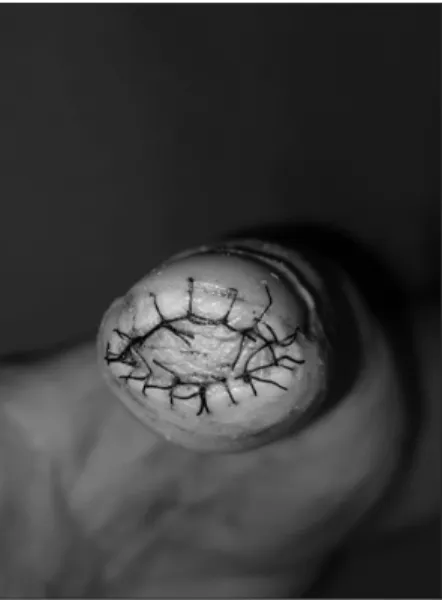
Once admitted, the patient was treated with a foam dress- ing and the exudates were monitored. On day 2 after the burn, the bed of the right thumb appeared whitish and not healthy. On day 6, a central eschar change of the right thumb and epithelialization was observed in the area of relatively shallow depth of the wound margin (Fig. 2). On day 18, all lesions except those on the right thumb were epithelialized, and demarcation of the lesion of the right thumb was completed and eschar of 2×1 cm2 was observed. Debridement and full-thickness skin graft (FTSG) were performed under local anesthesia. The ipsi- lateral forearm was the donor site. A negative-pressure wound therapy (NPWT) bolster along with a vacuum-as- sisted closure device (V.A.C., Kinetic Concepts, Inc, San Antonio, TX) was used. The bolster was placed with pet- rolatum gauze and wet gauze interface between the FTSG and NPWT dressing. The pressure was set at 50 mmHg.
On postoperative day 3, grafted skin was well taken and no hematoma or graft loss was observed (Fig. 3). On post- operative day 7, we applied a simple compression dressing.
On postoperative day 14, the stitches were removed; and on postoperative day 36, well-healed state was noted
Fig. 4. On postoperative day 36, the wound was completely healed.
Fig. 5. A 40-year-old male on day of injury. Fig. 6. On the sixth day after injury.
(Fig. 4). Postoperative complications such as wound de- hiscence, hematoma, necrosis, and functional deficit were not observed.
2. Case 2
A 40-year-old healthy man presented to the emergency room with chief complaints of burning sensation of the right thumb and index finger. The patient reported ex- posure to dichloromethane during the removal of a for- eign object from a wheel and did not wear any protective clothing while working. Systemic symptoms such as diz- ziness, nausea, drowsiness, weakness, and irritation of the eyes and respiratory tract were not observed. Multiple bullae were seen on the pulp of the distal phalanx of the right thumb and index finger (Fig. 5). We irrigated the affected area with normal saline and explained to the pa- tient the need for admission, but the patient refused. Day 1 after the burn, the patient complained of severe pain
and was admitted to the hospital through the outpatient clinic. Fluctuation in bullae of the right thumb was ob- served, and a transverse incision using #11 blade was made. Purulent discharge was observed and massive nor- mal saline irrigation was done. The patient was treated with a foam dressing and the exudates were monitored.
On day 2 after the burn, the bed of the right thumb ap- peared whitish and not healthy. On day 5, darkish dis- coloration was observed in the right thumb region. On day 6, a central eschar change in the right thumb and epi- thelialization was observed in the area of relatively shal- low depth of the wound margin (Fig. 6). Purulent dis- charge persisted but the amount gradually reduced. On day 18, the demarcation was completed and the eschar size was 2×1 cm2. Debridement and FTSG were per- formed under local anesthesia. The ipsilateral forearm was the donor site. NPWT bolster dressing was used as mentioned in case 1. At postoperative day 3, grafted skin was well taken and hematoma or graft loss was not ob- served (Fig. 7). On postoperative day 7, we applied a sim- ple compression dressing. On postoperative day 14, the stitches were removed, and on postoperative day 36, a well-healed state was noted without graft loss (Fig. 8).
Postoperative complications such as wound dehiscence, hematoma, necrosis, and functional deficit were not observed.
Fig. 8. On postoperative day 36, the wound was completely healed.
Fig. 7. On postoperative day 3, the well-taken graft was noted.
DISCUSSION
Dichloromethane (CH2Cl2) is an organic compound ex- isting at room temperature as a colorless liquid with sweet, pleasant odor similar to that of chloroform3). It is not miscible with water but with alcohol, dimethyl for- mamide, ether, and carbon tetrachloride.
Dichloromethane is widely used as a solvent in paint removers4). Exposure to the solvent easily occurs through inhalation or via the oral or dermal routes3). Human ex- posure is mainly due to inhalation. According to the Ministry of Environment, Korea, in 2016, the emission amount of dichloromethane was 3022 tons, showing an increase from 2787 tons in 2015; thus, there is a need for more careful efforts to reduce dichloromethane emissions.
The liver is the primary site of metabolism where con- siderable amounts of dichloromethane are biotransformed to carbon monoxide (CO)5). The central nervous system is the primary target organ of dichloromethane toxicity.
These result from both direct solvent-related narcosis and endogenous production of CO with subsequent carbox- yhemoglobin formation6). Short-term-exposure symptoms include lightheadedness, nausea, vomiting, headache, and mental confusion, whereas prolonged exposure can cause staggering, loss of consciousness, and death7). In the pres- ent cases, blood tests and electrocardiography showed no abnormal results and no central nervous system (CNS)- related symptoms were observed.
The patients in our case reports worked for a wheel manufacturing company, and the manufacturing process involves removing impurities from the wheels. The pa- tients touched the cleansing solution containing dichloro- methane with bare hands. Generally, workers who use di- chloromethane should wear protective clothing at work- places, but there are only a few companies and factories that require strict protective clothing. As in the present case reports, skin contact with dichloromethane can cause a third-degree burn rather than a simple skin irritation;
therefore, employees must be provided with and required to use impermeable clothing, face shields (8-inch mini- mum), gloves, and other appropriate protective clothing necessary to prevent prolonged or repeated skin contact with liquid dichloromethane or with vessels containing liquid dichloromethane. Clothing that becomes wet with liquid dichloromethane should be immediately removed and not worn until the employer has ensured that the protective clothing is fit for reuse. Contaminated pro- tective clothing should be placed in a regulated area des- ignated by the employer for the removal of dichloro- methane before the clothing is laundered or disposed of7). When working with dichloromethane, contact lenses should not be worn7). If the contact lens can be easily re- moved without trauma to the eye, the lens should be re- moved4). Exposed or irritated eyes must be irrigated with plain water or saline for at least 15 min. Emergency drench showers and eyewash facilities are recommended and should be kept in a sanitary condition. If exposed to the chemical, the worker should be instructed to do a quick wash and visit the hospital.
The present case reports observed two third-degree chemical burn patients who underwent surgery due to di- chloromethane exposure. Approximately 2 weeks after the injury, no improvement was noted in the wound.
Although the wound was small, FTSG was performed to prevent scarring and related symptoms. The patients also wanted to quickly return to work. No postoperative com- plications were observed, and the patients were able to quickly return to work and their daily life. In Korea, there have been no reports of third-degree burns caused by di- chloromethane exposure, and further research will help in preventing industrial accidents caused by dichloro- methane exposure.
CONFLICTS OF INTEREST
The authors declare that they have no competing interests.
REFERENCES
1) Koh DH, Lee SG, Kim HC. Incidence and characteristics of chemical burns. Burns 2017;43:654-64
2) Holbrook MT. Methylene chloride. In: Seidel A. Kirk-Othmer encyclopedia of chemical technology. 5th ed. Newyork: John Wiley & Sons; 2003. p.371-80.
3) National Toxicology Program. Toxicology and Carcinogenesis Studies of Dichloromethane (methylene chloride) (CAS No.
75-09-2) in F344/N Rats and B6C3F1 Mice (inhalation studies) [Internet]. Antlanta (GA): National Toxicology Program Technical report series; c1986 [cited 2019 Jun 15]. Available from: https://ntp.niehs.nih.gov/ntp/htdocs/lt_rpts/tr306.pdf.
4) Agency for Toxic Substances and Disease Registry. Medical management guidelines for methylene chloride [Internet].
Atlanta (GA): Agency for Toxic Substances and Disease Registry; c2009 [cited 2019 Jun 15]. Available from: https://
www.atsdr.cdc.gov/mmg/mmg.asp?id=230&tid=42.
5) Soslow A. Methylene chloride. Clin Toxicol Rev 1987;9:1-2.
6) Mahmud M, Kales SN. Methylene chloride poisoning in a cabinet worker. Environ Health Perspect 1999;107:769-72.
7) Occupational Safety and Health Administration. Substance safety data sheet and technical guidelines for methylene chloride [Internet]. Washington, DC: Occupational Safety and Health Administration; c1997 [cited 2019 Jun 24]. Available from: https://www.osha.gov/pls/oshaweb/owadisp.show_
document?p_table=STANDARDS&p_id=10095.