• 검색 결과가 없습니다.

Results of Extracorporeal Cardiopulmonary Resuscitation in Children

N/A
N/A
Protected

Academic year: 2021

Share "Results of Extracorporeal Cardiopulmonary Resuscitation in Children"

Copied!
6
0
0

로드 중.... (전체 텍스트 보기)

전체 글

(1)

ISSN: 2233-601X (Print) ISSN: 2093-6516 (Online)

1

Division of Cardiovascular Surgery, Department of Thoracic and Cardiovascular Surgery, Severance Cardiovascular Hospital, Yonsei University Health System,

2

Department of Thoracic and Cardiovascular Surgery, Chungbuk National University Hospital, Chungbuk National University College of Medicine

Received: February 1, 2016, Revised: April 16, 2016, Accepted: April 26, 2016, Published online: June 5, 2016

Corresponding author: Hong Ju Shin, Department of Thoracic and Cardiovascular Surgery, Chungbuk National University Hospital, Chungbuk National University College of Medicine, 776 1(il)sunhwan-ro, Heungdeok-gu, Cheongju 28644, Korea

(Tel) 82-43-269-8440 (Fax) 82-43-269-6069 (E-mail) [email protected]

C

The Korean Society for Thoracic and Cardiovascular Surgery. 2016. All right reserved.

CC
This is an open access article distributed under the terms of the Creative Commons Attribution Non-Commercial License (http://creative- commons.org/licenses/by-nc/4.0) which permits unrestricted non-commercial use, distribution, and reproduction in any medium, provided the original work is properly cited.

Results of Extracorporeal Cardiopulmonary Resuscitation in Children

Hong Ju Shin, M.D.

1,2

, Seunghwan Song, M.D.

1

, Han Ki Park, M.D.

1

, Young Hwan Park, M.D.

1

Background: Survival of children experiencing cardiac arrest refractory to conventional cardiopulmonary resuscitation (CPR) is very poor. We sought to examine current era outcomes of extracorporeal CPR (ECPR) support for re- fractory arrest. Methods: Patients who were <18 years and underwent ECPR between November 2013 and January 2016 were including in this study. We retrospectively investigated patient medical records. Results: Twelve children, median age 6.6 months (range, 1 day to 11.7 years), required ECPR. patients ’ diseases spanned several categories: congenital heart disease (n=5), myocarditis (n=2), respiratory failure (n=2), septic shock (n=1), trauma (n=1), and post-cardiotomy arrest (n=1). Cannulation sites included the neck (n=8), chest (n=3), and neck to chest conversion (n=1). Median duration of extracorporeal membrane oxygenation was five days (range, 0 to 14 days).

Extracorporeal membrane oxygenation was successfully discontinued in 10 (83.3%) patients. Nine patients (75%) survived more than seven days after support discontinuation and four patients (33.3%) survived and were discha- rged. Causes of death included ischemic brain injury (n=4), sepsis (n=3), and gastrointestinal bleeding (n=1).

Conclusion: ECPR plays a valuable role in children experiencing refractory cardiac arrest. The weaning rate is ac- ceptable; however, survival is related to other organ dysfunction and the severity of ischemic brain injury. ECPR prior to the emergence of end-organ injury and prevention of neurologic injury might enhance survival.

Key words: 1. Extracorporeal cardiopulmonary resuscitation 2. Child

3. Cardiopulmonary bypass 4. Resuscitation

INTRODUCTION

Extracorporeal cardiopulmonary resuscitation (ECPR) is the simultaneous deployment of extracorporeal membrane oxygen- ation (ECMO) and CPR to provide immediate cardiovascular support for patients who are experiencing cardiac arrest un- responsive to conventional CPR. Several reports in recent years have demonstrated the advantage of ECPR in rescuing

children unresponsive to CPR, with survival rates between 33% and 56% [1-7]. However, evidence from four observational studies of pediatric in-hospital cardiac arrest (IHCA) has shown no overall benefit to the use of ECPR compared to CPR without ECMO [8-11]. In 2015, the American Heart Association recommended ECPR for consideration in pediatric patients with cardiac diagnoses who have IHCA in the setting of ex- isting ECMO protocols, expertise, and equipment [12]. Therefore,

http://dx.doi.org/10.5090/kjtcs.2016.49.3.151

(2)

we sought to examine current era outcomes of ECPR support for refractory arrest at Severance Cardiovascular Hospital.

METHODS

From November 2013 to January 2016, 12 children under- went ECPR at Severance Cardiovascular Hospital. We retro- spectively reviewed the medical records of pediatric patients.

Patient characteristics are summarized in Table 1. Patients were diagnosed as follows: congenital heart disease (n=5), myocarditis (n=2), respiratory failure (n=2), septic shock (n=1), trauma (n=1), and post-cardiotomy arrest (n=1). The median age was 6.6 months (range, 1 day to 11.7 years), and the me- dian body weight was 9 kg (range, 2.6 to 31 kg). Four of the five congenital heart disease cases (patients 1, 7, 10, and 11) were untreated or had residual lesions. Another patient (patient 12) had sudden cardiac arrest due to coronary artery throm- botic obstruction seven days after aortic valve replacement.

ECPR was indicated in children who did not respond to con- ventional CPR and those with disease or injury expected to be reversible. Patients who were in a hemodynamically un- stable condition and placed on ECMO urgently without active cardiac arrest were not included in this study.

1) Extracorporeal membrane oxygenation technique and management

All patients were supported with venoarterial ECMO. ECMO was set up in the intensive care unit (ICU). If the arrest hap- pened in the emergency room or general ward, then the pa- tient was transferred to the ICU and the ECMO procedure was begun. The vascular approach used for cannula insertion was via peripheral access, and the route used was through the right neck using the right internal carotid artery and the right internal jugular vein when children had no perioperative ster- notomy (i.e., cardiotomy within two weeks). Those who had a perioperative sternotomy or opened sternum were cannu- lated through the chest. The appropriate cannula size was de- termined by the surgeon’s direct measurement.

Cannulation sites included the neck (n=8), chest (n=3), and neck to chest conversion (n=1). Patient 9 underwent cannula- tion conversion from the neck to the chest because the right internal jugular vein was difficult to approach after removal Ta ble 1. C har acte ristics of 12 p edia tric pa tie nts w ho un der w ent extr aco rp ore al C PR Pat ient A ge Bo dy weight (kg ) Sex D iag nos is Lo catio n Cannu lati on si te CPR time (min )

Cann ulat ion ti me (min ) ECMO time of day

ECMO urat ion (day ) Weanin g S urv ival

7 Survi val unt il dis charge 1 5.6 yr 11.4 M CHD (s ing le vent ricle) GW

HICU Neck 66 .0 18 .0 Day 14 Y es Yes N o 2 22 day 3.6 M P os t-cardi oto m y (s ing le vent ricle) HICU Ches t 58. 0 23. 0 N ight 5 Y es Yes N o 3 6. 7 m o 8.9 F M yo cardit is H ICU N eck 10 .0 58 .0 Ni ght 2 Y es Yes Y es 4 6.5 m o 8.6 F R esp irato ry failu re ICU N eck 86 .0 42 .0 Day 3 Yes Y es Yes 5 4.5 m o 5.1 F R esp irato ry failu re PCCU

H IC U N eck 61 .0 32 .0 Day 5 Yes Y es No 6 11.7 yr 31.0 F Myo cardit is H ICU N eck 13 .0 32 .0 Day 6 Yes Y es Yes 7 1 day 2.6 M CHD N ICU C hes t 44 .0 30 .0 Day 5 Yes Y es No 8 6.3 yr 26.0 M Trau ma ER

IC U N eck 75 .0 69 .0 Day 0 No N o No 9 20 .1 mo 11.0 F Sept ic sho ck ICU N eck

chest 94 .0 78 .0 D ay 6 N o N o N o 10 3. 8 m o 8. 7 F CHD E R

HICU Neck 61 .0 27 .0 Day 5 Yes N o N o 11 5. 6 mo 6.5 M CHD (si ngl e ventri cle) PCCU Neck 67 .0 37 .0 Day 6 Yes Y es No 12 9.5 yr 24.6 M CHD G W

HICU Ches t 62 .0 28 .0 D ay 2 Y es Yes Y es CPR, card iop ulmo nary res usci tati on; E CMO, ext racorpo real m embra ne oxyg enati on; M , male; CHD, co ngen ital heart di sease; G W, gen eral w ard; H ICU, heart int ensi ve care uni t; F, female; ICU, i nt ens ive care uni t; PCCU, ped iatri c cri tical care un it; N ICU, n eo natal i nten siv e care un it; E R, emergen cy room.

(3)

of a continuous renal replacement catheter. We attempted to cannulate through the neck vessel first; however, bleeding and collapse of the right internal jugular vein with inter- ruption of continuous cardiac massage made this difficult.

Patients were administered a loading dose of heparin (50 U/kg) 3 to 5 minutes before cannulation. Patients were maintained on a continuous intravenous heparin infusion to achieve an activated clotting time between 160 and 180 seconds. The goal for the activated clotting time was adjusted if there were issues with bleeding or coagulation, which included an oxy- genator thrombus or left ventricular thrombus. Because of the lack of prompt, freely available perfusionists, we used pre-as- sembled, simplified, and commercialized ECMO systems: nine patients received the Capiox EBS (Terumo Ltd., Tokyo, Japan) and three patients received the Quadrox PLS (MAQUET Car- diovascular, Hirlingen, Germany).

The median CPR duration was 61.5 minutes (range, 10 to 94 minutes). The median cannulation time was 32 minutes (range, 18 to 78 minutes). ECMO was set up on a weekday between 7:00 AM and 7:00 PM in 10 of the 12 patients.

After starting ECMO, delivery of the inotropic agent was diminished with close observation of pulse pressure. Generally, 0.5 μg/kgㆍmin milrinone was used, and the ECMO flow was adjusted with close monitoring of the echocardiogram, pulse pressure, arterial blood gas analysis, and chest X-ray.

Sedation was maintained using intravenous midazolam, fen- tanyl, and ketamine. Muscle relaxants were not routinely used because they interfere with the determination of neurological changes. Diuretics were administered to achieve a negative fluid balance. If acute renal failure developed, continuous re- nal replacement therapy was initiated by connecting to the ECMO circuit instead of creating a separate route to prevent bleeding complications. All inflow and outflow lines were connected to the venous drainage line to prevent an air embolism. Assessment of the underlying cause leading to car- diac arrest was begun soon after patient stabilization, and fur- ther intervention was considered to address and treat the un- derlying cause and optimize the patient for future weaning.

In patients who had cardiac arrest, follow-up echocardiog- raphy was conducted up to every 12 hours to evaluate the re- covery of the heart, detect residual lesions and thrombus for- mation in the ventricle, and to assess the need for heart trans-

plantation in case of failure of heart recovery. The decision to wean the patient from ECMO was determined by mutual agreement of the surgeon and physicians, including the car- diologist and pulmonologist, during a daily meeting. Weaning was initiated when the left ventricular ejection fraction improved more than 30% and there was no hemodynamic change after temporary cessation of ECMO flow for 5 to 10 minutes. ECMO weaning was performed concurrent with increased admin- istration of inotropic drugs and heparin to prevent thrombosis.

This study was approved by the institutional review board at Yonsei University Health System, with a waiver of the need to obtain consent granted for this retrospective study (4-2015-1028).

2) Statistical analyses

Descriptive statistics reported include the median, range for continuous variables, and frequencies and percentages for cat- egorical variables. Unrelated two-group comparisons were performed using unpaired, two-tailed t-tests or the Mann-Whi- tney test for continuous variables and the chi-square or Fisher’s exact test for categorical variables. Data were ana- lyzed using IBM SPSS ver. 20.0 (IBM Co., Armonk, NY, USA).

All statistical tests were two-sided and significance was de- fined as p<0.05.

RESULTS

The median duration of ECMO support was 5 days (range, 0 to 14 days). ECMO was successfully discontinued in 10 patients (83.3%). Patient 12, who had a coronary artery thrombotic obstruction seven days after aortic valve replace- ment, received a heart transplantation successfully.

Nine patients (75%) survived more than seven days after support discontinuation, and four patients (33.3%) survived and were discharged. Causes of death included ischemic brain injury (n=4), sepsis (n=3), and uncontrolled gastrointestinal bleeding (n=1).

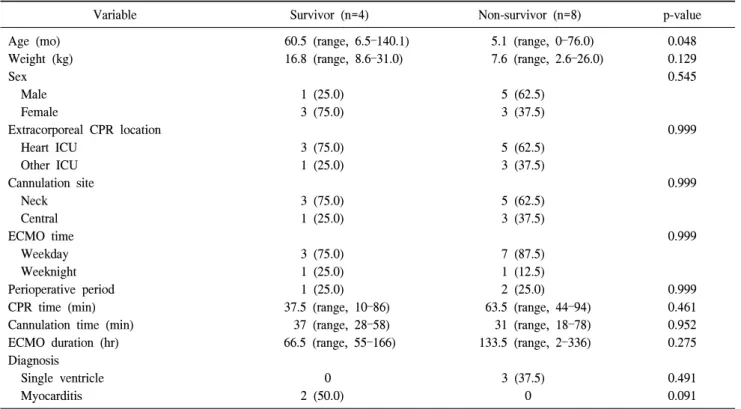
We compared variables between surviving patients and

non-surviving patients (Table 2). Surviving patients were sig-

nificantly older than non-surviving patients (p=0.048), but

there was no significant difference in other variables includ-

ing the cannulation site, ECMO time, CPR time, cannulation

(4)

Table 2. Comparative data between surviving patients and non-surviving patients

Variable Survivor (n=4) Non-survivor (n=8) p-value

Age (mo) 60.5 (range, 6.5–140.1) 5.1 (range, 0–76.0) 0.048

Weight (kg) 16.8 (range, 8.6–31.0) 7.6 (range, 2.6–26.0) 0.129

Sex 0.545

Male 1 (25.0) 5 (62.5)

Female 3 (75.0) 3 (37.5)

Extracorporeal CPR location 0.999

Heart ICU 3 (75.0) 5 (62.5)

Other ICU 1 (25.0) 3 (37.5)

Cannulation site 0.999

Neck 3 (75.0) 5 (62.5)

Central 1 (25.0) 3 (37.5)

ECMO time 0.999

Weekday 3 (75.0) 7 (87.5)

Weeknight 1 (25.0) 1 (12.5)

Perioperative period 1 (25.0) 2 (25.0) 0.999

CPR time (min) 37.5 (range, 10 –86) 63.5 (range, 44 –94) 0.461

Cannulation time (min) 37 (range, 28–58) 31 (range, 18–78) 0.952

ECMO duration (hr) 66.5 (range, 55–166) 133.5 (range, 2–336) 0.275

Diagnosis

Single ventricle 0 3 (37.5) 0.491

Myocarditis 2 (50.0) 0 0.091

Values are presented as median (range) or number (%).

CPR, cardiopulmonary resuscitation; ICU, intensive care unit ECMO, extracorporeal membrane oxygenation.

time, duration of ECMO support, and diagnosis.

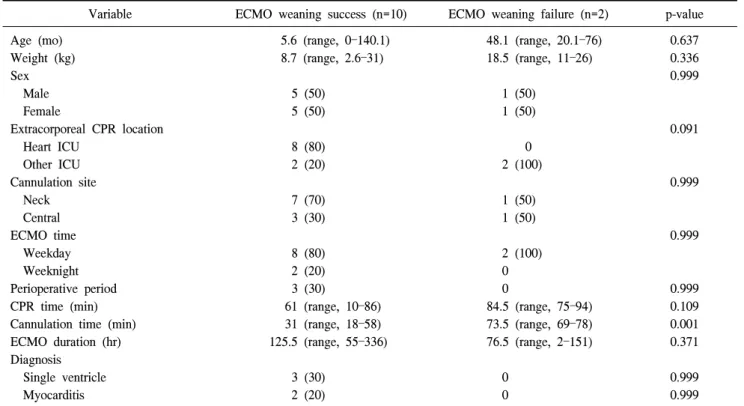
We also compared these variables between patients for whom ECMO weaning was successful and those for whom it failed (Table 3). The cannulation time was significantly shorter in the successful cases than in the failures (p=0.001). However, the other variables, including age, cannulation site, ECMO time, CPR time, duration of ECMO support, and diagnosis, did not differ significantly between the two groups.

DISCUSSION

In children, the survival rate after cardiac arrest is re- portedly 9% to 47% for in-hospital events and 0% to 29%

for events outside the hospital [4,6,13-15]. In comparison, the survival rate for pediatric ECPR is between 33% and 56%

[1-7]. However, according to the American Heart Association recommendation in 2015, ECPR can be considered for pedia- tric patients with cardiac diagnoses who have IHCA in set- tings with existing ECMO protocols, expertise, and equipment

[12]. If the child experiences cardiac arrest outside the hospi- tal, ECPR cannot be performed easily even if the child is promptly transferred to the nearest hospital. Unlike those of adults, the femoral vessels of children are small; therefore, it is very difficult to perform a percutaneous cannulation of a very small collapsed vessel. Furthermore, if the procedure is to be performed via a neck vessel, an experienced cardiac surgeon should perform it; however, excluding large hospitals which have good congenital heart surgery programs with skil- led professionals available at all times, the ECMO procedure for a collapsed vessel in a child cannot be performed smooth- ly with available staff. Even though the arrest may happen inside the hospital, if a child is in the bed of a general ward without an arterial or central line, the ECMO procedure is not easy due to collapsed arteries and veins. In light of all this, the decision to perform an ECPR requires careful delibe- ration. In this study, the median CPR time before ECMO on- set was 61.5 minutes, which is longer than in other studies [2,4].

However, our survival rate to discharge of 33% was com-

(5)

Table 3. Comparison of patients with ECMO weaning success and failure

Variable ECMO weaning success (n=10) ECMO weaning failure (n=2) p-value

Age (mo) 5.6 (range, 0–140.1) 48.1 (range, 20.1–76) 0.637

Weight (kg) 8.7 (range, 2.6–31) 18.5 (range, 11–26) 0.336

Sex 0.999

Male 5 (50) 1 (50)

Female 5 (50) 1 (50)

Extracorporeal CPR location 0.091

Heart ICU 8 (80) 0

Other ICU 2 (20) 2 (100)

Cannulation site 0.999

Neck 7 (70) 1 (50)

Central 3 (30) 1 (50)

ECMO time 0.999

Weekday 8 (80) 2 (100)

Weeknight 2 (20) 0

Perioperative period 3 (30) 0 0.999

CPR time (min) 61 (range, 10 –86) 84.5 (range, 75 –94) 0.109

Cannulation time (min) 31 (range, 18–58) 73.5 (range, 69–78) 0.001

ECMO duration (hr) 125.5 (range, 55–336) 76.5 (range, 2–151) 0.371

Diagnosis

Single ventricle 3 (30) 0 0.999

Myocarditis 2 (20) 0 0.999

Values are presented as median (range) or number (%).

ECMO, extracorporeal membrane oxygenation; CPR, cardiopulmonary resuscitation; ICU, intensive care unit.

parable to other studies with survival rates between 33% and 38% [2,4,5]. In this study, the CPR time did not differ be- tween survivors and non-survivors. The performance of effec- tive CPR during the pre-cannulation period is of paramount importance for a good outcome [4].

Five patients who survived more than seven days after sup- port discontinuation later succumbed to death. Patients 1, 5, and 11 had congenital heart disease, and they could not sur- vive due to an irreversible brain injury. Patient 2 had a single functional ventricle. He underwent the ECMO procedure on postoperative day 1 after a shunt operation involving an opened sternum and underwent a successful weaning course. This child could not be weaned from the ventilator, and thus, un- derwent a second-stage operation (bidirectional cavopulmo- nary shunt). However, the patient succumbed to sepsis. Patient 7 underwent an ECMO procedure on postnatal day 1 due to obstructive total anomalous pulmonary venous return (TAPVR) and received emergency TAPVR repair. This neonate under- went a successful weaning course of ECMO; however, he re-

quired reoperation for pulmonary vein stenosis and succum- bed to sepsis. Surviving more than seven days after ECMO weaning may be interpreted as an indicator of success.

However, in this case, neurologic injury during ECPR was

the main reason that the favorable outcome did not last

longer. Another patient (patient 10) who was successfully

weaned but succumbed to death also had severe hypoxic

brain injury. Our weaning rate for ECPR was 83.3%, which

is better than that of other studies [1,4]; however, many pa-

tients who had a successful weaning course died due to brain

injury. In the current era, ECMO weaning appears not to be

an obstacle itself; however, uncomplicated neurologic injury

after ECMO weaning is a major concern. To achieve this

goal, we should educate hospital employees on high-quality

skills in routine procedures, which is helpful to prevent neu-

rologic injury during ECPR. Regular training with ECPR sim-

ulation programs can also lead to the development of a high-

ly functional and well-coordinated team working towards the

reduction of the ECMO deployment time [16].

(6)

The limitations of the present study include its retro- spective nature, and the small number of patients included. In conclusion, ECPR plays a valuable role in children experienc- ing refractory postoperative cardiac arrest. In our study, the weaning rate was excellent; however, survival was based on other organ dysfunction and the severity of ischemic brain injury. Timely support prior to the emergence of end-organ injury and prevention of neurologic injury may enhance survival.

CONFLICT OF INTEREST

No potential conflict of interest relevant to this article was reported.

REFERENCES

1. Alsoufi B, Awan A, Manlhiot C, et al. Results of rapid-re- sponse extracorporeal cardiopulmonary resuscitation in chil- dren with refractory cardiac arrest following cardiac surgery.

Eur J Cardiothorac Surg 2014;45:268-75.

2. Morris MC, Wernovsky G, Nadkarni VM. Survival outcomes after extracorporeal cardiopulmonary resuscitation instituted during active chest compressions following refractory in-hos- pital pediatric cardiac arrest. Pediatr Crit Care Med 2004;

5:440-6.

3. Duncan BW, Ibrahim AE, Hraska V, et al. Use of rap- id-deployment extracorporeal membrane oxygenation for the resuscitation of pediatric patients with heart disease after cardiac arrest. J Thorac Cardiovasc Surg 1998;116:305-11.

4. Alsoufi B, Al-Radi OO, Nazer RI, et al. Survival outcomes after rescue extracorporeal cardiopulmonary resuscitation in pediatric patients with refractory cardiac arrest. J Thorac Cardiovasc Surg 2007;134:952-959.e2.

5. Thiagarajan RR, Laussen PC, Rycus PT, Bartlett RH, Bratton SL. Extracorporeal membrane oxygenation to aid cardiopulmonary resuscitation in infants and children. Circu- lation 2007;116:1693-700.

6. Kane DA, Thiagarajan RR, Wypij D, et al. Rapid-response

extracorporeal membrane oxygenation to support cardio- pulmonary resuscitation in children with cardiac disease.

Circulation 2010;122(11 Suppl):S241-8.

7. Wolf MJ, Kanter KR, Kirshbom PM, Kogon BE, Wagoner SF. Extracorporeal cardiopulmonary resuscitation for pedia- tric cardiac patients. Ann Thorac Surg 2012;94:874-9.

8. De Mos N, van Litsenburg RR, McCrindle B, Bohn DJ, Parshuram CS. Pediatric in-intensive-care-unit cardiac ar- rest: incidence, survival, and predictive factors. Crit Care Med 2006;34:1209-15.

9. Wu ET, Li MJ, Huang SC, et al. Survey of outcome of CPR in pediatric in-hospital cardiac arrest in a medical center in Taiwan. Resuscitation 2009;80:443-8.

10. Lowry AW, Morales DL, Graves DE, et al. Characterization of extracorporeal membrane oxygenation for pediatric car- diac arrest in the United States: analysis of the kids’ in- patient database. Pediatr Cardiol 2013;34:1422-30.

11. Odegard KC, Bergersen L, Thiagarajan R, et al. The fre- quency of cardiac arrests in patients with congenital heart disease undergoing cardiac catheterization. Anesth Analg 2014;118:175-82.

12. De Caen AR, Berg MD, Chameides L, et al. Part 12: pedia- tric advanced life support: 2015 American Heart Association guidelines update for cardiopulmonary resuscitation and emergency cardiovascular care. Circulation 2015;132(18 Suppl 2):S526-42.

13. Huang SC, Wu ET, Chen YS, et al. Extracorporeal mem- brane oxygenation rescue for cardiopulmonary resuscitation in pediatric patients. Crit Care Med 2008;36:1607-13.

14. Chan T, Thiagarajan RR, Frank D, Bratton SL. Survival af- ter extracorporeal cardiopulmonary resuscitation in infants and children with heart disease. J Thorac Cardiovasc Surg 2008;136:984-92.

15. Morris MC, Ittenbach RF, Godinez RI, et al. Risk factors for mortality in 137 pediatric cardiac intensive care unit pa- tients managed with extracorporeal membrane oxygenation.

Crit Care Med 2004;32:1061-9.

16. Su L, Spaeder MC, Jones MB, et al. Implementation of an

extracorporeal cardiopulmonary resuscitation simulation pro-

gram reduces extracorporeal cardiopulmonary resuscitation

times in real patients. Pediatr Crit Care Med 2014;15:856-60.

수치

Table 2. Comparative data between surviving patients and non-surviving patients
Table 3. Comparison of patients with ECMO weaning success and failure

참조

관련 문서

The purpose of this study is to analyze the situations of violating the right to learn and violence in student-athletes from an ethnographic view and

In the health-related fitness of middle-aged women who participated in the Zumba fitness exercise, muscle strength, muscular endurance, cardiopulmonary

Results: In this research, there were positive changes in sub-factors of body composition, cardiopulmonary endurance, and heart rate variability in obese

In order to compare physical strength before and after the experiment, measured physical strength is agility (side step), cardiopulmonary endurance

In the change of functional fitness, muscle strength and endurance, cardiopulmonary endurance, wits, and flexibility showed significantly increased results,

If the the bond to the leaving group is broken and the bond to the nucleophile is formed simultaneous, then bond to the nucleophile is formed simultaneous, then rxn

To improve nursing students' CPR knowledge, self-efficacy, and performance in the future, simulation-based CPR training that provides experience which is similar

volition of Cardiopulmonary resuscitation.. 그러나, 심폐소생술을 교육하였다하더라도, 정확한 지식의 습득 및 실제로 시 행하는 등의 교육의 효과는 교육 대상마다