• 검색 결과가 없습니다.

Right Lower Sleeve Bilobectomy for Lung Cancer with Posteparterial Tracheal Bronchus

N/A
N/A
Protected

Academic year: 2021

Share "Right Lower Sleeve Bilobectomy for Lung Cancer with Posteparterial Tracheal Bronchus"

Copied!
5
0
0

로드 중.... (전체 텍스트 보기)

전체 글

(1)

ISSN: 2233-601X (Print) ISSN: 2093-6516 (Online)

Received: September 13, 2016, Revised: October 5, 2016, Accepted: October 17, 2016, Published online: August 5, 2017

Corresponding author: Jhingook Kim, Department of Thoracic and Cardiovascular Surgery, Samsung Medical Center, Sungkyunkwan University School of Medicine, 81 Irwon-ro, Gangnam-gu, Seoul 06351, Korea

(Tel) 82-2-3410-3483 (Fax) 82-2-3410-6986 (E-mail) [email protected]

© The Korean Society for Thoracic and Cardiovascular Surgery. 2017. All right reserved.

This is an open access article distributed under the terms of the Creative Commons Attribution Non-Commercial License (http://creativecommons.org/

licenses/by-nc/4.0) which permits unrestricted non-commercial use, distribution, and reproduction in any medium, provided the original work is properly cited.

Right Lower Sleeve Bilobectomy for Lung Cancer with Posteparterial Tracheal Bronchus

Hongsun Kim, M.D. 1 , Jinsik Kim, M.D. 2 , Jong Ho Cho, M.D., Ph.D. 1 , Su Min Shin, M.D. 1 , Hong Kwan Kim, M.D., Ph.D. 1 , Jhingook Kim, M.D., Ph.D. 1

1
Department of Thoracic and Cardiovascular Surgery, Samsung Biomedical Research Institute, Samsung Medical Center, Sungkyunkwan University School of Medicine,

2

Department of Thoracic and Cardiovascular Surgery, Jeju National

University Hospital, Jeju National University School of Medicine

A 42-year-old man was diagnosed with cancer of the right lower lung lobe with a posteparterial type of tra- cheal bronchus, in which the posterior segmental bronchus of the right upper lobe arose from the distal bronchus intermedius. A mass involved the distal bronchus intermedius, requiring a right lower bilobectomy with an additional posterior segmental resection of the right upper lung lobe. Thus, we performed a right lower bilobectomy and sleeve anastomosis of the posterior segmental bronchus of the right upper lobe to the proximal bronchus intermedius, sparing the pulmonary parenchyma of the same lobe.

Key words: 1. Lung cancer, surgery 2. Trachea

3. Bronchi

4. Respiratory system abnormalities

Case report

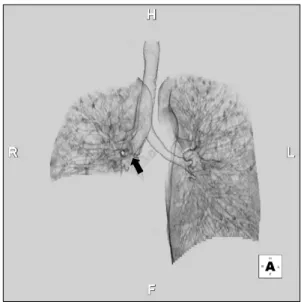
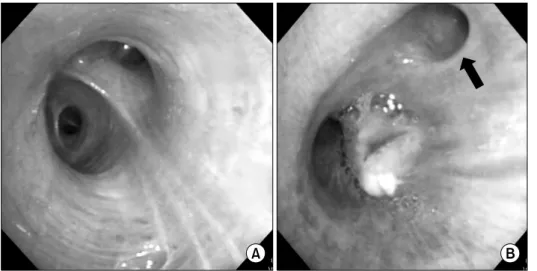
A 42-year-old man with symptoms including cough and sputum was diagnosed with squamous cell carci- noma of the right lower lobe (RLL) of the lungs, and referred to Samsung Medical Center for further eval- uation and management. Chest computed tomography (CT) showed a 6.5-cm malignant morphologic mass in the superior segment of the RLL, invading the bronchus intermedius (BI) (Fig. 1), and a sign of ob- structed pneumonitis distal to the mass. Bronchosco- py revealed that only 2 segmental bronchi arose from the right upper lobar bronchus, and an ac- cessory bronchus arose from the lateral wall of the middle of the BI (Fig. 2). The abnormal bronchus was presumed to be a posterior segmental bronchus

of the right upper lobe (RUL), indicating a post- eparterial tracheal bronchus. A huge necrotic mass originating from the RL L protruded to the distal BI.

Endobronchial ultrasound-guided transbronchial nee- dle aspiration (EBUS-TBNA) was performed for lymph node stations 4R and 7 because his chest CT also revealed mediastinal lymphadenopathy in these stations; the EBUS-TBNA results were negative for both stations. Thus, the disease was evaluated as clinical T3N0M0, and staged as clinical stage IIB. His pulmonary function test result was sufficient for him to undergo a further operation. For the preoperative risk evaluation, we performed a lung perfusion scan with 99mTc macroaggregated albumin, and the result showed a perfusion defect in the RLL and no abnor- malities in other areas.

https://doi.org/10.5090/kjtcs.2017.50.4.300

(2)

Fig. 1. Chest computed tomography. (A, B) A malignant morphologic mass in the superior segment of the right lower lobe invades the bronchus intermedius. (C) A 3-dimensionally-reconstructed computed tomography of airway shows posteparterial tracheal bronchus (ar- row) originating from bronchus intermedius.

Fig. 2. Bronchoscopy. (A) Only two segmental bronchi arose from right upper lobar bronchus. (B) The tu- mor obstructed the origin of right lower lobe and an accessory bron- chus (arrow) arose from the lateral wall of the middle of the bronchus intermedius.

Fig. 3. The right upper lobar bronchus (black arrow) arose from right main bronchus, and the posterior segmental bronchus (white arrow) arose from bronchus intermedius.

The operation was initiated with a right postero- lateral thoracotomy incision of the fifth intercostal space. As expected from the bronchoscopy results, the posterior segmental bronchus of the RUL arose from the distal BI, not from the right upper lobar bronchus (Fig. 3). The RL L mass involved the distal BI; therefore, a right lower bilobectomy was inevitable.

The right lower and middle lobar veins were both

stapled with a Proximate Reload TX Linear Stapler

XR30V (Johnson & Johnson, Cincinnati, OH, USA) and

then divided. The common basal artery and right

middle lobar artery were divided with a single surgi-

cal stapler. The posterior segmental bronchus of the

RUL was so close to the mass that we planned to

perform sleeve anastomosis instead of sacrificing it.

(3)

Fig. 5. A 3-dimensionally-reconstructed computed topography of airway at 18 months after the operation shows posteparterial tracheal bronchus (arrow) anastomosed to the second carina of right lung.

Fig. 4. Illustration of the sleeve anastomosis. (A) Red dashed-lines represented resection sites. The proximal bronchus intermedius (①) and the proximal right upper posterior segmental bronchus ( ②) were transected. (B) Then, the anastomosis was performed.

The proximal BI was resected first, followed by the proximal posterior segmental bronchus of the RUL . Frozen biopsy results of the proximal margin of the BI and the distal margin of the posterior segmental bronchus of the RUL were both negative. An anasto- mosis between the BI and the posterior segmental bronchus of the RUL was completed by multiple in- terrupted sutures with both 4-0 and 3-0 Vicryl (Fig. 4).

An additional systematic mediastinal lymph node dis- section was performed at lymph node stations 2R, 4R, and 7, and then sleeve right lower bilobectomy with mediastinal lymph node dissection was completed.

The patient recovered without significant complica- tions. On postoperative day 10, the follow-up bron- choscopy showed an intact anastomosis site; thus, he was discharged. Pathologic results documented a 4.5-cm squamous cell carcinoma mass with a pathologic TNM (tumor, node, metastasis) stage of pT2aN1M0; there- fore, he is now being treated with adjuvant chemo- therapy. No further follow-up bronchoscopy was done. Eighteen months after the operation, follow-up CT showed neither evidence of tumor recurrence nor stenosis of the anastomosis site (Fig. 5).

Discussion

In 1785, Sandifort and colleagues described trache- al bronchus as an RUL bronchus originating from the trachea [1]. However, the term ‘tracheal bronchus’

now refers to various bronchial anomalies that origi-

nate from the trachea or main bronchus and are di- rected towards the upper lobe area [2]. Previous bronchographic and bronchoscopic studies have dem- onstrated a prevalence of 0.1% to 2.0% for right tra- cheal bronchus, and 0.3% to 1.0% for left tracheal bronchus [2,3].

According to the modified nomenclature proposed

by Boyden [4] and Kubik and Műntener [1] to clarify

the classification of aberrant bronchi directed towards

(4)

Fig. 6. Aberrant bronchi to the upper lobes. Figure shows pre- arterial ( ①), preeparterial (②), posteparterial (③), eparterial ( ④, ⑤), prehyparterial (⑥), and posthyparterial (⑦) bronchi.

LLLB, left lower lobar bronchus; LULB, left upper lobar bronchus;

PA, pulmonary artery; RLLB, right lower lobar bronchus; RML, right middle lobar bronchus; RULB, right upper lobar bronchus.

the upper lobes (Fig. 6), the normal RUL bronchus is

‘eparterial’ since it ascends above the right pulmo- nary artery. The normal left upper lobe bronchus is

‘hyparterial’ since it descends below the left pulmo- nary artery. An anomalous bronchus arising before the origin of the upper lobe bronchus is described as

‘preeparterial’ on the right side, and ‘eparterial’ or

‘prehyparterial’ on the left side. Meanwhile, an anom- alous bronchus arising after the origin of the upper lobe bronchus is described as ‘posteparterial’ on the right side, and ‘posthyparterial’ on the left side [5].

Generally, tracheal bronchus is of no clinical signifi- cance in adult patients and is only diagnosed in- cidentally when bronchoscopy or other investigations are performed.

In this case, the patient had a posteparterial tra- cheal bronchus directed towards the posterior seg- ment of the RUL . This aberrant bronchus seemed dis- placed rather than supernumerary because the bron- choscopic finding showed only 2 segmental bronchi arising from the right upper lobar bronchus [5].

Further, the patient had a mass involving the distal BI; therefore, lower bilobectomy could not be avoided.

Because of the proximity between the tumor and the tracheal bronchus, an additional pulmonary resection

of the RUL seemed necessary. However, by perform- ing sleeve anastomosis of the tracheal bronchus, we were able to spare the pulmonary parenchyma.

Some cases have been reported of surgical re- section, including sleeve resection, of cancer of the tracheal bronchus in the literature [6,7]. However, to the best of our knowledge, this is the first case in which sleeve anastomosis of an abnormal bronchus to a normal bronchus was performed to preserve the pulmonary parenchyma.

According to Carilli et al. [8], an aberrant bronchus might be associated with regional ventilation and perfusion abnormalities. In this study, we did not perform a radionuclide ventilation scan preopera- tively, but a lung perfusion scan was performed, and showed a perfusion defect in the RLL. However, this finding cannot be fully explained only by pulmonary artery compression by the tumor. The decreased per- fusion might also be explained in some extent based on reflex vasoconstriction secondary to relative right lung base hypoventilation and hypoxia. Despite the absence of a ventilation scan, the normal perfusion in the posterior segment of the RUL might have in- dicated the absence of significant tracheal bronchus ventilation abnormalities.

Conflict of interest

No potential conflict of interest relevant to this ar- ticle was reported.

References

1. Kubik S, Muntener M. Bronchus abnormalities: tracheal, eparterial, and pre-eparterial bronchi. Fortschr Geb Rontgenstr Nuklearmed 1971;114:145-63.

2. Remy J, Smith M, Marache P, Nuyts JP. Pathogenetic left tracheal bronchus: a review of the literature in connec- tion with four cases (author’s transl). J Radiol Electrol Med Nucl 1977;58:621-30.

3. Ritsema GH. Ectopic right bronchus: indication for bron- chography. Am J Roentgenol 1983;140:671-4.

4. Boyden EA. Segmental anatomy of the lungs: a study of the patterns of the segmental bronchi and related pulmo- nary vessels. New York (NY): Blakiston Division, McGraw- Hill; 1955.

5. Ghaye B, Szapiro D, Fanchamps JM, Dondelinger RF.

Congenital bronchial abnormalities revisited. Radiogra- phics 2001;21:105-19.

6. Kim J, Park C, Kim H, Lee KS. Surgical resection of lung

(5)

cancer originating in a tracheal bronchus. Ann Thorac Surg 1998;66:944-6.

7. Okubo K, Ueno Y, Isobe J. Upper sleeve lobectomy for lung cancer with tracheal bronchus. J Thorac Cardiovasc Surg

2000;120:1011-2.

8. Carilli AD, The SH, Agress H Jr, Shin D, Budin JA. Tracheal

bronchus with regional ventilation and perfusion abnor-

malities. Chest 1980;78:343-6.

수치

Fig. 2. Bronchoscopy. (A) Only two  segmental bronchi arose from right  upper lobar bronchus
Fig. 4. Illustration of the sleeve anastomosis. (A) Red dashed-lines represented resection sites
Fig. 6. Aberrant bronchi to the upper lobes. Figure shows pre- pre-arterial ( ①), preeparterial (②), posteparterial (③), eparterial  ( ④,  ⑤), prehyparterial (⑥), and posthyparterial (⑦) bronchi

참조

관련 문서

We conducted a retrospective study using data base of 466 patients of primary lung cancer diagnosed in indoor and outdoor of the department of radiation therapy at Regional

This report is aimed to investigate the effect of Traditional Korean Therapy (TKT) in treating recurred breast cancer metastasized to lung.. A 53-year-old woman who was diagnosed

We present a case in which bleeding caused by cancer in the left central lung was successfully managed by tamponade with a polytetrafluoroethylene (PTFE)-covered self-expanding

Herein, the authors report a case of a 69-year-old man who was initially diagnosed with lung cancer with synchronous primary gastric cancer which proved to be lung cancer

Our objective was to identify the lower airway microbi- ota in patients with lung cancer, comparing the bacterial composition and relative abundance in the site of the

A 25-year-old woman (gravida 0) who had been diagnosed as non-small cell lung cancer 6 years ago and received multiple regimens of chemotherapy presented at full term pregnancy with

A 33-mm mass was observed adjacent to the margin of the right lower lobe stump in the subcarinal space on chest com- puted tomography (CT) in a 42-year-old

Methods: To determine the expression of MAGE A1-6 gene in 189 lung cancers diagnosed by conventional fluoroscopy-guided lung biopsy and 89 cancer-free controls,