Comparison of absolute and relative thermal QST thresholds In the orofacial region of the young Korean women
Ki-Suk Kim, D.D.S.,M.S.D.,Ph.D.
Department of Oral Medicine, Dankook University School of Dentistry
To diagnose sensory nerve damage, patient values for thermal stimuli as quantitative sensory test (QST) can be compared with the values of the general population (absolute reference data) or to values measured at contralateral unaffected side (relative reference data). It is well know that relative reference data are more sensitive for detecting sensory abnormality than absolute reference data. However it is still lack of the studies for comparisons between relative and absolute data. This study aimed to evaluate the validity of relative reference data and compare the sensitivities of the two approaches in the orofacial region. In 19 young Korean women as normal subjects, quantitative somatosensory thermotest were done in the forehead, cheek, mentum, lower lip and tongue tip bilaterally. After we get the standard deviations (SD) of average reference data and relative reference data, the ratios SD absolute data/SD relative data were calculated. Our study showed that relative reference data for side to side comparisons in the same patient have the high ratios than the absolute reference data, i.e. the side to side comparisons with relative reference data exhibit gain in sensitivity in assessment of sensory abnormality.
Keywords : facial, oral, quantitative sensory test, QST, relative and absolute, thermal threshold
Ⅰ. Introduction
1)Evaluation of sensory abnormality in the nerve pathologies is a challenging and often frustrating process. Based on evidence accumulated from
Corresponding author: Ki-Suk Kim
Department of Oral Medicine, Dankook University School of Dentistry, 119 Dandae-ro, Dongnam-gu, Cheonan-si, Chungcheongnam-do, Korea
Tel: 82-41-550-1914 Fax: 82-505-434-7951 E-mail: [email protected] Received: 2013-11-14 Accepted: 2013-11-30
*The present research was conducted by the research fund of Dankook University in 2012.
clinical and animal experiments, quantitative
sensory testing (QST) has emerged as a useful
tool in the assessment of sensory nerve damage.
1)The measurement of thermal perception is an
essential part of QST and reported to have
acceptable reliability in the orofacial region.
2-5)To diagnose sensory nerve damage, patient
values for thermal stimuli from innocuous to
noxious temperature range can be compared with
the values of the general population (absolute
reference data) or to values measured at
contralateral unaffected side (relative
reference data).
6)When using the approach
of absolute reference data, the mean value
and standard deviation could be obtained
from an age and sex matched sample of
healthy subjects using the same methodology of thermal QST. In this method, values beyond the limit of 2 standard deviations from the mean values are considered abnormal.
7-9)On the other hand, in the approach with the relative reference data, the normal value could be obtained from an unaffected contralateral site within the same subject. This approach is based on the hypothesis that corresponding areas on opposite sides of the affected site have approximately the same sensitivity in the normal condition.
6)On account of large inter-individual differences in the absolute values, comparison to a contralateral unaffected site in the same patient may be the best approach for the determination of sensory abnormality.
6,10)However, due to the lack of standard deviation of side difference, the cut off value between normal and abnormal is usually assigned arbitrarily.
6,11)Thus the current study aimed to find the standard deviation of side differences in the orofacial region of the young female subjects and evaluate the sensitivity of relative reference data comparing the absolute reference data.
Ⅱ. Material and Methods
Participants in this study consisted of 19 young healthy Korean women (mean age 26.4 years, range 21 to 34) without orofacial complaints. Participants were recruited from students of the Dankook University Dental School, Cheonan, Rep. of Korea.
Quantitative thermal sensory tests were performed from April to May 2013. The Institutional Review Board at Dankook University Dental Hospital approved the study (IRB No H-1303/004/003). A written informed consent was obtained from all subjects after a full explanation for the aims and procedures of the study. Participants received no monetary compensation for study participation.
Thermal thresholds were measured using the TSA
II neurosensory analyzer (Medoc, Israel). A Peltier thermode with a contact area of 0.25cm
2was applied to the skin with the baseline temperature of 32˚C for extraoral sites and 36˚C for the tongue.
The thermal change rate was 1.0˚C/s for detection thresholds and 1.5˚C/s for pain thresholds, with and interstimulus interval randomized between 4 and 6s.
Cut off temperature was 0˚C for cold stimuli and 50
˚ C for warm and hot stimuli. Thermal thresholds including Cold detection (CDT), warm detection (WDT), cold pain (CPT) and heat pain (HPT) thresholds were determined bilaterally in the orofacial region.
These were the mentum (above the mental foramen); the vermilion of the lower lip; the tip of the tongue; the midpoint of the cheek and the forehead (2 cm above the midpoint of the brow).
2Testing was carried out in a quiet room in the room temperature with subjects seated in a comfortable chair by one experiment. Three stimuli were given to determine each threshold and the mean threshold temperature of three consecutive measurements was calculated. The patients indicated when perception changed to warm, cold or pain by pressing a button.
The tests were done in order of the mentum, lower lip, tongue tip, cheek and forehead last, selecting alternatively from the right and left sides. CDTs and WDTs were measured first and then CPT and HPT were determined. The subjects were asked to keep their eyes closed throughout the QST procedure. One experienced examiner made all measurements.
All variables were continuous, and mean absolute threshold values and SD which used the average of left and right thresholds were calculated. Side differences were analyzed by Paired t test.
Pearson’s correlation was used to find the relationship between thermal detection and pain thresholds. Statistical tests were done at the 5%
significance level. All statistical calculations were made using the SPSS version 18.0.
Ⅲ. Results
There were no significant differences in thermal
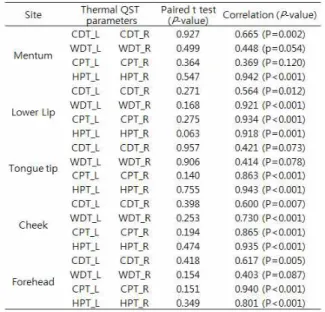
thresholds reference data between the left and right sides of the orofacial region (Table 1, all P > 0.05), and most of correlations across the test sites were highly significant except WDT (P=0.054) and CPT (P=0.120) side differences at the mentum, CDT (P=0.073) and WDT (P=0.078) side differences at the tongue tip and WDT side difference at the forehead (P=0.087) (Table 1). Standard deviations of the absolute data which mean inter-individual differences were relatively larger than those of the relative data which indicate left-right side differences except CPT in the mentum and WDT in the tongue tip.
To compare the gain in the sensitivities of absolute and reference data, we calculated as the ratio standard deviation of absolute data divided by standard deviation of relative data. we found that the all ratios except 2 cases were larger than number 1. 16 ratios of For side to side comparisons, total 20 calculated ratios (80%) in the orofacial region showed the values larger than 1. Although the ratios of CPT in the mentum and WDT in the tongue tip were less than number 1, relative reference data were up to 4.6 times larger than the absolute reference data. Especially the ratios of CDT and HPT in the orofacial region were consistently larger than the ratio 1 unlikely those of WDT and CPT.
Table 2. Sensitivity of absolute vs. relative thermal thresholds data in the orofacial regions
SDabs indicates mean standard deviation of absolute data as average values of right and left values.
SDrel indicates mean standard deviation of right-left difference.
Sensitivity in detection sensory abnormality for relative over absolute reference values was calculated as the ratio SDabs/SDrel.
a
clinically relevant gain over 30%
b
no gain in sensitivity with ratio under 1.00
Table 1. Analysis of side differences for thermal QST parameters in the orofacial region
L means left side R means right side
Pearson’s correlation coefficient was calculated
for the comparison of side differences
Ⅳ. Discussion
The primary goal of QST analysis is to evaluate whether the sensory function has changed. In the absence of normal value before sensory change, the clinician must use a comparative value. There are two approaches for comparison of evaluation of nerve function. First normative absolute values from other healthy populations can be used for comparison due to its efficiency, requiring test only in the affected side.
6)However, they show large standard deviations for the each thermal QST parameters. In consistent with that, most of standard deviations of absolute values in our data were larger than that of relative values. These findings suggest that left- right side comparisons may be more sensitive to detect sensory abnormality such as negative or positive signs than comparisons with the averaged normal values in the population (absolute reference data).
In addition, absolute values exhibit some limitations on identifying hyperesthesia and hypoalgesia. In the current study, Most of correlations between the left and right side data were highly significant with no side difference.
Also we found a substantially higher sensitivity of relative than absolute QST thermotest with the comparison of ratios standard deviation of absolute data divided by standard deviation of relative data, i.e. most of the comparisons between absolute reference data and relative reference data indicated the gain in sensitivity for relative values over absolute values except CPT in the mentum and WDT in the tongue tip in the orofacial region. This finding is consistent with the previous report of the German Research Network on Neuropathic Pain (DFNS)
12)and supports validity of priority of relative reference data on absolute reference data. Thus in patients with unilateral sensory change, relative reference data will be advantageous to detect minus or plus sensory changes in the clinics.
In addition to gain in sensitivity, relative reference data is relatively free to influential factors on thermal thresholds values, such as sex, age on the contrary to absolute reference data.
2,6,9,13-15)However in the assessment of bilateral sensory abnormalities, relative QST data has no advantages and absolute reference data should be compared the affected region. In this study, we found an interesting fact that especially the ratios of CDT and HPT in the orofacial region showed more gain in sensitivity than those of WDT and CPT.
Such finding represent thermal QST parameters such as CDT and HPT has more advantages for detecting negative or positive sensory changes using relative reference data. However, in consideration of our small sample size (n=19), our results deserve further study with more statistical powered sample size.
Ⅴ. Conclusion
The current study has shown that the use of relative reference data in the evaluation of patients with sensory abnormality has the validity and gain in sensitivity in the orofacial region. Most of the relative values in the orofacial region presented the gain in sensitivity to the absolute values in the range of ratio from 1.051 to 4.586. Especially among 4 thermal QST parameters, the use of relative reference data in CDT and HPT has more sensitivity in detecting negative or positive sensory change.
References
1. Eliav E, Gracely RH, Nahlieli O, Benoliel R.
Quantitative sensory testing in trigeminal nerve damage assessment. J Orofac Pain.
2004;18:339-344.
2. Kim HK, Kim KS, Kim ME. Influence of test
site and baseline temperature on orofacial
thermal thresholds. J Orofac Pain.
2013;27:263-270.
3. Pigg M, Badd-Hansen L, Svensson P, Drangsholt M, List T. Reliability of intraoral quantitative sensory testing (QST).
Pain. 2010;148:220-226.
4. Pigg M, Svensson P, List T. Orofacial thermal thresholds: Time-dependent variability and influence of spatial summation and test site. J Orofac Pain. 2011;25:39-48.
5. Green BG, Gelhard B. Perception of temperature of oral and facial skin. Somatosens Res.
1987;4:191-200.
6. Kemler MA, Schouten HJ, Gracely RH.
Diagnosing sensory abnormalities with either normal values or values from contralateral skin: comparison of two approaches in complex regional pain syndrome I.
Anesthesiology. 2000;93(3):718-727.
7. Verdugo R, Ochoa JL. Quantitative somatosensory thermotest: A key method for functional evaluation of small caliber afferents channels. Brain 1992;115:893-913.
8. Dyck PJ, Karnes J, O’Brien PC, Zimmerman IR. Detection thresholds of cutaneous sensation in humans, Peripheral Neuropathy, Vol. 1. Edited by Dyck PJ, Thomas PK, Griffin JW, Low PA, Poduslo JF. Philadelphia, 1992, WB Saunders Company, pp. 706-28.
9. Yarnisky D, Sprecher E. Thermal testing:
Normative data and repeatability for various test algorithms. J Neurol Sci.
1994:125:39-45.
10. Eliav E, Gracely RH, Nahlieli O, Benoliel R.
Quantitative sensory testing in trigeminal nerve damage assessment. J Orofac Pain.
2004;18:339-344.
11. H Gottrup, J Nielsen, L Arendt- Nielsen, TS Jensen. The relationship between sensory thresholds and mechanical hyperalgesia in nerve injury. Pain.
1998;75:321-329.
12. Rolke R, Baron R, Maier C et al.
Quantitative sensory testing in the German Research Network on Neuropathic Pain (DFNS): standardized protocol and reference values. Pain.
2006; 123:231-243.
13. Magerl W, Krumova EK, Baron R, Töller T, Treede RD, Maier C. Reference data for quantitative sensory testing (QST): Refined stratification for age and a novel method for statistical comparison of group data.
Pain. 2010;151:598-605.
14. N Becser, T Sand, J-A Zwart. Reliability of cephalic thermal thresholds in healthy subjects. Cephalalgia. 1998;18:574-582.
15. Matos R, Wang K, Jensen JD et al. Quantitative sensory testing in the trigeminal region: site and gender difference. J Orofac Pain.
2011;25:161-169.
국문초록
젊은 한국 여성의 구강안면영역에서 절대적 온도역치와 상대적 온도역치간의 비교