• 검색 결과가 없습니다.

Does Additional Aortic Procedure Carry a Higher Risk in Patients Undergoing Aortic Valve Replacement?

N/A
N/A
Protected

Academic year: 2021

Share "Does Additional Aortic Procedure Carry a Higher Risk in Patients Undergoing Aortic Valve Replacement?"

Copied!
6
0
0

로드 중.... (전체 텍스트 보기)

전체 글

(1)

http://dx.doi.org/10.5090/kjtcs.2012.45.5.295 ISSN: 2233-601X (Print) ISSN: 2093-6516 (Online)

Department of Thoracic and Cardiovascular Surgery,

1

Seoul National University Bundang Hospital, Seoul National University College of Medicine,

2

Asan Medical Center, University of Ulsan College of Medicine,

3

Dongguk University Ilsan Hospital, Dongguk University College of Medicine

Received: March 21, 2012, Revised: May 16, 2012, Accepted: May 19, 2012

Corresponding author: Kay-Hyun Park, Department of Thoracic and Cardiovascular Surgery, Seoul National University Bundang Hospital, Seoul National University College of Medicine, 82 Gumi-ro 173beon-gil, Bundang-gu, Seongnam 463-707, Korea

(Tel) 82-31-787-7141 (Fax) 82-31-787-4050 (E-mail) [email protected]

C

The Korean Society for Thoracic and Cardiovascular Surgery. 2012. All right reserved.

CC

This is an open access article distributed under the terms of the Creative Commons Attribution Non-Commercial License (http://creative- commons.org/licenses/by-nc/3.0) which permits unrestricted non-commercial use, distribution, and reproduction in any medium, provided the original work is properly cited.

Does Additional Aortic Procedure Carry a Higher Risk in Patients Undergoing Aortic Valve Replacement?

Tae-Hun Kim, M.D.

1

, Kay-Hyun Park, M.D., Ph.D.

1

, Jae Suk Yoo, M.D.

2

, Jae Hang Lee, M.D.

3

, Cheong Lim, M.D., Ph.D.

1

Background: With growing attention to the aortopathy associated with aortic valve diseases, the number of candi- dates for accompanying ascending aorta and/or root replacement is increasing among the patients who require aortic valve replacement (AVR). However, such procedures have been considered more risky than AVR alone. This study aimed to compare the surgical outcome of isolated AVR and AVR combined with aortic procedures.

Materials and Methods: A total of 86 patients who underwent elective AVR between 2004 and June 2010 were divided into two groups: complex AVR (n=50, AVR with ascending aorta replacement in 24 and the Bentall proce- dure in 26) and simple AVR (n=36). Preoperative characteristics, surgical data, intra- and postoperative allogenic blood transfusion requirement, the postoperative clinical course, and major complications were retrospectively re- viewed and compared. Results: The preoperative mean logistic European System for Cardiac Operative Risk Evaluation (%) did not differ between the groups: 11.0±7.8% in the complex AVR group and 12.3±8.0% in the simple AVR group. Although complex AVR required longer cardiopulmonary bypass (152.4±52.6 minutes vs.

109.7±22.7 minutes, p=0.001), the quantity of allogenic blood products did not differ (13.4±14.7 units vs. 13.9±11.2 units). There was no mortality, mechanical circulatory support, stroke, or renal failure requiring hemodialysis/filtration.

No difference was found in the incidence of bleeding (40% vs. 33.3%) which was defined as red blood cell trans- fusion ≥5 units, reoperation, or intentional delayed closure. The incidence of mediastinitis (2.0% vs. 0%), ventilator

≥24 hours (4.0% vs. 2.8%), atrial fibrillation (18.0% vs. 25.0%), mean intensive care unit stay (34.5 hours vs.

38.8 hours), and median hospital stay (8 days vs. 7 days) did not differ, either. Conclusion: AVR combined with additional aortic or root replacement showed an excellent outcome and recovery course equivalent to that after iso- lated AVR.

Key words: 1. Aortic valve, surgery 2. Aorta, surgery

INTRODUCTION

A dilated ascending aorta is a well-known risk factor for poor long-term prognosis after aortic valve replacement

(AVR). It is generally accepted that AVR alone cannot re-

verse the pre-existing dilatation of the ascending aorta or the

aortic root [1]. With the growing attention to the aortopathy

associated with aortic valve diseases, the indications for addi-

(2)

Table 1. Indications for complex AVR

Diagnosis Total no. AVR+AAR Bentall with MV Bentall with SG TCA required

Ascending aorta or root dilatation Porcelain aorta

Takayasu’s arteritis with AR Chronic type A dissection Sum

38 10 1 1 50

15 9 - - 24

11

a)

1 1 - 13

12 0 - 1 13

12 7 1 1 21 AVR, aortic valve replacement; AAR, ascending aorta replacement; MV, mechanical valve; SG, stentless graft; TCA, total circu- latory arrest.

a)

Four patients with Marfan syndrome were included.

tional replacement of the ascending aorta or the root have been expanded [2-4]. However, aortic or root replacement has been considered to be more complicated than isolated aortic valve replacement, carrying higher complication rate and transfusion requirement. In this study, we aimed to clarify whether this traditional belief remains valid.

MATERIALS AND METHODS

From January 2004 through June 2010, a total of 86 pa- tients underwent elective AVR in Seoul National University Bundang Hospital. Retrospective reviews of their medical re- cords were performed to investigate preoperative character- istics, surgical data, perioperative blood transfusion, post- operative course, and the incidence of major complications.

The outcomes were compared after dividing the patients into two groups: complex AVR (n=50; AVR with ascending aorta replacement in 24, and Bentall procedure in 26) and simple AVR (n=36). Late follow-up data were collected in June 2011.

The indications for additional ascending aorta or root re- placement were as follows (Table 1). An ascending aorta larger than 5.0 cm at its maximal diameter was replaced with a prosthetic graft. In the patients who had bicuspid aortic valve (BAV) or small body surface area (<1.4 m

2

), the threshold for ascending aorta replacement was lowered to 4.5 cm. In patients with dilated aortic root (sinus of Valsalva di- ameter ≥4.5 cm), total root replacement with a mechanical valved conduit or a stentless bioprosthesis was performed in- stead of separate AVR and replacement of the supraannular aorta. Indications other than dilatation included severely athe-

rosclerotic aorta, Takayasu’s aortitis, and chronic dissection.

1) Statistical methods

Data was entered in a Microsoft Excel 2007 spreadsheet (Microsoft Co., Redmond, WA, USA) and transferred to a SAS ver. 9.2 (SAS Institute Inc., Cary, NC, USA) for data description and analysis. The characteristics are presented as percentage or mean±standard deviation. Continuous variables were presented as means and standard deviations and com- pared between groups by Student’s t-test. Categorical varia- bles are presented as frequencies and percentages and χ

2

or Fisher’s exact test were used for comparison between groups.

RESULTS

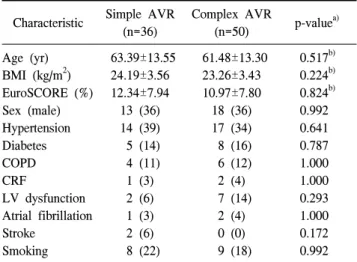
The preoperative profiles did not differ between the two groups (Table 2). The logistic European System for Cardiac Operative Risk Evaluation was 11.0±7.8 in the complex AVR group and 12.3±8.0 in the simple AVR group. There were no statistical differences in the two groups’ age, body mass in- dex (BMI), sex, incidence of hypertension, diabetes, renal failure, stroke, or smoking. The incidence of left ventricular dysfunction and atrial fibrillation did not differ, either.

The surgical data and early clinical outcome are shown in Table 3. The mean cardiopulmonary bypass time was 109.7±

2.67 minutes in simple AVR, and 152.4±52.56 minutes in

complex AVR (p=0.012). The mean cross-clamp time was al-

so longer in the complex AVR group, but there was no stat-

istical significance. The postoperative course and incidence of

major complications also showed no difference between the

two groups. In addition, there was no difference in the pa-

(3)

Table 2. Patients’ preoperative characteristics Characteristic Simple AVR

(n=36)

Complex AVR

(n=50) p-value

a)

Age (yr)

BMI (kg/m

2

) EuroSCORE (%) Sex (male) Hypertension Diabetes COPD CRF

LV dysfunction Atrial fibrillation Stroke

Smoking

63.39±13.55 24.19±3.56 12.34±7.94 13 (36) 14 (39) 5 (14) 4 (11) 1 (3) 2 (6) 1 (3) 2 (6) 8 (22)

61.48±13.30 23.26±3.43 10.97±7.80 18 (36) 17 (34) 8 (16) 6 (12) 2 (4) 7 (14)

2 (4) 0 (0) 9 (18)

0.517

b)

0.224

b)

0.824

b)

0.992 0.641 0.787 1.000 1.000 0.293 1.000 0.172 0.992 Values are presented as mean±standard deviation or number (%).

AVR, aortic valve replacement; BMI, body mass index; Euro- SCORE, European System for Cardiac Operative Risk Evaluation;

COPD, chronic obstructive pulmonary disease; CRF, chronic renal failure; LV, left ventricular.

a)

χ

2

tests were used for al comparisons unless otherwise noted.

b)

t-test.

Table 3. Clinical outcomes

Simple AVR (n=36) Complex AVR (n=50) p-value

CPB time (min) Cross-clamp time (min) Mechanical ventilation >24 hr Mean ICU stay (hr)

ICU stay >3 day Hospital stay >7 day Median hospital stay (day) In-hospital death

Postoperative IABP or ECMO Stroke

Postoperative hemodialysis Atrial fibrillation

Mediastinitis

Re-exploration due to bleeding Transfused RBC (>5 u) Intraoperative RBC+FFP (u) Postoperative RBC+FFP (u) Total transfused RBC (u) Total transfused PLT (u)

109.72±22.67 87.00±21.08 2 (5.5)

38.8 2 (5.5) 14 (38.8)

7 0 0 0 0 9 (26)

0 (0) 1 (3) 9 (25) 4.11±3.74 3.08±4.00 3.83±3.18 6.66±6.66

152.4±52.56 116.48±34.17

4 (8) 34.5 0 (0) 21 (42)

8 0 0 0 0 9 (18)

1 (2) 3 (6) 16 (32) 3.94±3.99 3.64±5.50 4.54±3.59 5.80±8.42

0.012 0.082 0.12

0.17 0.38

- - - - 0.64 0.23 0.07 0.67 0.73 0.32 0.15 0.11 Values are presented as mean±standard deviation or number (%).

AVR, aortic valve replacement; CPB, cardiopulmonary bypass; ICU, intensive care unit; IABP, intra-aortic balloon pump; ECMO, ex- tracorporeal membrane oxygenation; RBC, red blood cell; u, units; FFP, fresh frozen plasma; PLT, platelet concentration.

rameters related with bleeding such as the requirement for transfusion and the summated incidence of large quantity transfusion (red blood cell transfusion ≥5 units), reoperation, or intentional delayed closure (40% in simple AVR versus 33.3% in complex AVR).

Three patients who were in the complex AVR group were lost to follow-up. In the remaining patients, the mean fol- low-up duration was 50.5±23.66 months (range, 11 to 88 months) in the simple AVR group and 31.4±2.90 months (range, 2 to 84 months) in the complex group. The overall survival rates during those follow-up periods were 93.3% (28 out of 30) in the simple AVR group and 93.6% (45 out of 47) in the complex AVR group.

Four patients, two in each group, died during the follow-up periods. Two deaths, one in each group, were cardiac-related.

One patient died of myocardial failure after redo AVR that

was performed at 44 months after the initial surgery for se-

vere prosthetic stenosis caused by pannus overgrowth. The

other patient died of acute myocardial infarction at 57 months

after the Bentall procedure which was performed for aortic

(4)

regurgitation caused by Takayasu’s aortitis. In this patient, to- tal occlusion of the right coronary artery and stenosis of left coronary ostial anastomosis had been found during the fol- low-up. The remaining two deaths were caused by cancer.

DISCUSSION

As the long-term results of AVR have been published, the addition of root or ascending aortic replacement is being per- formed more frequently than before. Progressive proximal aortic dilatation or aortic dissection after AVR is a poor prognostic factor [5]. The incidence and clinical impact are valued differently by different surgeons. In 2003, Andrus et al. [6] published the natural history of ascending aortic dilata- tion after AVR, for 185 patients. Only 15% of them had an increase in the aortic diameter of more than 0.3 cm annually, but no patients developed aortic dilatation more than 5.5 cm after a mean 33.6 months of follow-up. They concluded that no replacement of ascending aorta would be done routinely at the time of AVR.

On the other hand, some studies reported that the reopera- tion rate on ascending aorta or aortic root in patients with previous AVR was up to 28%, which was due to aortic dis- section or aneurysm [7-9]. The incidence of acute type A dis- section after AVR is reported to be from 0.2% to 2.3%

[10-13]. The incidences of such untoward long term outcomes are known to be increased by several patient factors.

Hypertension is a risk factor of postoperative aortic dilation [14,15]. Patients with BAV are known to be at higher risk:

1% for aortic dissection and almost 10% for progressive aort- ic enlargement [12,16,17]. Thanks to recent studies that iden- tified structural and histological abnormalities in the ascend- ing aorta of the BAV patients, aortic dilatation in BAV is no longer regarded as simple ‘poststenotic’ dilatation.

Preoperative aortic size is also an important risk factor.

Natsuaki et al. [14] report that patients with an ascending aorta larger than 40 mm had a higher risk of aortic dissection or dilation of the aorta after AVR than those who had not. In the study by Tsutsumi et al. [18] who investigated 285 pa- tients who underwent isolated AVR, ten patients (3.5%) de- veloped type A aortic dissection during 7.6±8.1 years fol- low-up period. Male sex, thinning or fragility of the aortic

wall, hypertension, and ascending aortic dilatation of more than 45 mm at the time of AVR combined with aortic regur- gitation were considered to be prognostic factors for post-AVR aortic dissection. Indeed, there was a linear corre- lation between the ascending aorta diameter at AVR and the probability of developing type A aortic dissection, 0.4% for an ascending aorta diameter of less than 3 mm, 9.3% for 40 to 49 mm, and 55.6% for more than 50 mm.

Current guidelines by the American College of Cardiology and American Heart Association recommend replacing the as- cending aorta at the time of aortic valve surgery if the as- cending aorta is more than 4.5 cm in diameter for patients with BAV and 5 cm for others [19]. Many surgeons insist on a smaller (4.0 cm) criterion for patients with Marfan syn- drome [20]. In addition, there are surgeons who believe that body size should be taken into consideration [21]. However, due to the lack of long-term large scale analysis, it remains controversial whether it is beneficial to lower the size thresh- old of aorta or root replacement for smaller patients.

Aortic valve stenosis or insufficiency is associated with various types of aortitis such as infective endocarditis, Takayasu’s disease, and Behcet’s disease. A severely athero- sclerotic or ‘porcelain’ aorta, making cannulation and clamp- ing impossible, is also one of the conditions under which as- cending aorta replacement is necessary [22]. Sometimes, ag- gressive decalcification in patients with aortic valve stenosis can injure the aortic wall, making root replacement the safer option.

Despite of the substantial incidence of situations necessitat-

ing additional aortic or root replacement combined with

AVR, many surgeons still regard such ‘complex’ AVR as a

more complicated and risky procedure. Alternative procedures

to replacement, such as wrapping or reduction plasty, are pre-

ferred by those surgeons. Our study, which showed that the

risk was not increased by adding ascending aorta or root re-

placement to AVR, is in accord with contemporary data re-

ported by respected institutions [23,24]. The Mount Sinai

group reported that the Bentall operation was not inferior to

simple AVR in a review of long-term result after the Bentall

operation in 206 patients with BAV [25]. The overall hospital

mortality was 2.9% and stroke rate was 1.9%. Five-year sur-

vival was 95% and 10-year survival was 89%. Their report of

(5)

597 patients who underwent the Bentall operation published in 2010 showed remarkable reduction in hospital mortality as the cases of aortic root replacement increased. Mortality was 10.9% till 1988, 4.2% after 2005, and 3.9% by 2010 [26].

Compared with data from the Society of Thoracic Surgeons National Cardiac Database [27], in which the mortality rate after simple AVR is 3.6% to 4.6%, it can be said that root replacement is no more an overly risky procedure at least in the hands of experienced surgeons.

CONCLUSION

Despite the technical complexity and additional car- diopulmonary bypass time, the addition of aortic or root re- placement to aortic valve replacement did not result in higher operative risk, prolongation of postoperative recovery, or in- creased blood transfusion. For patients who have reasonable indications based on current evidences, the prospect of per- forming additional aortic or root replacement should not be dismissed for fear of increased complexity or untoward outcomes.

REFERENCES

1. Vallely MP, Semsarian C, Bannon PG. Management of the ascending aorta in patients with bicuspid aortic valve disease. Heart Lung Circ 2008;17:357-63.

2. Borger MA, Preston M, Ivanov J, et al. Should the ascend- ing aorta be replaced more frequently in patients with bi- cuspid aortic valve disease? J Thorac Cardiovasc Surg 2004;

128:677-83.

3. Hiratzka LF, Bakris GL, Beckman JA, et al. 2010 ACCF/

AHA/AATS/ACR/ASA/SCA/SCAI/SIR/STS/SVM Guidelines for the diagnosis and management of patients with thoracic aortic disease: a report of the American College of Cardio- logy Foundation/American Heart Association Task Force on Practice Guidelines, American Association for Thoracic Surgery, American College of Radiology, American Stroke Association, Society of Cardiovascular Anesthesiologists, Society for Cardiovascular Angiography and Interventions, Society of Interventional Radiology, Society of Thoracic Surgeons, and Society for Vascular Medicine. J Am Coll Cardiol 2010;55:e27-129.

4. Renzulli A, de Feo M, della Corte A, Ismeno G. Conservat- ive treatment of dilated ascending aorta: a new technique.

Heart Views 1999;1:163-9.

5. Nancarrow PA, Higgins CB. Progressive thoracic aortic di- latation after aortic valve replacement. AJR Am J Roent- genol 1984;142:669-72.

6. Andrus BW, O’Rourke DJ, Dacey LJ, Palac RT. Stability of ascending aortic dilatation following aortic valve replace- ment. Circulation 2003;108 Suppl 1:II295-9.

7. Dougenis D, Daily BB, Kouchoukos NT. Reoperations on the aortic root and ascending aorta. Ann Thorac Surg 1997;64:986-92.

8. Prenger K, Pieters F, Cheriex E. Aortic dissection after aort- ic valve replacement: incidence and consequences for strategy. J Card Surg 1994;9:495-8.

9. Michel PL, Acar J, Chomette G, Iung B. Degenerative aort- ic regurgitation. Eur Heart J 1991;12:875-82.

10. Russo CF, Mazzetti S, Garatti A, et al. Aortic complications after bicuspid aortic valve replacement: long-term results.

Ann Thorac Surg 2002;74:S1773-6.

11. Bauer M, Pasic M, Meyer R, et al. Morphometric analysis of aortic media in patients with bicuspid and tricuspid aortic valve. Ann Thorac Surg 2002;74:58-62.

12. Januzzi JL, Isselbacher EM, Fattori R, et al. Characterizing the young patient with aortic dissection: results from the International Registry of Aortic Dissection (IRAD). J Am Coll Cardiol 2004;43:665-9.

13. Yasuda H, Nakatani S, Stugaard M, et al. Failure to prevent progressive dilation of ascending aorta by aortic valve re- placement in patients with bicuspid aortic valve: comparison with tricuspid aortic valve. Circulation 2003;108 Suppl 1:

II291-4.

14. Natsuaki M, Itoh T, Rikitake K, Okazaki Y, Naitoh K.

Aortic complications after aortic valve replacement in pa- tients with dilated ascending aorta and aortic regurgitation.

J Heart Valve Dis 1998;7:504-9.

15. Pieters FA, Widdershoven JW, Gerardy AC, Geskes G, Cheriex EC, Wellens HJ. Risk of aortic dissection after aort- ic valve replacement. Am J Cardiol 1993;72:1043-7.

16. McKellar SH, Michelena HI, Li Z, Schaff HV, Sundt TM 3rd. Long-term risk of aortic events following aortic valve replacement in patients with bicuspid aortic valves. Am J Cardiol 2010;106:1626-33.

17. Braverman AC, Beardslee MA. The bicuspid aortic valve.

In: Otto CM, Bonow RO, editors. Valvular heart disease: a companion to Braunwald’s heart disease. 3rd ed. Philadel- phia: Saunders/Elsevier; 2009. p. 169-86.

18. Tsutsumi K, Inoue Y, Hashizume K, Kimura N, Takahashi R. Risk factor analysis for acute type A aortic dissection af- ter aortic valve replacement. Gen Thorac Cardiovasc Surg 2010;58:601-5.

19. American College of Cardiology; American Heart Associa-

tion Task Force on Practice Guidelines (Writing Committee

to revise the 1998 guidelines for the management of patients

with valvular heart disease); Society of Cardiovascular

(6)

Anesthesiologists, et al. ACC/AHA 2006 guidelines for the management of patients with valvular heart disease: a report of the American College of Cardiology/American Heart Association Task Force on Practice Guidelines (writing Committee to Revise the 1998 guidelines for the management of patients with valvular heart disease) developed in collabo- ration with the Society of Cardiovascular Anesthesiologists endorsed by the Society for Cardiovascular Angiography and Interventions and the Society of Thoracic Surgeons. J Am Coll Cardiol 2006;48:e1-148.

20. Glower DD. Indications for ascending aortic replacement size alone is not enough. J Am Coll Cardiol 2011;58:585-6.

21. Elefteriades JA, Farkas EA. Thoracic aortic aneurysm clin- ically pertinent controversies and uncertainties. J Am Coll Cardiol 2010;55:841-57.

22. Chung S, Park PW, Choi MS, et al. Surgical experience of ascending aorta and aortic valve replacement in patient with calcified aorta. Korean J Thorac Cardiovasc Surg 2012;45:

24-9.

23. van Putte BP, Ozturk S, Siddiqi S, Schepens MA, Heijmen RH, Morshuis WJ. Early and late outcome after aortic root replacement with a mechanical valve prosthesis in a series of 528 patients. Ann Thorac Surg 2012;93:503-9.

24. Hughes GC, Zhao Y, Rankin JS, et al. Effects of institu- tional volumes on operative outcomes for aortic root re- placement in North America. J Thorac Cardiovasc Surg 2012 Feb 3 [Epub].

25. Etz CD, Homann TM, Silovitz D, et al. Long-term survival after the Bentall procedure in 206 patients with bicuspid aortic valve. Ann Thorac Surg 2007;84:1186-93.

26. Etz CD, Bischoff MS, Bodian C, et al. The Bentall proce- dure: is it the gold standard? A series of 597 consecutive cases. J Thorac Cardiovasc Surg 2010;140(6 Suppl):S64-70.

27. Taylor NE, O’Brien S, Edwards FH, Peterson ED, Bridges

CR. Relationship between race and mortality and morbidity

after valve replacement surgery. Circulation 2005;111:1305-

12.

수치

Table 1. Indications for complex AVR
Table 2. Patients’ preoperative characteristics Characteristic Simple  AVR

참조

관련 문서

period was prolonged unavoidably, (3) by explaining the risk factors associated with the failure to patients honestly, and subsequently performing

Serum uric acid levels and risk for vascular disease in patients with metabolic syndrome... Prevalence if the metabolic syndrome in a Turkish

(Background) Gallbladder wall thickening(GWT) and gallbladder contraction are often observed in patients with acute hepatitis.. The incidence of acute hepatitis A

The safe ship operation of Korean coastal shipping, compared with that of ocean going shipping, is threatened by difficulties in replacement of a

In this group of high-risk patients with severe COVID-19 pneumonia, treatment with lenzilumab was associated with a significantly shorter time to clinical improvement compared

The sigil for the genii associated with Kaph in the Mercurial house displays a wheel (as does the Fortune Atu that also has Kaph for an attribution) with 6 spokes with

Based on the results of root cause analysis, the following corrective action to mitigate the erosion and corrosion damage at hot leg check valve were

Intermittent hemodialysis(IDH) and Continuous renal replacement therapy (CRRT) has been used widely for treating critically ill patients with acute renal failure, We