• 검색 결과가 없습니다.

Immediate Effect of Intermittent Versus Continuous Hamstring Static Stretching on the Muscle Tone and Range of Motion

N/A
N/A
Protected

Academic year: 2021

Share "Immediate Effect of Intermittent Versus Continuous Hamstring Static Stretching on the Muscle Tone and Range of Motion"

Copied!
9
0
0

로드 중.... (전체 텍스트 보기)

전체 글

(1)


| Abstract |

1)

PURPOSE: This study examined which stretching exercise had the most positive effect on increasing the range of motion (ROM) of the knee joint in healthy people and whether there was a difference between continuous stretching and intermittent stretching.

METHODS: This study included 30 healthy university students from OOO University. The subjects were asked to sit on a mat and perform hamstring-stretching exercise during which the ROM and muscle tone were measured with pre and post-tests. Each subject was assigned randomly to a continuous stretching group (stretching without relaxation time group, n=10, G1) or intermittent stretching group (stretching with 10s relaxing time group, n=10, G2; and stretching with 20s relaxing time group, n=10, G3). The participants conducted hamstring stretching exercises with a

†Corresponding Author : Myoung-Kwon Kim

[email protected], https://orcid.org/0000-0002-7251-6108 This is an Open Access article distributed under the terms of the Creative Commons Attribution Non-Commercial License (http://creativecommons.org/licenses/by-nc/3.0) which permits unrestricted non-commercial use, distribution, and reproduction in any medium, provided the original work is properly cited.

sit-and-reach box at three different rest times (0s, 10s, and 20s). Subsequently, they underwent passive knee extension (PKE) tests, in which the ROM of the knee joint was measured with a goniometer, and the muscle tone was evaluated using a MyotonPro.

RESULTS: Significant differences in muscle tone, stiffness, and ROM were observed between pre-test and post-test in each groups (p<.05). Although the post hoc tests indicated no significant differences in muscle tone and ROM between the continuous stretching group and intermittent stretching group (p>.05), the rate of change of the ROM showed that the intermittent stretching group developed more effective maintenance of the hamstring flexibility.

CONCLUSION: No significant differences in the muscle tone of the hamstring and ROM of the knee joint were observed according to the hamstring stretching exercises with three different rest times. On the other hand, the rate of change of the ROM showed that intermittent stretching maintained the hamstring flexibility more effectively.

Key Words: Muscle stretching exercise, Muscle tone, Range of motion

Research Article Open Access

Immediate Effect of Intermittent Versus Continuous Hamstring Static Stretching on the Muscle Tone and Range of Motion

Jin-Gyi Chen, PT, MS⋅Eun-Hong Choi, PT, MS 1 ⋅Myoung-Kwon Kim, PT, PhD 2†

Department of Rehabilitation Medicine and Physical Therapy, Second Affiliated Hospital, Chongqing Medical University, Chongqing, P. R. China

1 Department of Rehabilitation Sciences, Graduate School, Daegu University

2 Department of Physical Therapy, College of Rehabilitation Sciences, Daegu University

Received: August 1, 2019 / Revised: August 19, 2019 / Accepted: September 21, 2019

ⓒ 2019 J Korean Soc Phys Med

(2)

Appropriate flexibility is necessary to improve the level of human activity. Hamstring flexibility is an important part of good health and is considered a sign of good health and quality of life [1]. Flexibility training is incorporated into training programs because achieving flexibility can reduce the risk of injury, alleviate pain, and improve athletic performance [2,3]. Most experts consider the loss of flexibility to decrease the muscle performance. Moreover, a lack of flexibility has been shown to reduce muscle ability, limit the body from moving, and induce muscle injury [4].

As reported previously [5,6], hamstring muscles are important contributors to the control of human movement.

Moreover, hamstring flexibility is important to general health and physical fitness because hamstring muscles have a wide range of activities, ranging from jumping to forward ending during sitting or standing, running, and many postural control actions [7,8]. Therefore, the hamstrings play important roles in effective walking and running, and stretching has significant effects on increased the hamstring flexibility [9]. A lack of flexibility or poor flexibility of the hamstring reduces the performance of various daily living activities by patients, and reduced hamstring flexibility increases the risk of damage to the musculoskeletal system [10]. Accordingly, hamstring flexibility is an important matter in the context of physiotherapy.

Meroni [11] and Kang [12] reported that hamstring flexibility is improved by stretching. Stretching is one of the most popular methods to increase muscle flexibility [13]. because it increases the hamstring flexibility immediately and improves the hip joint proprioception [14].

Static stretching, which has been used to increase flexibility [15], is one method of rehabilitation and an integral component of sports-conditioning programs. Two common forms of static stretching exercise include continuous and intermittent modalities [16-18]. A comparison of different periods of stretching exercise (15s, 30s, 60s, 90s, and 120s)

appeared to be dependent on the duration and frequency of stretching [20]. Each type of static stretching exercise can have a range of effects, and different results are obtained when diverse stretching programs are applied to the same muscle group.

The passive knee extension (PKE) test is used frequently to stretch hamstrings and assess the hamstring flexibility [21,22]. Previous research has demonstrated that active knee extension (AKE) only measures the 'initial hamstring length', and PKE measures the 'maximal hamstring length' [23]. Muscle tone characterizes the tone (intrinsic tension on the cellular level) of a muscle in its passive or resting state without voluntary contraction. An abnormally high muscle tone is a serious and sometimes insurmountable challenge [24], and causes faster muscle fatigue and slows muscle recovery.

Many studies have investigated the increased flexibility of hamstrings after stretching, but few studies have examined the effects of varying the rest times between stretches on the hamstring flexibility. Moreover, few studies have compared the effects of continuous stretching and intermittent stretching in the same stretching exercise for the same exercise time. Moreover, almost no studies have examined the relationship between muscle tone and the ROM based on the PKE test during stretching to have positive effects on the hamstring flexibility.

Therefore, this study compared the effects of muscle tone and the ROM of the knee joints on the hamstring flexibility when different frequencies of the total time were used in conjunction with the same stretching exercise.

Furthermore, the effects of continuous and intermittent

stretching were compared.

(3)

Ⅱ. Methods

1. Participant

This study examined 30 healthy university students from OOO University, Korea. The inclusion criteria were as follows: non-professional sports students, no pain or any significant history of the pathology of the hip, knee, or thigh within the last six months, and less than 70° passive knee extension (PKE) test. The exclusion criteria were as follows: 1) prior history of musculoskeletal injury or surgery of the lower limbs; 2) aching pain in the lower limbs and lumbar spine; and 3) hamstring injury (hamstring muscle strain, hamstring spasm, or tendinopathies).

2. Ethics

Before the start of this study, all subjects were explained the study content and signed an informed consent form.

The ethical committee of Daegu University approved this study (IRB number 1040621-201811-HR-045-02).

3. Study Protocol

This study employed a pre-test and a post-test design, and all assessments were performed on the left leg. For randomization, sealed envelopes were prepared in advance and marked inside with G1, G2, or G3. The three groups were one continuous stretching group (stretching without relaxation time group, n=10, G1) and two intermittent stretching group (stretching with 10s relaxing time group,

n=10, G2; and stretching with 20s relaxing time group, n=10, G3). A third party unaware of the nature of the study performed the randomization procedure.

All participants performed a hamstring stretching exercise with a sit-and-reach device and the evaluations in one day. The program for each group was conducted in the following three steps. In the first step, a pre-test, five minutes sitting was performed to relax the hamstring muscle group followed by the PKE test to measure the ROM using a goniometer. Subsequently, the biceps femoris and semitendinosus were measured using a MyotonPro device. In the second step, during the 60-second hamstring stretching exercise with a sit-and-reach box (Fig. 1), static stretching was performed with each prescriptive relaxation time (no relaxation, 10s relaxation, and 20 s relaxation) (Fig. 2). G1 performed static stretching continuously for 60 s. G2 performed static stretching for 30 s, rested for 10 s, and performed the exercise again for 30 s. G3 performed static stretching for 20 s, rested for 10s, stretched for 20 s, rested for 10 s, and finally stretched for 20 s.

In the third step, the post-test, after 60 s of hamstring stretching exercise, a PKE test was conducted immediately to measure the ROM, and the muscle tone was evaluated with the MyotonPRO. All outcome measures obtained before and after treatment were assessed using a physical therapist, who was blinded to the treatment allocations.

A physical therapist, who was not involved in subject assessment, performed the intervention was performed by Fig. 1. Hamstring stretching exercise using the Sit-

and-Reach box. Fig. 2. Experimental posture.

(4)

Physical therapist, who was not involved in subject assessment. The physical therapist was instructed not to communicate the study goals or treatments with the subjects.

Kay et al. [25] reported that 30s and 45s of stretching is safe and effective during pre-exercise, but more than 60s of stretching can cause impaired muscle strength.

Therefore, 60s was chosen as the exercise time for this study.

4. Measurements

The muscle tone, stiffness, and ROM were measured in this study. Each subject underwent each measurement in a random order. All measurements were performed before and after the intervention. The pre-test and post-test measurements were as follows: 1) ROM of the knee joint in the PKE test, and 2) muscle tone measurements of the semitendinosus and biceps femoris before hamstring stretching. The post-test was performed after the intervention to compare the immediate effects.

The muscle tone of the biceps femoris and semitendinosus on the affected side was measured using MyotonPRO.

MyotonPRO (Myoton AS, Tallinn, Estonia) was used to quantify the mechanical muscle properties objectively, and the measurement method was based on a registration of the oscillation acceleration signals and subsequent computing of the parameters reflecting the tone, dynamic stiffness, elasticity, and mechanical stress relaxation time.

The principle behind the myotonometer was to apply multiple short impulses over the muscle bulk via the testing probe to generate oscillations in the muscle fibers [25].

Willy [27] reported a good to excellent confidence level of knee ROM measurements made using a goniometer.

5. Statistical analysis

SPSS version 21.0 (IBM Corporation, Armonk, NY, USA) was used for statistical analysis. The Shapiro-Wilk test was used to determine the normality of the distribution;

all data were distributed normally. One-way ANOVA was used to compare the changes in the muscle tone and the ROM according to hamstring stretching with different rest times (no relaxation, 10s relaxation, and 20s relaxation) in each subject, while a paired t-test was used to compare the intra-group differences. LSD was used for the post-hoc tests. The null hypothesis of no difference was rejected if p-values were <.05.

Ⅲ. Results

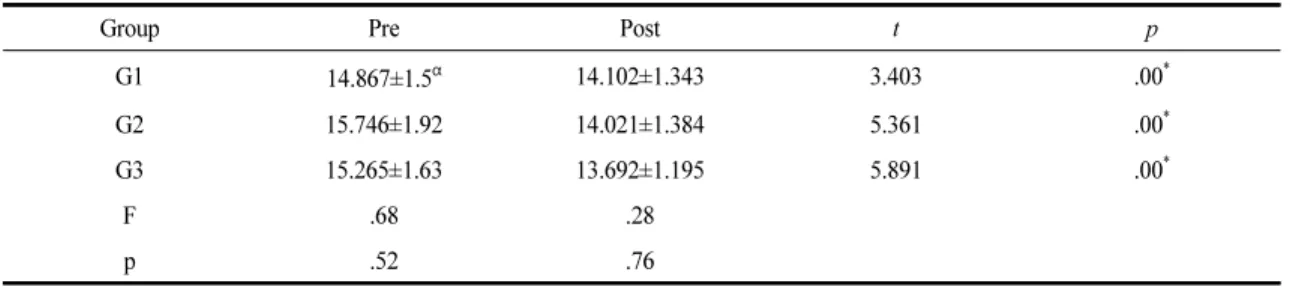
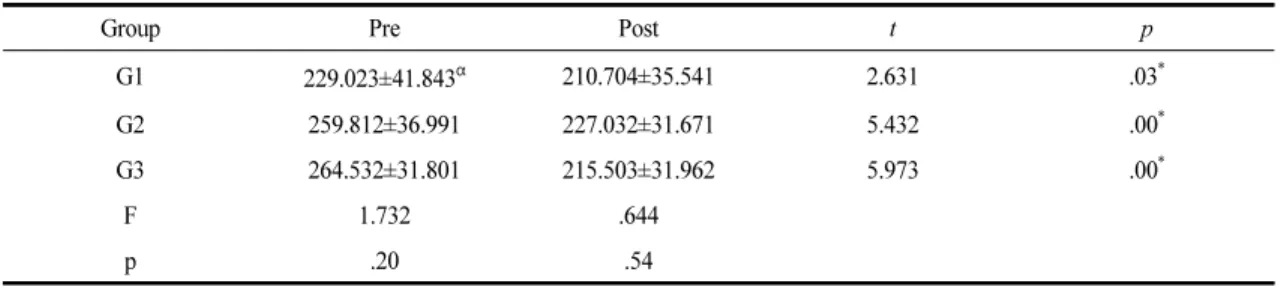
The results revealed significant differences in muscle tone and stiffness between the pre-test and post-test in each groups (p<.05)(Table 2-5). The results revealed significant differences in the ROM of the knee joint between the pre-test and post-test in each group (p<.05)(Table 6).

Age (year) 22.5±1.35 α 23.3±.82 23.4±1.26

Height (cm) 164.5±6.84 169.0±9.46 166.9±10.57

Weight (kg) 55.9±7.23 63.8±16.4 58.4±11.17

α Mean±SD

G1: hamstring stretching without relaxing time

G2: hamstring stretching with 10s relaxing time

G3: hamstring stretching with 20s relaxing time

(5)

Ⅳ. Discussion

A 60-second stretching exercise program was conducted in this study. Many studies of hamstring flexibility have shown that 30s~60s of stretching is sufficient to increase the ROM [20]. Although the post hoc test showed that the intervention did not produce a difference in muscle tone, hamstring stiffness, and knee joint ROM among G1,

G2, and G3, the rate of change of the ROM was approximately 16.34% higher in G3 than in G1, whereas it increased by approximately 1.05% relative to G2. Gomes [28] reported that intermittent stretching did not reduce muscle endurance. A previous study reported that intermittent stretching could improve the muscular condition by maintaining the stiffness of the muscle-tendon units, thereby improving the stretching flexibility.

Group Pre Post t p

G1 14.867±1.5 α 14.102±1.343 3.403 .00 *

G2 15.746±1.92 14.021±1.384 5.361 .00 *

G3 15.265±1.63 13.692±1.195 5.891 .00 *

F .68 .28

p .52 .76

α Mean±SD,

* p<.05

Table 2. Comparison of the Pre and Post Muscle Tone of the Biceps Femoris (unit: Hz)

Group Pre Post t p

G1 252.002±41.812 α 232.04±38.062 2.621 .03 *

G2 280.821±42.542 240.313±42.524 6.512 .00 *

G3 265.202±34.841 222.921±40.174 6.323 .00 *

F 1.312 .474

p .29 .63

α Mean±SD,

* p<.05

Table 3. Comparison of the Pre and Post Stiffness of the Biceps Femoris (unit: N/m)

Group Pre Post t p

G1 14.351±1.454 α 13.735±1.157 2.934 .02 *

G2 14.782±1.235 13.824±1.192 6.373 .00 *

G3 14.342±1.056 13.293±.952 9.312 .00 *

F .407 .662

p .67 .52

α Mean±SD,

* p<.05

Table 4. Comparison of the Pre and Post Muscle Tone of the Semitendinosus (unit: Hz)

(6)

Moreover, intermittent stretching may help prevent the ROM from decreasing by keeping muscles in a plastic elongation state [29]. Donti [30] reported that intermittent stretching was more effective than continuous stretching for both long-term and acute ROM enhancement in preadolescent female athletes. This explains the results of the study, in which intermittent stretching increased the ROM significantly, leading to the maintenance of hamstring flexibility.

Compared to the method used in the present study, Sato [31] reported that an analysis of the changes in hamstring muscle tone and stiffness is a simple and effective way to evaluate stretching for hamstring flexibility. Neumann [32] suggested that increases in muscle length during stretching affect the force-length relationship. When evaluating the principal muscle and stiffness outcome- interpretation criteria, higher F and S values are associated

with greater tension and stiffness of the soft tissue structure, respectively, at the dedicated body measurement points (MPs) [33]. The human resting muscle tone is the passive tension and resistance to stretching that continue postural stability in balanced positions [34]. The muscle tone and properties could be used to evaluate the effects of pathology [35,36] and sports-related injury [37].

From a clinical and practical perspective, although post hoc tests showed that the intervention did not produce a difference in the hamstring muscle tone, and the stiffness or ROM of the knee joint between continuous stretching and intermittent stretching, the rate of change of the ROM showed that intermittent stretching was more effective for maintaining the hamstring flexibility. Gajdosik [38]

reported that patients might be more likely to participate in a stretching program with less time than continuous stretching, but is still as effective as continuous stretching

G1 229.023±41.843 α 210.704±35.541 2.631 .03 *

G2 259.812±36.991 227.032±31.671 5.432 .00 *

G3 264.532±31.801 215.503±31.962 5.973 .00 *

F 1.732 .644

p .20 .54

α Mean±SD,

* p<.05

Group Pre Post t p

G1 52.702±8.153 α 62.702±8.273 -10.111 .00 *

G2 46.802±9.212 61.343±9.035 -17.446 .00 *

G3 43.612±7.011 61.512±7.381 -9.892 .00 *

F 3.191 .091

p .06 .92

α Mean±SD,

* p<.05

Table 6. Comparison of the Pre and Post ROM of the PKE Test (unit: °)

(7)

and may lead to a lower risk of re-injury. Intermittent stretching may be a particularly good choice for older patients [39].

This study had several limitations. First, this study only investigated individuals. Second, the sample size was small.

Third, only the range of motion and the quality of muscles were evaluated. Therefore, there was no functional evaluation of the subjects. Finally, this study could not identify the clinical effect and long term. Given these limitations, additional research, including a follow-up study of the continuous effects and investigations of the clinical effects in patients, is warranted.

Ⅴ. Conclusion

Based on the muscle tone and ROM, a significant difference and instant relief in hamstring flexibility occur after continuous stretching and intermittent stretching, with intermittent stretching having a more positive effect.

Acknowledgment

This material is based on work supported by the Ministry of Trade, Industry & Energy (MOTIE, Korea) under the Industrial Technology Innovation Program. No.20001123, 'Advanced design development of a design for an integrated sleep optimization platform service through core stretching and a motion air cell mattress based on pressure sensors and IOT technology’

References

[1] Kendall FP, McCrary EK, Provance PG, et al. Muscles:

Testing and Function, With Posture and Pain. LWW;

5 ed. North American Edition. 2005.

[2] Nelson RT. A comparison of the immediate effects of eccentric training vs static stretch on hamstring flexibility in high school and college athletes. N Am J Sports Phys

Ther. 2006;1(2):56-61.

[3] Spernoga SG, Uhl TL, Arnold BL. Duration of maintained hamstring flexibility after a one-time, modified hold-relax stretching protocol. J Athl Train. 2001;36(1):44-8.

[4] Scott D, Ashby PE. The effects of 3 stretching techniques on hamstring flexibility using consistent stretching parameters. Jouranal of Strength and conditioning research. 2005;19(1):27-32.

[5] Fasen JM, O’Connor AM. Schwartz SL. A randomized controlled trial of hamstring stretching: comparison of four techniques. J Strength Cond Res. 2009;23:660–7.

[6] Smith M, Fryer G. A comparison of two muscle energy techniques for increasing flexibility of the hamstring muscle group. J Bodyw Mov Ther. 2008;12:312–7.

[7] Stephens J, Davidson J, Derosa J, et al. Lengthening the hamstring muscles without stretching using

“awareness through movement”. Phys Ther. 2006;86:

1641 50.

[8] Ivan Zorić. Anatomy, physiology and biomechanics of hamstrings injury in football and effective strength and flexibility exercises for its prevention. Journal of Human Sport and Exercise. 2012.

[9] Ayala F, de Baranda PS, Croix MDS. Comparison of active stretching technique in males with normal and limited hamstring flexibility. Physical Therapy in Sport.

2013;14(2):98 –104.

[10] Hreljac A, Marshall RN, Hume PA. Evaluation of lower extremity overuse injury potential in runners. Med Sci Sports Exerc. 2000;32:1635–41.

[11] Meroni R, Cerri CG, Lanzarini C. Comparison of active stretching technique and static stretching technique on hamstring flexibility. Clin J Sport Med. 2010;20:8–14.

[12] Kang MH, Jung DH, An DH. Acute effects of hamstring-stretching exercises on the kinematics of the lumbar spine and hip during stoop lifting. J Back Musculoskeletal Rehabil. 2013;26:329–36.

[13] Kim K, Park S, Goo BO. Effect of self-myofascial release

on reduction of physical stress: a pilot study. J Phys

(8)

ultrasound on hamstring flexibility and proprioception.

Journal of Physical Therapy Science. 2016;28:1806 –8.

[15] Marshall PW, Cashman A, Cheema BS. A randomized controlled trial for the effect of passive stretching on measures of hamstring extensibility, passive stiffness, strength, and stretch tolerance. J Sci Med Sport.

2011;14:535-40.

[16] Avela J, Finni T, Liikavainio T, et al. Neural and mechanical responses of the triceps surae muscle group after 1 h of repeated fast passive stretches. J. Appl. Physiol.

2004;96:2325 –32.

[17] Trajano GS, Nosaka K,B Seitz L, et al. Intermittent Stretch Reduces Force and Central Drive more than Continuous Stretch. Medicine and Science in Sports and Exercise.

2014;46(5):902 –10.

[18] Reid JC, Greene R, Young JD, et al. The effects of different durations of static stretching within a comprehensive warm-up on voluntary and evoked contractile properties. Eur. J. Appl. Physiol. 2018;118:

1427 –45.

[19] Odunaya NA, Hamzat TK, Ajavi OF. The effects of static stretch duration on the flexibility of hamstring muscles. African Journal of Biomedical Research.

2005;8:79 –82.

[20] Bandy WD, Irion JM. The effect of time on static stretch on the flexibility of the hamstring muscles. Phys Ther.

1994;74(9):845-50.

[21] Leong HT, Ng GY, Leung VY, et al. Quantitative estimation of muscle shear elastic modulus of the upper trapezius with supersonic shear imaging during arm positioning. PLoS One 2013;8:e67199.

[22] Magnusson SP, Aagaard P, Nielson JJ. Passive energy return after repeated stretches of the hamstring muscle-tendon unit. Med Sci Sports Exerc. 2000;32:1160 – 4.

[23] O'Sullivan K, Murray E, Sainsbury D. The effect of

Musculoskelet Disord. 2009;10:37.

[24] Ahmed Z. Electrophysiological characterization of spino-sciatic and cortico-sciatic associative plasticity:

modulation by trans-spinal direct current and effects on recovery after spinal cord injury in mice. J Neurosci.

2013a;33:4935 –46.

[25] Kay AD, Blazevıch AJ. Effect of acute static stretch on maximalmuscle performance: A systematic review.

Med Sci Sports Exerc. 2012;44(1):154–64.

[26] Gapeyeva H, Vain A. Methodological guide: principles of applying Myoton in physical medicine and rehabilitation. Tartu, Estonia: Muomeetria Ltd, 2008.

[27] Willy RW, Kyle BA, Moore SA, et al. Effect of cessation and resumption of static hamstring muscle stretching on joint range of motion. J Orthop Sports Phys Ther.

2001;31(3):138-44.

[28] Gomes TM, Simão R, Marques MC, et al. Acute effects of two different stretching methods on local muscular endurance performance. J Strength Cond Res. 2011;25:745 –52.

[29] Rancour J,Holmes CF,Cipriani DJ. The effects of intermittent stretching following a 4-week static stretching protocol: a randomized trial. Journal of Strength &

Conditioning Research. 2009.

[30] Donti Ο, Papia K, Toubekis A, et al. Flexibility training in preadolescent female athletes: Acute and long-term effects of intermittent and continuous static stretching.

J Sports Sci. 2018;36(13):1453-60.

[31] Sato M, Mase Y, Sairyo K. Active stretching for lower extremity muscle tightness in pediatric patients with lumbar spondylolysis. J Med Invest. 2017;64(1.2):136-9.

[32] Neumann DA. Kinesiology of the musculoskeletal system:

foundations for rehabilitation, 2nd ed. St Louis: Mosby, 2010;452.

[33] Gavronski G, Veraksits A, Vasar E, et al. Evaluation

of viscoelastic parameters of the skeletal muscles in junior

(9)

triathletes. Physiol Meas. 2007;28(6):625-37.

[34] Masi AT, Hannon JC. Human resting muscle tone (HRMT): narrative introduction and modern concepts.

J Bodyw Mov Ther. 2008;12(4):320-32.

[35] Dahmane R, Valeni V, Knez N, et al. Evaluation of the ability to make non-invasive estimation of muscle contractile properties on the basis of the muscle belly response. Med Biol Eng Comput. 2001;39(1):51 –5.

[36] Marusiak J, Jaskolska A, Budrewicz S, et al. Increased muscle belly and tendon stiffness in patients with Parkinson’s disease, as measured by myotonometry. Mov Disord. 2011;26(11):2119–22.

[37] Vain A, Kums T. Criteria for preventing overtraining of the musculoskeletal system of gymnasts. Biol Sport.

2002;19(4):1–17.

[38] Gajdosik RL, Vander Linden DW, McNair PJ. Effects of an eight-week stretching program on the passive-elastic properties and function of the calf muscles of older women.

Clin Biomech (Bristol, Avon). 2005;20:973–83.

[39] Martínez-Jiménez EM, Losa-Iglesias ME, Díaz-Velázquez JI, et al. Acute Effects of Intermittent Versus Continuous Bilateral Ankle Plantar Flexor Static Stretching on Postural Sway and Plantar Pressures: A Randomized Clinical Trial.

J Clin Med. 2019;8(1):52.

수치

Table 2. Comparison of the Pre and Post Muscle Tone of the Biceps Femoris                                (unit: Hz)
Table 6. Comparison of the Pre and Post ROM of the PKE Test                                              (unit: °)

참조

관련 문서

Second, there was no significant difference in the effect of participants' motivation according to age, final educational attainment, motivation to

Sixth, there was no significant correlation between lower extremity muscle thickness, static stability, and dynamic stability of excellent athletes in college

Second, a frequency analysis and keyword network centrality of the words in the main texts of the units dealing with “sustainable” core concept was

Second, the perception of exercise immersion based on the general characteristics of the study subjects (gender, grade, guidance period, participation time,

Second, expertise and attitude, which are subfactors of leader image, had a static impact on psychological benefits, which are subfactors of exercis

For class flow, autotelic experience of the first and second graders was higher than that of the third graders, and matching of behavior with consciousness

To create a smooth path with continuous position and velocity, we start with the linear function but add a parabolic blend region at each path point.. During the blend portion

This study aimed to evaluate the site and extent of injury, injury mechanism, player position, and the reinjury incidence in the hamstring by using magnetic