INTRODUCTION
Lamivudine, a nucleoside analogue, has been known to be an effective antiviral agent for hepatitis B virus (HBV) infec- tion. The effectiveness of lamivudine therapy is indicated by serum HBV DNA clearance and the seroconversion of HBeAg to anti-HBe. According to follow-up reports of the multi- center study, seroconversion rates increased with the dura- tion of treatment from 17% at 1 yr to 27% and 40% at 2 and 3 yr, respectively (1, 2). However, the emergence of viral mutants resistant to lamivudine is the main concern with the treatment. The resistance begins to occur after 8 months of treatment (3, 4) and the resistance rates increase with the duration of therapy from 17% at 1 yr to 39% and 57% at 2 and 3 yr, respectively (2). The lamivudine-resistant mutants affect the YMDD motif of the catalytic domain of the HBV DNA polymerase. The most common mutants have a change at codon 552 from M to V (M552V) or from M to I (M552I).
Although the mutations of YMDD motif are thought to be secondary to lamivudine use, it is considered that the pre- treatment mutants already exist in endemic regions like Korea (5). Oligonucleotide chip technology is a very useful tool for the rapid and accurate identification of pathogenic microbes
and the detection of drug-resistant and point mutations. We developed an oligonucleotide chip for the detection of mutants resistant to lamivudine. This study aimed to determine the prevalence of natural mutants of YMDD motif by oligonu- cleotide chip technology in patients with chronic HBV infec- tion who had never received treatment of any antiviral agent including lamivudine.
MATERIALS AND METHODS Patients
This study consisted of 40 patients with chronic HBV infection who had never received any antiviral medication including lamivudine. Their average age was 29 yr (from 13 to 57 yr), and there were 38 males and 2 females. Thir- ty-four patients had chronic hepatitis and 6 had cirrhosis.
HBV DNA purification and target DNA preparation
As soon as blood samples were collected they were refrig- erated for one hour and left to coagulate, which then were Jeong Heo, Mong Cho, Hyung Hoi Kim*, Young Min Shin, Hyun Jung Jang�, Hee Kyung Park�, Cheol Min Kim�, Gwang Ha Kim, Dae Hwan Kang, Geun Am Song, Ung Suk Yang
Department of Internal Medicine, and *Department of Laboratory Medicine, Pusan National University College of Medicine; �Department of Microbiology, Pusan National University College of Natural Science;
�Department of Biochemistry, Pusan National University College of Medicine, Busan, Korea
Address for correspondence Mong Cho, M.D.
Department of Internal Medicine, Pusan National University College of Medicine, 1-10 Ami-dong, Seo-gu, Busan 602-739, Korea
Tel : +82.51-240-7215, Fax : +82.51-244-8180 E-mail : [email protected]
541
Detection of YMDD Motif Mutants by Oligonucleotide Chips in
Lamivudine-Untreated Patients with Chronic Hepatitis B Virus Infection
Lamivudine, a nucleoside analogue, has been used widely as an effective antiviral agent for the treatment of patients with chronic hepatitis B virus (HBV) infection.
However, the YMDD motif mutation of HBV polymerase resistant to lamivudine occurs very frequently after long term therapy. We developed an oligonucleotide chip for the detection of YMDD motif mutants resistant to lamivudine and investi- gated the prevalence of the mutants in patients with chronic HBV infection who had not been treated by lamivudine before. Forty patients who had not been treat- ed with lamivudine were included in this study. Serum samples were tested by the oligonucleotide chips designed for detection of wild-type YMDD motif, M552V and M552I. Samples were confirmed by restriction fragment length polymorphism (RFLP) and direct sequencing. M552I mutants were detected by the oligonucleotide chips in 7.5% (3/40) of chronic HBV infected patients (2 chronic hepatitis and 1 cir- rhosis). The results were in accordance with those of RFLP. YMDD motif mutants occur as natural genome variabilities in patients with chronic HBV infection who had not been treated with lamivudine before. Oligonucleotide chip technology is a reliable and useful diagnostic tool for the detection of mutants resistant to antiviral therapy in chronic HBV infection.
Key Words : Hepatitis, Viral; Hepatitis B, Chronic; Lamivudine; Polymorphism (Genetics); YMDD Motif Mutants; Oligonucleotide Array Sequence Analysis
Received : 11 November 2003 Accepted : 1 April 2004
centrifuged at 3,000 rpm for 5 min to separate the sera. These sera were stored at -70℃, and HBV DNA was extracted by alkaline methods. Eight L of 1 M NaOH and 72 L of fresh defrosted serum were placed in a sterilized 1.5 mL test tube, which was shaken for 10 sec and then left at 37℃for one hour. In this 80 L mixture of serum and NaOH, 0.1 M HCl of the same amount was added and shaken for 10 sec, which was then centrifuged at 12,000 rpm for 10 min. The super- natant was transferred to a new test tube and stored at -20℃. Two L of the DNA isolated from this process was used for each polymerase chain reaction (PCR).
Amplification of the target DNA to detect YMDD-mutant HBV was prepared by two biotin-modified primers, HBF2- biotin and HBR-biotin (Table 1). The primers and probes used in this study were oligonucleotide manufactured by the Perkin-Elmer DNA synthesizer (BioBasic, Ontario, Canada).
PCR reactants consisted of 500 mM KCl, 100 mM Tris HCl (pH 9.0), 1% Triton X-100, 0.2 mM dNTP (dATP, dGTP, dTTP and dCTP), 1.5 mM MgCl2, 20 pmol primer and 1 U Taq DNA polymerase (QIAGEN, CA, U.S.A.). This mix- ture was constituted in total to 25 L by adding 2 L of tem- plate DNA. It was left to react at 95℃for 3 min, enough to denature, followed by 30 cycles of reactions at 95℃for 1 min, 50℃for another minute, and at 72℃for 1 min. The last cycle was extended for 10 min at 72℃. After these reac- tions, this PCR product was verified to be 180 bp by elec- trophoresis with 2% agarose gel, stained with ethidium bro- mide and visualized on a gel documentation system (gel doc 2000, Bio-Rad, CA, U.S.A.).
The design of oligonucleotide DNA chip
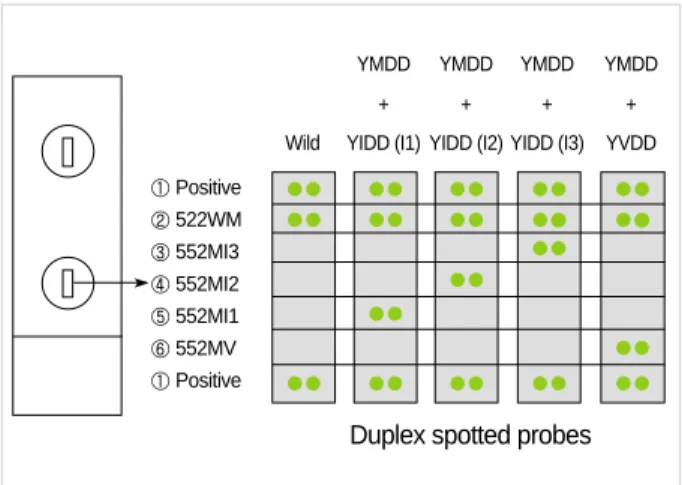
One probe (HB552-WM) was to detect wild-type YMDD motif and four kinds of probes (HB552-MV, HB552-MI1, HB552-MI2 and HB552-MI3) were to detect YMDD mutant on the bases of the HBV DNA polymerase sequence (Table 1). The 5 -end of each oligonucleotide probe was aminated to increase the efficacy of the immobilization of the oligonu- cleotide to a glass slide. The probes were diluted to 50 pmol
with 3×SCC (300 mM NaCl, 30 mM Na-citrate, pH 7.0) solution. These probes were printed in duplex arrays as shown in Fig. 1, and were adhered to the silylated glass slide (Cel Associates, Texas, U.S.A.) using the Microarrayer (PLXSYS 7500 SQXL Microarryer, Cartesian Technologies, CA, U.S.A.).
To get rid of unattached probes on the surface, the glass slide was washed with 0.2% SDS and then with distilled water twice, followed by sodium borohydride solution (300 mL of PBS, 100 mL of ethanol and 1 g of Na2BH4), and finally washed out with boiling distilled water. The slide was washed using 0.2% SDS again and then using distilled water at room temperature.
The detection of the mutants using the oligonucleotide chip
The biotin-labeled target DNA was boiled for 10 min and annealed at 4℃for 10 min to separate the two strands. Hybri- dization of 2 L of biotin-labeled ssDNA samples to the oligo- nucleotide chip was performed in hybridization solution, 3 L of 20×SSPE, 1.35 L of 22.2 M formamide, 0.5 L of bovine serum albumin (BSA) and 0.1 L of salmon sperm DNA containing 0.06 L of diluted Cy3-labeled streptavidin (Amer- sham Pharmacia Biotech, NJ, U.S.A.). Each sampling was placed on the slide, the cover slip being applied carefully so that no air bubble was trapped inside, and was left for reac- tion at 40℃for 30 min. After removing the cover slip using 2×SSC, the slide was washed out using 2×SSC and 0.2×
SCC solution in this order. The GenePix 4000A (Axon Instru- ments, CA, U.S.A.), non-confocal laser scanner was used for oligonucleotide chip analysis (543 nm for excitation of Cy3).
The variable sequences are in bold and italic print. W means wild type.
M means mutant type.
*Characters following W or M mean amino acid type encoded by codon at mutation region. V, valine; I, isoleucine.
Primer and probe* Sequence
HBF2-biotin 5 biotin-CCATCATCTTGGGCTTTCGC-3 HBR-biotin 5 biotin-AGACTTGGCCCCAATACCA-3 HB 552-WM 5 -CAGTTATATGGATGATG-3 HB 552-MV 5 -CAGTTATGTGGATGATG-3 HB 552-MI1 5 -CAGTTATATAGATGATG-3 HB 552-MI2 5 -CAGTTATATCGATGATG-3 HB 552-MI3 5 -CAGTTATATTGATGATG-3
Table 1.Primers and probes used in YMDD motif mutant detec- tion assay
′
′
′
′
′
′
′
′
′
′
′
′
′
′
Fig. 1.This schematic illustration shows the probe layout for the 17 mer oligonucleotide sequences noted in Table 1 and the inter- pretative results of oligonucleotide chips for YMDD motif mutation detection. The oligonucleotide probes are patterned as duplex arrays. ① Positive is mixture of HB552-WM, HB552-MV, HB552- MI1, HB552-MI2 and HB552-MI3 probes (Table 1), ② 522WM,
③ 552MI3, ④ 552MI2, ⑤ 552MI1 and ⑥ 552MV indicates HB552- WM, HB552-MV, HB552-MI1, HB552-MI2 and HB552-MI3 probes, respectively.
①Positive
②522WM
③552MI3
④552MI2
⑤552MI1
⑥552MV
①Positive
Wild YIDD (I1) YIDD (I2) YIDD (I3) YVDD
Duplex spotted probes
YMDD YMDD YMDD YMDD
+ + + +
′
Restriction fragment length polymorphism (RFLP) of YIDD (I3) mutant
To confirm the results of the oligonucleotide chip experi- ment, the partial polymerase gene containing YMDD was analyzed with the restriction fragment length polymorphism (RFLP) method and the PCR direct-sequencing.
A PCR reactant solution, which consisted of 500 mM KCl, 100 mM Tris HCl (pH 9.0), 1% Triton X-100, 0.2 mM
dNTP (dATP, dGTP, dTTP and dCTP), 1.5 mM MgCl2, 10 pmol primer (BF108 and BR112, Table 2) (4) and 1 U Taq DNA polymerase (QIAGEN, CA, U.S.A.), was added to 2 L of HBV DNA purified by the alkaline method to make it 25 L in total. This mixture solution was left to dena- ture at 94℃for 4 min, followed by 35 cycles of 1 min at 94
℃, 1 min at 58℃and 1 min and 30 sec at 72℃. For the last cycle, it was left for 10 min at 72℃. The second PCR was performed under the same circumstances as the first PCR using 1 L of the first PCR product, YNSspI and BR109 primer. This product was electrophoresed with 2% agarose gel to confirm that the PCR product was about 160 bp. Six L of this confirmed product was added to 5 units of the restriction enzyme SspI (TaKaRa, Shiga, Japan) and SspI buffer and left for reaction at 37℃for 3 hr, which was again con- firmed by electrophoresis with 4% agarose gel.
RFLP of YVDD mutant
As described above, the PCR was performed with BF107 and TMPpu10I primers (the first PCR) and BF111 and TMA- paLI primers (the second PCR) (Table 2). This product was electrophoresed with 2% agarose gel to confirm that the PCR product was about 190 bp. Six L of this confirmed product was added to 5 units of the restriction enzyme ApaLI (TaKaRa, Shiga, Japan) and ApaLI buffer and left for reaction at 37℃
Primer Sequence NucleotideDirection
position BF 105 5 -TCCTGCTGCTATGCCTCATC-3 411-430 sense BF 108 5 -ATGCCGTTTCTCCTGGCTCA-3 655-674 sense BR 112 5 -TTCCGTCGACATATCCCATGAA- 895-865 antisense
GTTAAGGGA-3
YNSspI 5 -TTTCCCCCACTGTTTGGCTTTCA- 711-740 sense GTAATAT-3
BR 109 5 -AAGGGAGTAGCCCCAACGTT-3 870-851 antisense BF 107 5 -CCAGGAACATCAACCACCAG-3 485-504 sense TMPpu10I 5 -CAGACTTGGCCCCCAATACCA- 769-740 antisense
CATCATGCA-3
BF 111 5 -TCGGACGGAAACTGCACTTG-3 581-600 sense TMApaLI 5 -CAGACTTGGCCCCCAATACCA- 769-740 antisense
CATCGTGCA-3
Table 2.Primers used in sequencing and enzyme digestion assay
′
′
′
′
′
′
′
′
′
′
′
′
′
′
′
′
′
′
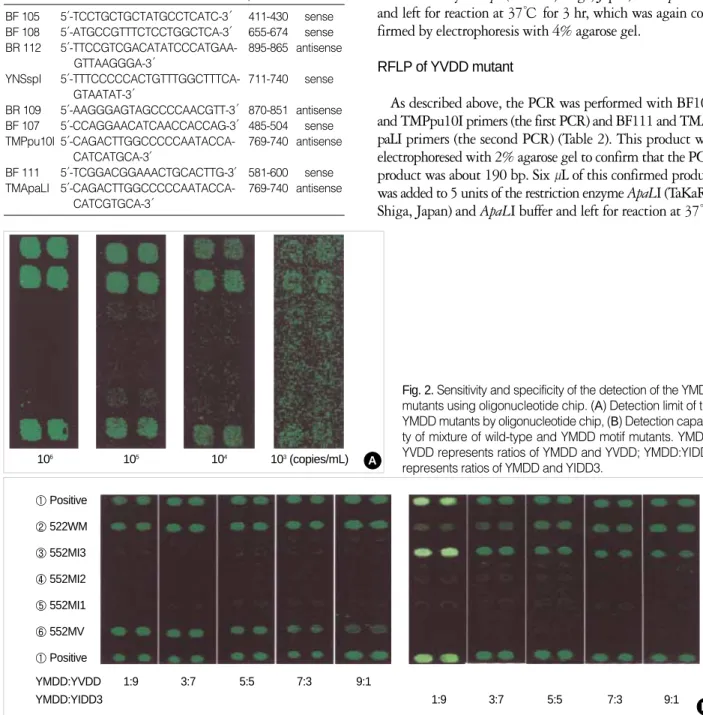
Fig. 2. Sensitivity and specificity of the detection of the YMDD mutants using oligonucleotide chip. (A) Detection limit of the YMDD mutants by oligonucleotide chip, (B) Detection capaci- ty of mixture of wild-type and YMDD motif mutants. YMDD:
YVDD represents ratios of YMDD and YVDD; YMDD:YIDD3 represents ratios of YMDD and YIDD3.
A
B
106 105 104 103(copies/mL)
①Positive
②522WM
③552MI3
④552MI2
⑤552MI1
⑥552MV
①Positive
YMDD:YVDD 1:9 3:7 5:5 7:3 9:1
YMDD:YIDD3 1:9 3:7 5:5 7:3 9:1
for 3 hr, which was again confirmed by electrophoresis with 4% agarose gel.
Sequencing and sequence analysis
PCR was performed with BF105 and BR112 primers (Table 2) under the same condition as target DNA prepara- tion. The sequence of PCR products was determined with BF111 and BR109 primers, and using the ABI prism BigDye Terminator cycle sequencing Ready Reaction Kit (Applied Biosystem Inc., CA, U.S.A.) in the automated BaseStation- 51 DNA fragment analyzer (MJ Research, CA, U.S.A.).
RESULTS
Sensitivity and specificity of oligonucleotide chip
After serially diluting samples (106-103copies/mL) with known HBV DNA concentrations by the Cobas Amplicor HBV Monitor testTM‚ (Roche Diagnostics Systems, Meylan, France), the detection limit of the DNA chip was evaluated.
The detection limit obtained by a DNA chip assay was 104 copies/mL of serum by the first PCR (Fig. 2A) and 103copies/
mL by nested PCR (data not shown). We constructed plas- mids containing a copy of the YMDD, YVDD and YIDD of the polymerase gene of HBV. The YMDD, YVDD and YIDD plasmids (cloned HBV DNA) were used to deter- mine the capacity of the DNA chip to detect wild-type HBV and YMDD motif mutant in a single sample. We could detect the YMDD motif mutant with the DNA chip when the mutant was mixed with a ten-fold-higher and -lower amount of wild-type HBV (Fig. 2B).
Detection of YMDD Mutants by oligonucleotide chip
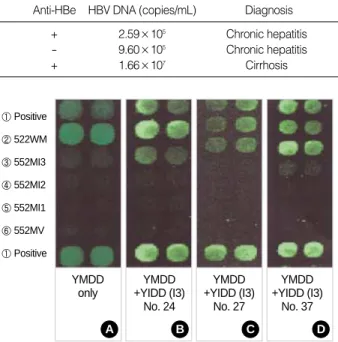
Thirty seven patients out of 40 had the wild-type YMDD mutants, and 3 of them (7.5%) had the mixed type of YMDD and YIDD (I3). Among 3 patients with any mutation (24th, 27th and 37th samples), 2 had chronic hepatitis and one had liver cirrhosis (Table 3, Fig. 3).
Detection of YMDD mutants by RFLP and direct sequencing
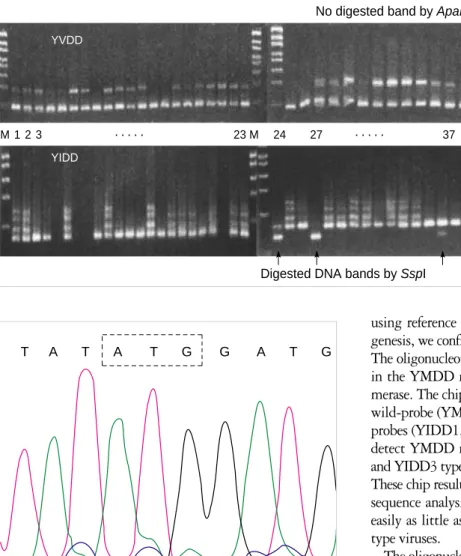
When the codon 552 of the second PCR product by the TMApaLI primer was GTG (GTGCAC), there was no band seen, and was 30 bp shorter by the limiting enzyme ApaLI,
throughout the samples. When the codon 552 of the second PCR product using the YNSspI primer was ATT (AATATT), about 30 bp were cut by the limiting enzyme SspI, and this shortened band was confirmed by electrophoresis with 4%
agarose gel. Out of the total samples, shortened bands were observed in sample Nos. 24, 27 and 37, which were identi- cal to YIDD mutants (ATT) detected by the oligonucleotide chip. No shortened band was seen in the other samples (Fig. 4).
The PCR direct-sequencing method was unable to prove YMDD mutation, which was confirmed by the oligonucleo- tide chip (Fig. 5).
DISCUSSION
The YMDD motif mutant of the polymerase gene is fre- quently found in patients who used lamivudine on a long term basis, and it is usually reported to emerge after 8 months of therapy (2, 6, 7). The selection of a mutation in the YMDD motif is known to occur several months earlier than the phe- notypic resistance, however the information about how early the genotypic resistance occurs and what causes the resistance is limited due to the small number of subjects and differences in detection methods (3, 4, 8). Hence the rate of hepatitis B resistance to lamivudine might increase further when more sensitive tests are used to detect the small amount of YMDD mutants among the wild type HBV, which would impact upon detection and monitoring the resistance.
This study demonstrated by oligonucleotide chip technolo-
Patient No. Age (yr) Sex ALT (IU/L) HBeAg Anti-HBe HBV DNA (copies/mL) Diagnosis
24 21 M 51 - + 2.59×10⁵ Chronic hepatitis
27 26 M 1,100 + - 9.60×10⁵ Chronic hepatitis
37 42 M 93 - + 1.66×10⁷ Cirrhosis
Table 3.Clinical features of patients with YMDD motif mutation (YMDD+YIDD) at the time of sampling
Fig. 3.Scanned images of oligonucleotide chip (A) wild type [YMDD], (B), (C), (D) YMDD motif mutation [YMDD+YIDD(I3)], slides of No. 24, 27 and 37, respectively.
①Positive
②522WM
③552MI3
④552MI2
⑤552MI1
⑥552MV
①Positive
A B C D
YMDD YMDD YMDD YMDD
only +YIDD (I3) +YIDD (I3) +YIDD (I3) No. 24 No. 27 No. 37
gy that the YMDD mutants exist naturally in the patients with chronic hepatitis B infection who had not received lami- vudine before.
YMDD mutants have a significantly low replication abili- ty. It is thought that naturally occurring YMDD mutants occupy very small portion of total HBV, and very sensitive investigative tools are required to prove it. Oligonucleotide chip technology is a very useful tool for the rapid and accu- rate identification of pathogenic microbes and the detection of drug-resistant and point mutations. This method has such sensitivity that it can find rifampin-resistant tuberculosis resultant from point mutation in amounts of less than 1%
(9). Oligonucleotide chip technology has been expected to be clinically applicable to detect minor variants in viral quasi- species and to increase our knowledge of spontaneous viral genome variability and selection of mutants by antiviral thera- py (10). We developed the oligonucleotide chip for the detec- tion of mutants resistant to lamivudine. In the experiment
using reference sequences generated by site-directed muta- genesis, we confirmed the sensitivity and specificity of probes.
The oligonucleotide chips could specifically detect mutations in the YMDD motif (codon 552) of the HBV DNA poly- merase. The chips included three types of probe (five species):
wild-probe (YMDD), valine-probe (YVDD) and isoleucine- probes (YIDD1, YIDD2 and YIDD3). We could accurately detect YMDD motif mutants of YMDD, YVDD, YIDD2 and YIDD3 types in sera from chronic HBV-infected patients.
These chip results were in accordance with results from RFLP, sequence analysis and allele-specific PCR. We could detect easily as little as 10% of coexisting mutant viruses in wild type viruses.
The oligonucleotide chip method detected 3 YIDD mutants in the 40 patients included in this study. Only ATT (YIDD3) was detected in all three samples. This chip result was con- sistent with that of the RFLP analysis. The mutants were not detected by direct-sequencing and this is reasonable when taking into consideration that naturally occurring YMDD mutants are a minor portion of the total HBV and that the standard base sequence determinant method requires more than 25% of mutants among HBV.
Our study supports that oligonucleotide chip technology may have an important role as a reliable and useful diagnos- tic tool for the early detection of mutants resistant to lamivu- dine.
REFERENCES
1. Liaw YF, Leung NW, Chang TT, Guan R, Tai DI, Ng KY, Chien RN, Dent J, Roman L, Edmundson S, Lai CL. Effects of extended lamivudine therapy in Asian patients with chronic hepatitis B. Asia Hepatitis Lamivudine Study Group. Gastroenterology 2000; 119:
172-80.
2. Leung NW, Lai CL, Chang TT, Guan R, Lee CM, Ng KY, Lim SG, Fig. 4.(A) YVDD RFLP anal- ysis in 4% agarose gel does not show any band digest- ed by the restriction enzyme ApaLI. M: 100 bp ladder.
(B) YIDD RFLP analysis in 4% agarose gel shows DNA bands (arrows) digested by the restriction enzyme SspI in 3 YIDD (I3) mutants (sam- ple Nos. 24, 27 and 37). M:
100 bp ladder.
B M 1 2 3 . . . . . 23 M 24 27 . . . . . 37 M
YIDD
200
100 Digested DNA bands by SspI
A YVDD
200 No digested band by ApaLI
Fig. 5.The sequences of 290 bp DNA including codon 552 rep- resent only the wild-type (ATG) in the samples with YIDD mutants (No. 24, 27 and 37).
T A T A T G G A T G
Wu PC, Dent JC, Edmundson S, Condreay LD, Chien RN. On behalf of the Asia Hepatitis Lamivudine Study Group. Extended lamivudine treatment in patients with chronic hepatitis B enhances hepatitis B e antigen seroconversion rates: results after 3 years of therapy. Hep- atology 2001; 33: 1527-32.
3. Lau DT, Khokhar MF, Doo E, Ghany MG, Herion D, Park Y, Klein- er DE, Schmid P, Condreay LD, Gauthier J, Kuhns MC, Liang TJ, Hoofnagle JH. Long- term therapy of chronic hepatitis B with lamivu- dine. Hepatology 2000; 32: 828-34.
4. Chayama K, Suzuki Y, Kobayashi M, Kobayashi M, Tsubota A, Hashimoto M, Miyano Y, Koike H, Kobayashi M, Koida I, Arase Y, Saitoh S, Murashima N, Ikeda K, Kumada H. Emergence and takeover of YMDD motif mutant hepatitis B virus during long-term lamivudine therapy and re-takeover by wild type after cessation of therapy. Hepatology 1998; 27: 1711-6.
5. Paik YH, Chung HY, Ryu WS, Lee KS, Lee JS, Kim JH, Lee CK, Chon CY, Moon YM, Han KH. Emergence of YMDD motif mutant of hepatitis B virus during short-term lamivudine therapy in South Korea. J Hepatol 2001; 35: 92-8.
6. Perrillo R, Rakela J, Dienstag J, Levy G, Martin P, Wright T, Cald- well S, Schiff E, Gish R, Villeneuve JP, Farr G, Anschuetz G, Crowther
L, Brown N. Multicenter study of lamivudine therapy for hepatitis B after liver transplantation. Lamivudine Transplant Group. Hepatol- ogy 1999; 29: 1581-6.
7. Liaw YF, Chien RN, Yeh CT, Tsai SL, Chu CM. Acute exacerba- tion and hepatitis B virus clearance after emergence of YMDD motif mutation during lamivudine therapy. Hepatology 1999; 30: 567-72.
8. Nafa S, Ahmed S, Tavan D, Pichoud C, Berby F, Stuyver L, John- son M, Merle P, Abidi H, Trepo C, Zoulim F. Early detection of viral resistance by determination of hepatitis B virus polymerase mutations in patients treated by lamivudine for chronic hepatitis B.
Hepatology 2000; 32: 1078-88.
9. Mikhailovich V, Lapa S, Gryadunov D, Sobolev A, Strizhkov B, Chernyh N, Skotnikova O, Irtuganova O, Moroz A, Litvinov V, Vla- dimirskii M, Perelman M, Chernousova L, Erokhin V, Zasedatelev A, Mirzabekov A. Identification of rifampin-resistant Mycobacteri- um tuberculosis strains by hybridization, PCR, and lipase detection reaction on oligonucleotide microchips. J Clin Microbiol 2001; 39:
2531-40.
10. Zoulim F. Detection of hepatitis B virus resistance to antivirals. J Clin Virol 2001; 21: 243-53.