Received:April 7, 2015, Revised:(1st) June 8, 2015, (2nd) July 4, 2015, Accepted:July 6, 2015
Corresponding to:Yeong Wook Song, Department of Internal Medicine, Seoul National University Hospital, 101 Daehak-ro, Jongno-gu, Seoul 03080, Korea. E-mail:[email protected]
pISSN: 2093-940X, eISSN: 2233-4718
Copyright ⓒ 2015 by The Korean College of Rheumatology. All rights reserved.
This is a Free Access article, which permits unrestricted non-commerical use, distribution, and reproduction in any medium, provided the original work is properly cited.
Depression and Quality of Life in Patients with Systemic Lupus Erythematosus
Sung Hae Chang1, Ja Hyun Cho2, Na Hee Shin2, Hye Jin Oh3, Byoong Yong Choi4, Myeong Jae Yoon3, Eun Young Lee3, Eun Bong Lee3, Yun Jong Lee5, Tae Jin Lee2, Bong Jin Hahm6, Young Wook Song3,7
1Department of Internal Medicine, Soonchunhyang University Cheonan Hospital, Cheonan, 2Graduate School of Public Health, Seoul National University, 3Division of Rheumatology, Department of Internal Medicine, Seoul National University Hospital, 4Department of Internal Medicine, Seoul Medical Center, Seoul, 5Department of Internal Medicine, Seoul National University Bundang Hospital, Seongnam, 6Department of Neuropsychiatry, Seoul National University Hospital, 7Department of Molecular Medicine and Biopharmaceutical Sciences, Graduate School of Convergence Science and Technology, Medical Research Center, Seoul National University, Seoul, Korea
Objective. The objective of this study is to examine the prevalence of depression and its related factors including quality of life, brain-derived neurotrophic factor (BDNF), and vitamin D in patients with systemic lupus erythematosus (SLE). Methods.
Depression was assessed using the center for epidemiologic studies depression (CES-D) scale. Disease activity, disease-related organ damage, the EuroQol-5 dimensions (EQ-5D), sociodemographic features, and laboratory tests including serum vitamin D level were surveyed. Serum BDNF was measured using an enzyme-linked immunosorbent assay. Results. Depression was observed in 22.8% of 180 SLE patients (n=41). Patients with marital status of single/divorced/separated/widowed, a higher pa- tient global assessment (PGA) score, and extreme pain/discomfort showed significant association with depression. The EQ-5D index showed negative correlation with CES-D score (r=−0.56, p<0.05). In each EQ-5D dimension, depression showed sig- nificant association with moderate to severe problems in self-care and usual activities, and extreme pain/discomfort. Serum BDNF levels were not associated with depression (p=0.75) but associated with SLE disease activity index (SLEDAI; r=−0.21, p<0.05). Serum vitamin D levels were not associated with depression (p=0.60) but showed negative correlation with SLEDAI (r=−0.23, p<0.05) and mean glucocorticoid dose over the previous 3 months (r=−0.21, p<0.05) after adjustment for use of vitamin D supplement. Conclusion. Depression was prevalent in patients with SLE and was associated with low quality of life, and a higher PGA but not with SLEDAI. Serum BDNF and vitamin D levels were not associated with depression but showed negative correlation with SLEDAI. (J Rheum Dis 2015;22:346-355)
Key Words. Systemic lupus erythematosus, Depression, Quality of life, Brain-derived neurotrophic factor, Vitamin D
INTRODUCTION
Depression is one of the most prevalent diseases with substantial disease burden [1]. The prevalence of depres- sion in patients with systemic lupus erythematosus (SLE) is reported to be higher than those in general pop- ulation [2-6]. In addition to psychological defense to cope with chronic disease, pathological processes of disease such as inflammations contribute the development of de- pression in patients with SLE. Circulating autoantibodies
such as anti-N-methyl-D-aspartate (NMDA) receptor an- tibody are prone to penetrate blood brain barrier due to increment of its permeability in inflammatory milieu.
They may result in non-thrombotic and non-vasculitic ab- normalities of central nervous system by modifying syn- aptic function and inducing neural cell death [7]. Further- more, inflammatory cytokines lead to decrease neuro- trophic support and alter monoamine release/reuptake [8].
The result of depression is also considerable in patients
with SLE. Patients with SLE and depression do not tend to adhere to medication regimens and require more fre- quent medical attention [6]. Psychological factors includ- ing depression are known to affect health related quality of life (HRQoL) in patients with SLE [9,10]. Considering improvement of HRQoL is one of important treatment target in SLE [11], understanding risk factors for depres- sion and early intervention for depression may improve the treatment results by improving not only compliance to medication but also HRQoL.
Neurotrophic factors (NFs) and vitamin D have at- tracted attentions as molecules untangling neurophy- siologic mechanism of depression [12-15]. In patients with depression, decreased levels of NFs result in volu- metric decreases of the hippocampus and other forebrain regions [12,13]. Vitamin D insufficiency/deficiency is ob- served in patients with depression, and the correction of vitamin D deficiency is reported to improve the depres- sion state [14,15]. However, because the most studies about brain-derived neurotrophic factor (BDNF) or vita- min D for depression were conducted among patients with depression irrelevant to comorbidity, it is unclear whether pathologic mechanisms of such molecules can be applicable in patients with certain disease subset.
In the present study, we investigated the prevalence of depression and its related factors including HRQoL and analyzed clinical factors associated with each of the EuroQol-5 dimensions (EQ-5D) in patients with SLE. In addition, we examined whether BDNF and vitamin D are related to the presence of depression in patients with SLE.
MATERIALS AND METHODS
Study population
A total of 180 patients were enrolled at the Rheumatolo- gy Clinic from January to March 2012. All the participants fulfilled the 1997 updated American College of Rheuma- tology (ACR) criteria for the classification of SLE [16].
The study was approved by the ethics committee of Seoul National University Hospital, and all the subjects pro- vided written informed consents (IRB: 1308-119-517).
Data and sample collection
The patients completed questionnaires about socio- demographic factors such as the number of family mem- bers, marital status, occupational status, and an annual income. Disease activity of SLE was evaluated using the patient’s global assessment (PGA), physician’s global as-
sessment (PhyGA), and SLE disease activity index (SLEDAI) at the time of the interview. Patients with ac- tive SLE were defined as those with a SLEDAI ≥6. PGA and PhyGA were measured using a 0 to 100 mm and 0 to 30 mm visual analogue scale, respectively. SLE-related or- gan damage was assessed using the Systemic Lupus International Collaborating Clinics/ACR damage index (SDI). Laboratory data including complete blood cell count including white cell, hemoglobin (Hb) level, plate- let count, serum creatinine, anti-dsDNA, and comple- ment (C3, C4) levels were measured. Use of azathioprine, mycophenolate mofetil, cyclophosphamide, methotrexate, hydroxychloroquine, vitamin D supplement and gluco- corticoid was surveyed retrospectively by reviewing pre- scribed medications during a year before the study.
Depression was evaluated using the center for epi- demiologic studies depression (CES-D) scale. The CES-D is a 20-item scale that is widely used to evaluate current depressive symptoms in adults with physical illness and in the general population [17]. The CES-D has been translated into Korean, and its psychometric properties have been validated [18]. Patients with a CES-D score
≥24 were considered to have depression according to a previous study in patients with SLE [19]. HRQoL was as- sessed by the EQ-5D [20]. The EQ-5D questionnaire con- sists of five domains about patient mobility, hygiene, dai- ly activities, pain, and anxiety/depression. EQ-5D index was obtained through a tariff system developed in South Korea as follows: EQ-5D index=1−(0.164+M2×0.003
+M3×0.274+SC2×0.058+SC3×0.078+UA2×0.045
+UA3×0.134+PD2×0.049+PD3×0.132+AD2×0.044
+AD3×0.102+N3×0.345+I2sq×0.014) (M: mobility, SC: self-care, UA: usual activity, PD: pain/discomfort, AD: anxiety/depression, 2: level 2, 3: level 3, N3: 1 in cas- es of existence of level 3 in any dimension, I2sq: [num- bers of level 2−1]2) [21]. A higher score of the EQ-5D in- dex indicates that the respondent had fewer problems in each dimension. EQ-5D has been reported to have good validity and sensitivity in assessing HRQoL of patients with SLE [22].
Serum BDNF and vitamin D measurements
Serum samples were obtained from 151 of 180 patients at baseline and stored at −80oC until analysis. Serum BDNF levels were also analyzed in 50 healthy age- and sex-matched subjects using enzyme-linked immunosor- bent assay kits (DuoSet BDNF ELISA; R&D Systems, Minneapolis, MN, USA) according to the manufacturer’sTable 1. Sociodemographic factors of the patients with SLE with or without depression
Variable All subjects
(n=180)
Depression (n=41)
No depression
(n=139) p-value*
Female 160 (88.9) 39 (95.1) 121 (87.1) 0.15
Age (yr) 43.3±13.9 42.0±18.0 43.5±12.6 0.22
Disease duration (yr) 11.0±7.6 10.4±7.34 11.2±7.69 0.54
Educational level
Less than college graduates 84 (46.7) 25 (61.0) 59 (42.4) 0.04
At least college graduates 96 (53.3) 16 (39.0) 80 (57.6)
Marital status
Married 110 (61.1) 16 (39.0) 94 (67.6) 9.63×10⁻⁴
Single/divorced /separated/widowed 70 (38.9) 25 (61.1) 45 (32.4) Living arrangement
Alone 8 (4.4) 2 (4.9) 6 (4.3) 1.00
With others 172 (95.6) 39 (95.1) 133 (95.7)
Unemployed 111 (61.7) 32 (78.0) 79 (56.8) 0.01
Annual income (n=161)
≤18,000,000 KRW 26 (16.1) 9 (25.7) 17 (13.5) 0.08
>18,000,000 KRW 135 (83.9) 26 (74.3) 109 (86.5)
Values are presented as number (%) or mean±standard deviation. KRW: Korean Won, SLE: systemic lupus erythematosus.
*p-value comparing patients with SLE with depression vs. those without depression by χ2-test or student t-test.
instructions. All assays were performed in duplicate.
Serum vitamin D (25-hydroxyvitamin D, 25[OH]D) lev- el was measured using liquid chromatography-tandem mass spectrometry (Waters Corp., Milford, MA, USA).
Serum vitamin D levels of 10 to 20 ng/mL and <10 ng/mL were defined as vitamin D insufficiency and defi- ciency, respectively.
Statistical analysis
Data are presented as the mean±standard deviation (SD) or number (percentage of the population) as appro- priate. For non-normally distributed variables, Mann- Whitney U test or Kruskal-Wallis test were used to com- pare group means as appropriate. Bonferroni correction was applied to multiple comparison procedures. Catego- rical variables were compared using chi-square or Fisher’s exact tests. Bivariate correlations were analyzed by Spear- man’s correlation coefficient. The multiple logistic re- gression analyses were performed to elucidate the asso- ciated clinical factors for depression and each dimensions of EQ-5D. Variables of p-value equal or less than 0.10 and factors that are expected to affect depression were in- cluded in analysis with adjusting for age and sex. p or cor- rected p (pc)-values <0.05 were considered significant.
All the analyses were performed using PASW Statistics ver. 18.0 (IBM Co., Armonk, NY, USA).
RESULTS
Patient characteristics
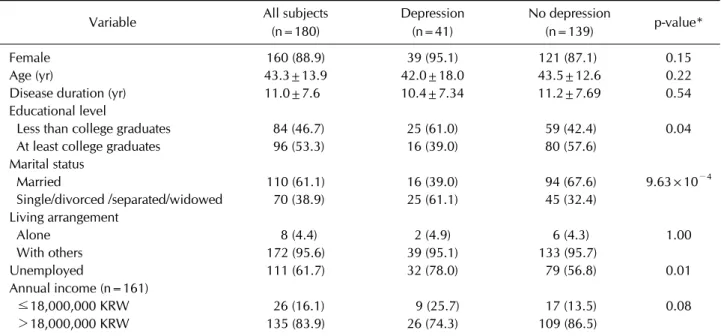
A total of 180 patients were enrolled (160 female pa- tients, 88.9%). The mean age (±SD) was 43.3±13.9 yr, and the mean disease duration was 11.0±7.6 yr (Table 1).
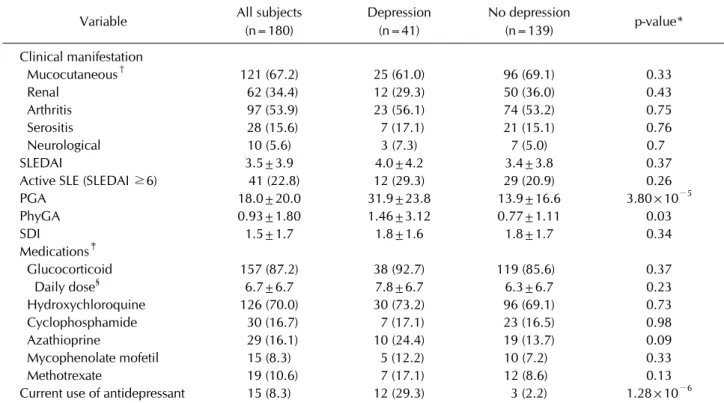
The annual income less than 18,000,000 Korean won per year were found in 21.1% of the study patients. More than half of the patients were married or at least college graduates. The mean SLEDAI was 3.5±3.9, and the mean SDI was 1.5±1.7 (Table 2).
On laboratory examination, the mean Hb levels, white cell, platelet and lymphocyte counts were 12.9±3.1 g/dL, 6,213.9±2,601.0/mm3, 214.3±69.6×10³/mm3, 1,247.3±
789.1/mm3, respectively. The mean of serum creatinine levels, anti-dsDNA titer, serum complement C3 and C4 levels were 1.04±1.13 g/dL, 24.6±41.1 IU/mL (refer- ence range: <10 IU/mL), 81.6±21.5 mg/dL (reference range: 70 to 150 mg/dL) and 17.3±9.3 mg/dL (reference range: 10 to 35 mg/dL), respectively.
Depression and sociodemographic or clinical fac- tors in SLE patients
Depression was observed in 22.8% of 180 SLE patients (n=41). Sex, age, and disease duration were not asso- ciated with depression. Among the sociodemographic factors, educational level, marital status, and employment
Table 2. Clinical factors of the patients with SLE with or without depression
Variable All subjects
(n=180)
Depression (n=41)
No depression
(n=139) p-value*
Clinical manifestation
Mucocutaneous† 121 (67.2) 25 (61.0) 96 (69.1) 0.33
Renal 62 (34.4) 12 (29.3) 50 (36.0) 0.43
Arthritis 97 (53.9) 23 (56.1) 74 (53.2) 0.75
Serositis 28 (15.6) 7 (17.1) 21 (15.1) 0.76
Neurological 10 (5.6) 3 (7.3) 7 (5.0) 0.7
SLEDAI 3.5±3.9 4.0±4.2 3.4±3.8 0.37
Active SLE (SLEDAI ≥6) 41 (22.8) 12 (29.3) 29 (20.9) 0.26
PGA 18.0±20.0 31.9±23.8 13.9±16.6 3.80×10⁻⁵
PhyGA 0.93±1.80 1.46±3.12 0.77±1.11 0.03
SDI 1.5±1.7 1.8±1.6 1.8±1.7 0.34
Medications‡
Glucocorticoid 157 (87.2) 38 (92.7) 119 (85.6) 0.37
Daily dose§ 6.7±6.7 7.8±6.7 6.3±6.7 0.23
Hydroxychloroquine 126 (70.0) 30 (73.2) 96 (69.1) 0.73
Cyclophosphamide 30 (16.7) 7 (17.1) 23 (16.5) 0.98
Azathioprine 29 (16.1) 10 (24.4) 19 (13.7) 0.09
Mycophenolate mofetil 15 (8.3) 5 (12.2) 10 (7.2) 0.33
Methotrexate 19 (10.6) 7 (17.1) 12 (8.6) 0.13
Current use of antidepressant 15 (8.3) 12 (29.3) 3 (2.2) 1.28×10⁻⁶
Values are presented as number (%) or mean±standard deviation. PGA: patient’s global assessment, PhyGA: physician’s global assessment, SDI: Systemic Lupus International Collaborating Clinics/American College of Rheumatology damage index, SLE:
systemic lupus erythematosus, SLEDAI: SLE disease activity index. *p-value comparing patients with SLE with depression vs. those without depression by χ2- test or student t-test. †Mucocutaneous (malar rash, discoid rash, photosensitivity, and oral ulcers), renal, and neurological involvement is defined as in the 1997 updated American College of Rheumatology criteria for the classification of SLE. ‡Medications prescribed during a year before the study. §Mean daily prednisolone dose over the previous 3 months (mg/d).
status were significantly associated with depression; pa- tients with less than college graduates (p=0.04), a mar- ital status of single/divorced/separated/widowed (p=
9.63×10⁻⁴) and unemployment (p=0.01) were associ- ated with depression in SLE. A lower annual income tend- ed to be associated with depression (p=0.08; Table 1).
Among the clinical factors, higher scores of PGA and PhyGA were significantly associated with depression, whereas mean daily glucocorticoid dose over the previous 3 months, SLEDAI or SDI was not. There was no sig- nificant association between depression and medications except antidepressant which were prescribed during a year before the study. The proportion of patients with cur- rent use of antidepressant was significantly higher in pa- tient with depression than in those without depression (p=1.28×10⁻⁶; Table 2). None of the clinical manifes- tations or laboratory results including Hb levels, white cell count, platelet count, serum creatinine levels, an- ti-dsDNA titer or complement levels was significantly as- sociated with depression.
HRQoL and analysis for associated factors in each dimension of EQ-5D in patients with SLE
In patients with SLE, EQ-5D index of patients with de- pression was significantly reduced than those of patients without depression (0.49±0.27 vs. 0.73±0.12, p=1.23×
10−6). Patients with depression had more problems in all dimensions of EQ-5D (Table 3). There were significant negative correlations between EQ-5D index and CES-D scores (r=−0.56, p=1.72×10⁻¹⁶), PGA (r=−0.24, p=
1.00×10⁻³), PhyGA (r=−0.33, p=1.43×10⁻⁵), or SDI (r=−0.17, p=0.02 by the Spearman correlation test).
The association between sociodemographic or clinical factors and each dimension of EQ-5D were analyzed (Supplementary Table 1; Supplementary Table in the on- line version of this article). Of note, in multiple logistic regression analysis, depression was significantly asso- ciated with dimensions of self-care, usual activity, and ex- treme pain/discomfort.
Table 3. Comparison of health related quality of life in the patients with SLE with or without depression
Variable All subjects
(n=180)
Depression (n=41)
No depression
(n=139) p-value*
EQ-5D index 0.68±0.19 0.49±0.27 0.73±0.12 1.23×10⁻⁶
Mobility
I have no problems walking 122 (67.8) 22 (53.7) 100 (71.9) 0.02
I have some problems in walking 57 (31.7) 18 (43.9) 39 (28.1)
I am confined to bed 1 (0.6) 1 (2.4) 0 (0.0)
Self-care
I have no problems with self-care 161 (89.4) 32 (78.0) 129 (92.8) 0.01
I have some problems in washing or dressing myself 16 (8.9) 7 (17.1) 9 (6.5)
I am unable to wash or dress myself 3 (1.7) 2 (4.9) 1 (0.7)
Usual activities
I have no problems in performing my usual activities 120 (66.7) 19 (46.3) 101 (72.7) 4.40×10⁻⁴ I have some problems performing my usual activities 58 (32.2) 20 (48.8) 38 (27.3)
I am unable to perform my usual activities 2 (1.1) 2 (4.9) 0 (0.0) Pain/discomfort
I have no pain or discomfort 65 (36.1) 7 (17.1) 58 (41.7) 1.17×10⁻⁵
I have moderate pain or discomfort 99 (55.0) 23 (56.1) 76 (54.7)
I have extreme pain or discomfort 16 (8.9) 11 (26.8) 5 (3.6)
Anxiety/depression
I am not anxious or depressed 79 (43.9) 5 (12.2) 74 (53.2) 1.87×10⁻¹⁰
I am moderately anxious or depressed 90 (50.0) 25 (61.0) 65 (46.8) I am extremely anxious or depressed 11 (6.1) 11 (26.8) 0 (0.0)
Values are presented as mean±standard deviation or number (%). EQ-5D: the EuroQol-5 dimensions, SLE: systemic lupus erythematosus. *p-value assessing the trend using linear by linear association comparing the patients with SLE with depression vs.
those without depression.
Multiple logistic regression analysis of depression in patients with SLE
Patients with a marital status of single/divorced/sepa- rated/ widowed (p=0.03), a higher PGA (p=2.13×10⁻⁴), and extreme pain/discomfort (p=0.02) were signifi- cantly associated with depression in patients with SLE.
Patients with lower educational level (less than college graduates; p=0.08) or with moderate to severe problems in usual activity (p=0.09) tended to be associated with depression (Table 4).
Serum levels of BDNF and associated factors in SLE
Serum levels of BDNF were measured in 151 patients (136 female patients, 90.1%) and 50 healthy age- and sex-matched subjects (45 female patients, 90.0%). The mean ages of the patients and healthy subjects were com- parable (43.0±14.3 vs. 43.3±12.6 years old, respecti- vely). Serum levels of BDNF in patients with SLE were not significantly different from those in healthy subjects (21.5±8.2 ng/mL vs. 22.0±9.3 ng/mL, p=0.73). Depres- sion was not associated with serum BDNF levels among
patients with SLE (SLE patients with depression vs. those without depression, 21.0±8.0 ng/mL vs. 21.5±7.8 ng/mL, respectively, p=0.75). There was no significant difference in serum BDNF levels between the healthy subjects and the SLE patients with depression (pc=1.00) or without depression (pc=1.00, Figure 1A). After subgroup analysis according to disease activity, no difference in BDNF level was seen between active or inactive patients with SLE with or without depression (Figure 1B). However, lower serum BDNF levels were significantly associated with ac- tive SLE (active vs. inactive SLE, 18.3±6.7 ng/mL vs.
22.4±7.9 ng/mL, respectively, p=0.04). Because platelet is the major storage source of BDNF [23-25], platelet count was highly positively correlated with serum BDNF levels in this study (r=0.53, p=2.16×10⁻¹²). In addition, platelet count could be decreased in active SLE and 17.4%
(n=31) patients had thrombocytopenia (platelet count
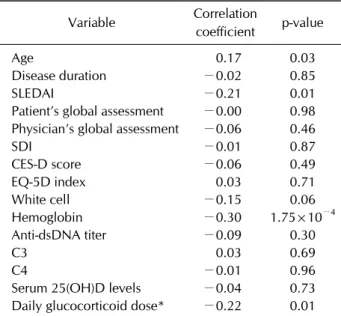
<150,000/mm3) in the current study. Partial correla- tion analysis, adjusting platelet count, revealed no corre- lation between serum BDNF levels and CES-D scores (r=−0.06, p=0.49), but a negative correlation between serum BDNF levels and SLEDAI (r=−0.21, p=0.01),
Figure 1. Association between serum levels of brain-derived neurotrophic peptide (BDNF) and depression in the patients with sys- temic lupus erythematosus (SLE). The serum levels of BDNF were comparable between the healthy subjects and SLE patients with depression or without depression (A). When the patients were divided into active and inactive disease, no difference in serum BDNF levels was found between patients with depression and those without depression (B).
Table 4. Multiple logistic regression analysis for depression in the patients with SLE
Variable Coefficient OR (95% CI) p-value
Age −0.02 0.98 (0.93∼1.03) 0.42
Sex (female) −0.31 0.74 (0.12∼4.56) 0.74
Educational level (less than college graduate) 1.00 2.71 (0.90∼8.15) 0.08 Marital status (single/divorced/separated/widowed) 1.51 4.53 (1.19∼17.25) 0.03
Unemployment 0.47 1.61 (0.51∼5.07) 0.42
Annual income (≤18,000,000 KRW) 0.12 1.12 (0.25∼5.11) 0.88
Patient’s global assessment 0.05 1.05 (1.02∼1.08) 2.13×10⁻⁴
Physician’s global assessment −2.8×10⁻³ 1.00 (1.02∼1.00) 0.48
Use of azathioprine −0.24 0.79 (0.21∼2.96) 0.73
Mobility (moderate to severe problems) 0.19 1.21 (0.37∼3.94) 0.75
Self-care (moderate to severe problems) 0.71 2.04 (0.37∼11.23) 0.41
Usual activity (moderate to severe problems) 1.04 2.83 (0.86∼9.35) 0.09
Pain/discomfort (extreme pain/discomfort) 2.00 7.38 (1.30∼42.06) 0.02
CI: confidence interval, KRW: Korean Won, OR: odds ratio, SLE: systemic lupus erythematosus.
Hb levels (r=−0.30, p=1.74×10⁻⁴), a mean daily glu- cocorticoid dose over the previous 3 months of the study (r=−0.22, p=0.01) (Table 5).
Serum 25(OH)D levels and depression in SLE
Serum 25(OH)D levels were measured in 103 patients (94 female patients, 91.3%). The mean serum 25(OH)D level was 20.1±10.8 ng/mL. Vitamin D insufficiency was observed in more than half of these patients (57 patients, 53.3%), whereas vitamin D deficiency was observed in only 8 patients (7.5%). Serum 25(OH)D levels were com-parable between the SLE patients with or without depres- sion (20.7±10.8 ng/mL vs. 19.9±10.9 ng/mL, p=0.60).
Serum 25(OH)D levels were not associated with clinical factors such as mucocutaneous involvement (21.0±9.1 vs. 20.0±11.7, p=0.28), renal disorder (p=0.36), or neu- ropsychiatric disorder (p=0.50). Use of vitamin D sup- plement was correlated with serum 25(OH)D levels (p=3.42×10⁻³) while use of other medications was not related to serum 25(OH)D levels. Twenty-three percent (n=24) of patients have taken vitamin D supplement dur- ing a year before the study. Partial correlation analysis, ad-
Table 5. Correlation analysis for serum brain-derived neuro- trophic factor levels and associated factors with adjustment for platelet count in patients with SLE (n=151)
Variable Correlation
coefficient p-value
Age 0.17 0.03
Disease duration −0.02 0.85
SLEDAI −0.21 0.01
Patient’s global assessment −0.00 0.98 Physician’s global assessment −0.06 0.46
SDI −0.01 0.87
CES-D score −0.06 0.49
EQ-5D index 0.03 0.71
White cell −0.15 0.06
Hemoglobin −0.30 1.75×10⁻⁴
Anti-dsDNA titer −0.09 0.30
C3 0.03 0.69
C4 −0.01 0.96
Serum 25(OH)D levels −0.04 0.73 Daily glucocorticoid dose* −0.22 0.01 C: complement, CES-D: the center for epidemiologic studies depression, EQ-5D: the EuroQol-5 dimensions, SDI: Systemic Lupus International Collaborating Clinics/American College of Rheumatology damage index, SLE: systemic lupus erythe- matosus, SLEDAI: SLE disease activity index. *Mean daily pre- dnisolonedose over the previous 3 months (mg/d).
justing use of vitamin D supplement, showed a negative correlation between serum 25(OH)D levels and SLEDAI (r=−0.23, p=0.02) or a mean daily glucocorticoid dose over the previous 3 months of the study (r=−0.21, p=0.04).
DISCUSSION
In the present study, the prevalence of depression was 22.8%, which is higher than that in the general pop- ulation (3.31% to 8.68%) as shown by earlier reports [2,4-6,18]. Among sociodemographic factors, depression was associated with marital status of single/divorced/
separated/widowed in patients with SLE. The previous study results were not consistent in terms of the socio- demographic variables related to depression in patients with SLE [1-4,6,9-10]. Those contradictory results imply that sociodemographic factors rather than disease itself may have more influence on depression in this population. Several previous studies conducted with Koreans showed robust association between disrupted marital status and depression [5,19].
Associations between depression and disease activity
are also inconsistent because of methodological differ- ence in measuring disease activity of SLE [2,26-28].
Using the objective disease activity measure such as SLEDAI there was no association between depression and disease activity [2,27-28], whereas using the sub- jective disease activity measure such as systemic lupus ac- tivity questionnaire (SLAQ), disease activity was shown to be associated with depression [2,26,27]. In the current study, PGA, the subjective disease activity measure by pa- tients’ perspective was significantly associated with de- pression while SLEDAI, the objective disease activity measure was not associated with depression in accord- ance with previous researches. Additionally, PhyGA, the subjective disease activity measure by physician’s per- spective were not correlated with depression, which sug- gest the discrepancy in assessment of disease activity ac- cording to patient’s or physician’s perspective in line with preceding study [29].
Because of diverse clinical manifestations and no stand- ardized blood test to assess disease status, improvement of HRQoL is one of important treatment target in patients with SLE [11]. Depression has been consistently reported to have substantial impact on HRQoL of SLE patients in accordance with the current study [9-11,30,31]. It is noteworthy that depression was highly associated with extreme pain/discomfort in the present study. Conside- ring that pain and depression share norepinephrine or se- rotonin neurotransmitter pathways, pain may result in depression and vice versa. Indeed, patients with cancer and depression experience more severe pain and have a worse prognosis than those without depression [31].
Considering fibromyalgia, characterized by generalized pain, was observed in 32% of patients with SLE in an ear- lier study [32], although we did not investigate fibro- myalgia among the study patients, patients with extreme pain/discomfort might have fibromyalgia, which can in- fluence mood and quality of life. Intensive management of depression has been reported to improve arthritis-re- lated pain and functional outcomes among older adults with arthritis [33]. Therefore, depression should be con- sidered in patients complaining of extreme pain/dis- comfort. Treatment of depression may alleviate pain and further improve HRQoL in patients with SLE.
BDNF is a NF that has attracted attention as a biomarker and molecular treatment target of depression [24]. The level of serum BDNF has been reported to be reduced in patients with depression [13,24,25]. Several studies re- ported serum levels of BDNF in patients with SLE, but
they did not evaluate the association of depression and se- rum levels of BDNF [34,35]. In the current study, how- ever, serum BDNF levels were not associated with depres- sion even after stratified analysis according to degree of inflammation (i.e., disease activity), but they showed a negative correlation with SLEDAI scores. The different results may be due to the net effect of altered platelet count, inflammation status and concurrent medication which may have more influence on serum BDNF levels than those of depression in patients with SLE. Indeed, chronic exposure to dexamethasone reported to result in decrease hippocampal BDNF levels and BDNF-asso- ciated synaptic proteins via suppression of ERK-signaling through src homology-2 domain-containing phosphatase 2 (Shp2) and Trk B interaction [36]. Our results suggest that, in patients with SLE, BDNF may not play a major role in the pathophysiological mechanism of depression and is less likely to be a biological marker.
Vitamin D was shown to regulate NFs and affect the neuronal plasticity process [37]. Vitamin D levels are low in patients with depression. Correction of vitamin D in- sufficiency was reported to improve the depressive state [15]. Vitamin D deficiency is also associated with auto- immunity and inflammation including antinuclear anti- body positivity, increased activity of B cells, and high se- rum interferon-α activity in patients with SLE [38]. In present study, low serum vitamin D levels were asso- ciated with high disease activity in line with previous studies SLE [39]. However, in contrast to previous stud- ies of vitamin D and depression [14], serum vitamin D levels were not associated with depression in patients with SLE. We speculate that use of vitamin D supplement and the impact of inflammatory cytokine milieu in SLE might negate the association between vitamin D and de- pression in patients with SLE.
The present study has several limitations. First, the sam- ple size was relatively small and the study was performed at a single medical center, so it may not have included pa- tients with various backgrounds. Second, there are some concerns about assessment instruments for depression such as the CES-D and its cutoff value. However, in an earlier study, the CES-D was validated as a tool for assess- ing mood disorders in patients with SLE [40] and a cutoff point score ≥24 was suggested to correctly classify 92%
of participants as having a current major depressive dis- order [19]. Third, we measured only the total BDNF in the sera of patients. The ratio of pro-BNDF and mature BDNF in patients with SLE may differ from that in
healthy subjects. Finally, few patients had active neuro- psychiatric symptoms at the time of the sampling; there- fore, a sub-analysis of patients with active neuropsychi- atric SLE could not be conducted.
CONCLUSION
Depression is prevalent in patients with SLE, in partic- ular those with a marital status of single/divorced/sepa- rated/widowed, a higher PGA, and extreme pain/discom- fort. Patients with depression had a low quality of life, es- pecially in a dimension of self-care and pain/discomfort.
Serum levels of BNDF and vitamin D were not associated with depression. The treatment of depression may be beneficial in patients with extreme pain/discomfort or high PGA.
ACKNOWLEDGMENTS
This research was supported by a grant of the Korea Health Technology R&D project through the Korea Health Industry Development Institute (KHIDI), funded by the Ministry of Health & Welfare, Republic of Korea (grant number: HI13C1754).
CONFLICT OF INTEREST
No potential conflict of interest relevant to this article was reported.
REFERENCES
1. Chisholm D, Sanderson K, Ayuso-Mateos JL, Saxena S.
Reducing the global burden of depression: population-level analysis of intervention cost-effectiveness in 14 world regions. Br J Psychiatry 2004;184:393-403.
2. Palagini L, Mosca M, Tani C, Gemignani A, Mauri M, Bombardieri S. Depression and systemic lupus erythema- tosus: a systematic review. Lupus 2013;22:409-16.
3. Karol DE, Criscione-Schreiber LG, Lin M, Clowse ME.
Depressive symptoms and associated factors in systemic lu- pus erythematosus. Psychosomatics 2013;54:443-50.
4. Sehlo MG, Bahlas SM. Perceived illness stigma is associated with depression in female patients with systemic lupus erythematosus. J Psychosom Res 2013;74:248-51.
5. Oh DH, Kim SA, Lee HY, Seo JY, Choi BY, Nam JH.
Prevalence and correlates of depressive symptoms in Korean adults: results of a 2009 korean community health survey. J Korean Med Sci 2013;28:128-35.
6. Julian LJ, Yelin E, Yazdany J, Panopalis P, Trupin L, Criswell LA, et al. Depression, medication adherence, and service utilization in systemic lupus erythematosus. Arthritis
Rheum 2009;61:240-6.
7. DeGiorgio LA, Konstantinov KN, Lee SC, Hardin JA, Volpe BT, Diamond B. A subset of lupus anti-DNA antibodies cross-reacts with the NR2 glutamate receptor in systemic lupus erythematosus. Nat Med 2001;7:1189-93.
8. Miller AH, Maletic V, Raison CL. Inflammation and its dis- contents: the role of cytokines in the pathophysiology of major depression. Biol Psychiatry 2009;65:732-41.
9. Choi ST, Kang JI, Park IH, Lee YW, Song JS, Park YB, et al.
Subscale analysis of quality of life in patients with systemic lupus erythematosus: association with depression, fatigue, disease activity and damage. Clin Exp Rheumatol 2012;30:
665-72.
10. Doria A, Rinaldi S, Ermani M, Salaffi F, Iaccarino L, Ghirardello A, et al. Health-related quality of life in Italian patients with systemic lupus erythematosus. II. Role of clin- ical, immunological and psychological determinants. Rheu- matology (Oxford) 2004;43:1580-6.
11. Smolen JS, Strand V, Cardiel M, Edworthy S, Furst D, Gladman D, et al. Randomized clinical trials and longi- tudinal observational studies in systemic lupus eryth- ematosus: consensus on a preliminary core set of outcome domains. J Rheumatol 1999;26:504-7.
12. Brunoni AR, Lopes M, Fregni F. A systematic review and meta-analysis of clinical studies on major depression and BDNF levels: implications for the role of neuroplasticity in depression. Int J Neuropsychopharmacol 2008;11:1169-80.
13. Sen S, Duman R, Sanacora G. Serum brain-derived neuro- trophic factor, depression, and antidepressant medications:
meta-analyses and implications. Biol Psychiatry 2008;64:
527-32.
14. Anglin RE, Samaan Z, Walter SD, McDonald SD. Vitamin D deficiency and depression in adults: systematic review and meta-analysis. Br J Psychiatry 2013;202:100-7.
15. Mozaffari-Khosravi H, Nabizade L, Yassini-Ardakani SM, Hadinedoushan H, Barzegar K. The effect of 2 different sin- gle injections of high dose of vitamin D on improving the de- pression in depressed patients with vitamin D deficiency: a randomized clinical trial. J Clin Psychopharmacol 2013;33:
378-85.
16. Hochberg MC. Updating the American College of Rheuma- tology revised criteria for the classification of systemic lupus erythematosus. Arthritis Rheum 1997;40:1725.
17. Radloff LS. The CES-D scale a self-report depression scale for research in the general population. Appl Psychol Meas 1977;1:385-401.
18. Cho MJ, Nam JJ, Suh GH. Prevalence of symptoms of depres- sion in a nationwide sample of Korean adults. Psychiatry Res 1998;81:341-52.
19. Julian LJ, Gregorich SE, Tonner C, Yazdany J, Trupin L, Criswell LA, et al. Using the Center for Epidemiologic Studies Depression Scale to screen for depression in sys- temic lupus erythematosus. Arthritis Care Res (Hoboken) 2011;63:884-90.
20. Rabin R, de Charro F. EQ-5D: a measure of health status from the EuroQol Group. Ann Med 2001;33:337-43.
21. Kang EJ, Shin HS, Park HJ, Jo MW, Kim NY. A valuation of health status using EQ-5D. J Korean Health Econ Policy 2006;12:19-43.
22. Kim MH, Cho YS, Uhm WS, Kim S, Bae SC. Cross-cultural adaptation and validation of the Korean version of the
EQ-5D in patients with rheumatic diseases. Qual Life Res 2005;14:1401-6.
23. Tamura S, Suzuki H, Hirowatari Y, Hatase M, Nagasawa A, Matsuno K, et al. Release reaction of brain-derived neuro- trophic factor (BDNF) through PAR1 activation and its two distinct pools in human platelets. Thromb Res 2011;128:
e55-61.
24. Nagahara AH, Tuszynski MH. Potential therapeutic uses of BDNF in neurological and psychiatric disorders. Nat Rev Drug Discov 2011;10:209-19.
25. Krishnan V, Nestler EJ. The molecular neurobiology of depression. Nature 2008;455:894-902.
26. Julian LJ, Tonner C, Yelin E, Yazdany J, Trupin L, Criswell LA, et al. Cardiovascular and disease-related predictors of depression in systemic lupus erythematosus. Arthritis Care Res (Hoboken) 2011;63:542-9.
27. Moldovan I, Katsaros E, Carr FN, Cooray D, Torralba K, Shinada S, et al. The patient reported outcomes in lupus (PATROL) study: role of depression in health-related qual- ity of life in a Southern California lupus cohort. Lupus 2011;20:1285-92.
28. van Exel E, Jacobs J, Korswagen LA, Voskuyl AE, Stek M, Dekker J, et al. Depression in systemic lupus erythema- tosus, dependent on or independent of severity of disease.
Lupus 2013;22:1462-9.
29. Alarcón GS, McGwin G Jr, Brooks K, Roseman JM, Fessler BJ, Sanchez ML, et al; LUMINA Study Group. Lupus in mi- nority populations: nature versus nurture. Systemic lupus erythematosus in three ethnic groups. XI. Sources of dis- crepancy in perception of disease activity: a comparison of physician and patient visual analog scale scores. Arthritis Rheum 2002;47:408-13.
30. Tamayo T, Fischer-Betz R, Beer S, Winkler-Rohlfing B, Schneider M. Factors influencing the health related quality of life in patients with systemic lupus erythematosus:
long-term results (2001-2005) of patients in the German Lupus Erythematosus Self-Help Organization (LULA Study). Lupus 2010;19:1606-13.
31. Avis NE, Levine B, Naughton MJ, Case LD, Naftalis E, Van Zee KJ. Age-related longitudinal changes in depressive symptoms following breast cancer diagnosis and treatment.
Breast Cancer Res Treat 2013;139:199-206.
32. Iannuccelli C, Spinelli FR, Guzzo MP, Priori R, Conti F, Ceccarelli F, et al. Fatigue and widespread pain in systemic lupus erythematosus and Sjögren's syndrome: symptoms of the inflammatory disease or associated fibromyalgia? Clin Exp Rheumatol 2012;30(6 Suppl 74):117-21.
33. Lin EH, Katon W, Von Korff M, Tang L, Williams JW Jr, Kroenke K, et al; IMPACT Investigators. Effect of improving depression care on pain and functional outcomes among older adults with arthritis: a randomized controlled trial.
JAMA 2003;290:2428-9.
34. Ikenouchi-Sugita A, Yoshimura R, Okamoto T, Umene- Nakano W, Ueda N, Hori H, et al. Serum brain-derived neu- rotrophic factor levels as a novel biological marker for the activities of psychiatric symptoms in systemic lupus erythe- matosus. World J Biol Psychiatry 2010;11:121-8.
35. Ikenouchi-Sugita A, Yoshimura R, Kishi T, Umene-Nakano W, Hori H, Katsuki A, et al. No association between BDNF Val66Met polymorphism and emergence of psychiatric symptoms in systemic lupus erythematosus patients. Hum
Psychopharmacol 2011;26:348-51.
36. Yau SY, Lau BW, Zhang ED, Lee JC, Li A, Lee TM, et al.
Effects of voluntary running on plasma levels of neuro- trophins, hippocampal cell proliferation and learning and memory in stressed rats. Neuroscience 2012;222:289-301.
37. Fernandes de Abreu DA, Eyles D, Féron F. Vitamin D, a neu- ro-immunomodulator: implications for neurodegenerative and autoimmune diseases. Psychoneuroendocrinology 2009;
34 Suppl 1:S265-77.
38. Ritterhouse LL, Crowe SR, Niewold TB, Kamen DL, Macwana SR, Roberts VC, et al. Vitamin D deficiency is as- sociated with an increased autoimmune response in healthy
individuals and in patients with systemic lupus erythema- tosus. Ann Rheum Dis 2011;70:1569-74.
39. Amital H, Szekanecz Z, Szücs G, Dankó K, Nagy E, Csépány T, et al. Serum concentrations of 25-OH vitamin D in pa- tients with systemic lupus erythematosus (SLE) are in- versely related to disease activity: is it time to routinely sup- plement patients with SLE with vitamin D? Ann Rheum Dis 2010;69:1155-7.
40. The American College of Rheumatology nomenclature and case definitions for neuropsychiatric lupus syndromes.
Arthritis Rheum 1999;42:599-608.