ISSN 1225-7842 / eISSN 2287-402X http://dx.doi.org/10.7779/JKSNT.2016.36.3.175
1. Introduction
Aerospace industrial field is gradually expanded since the first commercial flight takes off. Laminate composites are usually subjected to moisture condition in the in-service environment due to the flight condition.
Nondestructive evaluation for material health monitoring is important for aerospace industries.
Especially, aerospace wings and fuselages are made of composite materials to reduce the weight. The composite laminates are exposed to hydro-thermal environment.
Hydrothermal aging is caused by physical and chemical attacks [1,2]. The moisture absorption in composites may induce material degradation and fiber breaking. Water absorption of composite materials can produce severe degradations by the temperature and the exposure time variation [3,4]. Moisture absorption can cause composite material changes by producing micro-cavities and micro-cracks at
interfaces between fibers and matrix [5]. Therefore, measuring the mechanical properties of composite materials which is correlated to wave velocity can be an alternative method to evaluate the moisture content [5]. The moisture contents measurement by ultrasonic waves is rarely reported. The measured ultrasonic Lamb wave velocities are then correlated to the material properties which can be interpreted to material structure changes by the level of humidity in the materials.
The growth of damage in carbon/epoxy laminates exposed to thermal aging or thermal fatigue cycling was reported by Korta et al. and Li et al. [6,7]. In the process of thermal fatigue cycling, thermal stresses generate the transverse matrix cracks in the laminates which can produce delaminations and micro-cracking. Even though temperature variations and moisture absorption are well-known as a source of composite laminates debonding and dela- minations due to changing of the fiber/matrix
Using Lamb Waves to Monitor Moisture Absorption in Thermally Fatigued Composite Laminates
Jaesun Lee* and Younho Cho*
✝Abstract Nondestructive evaluation for material health monitoring is important in aerospace industries. Composite laminates are exposed to heat cyclic loading and humid environment depending on flight conditions. Cyclic heat loading and moisture absorption may lead to material degradation such as matrix breaking, debonding, and delamination. In this paper, the moisture absorption ratio was investigated by measuring the Lamb wave velocity.
The composite laminates were manufactured and subjected to different thermal aging cycles and moisture absorption. For various conditions of these cycles, not only changes in weight and also ultrasonic wave velocity were measured, and the Lamb wave velocity at various levels of moisture on a carbon-epoxy plate was investigated. Results from the experiment show a linear correlation between moisture absorption ratio and Lamb wave velocity at different thermal fatigue stages. The presented method can be applied as an alternative solution in the online monitoring of composite laminate moisture levels in commercial flights.
Keywords: Composite Laminates, Moisture Absorption, Cyclic Heat Loading, Lamb Waves, Material Degradation
[Received: April 4, 2016, Revised: May 18, 2016, Accepted: May 18, 2016] *School of Mechanical Engineering, Pusan National University, Busan 46241, Korea, ✝Corresponding Author: [email protected]
ⓒ 2016, Korean Society for Nondestructive Testing
absorption rate and material degradation is not clearly understood. Tracking the material degradation evolution is a critical aspect to study the damage mechanism [8]. There is a high demand on material characterization for delamination and material degradation induced by moisture aging on aircraft maintenance.
Many of earlier studies are focused on composite laminates defect detection by signal analysis on ultrasonic wave propagation. The Lamb wave also a good alternative approach for delamination detection on laminates.
In this paper, the composite laminates condition is characterized by Lamb waves for unidirectional composite laminates exposed to moisture absorption and thermal fatigue for operating temperature of aerospace. The various steps of variation thermal fatigue cycles and moisture absorption rate are correlated to Lamb wave propagation velocity to evaluate the level of material degradation
2. Lamb Wave Propagation in Composite Laminates
Lamb waves has two different wave modes such as symmetric and antisymmetric modes in the free boundary thin plates. The dispersion characteristic can explain the properties of Lamb wave propagation at certain frequency for particular wave modes in dispersion curves which plot the wave velocities versus the excitation frequency.
The dispersion curves of composite laminates are depicted in Fig. 1. There are two important graphs. Transducer design and mode tuning is based on phase velocity which is depicted in Fig. 1(a) and the wave packet propagation velocity is shown in Fig. 1(b) as group velocity dispersion curve.
(a)
(b)
Fig. 1 Lamb wave dispersion curves of 6 plies of unidirectional carbon/epoxy laminate, (a) phase velocity (b) group velocity
3. Carbon/Epoxy Laminate Specimen
3.1 Specimen Information
These carbon/epoxy laminates were made of six layers of fabric at ambient temperature based on ASTM D-5229. The material was post cured at 70℃ for 48 hours. The laminate stacking sequence is very important for elastic modulus and stiffness reduction of composite layer [9,10].
Fig. 2 (a) shows the faber layup of
unidirectional stack. The thickness of test
specimen is 1 mm. The dimensions of test
specimen are 400 mm × 400 mm as depicted in
Fig. 2 (b).
(a)
(b)
Fig. 2 Test carbon/epoxy laminates
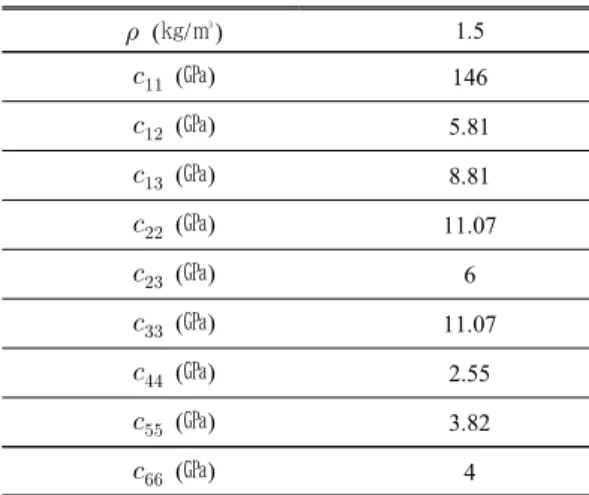
Table 1 Density and elastic stiffness coefficient of test specimen
(㎏/㎥) 1.5
(㎬) 146
(㎬) 5.81
(㎬) 8.81
(㎬) 11.07
(㎬) 6
(㎬) 11.07
(㎬) 2.55
(㎬) 3.82
(㎬) 4
Table 1 shows the density and elastic stiffness coefficients of the specimen. The specimen was dried to be as reference.
3.2 Heat Loading and Moisture Absorption
High and low temperature for heat fatigue cycle is 70℃ and -55℃ for one period of 15 minutes for each condition. One cycle of heat fatigue is 30 minute. Fig. 3 shows the tempera- ture of cyclic heat damage and time period.
Most polymeric materials such as a composite matrix or a polymeric fiber has potential to absorb small amount of moisture. It is relatively small but it can be a severe amounts of moisture for material properties changing from the surrounding environment. The physical mechanism for moisture gain, assuming there are no cracks or other wicking paths, is generally assumed to be mass diffusion following Fick's Law [11]. The moisture testing is performed based on MIL-HDBK-17-1F [12] to test specimen. There are two moisture properties of a Fickian material: moisture diffusivity and moisture equilibrium content. These properties are commonly measured weight of the specimen since it is exposed to moisture condition compared to initial dry specimen. The weight of specimen is frequently measured every 24 hours to identify the moisture content ratio. The moisture contents can be expressed by the weight of water absorbed specimen.
The moisture absorption rate can be measured by the weight of the specimen at every steps of experimental conditions. The weight gain or loss can be interpreted the absorption rate of moisture in the specimen. The objective is to determine the percent moisture content M (percent weight gain) of the material as a function of time [11].
Fig. 3 High and low temperature dwell cycle
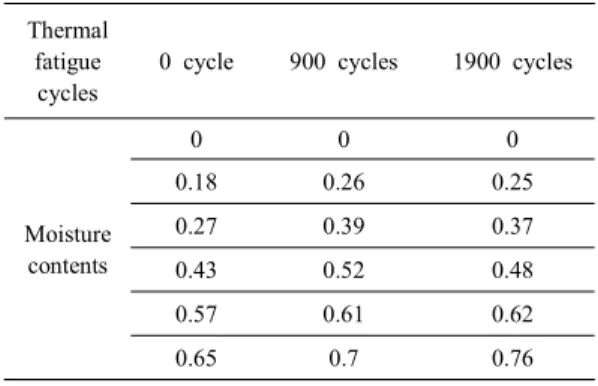
fatigue cycles
0 cycle 900 cycles 1900 cycles
Moisture contents
0 0 0
0.18 0.26 0.25
0.27 0.39 0.37
0.43 0.52 0.48
0.57 0.61 0.62
0.65 0.7 0.76
(1)
where,
is the weight of moisture contained specimen and
is the weight of dried specimen.
Three different heat cyclic loaded specimens are subjected to various moisture absorption conditions. The detailed specimen information is listed in Table 2. There are six steps for moisture contents ratio at each thermal fatigue damaged specimen.
4. Experimental Setup and Results
The experimental setup for ultrasonic Lamb wave velocity measurement of carbon/epoxy moisture condition is depicted in Fig. 4. To generate narrow band of 2 MHz for the experiment, 8 cycles of tone burst is excited by the RPR-400(RITEC Inc.). The ultrasonic wave is generated by the system and received through amplifier and digital filter. The center frequency of 2 MHz is used to generate the A1 mode of Lamb wave. The transmitter and receiver is at fixed position to measure the variation of wave velocity at difference thermal and moisture condition. The incident angle to generate A1 Lamb mode is 15.37° with excitation frequency of 2 MHz at 1 mm thickness specimen.
The heat loaded specimen is moisture absorbed in constant temperature water bath at
Fig. 4 Experimental ultrasonic measurement system setup
Fig. 5 Moisture absorption rate of time for thermal fatigue specimen
70℃ for 700 hours. The weight of specimen is measured every 24 hours for moisture absorption ratio as depicted in Fig. 5. Generally, the moisture absorption ratio is decreased as time goes by. The slope of time versus moisture absorption ratio is similar to each thermal cyclic load. Moisture diffusion rate is only affected by environmental condition. The cyclic thermal fatigue affects the moisture absorption ratio. The moisture absorption ratio is higher at high number of thermal fatigue cycles.
The Lamb wave velocity variation of
moisture contained carbon/epoxy laminates are
presented in Fig. 6. It is shown that the wave
velocity is decreased with respect to moisture
absorption ratio. The wave velocity is decreased
at higher moisture contained specimen. The moisture absorption affects to degradation of composite material.
In the thermal fatigue process, thermal stress is generated the transverse matrix cracks and delamination in the composite laminates [13,14].
The states of degradation of the transverse tensile strength due to moisture absorption in the various composite materials is well explained by Bradley [15]. The Lamb waves propagation velocity in the composites is depending on the condition of the material stiffness matrix [16].
The wave velocity can be affected by degradation of composite fiber and matrix. Fiber and matrix breaking and delamination can cause the decreasing wave propagation velocity. Lamb wave velocity change can be correlated to composite laminate properties and degradation state.
5. Conclusions
Specimens were exposed to thermal fatigue and moisture absorption to simulate the effect of temperature variation and humidity of in-service environment. The experimental result shows the correlation between Lamb wave velocity versus thermal fatigue and moisture absorption. Material
properties of unidirectional six layered composite plates are discussed in the paper. The wave velocity changing can predict composite plate properties degradation such as fiber and matrix breaking, delamination and debonding. The properly chosen Lamb wave features show linear correlation with moisture absorption ratio. The presented Lamb wave velocity measurement can play a significant role for carbon/epoxy laminate degradation which induced by thermal fatigue and moisture absorption.
Acknowledgment
This research was supported by INNOPOLIS Foundation funded by the Ministry of Science, ICT and Future Planning (2014BS0012).
References
[1] Z. M. Ishak, U. Ishiaku and J. Karger- Kocsis, "Hygrothermal aging and fracture behavior of short-glass-fiber-reinforced rubber-toughened poly (butylene terephthalate) composites," Composites Science and Technology, Vol. 60, No. 6, pp. 803-815 (2000)
[2] J. Willett and W. Doane, "Effect of moisture content on tensile properties of starch/poly (hydroxyester ether) composite materials," Polymer, Vol. 43, No. 16, pp.
4413-4420 (2002)
[3] P. Theocaris, G. Papanicolaou and E.
Kontou, "Interrelation between moisture absorption, mechanical behavior, and extent of the boundary interphase in particulate composites," Journal of Applied Polymer Science, Vol. 28, No. 10, pp. 3145-3153 (1983)
[4] D. Colombini, J. Martinez-Vega and G.
Merle, "Dynamic mechanical investigations of the effects of water sorption and physical ageing on an epoxy resin system,"
Fig. 6 Wave propagation velocity of moisture absorption carbon/epoxy laminate subjected to thermal fatigue