반도체디스플레이기술학회지 제17권 제1호(2018년 3월) Journal of the Semiconductor & Display Technology, Vol. 17, No. 1. March 2018.
Preparation and Characterization of Chemically Modified Wood Flour Reinforced Phenol-formaldehyde Composites
Byeong-Uk Nam
*†and Jun-Yeong Mun
**†
School of Energy, Material & Chemical Engineering, Korea University of Technology and Education
ABSTRACT
Wood Polymer Composites(WPC) have attracted significant attention because of ecological and environmental concerns. However, the structure of Wood Flour containing many hydroxyl groups(-OH) reduces the interface adhesion to Phenol-formaldehyde(PF) and it decreases the mechanical properties of the PF/Wood Flour Composites.
The present work involves the modification of Wood Flour using silanes reinforced with Phenol-formaldehyde to enhance the mechanical properties of the composites. The spectroscopic properties of the composites were analyzed using FT-IR, XPS(X-ray Photoelectron Spectroscopy) and the mechanical properties i.e., tensile strength, flexural strength and impact strength were studied. We confirmed the modification effect of silanes by spectroscopic analysis, and the mechanical properties of the composites using wood flour modified by silanes were significantly improved.
Key Words : Wood Flour, Phenol, XPS, Silane, Mechanical properties
1. Introduction
1
Wood Polymer composites(WPC) have made significant gains in popularity over the last decade. This is due to the environmental aspects compared to the other reinforcement materials. Also, using wood flour as reinforcing filler in plastic composites shows enhanced strength and modulus.
Among various types of plastics, phenol-formaldehyde resins have excellent flame retardancy and low toxic emission characteristic, and it is widely used in construction in construction, electric and electronic industry because of its excellent electrical and mechanical properties. As in other plastics industries, the phenolic resin industry has been conducting studies using various types of organic and inorganic fillers to lower the cost and improve the characteristics of the products. Particularly, many researches on WPC having advantages such as lows cost, biodegradability, recyclability, low density and high specific strength compared to other fillers have been conducted.
However, there are various limitations in development of
†
E-mail: [email protected]
PF/WP composites with excellent mechanical properties.
The critical drawbacks is the low interfacial adhesion between hydrophilic WP and hydrophobic PF. The poor interfacial adhesion occurs due to the structural difference between the structure of the WP consisting of cellulose, hemicellulose and lignin in which the hydroxyl groups(-OH) are distributed and the hydrophobic polymer matrix. The omnipresent hydroxyl groups form intermolecular and intramolecular hydrogen bonds, which leads to self- agglomeration and consequently causes low mechanical properties of the composites. The chemical modification of the hydroxyl groups on the surface of WP using silanes has been proposed as an approach to overcome this problem.
In the previous work, the chemical bonding of the
modifier and filler was identified through spectroscopic
analysis and the mechanical properties of the composites
were analyzed however there have been few studies that
analyzed both properties. In this work, the mechanical
properties of composites are improved by using silanes
which has amino, thiol, acrylate as functional groups,
respectively, as modifiers of wood flour for making
composites with excellent mechanical properties. The
Byeong-Uk Nam · Jun-Yeong Mun 2
mechanical properties of composites i.e., tensile strength, flexural strength and impact strength were analyzed. Also, XPS and FT-IR were analyzed to investigate the effect of silanes as a modifier.
2. Experimental
2.1 Materials
Novolac, NEOLITE KC-3032, was provided by Kangnam Chemical, Republic of Korea. Hexamethylenetetramin (HMTA), curing agent, was purchased from SABIC and 3- aminopropyltriethoxysilane was purchased from Sigma- Aldrich. Other silanes such as 3-(trimethoxysilyl)propyl methacrylate, (3-Mercaptopropyl) trimethoxysilane were purchased from Tokyo Chemical Industry.
2.2 Silane Treatment
3-aminopropyltriethoxysilane(AP), 3-(trimethoxysily-l) propyl methacrylate(MA), (3-Mercaptopropyl)rimetho- xysilane(MP) were used as a surface modifier for wood flour in this work. The mixture of silane/wood flour 5(w/w%) was soaked in the solution of ethanol/distillated water 20(v/v%) and stirred for 2 hour at Room Temperature. The modified wood flour was dried 24 hours in the vacuum oven at 120℃ to remove the unreacted silanes and kept it a desiccator before the preparation of composites.
2.3 Characterization of Modified Wood Flour
2.3.1 Fourier Transform Infrared Spectroscopy
FT-IR technique was used to determine the functional groups on the surface of Wood Flour before and after silane treatments. A total of 64 scans took in the range from 4000 to 600 cm
-1using PerkinElmer Spectrum 100 FT-IR Spectrometer at a resolution of 4 cm
-1with an attenuated total reflection(ATR) probe.
2.3.2 X-ray Photoelectron Spectroscopy(XPS)
X-ray photoelectron spectra of both modified and unmodified wood flour were measured by using X-ray Photoelectron(Thermo Fisher Scientific, K-ALPHA) with an unmonochromated aluminum K
αsource. The samples were onto a holder with double-sided adhesive tape and
placed in a vacuum in the range 10
-9~ 10
-8torr. The measured sample was circular sample with a diameter of 400um. For all the samples, a low-resolution narrow run was performed.
2.4 Mechanical Property Test
The mechanical properties related to the composites tensile properties and flexural properties were analyzed according to ASTM D638 and ASTM D790, respectively, with universal testing machine(Tinius Olsen, Modelf H5KT). The specimen dimensions were according to type
Ⅰ. Impact IZOD strength test was carried out as ASTM D256 on QM700A(Quality Measurement System). The specimens were notched with 2.54mm and dimensions were 63.5mmⅹ12.7mmⅹ3.2mm. The mechanical properties results of the different composites were obtained by averaging the measurement result of seven independent specimens and results very far from the average were discarded. All the mechanical property measurements were performed at Room Temperature at 50% relative humidity.
3. Results and Discussion
3.1 FT-IR
The analysis of FT-IR spectra of the composites enabled the hydrogen bond interaction to be identified. On the basis of the harmonic oscillator model the reduction in force constant ∆f can be represented by Equation (1) :
∆ = − =
( )(1)
where μ = m
1m
2/(m
1+m
2) corresponds to the reduced mass of the oscillator, v is the oscillating frequency and f is the force constant. The subscripts nm and m denote non- modified and modified oscillators, respectively[3,4]. In Equation (1), v
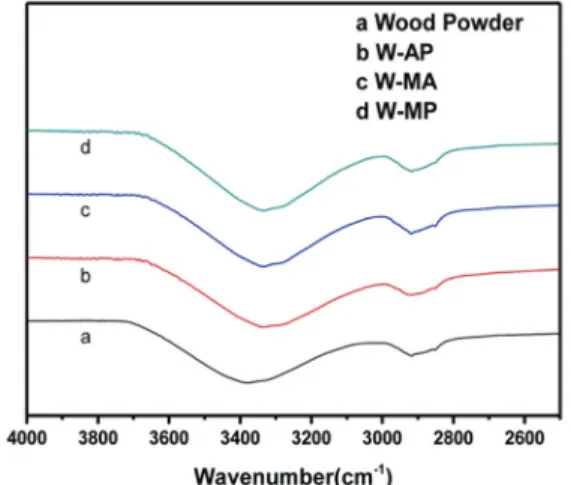
nmis a fixed value for non-modified wood flour and μ is invariable for the two oscillators. So, the reduction of force constant brought about by some interaction is directly related to the value of v
m. Thus, the lower the peak frequency the stronger is the interaction.
The frequency shift of the stretching vibration mode of
wood flour can be observed in Fig. 1. The characteristic
Preparation and Characterization of Chemically Modified Wood Flour Reinforced Phenol-formaldehyde Composites 3
peak at 3376 cm
-1associated with O-H group was shifted to wavenumber between 3333 cm
-1and 3337 cm
-1. Using Equation (1), the value of the force constant ∆f could be calculated.
Fig. 1. Hydroxyl group FT-IR spectra of Neat and modified Wood Flour.
The force constant of O-H bond stretching increased in order of 3-aminopropyltriethoxysilane, 3-(trimethoxysilyl) propyl methacrylate, (3-Mercaptopropyl) trimethoxysilane.
In the case of 3-aminopropyltri-ethoxysilane, besides the hydrogen bond between the hydroxyl groups, the amine group and the hydroxyl group can form a hydrogen bond.
For this reason, The ∆f of the W-AP was highest among three types of silane modified wood flour, which means stronger hydrogen bond were formed between AP and hydroxyl groups in wood flour.
Fig. 2. Reaction mechanism of silanes and wood flour.
3.2. X-ray Photoelectron Spectroscopy(XPS) The XPS spectra results of the unmodified wood flour and modified wood flour are presented in Fig. 3, and the elemental compositions of all the studied spectra are summarized in Table 1. The analysis of the C
1sspectra of the modified and modified wood flour shows that they consist of three component peak. The three peaks are C1(carbon atoms bonded only to a carbon and/or hydrogen atom (C-C/C-H), 285eV), C2(carbon atoms bonded to a single oxygen atom other than a carbonyl oxygen(C-OH), 286.9eV), and C3(carbon atoms bonded to two non-carbonyl oxygen atoms or to a single carbonyl oxygen atom(O-C-O, C=O), 288.7eV)[1,4,5].
Fig. 3. Binding Energy of Neat and modified Wood Flour (C
1s).
Table 1. Elemental Surface Compositions of the Umodified and Modified Wood Flour
Elemental compositions(%)
O C Si N Ca Na
Wood 20.14 76.88 0.52 1.93 0.26 0.26 W-AP 20.67 71.77 4.44 2.98 0.07 0.07 W-MA 21.16 71.55 4.4 2.63 0.13 0.13 W-MP 21.74 71.12 4.02 2.84 0.16 0.12
In the unmodified wood flour, Si atomic ratio of 0.52%
was found, whereas at the surface of the modified wood flour surface, more than 4% of Si atomic ratio were measured. Since Si contained in the ash of wood flour is
280 282 284 286 288 290 292 294
0 20000 40000 60000 80000 100000 120000 140000
Counts/s
Binding Energy(eV)
Wood Powder W-AP W-MA W-MP
C1
C2
C3
Byeong-Uk Nam · Jun-Yeong Mun 4
commonly within 2%, more than 4% of Si atomic ratio can be seen to be bonded to the surface of wood flour through silane treatment. In addition to Si, Ca and Na were also contained in small amounts, but they can be considered as impurities contaminated during storage and/or distribution [7,8].
In Fig. 3, the modified wood flour shows a decrease in the C2 peak, which is seen as the peak of the hydroxyl group(-OH), compared with the unmodified wood flour. It is also seen that the C3 peak, which is the glycosidic bond(C-O-C) present in cellulose and hemicellulose and the carbonyl group(C=O) of lignin, decrease. The decrease in the C2 and C3 peaks of the modified wood flour can be seen through chemical reaction with the silane, and it can be seen that the silane as a modifier has an excellent effect.
3.3 Mechanical Properties
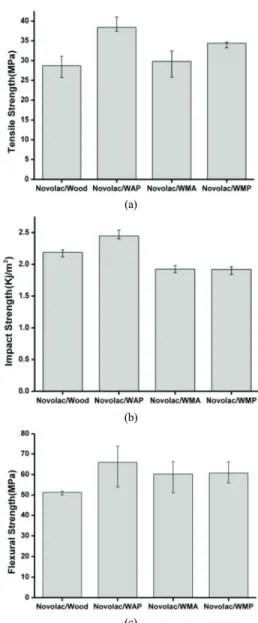
In order to analyze the possibility of silanes as a surface modifier of wood flour, tensile strength, flexural strength and impact strength test were conducted. As shown in Fig.
4 the composites using wood flour modified with silane showed a significant increase in tensile strength(a) and flexural strength(b) compared to the composites without silane modified wood flour.
In particular, the 3-aminopropyltriethoxysilane(AP) 34% and 28%, respectively. However, in the case of showed an excellent strength reinforcement effect by increasing the tensile strength and the flexural strength by impact strength, only PF/WAP showed a 12% increase in strength compared with PF/Wood and PF/WMA and PF/WMP were decreased.
It is because of the reaction of Phenol-formaldehyde and 3-aminopropyltriethoxysilane that the reinforcing effect of 3-aminopropyltriethoxysilane is superior to other silanes. The hydroxyl groups of the silane reacted with the wood flour and the –Y(-amino, -thiol, -methacrylate) groups reacted with the polymer matrix. Among these three functional groups, the amino groups react with – CH
2OH at the Phenol-formaldehyde end to form a covalent bond(Fig. 5)[2,6]. It should be noted that silanes act as a good surface modifier and improve the interfacial adhesion between PF and wood flour.
Ultimately, silane with amino group dramatically improves the mechanical properties of PF/WP composites system.
(a)
(b)
(c)
Fig. 4. Mechanical properties of PF/WP (a) Tensile Strength (b) Flexural Strength (c) Impact Strength.
Fig. 5. Reaction mechanism of PF and AP.
Preparation and Characterization of Chemically Modified Wood Flour Reinforced Phenol-formaldehyde Composites 5