• 검색 결과가 없습니다.

Design and Implementation of MEARN Stack-based Real-time Digital Signage System

N/A
N/A
Protected

Academic year: 2021

Share "Design and Implementation of MEARN Stack-based Real-time Digital Signage System"

Copied!
19
0
0

로드 중.... (전체 텍스트 보기)

전체 글

(1)

Design and Implementation of MEARN Stack-based Real-time Digital Signage System

Trinh Duy Khue

, Thanh Binh Nguyen

††

, UkJIn Jang

, Chanbin Kim

, Sun-Tae Chung

†††

ABSTRACT

Most of conventional DSS’s(Digital Signage Systems) have been built based on LAMP framework.

Recent researches have shown that MEAN or MERN stack framework is simpler, more flexible, faster and more suitable for web-based application than LAMP stack framework. In this paper, we propose a design and implementation of MEARN (ME(A+R)N) stack-based real-time digital signage system, MR-DSS, which supports handing real-time tasks like urgent/instant messaging, system status monitoring and so on, efficiently in addition to conventional digital signage CMS service tasks. MR- DSCMS, CMS of MR-DSS, is designed to provide most of its normal services by REST APIs and real- time services like urgent/instant messaging by Socket.IO base under MEARN stack environment. In addition to architecture description of components composing MR-DSS, design and implementation issues are clarified in more detail. Through experimental testing, it is shown that 1) MR-DSS works functionally well, 2) the networking load performance of MR-DSCMS’s REST APIs is better compared to a well-known open source Xibo CMS, and 3) real-time messaging via Socket.IO works much faster than REST APIs.

Key words: Digital Signage System, Content Management System, Real-time Web Service, MEAN Stack, MERN Stack, REST API, Socket.IO

※ Corresponding Author : Sun-Tae Chung, Address:

(06978) Dept. of Smart Systems Software, Soongsil Univ., 369, Sangdo-Ro, Dongjak-Gu, Seoul, Korea, TEL : +82- 2-820-0638, FAX : +82-2-821-7653, E-mail : [email protected]

Receipt date : Feb 15, 2017, Approval date : April. 28, 2017

†††

Dept. of Information and Telecommunication Engin- eering, Soongsil University

(E-mail :{khue.trinh, doublestat, kesuskim}@ssu.ac.kr)

†††

Embedded Vision, Inc, Seoul, Korea (E-mail : [email protected])

†††
Dept. of Smart Systems Software, Soongsil Uniersity (E-mail : [email protected])

1. INTRODUCTION

According to the proven effectiveness of digital signboards for advertisement and public in- formation, there has been a significant increase in the demand for digital signage systems (DSS) nowadays[1]. A digital signage system usually consists of content management system(DSCMS) and signage content players (responsible for dis- playing signage contents onto display devices).

In addition to primary task of contents display on schedule, DSCMS needs to support other tasks;

monitoring of signage players about their status

and what they are displaying, audience measure- ment, disaster information distribution, instant messaging, and so on [2]. Many tasks such as monitoring and disaster information distribution requires to be processed in real-time. The front- end GUI to back-end DSCMS server, called dash- board, provides administrative GUI for DSCMS management and at-a-glance views of DSCMS operational status such as registered users, current log-on users, display device status, and so on.

Web-based dashboard is popular since it allows

access to DSCMS server from any place through

Internet.

(2)

Most of conventional DSCMS’s with web-based dashboard have been developed based on LAMP/

WAMP platform (Linux/Windows, Apache Web Server, MySQL, PHP) or variants [3,4], with AJAX-based proprietary communication protocol and/or SOAP-based web service.

In web-based applications, REST API [5] be- comes a popular web service mechanism between servers and clients since it has cleaner and easier interface over non REST HTTP API and lighter than SOAP-based web services. Under traditional AJAX-based or SOAP-based networking envi- ronments, it is well known that real-time network- ing(messaging) is difficult to implement efficiently.

Recently, MEAN stack (a SW bundle of Mongo DB, Express.js, AngularJS and Node.js)[6] or MERN stack (a SW bundle of MongoDB, Express.js, ReactJS and Node.js) [7] has been widely adopted platform for developing web applications; MongoDB [8], Express.js[9], and Node.js[10] for server side, and AngularJS[11] or ReactJS[12] for client side.

MEAN or MERN stack-based web application de- velopment increasingly gains popularity for several advantages; fast performing and flexible web server architecture (Node.js, Express.js), easy to support real-time communication (asynchronous event driven processing of Node.js, Socket.IO li- brary [13]), flexible and easily scalable DB (MongoDB), clean and maintainable front-end de- sign (AngularJS, ReactJS), the same development language, JavaScript and the same data format, JSON [14] both on server side and client side, and convenient development environments. JSON (Java Script Object Notation) is the format for data-in- terchange through all the layers. Even though XML may have more representational power, JSON has also good enough representation capa- bility and can be parsed by a standard JavaScript function. MongoDB stores data records as JSON documents. Moreover, JSON also allows working with external APIs easily. MongoDB is superior for distributed databases and is highly scalable.

Under MEAN or MERN stack platform, REST API is simple and easy to implement with JSON as data format. Thus, REST API suits MEAN or MERN stack environments well.

Developing a real-time applications with popular web application stacks like LAMP (PHP) has tra- ditionally been very hard. It involves polling the server for changes, keeping track of timestamps, and it’s a lot slower than it should be. Recently, Socket.IO[13] has been the solution around which most real-time communication systems under web environments are architected, providing a bi-di- rectional communication channel between a client and a server. Whenever an event occurs, the idea is that the server or clients will get it and push it to concerned connected clients or the server. In Node.js environments, Socket.IO is implemented as Node.js module, and thus is well supported under MEAN or MERN stack.

In this paper, we propose a web-based real-time digital signage system, MR-DSS, based on MEARN stack under cloud computing environments, with a target for a signage service platform, not a sig- nage solution. Here, MEARN stack implies that the CMS server of the proposed MR-DSS, is con- structed based on Node.js, Express.js and Mongo DB. Dashboard of MR-DSCMS, and signage play- er are built on AngularJS and ReactJS, respectively.

Dashboard needs to provide an administrative GUI for user management, presentation management, schedule management, asset management, device (displayer) management, status of DSS, statistics of audience response, and so on. All GUI views are shown in comprehensively and systematically, and Some GUI views are supposed to be shown differ- ently depending on user level (privilege level), and an user may sometimes choose to see some views only in large-view mode. Therefore, more modular and flexible design and architecture are desirable.

AngularJS is a front-end framework on which web

GUI design with more modular and flexible archi-

tecture can be built. ReactJS is not a framework

(3)

but a convenient, flexile, light library for support- ing rendering front-end display quickly. For sig- nage displayer, which does not need complicated GUI, but needs a fast but flexible display, ReactJS fits signage player display more efficient than AngularJS since AngularJS is heavier and more complicated.

MR-DSS not only supports normal main CMS services via REST APIs, but also supports real- time event processing task by utilizing Socket.IO.

The efficient implementation of REST APIs under MEARN stack in MR-DSS is shown through comparison experiments with Xibo DSS, which is a popular open source DSS. Also, real-time service implemented in MR-DSS based on Socket.IO is shown to be faster compared non real-time service, REST APIs.

Even though there appear many WCMS(CMS for web site) based on Node.js [15,16], there are a few WCMS based on MEAN/MERN full stack [17]. To the best of our knowledge, no digital sig- nage CMS based on MEARN stack with support of real-time event processing has neither been re- ported in the literature and has nor been commer- cially released.

The rest of the paper is organized as follows.

Section 2 describes related work necessary for un- derstanding the paper. Section 3 discusses our pro- posed architecture. Section 4 shows the design of issues and implementation. Some evaluation is presented in Section 5. Finally, the conclusion is given in Section 6.

2. TECHNICAL BACKGROUNDS AND RELATED WORK

2.1 Technical Backgrounds; Node.js, MEAN/MERN stack, REST API, and Socket.IO

A. Node.js [10]

Node.js is an open-source, cross-platform JavaScript runtime environment for developing a diverse variety of applications. Node.js has an

event-driven architecture capable of asynchronous I/O, which makes Node.js excel at multi-user, re- al-time web applications. The real-time power comes through use of the WebSocket protocol sup- ported by Socket.IO library. Research has shown that a Node server significantly outperforms both Apache and Nginx [18] for serving dynamic con- tent—and Node’s implementation of JavaScript is more than 2.5 times faster than the more traditional PHP approach, by efficiently utilizing available hardware.

Node.js is now a popularly adopted web applica- tion framework and starts to be accepted as a good platform for CMS [15,16,17] since it is a concurrent JavaScript environment for building scalable and fast web applications.

B. MEAN/MERN/MEARN Stack

MEAN stack [6] means a S/W bundle of MongoDB, Express.js, and Node.js for server-side and AngularJS for client-side, which is well- known for building dynamic web sites and web applications. MERN stack [7] is the same as MEAN except that AngularJS is replaced by ReactJS.

MEARN stack in this paper means that both of AngularJS and ReactJS are used for client-side development in addition to MongoDB, Express.js, and Node.js for server-side.

- Express.js[9] is built on the underlying capa- bility of Node.js and provides a web application server framework which supports handling rout- ing and HTTP operations (such as GET and POST) conveniently. Express.js facilitates a sim- plified and more elegant solution than (re-)imple- menting these services directly using Node.

- MongoDB[8] is well-known for a high per- formance, well-scalable document-oriented NoSQL database built around the JSON data format [14]

and as such is ideally suited to a server-side JavaScript environments such as those provided by Node.js.

- AngularJS[11] is a frontend JavaScript frame-

(4)

work to develop complex client side applications with modular code and data binding UI. Angular implements the MVC pattern to separate pre- sentation, data, and logic components. Current AngularJS version is Angular2, which has a new architecture different from Angular1.

- ReactJS[12] is a declarative, efficient, and flexible JavaScript library for building user inter- faces. React creates an in-memory ‘virtual DOM’, computes the resulting differences from real DOM, and then updates the browser's displayed DOM efficiently. Thus, ReactJS can support rendering views quickly. As opposed to MVC pattern adopt- ed in AngularJS, ReactJS utilizes flux pattern, which is unidirectional so that it does not cause confusing and it defines workflow clearly. Redux is a very lightweight (2kB) implementation of flux.

ReactJS has smaller size and faster processing speed than AngularJS since it is library and uses virtual DOM.

C. REST API [5]

REST stands for Representational State Trans- fer. REST API, widely known as RESTful API or RESTful model for web-services, uses the native HTTP operations: POST, GET, PUT & DELETE to map on to the four fundamental CRUD oper- ations (Create, Read, Update & Delete) on re- sources, represented by a URL. The URL describes the object to act upon and the server replies with a result code and valid JavaScript Object Notation (JSON). Because the server replies with JSON, it makes the MEARN stack particularly well suited for our application, as all the components are in JavaScript and MongoDB interacts well with JSON.

REST API is simple and easy to implement compared to SOAP, which has been a facto stand- ard for web services.

D. Socket.IO [13]

Socket.IO is a JavaScript library for real-time

web applications. It enables real-time, bi-direc- tional communication between web clients and servers. It has two parts: a client-side library that runs in the browser or clients, and a server-side library for Node.js. Both components have a nearly identical API. Like Node.js, it is event-driven.

Socket.IO primarily uses the WebSocket protocol with polling as a fallback option, while providing the same interface.

E. SMIL Timesheets

Timesheets[19] defines declarative W3C stand- ards based on SMIL Timing [20] and SMIL Time- sheets[21] to synchronize HTML contents. SMIL Timing defines elements and attributes to coor- dinate and synchronize the presentation of media over time.

Basically, SMIL Timing allows an a-temporal language such as HTML5 to be extended with tim- ing features. SMIL Timesheets reuses a significant subset of SMIL Timing and allows timing and synchronization to be separated from content and presentation. This can be seen as the counterpart of CSS style sheets in the timing domain: like in CSS, these features are gathered either in an ex- ternal resource linked to the document, or in a timesheet element in the document itself. Like CSS style sheets, timesheets can be associated not only to HTML pages but also to other types of docu- ments such as SVG drawings, for instance, or even to compound documents made of HTML and SVG.

Based on the observations above, it appears that combining HTML5+CSS3 and SMIL Timing would bring a good solution to support temporal synchronization as well as spatial synchronization among assets in a presentation.

2.2 Related Works

Content management system (CMS) is a com-

puter application which provides an efficient con-

tent management tasks. The content management

tasks include storage, retrieval, creation, edition,

(5)

organization, distribution of contents [22], access control to contents, other additional tasks depend- ing upon usage purposes.

Digital Signage CMS(DSCMS) is different from WCMS (Web CMS), which is responsible for con- tent management in a web site. DSCMS supports scheduling of content dissemination so that they can be displayed at a desired time while WCMS supports organization of contents in a web site in a way that the contents are wanted to be shown when people visit the web site. Most of signage content management systems also support content creation and edition by a subsidiary content design module or program [15,16,17], as well as user man- agement, device management, asset management, and so on.

Dashboard of DSS, which is a front-end admin- istrative GUI to back-end CMS server, provides at-a-glance views of DSCMS operational status such as registered users, current log-on users, user privilege levels, display device status (con- nected, disconnected, live, dead), contents display- ing on display devices, network health reports, screen GEO maps, communication between users, audience measurement statistics as well as man- agement GUI (user management, schedule man- agement, and more). The dashboard is usually constructed in web base so that it is displayed on a web browser.

In order to support interoperability among digital signage products and services from different man- ufacturers, operators, and a wide variety of termi- nals (display devices) with different character- istics, several industry initiatives such as POPAI [23], Intel[24], Digital Signage Federation[25], and standardized organization such as ITU-T[26], W3C Business Group [27,28], have been formulated to define technical specifications for interoperable digital signage solutions. However, those standard efforts have not kept pace with flourishing deploy- ment of commercial or open source digital signage systems.

Many of conventional digital signage CMSs [3,4]

have been developed based on LAMP platform (Linux, Apache Web Server, MySQL, PHP) or variants; WAMP(Windows, Apache Web Server, MySQL, PHP), LAPP(Linux, Apache, PostgreSQL, PHP), MAMP (Mac OS X, Apache, MySQL, PHP), XAMPP (Linux, Mac OS X, Windows, Apache, MySQL, PHP, Perl). and many of them have uti- lized their own contents description in XML or JSON.

Nowadays, due to the efficiency and simplicity of the MEAN/MERN full stack platform, it has been popularly adopted for developing web-driven applications including WCMS and digital signage CMS [15,16,17].

In almost all digital signage systems, currently content representation about spatial synchroniza- tion among multimedia assets like text, image, and video is usually described declaratively, either in HTML, or in XML, or JSON. On the other hand, content control including temporal synchronization among assets can be achieved by either imperative or declarative approach. The imperative approach involves JavaScript codes which are programmed about how to control contents and playout. In the declarative approach, a mark-up or a format de- scription annotates control of contents. Then, sig- nage players parse the mark-up or format descrip- tion and display contents.

The declarative approach is generic so that it is useful for not only developers but also vendors of authoring tools. If the annotation format is stand- ardized, anyone could develop JavaScript libraries for playing signage contents. This means that the declarative approach could make signage oper- ations more cost-effective. Furthermore, this could achieve interoperability among terminals using or- dinary web browser.

Many declarative approaches have been pro-

posed; HTML, SMIL[29], SCXML[30], Timesheets

[19]. Timesheets approach is based on SMIL

Timing [20] and SMIL TimeSheet[21]. SMIL Tim-

(6)

esheets is a style sheet language which is intended for use as an external timing stylesheet for the Synchronized Multimedia Integration Language, and is meant to separate the timing and pre- sentation from the content inside the markup of another language (for instance, an SMIL Time- sheet can be used to time an SMIL-enabled slide- show).

We adopts Timesheets approach since we can use HTML/CSS and JSON as they are and sup- ports timing control by additional mark-ups or JSON formats which can be interpreted by a JavaScript library.

3. THE PROPOSED MEARN STACK-BASED REAL-TIME DIGITAL SIGNAGE (MR-DSS)

3.1 Design Principles

The proposed digital signage system, MR-DSS has the following requirements;

1) MR-DSS is structured as a web-based application.

- Web-based digital signage system is built on base of well-accepted web technologies; http, JavaScript, JSON, and others.

- MEAN/MERN stack is a useful and con- venient framework for constructing web-based application. Thus, we construct the digital signage system, MR-DSS, based on well-accepted web technologies and MEARN stack.

2) MR-DSS supports non real-time information processing through REST API

- Signage players or dashboard contacts MR- DSCMS (CMS of MR-DSS) server to receive sig- nage presentation information, and management information, respectively. The request and re- ception of these information do not have to be processed in real-time, In this case, it is more ap- propriate to support them by pull style non re- al-time communication like HTTP. REST APIs

over HTTP are simpler than SOAP, and fits well for MEAN/MERN stack-based web applications.

3) MR-DSS supports real-time information processing from or to CMS server through Socket.IO.

- Digital signage systems need to support dis- tribution of urgent information like disaster mes- sages and monitoring the status of signage players.

For these purpose, polling using HTTP isn't ap- propriate because it needs a certain amount of time to processing information over networking. Even though web supports many mechanisms like WebSocket, server-sent events, and push API, we construct real-time processing based on Socket.IO, a JavaScript library based on WebSocket.

4) Support the representation and control of sig- nage contents through declarative approach

- As explained in Section 2.2, as for content con- trol including temporal synchronization among as- sets in a content frame can be achieved more ge- nerically by declarative approach. The proposed digital signage system, MR-DSS adopts time syn- chronization description based on Timesheets ap- proach [19]. Thus, our description about content description consists of two parts; JSON descrip- tion for spatial layout, and JSON format for tempo- ral control description based on TimeSheets.

3.2 System Working Architecture

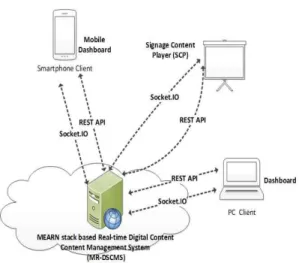
The proposed MEARN Stack-based real-time digital signage system (MR-DSS) as the following working architecture as shown in Fig. 1.

The proposed signage system, MR-DSS has two main components: MEARN stack-based re- al-time digital signage CMS (MR-DSCMS) lo- cated on a cloud network and signage content players (SCPs) at PC or embedded systems. MR- DSCMS consists of front-end dashboard clients and a main processing server (MR-DSCMS Server) based on MEARN stack.

The dashboard clients provide administrative

(7)

Fig. 1. System Working Architecture.

web GUI to MR-DSCMS. Mobile dashboards on Android or iOS are limited version of PC dashboard and constructed based on native systems, not like PC dashboard, which is built based on AngularJS JavaScript framework. SCP renders signage con- tents described in JSON format by utilizing React JS.

MR-DSS supports two kinds of communication mechanisms. For loosely coupling with RESTful- ness and openness, non real-time communications between MR-DSCMS server & SCP, and MR- DSCMS server & dashboard are processed by REST APIs. For real-time tasks such as real-time monitoring of signage players’ status, distribution of urgent messages, real-time processing of com- mands, notification of new schedules and contents, and sending of instant messages are processed in real-time via Socket.IO protocol.

Signage content presentation, which means a content frame to be displayed on SCP at a time, is designed and formatted in JSON from the layout editor in MR-DSCMS or manually. It can be also designed in HTML format from HTML designer like google web designer. It can be redesigned from editing pre-existing content presentations. When a new schedule for new contents is ready, then MR-DSCMS server notifies the fact to related SCPs via Socket.IO. Then, the SCPs contact MR-

DSCMS server and download the schedule/playlist and the edited presentations from the MR-DSCMS server via REST API and render them according to schedule or playlist.

A signage content presentation has a spatial layout and temporal control among constituents (assets) in the layout. The layout consists of many asset types such as a text, image, graphic, video, or widget. A widget is a small JavaScript codes with assets or links to assets, which can do some useful tasks (like showing weather information).

Spatial layout and temporal control in rendering presentation are described mainly in JSON format and description by HTML5/CSS3 + TimeSheets format is allowed in the sense that it can be in- serted in JSON format files. A playlist is a list of presentations to be displayed with durations on SCP. A schedule (file) is a document which has information for assigning start time and playing duration, and display days in a week to each presentation. Playlist and schedule are all described in JSON format.

The proposed MR-DSS supports monitoring what signage content a specific SCP is playing out through webRTC[31], which will be explained in detail in Section 4.8.

3.2 MR-DSCMS Server Architecture

MR-DSCMS is designed to consist of MR- DSCMS Server and administrative web GUI client, dashboard, which is loosely decoupled from MR-DSCMS Server in the sense that they are constructed as client/server based on MEARN stack. Fig. 2 shows overall S/W architecture of MR-DSCMS Server.

MR-DSCMS Server is designed to have three- tier architecture (front-end layer (Nginx server), application layer (MR-DSCMS application proc- essing), data layer (database) based on MEAN stack.

Front-end Nginx server plays a role of load

balancing. Application layer is responsible for han-

(8)

Fig. 2. S/W Architecture of MR-DSCMS Server.

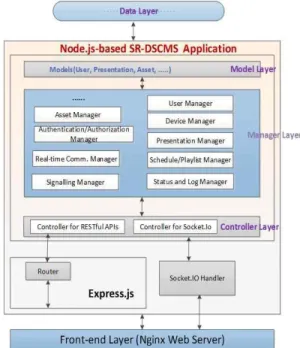
Fig. 3. Node.js-based MR-DSCMS Application Layer Architecture.

dling business logic about user, schedule, pre- sentation, device, asset management, and etc., and supports scalability to adapt traffics by increasing Node.js application instances according to traffics.

The architecture of it is clarified in Section 3.4.

Data layer handles data access to a database (MongoDB).

3.3 MR-DSCMS Server Data Layer

MR-DSCMS supports to manage user, asset, device, schedule, presentation, system admin- istration of MR-DSS, and so on. Thus, current MongoDB is designed to consist of the following collections; User, Device, Presentation, Asset, Weekly Schedule, Real-time Schedule, Playlist, Display Event, System Config, ECoin Transaction, Device Status, User Logs, System Logs, Event Logs, Sensor Status, Actuator Status, Audience Response, and so on. The System Logs, and User Logs are used to save history information of sys- tem and user, and all these log information of more than 30 days old will be cleaned automatically if no other settings are not designated.

We use mongoose as Object Document Mapper (ODM) for MongoDB. Through sharding, scal- ability of MongoDB is supported. Mongod is the

primary daemon process for the MongoDB system.

It handles data requests, manages data access, and performs background management operations.

Mongos for “MongoDB Shard,” is a routing service for MongoDB shard configurations that processes queries from the application layer, and determines the location of this data in the sharded cluster, in order to complete these operations. From the per- spective of the application, a mongos instance be- haves identically to any other MongoDB instance.

3.4 MR-DSCMS Server Application Layer Archi- tecture

Fig. 3 shows the S/W architecture for MR- DSCMS application layer of MR-DSCMS.

The MR-DSCMS server’s application layer is

constructed based on Node.js/Express.js and

MongoDB is utilized as a database. The server also

takes responsibility for managing contents, users,

device players, schedules comprehensively and

consistently. The server’s management services

are designed to be provided to clients by REST

(9)

Fig. 4. S/W Architecture of Signage Content Player.

APIs with the corresponding data stored on a MongoDB database.

When a client sends a request using a REST API to MR-DSCMS server, the router modules in application layer will route and dispatch it to the appropriate controller. Authentication/Authoriza- tion manager handles the authentication and au- thorization by using JWT (JSON Web Token). A module in Controller layer processes the REST API and, ask the corresponding manager in Manager layer for dealing with the request task appropri- ately. Socket.IO handler does in similar way to router modules and dispatches a real-time commu- nication request/response via on Socket.IO, to the corresponding controller module.

Modules in Manager layer are responsible for business logics handling nonreal-time manage- ment tasks such as user management, device man- agement, and so on, and real-time management tasks (event handling, etc.). For scalable extension, another instance of application layer based on a Node.js/Express can be launched on a processing unit like CPU.

3.5 Signage Content Player (SCP) Architecture ReactJS is smaller and faster than AngularJS.

And, it is a library not a framework like AngularJS, so that it can be easier to be integrated with other libraries. The S/W architecture of Signage Content Player (SCP) is illustrated in Fig. 4.

After SCP downloads a presentation description in JSON format from MR-DSCMS server using REST API or finds it from local storage, the pre- sentation manager will parse the presentation JSON description, and then the display manager will construct virtual DOM using ReactJS API based on parsing presentation information, and render using ReactJS API into connected display device in the Display Component process.

The Monitoring Service handles real-time SCP status (live or dead) update, gathering information such as playing mode, playing content type (pre-

sentation, playlist or schedule), the location, mem- ory use, collection of surround sensors’ data, audi- ence responses, and then report them to MR- DSCMS server via Socket.IO. The screen of dis- play device will also be captured and video will be streamed to MR-DSCMS using singnalling and- web RTC in this process, which will be explained in more detail in Section 4.7.

Currently, we implemented Android version as well as PC version. SCP on PC is constructed based on electron platform [32], Android version implemented above architecture using native an- droid framework, and is being migrated into React-based architecture using Reactive native.

3.6 Dashboard Architecture

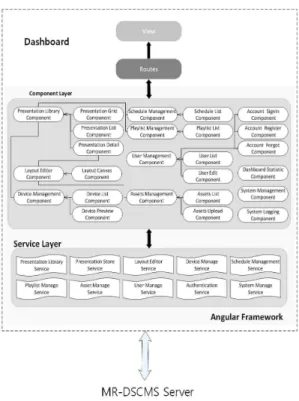
The architecture of MR-DSCMS Dashboard is illustrated in Fig. 5, which are constructed on Angular2 framework. Basically, components with views in component layer are designed respectively for each dashboard administrative work; user management, presentation management, schedule management, device management, layout editor, statistics, log, system management and so on.

Layout editor component utilizes Fabric.JS, a

Javascript HTML5 canvas library. A content pre-

(10)

Fig. 5. S/W Architecture of Dashboard.

sentation edited by layout editor component is saved in JSON format and saved into MR-DSCMS server. Services at service layer provides REST API handling with MR-DSCMS server for each corresponding component.

4. Design Issues and Implementation of MR- DSCMS

4.1 REST API Design

REST uses a client-server model, where the server is an HTTP server and the client sends HTTP verbs (GET, POST, PUT, DELETE), along with a URL and variable parameters that are URL- encoded. The URL describes the object to act upon and the server replies with a result code and valid JavaScript Object Notation (JSON) [14].

Because the server replies with JSON, it makes the MEARN stack particularly well suited for our application, as all the components are in JavaScript and MongoDB interacts well with JSON. The CRUD(CREATE, READ, UPDATE, and DELETE)

acronym is often used to describe database operations. These database operations map very nicely to the HTTP verbs; POST(insert or create data into server), GET(retrieve data from server), PUT(update the data into server), DELETE(re- move data from server).

The REST HTTP API in this paper is structured as the following format; ‘{METHOD}’ ‘https://API domain/prefix/collection name/extra functions’

- Method: GET, POST, PUT, DELETE - API domain: in our example, we use

‘api.erclab_ssu.com’

- Prefix: ∙ [auth] if need authentication

∙ Don’t have prefix if allow directly access without authentication - Collection name: the name of collection of

MongoDB which we want to deal with.

- Extra function: if the API is not basic CRUD, it will need this.

Examples of API format are as follows.

- Login; {POST} http://api.erclabs_ssu.com/log- in

- Get info of an asset; {GET}

http://api.erclabs_ssu.com/auth/asset - Create an asset; {POST}

http://api.erclabs_ssu.com/auth/asset - Update user information; {PUT}

http://api.erclabs_ssu.com/auth/user

4.2 Real-time Service Implementation based on Socket.IO in MEARN platform

In time-sensitive information processing, polling using HTTP isn't appropriate because it needs a certain amount of time to get information. W3C recommends the following APIs for real-time communication for digital signage system: Web Socket API, Server-Sent Events, Push API.

In the proposed system, we support real-time

communication by ‘publish/subscribe’ mechanism

based on Socket.IO library. When a client or CMS

server wants to receive real-time messages about

some events (disaster message, instant message,

(11)

notification message about new schedule/playlist, signage player status message, sensor status mes- sage, and etc.), then it calls ‘subscribe’ method with the event type and a callback function. The

‘subscribe’ method first enrolls the event and call- back function into the ‘subscribe’ management data structure, and sends the event type to the other party (CMS server or client). The other party en- rolls it in the event receiver list. When the event happens, then the other party calls for ‘publish’

method which looks for receivers of the event, and sends the event message to receivers one by one using Socket.IO function. When the event message arrives, the callback function registered to ‘sub- scribe management data structure’ is called and handles the event message.

4.3 Authentication and Authorization

Authentication means the ability of the server to determine the identity of the clients in a transaction. Authorization means allowing or pre- venting clients to use a particular resource or serv- ice by the server. For the proposed system, JWT (JSON Web Token) is utilized to authentication and authorization since it is simple and efficient.

JSON Web Token (JWT) is a JSON-based open standard (RFC 7519) for creating access tokens that assert some number of claims. As opposed to session cookie and OAuth2 protocol [33], JWT is stateless in the sense that session information or user state is saved in server memory. And it can include additional claims such as the users email address, who issued the token, scopes or permis- sions for the user, and more while session cookie contains only session id. Compared to OAuth2, JWT is simple since it is just protocol, and it is not a security framework like OAuth2. With a cookie based approach, you simply store the ses- sion id in a cookie. JWT's on the other hand allow you to store any type of metadata, as long as it's valid JSON. Depending on your use case, you may choose to make the minimal amount of claims such

as the user id and expiration of the JWT, or you may decide to include additional claims such as the users email address, who issued the token, scopes or permissions for the user, and more. The JWT in the proposed system is designed to contain user id, user level, issue time, life time. The life time of JWT can be manually configured by the admin- istrator (Super-admin).

As for authentication of REST HTTP API re- quest, it works as follows. After a user logins, then the MR-DSCMS server validates the user on the backend by querying in the database. If the login request is valid, the MR-DSCMS server creates a JWT token by using the user information fetched from the database, and then return that information in the response header so that the user can store the token in local storage. Once the client has that token, they will store it in local storage. This token is passed at the authorization header in every REST HTTP API request. The JWT token accom- panied with REST HTTP API request is validated in ‘validateRequest’ middleware module in Express.

js.

As for authorization of REST HTTP API re- quest about how much the API has privilege for accessing resources including system information, files, database information like asset, the in- formation extracted from JWT such as user id, user level, and others are utilized.

4.4 User Management

User management handles user registration, login, and user level. User level is related with ac- cess privilege to APIs, assets, and what each user can see and what menus he is allowed to use.

According to user’s role, each user will have differ- ent user level. The proposed MR-DSS supports three level groups of users, which are stored in

“role” field of User model database; Admin group

(Super-Admin, Admin, Moderator), User group

(Agent, End-user, Anonymous), and Guest. Super-

Admin and Admin can manage everything, but

(12)

Fig. 6. JSON description example for regions in a pre- sentation.

Admin can be many and added or removed. On the other hand, Super-Admin has root privilege and it can manage everything, and never be eliminated.

Moderator can manage information except for sys- tem information.

Each end-user associates at least a SCP with it. SCP is only allowed to be associated with to a user. Each end-user group can be represented by an agent. An end-user can belong to a group managed by an agent by declaring an associated agent. All user management is designed to be processed in MR-DSCMS. User is related to au- thentication, authorization, and device (SCP) management. Based on the role of user, the system will decide to give the permission to execute a function or not.

The proposed system is designed also to allow to log in through SNS like Facebook, google, and twitter.

4.5 Presentation Management

A presentation is described by a JSON document.

The presentation JSON document describes not only spatial layout of a content screen and but also temporal synchronization among regions and among assets in a region. Temporal synchroniza- tion allows slideshows, animation of images in a region.

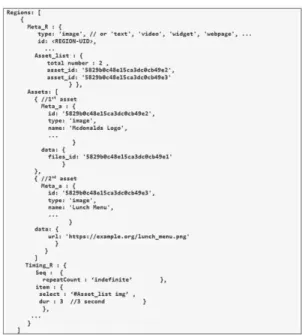
The presentation description contains two man- datory main parts: meta, regions, and one optional part; timing. A presentation can have one or many regions. Meta part of a presentation, denoted by Meta_P in JSON documents, keeps the attributes of presentation such as the presentation id, pre- sentation name, owner, status, onStore. creation/

modification time-stamp, type, size, resource URL, category, usage level, lock property, and the ori- entation of display. Lock property determines whether the presentation can be edited by the group of owner or buyers except the owner. Status represents activation; activated(default), deactivated.

Onstore attribute shows whether the presentation

belongs to store or not. Timing part of a pre- sentation, denoted by Timing_P in JSON docu- ments, has description about temporal synchroni- zation among regions based on SMIL Timesheets if any.

Similarly, each region contains two mandatory

parts; meta and assets, and one optional timing

part. Each region can be composed of one or many

assets of the same type. Meta part of region

(denoted by Meta_R) keeps the attributes of the

region such as the region id, creation/modification

time-stamp, asset type, size (width, height), posi-

tion (x,y) in the layout, z-order, asset list, usage

level, and lock property. Asset list keeps the num-

ber of assets, asset ids. Asset part has also meta

part and data part. Meta part of asset, denoted by

Meta_a, has attributes like asset id, asset name,

asset type, asset size, asset file extension, and so

on. Data part of the asset has a text string for text

type and file id or URL if asset types are image

or video. Timing part of a region, denoted by

Timing_R in JSON documents, has description

about temporal synchronization among assets

based on SMIL Timesheets if any. Fig. 6 shows

(13)

Fig. 7. Signalling and video streaming architecture be- tween dashboard and SCP.

a JSON description example for regions in a pre- sentation which has image assets and optional tim- ing part about how to animate images.

4.6 Schedule/Playlist/Display Management The playlist lists presentations to be displayed with durations in a SCP. There is two types of schedule: weekly and real-time schedule. The weekly schedule file that assigns start time, play- ing duration, and playing days in a week to each presentation. The real-time schedule file that as- signs flexible start time information as a calendar.

The schedule contains meta information about pre- sentations, name of presentation, days in week to display, start time, and playing duration time.

The information about playlist and schedule contents are kept in the corresponding collections in database. MR-DSCMS allows users to edit schedule/playlists for associated display devices (SCP). The updated schedule/playlist can be dif- ferent from the original schedule/playlist in contents. If the updated ones can be still applied to the same display devices, then the original schedule/playlist can keep the same ID except dif- ferent presentations. However, if the updated schedule/playlist has different applicable display devices (SCPs), the updated schedule/playlist will be assigned a new ID and the original ones will be assigned a new ID by Schedule/Playlist Mana- ger in order to keep consistent management of

schedule/playlists.

There might be a time conflict between event driven contents and scheduled contents. Recently, digital signages are developed to be interactive so that they can provide additional information (event driven contents) in response to user inputs.

Advertisers want a signage to display their paid advertisements (scheduled contents) on time.

Advertisement is a major funding source for digital signages. Therefore, it is required to handle this issue. In SMIL 3.0, there is a discussion of unifying event based and scheduled timing for multimedia presentation. Currently, we are working for the unification.

4.7 System Monitoring

Each SCP on the system always keep a con- nection with MR-DSCMS for reporting real-time status update. SCP will send a real-time updated status message through ‘publish/subscribe’ mech- anism (constructed based on Socket.IO) to MR- DSCMS at start time, and periodically during oper- ation and when there is any status change. This status information will be kept in corresponding models (DeviceStatus, Sensorstatus, EventLogs, SensorStatus, ActuatorStatus, AudienceResponse), which are used to diagnose and analyze system status, audience response for system monitoring.

Then, MR-DSCMS provides relevant users the necessary statistical data, such as weekly system status report or audience response report.

SCP also supports capturing a screen shot.

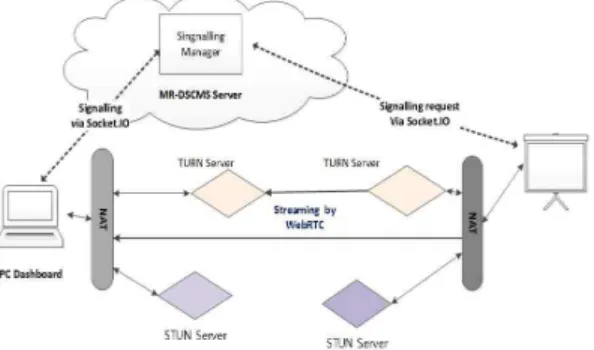
When a user wants to see what is playing on a specific SCP in entire network, from the dashboard, he requests a signaling via Socket.IO to the signal- ing manager in CMS server. Then, singnalling manager sends asking for signaling information to the SCP. Then, the singnalling manager sends back video channel connection between dashboard and the SCP, which has been obtained from outside STUN server, to each dashboard and the SCP.

Then, the dashboard and SCP establishes webRTC

(14)

(a) Log-in GUI (b) HomeGUI after Log-on Fig. 8. (a) Log-in GUI, (b) Home of MR-DSCMS's

Dashboard.

(a) Presentation lists (b) Layout editor Fig. 9. Presentation lists and Layout Editor GUI.

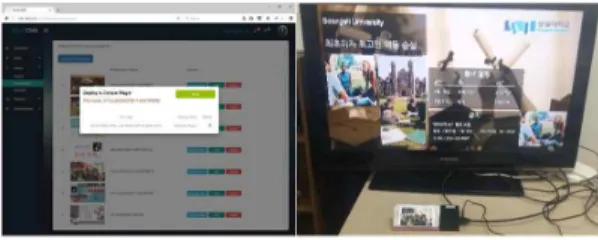
Fig. 10. Dispatching scheduled presentation for signage content players and working environment.

video session channel between two. Then, the SCP sends the screen shot captured by WebRTC Tab Content Capture API to the dashboard via webRTC channel.

5. EXPERIMENTS

5.1 Evaluation of System Operations

We tested and evaluated our implementation of the proposed system. Currently, we mainly con- centrated on testing of managing MR-DSCMS and working between MR-DSCMS located in Google Cloud and SCP. Two components can communi- cate each other through Internet. Fig. 8 shows log- in GUI (left) and home administrator GUI (right) of MR-DSCMS’s dashboard GUI respectively.

After logging on, end users see home administrator GUI which shows the statistical data analysis.

Dashboard supports administrative manage- ments, which are shown in the left frame in Fig.

8(b). Fig. 9(a) shows presentation lists after one selects ‘presentation’ menu in the left frame in Fig.

8(b). Fig. 9(b) shows Layout editor GUI.

Dispatching a scheduled signage content to sig- nage content players and working environment (Smartphone, set-top-box, monitor) are shown in Fig. 10.

Through lots of testing, it is evaluated that all of tried users feel editing the contents (presenta- tions) and dispatching them into signage content platers to be done conveniently and smoothly and observer engaged SCPs to play the presentations according to schedules well.

5.2 Evaluation of Networking Load Performance 5.2.1 Performance Evaluation of Response time and

Throughput of REST APIs

For the load performance evaluation of the pro- posed MR-DSCMS, we tested response times of REST APIs of MR-DSCMS and compared them with those of REST CMS APIs of a famous open source LAMP-based DSS, Xibo (version 1.8) [3].

Xibo supports two types of APIs; Player APIs and

CMS APIs. Player APIs are for exchange of in-

formation about content display and display sta-

tistics between Xibo CMS and Xibo Players. The

Player APIs are constructed based on SOAP

service. Xibo CMS APIs[34] are for providing CMS

management information and are constructed as

REST APIs under LAMP environments. Function-

alities provided by either soap-based Player APIs

or REST-based CMS APIs of Xibo are done by

REST APIs in the proposed MR-DSCMS. We did

not test the response times of the SOAP-based

CMS APIs since SOAP is well known to be slower

(15)

Table 1. Experimental results of Network load test about REST APIs of MR-DSCMS

APIs Avg.

(ms) Min

(ms) Max

(ms) Std

Dev Throughtput

(req/sec) Avg

Byte

Players 70 63 171 13.97 22.9/sec 795.0

Users 71 64 143 10.83 22.9/sec 245.0

Presentations 69 62 140 11.94 22.9/sec 801.0

Schedules 70 63 142 12.71 22.9/sec 803.0

Assets 69 63 139 11.00 22.9/sec 798.0

Overall 69.8 63 171 12.09 22.9/sec 688.4

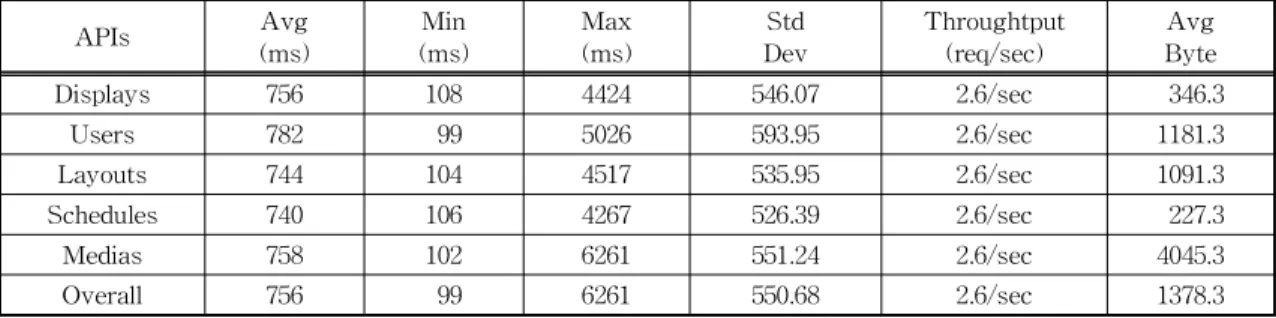
Table 2. Experimental results of Network load test about REST APIs of Xibo-DSCMS

APIs Avg

(ms) Min

(ms) Max

(ms) Std

Dev Throughtput

(req/sec) Avg

Byte

Displays 756 108 4424 546.07 2.6/sec 346.3

Users 782 99 5026 593.95 2.6/sec 1181.3

Layouts 744 104 4517 535.95 2.6/sec 1091.3

Schedules 740 106 4267 526.39 2.6/sec 227.3

Medias 758 102 6261 551.24 2.6/sec 4045.3

Overall 756 99 6261 550.68 2.6/sec 1378.3

than REST APIs[34]. Comparison with other com- mercial DSS’s with respect to performance was not possible due to unavailability of them. We installed the proposed MR-DSCMS and Xibo CMS in Google cloud platform (Google Compute Engine) under the same computing environments; Machine Type: g1-small, CPU: 0.5 vCPU Intel Zeon 2.6 GHz Intel Xeon E5 (Sandy Bridge), RAM: 1.7GB.

For fair comparison, we chose five APIs with similar functionalities from MR-DSCMS and Xibo-CMS [35]. Measurements have done by Apache JMeter tool [36] configured with 1000 sam- ples (request numbers) where each REST API is called. Table 1 and Table 2 summarize experi- mental results with JMeter. In Tables, ‘Samples’

denotes the number of REST API requests ran for given thread, and ‘Average’ means the average re- sponse time in millisecond for that particular REST API, “Throughput’ means the number of requests per second, that are sent to MR-DSCMS or Xibo- CMS during the test, and ‘Avg. Bytes’ means the average size of the sample response in bytes.

Experimental results of Table 1 and Table 2

show that overall, the REST APIs of the proposed MR-DSCMS performs faster and produces more throughput than those of the open source Xibo- CMS. These experimental results comes from the fact that Node.js/Express.js framework is lighter and more efficient in handling requests with light processing than Apache/PHP framework and that processing REST APIs on MEAN stack is simpler and easily than that on LAMP stack.

5.2.2 Performance Evaluation of Real-time Com-

munication Service based on Socket.IO

In digital signage systems, CMS needs to send

real-time messages like instant message to play-

ers, and a player needs to send its status in-

formation to CMS in real-time [28]. In the proposed

MR-DSS, real-time messaging service is sup-

ported via on Socket.IO. As for how commercial

DSS’s support real-time messaging service is not

publicly exposed. Open source Xibo DSS supports

a push message mechanism called XMR(Xibo

Message Relay) based on a messaging queueing

service, ZeroMQ[36] for sending updated schedules

(16)

Table 3. Testing results of Real-time Communication sercives by Socket.IO messages in MR-DSS Socket.IO

message type Success

Rate (%) Min Resp

(ms) Max Resp

(ms) Media Resp

(ms) 99p Resp

(ms) RPS

(reqs/sec)

status 100 0.2 11.3 0.4 2.3 49.16

event 100 0.1 3.1 0.3 1 49.2

or presentations to players. ZeroMQ is constructed directly on the top of TCP. On the other hand, Socket.IO is constructed on the top of HTTP, and thus it is an application layer protocol. Thus, ZeroMQ is faster than Socket.IO [37,38]. However, ZeroMQ does not run in web browser. Moreover, ZeroMQ does not use 80 port or http port unlike Socket.IO so that any global-based networking system utilizing ZeroMQ should handle firewall problem. Sovcket.IO is seamless under MEARN stack environments. That is one of main reasons why the proposed MR-DSS chooses to base Socket.IO for providing real-time messaging service. Here, we provide testing results of the performance of real-time messaging service of the proposed MR-DSS, but we don’t provide compar- ison between real-time messaging service of MR-DSS and Xibo’s XMR since it is clear that Xibo’s XMR is faster than the real-time messaging of the proposed MR-DSS [38,39].

For the performance evaluation, we utilized

‘Artillery’ tool [40] to test the networking perform- ance of the Socket.IO handling module of the pro- posed MR-DSCMS. In ‘Artillery’ tool, testing en- vironments are configured as follows. 100 users from our lab’s computer client are set to con- tinuously send the Socket.IO ‘event’ and ‘status’

message to the proposed MR-DSCMS during 30 seconds, which works at Google cloud platform under the same computing environments as that of the testing environments of REST APIs.

Socket.IO ‘event’ message handling is by default supported by Socket.IO library and Socket.IO

‘status’ message handling is implemented in re- al-time messaging service module of MR-DSCMS, which returns success or failure response depend- ing on the result of updating the status information

into the MongoDB.

Table 3 shows testing results about performance evaluation of real-time communication service built on the top of Socket.IO in MR-DSS. In Table 3, ‘# of virtual users’ means the number of virtual users created during 30 seconds, ‘#of Socket.IO messages sent’ means total number of Socket.IO messages sent during 30 seconds, and ‘RPS(Re- quests/sec)’ is the average number of requests per second completed in the preceding 10 seconds (or throughout the test).

Experimental data in Table 3 with comparison to those in Table 1 and 2 show that Socket.IO- based real-time messaging is much faster than REST API-based web service. As it is now well known, in web application environments, Socket.IO is popular adopted in implementation of real-time messaging service since it is simple but fast enough.

5. CONCLUSIONS

In this paper, we proposed a MEARN stack- based real-time digital signage system (MR-DSS) which supports real-time operation for system management and monitoring, fast content update, instant messaging, as well as non real-time CMS services via REST APIs. In addition to explanation of component architecture, some design and im- plementation issues were clarified. Experimental results show that REST APIS of the proposed MR-DSS are efficiently implemented so that they are faster than those of an open source digital sig- nage system, Xibo.

Currently, we are testing stability and scalability

of MR-DSS under various environments. Scalabil-

ity will be important for MR-DSSS since it aims

(17)

to serve cloud-based worldwide digital signage service in the future. In addition to multiple Node.js application instances and MongoDB sharding, re- al-time communication service based on Socket.IO will be investigated experimentally about load per- formance, and the experimental results will be ana- lyzed for improvement of scalability.

REFERENCES

[ 1 ] ITU-T Technology Watch Report, Digital Signage: The Right Information in All the Right Places, 2011.

[ 2 ] R. Gushue, What is a Digital Signage Content Management System?, https://enplug.com /blog/what-is-a-digital-signage-content- management-system.

(accessed April., 25, 2017).

[ 3 ] Xibo,http://xibo.org.uk/.

(accessed April., 25, 2017).

[ 4 ] Signagelive, https://signagelive.com/

(accessed April., 25, 2017).

[ 5 ] RESTful API, Learn RESTful: A RESTful Tutorial, http://www.RESTfulapitutorial.com/

(accessed April., 25, 2017).

[ 6 ] MEAN Stack, http://mean.io/

(accessed April., 25, 2017).

[ 7 ] MERN Stack, http://mern.io/

(accessed April., 25, 2017).

[ 8 ] MongoDB, https://www.mongodb.com/

(accessed April., 25, 2017).

[ 9 ] Express.js, https://expressjs.com/

(accessed April., 25, 2017).

[10] Node.js, https://nodejs.org/en/

(accessed April., 25, 2017).

[11] AngularJS, https://angularjs.org/

(accessed April., 25, 2017).

[12] ReactJS, https://facebook.github.io/react/

(accessed April., 25, 2017).

[13] Socket.IO, http://Socket.IO/

(accessed April., 25, 2017).

[14] JSON, http://json.org/

(accessed April., 25, 2017).

[15] Ghost, https://ghost.org/

(accessed April., 25, 2017).

[16] Keystone, http://keystonejs.com/

(accessed April., 25, 2017).

[17] Ulbora CMS, http://www.ulboracms.org/#!/

(accessed April., 25, 2017).

[18] Nginx, https://www.nginx.com/

(accessed April., 25, 2017).

[19] F. Cazenave, V. Quint, and C. Roisin, “Time- sheets.js: When SMIL Meets HTML5 and CSS3,” Proceedings of the Eleventh ACM Symposium on Document Engineering, pp.

43-52, 2011.

[20] W3C, SMIL 3.0 Timing and Synchronization, https://www.w3.org/TR/SMIL3/smil-timing.

html (accessed April., 25, 2017).

[21] W3C, SMIL Timesheets 1.0, https://www.

w3.org/TR/timesheets/. (accessed April., 25, 2017).

[22] Kyeong Hur, “Distributed Medium Access Control for N-Screen Multicast Services in Home Networks,” Journal of Korea Multime- dia Society, Vol. 19, No. 3, pp. 567-572, March 2016.

[23] POPAI, http://www.popia.com (accessed April., 25, 2017).

[24] Intel Digital Signage Technology, http://www.

intel.com/content/www/us/en/retail/retail- digital-signage.html. (accessed April., 25, 2017).

[25] Digital Signage Federation, http://www.digi talsignagefederation.org/

(accessed April., 25, 2017).

[26] ITU-T H.780, Digital Signage: Service Requirements and IPTV-based Architecture, ITU-T SG16, 2012.

[27] W3C, Web Authentication Working Group Charter, https://www.w3.org/2015/12/web- authentication-charter.html

(accessed April., 25, 2017).

[28] W3C, Web-based Signage Use Cases and

Requirements, Final Business Group Report

21, https://www.w3.org/2016/websigns/ucr/

(18)

(accessed April., 25, 2017).

[29] W3C, Synchronized Multimedia Integration Language (SMIL 3.0), https://www.w3.org/

TR/2008/REC-SMIL3-20081201/

(accessed April., 25, 2017).

[30] SCXML, State Chart XML (SCXML): State Machine Notation for Control Abstraction, https://www.w3.org/TR/scxml/

(accessed April., 25, 2017).

[31] WebRTC, https://webrtc.org/

(accessed April., 25, 2017).

[32] Electron, http://electron.atom.io/

(accessed April., 25, 2017).

[33] OAuth 2.0, https://oauth.net/2/

(accessed April., 25, 2017).

[34] S. Mumbaikar and P. Padiya, “Web Services Based On SOAP and RESTful Principles,”

International Journal of Scientific and Research Publications, Vol. 3, Issue 5, pp. 1-4, May 2013.

[35] Xibo-DSS APIs, http://xibo.org.uk/manual- tempel/api/ (accessed April., 25, 2017).

[36] Jmeter, http://jmeter.apache.org/usermanual /glossary.html (accessed April., 25, 2017).

[37] ZeroMQ, http://zeromq.org/

(accessed April., 25, 2017).

[38] Quora, How does Socket.IO Compare with a Message Queueing Service like ZeroMQ for Inter-process Communication?, https://www.

quora.com/How-does-Socket-io-compare- with-a-message-queueing-service-like- ZeroMQ-for-inter-process-communication (accessed April., 25, 2017).

[39] InfiniBand Tests, http://zeromq.org/results:

ib- tests-v206 (accessed April., 25, 2017).

[40] Artillery Tool, https://artillery.io/docs/ get-

tingstarted.html (accessed April., 25, 2017).

(19)

Khue Trinh Duy

He received the Engineer degree in computer engineering from the Hanoi University of Science and Technology, Hanoi, Viet- nam, in 2014. He is currently a research assistant at Embedded Real-time Computing Labor- atory, Soongsil University, Seoul, South Korea. His main areas of research interest are embedded systems, image processing, IO, mobile and web technology.

Thanh Binh Nguyen He received the B. Eng. degree in computer science from the University of Science, Ho Chi Minh, Vietnam, in 2005, the M.

Sc. degree in information and telecommunication engineering from the University of SoongSil, Seoul, South Korea, in 2010, and the Ph.D. degree in engineering at the University of SoongSil, Seoul, South Korea, in 2017. He is currently a principal soft- ware R&D researcher at Embedded Vision Inc., Seoul, South Korea, assistant at Embedded Real- time Computing Lab, University of Soongsil, Seoul, South Korea. His research interests cover the design and analysis of various smart embedded software system, I.O.T and also intelligent image, video analytic algo- rithms which is applied to visual surveillance, recog- nition systems, and etc.

Ukjin Jang

He received the Engineer degree in computer engineering from the Soongsil University, Seoul, Korea, in 2016. He is currently a research assistant at Embed- ded Real-time Computing La- boratory, Soongsil University, Seoul, South Korea. His main areas of research interest include modern web technology, and IoT.

ChanBin Kim

He received the B. Eng. degree in computer science from Soong- sil University in 2014. He is cur- rently a research assitant at Embedded Real-time Computing Laboratory, Soongsil University.

His research interests include modern web technology, data mining system, and em- bedded systems.

Sun-Tae Chung

He received B.E. degree from Seoul National University, and M.S. degree and Ph.D. degree in Electrical Eng. and Computer Science from the University of Michigan, Ann Arbor, USA, in 1986 and 1990, respectively.

Since 1991, he had been with the School of Electronic

Eng. at the Soongsil university, Seoul, Korea where

he is now a full professor. Now, he has been with the

Dept. of Smart Systems Software, at the Soongsil

Univ. since 2015. His research interests include digital

signage, computer vision, visual surveillance, and em-

bedded systems.

수치

Fig. 1. System Working Architecture.
Fig. 3. Node.js-based MR-DSCMS Application Layer  Architecture.
Fig. 4. S/W Architecture of Signage Content Player.
Fig. 5. S/W Architecture of Dashboard.
+6

참조

관련 문서

This paper proposes a histogram equalization technique with AGC (Automatic Gain Control) to extend the image enhancement range.. It is designed using VHDL (VHSIC Hardware

Al-Fahoum, “Quality Assessment of ECG Compression Techniquies Using a Wavelet-Based Diagnostic Measure,” IEEE Biomed.. Furht and A.Perez, “AN adaptive real-time

This paper proposes the improved real time object detection and distance measurement system using IR-UWB radar.. Firstly, the IR-UWB signal is applied for

For confirmation of results of direct real-time melting curve analysis, we also performed an in-house JAK2 V617F ASP and a BsaXI-treated nested PCR-direct

“Evaluation of R&D investments in wind power in Korea using real option.” Renewable and Sustainable Energy Reviews. "Real Option Valuation of a Wind Power Project Based

- Increase the rise time significantly if the extra pole is within a factor of 4 of the real part of the complex poles. of 4 of the real part of

S-100 standard based UML Design and XML Implementation for Marine Casualty Information.. 지도교수

Hsu, et al., “A low-noise wide-BW 3.6-GHz digital ΔΣ fractional-N frequency synthesizer with a noise-shaping time-to-digital converter and quantization noise cancellation,”