옥수수(corn, maize, Zea mays L.)는 벼와 밀과 함께 세계 3대 식량 작물 중 하나로 알려져 있으며, 우리나라에서 사료 용, 식용 및 가공용 등으로 폭넓게 이용되고 있다. 최근 지 구온난화 등에 따른 이상기후의 증가에 따라 우리나라를 포 함한 전세계에서 불규칙한 집중 강우 및 태풍 발생 빈도가 증가하였고, 이로 인해 토양에 과습 상태가 발생하여 옥수
수 전체 수확량이 10% 이상 감소되었다고 보고되었다(Ren et al., 2014). 따라서 침수 등에 의한 습해 문제가 옥수수의 안정 생산에 중요한 요인 중의 하나로 대두되고 있다.
침수 스트레스는 식물 근권부의 산소 농도를 낮추어 뿌 리 조직의 호흡을 방해하고 양분 흡수와 물질 수송에 필요 한 에너지 공급을 감소시킨다(Boru et al., 2003; Christianson
침수 처리에 따른 B73 옥수수의 생육 반응 및 유전자 발현 분석
고영삼1,† ・ 김정태2 ・ 배환희1 ・ 손범영1 ・ 이기범3 ・ 하준영4 ・ 김선림5 ・ 백성범5
Analysis of Growth Response and Gene Expression by Waterlogging Stress on B73 Maize
Young Sam Go1,†, Jung-Tae Kim2, Hwan Hee Bae1, Beom-Young Son1, Gibum Yi3, Jun Young Ha4, Sun-Lim Kim5, and Seong-Bum Baek5
ABSTRACT Maize is thought to be an alternative crop to rice in paddy fields for efficient field management and maintenance of rice production at appropriate levels in Korea. Thus efforts to breed waterlogging-tolerant maize cultivars have been ongoing.
However, molecular studies related to waterlogging tolerance are limited for developing molecular markers to select waterlogging tolerant maize varieties. In this study, we examined molecular biological changes of B73 in the V3 stage after immersion treatment for 7 days. Overall growth of maize was lower in treated samples compared to non-immersed control samples. The length of leaf and root decreased by 21.3% and 50.6%, respectively and the weight of root reduced by 21.6%. Soil plant analysis development (SPAD) value and chlorophyll content of leaf also decreased by 55.7% and 35.3%, respectively. Reactive oxygen species (ROS) content of root increased by 46.5% at 2 hours in immersion treatment. In addition, immersed roots were 2.5-fold thickened with additional aerenchyma formation in the cortex. In order to identify the causes of these changes, we performed a microarray and found increased expression of genes, such as WIP1, PMIP2, EXPA1, TPS1, and MAS1, in immersed samples. These differentially expressed genes and expression of previously reported genes, including ALDH2, Wusl1032, UP-1, UP-2, and CAT2 were further confirmed with qRT-PCR. Here, we report 7 differentially expressed genes after immersing treatment, which may be utilized as useful resources for breeding waterlogging- tolerant maize.
Keywords : B73 maize, gene expression, growth response, waterlogging DOI : https://doi.org/10.7740/kjcs.2020.65.2.104
Original Research Article
ⓒ 본 학회지의 저작권은 한국작물학회지에 있으며, 이의 무단전재나 복제를 금합니다.
This is an Open-Access article distributed under the terms of the Creative Commons Attribution Non-Commercial License (http://creativecommons.org/licenses/by-nc/3.0) which permits unrestricted non-commercial use, distribution, and reproduction in any medium, provided the original work is properly cited.
1)농촌진흥청 국립식량과학원 중부작물부 농업연구사 (Agriculture Researcher, Department of Central Area Crop Science, National Institute of Crop Science, Rural Development Administration, Suwon 16429, Korea)
2)농촌진흥청 국립식량과학원 기획조정과 농업연구사 (Agriculture Researcher, Planning and Coordination Division, National Institute of Crop Science, Rural Development Administration, Wanju 55365, Korea)
3)농촌진흥청 국립식량과학원 중부작물부 전문연구원 (Post-doctor, Department of Central Area Crop Science, National Institute of Crop Science, Rural Development Administration, Suwon 16429, Korea)
4)농촌진흥청 국립식량과학원 중부작물부 연구원 (Researcher, Department of Central Area Crop Science, National Institute of Crop Science, Rural Development Administration, Suwon 16429, Korea)
5)농촌진흥청 국립식량과학원 중부작물부 농업연구관 (Agriculture Senior Researcher, Department of Central Area Crop Science, National Institute of Crop Science, Rural Development Administration, Suwon 16429, Korea)
†
Corresponding author: Young Sam Go; (Phone) +82-31-695-4044; (E-mail) [email protected]
<Received 12 April, 2020; Revised 7 May, 2020; Accepted 11 May, 2020>
et al., 2010). 식물체는 침수 시 호기적인 호흡에서 혐기적 발효로의 대사 전환이 일어나며, 이로 인해 질소와 무기 양 분이 흡수가 저하되어 뿌리 생장이 억제되고, 지상부로 영 양분이 전달이 되지 않아 황화 현상 및 발육 저하가 발생 하는 것으로 알려져 있다(Sallan & Scott, 1987). 또한 침수 스트레스 조건하에서 식물의 초장, 바이오매스, 광합성 색 소 등이 감소하기 때문에, 종실 수량 감소의 중요한 요인이 된다(Ashraf et al., 2011). 또한 저 산소조건에서 식물은 탄 수화물 이화작용, 지질대사, 에틸렌 합성, 산화스트레스에 대한 황산화 반응, 부정근 및 통기조직 형성 등 다양한 요소 에 관여하는 유전자를 과다 발현 시켜 과습에 반응한다고 보고되고 있다(Liu et al., 2005; Alamgir & Uddin, 2011).
최근 우리나라는 쌀 소비 감소로 논 대체 작물에 대한 관 심이 증가되고 있으며, 논 토양에 맞는 다양한 밭작물 품종 들을 개발하는데 노력하고 있다. 그러나 대부분의 밭작물을 논 토양에서 재배할 경우 습해가 발생하여 생육이 부진하 고, 수확량이 급격히 감소하여 밭작물 품종에 대한 과습 저 항성 연구의 필요성이 부각되었고, 보리(Yordanova et al., 2004), 밀(Kong et al., 2010), 콩(Komatsu et al., 2013), 옥 수수(Tang et al., 2010) 등에서 생리적 반응 연구가 진행되 었다. 그 중에서 옥수수는 침수 스트레스에 강한 품종을 육 성하기 위해, 야생 옥수수(Zea nicarguensis)로부터 침수 스 트레스에 강한 인자를 도입하려는 연구가 시도된 바 있다 (Mano & Omori, 2013). 국내에서도 내습성 옥수수 품종의 선발 및 육성을 위한 분자 마커 개발의 필요성이 대두되고 있으나 습해 관련 분자생물학적 연구결과는 다소 미흡한 실정이다. 따라서 본 연구는 옥수수(B73)를 대상으로 내습 성 관련 생육 특성 및 분자생물학적 특성을 검토하여 습해 관련 품종 개발의 기초자료로 활용하고자 하였다.
재료 및 방법 시험재료 및 재배방법
본 연구는 농촌진흥청 국립식량과학원 중부작물부의 비 가림 비닐하우스에서 옥수수(B73)를 사용하여 연구를 수행 하였다. 6개의 플라스틱 14.7 L 포트(25 cm 직경 × 30 cm 높이)에 사양토를 채워 B73 종자 2개씩 2019년 5월 13일에 파종하였다. 옥수수가 출아하고 본엽이 3매가 되었을 때 생 육이 일정한 개체를 1개씩 남겨두고 나머지는 제거하였다.
침수 처리 및 생육 조사
옥수수의 침수 스트레스 처리는 식물체에 본 엽이 5개가 나왔을 때(V3, 유수형성기) 식물체가 약 3 cm 정도의 물에
7일동안 잠기도록 한 후 식물체의 잎이 황화현상을 발생시 키도록 유도하였다. 시험구 배치는 5반복으로 무처리구(대 조구)와 침수구로 나누어 시험을 수행하였으며 7일 동안 침수를 처리한 침수구와 무처리구의 식물체에서 줄기 및 뿌리의 길이와 생체중을 각각 조사하였다.
엽록소 및 ROS 함량 측정
SPAD를 이용한 엽록소의 측정은 대조구와 7일 동안 침수 처리한 옥수수의 3번째 잎을 대상으로 맑은 날씨의 오전 10 시에 휴대용 엽록소 측정기(Konica Minolta SPAD 502 Plus Chlorophyll Meter, Spectrum Technologies, Inc., IL, USA) 로 측정하였다. 총 엽록소 함량은 잎의 무게를 측정한 후, 80% 에탄올에 30°C에서 24시간 처리하여 추출된 엽록소를 Spectrophotometer로 665 nm 및 649 nm의 파장에서 흡광도 를 각각 측정하여 대조구와 엽록소 함량을 비교하였다. 활성 산소(ROS: reactive oxygen species)의 측정은 침수 처리한 식물체 뿌리의 중심 부분을 절단하여 무게를 잰 후, 10%
MS 식물 배지에 20 µM 2’, 7’-dichlorofluorescein diacetate (H2DCFDA, Sigma-Aldrich)와 0.1% Tween-20이 포함된 용액 1 mL에 넣어 Microplate Reader을 이용하여 488 nm 와 525 nm에서 흡광도를 각각 측정하였다.
뿌리조직 관찰
옥수수 뿌리 조직을 관찰하기 위하여, 대조구와 침수구의 옥수수 뿌리를 90% 에탄올에 넣어 24시간 처리하였다. 처 리 한 뿌리는 면도칼로 일정하게 절단하여 카메라가 연결된 광학현미경(Light Microscopes BX53M, Olympus, Japan)으 로 관찰하였다.
RNA 분리, RT-PCR 및 qRT-PCR
총 RNA는 옥수수 본 엽이 5개 나왔을 때(V3, 유묘형성기), 대조구와 7일간 침수를 처리한 식물체 뿌리에서 Plant RNA Extraction Kit (Qiagen)을 이용하여 추출하였고, GoScriptTM Reverse Transcription System (Promega) 사용하여 cDNA 를 합성하였다. RT- PCR은 Kim et al. (2014)에서 보고된 방법으로 수행하였고, 유전자 특이적 primers는 300~500 bp 크기로 증폭되게 제작하였다. DNA 밴드는 1.5% agarose gel에서 100V 전압으로 20분 전기영동하여 분리하여 확인 하였다. qRT-PCR은 Koo et al. (2014)에서 보고된 방법으로 수행하였고, 프라이머는 RT-PCR에서 이용한 것을 그대로 사용하였다. 사용된 프라이머 정보는 Supplementary Table 1 에 표기하였고, 옥수수 ACTIN1 유전자는 각 샘플들의 cDNA 농도를 표준화하기 위하여 사용되었다.
Microarray 분석
침수 처리한 옥수수 뿌리에서 습해 관련 유전자들의 발 현 양상을 확인하기 위하여, 옥수수 13,000 이상의 유전자 를 포함하고 있는 GenechipTM Maize Genome Array을 이 용해 옥수수 뿌리에서 mRNA 발현을 분석하였다. 분석한 결과는 Affymetrix® Power Tools (APT)이 적용된 robust multi-average (RMA) 방법을 이용하여 표준화하고 요약하 였다. RAM 분석을 통해 유전자의 발현 레벨을 수치화 하 였고, 값은 differentially expressed gene (DEG) 분석을 이 용해 표현하였다. 발현 데이터의 유의적 차이는 LPE 테스 트를 이용하여 표시하고, 발현 비교는 fold change 나타내었 다. P 값을 정하기 위해서 Benjamin-Hochberg 알고리즘을 이 용하였다. 유전자의 발현과 기능 분석은 각각 gene ontology (http://geneontology.org)와 KEGG (hrrp://kegg.jp) 프로그 램을 이용하였다. 모든 데이터 분석과 유전자 발현의 수치 화를 위해 R 3.3.2 (www.r-project.org)을 활용하였다. 이러 한 모든 분석은 2반복 수행하였다.
통계분석
모든 데이터는 평균 ± 표준편차(SD)로 나타내었고, 통계 분석은 SPSS 통계 패키지(SPSS Institute, USA) 프로그램 을 사용하였다. 통계적 검증은 t-test를 수행하여 p값이 0.05 미만인 경우를 유의한 차이가 있는 것으로 판단하였다.
결과 및 고찰
침수 처리에 따른 옥수수의 생육 특성 변화
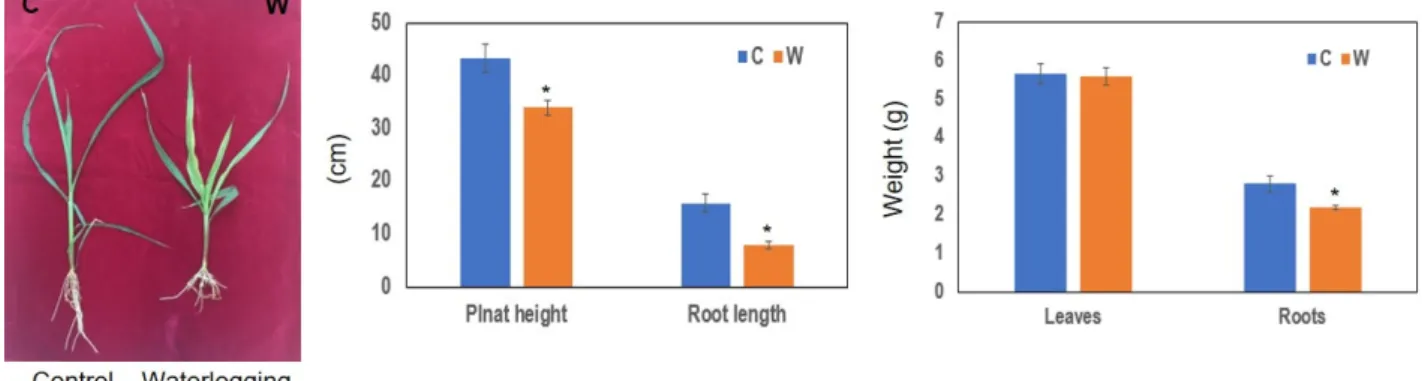
옥수수(B73)를 침수 처리하여 대조구와 침수구로 나누어 생육 특성 변화를 분석하였다. 전반적으로 대조구에 비해 침수구에서 지상부(잎)와 지하부(뿌리)의 생육이 저조한 것 으로 나타났다. 침수구는 대조구에 비해 초장 21.3%, 근장 50.6%, 뿌리의 무게 21.6%가 감소하였으나, 잎의 무게는 큰 변화를 보이지 않았다(Fig. 1).
침수구의 잎은 눈으로 관찰하였을 때 대조구에 비해 엽록소 가 감소되고 잎의 너비가 증가되는 것으로 나타났다(Fig. 2).
Fig. 1. The morphological phenotype, plant height, root length, weight of leaves and roots of maize inbred line (B73), 7 days after waterlogging initiation. Error bars represent standard deviation (n=5, * P <0.05). C, control; W, waterlogging.
Fig. 2. The morphological phenotype, SPAD value, content of total chlorophyll of maize leaves (B73), 7 days after waterlogging
initiation. Error bars represent standard deviation (n=5, * P <0.05). C, control; W, waterlogging.
엽록소의 변화를 알아보기 위하여 SPAD 분석과 엽록소 함 량을 측정한 결과 SPAD 값은 55.7%, 총 엽록소 함량은 35.3% 감소된 것으로 나타났다(Fig. 2). 얻어진 결과는 침수 처리에 의해서 옥수수의 생육, 특히 잎과 뿌리의 길이와 무 게, 엽록소 함량 등이 전체적으로 감소한다는 기존의 보고들 과 일치하였다(Ren et al., 2016; Salah et al., 2019). 따라서 옥수수의 유수형성기에 침수 스트레스를 받게 되면, 생육 에 영향을 주어 정상적인 발달이 이루어지 않는 것을 알 수 있었다(Ren et al., 2016).
옥수수 뿌리 조직 및 ROS 함량 변화
침수 처리에 따른 옥수수 뿌리 조직의 변화를 고배율의 광 학현미경으로 관찰한 결과, 침수구에서는 대조구에 비해 뿌 리의 두께가 2.5배 이상 증가하였고, 피층에 다수의 통기조 직이 형성되는 것으로 나타났다. 또한 침수 조건에서 형성되 는 활성산소(ROS: reactive oxygen species) 함량을 측정한 결과, 2시간 처리했을 때 ROS 함량이 대조구에 비해 침수구 에서 46.5% 급격히 증가하다가, 6시간 이후에는 ROS 함량 에 큰 차이를 보이지 않았다(Fig. 3). 따라서 식물 뿌리가 산소 결핍 조건이 되면, 이를 극복하기 위하여 산소를 쉽게 이용할 수 있는 통기조직을 형성하고, 생성된 ROS를 단시 간에 조절할 수 있는 기작을 가지고 있을 것으로 예상되었 다(Yamauchi et al., 2011; Gill et al., 2019).
침수 처리한 옥수수 뿌리에서 내습성 관련 유전자 발현 조사 내습성 관련 유전자를 선발하기 위해서 기존에 보고된 논 문 및 데이터 베이스를 참고하였다(Chalivendra & Martin, 2003; Arora et al., 2017). 에틸렌 반응 유전자(AP2/EREBP transcription factor 등), GA 생합성 조절 유전자(gibberellin 20 oxidase 등), 혐기성 호흡 관련 유전자(alcohol dehydrogenase 1
등), ROS 생합성 조절 유전자 및 아직까지 기능이 밝혀져 있지는 않으나 침수에 의해 발현이 증가하는 unknown 유전 자들을 포함 28개의 유전자를 선발하여 RT-PCR을 수행하 였다. 각각의 유전자의 특이적 primers는 논문 및 primers를 디자인 해주는 프로그램을 사용하여 제작하였으며, ACTIN1 유전자는 대조구 유전자로 사용하였다. 그 결과, 대조구에 비해 침수처리구에서 aldehyde dehydrogenase 2 (ALDH2), Wusl1032, unknown protein-1 (UP-1), unknown protein-2 (UP-2), 및 catalase 2 (CAT2) 유전자들의 발현이 2배 이상 증가한 것처럼 보였고, 이 결과를 수치화하여 확인하기 위 하여 qRT-PCR을 수행한 결과, Wusl1032와 UP-1 유전자 만 발현이 각각 300, 60배 증가하고 나머지 유전자들은 발 현의 차이가 없었다(Fig. 4). 이러한 결과는 기존에 보고된 내습성 관련 유전자들이 옥수수 품종에 따라 다른 발현 양 상를 보였고, B73 옥수수가 습해에 다소 강한 품종으로 알 려져 있어 일부 유전자만 발현의 차이를 보인 것으로 판단 되었다(Liu et al., 2012; Arora et al., 2017).
옥수수 뿌리의 Microarray 분석
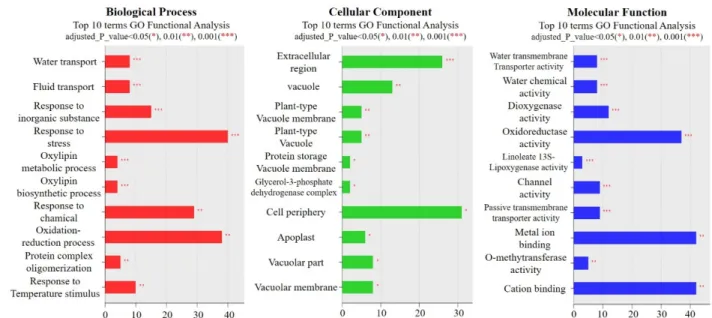
기존에 보고된 사실을 바탕으로 내습성 관련 유전자를 선발한 결과, 습해에 특이적으로 발현 되는 유전자들이 거 의 발견되지 않았다. 따라서 옥수수 23,000개 유전자를 동 시에 분석할 수 있는 microarray 분석을 수행한 결과, 내습 성 관련 유전자는 크게 3가지 범주로 구분할 수 있었다. 먼 저 생물학적 분석에서는 스트레스, 케미칼 및 산화-환원에 반응하는 유전자들의 발현이 급격하게 증가하였다. 두 번 째로 세포학적 분석은 세포 밖에 존재하는 단백질, 액포에 존재하는 단백질, 세포 주변에 존재하는 단백질 등 수송에 관여하는 유전자들의 발현이 대부분 증가하였다. 마지막으 로 분자 기능학적 분석에서는 산화-환원 효소 활성에 관련
Fig. 3. The microscopic analysis and ROS contents of roots of maize inbred line (B73), 7 days after waterlogging initiation.
Red arrow indicates aerenchyma. Error bars represent standard deviation (n=5, *P <0.05). C, control; W, waterlogging.
된 단백질, 메탈 이온 및 양이온 결합에 관련된 단백질에 관 여하는 유전자들이 많이 발현되는 것을 확인하였다(Fig. 5).
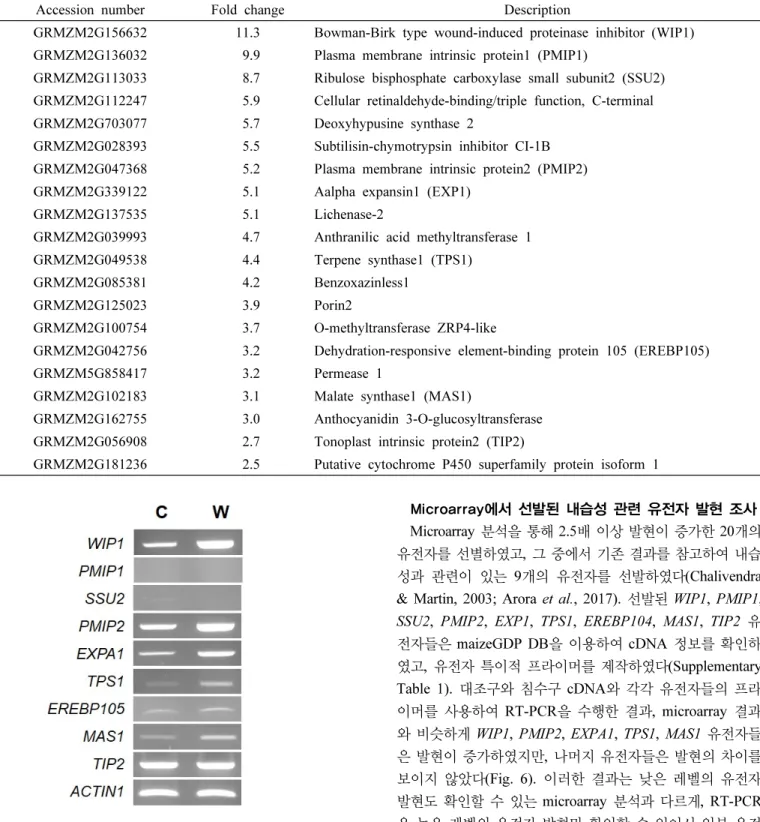
또한, microarray 분석 결과 통기 조직 형성에 관여하는 plasma membrane intrinsic protein1 (PMIP1) 유전자와 에 틸렌 생합성에 관여하는 ethylene response element binding
protein 105 (EREB105) 유전자 등 20개 유전자의 발현이 2.5배 이상 증가되어 있는 것을 확인하였다(Table 1). 이러 한 결과는 기존에 알려진 내습성 관련 유전자와 일부 유사 하였고, 내습성 마커를 개발하는데 B73을 이용하는 것이 유용할 것이라고 판단되었다(Qiu et al., 2007).
Fig. 4. mRNA expression analysis of waterlogging related genes in roots of maize inbred line (B73), 7 days after waterlogging initiation. Total RNA was isolated from maize roots and subjected to RT-PCR and qRT-PCR analysis. Relative expression measured by qRT-PCR. The Actin1 gene was used as a quantitative control. Error bars represent standard deviation (n=3,
*P <0.05). C, control; W, waterlogging.
Fig. 5. Transcriptomic analysis of the maize inbred line (B73) under the waterlogging stress Gene profiler of differentially
expressed genes in waterlogging treated maize relative to control maize. Significantly enriched GO in terms (Biological
process, Cellular compartment, Molecular function) of up-regulated genes was observed in waterlogging treated maize.
Microarray에서 선발된 내습성 관련 유전자 발현 조사 Microarray 분석을 통해 2.5배 이상 발현이 증가한 20개의 유전자를 선별하였고, 그 중에서 기존 결과를 참고하여 내습 성과 관련이 있는 9개의 유전자를 선발하였다(Chalivendra
& Martin, 2003; Arora et al., 2017). 선발된 WIP1, PMIP1, SSU2, PMIP2, EXP1, TPS1, EREBP104, MAS1, TIP2 유 전자들은 maizeGDP DB을 이용하여 cDNA 정보를 확인하 였고, 유전자 특이적 프라이머를 제작하였다(Supplementary Table 1). 대조구와 침수구 cDNA와 각각 유전자들의 프라 이머를 사용하여 RT-PCR을 수행한 결과, microarray 결과 와 비슷하게 WIP1, PMIP2, EXPA1, TPS1, MAS1 유전자들 은 발현이 증가하였지만, 나머지 유전자들은 발현의 차이를 보이지 않았다(Fig. 6). 이러한 결과는 낮은 레벨의 유전자 발현도 확인할 수 있는 microarray 분석과 다르게, RT-PCR 은 높은 레벨의 유전자 발현만 확인할 수 있어서 일부 유전 자의 발현을 관찰할 수 없었다(Moon et al., 2018). 결론적 으로, 최종 선발된 5개 유전자는 정상적인 조건에서 자라는 옥수수가 습해에 감수성인지 내성인지를 유묘기 시기에 판 단할 수 있는 내습성 선발 마커로써 개발이 가능할 것이다.
Table 1. Partial list of up-regulated genes in waterlogging-treated B73 compared with non- treated B73.
Accession number Fold change Description
GRMZM2G156632 11.3 Bowman-Birk type wound-induced proteinase inhibitor (WIP1) GRMZM2G136032 9.9 Plasma membrane intrinsic protein1 (PMIP1)
GRMZM2G113033 8.7 Ribulose bisphosphate carboxylase small subunit2 (SSU2) GRMZM2G112247 5.9 Cellular retinaldehyde-binding/triple function, C-terminal
GRMZM2G703077 5.7 Deoxyhypusine synthase 2
GRMZM2G028393 5.5 Subtilisin-chymotrypsin inhibitor CI-1B GRMZM2G047368 5.2 Plasma membrane intrinsic protein2 (PMIP2)
GRMZM2G339122 5.1 Aalpha expansin1 (EXP1)
GRMZM2G137535 5.1 Lichenase-2
GRMZM2G039993 4.7 Anthranilic acid methyltransferase 1
GRMZM2G049538 4.4 Terpene synthase1 (TPS1)
GRMZM2G085381 4.2 Benzoxazinless1
GRMZM2G125023 3.9 Porin2
GRMZM2G100754 3.7 O-methyltransferase ZRP4-like
GRMZM2G0427563.2 Dehydration-responsive element-binding protein 105 (EREBP105)
GRMZM5G858417 3.2 Permease 1
GRMZM2G102183 3.1 Malate synthase1 (MAS1)
GRMZM2G162755 3.0 Anthocyanidin 3-O-glucosyltransferase
GRMZM2G056908 2.7 Tonoplast intrinsic protein2 (TIP2)
GRMZM2G1812362.5 Putative cytochrome P450 superfamily protein isoform 1
Fig. 6. Gene expression confirmation results obtained from microarray analysis. RT-PCR was performed using cDNA of B73 root with primers for 2.5-fold up- regulated genes from microarray analysis. The ACTIN1 gene was used as a quantitative control. C, control;
W, waterlogging.
적 요
본 실험은 옥수수(B73)에서 습해에 대한 생육 특성 변화 와 습해 관련 유전자 발현 양상을 조사하여 내습성 옥수수 마커 개발을 위한 기초자료로 활용하고자 수행되었다.
1. 침수 처리구에서 초장(21.3%), 근장(50.6%), 잎 및 뿌리 의 무게(21.6%), 잎의 SPAD 값(55.7%) 및 엽록소 함량 (35.3%)은 감소하였고, 뿌리의 ROS의 함량은 2시간까 지 46.5% 증가하다가 6시간 후에는 차이가 발생하지 않 았다.
2. 뿌리 두께가 대조구에 비해 습해 처리구에서 2.5배이상 증가하였고, 뿌리 피층에 다수의 통기조직이 형성되었다.
3. 통기조직 형성(EXP1)과 에틸렌 생합성에 관련된 유전자 (EREBP105) 등 습해 관련 유전자 7개가 습해 처리구에 서 2.5배 이상 발현이 증가되는 것을 Microarray 분석을 통해 선별하고 RT-PCR을 통해 확인하였다.
사 사
본 논문은 농촌진흥청 연구사업(세부과제명: 선발계통 및 유전자원의 대사물질 분석을 통한 내습성 생리 기작 연 구, 세부과제번호: PJ014273022020)의 지원에 의해 이루어 진 것임
인용문헌(REFERENCES)
Alamgir, H. and S. N. Uddin. 2011. Mechanisms of waterlogging tolerance in wheat: morphological and metabolic adaptations under hypoxia or anoxia. Aust. J. Crop Sci. 5(9) : 940-1110.
Arora, K., K. K. Panda, S. Mittal, M. G. Mallikarjuna, R. R.
Atmakuri, K. D. Prasanta, and T. Nepolean. 2017. RNAseq revealed the important gene pathways controlling adaptive mechanisms under waterlogged stress in maize. Sci. Rep. 7 : 10950.
Ashraf, M. A., M. S. Ahmad, M. Ashraf, F. Al-Qurainy, and M.
Y. Ashraf. 2011. Alleviation of waterlogging stress in upland cotton (Gossypium hirsutum L.) by exogenous application of potassium in soil and as a foliar spray. Crop Pasture Sci. 62 : 25-38.
Boru, G., T. Vantoai, J. Alves, D. Hua, and M. Knee. 2003.
Response of soybean to oxygen deficiency and elevated root-zone carbon dioxide concentration. Ann. Bot. 91(4) : 447-453.
Chalivendra, C. S. and M. S. Martin. 2003. Molecular and cellular adaptations of maize to flooding stress. Ann. Bot. 91(2) :
119-127.
Christianson, J. A., D. J. Llewellyn, E. S. Dennis, and I. W.
Wilson. 2010. Global gene expression responses to waterlogging in roots and leaves of cotton (Gossypium hirsutum L.). Plant Cell Physiol. 51(1) : 21-37.
Gill, M. B., F. Zeng, L. Shabala, G. Zhang, M. Yu, V. Demidchik, S. Shabala, and M. Zhou. 2019. Identification of QTL related to ROS formation under hypoxia and their association with waterlogging and salt tolerance in barley. Int. J. Mol. Sci.
20(3) : 699-714.
Komatsu, S., C. Han, Y. Nanjo, M. Altaf-Un-Nahar, K. Wang, D.
He, and P. Yang. 2013. Label-free quantitative proteomic analysis of abscisic acid effect in early-stage soybean under flooding. J. Proteome Res. 12(11) : 4769-4784.
Kong, F., A. Oyanagi, and S. Komatsu. 2010. Cell wall proteome of wheat roots under flooding stress using gel-based and LC MS/MS based proteomics approaches. Biochim. Biophys.
Acta 1804(1) : 124-136.
Koo, S. C, H. T. Kim, B. K. Kang, Y. H. Lww, K. W. Oh, H. Y.
Kim, I. Y. Back, H. T. Yun, and M. S. Choi. 2014. Screening of Flooding Tolerance in Soybean Germplasm Collection.
Korean J. Breed. Sci. 46(2) : 129-135
Liu, F., T. Vantoai, G. Bock, L.D. Linford, and J. Quackenbush.
2005. Global transcription profiling reveals novel insights into hypoxic response in Arabidopsis. Plant Physiol. 137 : 1115- 1129.
Liu, Z., K. Sunita, L. Zhang, and W. Doreen. 2012. Characterization of miRNAs in response to short-term waterlogging in three inbred lines of Zea mays. PLoS ONE 7(6) : e39786.
Moon, J., S. Shin, H. C. Kim, K. Song, J. Y. Kim, K. Kim, and B.
Lee. 2018. Assessment of the candidate genes of expression markers associated with drought stress in maize seedlings.
Korean J. Breed. Sci. 50(3) : 224-235.
Qiu, F. Z., Y. L. Zheng, Z. L. Zhang, and S. Z. Xu. 2007. Mapping of QTL associated with waterlogging tolerance during the seedling stage in maize. Ann. Bot. 99(6) : 1067-1081.
Ren, B., J. Zhang, S. Dong, P. Liu, and B. Zhao. 2016. Effects of waterlogging on leaf mesophyll cell ultrastructure and photosynthetic characteristics of summer maize. PLoS ONE 11(9) : e0161424.
Ren, B. Z., J. W. Zhang, X. Li, X. Fan, S. T. Dong, B. Zhao, and P. Liu. 2014. Effect of waterlogging on leaf senescence characteristics of summer maize in the field. J. Appl. Ecol.
25(4) : 1022-1028.
Salah, A., J. Li, J. Ge, C. Cao, H. Li, Y. Wang, Z. Liu, M. Zhan, and M. Zhao. 2019. Morphological and physiological responses of maize seedlings under drought and waterlogging. J. Agr.
Sci. Tech. 21(5) : 1199-1214.
Sallam, A. and H. D. Scott. 1987. Effects of prolonged flooding on soybeans during early vegetative growth. Soil Sci. 144(1) : 61-66.
Tang, B., S. Xu, X. Zou, Y. Zheng, and F. Qiu. 2010. Changes of
antioxidative enzymes and lipid peroxidation in leaves and roots of waterlogging-tolerant and waterlogging-sensitive maize genotypes at seedling stage. Agric. Sci. China. 9 : 651-661.
Yamauchi, T., I. Rajhi, and M. Nakazono. 2011. Lysigenous aerenchyma formation in maize root is confined to cortical
cells by regulation of genes related to generation and scavenging of reactive oxygen species. Plant Signal. Behav.
6(5) : 759-761.
Yordanova, R. Y, K. G Zheng, Z. G. Stoinova, and L. P. Popova.
2004. Changes in the leaf polypeptide patterns of barley plants
exposed to soil flooding. Biologia Plantarum 48(2) : 301-304.
Supplementary Table 1. Primers of waterlogging stress-related genes in this study.
Symbol Gene name Forward primer (5’→3’) Reverse primer (5’→3’) ALDH2 Aldehyde dehydrogenase 2 CTCTACGTGGCCAACCTCCT CCTTGGACTTCTCCACGAACT GA20OX2 Gibberellin 20 oxidase 2 GTTCAGGAACATCCGTGTCG GGCGATGCGTATCATGAAGT GID1L2-1 Gibberellin receptor GID1L 2 AACTTTGTCCACAACGTCGC AAAGAAGGCGACCAGTCGAT GID1L2-2 Gibberellin receptor GID1L 2 GTTCAGGAACATCCGTGTCG GGCGATGCGTATCATGAAGT GID1L2-3 Gibberellin receptor GID1L 2 TCCTCCTGTCCCTGTTCCTC TCTGCATCAGCTCCTCGTTC GASA2 Gibberellin-regulated protein 2 GTTGCTGGCCTCCTCTTCTT GCACTTGGGCCTGGTGC EREBP193 AP2-EREBP-transcription factor 193 CGACGCCGAGGACTCC GTCGGACACCTGTGCGC EREBP148 AP2-EREBP-transcription factor 148 GACGCCGAGGACATTCATG AGCAGCAGCAGCAGCAGA EREBP179 AP2-EREBP-transcription factor 179 CGTGCTCCAGGAAGTACAGG CAGCGATCTCCTCCATCTGA EREBP180 AP2-EREBP-transcription factor 180 GAGACGCAGAGGAAGGAAGG GAACTCGTCGAAGCTCCACA ADH1 Alcohol dehydrogenase 1 CGATTGCTTTCCTGGACCC TGAGGGTTGATCTTTGCAACA
ALD1 Aldolase 1 AATGAGCCATCACAGCTTGC GTTCATGGCATTGAGGTTGC
ENO2 Enolase 2 GCGACAGCCTGAAAGACCTG GTATCTTGACCAGTTGACAGCGTA
GAP1 Glyceraldehyde-3-phosphate dehydrogenase 1 GGCCAATGGAAGCACAGC GAGGCCCCCTTCTCGATT PGI1 Phosphohexose isomerase 1 TGGCCAGCACAGCTTCTATC CCCTCAACAGGCTTTCCTTC PDC1 Pyruvate decarboxylase 1 ATGGAGACCCTCCTGGCTG GGCGTACTCCAGGTTGGC
Sh1 Shrunken1 GAGGATGTTTCCAGTGAAATAATGA GTTTCCGTATACGGGTAGTAAACACT
SUS1 Sucrose synthase1 CGTCTTCACCAGGCTGAAAA GGGTATCAGCTTGTAGGGTGGA
wusl1032 Wusl1032 ACTGCTTCATGCGGTACGAG GCACGACGATCTTGGTGTTC
UP-1 Unknown protein-1 CACAGACACAGTTGGGAAAGA CCAACTTTCGCAGTCACAAAC
UP-2 Unknown protein-2 CTTTCGCAGACCAAGGACAT GAGCGTTCCAGAGAAGTTGAG
UP-3 Unknown protein-3 CTGAGGTGAGGTGTTTCCTAAA TGAGAGTCGTTGCCTCTACTA RbohA Respiratory burst oxidase protein A CAGCGCACACAAGAACTCTC CCCCGCACACAAGAACTCTC RbohB Respiratory burst oxidase protein B TTGGGTTACACGTGAGCAAG AATGGAGCAAAGGCAACTGT RbohC Respiratory burst oxidase protein C GGCACAGGAACTAAGCAAGC AAACTCATCGCCAAGAAAGC RbohD Respiratory burst oxidase protein D TGTCTCTGGTCGTTCTCAGC CTCATCGCCCTCTAGAACCC
SOD Superoxide dismutase GCTTGAAGATGATTTGGGGA ACAGCGTAGCTCAACTGCAA
CAT2 Catalase 2 TAGCACGCAAACTGAATCGC TGGAAACCCAGCCAAACATT
Actin1 Actin1 ATGTTTCCTGGGATTGCCGAT CCAGTTTCGTCATACTCTCCCTTG