유채의 품질과 수량 특성에 대한 조합능력 분석
신동영1, 권병선1*, 정동수2, 함영수2, 이정일2, 장영석2, 정동희2, 박희진3, 배창휴1, 현규환1, 국용인1, 최갑림1, 윤영범1
1순천대학교 생명산업과학대학, 2농촌진흥청 국립식량과학원 바이오 에너지 작물센터, 3서강정보대학
Analysis of Combining Ability for Quality and Yielding Characteristics in Rapeseed (Brassica napus L.)
Dong Young Shin1, Byoung Sun Kwon1*, Dong Soo Jung2, Young Soo Ham2, Jung Il Lee2, Young Seok Jang2, Dong Hee Chung2, Hee Jin Park3, Chang-Hyu Bae1, Kyu Hwan Hyun1,
Yong In Kuk1, Gab Lim Choi1 and Young Beom Yun1
1Sunchon National University, Suncheon 540-742, Korea
2Bio-Energy Crop Center, National Institute of Food Science, Rural Development Administration, Muan 534-833, Korea
3Seokang University, Kwangju 500-742, Korea
Abstract - Naehanyuchae and Youngsanyuchae were originated from the cross between “Erra”(♀) and “Tower”(♂). The cultivars were made at Bioenergy Crop Research Center, National Institute of crop science, Rural Development Administration, Korea in order to develop the high cold tolerant and yielding rapeseed variety with non-erucic acid and non-glucosinolate as good seed quality indicator. The superiorities of these varieties have been shown through the regional performance trials and demonstration farmers fields. Naehanyuchae and Youngsanyuchae had good agronomic characteristics related to yield potential such as many valuable branches and pods, and long pod length. The seeds of these new varieties composed of the 80% of oleic acid and linoleic acid without erucic acid, and glucosinolate was not extracted in the oil cake. The average grain yields increased by the from 16% to 22% according to the regional performance trials compared to check variety.
Key words - Rapeseed, Combining ability, Quality and Yielding, Variety
*교신저자(E-mail) :[email protected]
서 언
계통 육종법에 있어서는 계승되는 각 분리 세대에서 최 우수형 개체 및 계통을 선발하여 나가며, 이때에 양친과 후 대(後代) 간의 관계를 잘 관찰 기록해 간다. 선발은 F2 세대 로부터 하는데 이때에 육종가의 판단으로 제일 우수한 후 대를 선발 하리라고 생각되는 개체들을 선발한다. 대부분 의 잡종들은 다수의 유전자들이 독립 혹은 연관되어 분리 된다는 것을 기대할 수 있으며, 개개의 F2 개체 사이에 상 호차이(相互差異)변이가 크게 나타나고 있다는 것도 뚜렷 한 사실이다.
F3는 F4 세대로 가면 많은 유전자좌(遺傳子座 ; loci)가 동질접합(同質接合)으로 되기 때문에 이때부터 계통 특성 이 나타나기 시작한다. 그러나 이들 세대에는 높은 이질접 합성(異質接合性)이 존속되고, 계통내의 개체들은 유전적 으로 서로 다르기 때문에 이들 세대에서의 선발은 가장 우 수한 계통 안에서 가장 우수한 식물체를 대상으로 한다.
F5, F6 세대쯤 되면 대부분의 계통은 대부분의 유전자좌가 동질접합성으로 된다. 따라서 이 시기의 계통내 선발은 효 과적이지 못하므로 이때부터는 계통간선발(系統間選拔)에 거의 전적으로 주력한다. 여기에서 선발된 계통은 생산력 검정 시험, 지방적응 연락 시험을 거처 신품종으로 육성되 게 되어있다. 따라서 F2 개체 선발이 가장 중요하다고 할
Table 1. Artificial crossing and hybrid generation of rapeseed I. Artifical crossing
No. of combination No. of flowers by crossing
No. of pods per plant
Seed set percentage (%)
No. of Fruiting grain Testing Selection
180 176 7,062 4,838 69 68,752
II. Hybrid generation
Generation
Testing Selection
No. of combination
No. of line (plant)
No. of combination
No. of line (plant)
F1 176 (3,520) 156 (3,120)
F2 156 (317,500) 60 (692)
F3 60 692 41 451 (2,176)
F4 41 2,176 15 267
수 있겠다. F2 개체 선발 시 많은 교배조합에서 여러 개체 를 선발하여 F3 이후 세대를 진전시키는 방법과 F2 세대의 많은 조합 중 우수한 조합을 먼저 선발하고 그 조합 내에서 우수한 개체를 선발한 방법이 있는데 저자들은 그 우수한 조합 내에서 우수한 개체를 선발했던 결과 우수한 품종이 한 조합 내에서 두 품종(내한유채, 영산유채)이나 육성되었 기에 이에 그 육성방법을 소개코자 한다.
재료 및 방법
공시재료는 Table 1과 같이 인공 교배 180조합, F1세대 176조합, F2세대 156조합 317,500개체, F3세대 60조합 692계통, F4세대 41조합 2,176계통을 공시하였다. 재배방 법은 N-P2O5-K2O=4-8-8 kg/10a를 기비로 시용하였고 익년 2월 하순에 N는 6 kg/10a를 추비로 시용하였다. 파 종방법은 휴폭 50 cm × 주간 15 cm로 직파하였으며 포장 배치는 순위배열 단일반복으로 배치하였다. F1세대에서 세 대단축을 실시한 다음 F2세대에서 Paper chromatography 에 의한 지방산 간이 검정과 Test tape법을 이용하여 유 박에 대한 간이분석을 통하여 zero-Erucic and zero- Glucosinolate 개체를 선발 하였다. F3 이후 세대에서는 지방산 조성이 개량되고 무독박이면서 장수, 다협, 다립, 무병 등의 실용적인 형질들이 고정된 계통들은 생산력을 검정 하였으며 생산력이 표준 품종보다 다수성인 계통들은 선발하여 조단백질 분석을 Kjeldahl법(AOAC, 1970)으로
총질소를 정량한 후 질소 계수 6.25를 곱하여 산출하였고, 지방산 분석은 유채 분말 20 mg에 Acetylchloride와 methanol 을 처리하여 70℃의 water bath에서 3시간 진탕시키고 hexane을 첨가한 후 원심분리하여(2,000 rpm, 5분) hexane 층을 분리 하였다. Hexane이 제거된 기름은 gas chro- matography에 주입하여 지방산 조성을 분석하였으며 palmitic(PAL. 16:0), stearic(STE. 18:0), oleic(OLE. 18:1), linoleic(LIN. 18:2), linolenic(LNL. 18:3), eicosenoic(EIC.
20:1) 및 erucic(ERU. 22:1) acid으로 분류하였다.
함유율조사는 soxhlet에 ethylether을 용제로 70℃의 soxhlet장치에서 8시간 추출하였으며, glucosinolate 함 량 분석은 Youngs & Wetter(1967, 1976)의 방법에 의하여 BI Butylisothiocyanate의 면적
Butenylisothiocyanate면적
× 와, P I
Butylisothiocyanate의 면적 Pentenyisothiocyanate의 면적
× 을 분석하였고, 5- viny1-2-oxazolidinethione(OZT)의 함량 분석은 Lein (1970)의 방법에 의하여 UV-spectrophoto meter system 으로 흡광도 235, 245, 255 nm에서 측정하였다.
결과 및 고찰
잡종세대 선발경과
인공 교배는 180조합을 실시하여 Table 1과 같이 교배 화수 7,062, 결실협수 4,838, 종자형성 69%, 성숙입수 68,752 립으로 176조합을 수확하여 F1세대로 진전시켰다
Table 2. Line selection of preliminary yield trial in rapeseed
No. Testing combibation (line) Selection combination (line) 15 combination (267) combination (2) 76018 Yudal×Oro / Norin23×Oro/Tower (2)
76035 Yudal×Rapora / Bronowski (1) 76036 Yudal×Rapora / Tower (2) 76038 Yudal×Erra / Tower (3) 76046 Na l#×Midas / Tower (5) 76047 Na l#×Orle / Bronowski (7) 76049 Na l#×Lesira / Bronowski (5) 76050 Na l#×Lesira / Tower (3)
76052 Oro×Tower (27) Erra×Tower - 76062-B-65-1
76053 Midas×Bronowski (71) Erra×Tower - 76062-B-70-3 76062 Erra×Tower (83)
76085 Asahi×Bronowski / Erra (5) 76152 Bronowski×Erra (25) 76156 Tower×Oro (15) 76157 Tower×Midas (13) Table 3. Preliminary yield trial of rapeseed I. Agronomic characteristics
No. Combination Pedigree Bolting date
Flowering date
Flower ending
Flowering period
Maturing period
Maturing date 81 Erra×Tower 76062-B-65 Mar. 9 Apr. 2 Apr. 30 34 58 May 30
86 76062-B-70 Mar. 14 Apr. 12 May 5 26 50 Jun. 5
94
Yongdang (Check Cultivar)
Feb. 27 Mar. 30 Apr. 30 33 63 May 30
II. Yield components and yield
No. Pedigree
Plant length (cm)
Ear length
(cm)
Branch
No. of pods per ear
Pod length
(cm)
Seed set percentage
(%)
10a
1ℓ weight
(g)
1,000 grains weight (g)
Oil content Total First Second (%)
Seed yielding
(kg) Index
(%) 1,000 grains weight (g)
81 76062-B-65 143.8 49.4 36 13 23 34.4 5.8 88.4 343 127 533.4 643 3.0 38.5 86 76062-B-70 134.2 37.6 32 13 19 50.2 5.0 88.4 333 123 512.3 650 3.0 37.8 94
Yong- dang (Check Cultivar)
160.6 44.4 50 20 30 57.6 4.8 61.0 270 100 447.8 603 3.0 43.0
C. V (%) ……… 10.9 L.S.D 5% ……… 57.9 1% ……… 76.5
Table 4. Regional performance trial at three location
No. Line Bolting date Flowering date Flower ending Maturing date Mokpo Jinju Jeju Mokpo Jinju Jeju Mokpo Jinju Jeju Mokpo Jinju Jeju 1 Youngdang Mar.
13 Apr.
2 - Apr.
14 Apr.
21 - May
15 Jun.
3 - Jun.
11
Jun.
12 - 2 Mokpo 29# - - Feb.
26 - - Apr.
3 - - Apr.
29 - - Jun.
3 9 Mokpo 51#
(Naehan)
Mar.
22
Mar.
29
Mar.
12
Apr.
18 Apr.
20 Apr.
13
May 12
May 27
Apr.
30
Jun.
10
Jun.
14
Jun.
11 10 Mokpo 52#
(Youngsan) Mar.
24 Apr.
2
Mar.
4
Apr.
17 Apr.
19 Apr.
7
May 15
May 30
May 1
Jun.
12
Jun.
10
Jun.
8
No. Line Plant length (cm) Ear length (cm) No. of branches
No. of Pods per ear Mokpo Jinju Jeju Mokpo Jinju Jeju Mokpo Jinju Jeju Mokpo Jinju Jeju
1 Youngdang 129 127 - 42 54 - 33 17 - 43 41 -
2 Mokpo 29# - - 125 - - 42 - - 33 - - 42
9 Mokpo 51#
(Naehan) 146 138 135 48 53 38 30 14 34 50 39 40
10 Mokpo 52#
(Youngsan) 143 141 137 44 51 38 40 13 33 49 40 49
No. Line Pod length (cm) No. of fruit per pod
No. of ovule per pod
Seed set percentage (%) Mokpo Jinju Jeju Mokpo Jinju Jeju Mokpo Jinju Jeju Mokpo Jinju Jeju
1 Youngdang 5.1 6.0 - 23 17 - 23 19 - 100 88 -
2 Mokpo 29# - - 4.4 - - 19 - - 21 - - 91
9 Mokpo 51#
(Naehan) 5.4 6.9 5.5 30 23 25 30 28 28 100 83 89
10 Mokpo 52#
(Youngsan) 6.0 7.0 6.0 26 22 21 28 26 25 93 85 84
No. Line
Seed yield
(kg/10a) Index (%) 1,000 grains
weight (gr) Mokpo Jinju Jeju Mokpo Jinju Jeju Mokpo Jinju Jeju
1 Youngdang 219.8 166.2 - 100 100 - 3.0 4.7 -
2 Mokpo 29# - - 324.5 - - 100 - - 3.9
9 Mokpo 51#
(Naehan) 242.8 235.6 347.3 111 142 107 3.0 4.1 3.1
10 Mokpo 52#
(Youngsan) 265.5 222.8 377.5 121 134 116 3.0 4.3 3.5
Table 5. Grain quality of rapeseed bred in the experiment
No. Line Fatty acid (%) Glucosinolate Protein
(%)
Oil content PAL STE OLE LIN LNL EIC ERU BI PI OZT Total (%)
1 Youngdang 3.4 1.8 68.5 21.2 4.5 0.6 0 4.15 0.37 6.16 10.68 24.9 43.0 2 Mokpo 29# 5.3 1.6 54.4 28.1 10.5 0 0 3.75 0.27 6.68 10.78 23.1 44.0 9 Mokpo 51#
(Naehan) 4.6 1.5 58.7 22.7 11.8 0.7 0 0.28 0.17 0.58 1.03 23.4 43.3 10 Mokpo 52#
(Youngsan) 4.5 1.6 66.0 17.1 9.2 1.5 0 0.06 0.03 0.34 0.43 24.5 43.9
Table 6. Regional mean yield of rapeseed bred in the experiment at three location. (kg/10a)
No. Line Mokpo Jinju Jeju Total
yield
Mean yield
Index (%) 1 Youngdang,
(Mokpo 29#) 220 166 325 711 237 100
8 Mokpo 51#
(Naehan) 243 236 347 826 275 116
9 Mokpo 52#
(Youngsan) 267 223 378 868 289 122
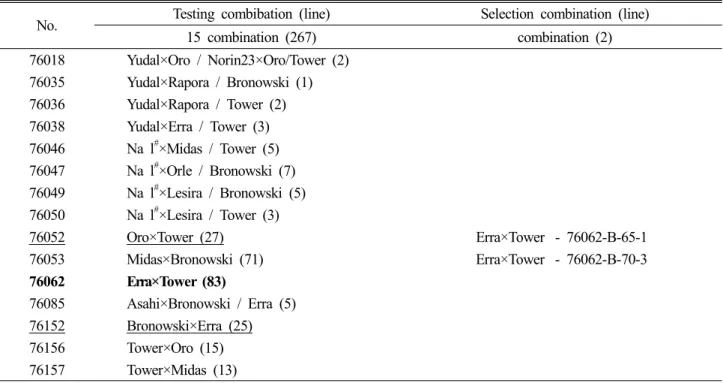
(Kwon et al., 1976). F1세대에서는 176조합 3,520개체를 공시하여 세대단축을 실시하였고 156조합 3,120개체를 양 성하여(Kwon et al., 1977) F2세대로 진전시켰다(Kwon et al., 1978). F2세대에서는 156조합 317,500개체를 공시 하여 60조합 692개체를 1차 선발로 개화기, 수장, 분지수, 협수 등의 수량구성요소와 병충해 정도를 선발 하였고, 2 차 선발로는 Paper chromatography에 의한 지방산 분석 과 Testape에 의한 박 분석을 하여 선발된 개체는 F3세대 로 진전시켰다(Kwon et al., 1979). F3세대에서는 60조합 692계통을 공지하여 41조합 451계통, 2,176개체를 1차 선 발(개화수, 수장, 분지수, 협수 등의 수량구성요소)과 병충 해 정도 및 2차 선발로는 Paper chromatography에 의한 지방산 분석과 Testape에 의한 박 분석을 실시하여 최종적 으로 15조합 267계통을 Table 2와 같이 선발하였다(Kwon et al., 1979; Kwon et al., 1980). 선발된 15조합 중 가장 많은 계통을 선발한 76062 (Erra × Tower) 조합은 83계 통을, 다음으로 많은 계통을 선발한 조합은 76053(Midas
× Bronowski) 조합으로 71계통을, 그 다음으로는 76052(Oro
× Tower) 조합 27계통을, 그 다음으로는 76152(Bronowski
× Erra) 조합 25계통을 선발하였고, 기타의 11조합들을 1~15계통 선발로 총합계 15조합 267계통 전체를 생산력
검정 시험에 공시하였다.
생산력 검정 및 지방 적응성 검정 결과
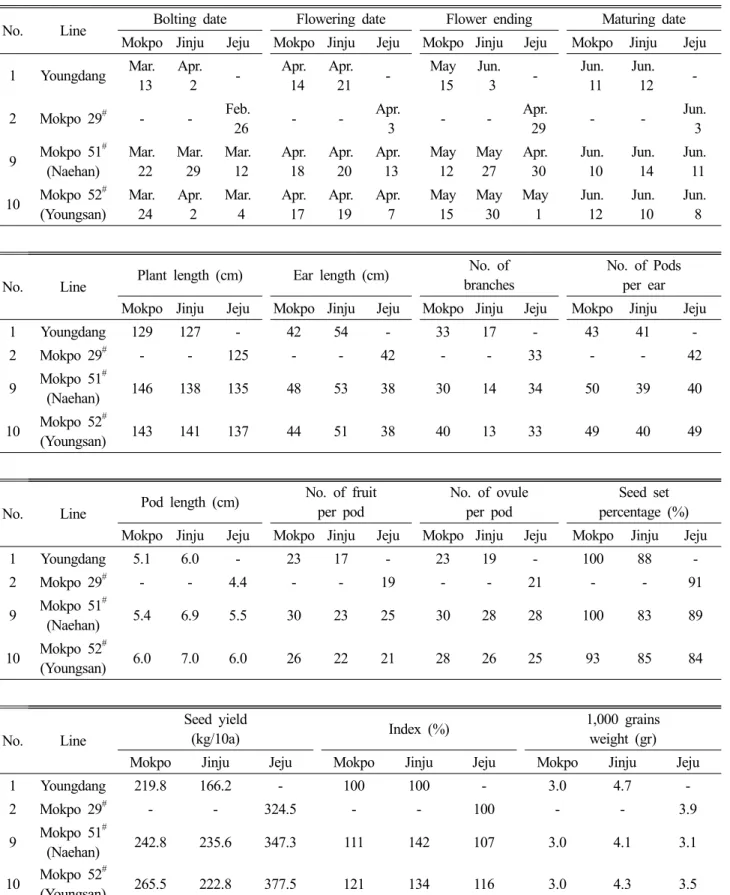
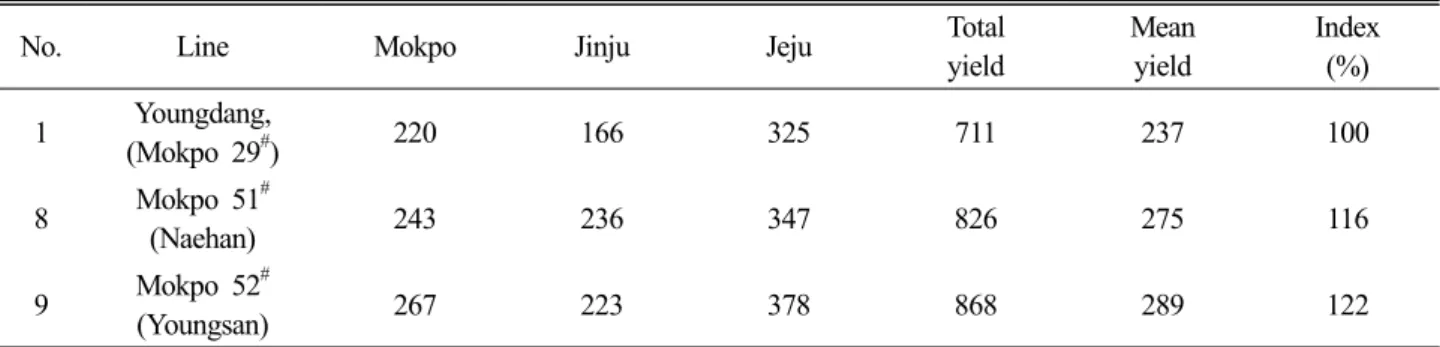
생검 예비 시험에 공시된 15조합 267계통(Table 2)들 중에서는 76062조합(Erra × Tower) 조합에서 76062-B-65-1 계통과 76062-B-70-3의 계통이 Table 3과 같이 생산력 이 높아서 목포51호와 목포52호로 명명하여 지방 적응 연 락 연락 시험에 Table 4, 5, 6과 같이 공시 하여 신품종으 로 Fig. 1과 같이 내한 유채와 영산 유채를 육성할 수 있었 다. 이상의 결과를 볼 때에 유채 신품종 목포11호는 1968년 에 Gogane(♀)와 Oro(♂)를 교배하여 육성되었으며(Lee et al., 1978), 목포29호(노적) 품종은 1970년에 Oro(♀) 와 Norin 16(♂)을 교배하여 육성되었고(Lee et al., 1980), 유달 품종은 1964년에 전남재래종을 계통 분리 육종을 시 작하여 육성 되었다(Kae et al., 1971). 이들 모든 품종들은 우량 개체 선발시 개체 위주로 선발한 결과로 육성년도가 장기간 소요 되었으나 조합 위주의 개체선발한 신품종 내 한 유체 영산유체는 육종연한도 짧게 소요되었으며 동일 조합 내에서 두 개의 품종이 육성되었다. 이와 같은 결과는 양친의 형질들이 아주 적합한 경우에는 선발한 개체 식물 중에 아주 우수한 형의 것들이 많을 수 있다는 Immer(1941)
Year 1976 1977 1978 1979 1980
Generation Cross *F1 F2 F3 F4 F5
Erra(♀)
Tower(♂)
×
1
20
1
2,800
1
⋮
⋮
⋮
⋮ 2,012
2 3
1 2
Mokpo 51 (Naehan)
Mokpo 52 (Youngsan)
Applied No. of families 1
No. of lines 21 3 1
No. of plant 20 2,800 105 60
Seleced No. of families
No. of lines 1 1
No. of plants 20 1,218(21) 3 1
( ) : No. of plants of O-erucic +O - glucosinolate *Generation shortening
Fig. 1. Pedigree diagram of Naehanyuchae and Youngsanyuchae.
의 결과와도 비슷한 결과이다. 따라서 앞으로의 유채 계통 육종은 개체 선발 이전에 충분한 양친의 특성을 감안하여 조합 선발 후 다수의 개체 선발로 이어진다면 좀 더 빠른 기간 내에 우수한 품종으로 육성이 이루어 질것으로 기대 되었다.
적 요
본 품종들은 우리나라 남부지방에 적응한 양질유, 양질 막 다수성 품종을 육성하기 위하여 Erra(♀)와 Tower(♂) 를 인공교배하여 육성한 양질유, 양질박, 다수성 품종으로 서 목포51호, 목포52호라는 계통명을 부여하여 지방 적응 연락 시험 및 농가 실증 시험을 거쳐서 장려 품종(내한유 채, 영산유채)으로 결정된 품종이다. 특히 본 품종들은 한 조합 내에서 장수, 다분지, 다협, 다립 품종으로 수량 형질 이 우수하며, 유질에서 지방산 조성이 극히 양호하며 불량 지방산은 전혀 함유치 않고 양질 지방산인 oleic acid과 linoleic acid이 80% 이상 함유된 양질유 품종이며, 박에 서도 glucosinolate가 전혀 없는 무독박 품종이다. 또한 생산력은 전국평균 16~22% 증수된 다수성 성분 육종 품종 들이다.
인용문헌
Choi, H.O., I.H. Kim, J.I. Lee, B.S. Kwon and B.M. Kae.
1977. Early maturing and high yielding rape variety,
“Mokpo 11”. The Research Reports of the RDA. 19(crop):
65-68.
Immer, F. R. 1941. Relation between yielding ability and homozygosis in barley cross. J. American Soc. Agron.
33:200-206.
Kae, B.M., J.I. Lee and B.S. Kwon. 1971. A new rape variety Yudal. The Research Reports of the RDA. 14(crop):
67-72.
Kim, I.H., J.I. Lee, B.S. Kwon and B.T. Moon. 1977.
Breeding of development in rapeseed by F1 generation.
The 1977, Annual Research Report of Industrial Crop.
National Crop Experiment Stations, Rural Development Administration. 239-268.
Kim, I.H., J.I. Lee, B.S. Kwon and Y.S. Ham. 1981. Newly developed better quality rape variety “Youngsan-Yuchae”
with non-erucic acid, non-glucosinolate. The Research Reports of the RDA. 23(crop):183-187.
Kwon, B.S. 1983. Studies on heterosis breeding in rapes for quality improvement of seed oil and oil cake with cytoplasmic genetic male sterile line “Mokpo-MS”. Ph.D. Thesis, Chosun
University of Korea (in Korean).
Kwon, B.S., D.S. Jung and J.I. Lee. 1978. Breeding of development in rapeseed by F2 generation. The 1978, Annual Research Report of Industrial Crop. National Crop Experiment Station, Rural Development Adminisration.
pp. 326-331.
Kwon, B.S., D.S. Jung and J.I. Lee. 1979. Breeding of development in rapeseed by F3 generation. The 1979, Annual Research Report of Industrial Crop. National Crop Experiment Station, Rural Development Administration.
pp. 312-316.
Kwon, B.S., D.S. Jung and J.I. Lee. 1980. Breeding of development in rapeseed by preliminary and regional yield trial. The 1980, Annual Research Report of Industrial Crop. National Crop Experiment Station, Rural Development Administration. pp. 355-357.
Kwon, B.S., D.S. Jung and J.I. Lee. 1976. Breeding of development in rapeseed by artificial crossing. The 1976, Annual Research Report of Industrial Crop. National Crop Experiment Station, Rural Development Administration.
p. 223.
Lee, J.I, B.S. Kwon and I.H. Kim. 1978. Newly developed high quality rape variety, “Yongdang”. The Research Reports of the RDA. 20(crop):173-176.
Lee, J.I., B.S. Kwon, I.H. Kim and Y.S. Ham. 1980. Newly developed high quality rape variety, “Mokpo 29, Nojeok”.
The Research Reports of the RDA. 00:145-147.
Lee, J.I. and B.S. Kwon. 1981. Studies on the heterosis breeding
in rape by using cytoplasmic genetic male strerile lines.
Embryological study of Mokpo MS line. The Memorial Papers for the Sixtieth Birthday of Dr. Ree Jeong Haeng.
pp. 29-37.
Lee, J.I., Kwon, I.H. Kim and Y.S. Ham. 1981. High yielding and cold tolerant rape variety “Naehan-Yuchae” with high quality of oil and oil cake. The Research Reports of the RDA. 23(crop):188-192.
Lee, J.I., Kwon, I.H. Kim and Y.S. Ham. 1984. A new single cross rapeseed hybrid “Cheongpungyuchae” by using male sterile lines (Mokpo-MS). The Research Reports of the RDA.
26-1(crop):100-105.
Lein, K.A. 1970. Methods for quantitative determination of seed glucosinolates of Brassica species and their application in plant breeding of rape low in glucosinolate content. Z.
Pflanzenzuchtg. 63:137-154.
Rho, S.P., J.K. Bang, S.K. Kim, J.I. Lee, R.K. Park and B.S. Kwon. 1986. A new good quality and high yielding rape variety “Hallayuchae”. The Research Reports of the RDA. 28-1(crop):208-211.
Wetter, L.R. and C.G. Youngs. 1976. A thiourea-UV assay for total glucosinolate content in rapeseed meals. JAOCS.
53:162-164.
Youngs, C.G. and L.R. Wetter. 1967. Microdetermination of the major individual isothiocyanates and oxazolidinethione in rapeseed. JAOCS. 44:551-554.
(접수일 2011.6.10; 수정일 2011.9.21; 채택일 2011.10.25)