들깨(Perilla frutescens var. japonica Hara)는 우리나라에 서 참깨와 더불어 전통 기름의 원료로 국내 유지작물 총생 산액 6,858억 원의 51.6%를 차지하고 있는 중요한 작물이 다(MAFRA, 2018a). 들깨의 종실은 기름함량이 40~50%
로, 그 중 60% 이상을 차지하고 있는 리놀렌산은 심장질환 예방, 학습능력 향상, 알레르기 치료, 암예방 등 건강 기능 성 효과가 널리 알려지면서 수요가 급증하고 있다(Kwak et al., 2018; Jeong et al., 2014; Kim et al., 2015). 들깨의 재
배면적은 2013년 30.1천 ha에서 2017년 43.8% 증가한 43.4 천 ha이며, 생산량은 33.4천 톤에서 51.8%가 증가한 50.7 천 톤으로 최근 재배면적과 생산량이 꾸준히 증가하고 있 다(MAFRA, 2018a). 들깨의 자급률 또한 2013년 52.2%에 서 2017년 67.2%로 증가하였다(MAFRA, 2018b).
그동안 종실용 들깨의 파종은 직파 재배가 일반적이었으 나, 종자 소모량, 솎음 노력 등 생산비를 절감할 수 있는 육 묘 기계정식 재배기술이 개발되고 있다(Yu et al., 2018). 육
상토 및 트레이 종류에 따른 종실용 들깨의 육묘 특성
박진기
1
・ 한원영2,†
・ 한길수2
・ 류종수1
・ 원옥재1
・ 정태욱2
・ 윤영호3
・ 배진우4
Seeding Soils and Tray Types Mediate Growth Characteristics of Perilla Seedlings
Jin-Ki Park
1
, Won-Young Han2,†
, Kil-Su Han2
, Jong-Soo Ryu1
, Ok-Jae Won1
, Tae-Uk Jeong2
, Young-Ho Yoon3
, and Jin-Woo Bae4
ABSTRACT The purpose of this study was to analyze the growth characteristics of perilla according to the materials of the seedbed for the development of seedling plug technology suitable for the mechanical transplantation of perilla. Perilla (Perilla frutescens var. japonica Hara) cultivars Deulsaem and Sodam were used in this experiment. The composition ratios of 170 products from 16 companies published in the ‘Korean Association of Seedbed Media’ homepage were compared according to usage and type, and 11 products that corresponded to the average were selected. The seedbed was classified according to the seedbed for paddy rice as light-weight, semi-weight, and weight, and based on the seedbed for horticulture, as light-weight and ultra-light. The seedlings were placed in 72-cell (semi-automatic), 128-cell (automatic) and 220-cell (automatic) plug trays. We selected 2 light-weight seedbeds of paddy rice and 2 light-weight seedbeds of horticultural products with the highest plant growth.
We analyzed plant height and mat formation of the perilla roots. Results showed that the perilla height and mat formation were the best in light-weight seedbeds of paddy rice (product R1). Therefore, light-weight seedbeds of rice (product R1) were suitable for perilla plant transplantation. The estimated major components were vermiculite 41.0%, cocopeat 31.0%, peat moss 5.7%, and red-yellow soil 20.0%. The mechanical transplantation of perilla significantly boosts plant growth and reduces sowing and thinning efforts. However, continuous evaluation of newly introduced, commercial seedbeds is needed.
Keywords : machine transplanting, perilla, seedling soil, tray DOI : https://doi.org/10.7740/kjcs.2020.65.1.063
Original Research Article
ⓒ 본 학회지의 저작권은 한국작물학회지에 있으며, 이의 무단전재나 복제를 금합니다.
This is an Open-Access article distributed under the terms of the Creative Commons Attribution Non-Commercial License (http://creativecommons.org/licenses/by-nc/3.0) which permits unrestricted non-commercial use, distribution, and reproduction in any medium, provided the original work is properly cited.
1)농촌진흥청 국립식량과학원 남부작물부 생산기술개발과 농업연구사 (Junior Research Scientist, Crop Production Technology Research Division, Department of Southern Area Crop Science, National Institute of Crop Science, Rural Development Administration, Miryang 50424, Korea)
2)농촌진흥청 국립식량과학원 남부작물부 생산기술개발과 농업연구관 (Senior Research Scientist, Crop Production Technology Research Division, Department of Southern Area Crop Science, National Institute of Crop Science, Rural Development Administration, Miryang 50424, Korea)
3)농촌진흥청 연구정책국 농업연구관 (Senior Research Scientist, Research Policy Bureau, Research and Development Coordination Division, Rural Development Administration, Jeonju 54875, Korea)
4)농촌진흥청 국립식량과학원 기획조정과 농업연구사 (Junior Research Scientist, Planning & Coordination Division, National Institute of Crop Science, Rural Development Administration, Wanju 55365, Korea)
†
Corresponding author: Won-Young Han; (Phone) +82-55-350-1267; (E-mail) [email protected]
<Received 2 November, 2019; Revised 14 December, 2019; Accepted 2 January, 2020>
묘를 하게 되면 균일도가 높고, 작기 조절이 용이하며, 작물의 생장 정도가 빠르고, 종자 소모가 적은 이점이 있다(Calson et al., 1992; Kim et al., 2009). 육묘 기계정식은 소립종자 직파의 어려움과 솎음 노력을 줄일 수 있으며, 적정 개체수 확보, 조류 피해 예방, 잡초와의 경합 등 초기 입모 확보의 어려움을 해결할 수 있다. 육묘 기계정식은 주로 쌀(Oryza sativa L.)과 채소 재배에 이용되어 왔으며, 옥수수, 양파, 토마토, 수수 등 여러작물에서 연구되어 왔다(Vavrina &
Orzolek, 1993; Oswald et al., 2001; Min et al., 2016; Jo et al., 2016).
기계정식에 적합한 육묘를 수행하기 위해서는 상토, 트레 이, 육묘일수, 환경조건 등의 설정이 중요하다. 일반적으로 정식 적기의 규격묘는 묘가 노화되지 않고 근권이 잘 발달 하여 정식 후 활착이 양호하며, 생육 및 개화가 잘되는 묘 이다(Kim et al., 2009). 육묘시 상토와 관련된 연구는 벼, 양파, 고추, 배추 등을 대상으로 혼합비율과 물리성을 제시 한 연구가 수행되었다(Kim & Sohn, 2001; Lee et al., 2006;
Lee et al., 2007; Min et al., 2016). 육묘일수와 트레이에 관한 연구는 옥수수, 고추, 시금치 등을 대상으로 이루어졌 다(Shin et al., 2000; Yeoung et al., 2004; Kim et al., 2009).
그러나 종실용 들깨는 대규모 재배와 재배면적 증가 등 기 계정식의 필요성이 부각되고 있으나 아직까지 기계정식에 대한 체계적인 연구가 이루어지지 않아 기계정식을 위한 육묘기술 개발이 필요하다.
따라서 본 연구는 규격화된 플러그 육묘를 탑재하여 자 동으로 묘를 정식하는 기존 채소용 정식기를 활용하여 들 깨 기계정식 효과를 구명하고자 하였으며, 기계정식 시 적 합한 상토, 트레이 선발, 적정 육묘일수를 설정하고자 2017 년부터 2018년까지 2년간 수행하였다.
재료 및 방법 식물재료
종실용 들깨의 시험 품종은 ‘들샘’과 ‘소담’을 사용하였 다. 들샘은 2013년에 신품종으로 지정되었으며 성숙기가 10 월 8일로 표준 품종인 새엽실들깨와 비슷하다. 10a당 수량 은 142 kg으로 새엽실들깨보다 5% 증수하였다. 소담은 2014 년에 신품종으로 지정되었으며 성숙기가 10월 2일로 새엽 실들깨에 비해 4일 정도 빠르고 경장이 116 cm로 도복에 강하다. 10a당 수량은 123 kg으로 새엽실들깨 보다 다소 낮 다. 본 연구는 신품종으로 지정되어 보급되고 있는 품종으 로 다분지형인 들샘과 소분지형인 소담을 선정하였다. 육 묘는 비가림하우스에서 실시하였다. 온도 측정은 비가림 하 우스 중앙에 1.5 m 높이에 설치하여 최고, 최저, 평균온도 를 9, 13, 18시에 매일 3회 측정하였다. 적산온도는 생육일 수를 기준으로 일평균기온을 적산하였다.
육묘 트레이
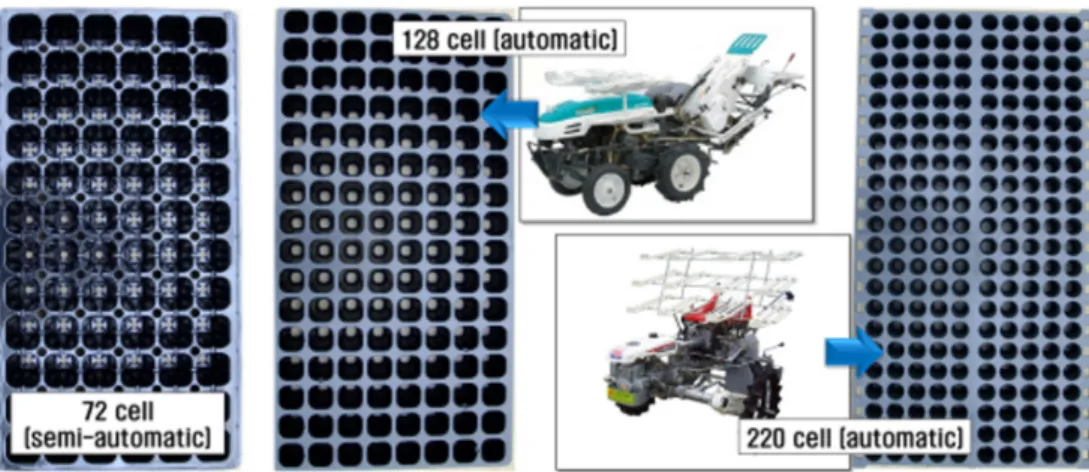
육묘 트레이는 72공, 128공, 220공을 사용하였다. 트레이 종류는 정식기 특성에 따라 선택하였는데, 반자동은 직접 뽑아서 묘를 공급하는 형식은 트레이에 구애받지 않고 사 용할 수 있다. 72공 트레이는 일반적으로 가장 많이 사용하 는 범용트레이를 사용하였으며 셀 부피는 35 ml이다. 128 공 전자동 정식기는 꽂아내기 식으로 묘의 생육 특성 중 매 트 형성이 가장 중요하며 128공 셀 부피는 20 ml이다. 220 공 전자동 정식기는 트레이 밑면을 밀어주는 밀어내기식 형 식으로 묘의 생육 특성 중 초장이 가장 중요하며 셀 부피는 12 ml이다(Fig. 1).
Fig. 1. Transplanting machines and different types of seedling trays with various cells: 72-cell (semi-automatic), 128-cell (automatic),
and 220-cell (automatic) trays.
육묘 상토
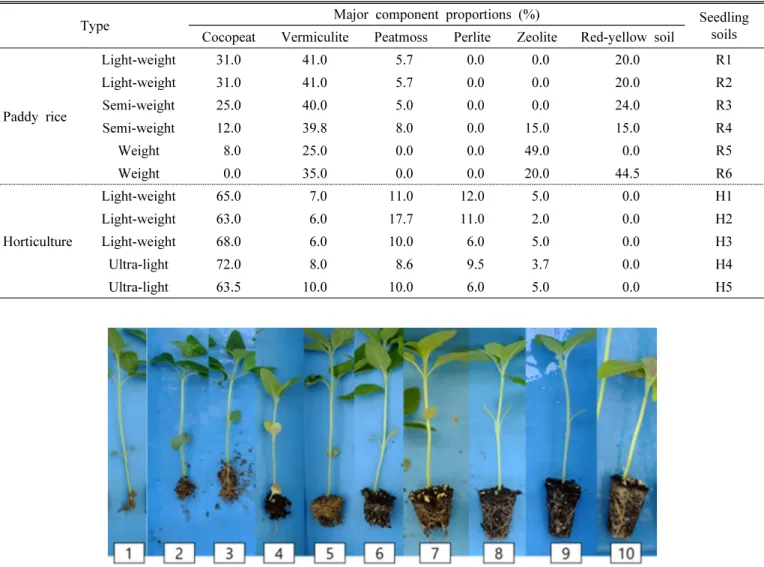
상토는 상토협회 홈페이지에 게시된 16개사 170제품에 대해 용도별, 종류별로 주요 성분 비율을 검토하였다. 상토 의 분류는 수도용 경량, 준중량, 중량, 원예용 경량, 초경량 으로 구분해 평균 성분 비율에 해당하는 11개 제품을 우선 적으로 선별하여 6차례 시험(2017년)을 수행하였다(Table 1).
상토 분류별로 들깨 생육이 우수한 4개 제품을 최종적으 로 선발하여 2018년 5월 25일, 6월 11일에 파종하였으며, 조사항목은 생육 특성, 묘 충실도, 매트 형성, 육묘 기간 등 을 분석하였다. 초장 등 생육 특성은 농업과학기술 연구조 사분석기준에 준하여 실시하였다(RDA, 2012). 묘 충실도는 지상부 건물중(mg)을 초장(cm)로 나누어 계산하였다(Min et al., 2016). 뿌리 매트는 Fig. 2와 같이 매트 형성 정도를
1~10으로 판별하여 평가하였으며 매트형성이 8이상일 때 정식기 적용시 묘 취출과 이송이 원활하게 가능하다.
통계분석
시험결과는 SAS 프로그램을 이용하여 α=0.05에서 DMRT (Duncan’s multiple range test)를 통해 유의성을 분석하였 다(SAS Institute, 2017).
결과 및 고찰 종실용 들깨 육묘시 주요 특성
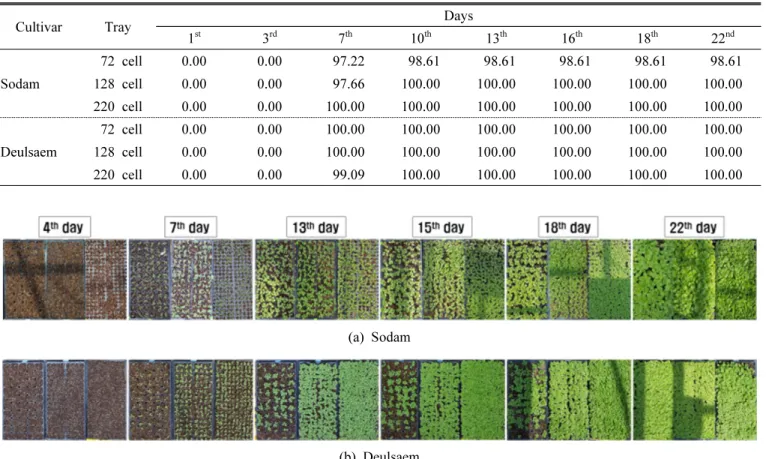
종실용 들깨 소담과 들샘은 파종 후 6~7일째 출현하였으 며, 품종 및 트레이간 차이는 없었다(p>0.05, Table 2). 육
Table 1. Major component proportions (%) relative to type of seedling soil based on paddy rice and horticultural types.
Type Major component proportions (%) Seedling
soils Cocopeat Vermiculite Peatmoss Perlite Zeolite Red-yellow soil
Paddy rice
Light-weight 31.0 41.0 5.7 0.0 0.0 20.0 R1
Light-weight 31.0 41.0 5.7 0.0 0.0 20.0 R2
Semi-weight 25.0 40.0 5.0 0.0 0.0 24.0 R3
Semi-weight 12.0 39.8 8.0 0.0 15.0 15.0 R4
Weight 8.0 25.0 0.0 0.0 49.0 0.0 R5
Weight 0.0 35.0 0.0 0.0 20.0 44.5 R6
Horticulture
Light-weight 65.0 7.0 11.0 12.0 5.0 0.0 H1
Light-weight 63.0 6.0 17.7 11.0 2.0 0.0 H2
Light-weight 68.0 6.0 10.0 6.0 5.0 0.0 H3
Ultra-light 72.0 8.0 8.6 9.5 3.7 0.0 H4
Ultra-light 63.5 10.0 10.0 6.0 5.0 0.0 H5
Fig. 2. Sequential representation of mat formation of perilla roots based on the matting degree range from 1 to 10. Increase
of the matting degree above 8 indicates easy extraction and transfer for the machine.
묘기간에 따른 생육은 Fig. 3과 같다. 들깨의 육묘는 비가 림하우스에서 실시하였으며, 육묘기간인 5~6월 평균온도는 29.2°C, 최대 47.7°C 최소 13.4°C로 나타났다(Fig. 4(a)).
5~6월 파종시 초장 10 cm 도달 적산온도는 643.3°C로 약
21일에 해당하며, 15 cm 도달 적산온도는 833.4°C, 약 28 일이며, 20 cm 도달 적산온도는 1,023.6°C로 약 34일이 소 요되었다(Fig. 4(b)). 이와 같은 결과는 적산온도와 발아 소 요일수와의 정상관관계로 조기파종하면 발아에 소요되는
Table 2. Emergence rate (%) of Sodam and Deulsaem cultivars of perilla days after sowing in different seedling trays of 72,
128, and 220 cells.
Cultivar Tray Days
1
st3
rd7
th10
th13
th16
th18
th22
ndSodam
72 cell 0.00 0.00 97.22 98.61 98.61 98.61 98.61 98.61
128 cell 0.00 0.00 97.66 100.00 100.00 100.00 100.00 100.00
220 cell 0.00 0.00 100.00 100.00 100.00 100.00 100.00 100.00
Deulsaem
72 cell 0.00 0.00 100.00 100.00 100.00 100.00 100.00 100.00
128 cell 0.00 0.00 100.00 100.00 100.00 100.00 100.00 100.00
220 cell 0.00 0.00 99.09 100.00 100.00 100.00 100.00 100.00
(a) Sodam
(b) Deulsaem
Fig. 3. Germination of Sodam and Deulsaem perilla cultivar seedlings 4 to 22 days after sowing.
Fig. 4. Perilla plant height (cm) relative to temperature regimes (lowest, highest, and average temperature per day) in different
months (May-June) (a), and the relationship between the height of perilla and accumulated temperature (b) (Regression
p < 0.05).
일수와 소요 적산온도가 증가되는 Park (2005)의 연구와 일치하였다.
들깨 육묘에 따른 초장은 상토와 육묘일수, 트레이에 따 라 영향을 받으며 품종간 차이는 없었다. 매트 형성은 상토 와 육묘일수에 따라 영향을 받는 것으로 나타났다(Table 3). Table 4와 같이 육묘일수가 길어질수록 초장과 매트형 성, 묘 충실도 증가하며, 23일 이후에는 매트형성 정도가 8 이상으로 기계정식이 가능하다. 그러나 30일 이상 육묘에 도 초장이 15 cm 미만으로 220공 전용트레이를 사용하는 밀어내기식 정식기는 적용이 부적정한 것으로 판단된다.
육묘시 트레이 종류별 기계정식 적합성 검토
트레이에 따른 초장은 128공, 72공, 220공 순으로 나타 났으며, 매트형성은 트레이에 따른 차이가 없었다. 묘충실 도는 매트형성과 반대로 72공, 128공, 220공 순으로 나타 났다(Table 5). 육묘 트레이는 공수가 많을수록 한 개 묘를 키울 수 있는 부피가 작아져 매트형성이 빨리 되는 장점이 있는 반면에 부피가 작아 묘가 생육할 수 있는 양분도 낮아 육묘기간이 길어질수록 양분부족 현상이 나타난다. 따라서
매트형성과 육묘기간 양분을 충분히 공급할 수 있는 점을 고려하여 육묘 트레이 선택이 중요하다. 본 연구 결과를 바 탕으로 정식기계를 고려하면 종실용 들깨의 육묘는 128공 트레이가 가장 적합하게 판단되었다. 220공 트레이를 사용 하는 정식기의 경우 줄기를 잡고 정식하기 때문에 초장이 15 cm 이상이 되어야 가능하다. 220공에서 15 cm 이상으 로 육묘하는 것이 어려워 기계정식에는 부적정한 것으로 판단된다(Fig. 5).
Table 3. Growth characteristics (height and mat formation) of perilla according to cultivar, seedbed, seedling days, and seedling tray.
Cultivar Seedbed Seedling days Seedling tray
Height 2.91
ns27.23
**26.18
**10.12
**Mat formation 8.25
ns28.86
**13.15
**6.93
nsMeans with the same letter within a row are not significantly different (ANOVA, DMRT, p<0.05).
*
and
**denote significance at the 5% and 1% levels, respectively.
ns
indicates non-significant.
Table 4. Growth characteristics (height, mat formation, and seedling compactness) of perilla on particular days after plnating.
Days after seedling 14
th18
th23
rd27
th31
stHeight (cm) 3.75
c5.27
bc7.94
ab9.1 7
ab11.48
aMat formation 6.25
b7.88
ab8.25
ab9.50
a10.00
aSeedling compactness 12.85
c18.88
bc23.05
b31.90
a35.53
aMeans with the same letter within a row are not significantly different (ANOVA, DMRT, p<0.05).
Table 5. Comparison of growth characteristics (height, mat formation, and seedling compactness) of perilla seedlings among seedling tray types (72, 128, and 220 cells).
Seedling tray Height (cm) Mat formation Seedling compactness
72 6.00
ab7.38
a29.29
a128 8.35
a8.50
a26.97
ab220 5.25
b9.25
a22.96
bMeans with the same letter within a row are not significantly different (ANOVA, DMRT, p<0.05).
Fig. 5. Conformance test of seedlings grown in 220 cell trays
under field conditions.
육묘시 상토 종류별 기계정식 적합성 검토
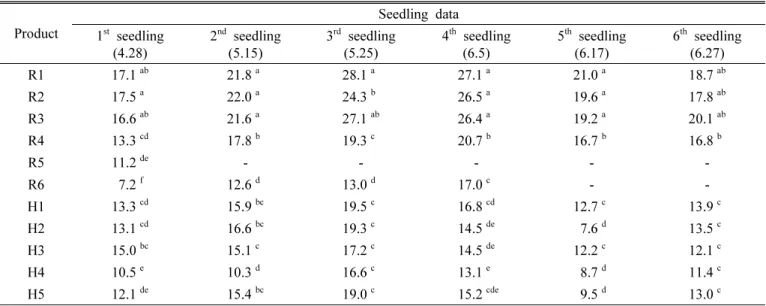
종실용 들깨 육묘 기계정식을 위해 상토 종류별로 평균 성분비율에 해당하는 11종을 우선적으로 검토하였다. 상토 종류에 따른 초장 비교는 Table 6과 같다. 초장은 6차례 육 묘시험 결과, 평균적으로 원예용 상토에 비해 수도용 상토 (경량, 준중량)에서 32.7% 더 컸다. 수도용 중량(R5, R6)의 경우 초장이 가장 작을 뿐만 아니라 굵은 입자를 많이 포함 하고 있어 72공, 128공, 220공 트레이의 물빠짐 구멍으로 상토 빠짐 현상이 발행하여 R5는 1차파종 후 제외하였으 며, R6는 4차파종 후 제외하였다. 6차례 육묘시험 결과 상 토 종류별로 들깨 생육이 가장 좋은 수도용 경량 R1과 준 중량 R4, 원예용 경량 H3, 원예용 초경량 H4 4종을 선발하 였다.
Table 7은 6차례 육묘시험으로 선발된 4종의 상토를 대 상으로 2018년 5월 25일 1차파종과 6월 11일에 2차 파종 하여 초장, 매트형성, 묘충실도를 비교한 것이다. 5월 25일 파종한 들깨의 육묘일수는 21일이며, 6월 11일은 23일이
다. Table 7의 시험성적은 들샘으로 대상으로 5월 25일과 6월 11일 파종한 육묘의 평균값을 사용하였으며, 트레이는 128공을 기준으로 하였다. 들깨의 초장은 R1상토가 가장
Table 6. Comparison of plant height of perilla in different seedlings using various commercial seedling soil products (Unit: cm).
Product
Seedling data 1
stseedling
(4.28) 2
ndseedling
(5.15) 3
rdseedling
(5.25) 4
thseedling
(6.5) 5
thseedling
(6.17) 6
thseedling (6.27)
R11 7.1
ab21.8
a28.1
a27.1
a21.0
a18.7
abR2 17.5
a22.0
a24.3
b26.5
a19.6
a17.8
abR3 16.6
ab21.6
a27.1
ab26.4
a19.2
a20.1
abR4 13.3
cd17.8
b19.3
c20.7
b16.7
b16.8
bR5 11.2
de- - - - -
R6 7.2
f12.6
d13.0
d17.0
c- -
H11 3.3
cd15.9
bc19.5
c16.8
cd12.7
c13.9
cH2 13.1
cd16.6
bc19.3
c14.5
de7.6
d13.5
cH3 15.0
bc15.1
c17.2
c14.5
de12.2
c12.1
cH4 10.5
e10.3
d16.6
c13.1
e8.7
d11.4
cH5 12.1
de15.4
bc19.0
c15.2
cde9.5
d13.0
cMeans with the same letter within a row are not significantly different (ANOVA, DMRT, p<0.05).
Table 7. Comparison of growth characteristics (height, mat formation, and seedling compactness) of perilla seedlings grown in different seedbeds.
Seedbed Height (cm) Mat formation Seedling compactness
R11 0.8
a8.3
b22.8
aR4 6.9
b4.5
c17.8
aH3 5.8
b10.0
a26.3
aH4 5.6
b10.0
a20.7
aMeans with the same letter within a row are not significantly different (ANOVA, DMRT, p<0.05).
Fig. 6. Height of perilla seedlings; < 5 cm (a), and > 10 cm
(b) after transplanting by mechanical transplantation
under field conditions.
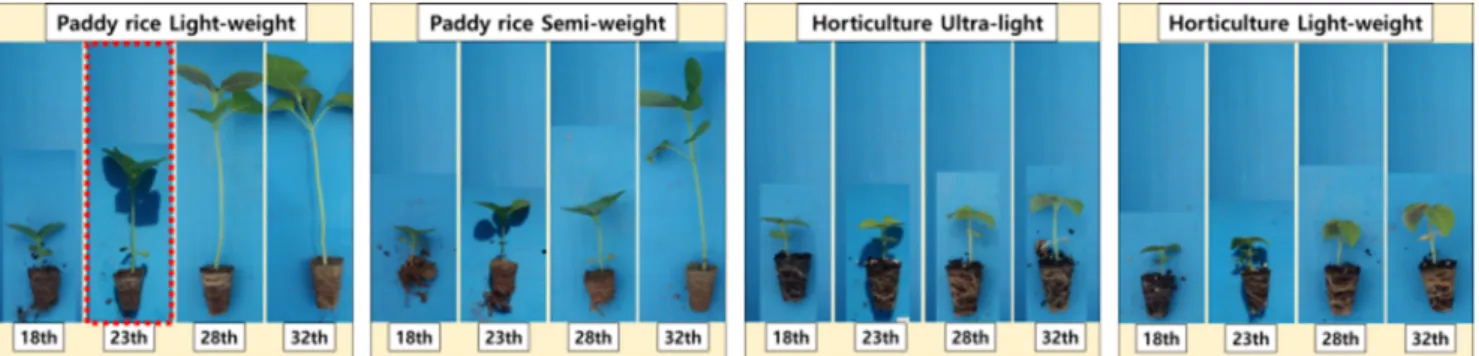
좋았으며, 매트형성은 H3와 H4, 묘 충실도는 유의성이 없 었다. Kim et al. (2000)과 Bae et al. (2013)의 연구에 따르 면 육묘는 짧은 기간 내에 육묘하여 뿌리의 활력이 좋을 때 정식하는 것이 좋기 때문에 기계정식을 위한 육묘 또한 적 정한 초장과 매트가 형성되면 최단기간에 정식하는 것이 좋다. Yu et al. (2018)의 연구에서 매트형성은 손으로 뽑아 서 부서지지 않을 정보에서 정식작업이 가능하다고 하였으 며, Fig. 2의 매트형성이 8 정도가 된다. 따라서 매트형성 8 이상일 때 정식기 적용시 묘 취출과 이송이 원활하게 작업 이 가능하다. 또한 초장은 5 cm 미만인 경우 정식시 땅속에 파묻혀 정식이 어렵기 때문에 초장 10 cm 이상이 되어야 기 계정식이 적정할 것으로 판단된다(Fig. 6). 본 육묘시험을 종 합하면 수도용 경량 상토(R1)에서 23일정도 육묘시 초장과 매트가 형성되어 기계정식에 적합한 시기로 판단된다(Fig. 7).
종실용 들깨 기계정식에 적합한 육묘방법 설정
들깨 기계정식에서 가장 중요한 요인은 매트형성과 초장
이다. 묘를 직접 뽑아서 공급하는 반자동 정식기를 사용할 경우 128~220공 트레이와 수도용 경량 상토(R1)에서 23일 육묘가 적정한 것으로 나타났다. Fig. 8(a)는 128공 트레이 에서 23일 육묘시 상토 종류별로 매트형성과 초장을 나타 낸 것이며, Fig. 8(b)~(e)는 R1 상토로 육묘하여 128공 전용 전자동 이식기를 통해 포장에 정식한 결과로 파종 후 24일, 50일, 90일, 130일째 생육을 나타낸 것이다. 128공 전용트 레이를 사용하는 꽂아내기식 정식기는 매트형성과 초장을 고려하면 수도용 경량 상토(R1)에서 23일정도 육묘가 적정 한 것으로 나타났다. 반면에 220공 전용트레이를 사용하는 밀어내기식 정식기는 줄기를 잡고 정식하기 때문에 초장이 15 cm 이상 되어야 가능하다. 220공에서 15 cm 이상으로 육묘하는 것이 어려워 기계정식에는 부적정한 것으로 판단 된다. 들깨 정식 기계화를 통해 소립종자의 파종 및 솎음노 력 절감이 가능하며, 입모율 증진으로 생산성도 향상될 것 으로 판단된다. 들깨는 기계화율이 매우 낮은 작물인데, 재 배면적은 넓어 파종, 육묘, 수확 등 기계화 재배 기술 개발
Fig. 7. Growth characteristics (height, mat formation, and seedling compactness) of perilla seedlings according to selected
seedbed types at 18, 23, 28, and 32 days after sowing.
(a) (b) (c) (d) (e)
Fig. 8. Mat formation of the root and height changes among seedbed types (R1, R4, H3, and H4) and growth of perilla plants
24 (b), 50 (c), 90 (d), and 130 (e) days after transplanting by mechanical transplantation under field conditions.
이 지속적으로 추진되어야 할 것이다.
적 요
본 연구는 기존 채소 정식기를 활용하여 기계화율이 낮은 종실용 들깨를 대상으로 육묘 기계정식 재배 시 적합한 상 토, 트레이, 육묘일수를 설정하고자 2017년부터 2018년까지 2년간 수행하였으며, 주요 결과를 요약하면 다음과 같다.
1. 들깨의 지상부 생육은 수도용 경량인 R1 상토가 가장 좋 았으며, 주요 성분비는 질석(Vermiculite) 41.0%, 코코피 트(Cocopeat) 31.0%, 황토(Red-yellow soil) 20.0%, 피트 모스(Peatmoss) 5.7% 등을 포함하고 있다.
2. 묘를 직접 뽑아서 공급하는 반자동 정식기를 사용할 경 우 128~220공 트레이와 수도용 경량 상토에서 23일 육 묘가 적정한 것으로 판단된다.
3. 128공 전용트레이를 사용하는 꽂아내기식 정식기는 매 트형성과 초장을 고려하면 수도용 경량 상토에서 23일 정도 육묘가 적정한 것으로 나타났다.
4. 220공 전용트레이를 사용하는 밀어내기식 정식기는 줄기 를 잡고 정식하기 때문에 초장이 15 cm 이상 되어야 가 능하다. 220공에서 15 cm 이상으로 육묘하는 것이 어려 워 기계정식에는 부적정한 것으로 판단된다.
사 사
본 논문은 농촌진흥청 연구사업(세부과제명: 참깨·들깨 육묘기술 개발, 세부과제번호: PJ01253902)의 지원에 의해 이루어진 것임.
인용문헌(REFERENCES)