식물병연구
Res. Plant Dis. 18(3) : 236−239 (2012)
Research in Plant Disease
© The Korean Society of Plant Pathology http://dx.doi.org/10.5423/RPD.2012.18.3.236
Acidovorax avenae subsp. avenae에 의한 기장 세균성줄무늬병
윤영남*·정지훈·이영훈1·김현주·배순도·최병렬2·남민희·이영기3**
국립식량과학원 기능성잡곡과, 1국립식량과학원 두류유지작물과, 2농촌진흥청 평가관리과,
3국립농업과학원 작물보호과
Bacterial Stripe of Proso Millet Caused by Acidovorax avenae subsp. avenae in Korea
Young Nam Yoon*, Jihun Jung, Yeonghoon Lee1, Hyunjoo Kim, Soondo Bae, Byeongryeol Choi2, Minhee Nam and Young Kee Lee3**
Functional Cereal Crop Research Division, National Institute of Crop Science, Rural Development Administration, Miryang 627-803, Korea
1Legume and Oil Crop Research Division, National Institute of Crop Science, Rural Development Administration, Miryang 627-803, Korea
2Evaluation Division, Rural Development Administration, Suwon 441-707, Korea
3Crop Protection Division, National Academy of Agricultural Science, Rural Development Administration, Suwon 441-707, Korea
(Received on February 23, 2012; Revised on August 9, 2012; Accepted on August 10, 2012)
In July, 2009, proso millet (Panicum miliaceum), which showing the bacterial brown stripes on leaf sheaths, was collected in Miryang in Korea. Symptoms were systemic brown necrotic stripe lesions on the leaf sheaths and stems, and these symptoms were found in the entire field. The causal agent isolated from symptomatic plants was identified as an Acidovorax avenae subsp. avenae, based on its biochemical and physiological characteristics and also confirmed by the Biolog data and 16S rRNA gene sequence analysis. Also it caused hypersensitive response (HR) when it was inoculated onto the tobacco and tomato. It caused similar symptoms when inoculated onto proso millet. This is the first report of A. avenae subsp. avenae, the causal agent of bacterial brown stripe of the proso millet in Korea.
Keywords : Acidovorax avenae, Bacterial stripe, Panicum miliaceum
기장(Panicum miliaceum L.)은 아프리카, 아시아, 남미 에서 널리 이용되는 식량작물로 이들 지역의 단백질 공 급에 기여하고 있다(Park 등, 2009). 또한 비타민, 무기질 및 식이섬유 등의 기능성 성분의 함량이 높고 다양한 생 리활성 물질이 많이 함유되어 있어 건강을 유지시키는 보 조식량으로서의 역할이 중요시되고 있다(Ko 등, 2011).
Acidovorax avenae subsp. avenae는 1909년 미국 오하 이오 지역에서 귀리의 잎마름을 일으키는 식물병원세균 으로 Manns(1909)에 의해 처음 보고된 후 벼 세균성줄무 늬병(Goto, 1964; Kadota, 1996; Shakya 등, 1985), 옥수수 의 세균성 줄기부패병(Rosen, 1926; Summer와 Schaad, 1977), 조의 갈색줄무늬병(Rosen, 1926), 사탕수수와 기장 의 붉은줄무늬병(Martin과 Wismer, 1989)을 일으키는 것 으로 보고되었다. 국내에서는 벼 세균성줄무늬병(Shakya, 1980)과 옥수수 줄기썩음병(Lee, 1991)이 보고되어 있으 나, 기장에서는 아직 보고된 바 없다.
본 연구는 국내에서 기장에 새롭게 발생한 세균성줄무 늬병의 병징 및 병원세균의 균학적 특성을 보고하고자 한다.
**Corresponding author
Phone) +82-55-350-1264, Fax) +82-55-352-3059 Email) [email protected]
**Corresponding author
Phone) +82-31-290-0414, Fax) +82-31-290-8488 Email) [email protected]
Note Open Access
Acidovorax avenae subsp. avenae에 의한 기장 세균성줄무늬병 237
병 발생 및 병징. 2009년 7월 경상남도 밀양시 내이 동 포장에서 기장 잎에 갈색 줄무늬의 괴저증상이 발생 하였다. 기장의 생육단계는 중기였으며, 병징은 잎에는 갈 색 괴저줄무늬 증상, 줄기에는 갈색 줄무늬가 나타났다.
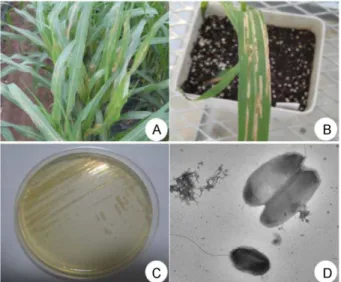
병징은 기장재배 포장전체에서 확인되었으며, 전신적인 병징이 관찰되었다(Fig. 1A).
세균 분리 및 간이동정. 기장의 잎에 줄무늬병을 일으 키는 세균을 분리하기 위하여 채집된 시료별로 건전부와 병든 부위의 경계면을 4 × 4 mm 크기로 3−5개씩 자른 다 음 70% 에틸알코올에 수 초간, 1% 차아염소산나트륨
(NaOCl) 용액으로 1분간 침지하여 표면소독 후 멸균증류 수에 3회 세척하였다. 소독된 조직을 0.5 ml의 멸균증류 수가 들어있는 Eppendorf tube에 넣고 살균된 메스를 이 용하여 마쇄 후 실온에서 30분간 두었다. 현탁액은 King's B(KB) 배지에 도말하였으며, 28oC에서 3일간 배양하면서 생장하는 콜로니의 특징을 고려하여 대표적인 4개의 세 균(MR1−MR4)을 선별하였다. Tryptic soy agar(TSA) 배 지에서 세균의 콜로니는 흰 크림색에서 옆은 갈색으로 매 끈했으며, 가운데가 돌출된 둥근 형태였다(Fig. 1C). 순수 분리된 세균은 15% 글리세롤에 현탁하여 −70oC 초저온 냉동고에 보존하면서 실험에 이용하였다.
4개의 대표균은 기질의 이용성을 비교하는 Biolog 시스 템과 16S rRNA 유전자 염기서열 분석으로 간이 동정하 였다. GN2 MicroPlateTM을 이용한 Biolog 동정 시스템에 서 4개의 세균은 모두 A. avenae subsp. avenae로 동정되 었으며, 유사도는 0.67−0.80이었다. 16S rRNA 유전자 염 기서열 분석을 통하여 나온 결과를 병원성 Acidovorax속 의 표준세균들과 비교하여 계통분류도를 작성하였을 때, 모든 균주는 A. avenae subsp. avenae로 분류되었으며, 표 준균주와 99.2−99.6%의 상동성을 나타냈다(Fig. 2).
병원성 검정. 세균의 병원성은 본엽 3−4엽기의 기장 (cv. 황금) 유묘를 이용하여 확인하였다. 분리균은 TSA 배 지에 도말하여 28oC에서 2일간 배양 후 멸균수에 현탁하 여 농도(1.0 × 10⁸ cfu/ml)를 조절하였다. 유묘의 잎 표피에 주사바늘을 이용하여 상처를 내고 세균현탁액을 접종하 였으며, 대조구는 멸균수를 처리하였다. 세균은 1주일 내 인공접종한 부위에서 갈색의 괴저 줄무늬 증상을 보였으 며, 시간이 경과함에 따라 병반의 크기가 커지면서 포장 Fig. 1. Symptoms of bacterial stripe on proso millet in the field
(A) and artificial inoculation (B). Colonies grown for 3 days on tryptic soy agar (C) and transmission electron micrograph (D) of the pathogen of the bacterial brown stripe of proso millet.
Fig. 2. Phylogenetic tree based on the 16S rRNA gene sequences of proso millet strains (MR1, MR2, MR3 and MR4) and reference Acidovorax strains. The branching pattern was produced by the neighbour-joining method. Numbers at nodes indicate levels of bootstrap support based on neighbour-joining analysis of 1000 resampled datasets. GenBank accession numbers for each sequence are shown in parentheses.
238 윤영남·정지훈·이영훈·김현주·배순도·최병렬·남민희·이영기 에서 관찰된 증상과 동일한 양상으로 변하였다(Fig. 1B).
멸균수를 처리한 대조구에서는 특이증상이 관찰되지 않 았다. 인공접종 후 발병된 잎에서 세균을 분리 후 Biolog 시스템으로 동정하여 동일 세균의 유무를 재확인하였다.
세균학적 특성. 기장에서 분리한 4계통의 병원세균은 한국농업미생물자원센터(Korean Agricultural Culture Collection, KACC)에서 분양받은 대조균주를 이용하여 Schaad 등(2001)의 방법에 따라 균학적 특성을 조사하였 다. 병원세균의 형태를 투과전자현미경으로 조사한 결과, 모든 세균은 1개의 편모를 가진 간상이었다(Fig. 1D). 모 든 세균은 그람 음성이면서 호기적으로 생장하였으며, YDC 배지에서 점액성의 콜로니를 형성하였다. 또한 urease 생성, oxidase 반응, 40oC 생장, lactalysate, nitrate 환원, starch 가수분해 및 담배에 대한 과민성 반응이 양성이었 다. 기장에서 분리된 계통들은 L-arabinose 등 다양한 탄 소원을 이용하였으나 대조균주에 비해 L-histidine과 L-
threonine 반응은 다소 지연되는 경향이 있었다(Table 1).
이상의 결과로 기장에서 분리된 세균들은 병원성, 형태 적, 배양적, 생리생화학적 특성 등의 표현형적 특성과 16S rRNA 유전자 염기서열 분석에 근거하였을 때 A. avenae subsp. avenae로 동정되었다. A. avenae subsp. avenae에 의한 기장의 세균성줄무늬병은 지금까지 국내에 보고된 적이 없었다. 본 연구에서 분리·동정된 병원세균(MR1−
MR4)의 16S rRNA 유전정보는 GenBank에 등록되었으며 (JF794742−JF794745), 4계통의 균주는 한국농업미생물자 원센터에 기탁되었다.
요 약
2009년 7월 밀양지역의 농가포장에서 재배된 기장의 잎 에 세균성 줄무늬증상이 발생되었다. 병징은 잎과 줄기 전신에서 갈색의 괴저줄무늬를 보였으며, 포장전체에서 확인되었다. 이병된 잎에서 분리된 4계통의 세균들은 배 양적, 생리·생화학적 특성, Biolog 검정, 16S rRNA 유전 자 염기서열분석에 의하여 Acidovorax avenae subsp.
avenae로 동정되었다. 또한 담배, 토마토에 접종하여 과 민성반응을 확인하였으며, 기장에 접종하여 동일 병반을 확인할 수 있었다. 이상의 연구결과에 의하여 기장에서 Acidovorax avenae subsp. avenae에 의한 세균성줄무늬병 을 국내 처음으로 보고한다.
Acknowledgement
This research was supported by the Department of Functional Crop, National Institute of Crop Science, Rural Development Administration Foundation (Project No.
PJ006464).
References
Goto, M. 1964. Nomenclature of the bacteria-causing bacterial leaf streak and bacterial stipe of rice. Bull. Fac. Agric.
Shizuoka Univ. 14: 3−10.
Kadota, I. 1996. Studies on the pathogen of bacterial brown stripe of rice and its ecology. Bull. Hokuriku. Nat. Agric. Expt. Stn.
38: 113−171.
Ko, J. Y., Song, S. B., Lee, J. S., Kang, J. R., Seo, M. C., Oh, B.
G., Kwak, D. Y., Nam, M. H., Jeong, H. S. and Woo, K. S.
2011. Changes in chemical components of foxtail millet, proso millet, and sorghum with germination. J. Korean Soc. Food Sci. Nutr. 40: 1128−1135.
Lee, Y. H., Cho, W. D., Kim, W. G., Jin, K. S., Kim, C. H. and Table 1. Biochemical and physiological characteristics of
Acidovorax avenae subsp. avenae from proso millet
Characteristics
Strains from proso millet
(n = 4)a
KACC10162
Gram positive −b −
Grows anaerobically − −
Grows aerobically + +
Colonies yellow or orange on YDC − − Colonies mucoid on YDC at 30oC + + Fluorescent pigment on KB − − Diffusible non-fluorescent pigment
on KB
− −
Urease + +
Oxidase + +
Grows at 40oC + +
Yellow insoluble pigment on NA − −
Growth at 41oC + +
Carbon sources utilized for growth L-arabinose
L-tyrosine
D-arabitol or mannitol D-fucose
L-histidine or L-threonine Sorbitol
D-xylose Lactalysate Nitrate reduction Starch hydrolysis Tobacco HR
+ + + + +D + + + + +D +
+ + + + + + + + + +D +
aNo. of strains tested.
b−: negative, +: positive, +D: delayed positive.
Acidovorax avenae subsp. avenae에 의한 기장 세균성줄무늬병 239
Lee, E. J. 1991. Report on host-unrecorded diseases identified from economical crops in Korea. Res. Rept. RDA. 33: 15−19.
(In Korean)
Manns, T. F. 1909. The blade blight of oats - a bacterial disease.
Ohio Agric. Exp. Stn. Res. Bull. 10: 91−167.
Martin, J. P. and Wismer, C. A. 1989. Red stripe. In: Disease of sugarcane, eds. by C. Ricaud, B. T. Egan, A. G. Gillespie Jr, and C. G. Hughes, pp. 86−91. Elsevier, The Netherlands.
Park, J. H., Jeong, J. B., Lee, J. R., Lumen, Ben O. de, and Jeong, H. J. 2009. Effect of lunasin extracted from millet (Panicum miliaceum) on the activity of histone acetyltransferases, yGCN5 and p/CAF. Korean J. Plant Res. 22: 203−208. (In Korean)
Rosen, J. R. 1926. Bacterial stalk rot of corn. Phytopathology 16:
241−267.
Schaad, N. W., Jones, J. B. and Chun, W. 2001. Laboratory guide for identification of plant pathogenic bacteria, 3rd ed., APS Press. St Paul, MN, USA. 373 pp.
Shakya, D. D. and Chung, H. S. 1980. Bacterial brown stripe on rice seedlings in Korea. Korean J. Plant Prot. 19: 125. (In Korean)
Shakya, D. D., Vinther, F. and Mathur, S. B. 1985. Worldwide distribution of bacterial stripe pathogen of rice identified as Pseudomobas avenae. Phytopathologische Zeitschrift 111:
256−259.
Summer, D. R. and Schaad, N. W. 1977. Epidemiology and control of bacterial leaf blight of corn (Pseudomonas avenae).
Phytopathology 67: 1113−1118.