658
온도와 염분이 Rotifer Brachionus plicatilis와 B. rotundiformis의 성장과 크기에 미치는 영향
윤주연·허성범✽
부경대학교 해양바이오신소재학과/한국해양미세조류은행
Influence of Temperature and Salinity on the Growth and Size of the Rotifer Brachionus plicatilis and B. rotundiformis
Joo-Yeon Youn and Sung Bum Hur
✽Korea Marine Microalgae Culture Center/Department of Marine Bio-materials and Aquaculture, Pukyong National University, Busan 608-737, Korea
Rotifers of the genus
Brachionus
are commonly used as a live food for larval fish, and rotifers of different sizes are preferred according the mouth size of the fish. Rotifer species vary in size, and individual size can depend on the tem- perature and salinity of the rearing environment. We investigated the effects of temperature and salinity for two spe- cies,B. plicatilis
(250-300 µm) andB. rotundiformis
(100-220 µm). Two strains ofB. plicatilis
(CCUMP 36 and 48) and two strains ofB. rotundiformis
(CCUMP 51 and 56) were received from the Culture Collection of Useful Marine Plankton (CCUMP) at Pukyong National University and cultured with the green alga,Nannochloris oculata
(KMMCC 16) from the Korea Marine Microalgal Culture Center (KMMCC). The growth and size of rotifers were examined at three water temperatures (16ºC, 24ºC, 32ºC) and four salinities (20 psu, 25 psu, 30 psu, 35 psu) under continuous light (40 μmolm-2s-1). The maximum density and growth rate ofB. rotundiformis
were greater than those ofB. plicatilis
. The lorica length ofB. plicatilis
ranged from 215.4 to 269.7 µm and from 154.9 to 206.6 µm forB. rotundiformis,
depending on strain, temperature and salinity. Rotifers were smaller when cultured at high temperatures, regardless of salinity.B. rotundiformis
preferred higher salinity thanB. plicatilis
. The results demonstrated that the size of rotifers could be controlled to some extent by temperature and salinity.Key words: Rotifer, Growth, Salinity, Size, Temperature
서 론
Rotifer Brachionus plicatilis와 B. rotundiformis는 광염성 으로 고밀도 배양이 수월하고, 크기가 작고 움직임이 느리며 영양가가 높고 영양강화가 가능하여 어류와 갑각류의 종묘 생 산시 초기 먹이생물로 가장 널리 이용되고 있다(Hirayma and Kusano, 1972, Lubzen, 1987, Yukino et al., 2004, Hayashi et al., 2007). 특히 입의 크기가 작은 능성어(Epinephelus septem- fasciatus)와 같은 자어의 경우 대형의 rotifer를 섭취할 수 없으 므로 rotifer의 크기는 어류종묘생산에서 매우 중요한 요인이 된다(Lubzen et al., 1985, Hur and Park, 1996, Tomoda et al., 2011).
B. plicatilis는 250-300 µm의 large-type이고 B. rotundifor- mis는160-220 µm의 small-type 및 100-140 µm의 ultra small- type으로 구분하나 strain에 따라서 크기, 최적성장 환경요 인, 영양가, 번식 생태 등의 차이가 있다(Minkoff et al., 1983,
Yoseda et al., 2003). 또 rotifer 배양시의 환경요인(Lubzens and Minkoff, 1988, Stelzer, 2002)과 먹이의 영양(Snell et al., 1983, Park and Hur, 1996a, Yoshimatsu et al., 2006)은 rotifer의 크기 에 영향을 준다. 따라서 어류 자어의 입 크기에 적합한 다양한 크기의 rotifer strain이 요구된다.
본 연구에서는 염기서열이 상이한 B. plicatilis와 B. rotundi- formis의4 strains을 대상으로 온도와 염분의 변화에 따른 rotifer 의 성장과 크기의 변화를 조사하여 어류 종묘생산에 필요한 다 양한 크기의 rotifer strain개발을 위한 기초자료를 파악하고자 하였다.
재료 및 방법
Rotifer의 배양
본 실험에 사용된 rotifer B. plicatilis와 B. rotundiformis 는 부경대학교 해양바이오신소재학과 유용플랑크톤자원 기탁 등록보존기관(Culture Collection of Useful Marine Plankton,
*Corresponding author: [email protected]
보기 위해서 온도는 16℃, 24℃, 32℃로, 염분은 자연 여과해수 와 증류수를 이용하여 20 psu, 25 psu, 30 psu, 35 psu로 구분하 였다.
알을 달고 있지 않은 amictic female 1 개체를 취해 3 mL multi-culture plate (배양수 2 mL)에서 각 온도와 염분 별로 20 일간 배양하였고 N. oculata를 앞에서와 같은 농도로 충분하게 매일 공급하였다.
Multi-culture plate에서 배양된 rotifer는 2일 간격으로 14일 간 개체수의 변화를 조사하여 최고밀도(개체수/mL)와 성장률 (specific growth rate, SGR, SGR=3.322(log(NT/N0))/T, T=접종 이후 rotifer가 최고밀도에 도달하기까지의 배양일수; NT=T day 의 rotifer 최고밀도; N0=최초 rotifer 접종밀도)을 조사하였다.
실험은 8회 반복하였다.
CCUMP)에서 보관중인 염기서열이 다른 B. plicatilis (CCUMP 36, 48)와 B. rotundiformis (CCUMP 51, 56)을 분양 받아 실험 에 사용하였다(Table 1).
Rotifer는 한국해양미세조류은행(Korea Marine Microalgae Culture Center, KMMCC)에서 분양 받은 Nannochloris oculata (KMMCC 16)를 f/2 배지 (Guillard and Ryther, 1962), 24℃, 20 psu 및 50 mol µ molm-2s-1연속조명하에서 배양하고 원심분 리기(3000 rpm, 25 min)로 세포만을 농축하여 1일 rotifer 1개체 당 2×10⁵ 세포를 기준으로 충분한 먹이 양이 되도록 공급하였 다.
온도와 염분별 rotifer 성장과 크기
배양온도와 염분에 따른 rotifer의 성장과 크기 변화를 알아 B. plicatilis
CCUMP 36
SGR
1.2 1.0 0.8 0.6
16°C 24°C
20 psu 25 psu 30 psu 35psu
32°C 0.4
0.2 0.0
f f g e
c c d
e
a ab a b
B. rotundiformis
CCUMP 51
SGR
1.2 1.0 0.8 0.6
16°C 24°C
20 psu 25 psu 30 psu 35psu
32°C 0.4
0.2 0.0
e e f f
c c c
d
a b b b
CCUMP 48
SGR
1.2 1.0 0.8 0.6
16°C 24°C 32°C
0.4 0.2 0.0
cd c
d d b
Temperature
b b c
a a a a
CCUMP 56
SGR
1.2 1.0 0.8 0.6
16°C 24°C 32°C
0.4 0.2 0.0
f f f
g c
Temperature
d de e a
b a a
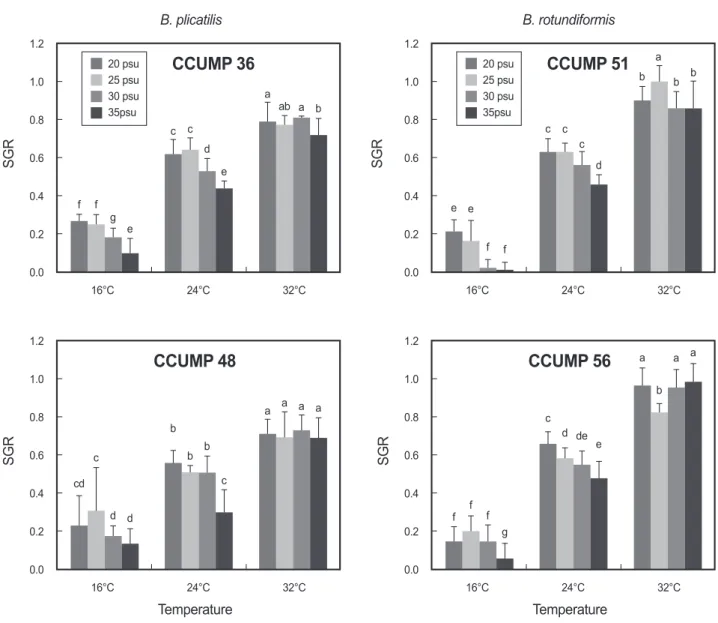
Figure 1. Specific growth rate (SGR) of Brachionus plicatilis and B. rotundiformis at different temperatures and salinities. The dif- ferent letter on the bar means a significant difference at the P<0.05 level.
분일수록 성장률이 높았지만, 32℃의 높은 온도에서는 염분에 따른 성장률은 서로 유사하였다. CCUMP 36 strain은 32℃, 30 psu에서 12일만에 1 개체/mL에서 822 개체/mL로 증가하여 가 장 높은 성장률(0.81)을 보였다. CCUMP 48 strain은 32℃, 30 psu에서 12일만에 524 개체/mL로 증가하여 0.73의 성장률을 보였다. 이와같이 B. plicatilis는 strain에 따라 성장률의 차이를 보였으나 최적수온과 염분은 32℃와 30 psu로 나타났다.
B. rotundiformis에서도 낮은 온도보다 높은 온도에서 성장 률이 유의하게 높았다. 16℃, 24℃의 낮은 수온에서는 낮은 염 분에서 성장률이 더 높았으나 32℃의 높은 온도에서는 B. pli- catilis에서와 같이 뚜렷한 차이를 보이지 않았다. CCUMP 51 strain은 16℃, 30과 35 psu에서는 성장이 거의 일어나지 않았으 며, 24℃에서는 20과 25 psu에서 배양 12일만에 1 개체/mL에서 180 개체/mL로 성장하여 동일한 성장률(0.62)을 보였다. 32℃
에서는 25 psu에서 성장률 1.00 (최고밀도 1,237개체/mL)로 유 의하게 가장 높게 나타났다. CCUMP 56 strain도 16℃에서는 매우 낮은 성장률을 보였고 특히 35 psu에서는 0.07의 성장률로 수온과 염분에 따른 rotifer 피갑장과 피갑폭의 크기 변화를
보기 위해서 각 수온과 염분 실험구에서 20일간 배양된 rotifer 를 각 strain마다 50개체씩 무작위로 취하여 크기를 Motic Im- ages Plus 2.0을 이용하여 25 µm 단위로 측정하였다.
통계처리
Rotifer의 성장률과 크기에 대한 결과는 one-way ANOVA- test를 실시 후 Duncan’s multiple range test (Duncan, 1955)로 평균간의 유의성(P<0.05)을 SPSS (SPSS Inc. version 17.0)로 검정하였다.
결 과
온도와 염분에 따른 rotifer의 성장률
B. plicatilis의 온도와 염분에 따른 최고밀도와 성장률에 대 한 결과는 Fig. 1과 같다. B. plicatilis는 온도가 높을수록 성장률 이 유의하게 높았다(P<0.05). 온도가 낮은 16℃에서는 낮은 염
CCUMP 36
Rorica length (µm)
0 50 100 150 200
20 psu 25 psu 30 psu
16˚C 24˚C 32˚C
bcd a a a
cde cd ab de bc
bc ab
e
35 psu 250
300 350
Rorica width (µm)
0 20 40 60 80
20 psu 25 psu 30 psu
ab ab abc abc abc bc
Salinity
ab a c bcabc ab
35 psu 120
160 200 180 140 100
CCUMP 48
Rorica length (µm)
0 50 100 150 200
20 psu 25 psu 30 psu
16˚C 24˚C 32˚C
a ab a a a
bc
e de de
de cd de
35 psu 250
300 350
Rorica width (µm)
0 20 40 60 80
20 psu 25 psu 30 psu
a abc abc bcd bcd cd
Salinity
a
d abc abc d ab
35 psu 120
160 200 180 140 100
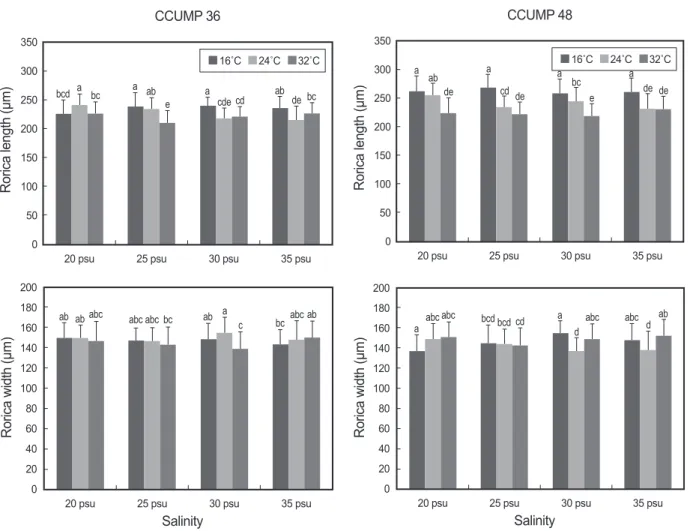
Figure 2. Rorica length and width of Brachionus plicatilis at different temperatures and salinities. The different letter on the bar means a significant difference at the P<0.05 level.
가장 낮았다(P<0.05). 24℃에서는 염분이 높아질수록 성장률이 유의하게 낮았다. 20 psu에서 성장률 0.67 (최고밀도 283 개체/
mL)로 가장 높았다. 32℃에서는 35 psu에서 성장률 0.99 (최고 밀도 1,246 개체/mL)로 가장 높았으나 25 psu를 제외한 나머지 염분에서의 성장률은 유의한 차이를 보이지는 않았다(P<0.05).
B. rotundiformis는 B. plicatilis에 비하여 16℃의 저온에서
성장률이 더 낮고 32℃의 고온에서는 성장률이 더 높은 것으로 나타났다. 또 32℃의 고온에서는 30 psu보다 35 psu에서 성장률 이 더 높은 경향을 보여 B. plicatilis와 반대의 결과를 보였다.
온도와 염분에 따른 rotifer의 피갑의 크기
B. plicatilis의 온도와 염분에 따른 피갑의 크기에 대한 결과 는 Fig. 2와 같다. CCUMP 36 strain은 20 psu에서의 피갑장은 24℃에서 241.7 µm로 유의하게 가장 컸으며 16℃와 32℃에서 는 226.1 µm와 227.3 µm로 차이가 없었다(P<0.05). 피갑폭은 16℃에서 137.7 µm로 가장 작았다. 25 psu에서는 온도에 따른 유의한 차이가 없었고 30 과 35 psu에서는 24℃에서 각각 218.1 µm 과 215.4 µm로 가장 낮았고 피갑장의 결과와 유사한 경향을 보였다.
CCUMP 48 strain은 20 psu에서는 피갑장의 크기가 16℃에 서는 263.7 µm로 가장 크고 32℃에서는 224.9 µm로 가장 작았 다. 25 psu와 30 psu에서의 피갑장은 온도가 높아질수록 유의하 게 작았다(P<0.05). 35 psu에서도 16℃에서는 261.7µm로 가장 크고 24℃와 32℃에서는 유의한 차이가 없었다(P<0.05). 피갑 CCUMP 51
Rorica length (µm)
0 50 100 150 200
20 psu 25 psu 30 psu
16˚C 24˚C 32˚C
ab c a ab
cd cd b
de cd
de de e
35 psu 250
300 350
CCUMP 56
Rorica length (µm)
0 50 100 150 200
20 psu 25 psu 30 psu
16˚C 24˚C 32˚C
a cde
b b
de cde b e cde cde cd c
35 psu 250
300 350
Rorica width (µm)
0 20 40 60 80
20 psu 25 psu 30 psu
abc ab
bc ab bc c
Salinity
a abc ab abc bc ab
35 psu 120
160 200 180 140 100
Rorica width (µm)
0 20 40 60 80
20 psu 25 psu 30 psu
a abcdcd cd bcd abc
Salinity
bcd d ab abcabcdabcd
35 psu 120
160 200 180 140 100
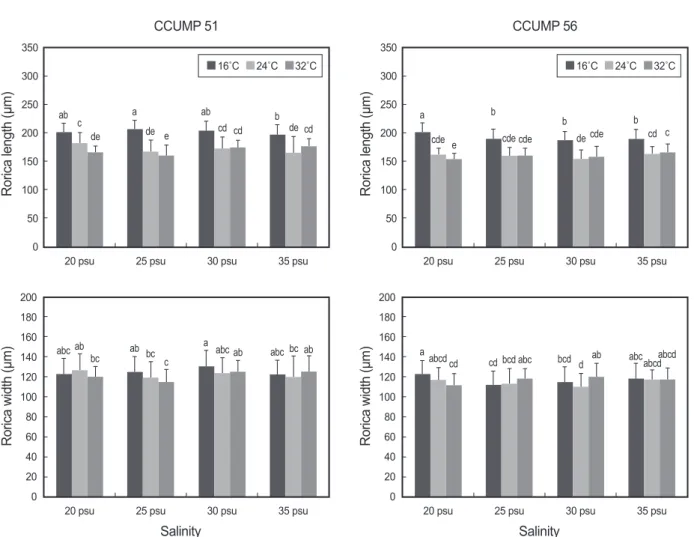
Figure 3. Rorica length and width of Brachionus rotundiformis at different temperatures and salinities. The different letter on the bar means a significant difference at the P<0.05 level.
Species Source of strain
(CCUMP) Size (μm) Habitat
B. plicatilis CCUMP 36 234.0±23.4b (175-275) Salt pond CCUMP 48 245.5±21.2a (200-275) ? B. rotundiformis CCUMP 51 162.8±16.1c (112.5-187.5) Salt pond
CCUMP 56 168.0±14.1c (150-200) Salt pond CCUMP : Culture Collection of Useful Marine Plankton Different letter in size means significant different at P<0.05 level.
Tabel 1. Source of Brachionus plicatilis and B. rotundiformis used in the study
폭은 피갑장과 달리 각 염분에서 온도에 따른 유의한 차이가 뚜 렷하지 않은 경향을 보였다.
B. rotundiformis의 온도와 염분에 따른 피갑장과 피갑폭의 결과는 Fig. 3과 같다. CCUMP 51 strain은 20 psu에서는 16℃
에서 200.9 µm, 32℃에서 166.6 µm로 온도가 높아질수록 피갑 장이 작아지는 경향이 뚜렷하였다. 25-35 psu에서는 16℃의 낮 은 온도에서는 피갑장이 컸으나 24℃와 32℃에서는 차이가 없 었다. 피갑폭에서는 각 염분에서 온도에 따른 차이가 뚜렷한 경 향을 보이지 않았다.
CCUMP 56 strain은 20 psu 16℃에서 피갑장의 크기가 200.9 µm로 유의하게 가장 컸다. 25-35 psu에서도 피갑장은 16℃에서 유의하게 컸으나 24와 32℃에서는 유의적인 차이가 없었다. 피갑폭은 CCUMP 51 strain에서와 같이 염분과 온도에 대한 뚜렷한 경향을 보이지 않았다.
전체적으로 rotifer는 온도가 높을수록 크기가 작은 경향을 보 였고 염분은 크기에 뚜렷한 영향을 주지 않았다. 그러나 낮은 염 분에서 rotifer의 크기는 높은 염분에서보다 온도 영향을 더 받는 것으로 나타났다. 온도변화에 따라 피갑장의 크기는 영향이 뚜 렷하나 피갑폭은 큰 변화가 없었다. B. plicatilis는 온도 변화에 대한 크기의 변화가 B. rotundiformis에 비해 적은 경향을 보였 다.
고 찰
어류종묘생산에서 먹이생물 배양이 차지하는 비용은 매우 높다. 따라서 rotifer 대량배양에서 빠른 성장, 고밀도 배양 및 적합한 크기 등은 매우 중요한 요인이다. B. plicatilis는 type, strain, 배양환경 등에 따라 성장률과 크기가 다르다(Snell and Carrillo, 1984, Stelzer, 2002). 따라서 자어 입크기에 적합한 다 양한 크기의 rotifer를 개발하고 고밀도로 배양할 수 있는 기술이 중요하다.
일반적으로 B. plicatilis의 최적배양온도는 20-22℃, B. ro- tundiformis는 25-27℃로 알려져 있고(Lubzens and Minkoff, 1988, Cabrera et al., 1993, Kobayashi et al., 2009), 염분은 4-35 psu로 strain에 따라 차이가 있으나 매우 광염성이다(Walk- er, 1981, Park and Hur, 1996b, Tomoda et al., 2011).
Pascual and Yúfera (1983)은 B. plicatilis 의 배양온도에 따 른 성장을 비교한 결과 17℃에서는 거의 성장이 이루어지지 않 았고 20-35℃에서는 온도가 높을수록 성장률이 높아 35℃에서 는 1.35의 성장률을 보였다고 보고하였다. Fielder et al. (2000) 는 23℃, 35 psu에서 배양하던 밀도 15 개체/ mL의 B. plicatilis 를 동일 온도의 25, 30, 35 psu로 옮겨 6시간 동안 배양한 결 과, 같은 염분이였던35 psu에서는 23 개체/mL의 성장을 보였 으나 30 psu와 25 psu에서의 각각 20 개체/ mL, 16 개체/mL로 35 psu에 비해 낮은 성장을 보였다고 하였다. B. plicatilis는 배 양온도 36℃에서 ω-yeast를 먹이로 배양하였을 때 배양 7일후 1,420 개체/mL로 최대밀도를 보였고 B. rotundiformis는 배양
온도 34℃에서 먹이생물로 ω-yeast를 공급하였을 때 배양 7일 후 1,669 개체/mL 로 최고 성장을 보였다(Kim et al., 1997).
본 실험에서도 B. plicatilis와 B. rotundiformis 모두 16℃의 낮은 온도보다는 높은 온도 32℃에서 성장이 높았고 염분의 영 향은 높은 온도에서보다 낮은 온도에서 염분의 영향이 더 큰 것 으로 나타났다. 16℃의 낮은 온도에서는 낮은 염분에서 성장이 높지만 32℃의 높은 온도에서는 20 psu 보다는 30 psu에서 성장 이 높았고 염분이 너무 높은 35 psu에서는 성장이 감소하였다.
그러나 B. rotundiformis는 B. plicatilis보다 고염분에서 성장이 높고 상대적으로 낮은 온도에서 성장이 더 낮았고 높은 온도에 서는 성장이 더 높았다.
본 연구에서 B. plicatilis로는 CCUMP 36이, B. rotundifor- mis로는 CCUMP 56이 성장이 높았고, 이들을 배양하기 위한 최적 온도와 염분은 각각32℃와 30 psu 및 32℃와 35 psu로 나타났다. 또 32℃의 높은 온도에서는 B. rotundiformis가 B.
plicatilis에 비하여 성장이 높은 것으로 나타났다. 이와같이 B.
plicatilis와 B. rotundiformis는 온도와 염분에 따른 성장 차이가 있음을 알 수 있었다.
능성어(Epinephelus septemfasciatus), 붉바리(Epinephelus akaara) 등의 능성어류와 돌돔(Oplepnathus fasciatus)의 자어는 입이 작아 200 µm 이상의 rotifer는 섭취하기 어렵다(Kayano, 1988, Kayano and Mito, 1995, Kang et al., 1999). 따라서 가능 하면 크기가 작은 rotifer를 개발할 필요가 있다. 본 실험에서 B.
plicatilis와 B. rotundiformis의 피갑장은 각각 210-269 µm와 153-206 µm의 범위로 B. rotundiformis는 B. plicatilis에 비해 각각 74%, 82%의 수준이었다. 또 피갑장은 온도가 높을수록 감 소하는 경향이 있었다.
Kim et al. (1997)은 B. plicatilis에서의 성체의 크기 변화는 C. ellipsoidea를 먹이로 공급하였을 때 18℃에서 배양 4일에 213.7 µm로 가장 컸고, 34℃에서는 배양 5일에 112.1 µm까지 감소하였다. 또 B. rotundiformis 성체의 크기 변화는 ω-yeast 를 먹이로 공급하였을 때 20℃에서 배양 5일에 201.3 µm로 가 장 컸고, 34℃에서 C. ellipsoidea를 먹이로 공급하였을 때 배양 6일에 114.4 µm까지 감소하였다고 보고하였다.
본 실험에서는 B. plicatilis인 CCUMP 48은 16℃, 25 psu에 서 배양하였을 때 269.7 µm로 가장 컸고, 32℃, 30 psu에서 배 양하였을 때 219.3 µm로 온도와 염분 조절에 의해 크기가 약 19% 감소하여 가장 작았다. 또 CCUMP 36은 24℃, 20 psu에서 241.6 µm로 가장 컸고, 32℃, 25 psu에서 210.2 µm로 약 13%
감소하였다. B. rotundiformis의 경우 CCUMP 51은 16℃, 25 psu에서 배양하였을 때 206.6 µm로 가장 컸고, 32℃, 25 psu에 서 160.8 µm로 가장 작아 22% 감소하였다. 또 CCUMP 56은 16℃, 20 psu에서 배양하였을 때 200.9 µm였으나 32℃, 20 psu 에서는 154.0 µm로 약 23% 감소하였다. 이와 같이 rotifer의 크 기는 온도와 염분의 변화에 영향을 받았다. B. rotundiformis는 B. plicatilis에 비하여 온도와 염분에 따른 크기의 변화가 더 큰 것으로 나타났다. 일반적으로 온도가 높으면 성숙과 성장이 빠
source replacing fish meal in parrot fish, Oplegnathus fas- ciatus. J Aquaculture 12, 205-212.
Kayano Y. 1988. Development of mouth parts and feeding in the larval and juvenile stages of red spotted grouper Epi- nephelus akaara. Bull Okayama Pref Fish Exp Stat 3, 55- 60.
Kayano Y and Mito T. 1995. Mass production of seedings of the red spotted grouper Epinephelus akaara. Bull Okaya- ma Pref Fish Exp Stat 10, 209-212.
Kim HJ, K JD, Choi YG and Woo YB. 1997. Growth and size variation of (Brachionus plicatilis) reared at different con- ditions. J Aquaculture 10, 219-225.
Kobayashi T, Nagase T, Hino A and Takeuchi T. 2009. Influ- ence of photoperiod on the eicosapentaenoic acid concen- tration of Nannochloropsis, and fatty acid composition of s-type rotifer Brachionus in a continuous culture system.
Aquaculture Sci. 57, 133-139.
Lubzens E, Minkoff G and Marom S. 1985. Salinity depen- dence of sexual and asexual reproduction in the rotifer Brachionus plicatilis. Mar Biol 85, 123-126.
Lubzens E. 1987. Raising rotifers for use in aquaculture. Hy- drobiologia 147, 245-255.
Lubzens E and Minkoff G. 1988. Influence of the age of algae fed to rotifers (Brachionus plicatilis O.F. Müller) on the expression of mixis in their progenies. Oecologia (Berlin) 75, 430-435.
Minkoff G, Lubzens E and Kahan D. 1983. Environmental factors affecting hatching of rotifer (Brachionus plicatilis) resting eggs. Hydrobiologia 104, 61-69.
Park HG and Hur SB. 1996a. Production and hatching rate of resting egg of Korean rotifer, Brachionus plicatilis (S-type) with different diets. Aquaculture 9, 329-337.
Park HG and Hur SB. 1996b. Effect of temperature, salinity and preservation method on hatching rate of resting egg of Korean rotifer, Brachionus plicatilis (S-type). Aquaculture 9, 339-344.
Pascual E and Yúfera M. 1983. Crecimiento en cultivo de un- acepa de Brachionus plicatilis O. F. Müller en función de la temperatura y la salinidad. Invest Pesq 47, 151-159.
Snell TW, Bieberich CJ and Fuerst R. 1983. The effects of green and blue-green algal diets on the reproductive rate of the rotifer Brachionus plicatilis. Aquaculture 31, 21-30.
Snell TW and Carrillo K. 1984. Body size variation among strains of the rotifer, Brachionus plicatilis. Aquaculture 37, 359-367.
Stelzer CP. 2002. Phenotypic plasticity of body size at differ- ent temperatures in a planktonic rotifer: mechanism and adaptive significance. Funct Ecol 16, 835-841.
Tomoda T, Dan S, Ashidate M, Koiso M and Sakae. 2011. Di- 르므로 개체밀도는 증가하나 개체의 크기는 상대적으로 작아진
다. 본 연구에서 B. plicatilis와 B. rotundiformis의 성장률과 크 기의 상관관계를 분석해 보았으나 뚜렷한 유의적인 상관성을 보이지 않았다. 온도와 염분이 rotifer의 크기에 미치는 영향은 strain에 따른 성숙, 성장, 밀도 등의 관점에서 구체적으로 조사 되어야 할 것이다.
본 실험에서 B. rotundiformis CCUMP 56 strain은 32℃와 35 psu에서 피갑장과 피갑폭은 각각 166 µm와 117 µm로 다 른 strain에 비하여 가장 작았다. 또 배양 10일만에 1 개체/mL에 서 1,246 개체/mL로 성장하여 성장률(0.99)도 가장 높았다. 따 라서 CCUMP 56은 입이 작은 자어의 종묘 생산을 위한 먹이생 물로 가장 적합한 small-type rotifer strain으로 판단된다. 앞으 로 이 strain을 대량으로 양산할 필요가 있으며 더욱 작은 크기의 rotifer 개발 연구도 함께 요구된다.
사 사
이 논문은 2011년 국토해양부의 재원으로 한국해양과학기술 진흥원의 지원을 받아 수행된 연구임(해양생명공학기술개발사 업)
참고문헌
Cabrera T, Hur SB and Kim HJ. 1993. Lifespan and fecundity of three types of rotifer, Brachionus plicatilis by an indi- vidual culture. Bull Korean Fish Soc 26, 511-518.
Duncan DB. 1955. Multiple-range and multiple F test. Biomet- rics 11, 1-42.
Fielder DS, Purser GJ and Battaglene SC. 2000. Effect of rapid changes in temperature and salinity on availability of the rotifers Brachionus rotundiformis and Brachionus plicati- lis. Aquaculture 189, 85-99.
Guillard RRL and Ryther JH. 1962. Studies of marine plank- tonic diatoms. I. Cyclotella nana Hustedt and Detonula confervacea Cleve. Can J Microbiol 8, 229-239.
Hayashi M, Yukino T, Watanabe F, Miyamoto E and Nakano Y.
2007. Effect of vitamin B12-enriched Thraustochytrids on the population growth of rotifers. Biosci Biotechnol Bio- chem 71, 222-225.
Hirayma K and Kusano T. 1972. Fundamental studies on phys- iology of rotifer for its mass culture. II. Influence of water temperature on population growth of rotifer. Bull Jpn Soc Sci Fish 38, 1357-1363.
Hur SB and Park HG. 1996. Mass production of resting egg of Korean rotifer, Brachionus plicatilis (L and S-type). Jour- nal of Aquaculture 9, 345-351.
Kang YJ, Lee SM, Yang SG and Bai SC. 1999. Effects of meat meal, blood meal or soybean meal as a dietary protein
tion on the population growth of rotifer Brachionus rotun- diformis. Fish Sci 72, 214-216.
Yukino T, Hayashi M, Yoshimatsu T, Maruyama I and Murata H., 2004. Nutritional enrichment and cultivation of rotifers by feeding of docosahexaenoic acid-enriched Chlorella vulgaris K-22. Suisanzoshoku 52, 381-386.
2011년 8월 30일 접수 2011년 12월 6일 수정 2011년 12월 8일 수리 etary value of marine rotifer Brachionus plicatilis cultured
at different salinities for larval Japanese Flounder Parali- chthys olivaceus. Aquaculture Sci. 59, 41-50.
Walker KF. 1981. A synopsis of ecological information on the saline lake rotifer Brachionus plicatilis Müller 1786. Hy- drobiologia 81, 159-167.
Yoseda K, Asami K, Fukumoto M, Takaira S, Kurokawa Y and Kawai S. 2003. Effects of two types of rotifer on first- feeding success and early survival in coral trout. Suisanzo- shoku 51, 101-108.
Yoshimatsu T, Higuchi T, Zhang D, Fortes NR, Tanaka K and Yoshimura K. 2006. Effect of dietary cobalt supplementa-