Evaluation of Anti-oxidant, Anti-microbial and Anti-thrombosis Activities of Fruit, Seed and Pomace of Schizandra chinensis Baillon
Mi-Sun Kim
1, Hwa-Jung Sung
1, Jong-Yi Park
2and Ho-Yong Sohn
1*
1Department of Food and Nutrition, Andong National University, Andong 36729, Korea
2Gyeongbuk Institute For Bio-Industry, Andong 36728, Korea
Received October 7, 2016 /Revised October 12, 2016 /Accepted October 12, 2016
In this study, for the efficient use of the byproduct of the omija (Schizandra chinensis Baillon: SC) proc- essing industry, the ethanol extracts of the fruit (F), seed (S), and pomace (P) of SC were prepared, and their useful bioactivities were evaluated. For F-SC, S-SC, and P-SC, the extraction yields were 28.3%, 22.1%, and 7.2%, respectively, and the polyphenol contents were 8.81, 37.22, and 9.20 mg/g, respectively. The total flavonoid content in P-SC (4.31 mg/g) was 3.5-fold higher than that in F-SC (0.76 mg/g). In an antioxidation activity assay, P-SC showed stronger radical scavenging activities against DPPH anion, ABTS cation, and nitrite and stronger reducing power activities than the other extracts. The calculated concentration required for 50% radical scavenging activity, RC
50s, of P-SC for DPPH anion, ABTS cation, and nitrite was 226.2, 192.5, and 92.5 μg/ml, respectively. In an anti- microbial activity assay, F-SC, S-SC, and P-SC showed similarly strong growth inhibitions against Bacillus subtilis and P. vulgaris at a concentration of 0.5 mg/disc. F-SC and P-SC showed 15-fold ex- tended time in thrombin, prothrombin, and activated partial thromboplastin time assays at a concen- tration of 5 mg/ml. The anticoagulation activity of P-SC (2.5 mg/ml) was comparable to that of aspir- in (1.5 mg/ml). Furthermore, F-SC and S-SC showed very good platelet aggregation inhibitory activities. F-SC, S-SC, and P-SC did not show significant hemolysis against human red blood cell up to a concentration of 0.5 mg/ml. These results suggest that S-SC and P-SC, both of which are by- products of the omija processing industry, show strong potential as novel antioxidant, antimicrobial, and antithrombosis agents.
Key words : Anti-coagulation, anti-oxidation, anti-platelet aggregation, pomace and seed, Schizandra
chinensis
*Corresponding author
*Tel : +82-54-820-5491, Fax : +82-54-820-7804
*E-mail : [email protected]
This is an Open-Access article distributed under the terms of the Creative Commons Attribution Non-Commercial License (http://creativecommons.org/licenses/by-nc/3.0) which permits unrestricted non-commercial use, distribution, and reproduction in any medium, provided the original work is properly cited.
Journal of Life Science 2017 Vol. 27. No. 2. 131~138 DOI : http://dx.doi.org/10.5352/JLS.2017.27.2.131
서 론
오미자(Schizandra chinensis Baillon)는 목련과의 넝쿨성 식 물인 오미자 나무의 열매로서, 지름 약 1cm의 짙은 붉은 빛깔 의 공 모양이며, 속에는 붉은 즙과 불그스레한 갈색 종자가 1~2개 들어 있다. 한국에서는 10월 이후 서리가 내린 후에 수 확하며, 열매는 단맛, 신맛, 쓴맛, 매운맛, 짠맛의 5가지 다양한 맛을 나타내면서 약리작용이 우수하다고 알려져 식용 및 약용 으로 이용되고 있다[23]. 오미자는 주로 열매를 착즙하여 음료 로 제조하거나, 또는 열풍 건조하여 건조열매로 판매된다. 민 간에서는 건조 열매를 우려내어 음료로 마시거나 다양한 식용 약용작물과 함께 끓여 차 또는 술을 만드는데 사용하기도 하
며, 화채나 녹말편을 만들어 먹기도 한다[11, 28]. 최근에는 오 미자를 이용한 다양한 제품개발 연구가 진행되고 있으며 오미 자 추출액을 첨가한 식빵[28], 정과, 두부, 고추장, 요구르트 및 오미자 첨가 발효주[23], 오미자 첨가 물김치[19] 등이 보고 되어 있다. 그러나 가공부산물로 다량 발생하는 오미자 씨와 착즙 후의 박은 특이한 용도 없이 대부분 폐기되고 있는 실정 이다.
한편, 오미자에 대한 성분 및 효능 연구 역시, 주로 열매에
집중되어 있다. 오미자 열매에 대한 주요 성분 연구로는, 오미
자 유래 리그난 성분 분석[9], 불용성 페놀산 및 정유 분석[11],
오미자 과실의 기름성분의 분포[16], 오미자의 건조와 저장에
관한 연구[18], 과육의 추출조건의 최적화[3, 23] 등이 보고되
어 있으며, 오미자 과육의 유용성분으로 schizandrin, schizan-
drol, schizantherin, isoschizandrin, gomisin, angeloylgomi-
sin, epigomisin, benzoylgomisin, tigloylgomisin, deoxy-
gomisin, pregomisin 등의 lignans [7, 9, 27, 32], 다양한 정유
및 anthocyanin 색소[11, 15, 24]가 알려져 있다. 오미자 열매의
유용생리활성으로는, 조골세포 분화촉진 활성[3], 항당뇨 및
고혈압 억제효과[5, 13], 항산화 활성[7, 12, 24], 항세균 활성[8],
항염증 활성[10], 돌연변이 억제활성[12], 혈소판 응집저해 활
성[16], 혈전 용해활성[20] 및 암세포 성장억제활성[26, 27, 36]
등이 잘 알려져 있다. 따라서 민간에서는 오미자를 강장제로 사용하며, 한방에서는 폐 기능을 강하게 하는 정천, 진해 거담 제 및 피를 맑게 하는 청혈 및 보신제로 사용하고 있다
한편 오미자 씨를 이용하고자 하는 연구가 상대적으로 제한 적이며, 현재까지 오미자 씨 추출물의 항균, 항산화 활성[14], 알코올 무독화 효소 활성화[23], 오미자 씨 오일의 항산화 활성 [35], 로스팅 조건에 따른 오미자 씨 오일의 품질특성[21] 등이 알려져 있다. 또한 오미자 씨 주정 추출물의 단회독성 평가 결과 5 g/kg 경구투여시 독성이 나타나지 않았다는 보고[30]
와 오미자 씨 오일이 주로 palmitic acid 및 oleic acid로 구성되 어 있으며, 이들 오일은 화장품 소재로 적합하다는 연구결과 도 보고[35]되어 있으나, 오미자 열매와의 비교 연구는 거의 없는 실정이다. 또한 현재까지 오미자 착즙 후의 박에 대한 연구는 국내외적으로 전무한 실정이다.
따라서, 본 연구에서는 오미자 열매와 가공 부산물인 오미 자 씨 및 착즙 후 박으로부터 ethanol 추출물을 제조하고, 이들 의 유용성분 분석 및 항산화, 항균, 항혈전 및 인간 적혈구 용혈활성을 평가하였다. 이러한 연구는 오미자 가공산업의 부 산물인 오미자 씨 및 착즙 후 박의 새로운 생물소재로서의 가능성을 제시하게 될 것이다.
재료 및 방법
실험재료
본 실험의 오미자 열매, 씨 및 착즙 후 박 시료는 경북 문경 의 오미자 가공회사로부터 구입하여 사용하였다. 오미자 열매 는 시판 건조 오미자(수분함량 8.6±0.3%)를 구입하여 사용하 였으며, 착즙 후 박(수분함량 60.5±3.3%)은 오미자를 착즙 직 후 4℃의 냉장조건에서 실험실로 옮겨 사용하였다. 착즙 후 회수된 오미자 씨는 흐르는 물에 과육 잔류물을 수작업으로 제거한 후 수분을 제거하고 분쇄기로 12 mesh 이하로 파쇄하 여 사용하였다. 오미자 시료의 에탄올 추출물 제조를 위해서 는, 열매, 씨 및 착즙 후 박에 대해 각각 10배의 95% ethanol (Daejung Chemicals & Metals Co., Ltd., Korea)을 가한 후 상온에서 24시간, 3회 반복 추출하였으며, 추출액은 filter pa- per (Whatsman No. 2)로 거른 후 감압 농축(Eyela Rotary evaporator N-1000, Tokyo Rikakikai Co., Ltd. Japan)하여 분 말로 조제하였다. 조제된 추출물들은 DMSO (Dimethylsulf- oxide)에 적당한 농도로 녹여, 성분분석, 항산화, 항균, 혈액응 고 저해, 혈소판 응집저해 및 적혈구 용혈활성 평가에 사용하 였다. 실험에 사용한 오미자 시료는 안동대학교 식품영양학과 에서 보관하고 있다(voucher specimen 2014-SC-1~3).
항산화 활성
조제된 오미자 열매, 씨 및 착즙 후의 박의 ethanol 추출물
들의 항산화 활성은 기존의 보고[1, 17]한 DPPH (1,1-diphe- nyl-2-picryl hydrazyl) 음이온 소거능, ABTS [2,2-azobis(3- ethylbenzothiazoline-6- sulfonate)] 양이온 소거능, nitrite 소 거능 및 환원력 측정으로 평가하였으며, 최종 항산화 활성의 비교는 RC
50(표준조건에서 활성 radical을 50% 제거하는 데 소요되는 시료의 양)으로 나타내었다. 이때 활성 대조구로는 vitamin C (Sigma Co.)를, 용매 대조구로는 DMSO를 사용하 였다. DPPH 음이온 소거능의 경우, 다양한 농도로 희석한 시 료 20 μl에 99.5% ethanol에 용해시킨 2×10
-4M DPPH용액 380 μl를 넣고 혼합하여 37℃에서 30분 동안 반응시킨 후, 516 nm에서 microplate reader (Asys Hitech, Expert96, Asys Co., Austria)를 사용하여 흡광도를 측정하였다[17]. ABTS 양이온 소거능 측정의 경우, 7 mM ABTS (Sigma Co.) 5 ml와 140 mM potassium persulfate 88 ml를 섞은 후 상온에서 16시간 빛을 차단하여 ABTS 양이온을 형성시켰으며, 이후 이 용액을 414 nm에서 흡광도 값이 1.5가 되도록 ethanol로 희석하였다.
조제된 희석용액 190 μl와 시료 10 μl를 혼합한 후 상온에서 6분간 반응시킨 후 734 nm에서 흡광도를 측정하였다[17].
Nitrite 소거능의 경우, 아질산염 용액(1 mM)에 시료용액을 가하고 여기에 0.1 N HCl을 가해 pH 1.2로 조정한 후, 37℃에 서 1시간 반응시킨 후 Griess reagent (Sigma Co., USA)를 가 하고 혼합하였다. 이후 15분간 실온에서 방치 후 520 nm에서 흡광도를 측정하여 잔존 nitrite 양을 측정하였다[17]. 환원력 평가를 위해서는 ethanol에 용해한 시료 2.5 ml에 0.2 M so- dium phosphate buffer (pH 6.6) 2.5 ml와 10% potassium fer- ricyanide 2.5 ml를 첨가하고 50℃에서 20 분간 반응시킨 후, 10% trichloroacetic acid 2.5 ml를 첨가하여 반응을 종료하고 4,000 rpm에서 10분간 원심분리하여 상등액을 회수하였다. 회 수한 상등액은 증류수로 2배 희석한 후, 신선하게 조제된 0.1%
ferric chloride 용액과 5:1(v/v) 비율로 혼합하고 700 nm에서 흡광도를 측정하여 평가하였다[17].
항균 활성
조제된 오미자 열매, 씨 및 착즙 후의 박의 ethanol 추출물
들의 항균 활성은 기존의 보고[1]된 방법과 동일하게 disc-dif-
fusion법으로 평가하였다. 그람 양성세균으로는 Staphylococcus
aureus KCTC 1916, Staphylococcus epidermidis ATCC 12228,
Listeria monocytogenes KACC 10550, Bacillus subtilis KCTC
1924를, 그람 음성세균으로 Escherichia coli KCTC 1682,
Pseudomonas aeruginosa KACC 10186, Proteus vulgaris KCTC
2433, Salmonella Typhimurium KCTC 1926, 진균으로는
Candida albicans KCTC 1940 및 Saccharomyces cerevisiae IF0
0233를 사용하였으며, 항세균 활성의 경우 Nutrient agar
(Difco Co., USA) 배지를, 항진균 활성의 경우 Sabouraud dex-
trose (Difco Co. USA) 배지를 이용하였다. 각각의 조제된 배
지(90×15 mm, Green Cross Co., Ltd. Korea)에 실험균주
(O.D.
6000.1)를 100 μl 도말하고, 이후 각각의 시료 5 μl를 멸균 disc-paper (지름 6.5 mm, Whatsman No.2)에 가하여 37℃ 및 30℃에서 24시간 동안 배양 후, 생육저지환의 크기를 측정하 여 항균활성을 평가하였다[1]. 대조구로는 항세균제인 ampi- cillin과 항진균제인 miconazole (Sigma Co., St. Louis, MO, USA)을 각각 1 μg/disc 농도로 사용하였으며, 생육저지환의 크기는 생육이 나타나지 않는 부분의 지름을 mm 단위로 측정 하였고, 3회 이상 평가 후 대표 결과로 나타내었다.
혈액응고 저해활성
조제된 오미자 열매, 씨 및 착즙 후의 박의 ethanol 추출물 들의 혈액응고 저해 활성은 기존의 보고한 thrombin time (TT), prothrombin time (PT) 및 activated partial thrombo- plastin time (aPTT) 을 측정하여 평가하였다[17]. 혈장은 시판 control plasma (MD Pacific Technology Co., Ltd, Huayuan Industrial Area, China), PT reagent와 aPTT reagent는 MD Pacific Hemostasis (MD Pacific Technology Co., Ltd, Huayuan Industrial Area, China)의 분석시약을, 기타 시약은 시약급 이상으로 Sigma Co. (St. Louis, MO, USA)의 제품을 구입하여 사용하였다. 각각의 혈액응고활성은 3회 반복 측정 하였으며, thrombin, prothrombin, 혈액응고인자 저해활성은 시료 첨가시의 TT, PT 및 aPTT의 평균값을 용매 대조구인 DMSO첨가시의 TT, PT및 aPTT 평균값의 비로 각각 나타내었 다[17]. 이때 시료 대조군으로는 aspirin (Sigma Co., St. Louis, MO, USA)을 사용하였으며, 각각의 실험은 3회 반복 측정하였 다.
혈소판 응집 저해 활성
조제된 오미자 열매, 씨 및 착즙 후의 박의 ethanol 추출물 들의 혈소판 응집저해 활성은 기존에 보고한 방법과 동일하 게, Whole Blood Aggregometer (Chrono-log, PA, U.S.A)를 이용한 impedance법[33]으로 평가하였다. 먼저 10 mM CaCl
250 μl, suspending buffer 147.5 μl, 오미자 추출물 시료 5 μl 가 포함된 반응 cuvette에 50 μl의 혈소판(5×10
8cells/ml)을 넣은 후 3분 동안 37℃로 가온 후 응집유도제로 collagen (1 mg/ml)을 2.5 μl를 넣고 혈소판 응집을 측정하였다. 응집반응 은 collagen 첨가 후 12분간 측정하였으며, amplitude, slope, area under curve (AUC)를 측정하여 평가하였다 이때, ampli- tude (ohm)는 혈소판에 응집유도제를 첨가하였을 때 일어나 는 최대 응집정도를 나타내며, slope 는 응집유도제를 첨가한 직후부터 1분 동안의 응집곡선의 기울기를 나타내며, AUC는 전체적인 혈소판 응집 정도를 표시하는 것으로 전기저항 증가 에 따른 slope 곡선의 하강면적을 의미한다. 최종 혈소판 응집 저해도(DPAI: Degree of Platelet Aggregation Inhibition)는 다음의 식에 의해 계산하였다[16].
DPAI (%) = [(A-B)/A] ×100.
A: 용매 대조구 DMSO처리시의 AUC, B: 시료 처리시 AUC
인간 적혈구 용혈 활성 평가
조제된 오미자 열매, 씨 및 착즙 후의 박의 ethanol 추출물 들의 인간 적혈구 용혈 활성은, 기존의 보고한 방법[17]과 동일 하게 평가하였다. 먼저 PBS로 3회 수세한 인간 적혈구(4%) 100 μl를 96-well microplate에 가하고 다양한 농도의 시료용 액 100 μl를 가한 다음 37℃에서 30분간 반응시켰으며, 이후, 반응액을 10분간 원심분리(1,500 rpm)하여 상등액 100 μl를 새로운 microtiter plate로 옮긴 후 용혈에 따른 헤모글로빈 유출 정도를 414 nm에서 측정하였다. 시료의 용매 대조구로는 DMSO (2%)를 사용하였으며, 활성 대조구로는 triton X-100을 사용하였다. 용혈활성은 다음의 식을 이용하여 계산하였다.
(%) Hemolysis = [(S–C)/(T–C)] ×100.
S: 시료 첨가구의 흡광도, C: DMSO 첨가구의 흡광도, T:
Triton X-100첨가구의 흡광도.
기타 분석
총 폴리페놀 (total polyphenol) 및 총 플라보노이드 (total flavonoid) 함량은 기존의 보고된 방법[31]에 따라 측정하였으 며, 각각 rutin과 tannic acid를 표준시약으로 사용하였다. 총 당 정량의 경우에는 phenol-sulfuric acid법을, 환원당 정량의 경우에는 DNS 변법을 이용하였다[34]. 각각의 분석결과는 3 회 반복한 실험의 평균과 편차로 나타내었다.
통계분석
실험 결과는 SPSS 24.0 버전을 사용하여 mean±SD로 나타 내었으며, 각 군간의 차이는 ANOVA로 분석하였으며, Dun- can 다중비교 검증법으로 통계적 유의성 검정을 조사하였다.
유의수준은 p<0.05로 하였다.
결과 및 고찰
오미자 열매, 씨 및 착즙 후 박의 ethanol 추출 수율 및 추
출물의 총 폴리페놀, 총 플라보노이드, 총당 및 환원당 분석
상업적 시설에서 오미자를 착즙하는 경우, 신선 열매 100
kg으로부터 약 20 kg의 과즙, 30~35 kg의 씨와 45 kg의 착즙
후 박(pomace)을 회수하게 된다. 과즙은 살균 후 음료로 주로
이용되나, 씨와 박은 특별한 용도 없이 폐기되고 있는 실정이
다. 따라서, 오미자 열매와 가공부산물인 씨 및 착즙 후 박의
유용생리활성 평가를 위해 에탄올 추출물을 조제하였다. 열
매, 씨 및 박의 추출 수율은 각각 28.3, 22.1 및 7.2%로 나타났다
(Table 1). 권 등은 오미자 열매의 ethanol 추출 수율을 33.9%로
보고[20]하여 본 연구보다 약 5.6% 높은 수율을 보고한 바,
이는 오미자 시료의 차이와 70% ethanol을 추출용매로 사용한
차이로 이해된다. 한편 오미자 씨의 경우, 기존의 볶음 처리후
Table 1. Yields of the ethanol extracts of Schizandra chinensis Baillon fruit, seed and pomace and their components analysis
Samples Extraction
yield (%)
Content (mg/g)
Total polyphenol Total flavonoid Total sugar Reducing sugar
Fruit Seed Pomace
28.27 22.1 7.2
8.81±0.01a 37.22±0.65b 9.20±0.15a
0.76±0.05a 1.25±0.13b 4.31±0.18c
233.34±1.22a 41.53±0.14b 153.24±8.95c
143.32±2.35a 39.68±1.81b 124.94±2.15c Data are presented as the mean±SD of three determinations. Different superscript letters within a column differ significantly by Duncan’s multiple range test (p<0.05).
Table 2. Radical scavenging activities against DPPH anion, ABTS anion, nitrite and reducing power of the ethanol extracts of Schizandra chinensis Baillon fruit juice, seed and pomace
Samples/Chemicals Antioxidant activity (%)
DPPH SA1) ABTS SA1) Nitrite SA1) Reducing power
Fruit Seed Pomace Vitamin C
21.03±1.73a 38.92±5.15b 74.19±4.41c 81.98±1.55d
29.65±1.48a 66.16±1.38b 76.50±3.08c 89.14±0.01d
31.39±2.24a 66.13±0.98b 70.05±1.30c 83.79±0.56d
0.121±0.001a 0.275±0.012b 0.442±0.011c 1.791±0.001d
1)SA: scavenging activity. The concentrations of samples used for DPPH, ABTS and nitrite scavenging activity assay and reducing power assay were 500 μg/ml, 500 μg/ml, 200 μg/ml and 500 μg/ml, respectively. The concentration of vitamin C used for assay was 50 μg/ml.
Data are presented as the mean±SD of three determinations. Different superscript letters within a column differ significantly by Duncan’s multiple range test (p<0.05)
의 n-hexane 추출 수율은 23.9~26.3%로 알려져 있으며, 압착 추출의 경우 32~38%로, 용매추출보다 수율이 높은 것으로 알 려져 있다[21]. 본 연구에서는 별도의 볶음 전처리 없이 약 22.1%의 수율을 나타내어 기존 보고된 n-hexane 추출 수율보 다 1.8~4.2% 낮은 수율을 나타내었다. 한편 박의 경우 추출 수율 이 열매에 비해 약 1/4정도(7.2% 추출 수율)로 낮게 나타났다.
조제된 오미자 열매, 씨 및 착즙 후의 박의 ethanol 추출물 들의 총 폴리페놀 함량을 측정한 결과, 각각 8.81, 37.22 및 9.20 mg/g함량을 보였다(Table 1). 오미자 열매 추출물의 경우 기 존 보고[20]인 6.96 mg/g 보다 약간 높은 함량을 보였으며, 오미자 씨 추출물의 경우 오미자 열매보다 4.2배 높은 함량을 보였다. 이는 기존의 탈산, 탈검 등을 거친 정제된 포도씨유 및 카놀라씨유가 각각 7.5 mg/g, 5.9 mg/g을 나타냄[21]을 고려한다면, 오미자씨 추출물은 매우 높은 폴리페놀 함량을 가짐을 알 수 있다. 또한 박의 경우에도 오미자 열매와 유사한 함량의 폴리페놀을 확인하였다. 한편, 총 플라보노이드 함량 분석 결과 박(4.31 mg/g)>씨(1.25 mg/g)>열매(0.76 mg/g) 추 출물 순으로 나타났으며, 착즙 후 박이 열매 추출물보다 약 5.6배 높은 플라보노이드 함량을 나타내었다. 총당 및 환원당 의 경우 열매>박>씨 추출물 순으로 나타나, 씨 추출물은 상대 적으로 당 성분이 적음을 알 수 있었다.
오미자 열매, 씨, 착즙 후 박의 ethanol 추출물의 항산화 활성 조제된 오미자 추출물 시료들의 항산화 활성 평가 결과는
Table 2에 나타내었다. 먼저 DPPH 음이온 소거능을 0.5 mg/
ml 농도에서 평가한 결과 예상과는 달리 박 추출물에서 가장 높은 74%의 소거능을 나타내었으며, 씨 추출물, 열매 추출물 순으로 나타났다. 또한 ABTS 양이온 소거능 및 nitrite 소거능 평가에서도 박>씨>열매 추출물 순으로 우수한 항산화능을 나 타내었다. 환원력 평가 결과 역시, 가장 강력한 활성은 박 추출 물에서 확인되었으며, 박>씨 >열매 추출물 순의 활성을 보였 다.
다양한 농도의 오미자 추출물 시료의 항산화력을 측정하여
RC
50을 계산하였으며, 그 결과 박 추출물의 DPPH 양이온,
ABTS 음이온 및 nitrite 소거능에 대한 RC
50는 각각 226.2,
192.5 및 92.5 μg/ml 로 확인되었다(Table 3). 이는 vitamin
C의 DPPH 양이온, ABTS 음이온 및 nitrite 소거능에 대한
RC
50가 각각 9.6, 4.9 및 15.3 μg/ml 임을 고려하면, 상대적으로
약한 항산화능이지만, 열매 및 씨 추출물에 비해서는 우수한
항산화능을 나타냄을 의미한다. 또한 씨 추출물의 경우, DPPH
양이온, ABTS 음이온 및 nitrite 소거능에 대한 RC
50가 각각
611.0, 225.7 및 117.6 μg/ml 로 계산되어, DPPH 소거능에 대
한 RC
50값인 630.1 μg/ml (가시오가피), 540.2 μg/ml (백부
자), 700 μg/ml (산수유) 및 800 μg/ml (삼지구엽초) 와 유사하
거나 우수한 항산화력을 알 수 있었다[12]. 이러한 결과는 폐기
되고 있는 오미자 씨 및 착즙 후 박의 우수한 항산화 활성을
이용한 식의약품 소재 개발이 필요함을 제시하고 있다.
Table 3. Radical scavenging activities (RC50s) of the ethanol ex- tracts of Schizandra chinensis Baillon fruit, seed and po- mace
Samples/
Chemicals
Radical scavenging activity : RC50 (μg/ml)1)
DPPH ABTS Nitrite
Fruit Seed Pomace Vitamin C
1,188.6 611.0 226.2 9.6
229.0 225.7 192.5 4.9
159.3 117.6 92.5 15.3
1)RC50: The concentration required to scavenge 50% of particular radical under the standard conditions.
Table 4. Antimicrobial activities of the ethanol extracts of Schizandra chinensis Baillon fruit, seed and pomace against pathogenic and food-spoilage bacteria and fungi
Samples/
Chemicals
Growth inhibition zone (mm)
Gram positive bacteria Gram negative bacteria Fungi
SA1) SE LM BS EC PA PV ST CA SC
Fruit Seed Pomace Ampicillin Miconazole
8.0 - - 26.0
-
-2) - - 22.5
-
- - - 16.0
-
12.0 8.5 10.5 28.0 -
- - - 12.5
-
- - - 18.0
-
8.5 10.0 19.0 30.0 -
- - - 22.5
-
9.0 - - - 20.5
- - - - 24.5
1)SA: Staphylococcus aureus, SE: Staphylococcus epidermidis, LM: Listeria monocytogenes, BS: Bacillus subtilis, EC: Escherichia coli, PA:
Pseudomonas aeruginosa, PV: Proteus vulgaris, ST: Salmonella typhimurium, CA: Candida albicans, SC: Saccharomyces cerevisiae, 2)-: No inhibition.
The concentrations of the extract and antibiotics chemicals used were 500 μg/disc and 1 μg/disc, respectively. The growth inhibition zone expressed was included size of disc-paper (6.5 mm of diameter). The data represent a classical result of three independent determinations.
오미자 열매, 씨, 착즙 후 박의 ethanol 추출물의 항균 활성 조제된 오미자 추출물 시료들의 항세균 및 항진균 활성을 평가하였으며, 그 결과는 Table 4에 나타내었다. 먼저 대조구 로 사용된 ampicillin과 miconazole은 각각 광범위하면서도 강력한 항세균 및 항진균 활성을 나타내었다. 오미자 열매, 씨 및 박 추출물은 0.5 mg/disc 농도에서 B subtilis 및P. vulga- ris 균에 대한 항균 활성을 나타내었으며, 열매 추출물은 특히 S. aureus 및 C. albicans에 대해서도 생육억제 활성을 나타내었 다. 특히 오미자 박 추출물은 P. vulgaris에 대해 열매 및 씨 추출물보다 강력한 항균력을 나타내었다. 따라서 오미자 박 및 씨의 경우 오미자 열매와 유사한 항균 스펙트럼을 가질 것으로 추측된다. 기존의 오미자의 항균력 보고의 경우, 열매 에탄올 추출물은 10 mg/ml 이상의 농도에서 L. monocytogenes 및 S. aureus에 대해 항균 활성이 나타나며, 그람 음성균인 S.
typhumurium 및 E. coli에 대해서는 30 mg/ml 농도까지 항균 활성이 나타나지 않는다[20]는 보고가 있으며, 씨 에탄올 추출 물이 그람양성균인 Lactobacillus plantarum, B subtilis, S. aureus 및 그람 음성균인 S. typhumurium, E. coli 및 진균인 Penicillium citrinum 에 대해 9.7~12.6 mm의 생육억제환을 나타내며, 특히 B subtilis에 대한 가장 우수한 항균력을 나타낸다고 보고되어
있다[14]. 본 연구결과와 기존 보고를 고려한다면, 항균력 측정 방법과 사용균주, 사용농도의 차이로 정확한 비교는 어려우 나, 오미자 가공부산물을 이용하여 다양한 식중독 및 병원성 세균에 대한 항균제 개발도 가능하리라 예상된다.
오미자 열매, 씨, 착즙 후 박의 ethanol 추출물의 항혈전 활성 및 적혈구 용혈활성
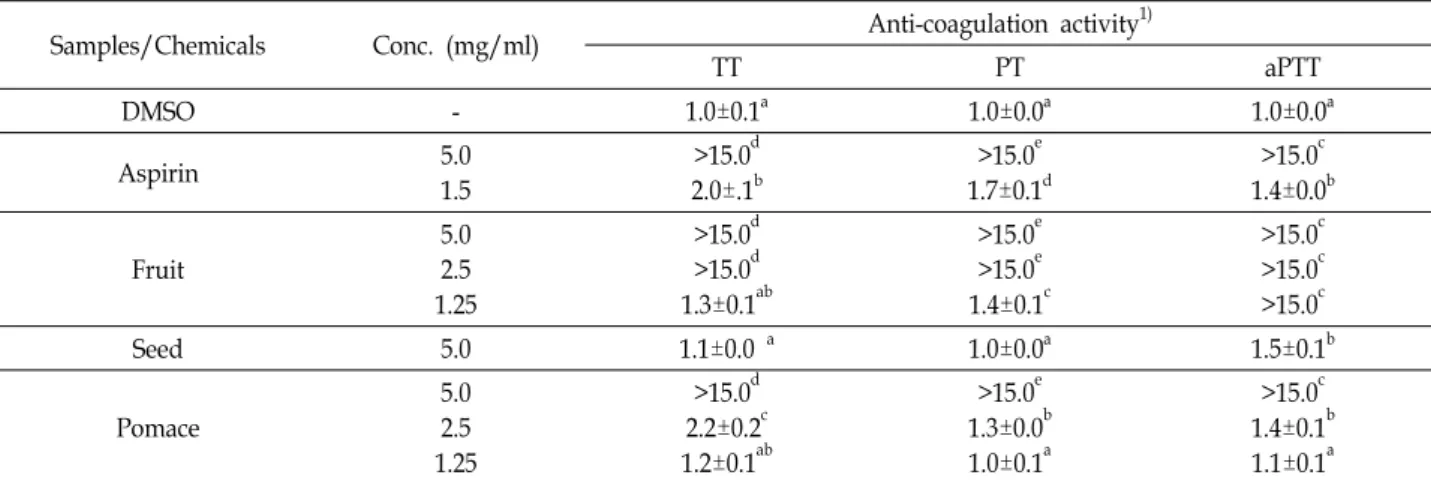
조제된 오미자 추출물 시료들의 항혈전 활성을 평가하기 위해 5 mg/ml 농도의 시료를 이용하여 혈액응고 저해활성을 평가하였다. 먼저 대조구로 사용된 aspirin의 경우 5 mg/ml 농도에서 TT, PT 및 aPTT를 모두 무첨가구에 비해 15배 이상 연장시켰으며, 1.5 mg/ml농도에서도 TT, PT 및 aPTT를 각각 2배, 1.7배, 1.4배 연장시켜 혈액응고를 효율적으로 저해함을 확인하였다(Table 5). 한편 오미자 열매 추출물과 박 추출물은 5 mg/ml 농도에서 TT, PT 및 aPTT를 모두 무첨가구에 비해 15배 이상 연장시켰다. 열매 추출물의 경우 2.5 mg/ml 농도에 서도 TT, PT 및 aPTT를 무첨가구에 비해 15배 이상 연장시킨 반면, 오미자 박 추출물은 2.5 mg/ml 농도에서 TT, PT 및 aPTT를 각각 2.2배, 1.3배 및 1.4배 연장시켜 aspirin 1.5 mg/
ml와 유사한 혈액응고 저해를 나타내었다. 따라서 오미자 박 추출물은 기존의 혈액응고저해 활성이 우수하다고 보고된 마 가목 줄기보다 우수한 혈액 응고저해 활성[17]을 가짐을 알 수 있었다. 씨 추출물은 5mg/ml 농도에서 aPTT를 1.5배 연장 시켜 혈액응고인자 저해활성은 인정되었으나, 혈전 생성 관련 효소인 thrombin, prothrombin의 저해활성은 나타나지 않았 다.
한편 조제된 오미자 추출물 시료들의 항혈전 활성을 평가하
기 위해 0.25 mg/ml 농도의 시료를 이용하여 인간 혈소판 응
집저해능을 평가하였다. Aspirin은 농도 의존적으로 혈소판
응집을 저해하였으며, 0.25 mg/ml농도에서 17%의 응집저해
및 0.5 mg/ml 농도에서 62.4%의 응집저해를 나타내었다(Table
Table 5. Anti-coagulation activities of the ethanol extracts of Schizandra chinensis Baillon fruit, seed and pomace
Samples/Chemicals Conc. (mg/ml) Anti-coagulation activity1)
TT PT aPTT
DMSO - 1.0±0.1a 1.0±0.0a 1.0±0.0a
Aspirin 5.0
1.5
>15.0d 2.0±.1b
>15.0e 1.7±0.1d
>15.0c 1.4±0.0b
Fruit
5.0 2.5 1.25
>15.0d
>15.0d 1.3±0.1ab
>15.0e
>15.0e 1.4±0.1c
>15.0c
>15.0c
>15.0c
Seed 5.0 1.1±0.0 a 1.0±0.0a 1.5±0.1b
Pomace
5.0 2.5 1.25
>15.0d 2.2±0.2c 1.2±0.1ab
>15.0e 1.3±0.0b 1.0±0.1a
>15.0c 1.4±0.1b 1.1±0.1a
1)Anti-coagulation activity is calculated on the clotting time of sample divided by the clotting time of solvent control in blood coagulation assay. Data are presented as the mean±SD of three determinations. The thrombin time (TT), prothrombin time (PT) and activated partial thromboplastin time (aPTT) of solvent control (dimethylsulfoximide) were 31.1 sec, 19.7 sec, 42.7 sec, respectively. Data are presented as the mean±SD of three determinations. Different superscript letters within a column differ sig- nificantly by Duncan’s multiple range test (p<0.05).
Table 6. Platelet aggregation inhibitory activities of the ethanol extracts of Schizandra chinensis Baillon fruit, seed and pomace Chemicals/
Samples Conc. (mg/ml) Amplitude (Ω) Slope (Ω/min) Lag time (sec) Area under curve DPAI1) (%)
DMSO - 17
17
3 3
31 36
123.6 123.4
-0.1 0.1
Aspirin 0.5
0.25
8 16
1 2
40 25
46.4 102.5
62.43 17.00 Fruit
Seed Pomace
0.25 0.25 0.25
4 7 26
1 2 6
74 16 8
31.3 64.3 243.9
74.66 47.93 -97.49
1)DPAI: Degree of Platelet Aggregation Inhibition. Data are presented as a representative result relative of independent three determinations. Amplitude is expressed as ohms by maximum extent of platelet aggregation, and slope (rate of reaction) is de- termined by drawing a tangent through the steepest part of curve. Area under curve is a calculated area in descent drawing during platelet aggregation.
Table 7. Hemolysis activities of the ethanol extracts of Schizandra chinensis Baillon fruit, seed and pomace against human red blood cell
Samples (mg/ml) Hemolysis (%)
Fruit (0.5) Seed (0.5) Pomace (0.5) Triton X-100 (1.0) Amphotericin B (0.05)
0.0±0.4 13.6±0.5 -2.5±0.7 100±0.5 97.3±1.6
6). 오미자 열매 추출물(0.25 mg/ml)은74.6%의 응집저해를 나
타내어 aspirin 보다 강력한 응집저해를 나타내었다. 이는, 오 미자 열매 methanol 추출물이 1 mg/ml 농도에서 rabbit 혈소 판 응집을 65.7% 저해한다는 기존의 보고[16]와 유사한 결과 이다. 한편 오미자 박 추출물은 응집저해가 전혀 나타나지 않 은 반면, 오미자 씨 추출물(0.25 mg/ml)은 47.9%의 응집저해 를 나타내어 동일농도의 aspirin 보다 우수한 혈소판 응집저해 활성을 나타내었다. 따라서, 상기 결과는 오미자 씨를 이용한 신규의 항혈소판제 개발이 가능함을 제시하고 있다.
조제된 오미자 추출물 시료들의 실제적인 식의약품 소재 개발 가능성을 검토하기 위해 인간 적혈구 용혈활성을 평가하 였다. 그 결과, 0.5 mg/ml 농도까지 열매 추출물 및 박 추출물 에서는 용혈활성이 전혀 나타나지 않았으며, 씨 추출물에서는 13.6%의 용혈활성이 나타났다. 그러나 이는 용혈활성이 문제
가 되고 있는 amphotericin이나, triton X-100과 비교시 매우
미약한 활성이며, 오미자씨유 5g/kg 경구투여시 독성이 나타
나지 않았다는 보고[30]를 고려한다면 특이 문제는 야기하지
않을 것으로 판단된다. 최종적으로 본 연구에서, 오미자 가공
산업에서 발생하는 오미자 씨와 착즙 후의 박은 오미자 열매
와 유사하거나 보다 우수한 항혈소판, 항균 및 항산화 활성을 나타냄을 확인하였다. 본 연구결과는 오미자 가공부산물을 이 용한 고부가가치 식의약품, 화장품 소재 개발의 기초자료로 이용될 것이다.
감사의 글
본 연구는 2015년도 산업통산자원부 바이오테라피 산업기 반구축사업(과제번호 N0001805)에 의해 수행되었으며, 이에 감사드립니다.
References
1. Ahn, S. M., Ryu, H. Y., Kang, D. K., Jung, I. C. and Sohn, H. Y. 2009. Antimicrobial and antioxidant activity of the fruit of Prunus avium L. Kor. J. Microbiol. Biotechnol. 36, 195- 200.
2. Bijak, M., Nowak, P., Bobrowiecka, M., Ponczek, M. B., Zbikowska, H. and Wacowicz, B. 2012. Protective effects of (-)-epicatechin against nitrative modifications of fibrinogen.
Thrombosis Res. 130, 123-128.
3. Caichompoo, W., Zhang, Q. Y., Hou, T. T., Gao, H. J., Qin, L. P. and Zhou, X. J. 2009. Optimization of extraction and purification of active fractions from Schisandra chinensis (Turcz.) and its osteoblastic proliferation stimulating activity.
Phytother Res. 23, 289-292.
4. Chen, H., Qi, X., He, C., Yin, Z., Fan, D. and Han, G. 2013.
Coagulation imbalance may not contribute to the develop- ment of portal vein thrombosis in patients with cirrhosis.
Thrombosis Res. 131, 173-177.
5. Cho, E. K., Cho, H. E. and Choi, Y. J. 2010. Inhibitory effects of angiotensin converting enzyme and α-glucosidase, and alcohol metabolizing activity of fermented omija (Schizandra chinensis Baillon) beverage. J. Kor. Soc. Food Sci. Nutr. 39, 655-661.
6. Choi, S. R., Kim, C. S., Kim, J. Y., You, D. H., Kim, J. M., Kim, Y. S., Song, E. J., Kim, Y. G., Ahn, Y. S. and Choi, D. G. 2011. Changes of antioxidant activity and lignan con- tents in Schisandra chinensis by harvesting times. Kor. J. Med.
Crop. Sci. 19, 414-420.
7. Choi, Y. W., Takamatsu, S., Khan, S. I., Srinivas, P. V., Ferreira, D., Zhao, J. and Khan, I. A. 2006. Schisandrene, a dibenzocyclooctadien lignin from Schisandra chinensis:
structure antioxidant activity relationships of dibenzocy- clooctadien lignans. J. Nat. Prod. 69, 356-359.
8. Chung, K. H., Lee, S. H., Lee, Y. C. and Kim, J. T. 2001.
Antimicrobial activity of Omija (Schizandra chinensis) ex- tracts. J. Kor. Soc. Food Sci. Nutr. 30, 127-132.
9. Deng, X., Chen, X., Cheng, W., Shen, Z. and Bi, K. 2008.
Simultaneous LC-MS quantification of 15 lignans in Schisan- dra chinensis (Turcz.) Baill. fruit. Chromatographia 67, 559- 566.
10. Guo, L. Y., Hung, T. M., Bae, K. H., Shin, E. M., Zhou, H.
Y., Hong, Y. N., Kang, S. S., Kim, H. P. and Kim, Y. S. 2008.
Anti-inflammatory effects of schisandrin isolated from the fruit of Schisandra chinensis Baill. Eur. J. Pharmacol. 591, 293- 299.
11. Hyun, K. H., Kim, H. J. and Jeong, H. C. 2002. A study of determining chemical composition of Schizandra chinensis.
Kor. J. Plan. Res. 15, 1-7.
12. Jeon, Y. H., Kil, J. H., Lim, S. M., Kim, M. H. and Kim, M. R. 2008. Analysis of antioxidative activity and anti- mutagenic effect of ethanol extract from Schizandra chinensis Baillon. J. East Asian Soc. Diet. Life 18, 746-752.
13. Jo, S. H., Ha, K. S., Moon, K. S., Lee, O. H., Jang, H. D.
and Kwon, Y. I. 2011. In vitro and in vivo anti-hyperglycemic effects of omija (Schizandra chinensis) fruit. Int. J. Mol. Sci.
12, 1359-1370.
14. Jung, G. T., Ju, I. O., Choi, C. S. and Hong, J. S. 2000. The antioxidative, antimicrobial and nitrite scavenging effects of Schizandra chinensis (Omija) seed. Kor. J. Food Sci. Technol.
32, 928-935.
15. Kim, K. S., Park, C. G., Ryu, S. N., Bang, J. K. and Lee, B. H. 2000. Schizandrin, oil compounds and their extraction yield in fruits of Schizandra chinensis Baillon. Kor. J. Crop.
Sci. 45, 158-162.
16. Kim, M. G., Lee, C. H. and Lee, H. S. 2010. Anti-platelet aggregation activity of lignans isolated from Schisandra chi- nensis fruit. J. Kor. Soc. Appl. Biol. Chem. 53, 740-745.
17. Kim, M. S., Seong, H. J. and Sohn, H. Y. 2016. In-vitro antith- rombosis activity of different parts of Sorbus commixta from Ulleung island. J. Life Sci. 26, 289-295.
18. Kim, Y. J., Lee, Y. G., Choi, Y. W. and Kim, Y. C. 2008.
Effects of drying conditions on the profile of volatile terpe- noid and color of Shizandra Fruit. J. Life Sci. 18, 1066-1071.
19. Kim, Y. S., Kim, Y. S., Kim, S. Y., Whang, J. H. and Suh, H. J. 2008. Application of omija (Schiandra chinensis) and plum (Prunus mume) extracts for the improvement of Kimchi quality. Food Control 19, 662-669.
20. Kwon, H. J. and Park, C. S. 2008. Biological activities of ex- tracts from Omija (Schizandra chinensis Baillon). Kor. J. Food Preserv. 15, 587-592.
21. Lee, H. J., Cho, J. S., Lee, Y. M., Choi, J. Y., Sung, J. H., Chung, H. S. and Moon, K. D. 2015. Quality characteristic of Omija (Schizandra chinensis Baillon) seed oils by roasting conditions and extraction methods. Kor. J. Food Preserv. 22, 845-850.
22. Lee, J. S. and Lee, S. W. 1991. Effect of water extracts of endocarps and seeds of omija (Schizandra chinensis Baillon) on alcohol metabolism. J. East Asian Soc. Diet. Life 1, 299-304.
23. Lee, W. Y., Choi, S. Y., Lee, B. S., Park. J. S., Kim, M. J.
and Oh, S. L. 2006. Optimization of extraction conditions from omija (Schizandra chinensis Baillon) by response surface methodology. Kor. J. Food Preserv. 17, 637-643.
24. Liu, C. J., Zhang, S. Q., Zhang, J. S., Liang, Q. and Li, D.
S. 2012. Chemical composition and antioxidant activity of essential oil from berries of Schisandra chinensis (Turcz.) Baill. Nat. Prod. Res. 26, 2199-2203.
25. Martinez, M., Weisel, J. W. and Ischiropoulos, H. 2013.
초록:오미자 열매, 씨, 착즙 후 박의 항산화, 항균 및 항혈전 활성 평가
김미선
1․성화정
1․박종이
2․손호용
1*
(1안동대학교 식품영양학과, 2경북바이오산업연구원)
본 연구에서는 오미자 가공산업의 부산물 이용을 위해, 오미자 열매, 씨 및 착즙 후의 박의 에탄올 추출물을 각각 조제하고, 이들의 유용생리활성을 평가하였다. 오미자 열매, 씨 및 박의 추출 수율은 각각 28.3, 22.1 및 7.2%
로 나타났으며, 추출물들의 총 폴리페놀 함량은 각각 8.81, 37.22 및 9.20 mg/g로 나타났다. 총 플라보노이드 함량 분석 결과 박(4.31 mg/g)>씨(1.25 mg/g)>열매(0.76 mg/g) 추출물 순으로 나타났다. 항산화 활성 평가 결과, 다양 한 radical (DPPH 음이온, ABTS 양이온 및 nitrite) 소거능 및 환원력 평가에서 박>씨>열매 추출물 순으로 항산화 능이 나타났으며, 오미자 박 추출물의 DPPH 양이온, ABTS 음이온 및 nitrite 소거능에 대한 RC
50는 각각 226.2, 192.5 및 92.5 μg/ml로 계산되었다. 항균 활성 평가 결과, 오미자 열매, 씨 및 박 추출물(0.5 mg/disc)은 B subtilis 및 P. vulgaris 균에 대한 강한 항균 활성을 나타내었다. 혈액응고저해 활성의 경우, 오미자 열매 및 박 추출물은 5 mg/ml 농도에서 TT, PT 및 aPTT를 모두 무첨가구에 비해 15배 이상 연장시켰으며, 박 추출물(2.5 mg/ml)은 aspirin (1.5 mg/ml)과 유사한 혈액응고 저해를 나타내었다. 혈소판응집 저해 활성 평가 결과, 열매 추출물과 씨 추출물(0.25 mg/ml)은 동일농도의 aspirin 보다 우수한 혈소판 응집저해 활성을 나타내었다. 상기의 오미자 시료 들은 0.5 mg/ml 농도까지 유의적인 용혈활성이 나타나지 않았다. 본 연구 결과는 오미자 가공산업에서 발생하는 오미자 씨와 착즙 후의 박을 이용한 항산화, 항균, 항혈전 기능성 소재 개발이 가능함을 제시하고 있다.
Functional impact of oxidative posttranslational mod- ifications on fibrinogen and fibrin clots. Free Radic. Biol. Med.
65, 411-418.
26. Min, H. Y., Park, E. J., Hong, J. Y., Kang, Y. J., Kim, S. J., Chung, H. J., Woo, E. R., Hung, T. M., Youn, U. J., Kim, Y. S., Kang, S. S., Bae, K. H. and Lee, S. K. 2008 Antiprolifer- ative effects of dibenzocyclooctadiene lignans isolated from Schisandra chinensis in human cancer cells. Bioorg. Med.
Chem. Lett. 18, 523-526.
27. Nomura, M., Nakachiyama, M., Hida, T., Ohtaki, Y., Sudo, K., Aizawa, T., Aburada, M. and Miyamoto, K. I. 1994.
Gomisin A, a lignan component of Schizandra fruits, in- hibits development of preneoplastic lesions in rat liver by 3'-methyl-4-dimethylamino-azobenzene. Cancer Lett. 76, 11- 18
28. Park, L. Y., Lee, S. H. and Kim, S. J. 2010. Preparation and sensory characteristics of bread containing Schizandra chi- nensis Baillon (a traditional Korean medicinal plant). Kor.
J. Food Preserv. 17, 637-643.
29. Ryu, I. H., Kwon, T. O. 2012. The antioxidative effect and ingredients of oil extracted from Schizandra chinensis seed.
Kor. J. Med. Crop Sci. 20, 63-71.
30. Ryu, S. N., Kim, K. S., Lee, E. B., Kang, S. S., Kim, J. S., Cheon, S. A. and Lee, B. H. 1998. Acute toxicity of fruit pigment and seed oil of Schizandra chinensis in mice. Kor.
J. Intl. Agri. 10, 37-41.
31. Singleton, V. L., Orthofer, R. and Lamuela-Raventos, R. M.
1999. Analysis of total phenols and other oxidation sub- strates and antioxidants by means of Folin-Ciocaleau re- agent. Methods Enzymol. 299, 152-178.
32. Sung, K. C. 2011. A study on the pharmaceutical and chem- ical characteristics and analysis of natural omija extract. J.
Kor. Oil Chem. Soc. 28, 290-298.
33. Sweeney, J. D., Hoerning, L. A., Behrens, A. N., Novak, E.
and Swank, R. T. 1990. Thrombocytopenia after desmo- pressin but absence of in-vitro hypersensitivity to ristocetin.
Amer. J. Clin. Path. 93, 522-525.
34. Valentina, U., Fabcic, J. and Stampar. F. 2007. Sugars, organ- ic acids, phenolic composition and antioxidant activity of sweet cherry (Prunus avium L.). Food Chem. 107, 185-192.
35. Yang, J. C. 2012. The evaluation on the effectiveness as a cosmetic material of oil extracted from Schizandra chinensis seed J. Kor. Oil Chem. Soc. 29, 231-237.
36. Yim, S. Y., Lee, Y. J., Lee, Y. K., Jung, S. E., Kim, J. H., Kim, J. E., Kim, H. J., Son, B. G., Park, Y. H., Lee, Y. G., Choi, Y. W. and Hwang, D. Y. 2009. Gomisin N isolated from Schisandra chinensis significantly induces anti-pro- liferative and pro-apoptotic effects in hepatic carcinoma.
Mol. Med. Rep. 2, 725-732.