Image Denoising Methods based on DAECNN for Medication Prescriptions
Dashdondov Khongorzul1, Lee Sang-Mu2, Yong-Ki Kim2, Mi-Hye Kim3*
1Ph.D. Dept. Computer Engineering, Chungbuk National University
2Ph.D.Cand. Dept. Computer Engineering, Chungbuk National University
3Prof. Dept. Computer Engineering, Chungbuk National University
DAECNN 기반의 병원처방전 이미지잡음제거
홍고르출1, 이상무2, 김용기2, 김미혜3*
1충북대학교 컴퓨터공학과 박사, 2충북대학교 컴퓨터공학과 박사과정, 3충북대학교 컴퓨터공학과 교수
Abstract We aimed to build a patient-based allergy prevention system using the smartphone and focused on the region of interest (ROI) extraction method for Optical Character Recognition (OCR) in the general environment. However, the current ROI extraction method has shown good performance in the experimental environment, but the performance in the real environment was not good due to the noisy background. Therefore, in this paper, we propose the compared methods of reducing noisy background to solve the ROI extraction problem. There five methods used as a SMF, DIN, Denoising Autoencoder(DAE), DAE with Convolution Neural Network(DAECNN) and median filter(MF) with DAECNN (MF+DAECNN). We have shown that our proposed DAECNN and MF+DAECNN methods are 69%, respectively, which is relatively higher than the conventional DAE method 55%. The verification of performance improvement uses MSE, PSNR and SSIM. The system has implemented OpenCV, C++and Python, including its performance, is tested on real images.
Key Words : ROI, DAECNN, SSIM, PSNR, MSE
요 약 본 연구는 환자의 알레르기 예방시스템을 구축하기 위해 스마트폰을 이용하여 저장된 처방전의 이미지잡음제거 를 위한 ROI 추출 방법에 중점을 두었다. 현재 ROI 추출은 제한된 실험 환경에서 좋은 성능을 보여 주었지만 실제 환경에서의 성능은 잡음으로 인해 좋지 않았다. 따라서 본 연구에서는 정확도 높은 ROI 추출을 위해 스마트폰 영상에 서 발생하는 잡음제거 방법을 제안한다. SMF, DIN, DAE, DAECNN(Denoising Autoencoder with Convolution Neural Network) and median filter with DAECNN(MF+DAECNN) 방법을 실험하였고 그 결과 DAECNN 및 MF + DAECNN 방법이 스마트폰에서 이미지의 잡음제거가 효과적임을 보여주었다. 성능 향상을 검증하기 위해 SSIM, PSNR 및 MSE 방법을 사용하였고 이 시스템은 OpenCV, C ++ 및 Python로 구현 및 실험되었고 실제 이미지에서 성능 테스트를 거쳐 자연잡음(natural noise)을 제거하는데 본 논문에서 제안한 DAECNN과 MF+DAECNN이 각 69%로 기존의 DAE 방법 55% 보다 상대적으로 높은 결과를 도출하였다.
주제어 : ROI, DAECNN, SSIM, PSNR, MSE
*Corresponding Author : Mi-Hye Kim([email protected]) Received March 11, 2019
Accepted May 20, 2019 Revised April 19, 2019
Published May 28, 2019
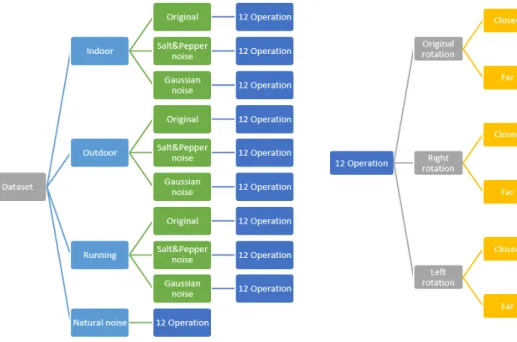
Fig. 1. Dataset structure
1. Introduction
Patients with a high possibility of an allergic reaction are generally difficult to identify dangerous medicines that cause allergies. In order to resolve this problem, we have developed a patient-based allergy prevention system using the smartphone for allergy patients. Patients take a picture of the medication prescriptions use the smartphones camera. After getting the photo, can recognize the digits on the picture and know medicine name. The system has three methods of searching: general search for drugs, prescription QR code search, and prescription drug search using OCR. Among them, prescription medication detection using OCR works well in an experimental environment, but its performance is very low in the real environment. The reason is that the region of interest (ROI) extraction is not performed properly. This is a common problem in general OCR as well as in our problems. OCR is a technique for extracting characters from an image and generally performs data input, preprocessing, ROI extraction and recognition
[1]. The accuracy of OCR recognition is high in the image-based pattern recognition model, and general OCR shows good performance in a clean image. ROI extraction give in very good recognition results in a high-resolution, high-quality images with black text on a white background. However, OCR is very weak to problems of camera systems such as low resolution, uneven illumination, noisy backgrounds, enlargement and focusing problems, moving objects, which are common disadvantages in image processing. In particular, ROI extraction performance is very poor than the problem of recognizing characters themselves.
Therefore, we propose to find method of reduce noisy background to solve the ROI extraction problem.
Several methods of noise reduction have also been introduced in [2] median filter and denoising illumination normalization. Based on morphologic transform, the uneven illumination normalization algorithm has been executed in [3]. [4] has been developed as an illumination normalization method for face recognition since it was complex to check lighting conditions
efficiently in practical applications.
Recently, outperforming deep learning-based conventional methods have shown a great promise. These methods are regulated for demand for large training sample size and high computational costs. In this paper, we propose a novel fully denoising autoencoder with the convolutional neural network for salt and pepper, natural and Gaussian noise removal.
Autoencoders have been used for image denoising [5-7]. They easily outperform conventional denoising methods and restrictive for specification of noise generative processes.
The idea of adding noise to the states has previously been used in the context of DAE by [6]
where noise is added to the input part of an autoencoder and the network is trained to remodel the noise-free input. Denoising autoencoders constructed using convolutional layers have superior image denoising performance for their ability to take advantage of spatial correlations [8-10].
In this paper, we show that using big sample size denoising autoencoders composed using convolutional layers can be used for capable denoising of medication prescription text images.
On the contrary small sample size DAECNN used for medical images in [9]. The contribution we made initially create the database of medication prescriptions. The strategy of the datasets is illustrated in Fig. 1.
The rest is organized as follows: section 2 will present the proposed model. Section 3 will present the denoising methods for images.
Section 4 will present experimental results briefly and finally, section 5 will end the paper with a conclusion and future works.
2. Proposed Model
The model uses a series of image processing techniques which are implemented in OpenCV
with Python and C++. The first part is image enhancement on preprocessing. Since images may have several qualities under different light sources and conditions, we assume the combination of basic denoising algorithms to improve their qualities. General OCR can predict good results from clean images. Specifically, ROI extraction needs high resolution, high-quality input images with a black text on a white background to produce a good recognition result. However, for the camera-based systems, these requirements are not standards. In the previous study, [3] introduced some kinds of types that a camera-based system: low resolution, uneven lighting, noisy backgrounds, non-focusing and zooming, motion objects, intensity and color quantization, and noise.
Therefore, first, we determined device conditions. Next, we focus on environmental factors, it can be categorized into four classes as follows: Indoor, outdoor, running and natural noise. For our system, the environmental limitations can be simplified into three types: no flash - original, lighting – given gaussian noise, complex backgrounds – given salt and pepper noise. Also, these three types have 12 categories:
zooming and focusing, centered and non-centered, rotated and not rotated.
2.1 Datasets for Medication Prescriptions We build up the dataset for medical prescriptions. In first we have taken 66 images by smartphone cameras. To make more data from limited data, we used the Data augmentation techniques. Data augmentation technique is a procedure for creating new ‘data’ with different orientations. In the database, we collected 7920 images like the following strategy. There have four classes. Each class has three types. Each type has 12 operations as the following figures.
In the image, the background has white, dark light and salt and pepper noise. Dataset structure is illustrated in Fig. 1. The sample images of the
a b c
d e f
g h i
k l m
Fig. 2. Sample Images of Real Dataset
real dataset presented in Fig. 2. The first column of Fig. 2 shows original → far->centered orientation, the second column shows right rotated → far → non-centered orientation and the third column shows left rotated → closed → centered orientation. Also, (a)-(c) indoor, (d)-(f) outdoor, (g)-(i) running, (k)-(m) natural noise classes shown in Fig. 2.
Fig. 3. System architecture
2.2 System Architecture
In this paper, we focus on preprocessing for OCR recognition. Among those images, we randomly chose 198 of them as noisy training dataset and 66 of as the normal test dataset. For the training dataset, it was utilized in experiments in the noisy component to find out the best values or parameters. For testing dataset, it was used to evaluate the denoising performance of the overall procedure. Besides, we mainly discuss the component of image denoising. Since the camera is taken images may have different qualities under varied light conditions. We assumed the comparison of denoising algorithms to improve their qualities, say SMF, DIN, DAE, DAECNN, and MF+DAECNN to achieve the best results. After parameter searching, we got the optimal parameters such as image size and dimensions for our training images which were confirmed on test images.
The system architecture illustrated in Fig. 3.
3. Denoising Methodology
In this section, we introduce the popular noise reduction methods for noisy images. They are tandard median filter (SMF), Denoising Illumination Normalization(DIN), DAE, and our proposed DAECNN and MF+DAECNN methods respectively. In other words, we have implemented as well as some methods, such as the proposed approach with reducing the noise of images.
3.1 Standard Median Filter method
The original images may hold various noises, and former methods also introduce extra noise.
The SMF [2] is a simple rank selection filter which is also called as median smoother. The median filter (MF) is simple and can be used noise removal reasonably; it also eliminates thin
Fig. 6. A Denoising Autoencoder lines and blurs the details of the image even
when it is low noise densities. The filtered image
g from SMF can be interpreted by the Eq. 1:
∈ (1) where is a sliding window of size × pixels centered at coordinates (i,j). The median value is resolved by using Eq. (1) with × .
Fig. 4. Standard Median Filter
However SMF can critically decrease the level of distortion noise, accurate pixel intensity values are also changed by SMF. SMF is not capable of differentiating between accurate from distortion pixel and therefore unexpected situation occurs. In addition, SMF needs a more filter size when there is a high difference.
Though, a large filter of SMF will bring a serious deformation into the image.
3.2 Denoising Illumination Normalization method Reflect on the problem, we discussed one important problem is the uneven lighting. When the camera flash on holds, the center of the view is the shiny, and then lighting decomposes outbound. Under this condition, the same uniform region will appear brighter in some areas or darker on others.
This unsought situation will induce to several problems in computer vision-based system. The pixels may be misclassified, pass to wrong segmentation results, and thus contribute to unreliable valuation or analysis from the system.
For that reason, it is very critical to process these types of images before supplying them into the
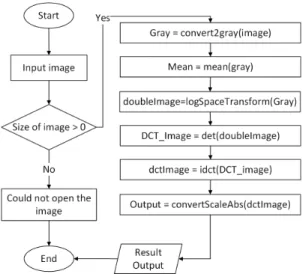
system. One of the most common methods for enhancing or restoring degraded images due to uneven lighting is called normalization. The structure of light illumination normalization [11]
is composed as shown in Fig. 5.
Fig. 5. Structure of light illumination normalization
3.3 Denoising Autoencoder method
An autoencoder's purpose is to map high dimensional images to a compressed form hidden representation and build up the original image from the hidden representation. A stacked denoising autoencoder, in addition to learning to compress data (like an autoencoder), it learns to remove noise in images, which allows performing
well even when the inputs are noisy. So denoising autoencoder is learned more features from the data and robust than a standard autoencoder. Also, one of the uses of autoencoder was to find a good initialization for deep neural networks [5, 6]. However, with good initializations [9, 12] and activation functions ReLU, their advantage has disappeared. Now they are more used in generative tasks e.g. variational autoencoder.
The architecture of the DAE is composed of the 5 number of layers as follows: InputLayer (n nodes) → encodingLayer_1 (n/2 nodes) → encodingLayer_2 (1 nodes) → decodingLayer_1 (n/2 nodes) → decodingLayer_2 (n nodes), where n is the number of nodes [12]. Here, the compressed representation of the original input, the number of nodes in the bottleneck hidden
layer is one, and the other hidden layer consists of about half of the input neurons. The sigmoid activation function is used to encoding layers, and the tanh activation function is used to the decoding layers, respectively.
3.4 Denoising Autoencoder method with CNN Therefore, in this study, we propose an ROI extraction method by applying an effectual DAE to remove the noisy background to solve this problem. To solve this problem, we study the ROI extraction method using DAECNN which is known to be effective in removing the noisy background image. The architecture of DAECNN is composed of the 10 layers step by step as following Algorithm 1. The ReLU activation function is used for encoding and decoding 1-4 layers, the sigmoid activation function is for decoding 5 layer respectively. Backpropagation is used to calculate the gradient of the error function for the parameter.
3.5 Median filter with DAECNN
We would like to investigate similar architecture on high-resolution images and
median filters for image preprocessing before using DAECNN. Generic function of the proposed MF+DAECNN is shown in Algorithm 2.
4. Evaluation Methods 4.1 Implementation setup
The experiment was carried out on an Intel (R) Core (TM) i7-8550U and 16GB Ram. The experimental work is tested train image 66, test image 792, a total of 858 each noised images were taken by smartphone cameras. Each image is of size 1000 x 1000 pixels. There are 66 images for each class and totally there are 7920 images. DAE and DAECNN were trained by the Adam algorithm [13] and the learning rate was 0.001 in order to minimize the mean squared error. Batch size of 128 and the number of epochs to train model was 100 which roughly took 36 hours. Standard Median filter, DAE and DAECNN methods were implemented in Python with OpenCV, Keras and TensorFlow [14]. Light illumination normalization method was implemented in C++ with OpenCV.
4.2 Evaluation methods
The image evaluation of this paper was performed using mean squared error (MSE) [15], peak signal to noise ratio (PSNR) [5] and structural similarity index (SSIM) [9].
4.2.1 Mean squared error
MSE is a measuring how similar two images are. With image X as an approximation of image Y, the definition of mean squared error as follows:
(2) Where, m and n are the dimensions of the images. In a grayscale image, this is the number of pixels. In color images, this is the number of
pixels (red, green, blue) for the three color channel.
4.2.2 Peak signal to noise ratio
PSNR is common evaluation metric when comparing similarity of two images. PSNR is defined as the ratio of the maximum possible power of the signal to the maximum possible power of the noise. PSNR is based on MSE as follows:
log
(3) PSNR between two same images are infinite.4.2.3 Structural similarity index
The similarity of two images are measured by SSIM as follows:
(4) where luminance comparison is defined as
(5)
The contrast comparison as
(6)
And the structural comparison as
(7) The metric is symmetric in the sense that
≤ . The closer the SSIM value is to 1 in the results section, the higher the similarity of the images.
5. Experimental results
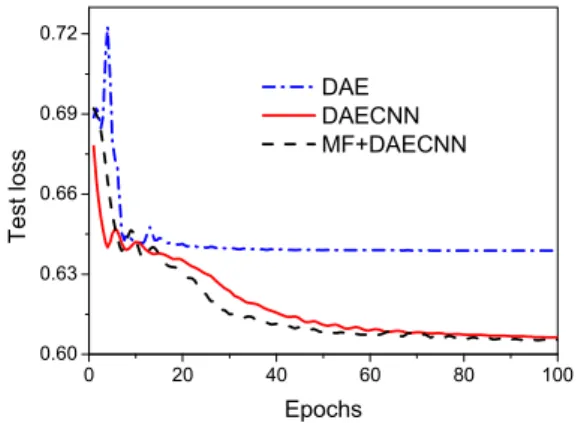
In this part, we will explain the experimental results. Fig. 7. illustrated the comparison of testing loss for DAE, DAECNN and MF+DAECNN
methods. From the figure, MF+DAECNN method is the better performance than DAECNN and DAE methods. Basic settings were kept epochs 100 and batch size of 128. We combined both data sets with 858 images for the training and testing.
Also, we explain image quality evaluation results besides objective and subjective methods. The objective evaluation is numerical comparisons are between references image and noisy image.
The subjective method called a human judgment method that is not based on reference images.
0 20 40 60 80 100
0.60 0.63 0.66 0.69 0.72
Test loss
Epochs DAE DAECNN MF+DAECNN
Fig. 7. Testing loss comparison of DAE, DAECNN and MF+DAECNN methods
Natural noise Gaussian noise Salt&
Pepper noise
MF+DAECNN 40.92 40.92 40.92
DAECNN 44.95 43.2 42.38
DAE 45.33 47.05 44.83
MF 66.54 12.3 3.95
DIN 73.54 23.61 217.1
Table 1. MSE comparison results of different denoising methods with the original image on Eq. 2.
As well as, the analysis of denoising images has been done in Python to find the values of the MSE, PSNR, and SSIM. The objective evaluation value MSE value of noisy vs original images has 81.7 for natural noise, 8.59 for Gaussian noise and 40.24 for salt&pepper noise. Also, the PSNR value of noisy vs original images has 11.94 for natural noise, 21.73 for Gaussian noise and 15.02
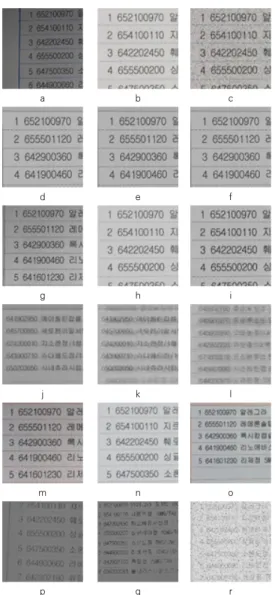
for salt&pepper noise. Additionally SSIM value of noisy vs original images has 0.59 for natural noise, 0.99 for Gaussian noise and 0.13 for salt&pepper noise. Tables 1-3 presented comparison results of MSE, PSNR and SSIM metrics by separate different denoising methods with the original image based on Eq. 2-4. The subjective evaluation can also be done on illustrating the images given in Fig. 8. The first column of Fig. 8 shows natural noise, the second column shows Gaussian noise and the third column shows Salt & Pepper noise. Besides (a)-(c) show noisy data image, (d)-(f) MF+DAECNN, (g)-(i) DAECNN, (j)-(l) show DAE, (m)-(o) show median filter, (p)-(r) show DIN methods in the Fig. 8.
Natural noise Gaussian noise Salt&
Pepper noise
MF+DAECNN 13.88 13.88 13.88
DAECNN 13.47 13.73 13.82
DAE 13.43 13.27 13.48
MF 12.83 20.17 25.09
DIN 12.41 17.33 7.7
Table 2. PSNR comparison results of different denoising methods with the original image on Eq. 3.
Natural noise Gaussian noise Salt&
Pepper noise
MF+DAECNN 0.69 0.69 0.69
DAECNN 0.69 0.72 0.64
DAE 0.55 0.47 0.49
MF 0.65 0.93 0.94
DIN 0.60 0.62 0.05
Table 3. SSIM comparison results of different denoising methods with the original image on Eq. 4.
From the results, our proposed method DAECNN methods have good performance for the natural noised image. Furthermore, MF+DAECNN has better performance than DAECNN for natural images and the same results for all noisy images and the best performer are in bold.
Fig. 8 shows the comparison results of images for denoising performance of different methods.
a b c
d e f
g h i
j k l
m n o
p q r
Fig. 8. Sample of Noisy and Denoised images for different denoising methods.
In this figure, MF+DAECNN and DAECNN perform better than other methods for the natural noise. DAE method is bad performs for all images. The median filter is a good performance on the salt and pepper noise and Gaussian noise image. But not good for the ROI extractions. Denoising illumination method is also a not good performance for the ROI extraction.
Therefore from results, we have to use both objective and subjective evaluation methods for
the ROI extraction. For example, when Gaussian noise image there MSE have 23.61 for the DIN method. But in Fig. 8 illustrated DIN method very bad performance based on subjective analysis.
Hence we can not say DIN is a good method for the denoising in our results.
6. Conclusions
In this paper, we propose the compared methods of reducing image noisy background to solve the ROI extraction problem. From the experimental results, DAECNN is good for the natural noisy images, MF is better on the salt and pepper noisy images than DAE, illumination normalization is poor performance all noisy images. Furthermore, our proposed method MF+DAECNN has better than DAECNN and same performance for all noisy images. We have acceptable execution can be achieved using training and testing sample as 858 is enough for good performance. The verification of performance improvement uses SSIM, PSNR, and MSE.
REFERENCES
[1] M. Mirmehdi, P. Clark & J. Lam. (2001). Extracting low resolution text with an active camera for OCR, Proc.
of the 9th Spanish symposium on pattern recognition and image processing, 43–48.
DOI: 10.1109/TSMCB.2005.857353
[2] S. Suman. (2014). Image Denoising using New Adaptive Based Median Filter, Signal and Image Processing: An International Journal,5(4).
DOI: 10.5121/sipij.2014.5401
[3] Wang G, Wang Y & Li H, et al. (2014). Morphological background detection and illumination normalization of text image with poor lighting, PLoS One, 9(11):e110991. DOI:10.1371/journal.pone.0110991 [4] Y. Luo, Y. P. Guan & C. Q. Zhang. (2013). A robust
illumination normalization method based on mean estimation for face recognition, ISRN Machine Vision, 1-10. Article ID 516052.
DOI: 10.1155/2013/516052
[5] K. G. Lore, A. Akintayo & S. Sarkar (2017). LLNet: A deep autoencoder approach to natural low-light image enhancement, Pattern Recognition, 61, 650-662.
DOI: 10.1016/j.patcog.2016.06.008.
[6] P. Vincent, et al., (2010). Stacked denoising autoencoders: Learning useful representations in a deep network with a local denoising criterion, Proc.
of the 27th Int. Conf. on Machine Learning. 3371–
3408, ACM.
DOI: 10.1.1.297.3484
[7] K. H. Cho. (2013). Boltzmann machines and denoising autoencoders for image denoising. arXiv:1301.3468.
DOI: arXiv:1301.3468v6.
[8] T. Remez, et al. (2017). Deep convolutional denoising of low-light images, arXiv:1701.01687.
DOI: arXiv:1701.01687v1
[9] L. Gondara. (2016). Medical Image Denoising Using Convolutional Denoising Autoencoders. IEEE 16th Int.
Conf. on Data Mining Workshops, pp. 241-246, Barcelona.
DOI: 10.1109/ICDMW.2016.0041
[10] X. Glorot & Y. Bengio. (2010). Understanding the difficulty of training deep feedforward neural networks, Proc. of the 13th Int. Conf. on Artificial Intelligence and Statistics, 9, 249-256.
DOI:10.1.1.207.2059
[11] W. Chen, J. E. Meng & W. Shiqian (2006). Illumination compensation and normalization for robust face recognition using discrete cosine transform in logarithm domain, IEEE Transactions on Systems, Man, and Cybernetics, 36(2), 458-466.
DOI: 10.1109/TSMCB.2005.857353
[12] A. Tsatsral, J. Bilguun & H. R. Keun, (2018).
Unsupervised Novelty Detection Using Deep Autoencoders with Density Based Clustering, Appl.
Sci., 8(9), 1468.
DOI: 10.3390/app8091468
[13] D. P. Kingm & J. Ba. (2014). Adam: A method for stochastic optimization, Proc. of the 3rd Int. Conf. for Learning Representations, pp. 7-9, San Diego, CA, USA.
DOI:arXiv:1412.6980v9
[14] M. Abadi, et al., (2016). Tensorflow: Large-scale machine learning on heterogeneous distributed systems, arXiv:1603.04467.
DOI: arXiv:1603.04467v2
[15] Q. Shan, et al., (2010). Using optical defocus to denoise. IEEE Computer Society Conference on Computer Vision and Pattern Recognition, 561-568, San Francisco, CA.
DOI: 10.1109/CVPR.2010.5540164
홍 고 르 출(Khongorzul, Dashdondov) [정회원]
․ 1998년 6, 월2000년 12월 : 몽골국 립대학교 수학과(수학학사, 수학석사)
․ 2013년 8월 : 충북대학교 전파통신공 학과(공학박사)
․ 2017년 3월 ~ 현재 : 충북대학교 컴 퓨터공학과 연구원
․ 관심분야 : Probability and Statistics, Queueing theory, Image processing, Machine Learning
․ E-Mail : [email protected]
이 상 무(Sang Mu, Lee) [정회원]
․ 2012년 2월 : 충북대학교 컴퓨터공학 과(공학사)
․ 2014년 2월 : 충북대학교 컴퓨터공학 과(공학석사)
․ 2014년 9월 ~ 현재 : 충북대학교 컴 퓨터공학과 박사 재학
․ 관심분야 : 관심분야 : Machine Learning, Pattern Recognition, Gesture Recognition
․ E-Mail :[email protected]
김 용 기(Yong-Ki, Kim) [정회원]
․ 2008년 2월 : 청주대학교 관광경영학 과 (경영사)
․ 2014년 2월 : 충북대학교 컴퓨터공학 과 (공학석사)
․ 2015년 3월 ~ 현재 : 충북대학교 컴퓨 터공학과 박사 재학
․관심분야 : Image Processing, AVSR, Lip Reading, Machine Learning
․ E-Mail : [email protected]
김 미 혜(Mi-Hye, Kim) [정회원]
․ 1992년 2월 : 충북대학교 수학과 (이 학사)
․ 1994년 2월 : 충북대학교 수학과 (이 학석사)
․ 2001년 2월 : 충북대학교 수학과 (이 학박사)
․ 2004년 9월 ~ 현재 : 충북대학교 컴 퓨터공학과 교수
․ 관심분야 : 빅데이터, 기능성 게임, 유비쿼터스 게임, 플랫폼, 퍼지측도 및 퍼지적분, 제스츄어 인식
․ E-Mail : [email protected]