http://www.medicinalcrop.org
http://dx.doi.org/10.7783/KJMCS.2018.26.1.26
Multiplex Polymerase Chain Reaction을 이용한 당귀 종 판별
김용상* · 박혁주* · 이동희**· 김현규*†
*콜마비앤에이치 식품과학연구소, **경북바이오산업연구원 식품시험검사사업단
Development of Multiplex Polymerase Chain Reaction Assay for Identification of Angelica Species
Yong Sang Kim*, Hyeok Joo Park*, Dong Hee Lee** and Hyun Kyu Kim*†
*Food Science R&D Center, Kolmar BNH, Sejong 27670, Korea.
**Gyeongbuk Institute for Bio Industry Food Testing and Inspection Project, Andong 36728, Korea.
ABSTRACT
Background: Angelica gigas, A. sinensis, and A. acutiloba are commercially important in the herbal medicine market, and among them, A. gigas has the highest economic value and price. However, their similar morphological traits are often used for fraud.
Despite their importance in herbal medicine, recognition of the differences between Angelica species is currently inadequate.
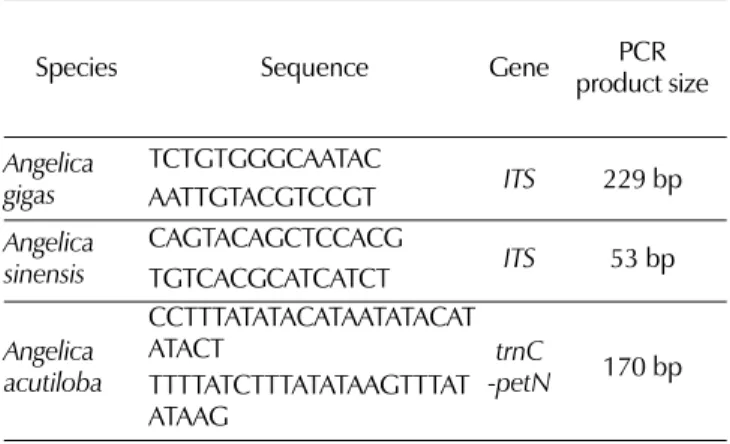
Methods and Results: A multiplex polymerase chain reaction (PCR) method was developed for direct detection and identification of A. gigas, A. sinensis, and A. acutiloba. The gene for the distinction of species was targeted at ITS in the nucleus and trnC-petN gene in chloroplasts. The optimized multiplex PCR in the present study utilized each Angelica species-specific primer pairs. Each primer pair yielded products of 229 base pairs (bp) for A. gigas, 53 bp for A. sinensis, 170 bp for A. acutiloba. Additionally non-spe- cific PCR products were not detected in similar species by species-specific primers.
Conclusions: In the present study, a multiplex-PCR assay, successfully assessed the authenticity of Angelica species (A. gigas, A.
sinensis, and A. acutiloba). and whole genome amplification (WGA) was performed after DNA extraction to identify, the species in the product. The detection method of raw materials developed in the present study could be applied to herbal medicine and health functional food management.
Key Words: Angelica acutiloba, Angelica gigas, Angelica sinensis, Multiplex Polymerase Chain Reaction, Species-specific Primer, Whole Genome Amplification
서 언
당귀는 산형과인 Angelica 속에 속하며, 다년생 초본으로 동 북아시아 지역에 널리 분포하고 있으며 특히, 한국, 중국, 일 본에서 참당귀 (Angelica gigas)와 중국당귀 (Angelica sinensis) 그리고 일당귀 (Angelica acutiloba) 품종이 대표적으 로 재배 되고 있다 (Choi et al., 2005). 국내에서 재배 되고 있는 당귀 품종으로는 기후환경이 맞지 않아 재배가 불가능한 중국당귀를 제외한 참당귀와 일당귀가 있는데 주로 한약재나 쌈채소 등으로 이용되고 있다.
자료에 따르면 2013년 한해 국내에서 참당귀는 1,371 톤, 일당귀는 231 톤이 생산 되었으나, 건강기능식품 원료로서 효 능이 알려지면서 수요량이 생산량을 크게 앞지른다고 보고되 었다 (MAFRA, 2015). 높은 국내 수요량에 의하여 대량생 산이 가능한 중국으로부터의 수입이 불가피한 실정이며, 건 강기능식품 원재료로 사용되는 참당귀, 중국당귀 및 일당귀 는 형태적으로 유사하여 오·혼용되는 사례가 확인되고 있어 품질 관리를 위한 원산지 판별 및 종 판별의 중요성이 대두 되고 있다
현재 종 판별을 위한 여러 방법들이 연구되고 있으며 대표
†
Corresponding author: (Phone) +82-44-860-4262 (E-mail) [email protected]
Received 2017 October 30 / 1st Revised 2017 December 19 / 2nd Revised 2018 January 3 / 3rd Revised 2018 January 9 / Accepted 2018 January 10 This is an open access article distributed under the terms of the Creative Commons Attribution Non-Commercial License (http://creativecommons.
org/licenses/by-nc/3.0/) which permits unrestricted non-commercial use, distribution, and reproduction in any medium, provided the original work
is properly cited.
적인 분류 방법으로는 형태학적 분류와 이화학적 분류 방법이 있다. 먼저 형태학적 분류방법은 근적외선 분광법, 엑스선형광 법등이 있으나 (Cho et al., 2002), 이들 형태학적 분류는 식 물체가 완전히 성장한 이후 그리고 온전히 유지되어 있어야 판단할 수 있는 방법으로 한약재로 유통될 시 가공처리 후 절 편이나 분말의 형태이기 때문에 정확한 분류가 어렵다.
이화학적인 분류방법은 생체 내에 존재하는 저분자 대사 체를 광범위하게 분석하여 종을 판별하는 방법으로 nuclear magnetic resonance (NMR), gas chromatography-mass spectrometer (GC-MS), liquid chromatography-mass spectrometer (LC/MS) 등과 같은 분석기기를 이용한다 (Arbona et al., 2009). 그러나 분석까지의 과정이 복잡하고 고가의 장비를 사 용하여야 하며, 혼입 시 종 판별 기준의 부정확 등의 한계를 지니고 있어 보완해줄 방법이 필요하다 (Jiang and Leem, 2016).
최근 많은 연구가 진행되고 있는 분자생물학적 분류 방법은 형태학적 및 이화학적인 방법의 한계를 보완하고 종판별의 정 확도를 향상시키는데 도움을 주고 있다 (Williams et al., 1990). 분자생물학과 염기서열 분석기술의 발전으로 유전자를 이용한 종간 분류연구가 활발하게 진행되고 있다. 대표적으로 바코드유전자 분석법이 있는데, 국제생물바코드 컨소시엄 (CBOL, consortium of barcording of life) 에서는 식물체 내 의 특정유전자 (DNA barcord gene) 분석을 통하여 정확한 종 판별과 분자계통학적 분석이 가능하다는 연구결과가 발표 되었다 (Guo and Ge, 2005).
식물체에서 바코드유전자 분석에 이용되는 대표적인 특정 유전자로 핵 내 존재하는 internal transcribed spacer (ITS), 그리고 엽록체에 존재하는 matK, rbcL, psbA-trnH 등이 있다.
ITS의 경우는 다른 유전자 코딩 부위보다 빠르게 진화하여 분 자계통학적 연구에 많이 이용되고 있으며, matK, rbcL 등의 경우 대부분의 식물체에서 잘 보존되어 있기 때문에 바코드 유전자로서 활발하게 연구되고 있다 (Kim et al., 2005).
한약재에 대한 종 판별도 바코드유전자 분석법이 이용되고 있는데, 연구 결과로는 대표적인 혼·오용 한약재인 반하, 오미 자, 시호 등의 종 감별법 등이 있다 (Moon et al., 2009;
Kim et al., 2012; Lee et al., 2013).
본 연구에서는 건조 가공 후 그 형태가 동일하여 혼·오용 할 가능성이 큰 참당귀, 중국당귀 그리고 일당귀 시료를 확보하고, 바코드유전자 부위로 알려진 ITS와 trnC-petN 유 전자 부위를 분석하고 National Center for Biotechnology Information (NCBI) DB 와 비교한 후 각각의 정확한 종 판별을 위한 종 특이 프라이머를 개발하였으며, Multiplex PCR 법을 적용하여 정확하고 빠른 시험방법을 통해 당귀의 혼·오용 방지를 위한 종 판별법으로 활용하고자 하였다.
재료 및 방법
1. 표준 시료확보 및 전처리
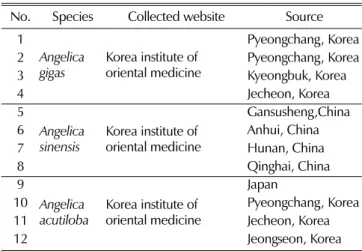
참당귀 (Angelica gigas), 중국당귀 (Angelica sinensis) 그리 고 일당귀 (Angelica acutiloba) 3 종에 대한 표준시료는 한국 한의학연구원에서 분양 받은 시료를 사용하였으며, 적용 시료 의 경우 국내·외 약재시장 [경동시장 (서울, 한국), 보저우 (박 주, 중국)]에서 구입하여 사용하였다 (Table 1).
3 종의 혼입여부 및 프라이머의 검출한계를 확인하기 위하 여 표준시료를 분쇄한 후 질량 대비 1, 2, 5, 10, 25%로 혼 합한 후 유전자를 추출 하였다 (Table 2).
2. 유전자 추출 및 유전자 증폭
유전자는 DNeasy Plant mini kit (QIAGEN GmbH,
Table 1. List and imformation of Angelica species used in this study.
No. Species Collected website Source 1
Angelica
gigas Korea institute of oriental medicine
Pyeongchang, Korea
2 Pyeongchang, Korea
3 Kyeongbuk, Korea
4 Jecheon, Korea
5
Angelica
sinensis Korea institute of oriental medicine
Gansusheng,China
6 Anhui, China
7 Hunan, China
8 Qinghai, China
9
Angelica
acutiloba Korea institute of oriental medicine
Japan
10 Pyeongchang, Korea
11 Jecheon, Korea
12 Jeongseon, Korea
Table 2. Mixing ratios for analysis of the detection limit.
No. Angelica gigas
(%/mass) Angelica sinensis (%/mass)
Angelica acutiloba (%/mass)
1 50 25 25
2 80 10 10
3 90 5 5
4 96 2 2
5 98 1 1
6 25 25 50
7 10 45 45
8 5 45 50
9 2 48 50
10 1 49 50
11 100 0 0
12 0 100 0
13 0 0 100
14 33.3 33.3 33.3
Hilden, Germany) 를 사용하여 추출 하였으며, 추출 방법은 제 조사에서 매뉴얼에 따라 추출하였다.
또한, 당귀 추출분말 및 농축액에 대한 적용 시험을 진행하 기 위하여 유전자 증폭 시험을 진행 하였는데 증폭은 제품가 공에 따른 가열 및 강압으로 소량 추출된 유전자를 PCR이 가 능한 농도로 증폭하는 단계로, 이를 위해 GenomePlex
®whole genome amplification (WGA) kit (Sigma-Aldrich Co., St.
Louis, MO, USA) 를 사용하여 증폭 하였다.
제조사에서 제공하는 방법에 따라 증폭을 수행한 후 최종 증폭된 산물은 AccuPrep
®PCR Purification Kit (Bioneer, Daejeon, Korea) 로 정제하였다. 정제된 DNA는 Nanodrop (Thermo Fisher Scientific Inc., Waltham, MA, USA) 을 이 용하여 농도를 측정하였으며 멸균증류수로 최종 DNA농도를 10 ng/ ㎕ 으로 조정 하였다.
3. 종 특이 프라이머 탐색
각 품종에 대하여 특이적으로 반응 하여 증폭하는 종 특이 프라이머 설계를 위하여 National Center for Biotechnology Information (NCBI, https://www.ncbi.nlm.nih.gov) 의 DB에서 각 품종의 염기서열 정보를 확보 했으며, 염기서열 정보가 없 는 경우에는 일반 프라이머 (ITS1 5'-TCCGTAGGTGAACC TGCGG-3', ITS4 5'-TCCTCCGCTTATTGATATGC-3') 를 이용 하여 유전자를 증폭한 후 염기서열을 분석 및 확보 하였다.
확보된 염기서열은 Bioedit v7.0.9 (http://mbio.ncsu.edu/
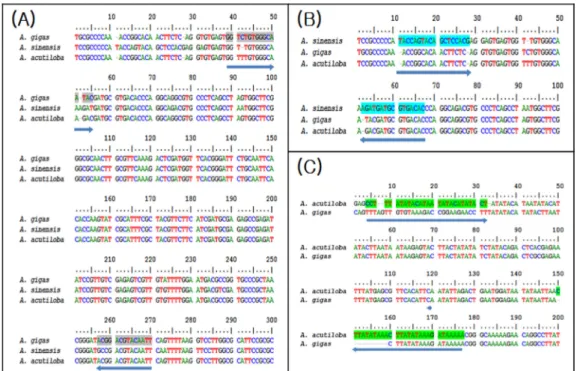
BioEdit/page2.html) 의 ClustalW Multiple sequence alignment 를 이용하여 분석하였으며, 종간 상이한 염기서열 부위를 선 택 하였고, Primer Blast (NCBI)에서 melting temperature (Tm) 값 및 self complementarity 여부 등과 다른 종의 유전자 와의 결합유무를 확인한 후 결과를 토대로 프라이머를 제작하 였다.
4. Multiplex PCR
유전자 증폭 (PCR)을 위해 AccuPower Gold Multiplex PCR Premix (Bioneer, Daejeon, Korea) 가 사용하였으며, PCR 반응액의 총 부피는 20 ㎕ 로 PCR premix에 10 ng genomic DNA, 각 0.5 μM 참당귀/일당귀 primer, 0.25 μM 중국당귀 primer를 첨가하여 반응시켰다.
유전자 증폭 반응은 A200 Gradient Thermal Cycler (Hangzhou LongGene Scientific Instruments Co., Ltd., Zhejing, China) 기기를 이용하여 진행 하였으며, 유전자 증폭 조건은 95℃에서 5 분간 pre-denaturation한 후, 95℃에서 30 초, 35℃에서 10 초, 72℃에서 30 초로 30 cycles로 수행하 였고, final extention 과정은 72℃에서 5 분간 반응시켰다.
증폭 완료된 산물은 5 ㎕ 를 취하여 ethidium bromide (EtBr) 이 첨가된 (1 ㎕/㎖) 아가로즈 젤로 100 V, 30 분간 전
기영동 하였다. PCR 산물의 크기 확인은 100 bp DNA ladder (Bioneer, Daejeon, Korea) 를 사용하였으며, 전기영동 완료 후 OPTINITY gel documentation system (Korea Lab Tech, Seongnam, Korea) 에서 PCR 증폭산물을 확인하였다.
결 과
1. 종 특이 프라이머의 설계 및 PCR 조건 최적화
참당귀 (Angelica gigas), 중국당귀 (Angelica sinensis) 그 리고 일당귀 (Angelica acutiloba) 각각의 종 특이 프라이머를 설계하기 위하여 핵 내에 존재하는 ITS유전자 부위와, 엽록체 에 존재하는 trnC-petN유전자 부위를 마커로 사용하였으며 이 들 유전자 염기서열의 각 품종 간 차이를 확인 하여 조건에 맞는 프라이머를 설계했다 (Table 3, Fig. 1).
합성된 프라이머의 특이적인 결합 및 유전자 증폭을 확인하 기 위하여 참당귀, 중국당귀 그리고 일당귀 표준시료의 DNA 를 추출 하여 PCR을 진행 하였으며, 최적화된 조건에서 Multiplex PCR 을 진행한 결과 참당귀는 229 bp, 중국당귀는 53 bp, 일당귀는 170 bp 크기의 종 특이적 증폭산물을 확인 할 수 있었다 (Fig. 2). 또한, 각 프라이머의 혼합 시료에 대한 검출 한계를 확인하기 위하여 중량 대비 1, 2, 5, 10, 25%
혼합하고 유전자를 추출한 후 Multiplex PCR을 진행 한 결과 참당귀, 일당귀는 5% 이상, 중국당귀는 2%이상 혼합되어 있 을 때 혼입 유무를 확인 할 수 있었다.
2. 가공 식품에 대한 적용
당귀류 종 판별용 종 특이 프라이머의 활용·적용성을 확인 하기 위하여 시중에 판매중인 당귀를 원재료로 하는 제품 5 건 (당귀 추출분말 1 건, 추출농축액 3 건, 환 제품 1 건)을 무작위 선별 구입하였다. 제품 중 추출 농축액 형태의 경우 제조 시 발생하는 고열 및 고압으로 유전자 추출 단계 중 최
Table 3. DNA sequences of the oligonucleotide primer for identification of the three Angelica species in this stud.
Species Sequence Gene PCR
product size
Angelica gigas
TCTGTGGGCAATAC
ITS 229 bp AATTGTACGTCCGT
Angelica sinensis
CAGTACAGCTCCACG
ITS 53 bp
TGTCACGCATCATCT Angelica
acutiloba
CCTTTATATACATAATATACAT
ATACT trnC
-petN 170 bp TTTTATCTTTATATAAGTTTAT
ATAAG
Fig. 1. Sequence alignment of the three Angelica species showing the location of the species- specific primers. (A); A. gigas, (B); A. sinensis, (C); A. acutilobae.
Fig. 2. PCR results from various standard sample by PCR using Angelica species specific Multiplex markers. M; 100bp size marker, 1 - 3; A. gigas, 4 - 5; A. sinensis, 7 - 9; A. acutilobae, 10 - 11; mixture of three Angelica species, 12; negative control.
Fig. 3. Detection of Angelica species from health functional food by PCR using Angelica species specific Multiplex markers. 1; powder type product, 2; pill type product, 3 - 7; juice type products, 8; negative control.
종 추출되는 DNA의 양이 적어 PCR 후 증폭 산물을 확인 할 수 없었다. 때문에 WGA kit를 이용한 유전자 증폭 후 PCR 재실험을 진행한 결과 5 건 모두에서 참당귀가 확인 되 었다. 정확한 적용 시험을 진행하기 위하여 제품 제조방법과 동일하게 중국당귀를 열수 추출하고 농축한 후 동일 한 방법 으로 유전자 추출 및 PCR을 진행 한 결과 참당귀 및 일당귀 를 제외한 중국당귀 만이 특이적으로 증폭됨을 확인 할 수 있 었다 (Fig. 3).
고 찰
건강기능식품의 수요가 증가하면서 약물약성의 동등성 확보 와 표준화에 있어 주원료가 되는 한약재 정확한 감별의 중요 성이 대두되고 있다 (Kim et al., 2014).
한약재에 대한 감별 방법으로는 관능감별, 이화학 분석을 이 용한 감별 그리고 유전자 분석을 이용한 감별이 있는데, 약재 의 외부형태 및 성산 그리고 냄새 등에 의존하는 관능감별은 주관적이 요소가 포함되어 사람마다 결과의 차이가 발생할 수 있다는 단점이 있으며, 이화학 분석은 관능 감별보다 정확한 데이터 값을 확인 할 수 있지만, 재배 기간과 재배지의 환경 등 여러 가지 요소에 의해 정확한 기준설정이 어렵다는 단점 이 있다 (Joshi et al., 2004; Choo et al., 2009).
이러한 단점을 보안하기 위하여 유전자 분석을 이용한 종 판별이 국·내외서 활발하게 연구가 진행 중인데, DNA 바코드 유전자 분석을 통하여 한약재의 정확한 종 단위 분석이 가능 하게 되었다 (Shucher and Carles, 2008; Lee et al., 2013).
당귀의 경우에도 유전자 분석을 통한 종 판별에 대한 연구 가 활발히 진행 되고 있는데, 유전적으로 근연종인 참당귀, 중 국당귀 그리고 일당귀의 정확한 동정을 위하여 5SrRNA spacer domains 및 ITS부위 염기서열 분석을 진행 하였고 RAPD, AFLP 등의 방법을 이용하여 종간 다형성을 확인하는 연구가 진행 되었다 (Lee and Rasmussen, 2000; Zhao et al., 2003; He et al., 2011).
본 연구에서도 바코드 유전자 내에서 참당귀, 중국당귀 그 리고 일당귀 염기서열 차이를 확인 하고 각각의 종 특이 프라 이머를 합성하였으며, Multiplex PCR기법을 이용한 당귀 종 판별법을 개발 하였다. 다중 시료 적용시험 결과 개발된 종 특이 프라이머 및 Multiplex PCR법은 원물 뿐만 아니라 가공 제품 내에서도 당귀의 정확한 종 판별이 가능 하였다. 따라서 점차적으로 커지고 있는 건강기능식품 시장에서 당귀류 3 종 의 혼·오용을 예방하여 제품의 진위를 신속하게 확인 가능할 것으로 생각된다.
REFERENCES
Arbona V, Iglesias DJ, Talon M and Gomez-Cadenas A. (2009).
Plant phenotype demarcation using non-targeted LC-MS and GC-MS metabolite profiling. Journal of Agricultural and Food Chemistry. 57:7338-7347.
Cho CH, Kim SJ and Kim HJ. (2002). Comparative studies on the discrimination of Angelicae gigantis radix by near-infrared spectroscopy, electronic nose and X-ray fluorescence spectrometry.
Yakhak Hoeji. 46:161-167.
Choi HW, Koo DH, Lee WK, Kim SY, Sung JS, Seong NS, Suh YB and Bang JW. (2005). Cytogenetic analysis of seven Angelica species. Korean Journal of Medicinal Crop Science. 13:118-121.
Choo BK, Moon BC, Ji Y, Kim BB, Choi G, Yoon T and Kim HK. (2009). Development of SCAR markers for the discrimination of three species of medicinal plants, Angelica decursiva(Peucedanum decursivum), Peucedanum praeruptorum and Anthricus sylvestris, based on the internal transcribed spacer(ITS) sequence and random amplified polymorphic DNA(RAPD). Biological and Pharmaceutical Bulletin. 32:24-30.
Guo YL and Ge S. (2005). Molecular phylogeny of Oryzeae (Poaceae) based on DNA sequences from chloroplast, mitochondrial, and nuclear genomes. American Journal of Botany. 92:1548-1558.
He Y, Hou P, Fan G, Song Z, Liu H, Li Y and Zhang Y.
(2011). Internal transcribed spacers(ITS) identification of Angelica anomala lallem chuanbaizhi(in Chinese) cultivars collected in Sichuan and their molecular phylogenetic analysis with other Angelica L. species. Journal of Medicinal Plants Research. 5:3653-3659.
Jiang G and Leem JY. (2016). Comparative analysis of cultivation region of Angelica gigas using a GC-MS-based metabolomics approach. Korean Journal of Medicinal Crop Science. 24:93-100.
Joshi K, Chavan P, Warude D and Patwardhan B. (2004).
Molecular markers in herbal drug technology. Current Science.
87:159-165.
Kim JS, Jang HW, Kim JS, Kim HJ and Kim JH. (2012).
Molecular identification of Schisandra chinensis and its allied species using multiplex PCR based on SNPs. Genes and Genomics. 34:283-290.
Kim WJ, Ji Y, Lee YM, Kang YM, Choi G, Kim HK and Moon BC. (2014). Development of molecular marker for the authentication of Patriniae radix by the analysis of DNA barcodes. Korean Journal of Herbology. 29:45-53.
Kim YD, Park CW, Sun BY, Kim KJ, Lee EJ and Kim SH.
(2005). ITS sequence variations in common ragweed and giant ragweed. Korean Journal of Plant Taxonomy. 35:273-285.
Lee SB and Rasmussen SK. (2000). Molecular markers in some medicinal plants of the Apiaceae family. Euphytica 114:87-91.
Lee YM, Moon BC, Ji Y, Kim WJ and Kim HK. (2013).
Molecular authentication of Pinelliae tuber from its adulterants by the analysis of DNA barcodes, matK and rbcL genes.
Korean Journal of Herbology. 28:53-58.
Ministry of Agriculture, Food and Rural Affairs(MAFRA).
(2015). Food and rural affairs statistics yearbook 2015. Ministry
of Agriculture, Food and Rural Affairs. Seoul, Korea. p.1-131.
Moon BC, Choo BK, Ji Y, Yoon T, Lee AY, Cheon MS, Kim BB and Kim HK. (2009). Molecular authentication and phylogenetic relationship of Bupleurum species by the rDNA-ITS sequences. Korean Journal of Herbology.
24:59-68.
Shucher NJ and Carles MC. (2008). Genome-based approaches to the authentication of medicinal plants. Planta Medica.
74:603-623.
Williams JGK, Kubelik AR, Livak KJ, Rafalski JA and Tingey SV. (1990). DNA polymorphisms amplified by arbitrary primers are useful as genetic markers. Nucleic Acids Research. 18:6531-6535.
Zhao KJ, Dong TTX, Tu PF, Song ZH, Lo CK and Tsim KWK. (2003). Molecular genetic and chemical assessment of radix Angelica(Danggui) in China. Journal of Agricultural and Food Chemistry. 51:2576-2583.