친환경에너지 LED 광 조건에 따른 ‘바이킹’ 장미의 생장과 개화품질에 미치는 영향*
1)
한태호
***․안영상
****․최현석
**Effect of Lighting Condition of Eco Energy LED on Growth and Flowering Quality of ‘Viking’ Rose
Han, Tae-Ho․Ahn, Young-Sang․Choi, Hyun-Sug
This study was conducted to evaluate effects of various eco light sources with various lighting distance in ‘Viking’ rose (Rosa spp.) on the growth and flowering quality to be applied for farm sites. Treatment included 10-, 20-, and 30-RL (-BL, -RBL, -FL, and -IL), which referred to red LED (blue LED, red+blue LED, fluorescent, and incandescent) lighting at 10 cm, 20 cm, 30 cm respectively, apart from flowers. NL referred to natural light as a control. Growth and flowering of
‘Viking’ rose were non-destructively measured at 4, 6, and 8 weeks after treatment (WAT). FL treatment increased plant height at 4, 6, and 8 WAT, regardless of lighting distance, with the shortest height observed for the NL-treated flowers. 30 RL treatment also increased plant height at 6 and 8 WAT. Stem diameter and number of leaves were not significantly different for all the treatments at 8 WAT, with the lowest values observed for RBL treated-flowers among the light source treatments. Number of root was the greatest for the 30 BL-treated flowers (10.0) but the fewest for the 30 FL (4.7). Length of flower neck at 6 WAT was the extended by 6~7 cm in the 10 FL and 20 FL treatments as well as by 5~6 cm in the 20 RL and 30 RL treatments, inducing 100% of flowering. NL increased a
*(29) of flower color, with the lowest value (10) observed for 20 RL. All things considered, 30 RL would be the best interaction treatment of source and distance of eco light to improve plant height and flowering quality of ‘Viking’ rose.
Key words : eco, flowering, fluorescent, incandescent, LED
****
본 연구는 농림수산식품부 생명산업기술개발사업과 농촌진흥청 농업유전자원관리기관사업 지원
에 의해 이루어진 것임. 대구가톨릭대학교 원예학과 지원에도 감사드림.
****
Corresponding author, 대구가톨릭대학교 원예학과([email protected])
****
전남대학교 농업과학기술연구소, 전남대학교 농업생명과학대학 원예학과
****
전남대학교 농업생명과학대학 산림자원학부
Ⅰ. 서 론
잎에 존재하는 엽록소는 660 nm의 적색광과 450 nm의 청색광의 광에너지를 흡수할 수 있는 색소체로 알려져 있다(Okamoto, 1996). 적색광은 식물체의 광합성 활성에 관여하여 광 합성산물의 축적과 식물의 영양생장을 조절하며 청색광은 주로 형태형성과 항산화물질 합 성에 일부 영향을 주는 것으로 알려져 있다(Choi et al., 2014; Ebisawa et al., 2008; Johkan et al., 2010; Kojima et al., 2010; Okamoto, 1996). 최근 실내 식물재배를 위한 인공광원으로서 의 이용가치가 증가되고 있는 LED (light emitting diode, 발광다이오드)는 청색과 적색광을 유도하여 효과적인 전조시간으로 광합성 작용스펙트럼을 증가시킬 수 있으며(Massa et al., 2008), 이러한 활용 가능성에 대한 시험이 꾸준히 진행되어 왔다. 백열등이나 형광등은 전 력소비와 환경오염 문제를 내포하여왔고, LED 등은 이들 기존 조명 보다 전력소모량을 1/3 이하로 절감하여 반영구적으로 오래 이용될 수 있을 뿐만 아니라 열선이 방지되어 근거리 조사를 할 수 있는 장점이 있다(Choi et al., 2012; Massa et al., 2008). 기존 조명은 수은 사용 과 짧은 램프의 수명으로 환경오염을 유발하고 있으며 고유가 문제로 친환경적인 광원 이 용의 필요성이 증대되고 있다.
광파장은 주로 식물의 형태형성 반응에 차이를 주는 것에 비하여 광량은 CO2 흡수량에 영향을 주어 식물의 생장과 바이오매스 생산에 일정부분 제한요인이 될 수 있다(Stuefer and Huber, 1998). LED를 이용한 육묘는 주로 10~20 cm의 근거리 조명으로 식물의 생장과 형태 형성 반응에 관한 연구가 수행되어 왔다(Massa et al., 2008). 하지만 LED의 근거리 조명으 로 인한 열 피해가 보고되어 왔고 광원거리를 달리하였을 때 광량의 차이로 작물의 형태형 성과 생장반응에 다양한 영향을 끼쳐왔다는 농가사례가 보고되고 있어서 이에 대한 연구 가 수행되어야 할 것으로 판단된다.
최근 친환경 ․ 기능성 식품의 요구가 높아지면서, 이를 효율적으로 대량 생산할 수 있는 LED 식물공장의 이용이 확대되고 있다. LED 광원을 이용한 화훼작물 시험은 주로 일장에 반응하는 장일성과 단일성 작물에 시도되어 왔고 일장과 관련이 적은 장미의 생장과 개화 품질에 관련한 연구는 미미한 실정이다(Terfa et al., 2013). 본 시험은 농가에서 자가육성된 적색 분화장미인 ‘바이킹’을 이용하여 백열등과 형광등을 대체하기 위한 친환경적인 LED 광원의 파장을 선발하고 효과적인 광원거리를 구명하여 농가현장에 적용할 수 있는 실용 화 기술을 개발하고자 수행되었다.
Ⅱ. 재료 및 방법
1. 식물재료 및 시험처리삽목 ․ 발근된 적색의 화색을 가진 ‘바이킹’을 구입하여 전남대학교의 유리온실(330 m2)에 서 2011년 9월 15일부터 12월 5일까지 시험을 수행하였다. 구입한 삽목을 1일간 실내에서 순화시켜서 화분 지재부에서 8 cm 높이에서 절단하여 적화하였다. 신초가 이미 발생된 가 지는 제거하여 처리에 따른 생육반응을 확인할 수 있도록 하였다. 4주씩 장미를 식재한 9 cm 길이의 화분을 처리마다 180개씩 배치하였고, 이중 가장자리의 60개는 바람막이용으로 실험결과에서 제외하였다. 상토는 친환경유기배지인 펄라이트와 코코피트(Dadyoung Ind., Co., Damyang, South Korea)를 1:1(v:v)로 혼합한 배양토를 이용하였다. 모든 처리구의 양액 은 화란 장미처방액을 저면관수로 2일 간격으로 EC 2.5 dS m-1으로 맞추어서 1회 공급하였 다. 양액 용액 간의 침전을 방지하기 위하여 A액과 B액 그리고 미량요소액으로 분리하였 고 양액 A액과 B액을 100배로 희석하였다. 양액 조성은 다음과 같다; [양액 A: 630.0 mgl-1 5{Ca(NO3)2․ 2H2O}․ NH4NO3, 87.2 mgl-1 KNO3, 35.0 mgl-1 NH4NO3, 19.1 mgl-1 HNO3, 11.2 mgl-1 FeEDTA (12.5%), 양액 B: 312.8 mgl-1 KNO3, 300.0 mgl-1 MgSO4․ 7H2O, 140.0 mgl-1 KH2PO4, 29.6 mgl-1 H3PO4, 미량요소액: 1.26 mgl-1 H3PO3, 1.01 mgl-1 ZnSO4․ 7H2O, 0.83 mgl-1 MnSO4․ H2O, 0.20 mgl-1 CuSO4․ 5H2O, 0.13 mgl-1 N2MoO4․ 2H2O].
실험처리는 2인자 교호작용(interaction effect; 광원 × 광원거리)으로 분석하였다. 식물 선 단으로부터 10 cm, 20 cm, 30 cm 거리에서 각 광원을 매일 16시간 조사하였는데 자연광을 기본으로 하여 인공광원을 보광하였다. 식물체가 생장함에 따라 광원거리를 조절하여 일정 한 간격을 유지하였고, 각 처리구의 명칭은 다음과 같이 표기하였다.
∙ 10 cm, 20 cm, 30 cm 거리에서 막대형(57 cm × 5 cm) LED 적색(SG-LED10R, Shinan Green-Tech Co., Suncheon, South Korea) 처리 : 10 RL, 20 RL, 30 RL
∙ 10 cm, 20 cm, 30 cm 거리에서 막대형(57 cm × 5 cm) LED 청색(SG-LED10B, Shinan Green-Tech Co., Suncheon, South Korea) 처리 : 10 BL, 20 BL, 30 BL
∙ 10 cm, 20 cm, 30 cm 거리에서 막대형(57 cm × 5 cm) LED 적색 + 청색(SG-LED10RB, Shinan Green-Tech Co., Suncheon, South Korea)의 혼합광 처리 : 10 RBL, 20 RBL, 30 RBL
∙ 10 cm, 20 cm, 30 cm 거리에서 일반 형광등 설치 : 10 FL, 20 FL, 30 FL
∙ 10 cm, 20 cm, 30 cm 거리에서 60W 백열등 설치 : 10 IL, 20 IL, 30 IL
∙ 자연광(대조구) : NL
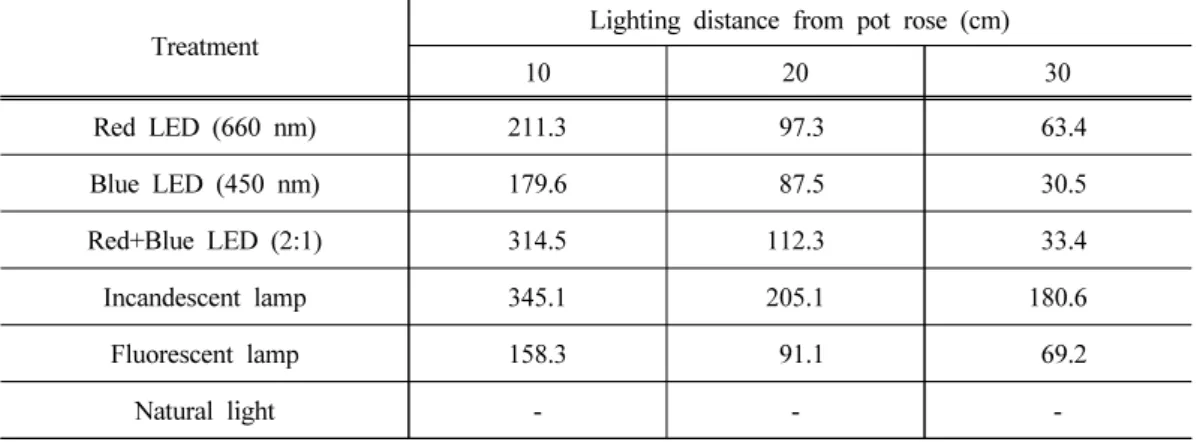
처리구 내부의 180개 화분 상단에 6개의 광원을 설치하여 조사하였고 각 처리구의 광도
는 Table 1에 제시하였다. 혼합광의 경우 적색과 청색광을 2 : 1(4개의 적색 LED : 2개의 청 색 LED)로 조합하여 처리하였다. 각각의 광원 사이에 부직포 막을 설치하여 광이 혼합되지 않도록 하였다.
온도관리는 온수 보일러를 사용하여 상온(20 ± 5℃)으로 유지하여 주었다.
2. 시험조사
각 광원의 광량은 휴대용 광도측정기(LI-250A, LI-COR Inc., Lincoln, USA)를 이용하여 조 사하였다(Table 1).
Table 1. Light quantity (µmol m-2 s-1) on eco light sources lighting at 10, 20, and 30 cm apart from ‘Viking’ pot rose
Treatment
Lighting distance from pot rose (cm)
10 20 30
Red LED (660 nm) 211.3 97.3 63.4
Blue LED (450 nm) 179.6 87.5 30.5
Red+Blue LED (2:1) 314.5 112.3 33.4
Incandescent lamp 345.1 205.1 180.6
Fluorescent lamp 158.3 91.1 69.2
Natural light - - -
시험조사는 광원조사 4 (4 WAT), 6 (6 WAT), 8주 후(8 WAT)에 비파괴로 식물의 초장과 경경 그리고 엽수 등의 영양생장을 조사하였고 꽃목의 길이, 화경 및 개화율을 동시에 측 정하였다. 개화율은 육안으로 꽃봉오리가 맺혔을 때 개화가 된 것으로 인정하였다. 8주차 에 발근(1cm 이상의 길이)수와 화색을 조사하였다. 화색도는 색차계(CR-200, Minolta Co., Tokyo, Japan)로 꽃잎의 L*, a*, b*의 hue값을 관찰하였는데, 값이 높으면 각각 명도, 적색, 그 리고 황색이 짙게 착색되었음을 의미하였다.
3. 통계분석
각각의 포트를 1반복으로 하여 처리 당 9반복의 요인실험법(factorial experiment)으로 배 치하였다. 실험결과의 통계분석을 위하여 SAS 프로그램(SAS version 8.2, Cary, USA)을 이 용하여 95% 수준에서 Duncan’s multiple range test로 수행하였다.
Ⅲ. 결과 및 고찰
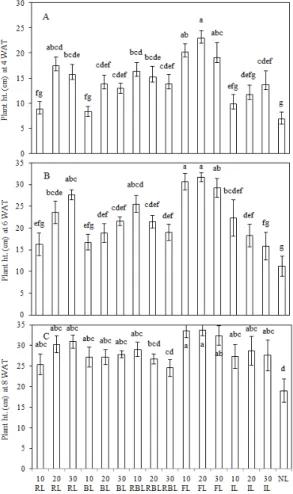
1. 분화장미의 생장 비교분화장미 ‘바이킹’의 초장은 4주와 6주차에서 20 FL (20 cm 거리에서 형광등 조사)처리 에서 가장 길게 신장되었고 8주차에서도 33.8 cm로 가장 길었다(Figs. 1A-C). 10 FL과 30 FL 처리에서도 초장이 모두 증가되는 경향이 나타났다. NL로 처리된 분화의 초장은 4주와 6주차에 가장 짧았고 8주차에도 19.0 cm로 다른 처리에 비해 뚜렷하게 짧았다.
Fig. 1. Plant height at 4 (A), 6 (B), and 8 WAT (C; weeks after treatment) as affected by eco light sources lighting at 10, 20, and 30 cm apart from ‘Viking’ pot rose.
Different lower-case letters on each datum point indicate significant differences as determined by Duncan’s multiple range test (P<0.05).
10-, 20-, and 30-RL (-BL, -RBL, -FL, and -IL), which referred to red-LED (blue-LED, red+blue- LED, fluorescent, and incandescent) lighting at 10 cm, 20 cm, 30 cm respectively. NL referred to natural light.
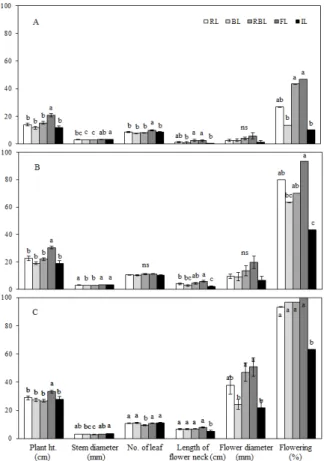
Fig. 2. Plant height, stem diameter, number of leaves, number of root, length of flower neck, flower diameter, and flowering at 4 (A), 6 (B), and 8 WAT (C; weeks after treatment) as affected by eco light sources lighting at 10, 20, and 30 cm apart from ‘Viking’ pot rose.
Different lower-case letters on each datum point indicate significant differences as determined by Duncan’s multiple range test (P<0.05). ns: not significantly different.
RL, BL, RBL, FL, IL referred to red-LED, blue-LED, red+blue-LED, fluorescent, and incandescent, respectively.
적색광 조사는 화훼류를 포함한 원예작물의 광합성 증가로 초장이 신장되는 것으로 알 려져 왔으나(Massa et al., 2008; Miyashita et al., 1995), 본 시험의 광원간 비교에서는 FL처 리를 제외하고 나머지 처리 간에 통계적으로 유의성 있는 차이가 관찰되지 않았다(P>0.05;
Figs. 2A-C). 이는 식물종에 따라 적색과 청색광을 받는 반응센터(receptor)와 피토크롬 단백 질 간의 상호 상승작용이 억제된 것에 기인한 것으로 추정되며(Kim et al., 2004), 프리지아 꽃에서도 본 시험과 비슷한 결과가 확인되었다(Lee and Hwang, 2014). 4주와 6주차에 측정 된 초장은 처리 간에 차이가 확연하였지만 8주차로 경과 시에 NL처리를 제외하고는 그러 한 차이가 경감된 것으로 나타났다.
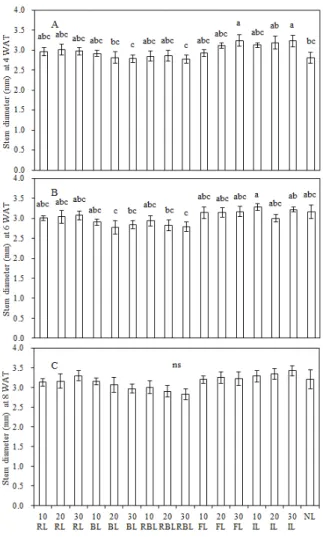
Fig. 3. Stem diameter at 4 (A), 6 (B), and 8 WAT (C; weeks after treatment) as affected by eco light sources lighting at 10, 20, and 30 cm apart from ‘Viking’ pot rose.
Different lower-case letters on each datum point indicate significant differences as determined by Duncan’s multiple range test (P <0.05). ns: not significantly different.
10-, 20-, and 30-RL (-BL, -RBL, -FL, and -IL), which referred to red-LED (blue-LED, red+blue-LED, fluorescent, and incandescent) lighting at 10 cm, 20 cm, 30 cm respectively. NL referred to natural light.
4주차에 경경은 30 FL과 30 IL에서 3.2 mm로 가장 두꺼웠고 30 BL과 30 RBL에서 2.8 mm로 가장 가는 수준을 보였다(Fig. 3A). 6주차에 경경은 10 IL과 30 IL처리에서 각각 3.3 mm와 3.2 mm로 가장 두꺼웠고 20 BL과 30 RBL에서 모두 2.8 mm로 가장 가늘었다(Fig.
3B). 8주차에는 처리 간에 통계적으로 유의성 있는 차이가 나타나지 않았다(Fig. 3C). 경경 은 초장이 짧았던 IL 처리구에서 두껍게 나타났다.
4주차의 엽수는 20 FL 처리에서 10.2장으로 가장 많았고 30 RL과 30 FL이 9.7장으로 다 음으로 많았다(Fig. 4A).
Fig. 4. Number of leaves at 4 (A), 6 (B), and 8 WAT (C; weeks after treatment) as affected by eco light sources lighting at 10, 20, and 30 cm apart from ‘Viking’ pot rose.
Different lower-case letters on each datum point indicate significant differences as determined by Duncan’s multiple range test (P <0.05). ns: not significantly different.
10-, 20-, and 30-RL (-BL, -RBL, -FL, and -IL), which referred to red-LED (blue-LED, red+blue-LED, fluorescent, and incandescent) lighting at 10 cm, 20 cm, 30 cm respectively. NL referred to natural light.
이와는 반대로 NL과 10 BL 처리가 각각 7.3장과 7.4장의 엽수로 적은 수준을 보였다. 6 주와 8주차에는 처리 간에 통계적으로 유의성 있는 차이가 관찰되지 않았다(Figs. 4B-C). 광 원처리 간 엽수 비교에서는 4주와 8주차에 FL 처리에서 많았으며 8주차에는 RBL 처리에 서 가장 적었다(Figs. 2A-C). RBL 처리는 적색과 청색 파장대의 조도(PPFD, photosynthetic photon flux density)를 최대로 받아서 식물의 생장과 발달을 향상시킨다고 알려져 왔으나 (Goins et al., 1997), 본 시험에서 RBL 처리는 초장과 경경 그리고 엽수가 조사시기에 상관
없이 비교적 낮은 수준을 보였다. 적색과 청색광의 혼합비율이 오이 잎의 광합성 수준에 유의성 있게 영향을 주었고(Hogewoning, 2010), 상추에서도 8(적색광) : 2(청색광)의 비율이 었을 때 건물중이 가장 증가되었다고 하였다(Choi et al., 2014). 따라서 혼합광의 비율에 따 른 분화장미 생장에 관한 보다 구체적인 연구가 필요할 것으로 판단된다.
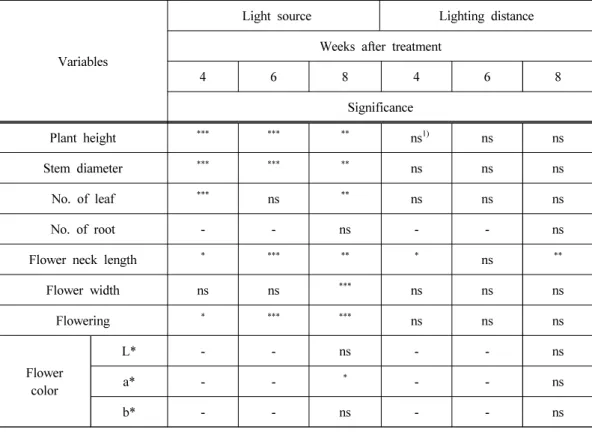
Variables
Light source Lighting distance Weeks after treatment
4 6 8 4 6 8
Significance
Plant height
*** *** **ns
1)ns ns
Stem diameter
*** *** **ns ns ns
No. of leaf
***ns
**ns ns ns
No. of root - - ns - - ns
Flower neck length
* *** ** *ns
**Flower width ns ns
***ns ns ns
Flowering
* *** ***ns ns ns
Flower color
L* - - ns - - ns
a* - -
*- - ns
b* - - ns - - ns
Table 2. Significance of variables of ‘Viking’ pot rose as affected by eco light sources and lighting distance
1)*, **, ***indicate significant differences as determined by Duncan’s multiple range test at P < 0.05, 0.01, or 0.001, respectively. ns, not significantly different. ns: not significantly different.
상추의 지상부 생장에는 적색광이 그리고 지하부 생장에는 청색광이 영향을 끼친다고 알려졌으나(Choi et al., 2014) 본 시험에서는 그러한 효과가 미미하였다(Table 2).
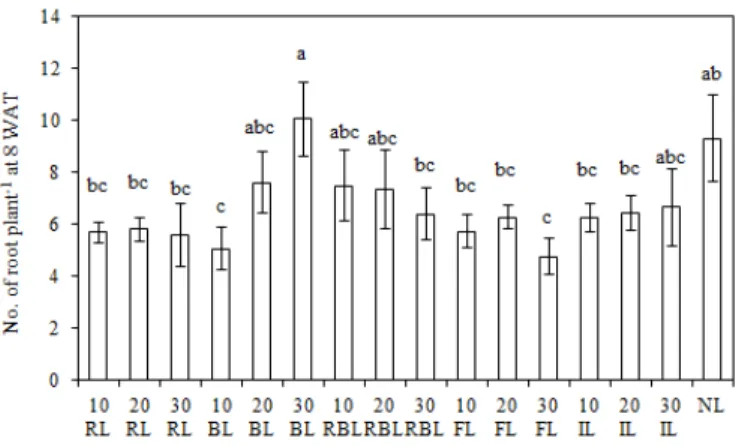
발근수는 30 BL 처리구에서 10.0개로 가장 많았고 NL이 9.3개로 다음으로 많았으며, 10 BL (5.1개)과 30 FL (4.7개)에서 가장 적었다(Fig. 5). 이는 지상부 생장이 비교적 저조하였 던 처리구에서 지하부 생장량이 상대적으로 증가되는데 일부 영향을 주었을 것으로 생각 된다.
Fig. 5. Number of roots at 8 weeks after treatment as affected by eco light sources light- ing at 10, 20, and 30 cm apart from ‘Viking’ pot rose.
Different lower-case letters on each datum point indicate significant differences as determined by Duncan’s multiple range test (P <0.05).
10-, 20-, and 30-RL (-BL, -RBL, -FL, and -IL), which referred to red-LED (blue-LED, red+blue-LED, fluorescent, and incandescent) lighting at 10 cm, 20 cm, 30 cm respectively. NL referred to natural light.
2. 분화장미의 개화품질 비교
꽃목의 길이는 영양생장과는 다르게 4주차에는 처리 간에 통계적으로 유의성 있는 차이 가 관찰되지 않았다(Fig. 6A). 6주차 이후에 반응이 높았는데 20 FL과 10 FL 처리에서 각각 6.5 cm와 6.8 cm로 가장 길었고 30 RL과 20 RL에서도 5 cm 이상의 꽃목길이의 증가가 나 타났다(Fig. 6B). 8주차의 꽃목길이는 20 FL (8.4 cm), 20 RL (8.2 cm), 30 FL (8.2 cm), 30 RL (7.7 cm) 처리에서 길게 나타났다(Fig. 6C). 적색 LED 처리가 국화의 ‘백마’와 ‘신마’ 꽃 목의 길이 감소에 효과적이었다고 하였는데(Choi et al., 2012; Kwon et al., 2013), 본 시험에 서는 프리지아꽃에서 관찰된 것(Lee and Hwang, 2014)처럼 그러한 경향이 확인되지 않았다 (Figs. 2A-C).
꽃의 크기를 나타내는 화경은 4주차에는 처리 간에 차이가 관찰되지 않았고(Fig. 7A), 6 주차에 10 FL 처리에서 31.5 mm로 가장 컸다(Fig. 7B). 8주차의 화경은 20 FL (58.3 cm) >
20 RL (52.9 cm), 10 RBL (51.1 cm), 20 RBL (49.3 cm), 30 RL (48.3 cm), 10 FL (47.7 cm), 30 FL (46.3 cm) 처리순으로 증가되었다(Fig. 7C). 광원처리 간 화경의 크기 비교에서는 8주 차에 처리 간에 차이가 나타났고 FL (50.7 mm), RBL (47.1 mm) > RL (37.6 mm) 순으로 높 았다(Figs. 2A-C). ‘백마’와 ‘신마’ 품종의 국화와 작약은 적색 LED처리로 꽃목길이와 화경 이 감소되었는데 이는 지상부의 생육증진 시기가 연장되어 개화기가 지연되었고 이에 개 화와 관련되는 생식생장이 감소되었다고 하였다(Bae et al., 2008; Lee and Hwang, 2014). 하 지만 본 시험의 광원처리 간에 초장, 경경, 그리고 엽수 비교에서는 일관성 있는 차이가 관
찰되지 않아서 영양생장과 생식생장 간의 상호작용의 관련성이 적었던 것으로 판단된다 (Figs. 2A-C).
Fig. 6. Length of flower neck (FN) at 4 (A), 6 (B), and 8 WAT (C; weeks after treatment) as affected by eco light sources lighting at 10, 20, and 30 cm apart from ‘Viking’ pot rose.
Different lower-case letters on each datum point indicate significant differences as deter- mined by Duncan’s multiple range test (P <
0.05). ns: not significantly different.
10-, 20-, and 30-RL (-BL, -RBL, -FL, and -IL), which referred to red-LED (blue-LED, red+blue-LED, fluorescent, and incandescent) lighting at 10 cm, 20 cm, 30 cm respectively.
NL referred to natural light.
Fig. 7. Flower diameter at 4 (A), 6 (B), and 8 WAT (C; weeks after treatment) as affected by eco light sources lighting at 10, 20, and 30 cm apart from ‘Viking’ pot rose.
Different lower-case letters on each datum point indicate significant differences as deter- mined by Duncan’s multiple range test (P <
0.05). ns: not significantly different.
10-, 20-, and 30-RL (-BL, -RBL, -FL, and -IL), which referred to red-LED (blue-LED, red+blue- LED, fluorescent, and incandescent) lighting at 10 cm, 20 cm, 30 cm respectively.
NL referred to natural light.
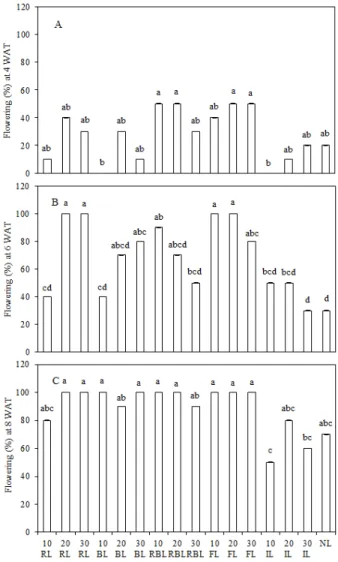
Fig. 8. Flowering at 4 (A), 6 (B), and 8 WAT (C; weeks after treatment) as affected by eco light sources lighting at 10, 20, and 30 cm apart from ‘Viking’ pot rose.
Different lower-case letters on each datum point indicate significant differences as determined by Duncan’s multiple range test (P <0.05).
10-, 20-, and 30-RL (-BL, -RBL, -FL, and -IL), which referred to red-LED (blue-LED, red+blue-LED, fluorescent, and incandescent) lighting at 10 cm, 20 cm, 30 cm respectively. NL referred to natural light.
‘바이킹’ 장미의 4주차의 개화율은 10 RBL, 20 RBL, 20 FL, 그리고 30 FL 처리에서 50%
수준으로 가장 높았고(Fig. 8A), 6주차에는 20 RL, 30 RL, 10 FL, 20 FL에서 100%의 개화율 을 보였다(Fig. 8B). 8주차에는 대부분의 처리구에서 80% 이상의 개화율을 보였고 10 IL, 30 IL, NL 처리구의 장미에서 60% 이하의 낮은 개화율을 보였다(Fig. 8C). 광원 간의 비교에서 도 4주차에는 FL이 가장 높았고 6주차에는 FL과 RL 처리구에서 80% 이상의 높은 개화율 을 보여 조기출하의 가능성을 보여주었다(Figs. 2A-B). 8주차에는 IL (63%)을 제외하고 모
든 처리구에서 90% 이상의 개화율이 관찰되었다(Fig. 2C).
화색의 밝기와 청색의 착색도를 나타내는 L*과 b*값은 처리 간에 통계적으로 유의성 있 는 차이가 관찰되지 않았다(Table 3). 적색을 나타내는 a*값은 NL 처리에서 크게 증가되었 고 20 RL에서 가장 낮았다(Table 3). 광원간 비교에서는 BL 처리구에서 가장 높은 a*값 (24.3)을 보였다(Table 2). 페튜니아는 청색과 가까운 파장대에 있는 자외선으로부터 보호하기 위하여 안토시아닌이나 클로로겐산과 같은 항산화물질을 증가시켰다고 하였고(Ryan et al., 2002), 청색 LED를 조사한 적상추와 메밀 등에서도 확인되었다(Choi et al., 2014; Ebisawa et al., 2008; Johkan et al., 2010; Kojima et al., 2010). 안토시아닌은 적색과 관련되는 색소체로
Treatment
Flower color (hue value)
L
*a
*b
*10 RL 86 24
ab1)30
20 RL 88 10
c27
30 RL 85 21
abc30
10 BL 85 28
ab29
20 BL 83 27
ab28
30 BL 88 18
abc26
10 RBL 87 16
bc27
20 RBL 87 16
bc27
30 RBL 86 17
abc28
10 FL 87 22
abc29
20 FL 87 21
abc28
30 FL 87 23
ab25
10 IL 86 25
ab30
20 IL 86 24
ab30
30 IL 86 20
abc30
NL 84 29
a26
Significance ns <0.05 ns
1)Numbers followed by the same letter within a column are not significantly different (Duncan’s multiple range test, P <0.05). ns: not significantly different.
10-, 20-, and 30-RL (-BL, -RBL, -FL, and -IL), which referred to red-LED (blue-LED, red+blue-LED, fluo- rescent, and incandescent) lighting at 10 cm, 20 cm, 30 cm respectively. NL referred to natural light.
Table 3. Flower color at 8 weeks after treatment as affected by eco light sources lighting at 10, 20, and 30 cm apart from ‘Viking’ pot rose
BL처리에 의해 화색이 적색으로 유도된 것으로 추정되지만 LED 광원에 따른 꽃의 폴리페 놀과 같은 항산화물질 함량분석이 필요할 것으로 판단된다.
본 시험에서는 기존 광원인 고압나트륨 램프나 형광등의 단점을 보완하는 LED 조명이 차세대 친환경 광원으로 식물의 성장에 필요한 빛의 파장이나 광량, 조명시간 등을 조정할 수 있는 것이 확인 되었다. 광원을 근거리(10 cm)로 조사하였을 때 PPFD가 증가하여 식물 체 생장에 영향을 주었을 것으로 예상되었지만 본 시험에서는 광원의 종류가 분화장미 ‘바 이킹’의 영양생장과 생식생장에 중요한 제한요인으로 관찰되었다(Table 2). 광원거리를 10 cm로 조사하였을 때에는 일부 개체에서 고온장해 현상이 나타났지만 통계적으로 유의성 있는 차이는 관찰되지 않았다(자료 미제시). 30 RL 처리는 6주차에 화아형성을 100% 유도 하여 조기수확과 에너지 절감 효과가 기대되어 친환경 산업을 이끌 수 있는 LED 조명으로 판단된다. 하지만 20 RL 처리는 꽃눈형성과 꽃의 크기 등을 향상시켰지만 화색의 선명도나 수명연장 효과에는 미미하였다.
Ⅳ. 적 요
본 시험은 농가현장에 적용될 수 있는 실용화 기술을 개발하기 위하여 친환경 LED 광원 과 광원거리가 ‘바이킹’분화장미의 생장과 개화품질에 어떠한 영향을 미치는 지를 구명하 자 수행되었다. 시험처리는 꽃으로부터 10 cm, 20 cm, 30 cm 거리에서 각 광원을 조사하였 고 각 처리구의 명칭은 다음과 같이 표기하였다. 10 cm (20 cm, 30 cm)거리에서 LED 적색, LED청색, LED 적색+청색, 형광등, 백열등 처리: 10 RL (20 RL, 30 RL), 10 BL (20 BL, 30 BL), 10 RBL (20 RBL, 30 RBL), 10 FL (20 FL, 30 FL), 10 IL (20 IL, 30 IL)로 하였다. 대조 구로 자연광을 처리하였고 NL로 표기하였다. 처리 4주, 6주, 8주 후에 장미의 생장과 개화 율을 비파괴적으로 조사하였다. 4, 6, 8주차에서 광원거리에 상관없이 FL 처리에서 초장이 가장 길었고 NL처리에서 가장 짧았다. 30 RL 처리에서 또한 6주와 8주차에 초장이 크게 신장되었다. 경경과 엽수는 8주차에는 처리구 간에 통계적으로 유의성 있는 차이가 나타나 지 않았고 광원간 비교에서는 RBL 처리에서 가장 낮은 수준이 관찰되었다. 발근수는 30 BL 처리구에서 10.0개로 가장 많았고 30 FL이 4.7개로 가장 적었다. 6주차에 꽃목길이는 10 FL과 20 FL 처리에서 가장 증가되었고(6~7 cm) 20 RL과 30 RL에서도 연장효과가 확인되 었으며(5~6 cm), 이러한 처리구들에서 100%의 개화율을 보였다. 화색의 a*값은 NL처리구에 서 가장 높았고(29) 20 RL에서 가장 낮았다(10). 이에 따라 ‘바이킹’장미의 크기와 개화품질 을 고려하면 30 RL 처리가 가장 효과적인 친환경 광조건이었던 것으로 판단된다.
[Submitted, December. 3, 2015 ; Revised, December. 17, 2015 ; Accepted, December. 28, 2015]
References
1. Bae, S. G., J. H. Kim, S. J. Park, and J. C. Kim. 2008. Influence of forcing cultivation time on cut flower, root quality, and yield in peony (Paeonia lactiflora Pall. cv. Taeback). J.
Medical Crop Sci. 16: 421-426.
2. Choi, S. Y., M. J. Kil, Y. S. Kwon, J. A. Jung, and S. K. Park. 2012. Effect of different light emitting diode (LED) on growth and flowering in chrysanthemum. Flower Res. J. 20:
128-133.
3. Choi, M. K., G. Y. Baek, S. J. Kwon, Y. C. Yoon, and H. T. Kim. 2014. Effect of LED light wavelength on lettuce growth, vitamin C and anthocyanin contents. Protected Hort.
Plant Fac. 23: 19-25.
4. Ebisawa, M., K. Shoji, M. Kato, K. Shimomura, F. Goto, and T. Yoshihara. 2008. Sup- plementary ultraviolet radiation B together with blue light at night increased quercetin content and flavonol synthase gene expression in leaf lettuce (Lactuca sativa L.). Environ.
Control Biol. 46: 1-11.
5. Goins, G. D., N. C. Yorio, M. M. Sanwo, and C. S. Brown. 1997. Photomorphogenesis, photosynthesis, and seed yield of wheat plants grown under red light-emitting diodes (LEDs) with and without supplemental blue lighting. J. Exp. Bot. 48: 1407-1413.
6. Hogewoning, S. W., G. Trouwborst, H. Maljaars, H. Poorter, W. van Ieperen, and J.
Harbinson. 2010. Blue light dose-responses of leaf photosynthesis, morphology, and chemi- cal composition of Cucumis sativus grown under different combinations of red and blue light. J. Exp. Bot. 61: 3107-3117.
7. Johkan, M., K. Shoji, F. Goto, S. N Hashida, and T. Yoshihara. 2010. Blue light-emitting diode light irradiation of seedlings improves seedling quality and growth after transplanting in red leaf lettuce. HortScience 45: 1809-1814.
8. Kim, S. J., E. J. Hahn, J. W. Heo, and K. Y. Paek. 2004. Effects of LEDs on net photo- synthetic rate, growth and leaf stomata of chrysanthemum plantlets in vitro. Sci. Hortic. 101:
143-151.
9. Kojima, M., Y. Nakano, and H. Fujii. 2010. Light stimulation triggered expression of genes coding for vacuolar proton-pump enzymes V-ATPase and V-PPase in buckwheat. Biosci.
Biotechnol. Biochem. 74: 1507-1511.
10. Kwon, Y. S., S. Y. Choi, M. J. Kil, B. S. You, J. A. Jung, and S. K. Park. 2013. Effect of night break treatment using red LED (660 nm) on flower bud initiation and growth characteristics of chrysanthemum cv. ‘Baekma’, and cv. ‘Jinba’. CNU J. Agric. Sci. 40: 297- 303.
11. Lee, J. J. and J. H. Hwang. 2014. Effect of day-length extension treatment using LED on growth and flowering of Freesia hybrid ‘Yvonne’. Kor. J. Hort. Sci. Technol. 32: 794-802 12. Massa, G. D., H. H. Kim, R. M. Wheeler, and C. A. Mitchell. 2008. Plant productivity in
response to LED lighting. HortScience 43: 1951-1956.
13. Miyashita, Y., Y. Kitaya, and T. Kozai. 1995. Effects of red and far-red light on the growth and morphology plantlets in vitro: using light emitting diode as a light source for micro- propagation. Acta Hort. 393: 189-194.
14. Okamoto, K., T. Yangi, S. Tanaka, T. Higuchi, Y. Ushida, and H. Watanabe. 1996. Devel- opment of plant growth apparatus using blue and red LED as artificial light source. Acta Hort. 440: 111-116.
15. Ryan, K. G., E. E. Swinny, K. R. Markham, and C. Winefield. 2002. Flavonoid gene ex- pression and UV photoprotection in transgenic and mutant Petunia leaves. Phytochemistry 59: 23-32.
16. Stuefer, J. F. and H. Huber. 1998. Differential effects of light quantity and spectral light quality on growth, morphology and development of two stoloniferous Potentilla species.
Oecologia 117: 1-8.
17. Terfa, M. T., K. A. Solhaug, H. R. Gislerød, J. E. Olsen, and S. Torre. 2013. A high pro- portion of blue light increases the photosynthesis capacity and leaf formation rate of Rosa × hybrida but does not affect time to flower opening. Physiol. Plant. 148: 146-159.