• 검색 결과가 없습니다.

Identification of Genes Involved in Liver Cancer Cell Growth Using an Antisense Library of Phage Genomic DNA

N/A
N/A
Protected

Academic year: 2021

Share "Identification of Genes Involved in Liver Cancer Cell Growth Using an Antisense Library of Phage Genomic DNA"

Copied!
9
0
0

로드 중.... (전체 텍스트 보기)

전체 글

(1)

246

Identification of Genes Involved in Liver Cancer Cell Grow th U sing an A ntisense Library of Phage Genomic DN A

Yun Han Lee, M.S.

1,3

, Young Ho Kim, Ph.D.

3

and Jong Gu Park, Ph.D.

1,2

1

WelGENE Inc., Daegu, Korea,

2

Department of Medical Genetic Engineering, Keimyung University School of Medicine, Dongsan Medical Center, Daegu, Korea,

3

Department of Microbiology, College of Natural Sciences, Kyungpook National University, Daegu, Korea

P urpose: G enes involved in liver cancer cell growth have been identified using an antisense library of large circular (LC -) genomic DN A of a recombinant M 13 phage.

M aterials and M ethods: A subtracted cD N A library was constructed by com bining procedures of suppression subtractive hybridization (S S H ) and unidirectional cloning of the subtracted cD N A into an M 13 phagemid vector.

U tilizing the life cycle of M 13 bacteriophages, LC -an- tisense molecules derived from 1,200 random cD N A clones selected by size were prepared from the culture supernatant of bacterial transformants. T he antisense molecules were arrayed for transfection on 96-well plates preseeded with H epG 2.

R esults: W hen exam ined for growth inhibition after antisense transfection, 153 out of 1,200 LC -antisense

m olecules showed varying degrees of growth inhibitory effect to H epG 2 cells. S equence com parison of the 153 clones identified 58 unique genes. The observations were further extended by other cell-based assays.

C onclusion: T hese results suggest that the LC -an- tisense library offers potential for unique high-throughput screening to find genes involved in a specific biological function, and may prove to be an effective target validation system for gene-based drug discovery. (C ancer R esearch and T reatm ent 2004;36:246-254)

󰠏󰠏󰠏󰠏󰠏󰠏󰠏󰠏󰠏󰠏󰠏󰠏󰠏󰠏󰠏󰠏󰠏󰠏󰠏󰠏󰠏󰠏󰠏󰠏󰠏󰠏󰠏󰠏󰠏󰠏󰠏󰠏󰠏󰠏󰠏󰠏󰠏󰠏󰠏󰠏󰠏󰠏󰠏󰠏󰠏󰠏󰠏󰠏󰠏󰠏󰠏󰠏󰠏󰠏󰠏

Key W ords: F unctional genom ics, R ecom binant M 13 phage, LC -antisense library, Liver cancer, T arget validation

Correspondence: Jong Gu Park, Department of Medical Genetic Engineering, Keimyung University School of Medicine, Dong- san Medical Center, 194 Dongsan-dong, Jung-gu, Daegu 700-712, Korea. (Tel/Fax) 82-53-250-7854, (E-mail) jonggu@

kmu.ac.kr

Received March 27, 2004, Accepted July 22, 2004

This study was supported by generous grants of the CDRC of Korean Science & Engineering Foundation (R13-2002-028-01004- 0), 2002 Technology Innovation & Development Funds from the Small & Medium Business Administration, Korea, and WelGene Inc., a biotechnology company founded by Dr. Jong-Gu Park.

INTRODUCTION

Rapid accumulation of genomic sequence information has necessitated the need to elucidate gene functions in a high throughput mode. Various methods, including DNA or protein chips, have been devised to study the expressions of a large number of genes, which has generated a vast amount of information (1~6). However, this information is limited in that it only provides differential expression profiles for genes in different tissues or cells.

Gene expression can be specifically reduced or ablated in cells following uptake of antisense molecules that are comple-

mentary to a specific mRNA sequence. Intense efforts have been made to develop antisense anticancer agents that eliminate aberrant expression of genes involved in tumor initiation and progression (7~9). The efficacy of antisense oligonucleotides (AS-oligos) has been validated in animal models as well as in several recent clinical studies (10~12). In addition, the anti- sense approach has been considered ideal for functional anal- ysis of genes and for further drug target discovery (13). AS- oligos libraries have been established and employed to obtain functional data of a large number of genes. However, cons- tructing such a library with conventional approaches can be costly and time consuming due to the exhaustive search for effective target sites (14~17). Thus, a novel approach to faci- litate easy construction of an antisense library would greatly increase the efficiency of gene functionalization and drug target discovery.

A series of distinct antisense molecules with enhanced stabi-

lity, having 1) a stem-loop structure (15), 2) the CMAS (Coval-

ently-Closed Multiple Antisense) structure (18) or 3) the RiAS

(Ribbon Antisense) structure (19), have previously been

described by us. Both CMAS- and RiAS-oligos, having their

action point to exonucleases eliminated, exhibited greatly

enhanced stability in biological fluids and were found to be

effective in the specific reduction of target mRNA. The results

obtained with those antisense molecules with a closed and

circular structure prompted us to study the utility of genomic

(2)

DNA of M13 bacteriophages as antisense molecules. The an- tisense sequence as a part of single-stranded large circular (LC) genomic DNA exhibited a specific antisense activity in redu- cing target gene expression (manuscript in preparation).

M13 bacteriophage vectors can be engineered to produce single-stranded circular genomic DNA containing an antisense sequence to a specific gene. These large circular antisense (LC- antisense) constructs may provide advantages, such as enhanced stability to exonucleases, high sequence fidelity, no target site search and easy construction of an antisense library. Thus, an antisense library encompassing a large panel of LC-antisense molecules can be readily generated and used as an effective ablator of gene expression in a high throughput mode.

Hepatoblastomas (HBs) are a subset of hepatocarcinomas and represent the most frequently occurring childhood malignant liver tumors (20). To better understand the molecular back- ground of the disease, it would be beneficial to find genes involved in growth of HBs. In the present study, a differential antisense library was constructed using subtracted cDNA pre- pared from hepatoblastoma tissue, which was used to screen genes involved in the growth of a hepatoblastoma (HepG2) cell line. To do this, a subtracted cDNA library was constructed by combining procedures of suppression subtractive hybridization (SSH) and unidirectional cloning of the subtracted cDNA frag- ments into an M13 phagemid vector. LC-antisense molecules of 1,200 member species, selected by size, were prepared on a large scale in 96-well plates. The LC-antisense library was complexed with a cationic liposome and transfected to HepG2 cells for the massive identification of genes involved in the growth of liver cancer cells. Antisense activities were reaf- firmed by other cell-based assays once the number of candidate genes had been narrowed to a manageable level.

MATERIALS AND METHODS

1) Preparation of a unidirectional subtracted liver cDNA library

To clone genes that are differentially expressed in hepato- blastomas, a cDNA library was constructed according to the manufacturer's recommendations. The SSH procedure (21) was performed with the PCR-Select cDNA Subtraction Kit (Clon- tech, Palo Alto, CA) using cancer and normal tissues as tester and driver, respectively. The tissue samples were washed with phosphate-buffered saline (PBS) and sliced into smaller pieces.

Total RNA was extracted with Tri reagent (MRC, Cincinnati, OH). Poly(A)

+

mRNA was isolated with the poly(A) Quick mRNA Isolation Kit (Stratagene, La Jolla, CA) and used as the template for cDNA synthesis. To clone the cDNA inserts unidirectionally, a cDNA synthesis primer with the HindIII recognition sequence, supplied in the kit, was replaced with a primer with a XhoI recognition sequence (5'-TTTTGTACCTC GAGTTTTTTTTTTTTTTTTTTTTTTTTTTTTTT-3').

First-strand cDNA was synthesized with the modified primer, followed by second-strand cDNA synthesis using T4 DNA polymerase. The tester and driver cDNAs, prepared according to the protocol, were digested with RsaI, a four-base cutting restriction enzyme that yields blunt ends. The tester cDNAs were then subdivided into two groups, and separately ligated to group-specific cDNA adaptors (Adaptor 1: 5'-ACCTGCCC

GG-3', complementary to a portion of 5'-CTAATACGACTCA CTATAGGGCTCGAGCGGCCGCCCGGGCAGGT-3';

Adaptor 2: 5'-ACCTCGGCCG-3', complementary to a portion of 5'-CTAATACGACTCACTATAGGGCAGC GTGGTCGCG GCCGAGGT-3'). Two hybridization reactions were performed, followed by suppression PCR to amplify the differentially expressed sequences using a pair of primers (forward 5'-TCGA GCGGCCGCCCGGGCAGGT-3' and reverse 5'-AGCGTGGT CGCGGCCG AGGT-3') and the Advantage cDNA polymerase mix (Clontech, Palo Alto, CA). The subtracted cDNA pool was cloned into the NotI and XhoI restriction sites of the multiple cloning site of the pBluescript (pBS) SK (-) vector (Stratagene, La Jolla, CA) in the same direction as the LacZ gene using the standard procedure (22). The cDNA plasmid library was transformed into Epicurian Coli XL-10 Gold Ultracompetent Cells (Stratagene, La Jolla, CA) by the calcium-chloride method (22).

To determine the total number of primary transformants, 1 or 10μl of 1 ml pilot transformation was plated onto LB ampicillin agar plates. After overnight incubation at 37

o

C, the number of ampicillin-resistant colonies was counted and multi- plied by a factor of 1000 or 100. To determine the percentage of vectors with inserts and the average insert size, recombinant plasmids of 40 randomly selected individual clones were purified by the alkaline lysis method (22) and digested by the same restriction enzymes used in cloning. Further, to determine if unidirectional cloning had been successfully, cDNA regions of purified plasmids derived from 100 randomly selected individual transformants were sequenced from the 5' end of the (+) strand by employing the T3 primer in an automated DNA sequencer.

2) Construction of a liver-specific random gene LC- antisense library

Bacterial competent cells containing recombinant pBS SK (-) phagemids were plated on LB agar plates containing 50μg/ml ampicillin and 50μg/ml tetracycline and incubated at 37

o

C for 16 h. Well-isolated colonies were seeded in a well of 96 deep-well plates containing 1.4 ml of 2× YT liquid media (tryptone 16 g, yeast extract 10 g and NaCl 10 g per 1000 ml)with and additional 50μg/ml ampicillin. Cells were cultured for 7 h at 37

o

C with vigorous shaking. To produce LC-antisense molecules from each phagemid, 20μl of the bacterial culture was transferred to each well that had been prefilled with 1.4 ml of fresh 2× YT liquid media containing 9μl of helper bacteriophages, M13K07 (New England Biolabs, Bevelry, MA).

After 1 h incubation, 4.2μl kanamycin (70μg/ml) was added

and cultured at 37

o

C for 12 h. The superinfection was carried

out in triplicate for each clone to maximize the yield of

antisense molecules in a single purification step. Single-stran-

ded LC-antisense molecules were purified from the culture

supernatant of bacterial competent cells using QIAprep 96 M13

Kits and QIAVAC vacuum manifolds (Qiagen, Hilden, Ger-

many) according to the manufacturer's instructions. To test both

the quantity and purity, the prepared LC-antisense molecules

were run on a 1% agarose gel along with control LC-molecules

derived from pBS SK (-) phagemid without a cDNA insert.

(3)

3) Transfection of the LC-antisense library into HepG2 cells

To identify genes involved in the growth of liver cancer cells, antisense molecules of the liver cancer specific LC- antisense library were mixed with a cationic liposome and transfected into the liver cancer cell line, HepG2. Briefly, the cells (7×10

3

), washed twice with Opti-MEM (Invitrogen, Carlsbad, CA), were seeded in each well of 96-well plates in 100μl of Opti-MEM supplemented with 10% FBS (JBI, Daegu, Korea). HepG2 cells were incubated for a further 12~18 h at 37

o

C in an incubator with 5% CO

2

. LC-antisense molecules (0.1μg) were complexed with Lipofectamine 2000 (Invitrogen, Carlsbad, CA) in a ratio of 1:3 (w/w), and the antisense molecule+liposome complexes were added to the cultured cells according to the manufacturer's instructions. The cultures were exchanged with fresh media 24 h after transfection and incubated for a further 4 days. To compare the effects of the LC-antisense molecules on cell proliferation, identical quantities of liposome alone and control DNA+liposome complexes were also added to the cells in a different 96-well plate and simul- taneously assayed. Control DNA was single-stranded phage genomic DNA derived from pBS SK (-) phagemid without a cDNA insert.

4) Cell proliferation assay

Light microscopic observation and an MTT reduction assay were performed to study the effect of antisense molecules on the proliferation of HepG2 cells. For an MTT reduction assay, cell culture media was replaced with 50μl fresh media and 25 μl 5 mg/ml MTT reagent (3-(4,5-dimethylthazol-2-yl)-2,5- di- phenyltetrazolium bromide, in PBS) (Sigma-Aldrich, St. Louis, MO). The MTT reaction was carried out in a 37

o

C incubator for 4 h followed by addition of 150μl isopropanol, containing 0.1 N HCl, and further incubation at room temperature for 1 h. The absorbance was measured at 570 nm with a SpectraMAX 190 (Molecular Devices, Sunnyvale, CA) to quantify the sur- viving cells. The percentage growth inhibition of the cells in each well treated with liposome alone, antisense+liposome complexes or control DNA+liposome complexes was calcul- ated by comparing the optical density to that of a sham treat- ment, using the following formula: 1-(absorbance of an experi- mental well/absorbance of a sham control well)×100.

5) Gene identification and sequence motif search To identify genes complementary to the LC-antisense mole- cules that inhibited the proliferation of liver cancer cells, recombinant phagemids obtained by alkaline lysis were seq- uenced from the 5' upstream of the (+) strand of cDNA inserts using the T3 primer. The revealed cDNA sequences were compared with those of the GenBank database (http://www. ncbi.

nlm.nih.gov/genebank). Polypeptides deduced from the cDNA sequences were then searched for amino acid motifs using the ProfileScan Server (http://hits.isb-sib.ch/cgi-bin/PFSCAN?).

6) Cell cycle analysis

HepG2 cells (5×10

4

) were seeded in each well of 24-well plates. Cells were trypsinized and suspended in 250μl PBS buffer in 48 h treatments of 0.8μg of selected LC-antisense

molecules combined with 2.4μg of Lipofectamine 2000. As controls, sham treated cells, with liposome alone or control DNA+liposome complexes, were also prepared. Cell suspen- sions were fixed with 750μl 95% ethanol by vortexing and incubating for at least 1 h on ice. Cells were centrifuged, washed twice with 1 ml PBS, and treated with 5μl RNaseA (1 mg/ml) at room temperature for 5 min. Cells were stained with propidium iodide (PI), at a final concentration of 10μg/

ml, followed by incubation at room temperature for 30 min.

The cell cycle patterns were analyzed on an equal number (10

4

) of cells by flow cytometry using a FACSCalibur System (Becton Dickinson, Franklin Lakes, NJ).

7) Apoptotic DNA fragmentation analysis

HepG2 cells (1×10

6

) were seeded in a 6 cm-dish one day prior to antisense transfection. Eightμg of each LC-antisense species was complexed with 24μg of Lipofectamine 2000 and added to the cells. To compare the effects of the LC-antisense molecules on apoptosis, equal amounts of the control DNA+liposome complexes were added to the cells for control analysis. In addition, cisplatin (Sigma-Aldrich, St. Louis, MO), an apoptosis-inducing positive-control drug, was also added, to a final concentration of 16μg/ml. Cells were lysed with a cell lysis buffer (1% NP-40, 25 mM EDTA and 50 mM Tris-HCl, pH 6.6) 48 h post-transfection. Cell lysates were treated with RNaseA (final conc. 20μg/ml) and incubated for 3 h at 58

o

C.

Proteinase K was then added to a final concentration of 20μg/

ml and incubated for 3 h at 37

o

C. The cell lysates were mixed with 2.5 vol. of ice-cold ethanol and 0.1 vol. of 3 M ammo- nium acetate and stored overnight at -20

o

C. Precipitated DNA was resuspended in 25μl TE buffer (pH 8.0) and run on a 1.6%

agarose gel.

RESULTS

1) Construction of an LC-antisense library

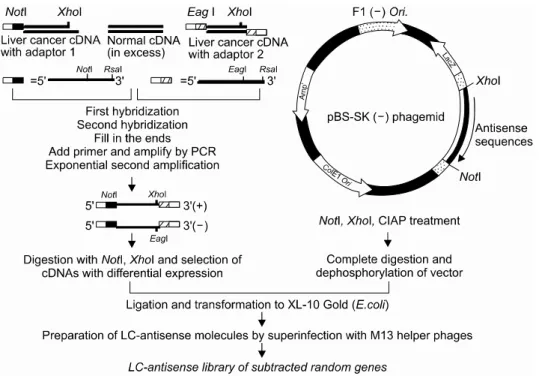
A library of LC-antisense molecules was constructed with an M13 phagemid vector, utilizing the salient feature of easy cDNA library construction (Fig. 1). Messenger RNA was pre- pared from normal liver and hepatoblastoma tissues, and dif- ferentially amplified for liver cancer specific mRNA by a sub- tractive hybridization method. Amplified cDNAs were unidirec- tionally cloned into the pBS SK (-) vector using the NotI and XhoI restriction sites, and the cDNA library was transformed into E. coli competent cells. The primary library size was deter- mined as 2×10

4

cfu/ml. By performing restriction analysis, it was determined that 97.5% of the tested transformants had cDNA inserts, and the average insert size was approximately 300 bp (data not shown). When sequenced for cloning integrity using 100 randomly selected clones, 96% of the recombinant phagemids had inserts in the intended orientation (data not shown). From the cDNA library of 9,600 transformants, 1,200 clones with cDNA inserts of more than 500 base pairs were selected with a simplified procedure for plasmid preparation (23).

LC-antisense molecules were purified from the culture

supernatant of bacterial competent cells superinfected with

helper bacteriophages. After confirming adequate purification of

(4)

Fig. 1. A schematic diagram for the construction of a random gene LC-antisense library. Total RNA was prepared from a pair of liver normal and cancer tissues, with both mRNA populations converted into cDNA. The tester cDNA (from cancer tissue) and driver cDNA (from normal tissue) were digested with RsaI to obtain shorter and blunt-ended fragments. Two hybridization reactions were performed, followed by suppression PCR to selectively amplify sequences overexpressed or expressed only in liver cancer cells, but not in normal liver cells. The subtracted cDNA pool was cloned into the multicloning site of the pBS SK (-) vector in the same direction as the LacZ gene. The cDNA plasmid library was transformed into E.coli competent cells. LC-antisense molecules were prepared on a large scale by superinfecting competent bacterial cells with a helper phage, and arrayed in 96-well plates.

the antisense molecules by gel electrophoresis, the random gene LC-antisense library of 1,200 member species specific for liver cancer was arrayed in thirteen 96-well plates for further use in functional analysis.

2) Identification of genes involved in liver cancer cell growth

LC-antisense molecules from the antisense library were transfected into HepG2 cells in order to screen genes affecting the growth of the liver cancer cell line. To examine the optimal transfection conditions in HepG2 cells, various cationic lipo- somes were complexed with recombinant plasmid, containing the GFP or luciferase gene in various ratios, and treated to the cells (data not shown). Based on these preliminary results, each LC-antisense molecule (0.1μg) was complexed with a cationic liposome at a ratio of 1:3 (w/w) and transfected into 7×10

3

HepG2 cells in each well of 96-well plates. Fresh media was added 24 h post-transfection, and the cells incubated for a further 4 days prior to the functional analysis. Cells were inspected for morphological changes under light microscopy (Fig.

2) and the growth inhibition measured quantitatively with MTT reduction assays. Of the 1,200 antisense species, 153 (~13%) were found to have varying inhibitory degrees on the growth of HepG2 cells. In contrast, cells treated with single-stranded control DNA (without antisense insert sequences) exhibited a mild level of growth inhibition, which could also be seen in cells treated with the double- stranded DNA-liposome complex.

To eliminate redundancy, cDNA clones reversely comple- mentary to the 153 growth- inhibiting LC-antisense molecules were sequenced and then searched for in the GenBank database.

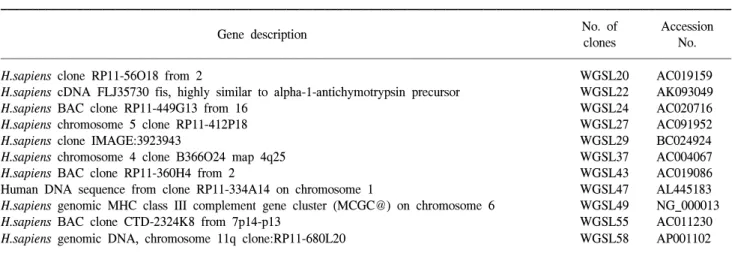
There were 58 unique sequences out of the 153 cDNAs, which were designated as clones WGSL 1 to 58 (Table 1).

From the cDNA sequence analysis, the antisense region of each clone was revealed. For instance, LCAS 3, 5, 8, 9, 10 and 23 contained the antisense sequences reversely complementary to the cDNA site 1367-1885 of WGSL 3, 21-489 of WGSL 5, 1448-2017 of WGSL 8, 421-863 of WGSL 9, 2119-2446 of WGSL 10 and 321-512 of WGSL 23, respectively. The LC- antisense molecules of the 58 clones were designated as LCAS 1 to 58. The growth inhibiting activities of the LC- antisense molecules were further confirmed by repetitive MTT assays (Fig. 3). As shown in Table 1, the GenBank annotation and motif-based searches suggested that 18 out of the 58 genes encode proteins of novel functions. The remaining 40 have an additional function to those previously characterized (e.g. pro- tein synthesis, translation factors, metabolism and so on). These 58 genes may have functions directly or indirectly related to liver cancer cell growth.

3) Effects of LC-antisense on cell cycle progression and apoptotic induction

The 58 LC-antisense species inhibitory to cell growth were

studied further to reconfirm their roles in cell growth inhibition

and to understand the underlying molecular mechanisms of

(5)

Fig. 3. Examination for growth inhibition by an MTT reduction assay. LC-antisense species of 58 genes were transfected into HepG2 cells. Sham treated cells with liposome alone or with control DNA+liposome complexes were simultaneously assayed.

Control treatments

Sham Liposome Control DNA+Li.

Treated with LC-antisense molecules

A B C

D E F

G H I

Control treatments

Sham Liposome Control DNA+Li.

Treated with LC-antisense molecules

A B C

D E F

G H I

Fig. 2. Microscopic observations after LC-antisense transfection to HepG2 cells. Growth Inhibitions of HepG2 cells were examined by

light microscopy 4 days post transfection of the LC-antisense library (×200). (A)-(C); control treatments as indicated, (D)-(I); HepG2

cells treated with six different LC-antisense molecules. In this figure, the data acquired from the treatments with 6 out of 1,200

LC-antisense types are representatively shown as an example. *Li., liposome

(6)

Table 1. List of genes involved in liver cancer cell growth

󰠚󰠚󰠚󰠚󰠚󰠚󰠚󰠚󰠚󰠚󰠚󰠚󰠚󰠚󰠚󰠚󰠚󰠚󰠚󰠚󰠚󰠚󰠚󰠚󰠚󰠚󰠚󰠚󰠚󰠚󰠚󰠚󰠚󰠚󰠚󰠚󰠚󰠚󰠚󰠚󰠚󰠚󰠚󰠚󰠚󰠚󰠚󰠚󰠚󰠚󰠚󰠚󰠚󰠚󰠚󰠚󰠚󰠚󰠚󰠚󰠚󰠚󰠚󰠚󰠚󰠚󰠚󰠚󰠚󰠚󰠚󰠚󰠚󰠚󰠚󰠚󰠚󰠚󰠚󰠚󰠚󰠚󰠚󰠚󰠚󰠚󰠚󰠚󰠚󰠚󰠚󰠚󰠚󰠚󰠚󰠚󰠚󰠚󰠚󰠚󰠚󰠚󰠚󰠚󰠚󰠚󰠚󰠚󰠚󰠚󰠚󰠚󰠚󰠚󰠚

No. of Accession Gene description

clones No.

󰠏󰠏󰠏󰠏󰠏󰠏󰠏󰠏󰠏󰠏󰠏󰠏󰠏󰠏󰠏󰠏󰠏󰠏󰠏󰠏󰠏󰠏󰠏󰠏󰠏󰠏󰠏󰠏󰠏󰠏󰠏󰠏󰠏󰠏󰠏󰠏󰠏󰠏󰠏󰠏󰠏󰠏󰠏󰠏󰠏󰠏󰠏󰠏󰠏󰠏󰠏󰠏󰠏󰠏󰠏󰠏󰠏󰠏󰠏󰠏󰠏󰠏󰠏󰠏󰠏󰠏󰠏󰠏󰠏󰠏󰠏󰠏󰠏󰠏󰠏󰠏󰠏󰠏󰠏󰠏󰠏󰠏󰠏󰠏󰠏󰠏󰠏󰠏󰠏󰠏󰠏󰠏󰠏󰠏󰠏󰠏󰠏󰠏󰠏󰠏󰠏󰠏󰠏󰠏󰠏󰠏󰠏󰠏󰠏󰠏󰠏󰠏󰠏󰠏󰠏

Protein synthesis

H.sapiens, ribosomal protein S25 (RPS25) WGSL5 BC004986

Siboglinum ekmani 18S ribosomal RNA, partial sequence WGSL16 AF315062

H.sapiens ribosomal protein S8 (RPS8) WGSL19 NM_001012

H.sapiens ribosomal protein, large P1 WGSL23 NM_001003

H.sapiens ribosomal protein S24 (RPS24) WGSL33 NM_033022

H.sapiens ribosomal protein S17 (RPS17) WGSL38 M13932

H.sapiens, clone IMAGE:3543815 WGSL39 BC020169

H.sapiens ribosomal protein L27 (RPL27) WGSL45 NM_000988

H.sapiens, ribosomal protein S5 (RPS5) WGSL46 BC018151

H.sapiens, ribosomal protein S17 (RPS17) WGSL48 BC022370

H.sapiens ribosomal protein L35 (RPL35) WGSL56 NM_007209

H.sapiens ribosomal protein S5 (RPS5) WGSL57 NM_001009

Translation factors

H.sapiens eukaryotic translation initiation factor 3, subunit 6 interacting protein (EIF3S6IP) WGSL3 NM_016091 H.sapiens eukaryotic translation initiation factor 4A, isoform 2 (EIF4A2) WGSL28 NM_001967

H.sapiens, eukaryotic translation elongation factor 1 gamma WGSL41 BC028179

Structural proteins and their regulators

H.sapiens tissue inhibitor of metalloproteinase 1 (TIMP1) WGSL6 XM_033878

Homo sapiens, clone MGC:5318 IMAGE:2900273 WGSL14 BC006781

H.sapiens beta-2-microglobulin (B2M) WGSL32 NM_004048

H.sapiens syntaxin 7 (STX7) WGSL54 XM_004526

Metabolism

H.sapiens glutamate dehydrogenase 1 (GLUD1) WGSL18 NM_005271

Human liver glutamate dehydrogenase WGSL25 J03248

H.sapiens, Similar to serine (or cysteine) proteinase inhibitor WGSL34 BC011991

Human mRNA for glutamate dehydrogenase (Glud-1) WGSL42 X07769

Other

H.sapiens, alpha-fetoprotein WGSL8 BC027881

H.sapiens ferritin, light polypeptide (FTL) WGSL9 NM_000146

H.sapiens cutaneous T-cell lymphoma-associated tumor antigen se20-4 (SE20-4) WGSL11 BC024270

H.sapiens, apolipoprotein A-II WGSL12 BC005282

H.sapiens heat shock 70kD protein 8 (HSPA8) WGSL13 NM_006597

H.sapiens haplotype M*2 mitochondrion WGSL21 AF382013

H.sapiens haptoglobin (HP) WGSL26 NM_005143

Human cytochrome P450IIE1 (ethanol-inducible) gene WGSL30 J02843

H.sapiens, cytochrome b5 outer mitochondrial membrane precursor WGSL31 BC014431

Human DNA sequence from clone RP4-792D7 on chromosome 1q42.2-43. Contains the 5' end of

WGSL35 AL136124

the TARBP1 gene for TAR (HIV) RNA-binding protein 1

H.sapiens interferon, gamma-inducible protein 30 (IFI30) WGSL36 XM_038146

H.sapiens fibrinogen, gamma polypeptide (FGG), transcript variant gamma-A WGSL40 NM_000509

H.sapiens hypothetical protein My014 (MY014) WGSL44 NM_030918

Human liver fatty acid binding protein (FABP) WGSL50 M10050

H.sapiens, clone MGC:12445 IMAGE:3935036 WGSL51 BC005348

Human gene for heterogeneous nuclear ribonucleoprotein (hnRNP) core protein A1 WGSL52 X12671

H.sapiens FK506 binding protein 3 (25kD) (FKBP3) WGSL53 NM_002013

Novel functions

Human chromosome 14 DNA sequence BAC R-123M6 of library RPCI-11 from chromosome 14 WGSL1 AL117190

Human DNA sequence from clone CTA-175E3 on chromosome 22q12.1 WGSL2 Z95113

Human DNA sequence from clone RP11-38P6 on chromosome 9 WGSL4 AL354874

H.sapiens BAC clone RP11-620E11 from 4 chromosome WGSL7 AC079926

H.sapiens hypothetical protein FLJ14075 (FLJ14075) WGSL10 NM_024894

H.sapiens PRO2675 mRNA WGSL15 AF119890

H.sapiens mRNA; cDNA DKFZp762B195 WGSL17 AL359585

󰠏󰠏󰠏󰠏󰠏󰠏󰠏󰠏󰠏󰠏󰠏󰠏󰠏󰠏󰠏󰠏󰠏󰠏󰠏󰠏󰠏󰠏󰠏󰠏󰠏󰠏󰠏󰠏󰠏󰠏󰠏󰠏󰠏󰠏󰠏󰠏󰠏󰠏󰠏󰠏󰠏󰠏󰠏󰠏󰠏󰠏󰠏󰠏󰠏󰠏󰠏󰠏󰠏󰠏󰠏󰠏󰠏󰠏󰠏󰠏󰠏󰠏󰠏󰠏󰠏󰠏󰠏󰠏󰠏󰠏󰠏󰠏󰠏󰠏󰠏󰠏󰠏󰠏󰠏󰠏󰠏󰠏󰠏󰠏󰠏󰠏󰠏󰠏󰠏󰠏󰠏󰠏󰠏󰠏󰠏󰠏󰠏󰠏󰠏󰠏󰠏󰠏󰠏󰠏󰠏󰠏󰠏󰠏󰠏󰠏󰠏󰠏󰠏󰠏󰠏

(7)

Fig. 4. Effects of LC-antisense molecules on the cell cycle progression. The LC-antisense molecules of 58 genes were transfected into HepG2 cells along with the controls. Cells were harvested 48 h post transfection. Functional analysis was performed on an equal number of cells (10

4

events) by flow cytometry after DNA staining with propidium iodide. In this figure, the data acquired from the treatments with 6 out of 58 LC-antisense types are representatively shown as an example. (A)-(C) control treatments as indicated;

(D) LCAS 11; (E) LCAS 14; (F) LCAS 15; (G) LCAS 16; (H) LCAS 29; (I) LCAS 31. *Li., liposome Table 1. Continued

󰠚󰠚󰠚󰠚󰠚󰠚󰠚󰠚󰠚󰠚󰠚󰠚󰠚󰠚󰠚󰠚󰠚󰠚󰠚󰠚󰠚󰠚󰠚󰠚󰠚󰠚󰠚󰠚󰠚󰠚󰠚󰠚󰠚󰠚󰠚󰠚󰠚󰠚󰠚󰠚󰠚󰠚󰠚󰠚󰠚󰠚󰠚󰠚󰠚󰠚󰠚󰠚󰠚󰠚󰠚󰠚󰠚󰠚󰠚󰠚󰠚󰠚󰠚󰠚󰠚󰠚󰠚󰠚󰠚󰠚󰠚󰠚󰠚󰠚󰠚󰠚󰠚󰠚󰠚󰠚󰠚󰠚󰠚󰠚󰠚󰠚󰠚󰠚󰠚󰠚󰠚󰠚󰠚󰠚󰠚󰠚󰠚󰠚󰠚󰠚󰠚󰠚󰠚󰠚󰠚󰠚󰠚󰠚󰠚󰠚󰠚󰠚󰠚󰠚󰠚

No. of Accession Gene description

clones No.

󰠏󰠏󰠏󰠏󰠏󰠏󰠏󰠏󰠏󰠏󰠏󰠏󰠏󰠏󰠏󰠏󰠏󰠏󰠏󰠏󰠏󰠏󰠏󰠏󰠏󰠏󰠏󰠏󰠏󰠏󰠏󰠏󰠏󰠏󰠏󰠏󰠏󰠏󰠏󰠏󰠏󰠏󰠏󰠏󰠏󰠏󰠏󰠏󰠏󰠏󰠏󰠏󰠏󰠏󰠏󰠏󰠏󰠏󰠏󰠏󰠏󰠏󰠏󰠏󰠏󰠏󰠏󰠏󰠏󰠏󰠏󰠏󰠏󰠏󰠏󰠏󰠏󰠏󰠏󰠏󰠏󰠏󰠏󰠏󰠏󰠏󰠏󰠏󰠏󰠏󰠏󰠏󰠏󰠏󰠏󰠏󰠏󰠏󰠏󰠏󰠏󰠏󰠏󰠏󰠏󰠏󰠏󰠏󰠏󰠏󰠏󰠏󰠏󰠏󰠏

H.sapiens clone RP11-56O18 from 2 WGSL20 AC019159

H.sapiens cDNA FLJ35730 fis, highly similar to alpha-1-antichymotrypsin precursor WGSL22 AK093049

H.sapiens BAC clone RP11-449G13 from 16 WGSL24 AC020716

H.sapiens chromosome 5 clone RP11-412P18 WGSL27 AC091952

H.sapiens clone IMAGE:3923943 WGSL29 BC024924

H.sapiens chromosome 4 clone B366O24 map 4q25 WGSL37 AC004067

H.sapiens BAC clone RP11-360H4 from 2 WGSL43 AC019086

Human DNA sequence from clone RP11-334A14 on chromosome 1 WGSL47 AL445183

H.sapiens genomic MHC class III complement gene cluster (MCGC@) on chromosome 6 WGSL49 NG_000013

H.sapiens BAC clone CTD-2324K8 from 7p14-p13 WGSL55 AC011230

H.sapiens genomic DNA, chromosome 11q clone:RP11-680L20 WGSL58 AP001102

󰠏󰠏󰠏󰠏󰠏󰠏󰠏󰠏󰠏󰠏󰠏󰠏󰠏󰠏󰠏󰠏󰠏󰠏󰠏󰠏󰠏󰠏󰠏󰠏󰠏󰠏󰠏󰠏󰠏󰠏󰠏󰠏󰠏󰠏󰠏󰠏󰠏󰠏󰠏󰠏󰠏󰠏󰠏󰠏󰠏󰠏󰠏󰠏󰠏󰠏󰠏󰠏󰠏󰠏󰠏󰠏󰠏󰠏󰠏󰠏󰠏󰠏󰠏󰠏󰠏󰠏󰠏󰠏󰠏󰠏󰠏󰠏󰠏󰠏󰠏󰠏󰠏󰠏󰠏󰠏󰠏󰠏󰠏󰠏󰠏󰠏󰠏󰠏󰠏󰠏󰠏󰠏󰠏󰠏󰠏󰠏󰠏󰠏󰠏󰠏󰠏󰠏󰠏󰠏󰠏󰠏󰠏󰠏󰠏󰠏󰠏󰠏󰠏󰠏󰠏

(8)

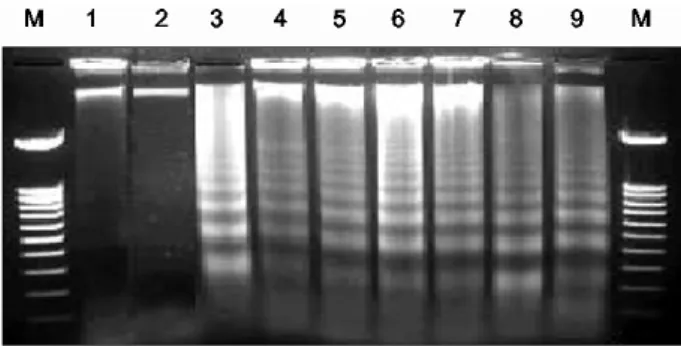
Fig. 5. Induction of apoptotic DNA ladder formation by LC-an- tisense molecules. The LC-antisense molecules of 58 genes were transfected into HepG2 cells along with the controls.

Genomic DNA was extracted 48 h post transfection and run on a 1.6% agarose gel. In this figure, the data acquired from treatments with 6 out of 58 LC-antisense types are representatively shown as an example. Lane M, 100 bp DNA ladder size marker; lane 1, sham treatment; lane 2, control DNA+liposome complexes; lane 3, LCAS 11; lane 4, LCAS 14; lane 5, LCAS 15; lane 6, LCAS 16; lane 7, LCAS 21; lane 8, LCAS 29; lane 9, cisplatin (positive control).

their inhibitory effects. To accomplish this, flow cytometric analysis was used to detect changes of the cell cycle patterns in HepG2 cells treated with the selected LC-antisense species for 48 h. When compared to the sham or control treatments employing liposome alone or single-stranded control DNA+liposome complexes, 53 (~91%) out of the 58 LC-antisense molecules exhibited varying degrees of an increasing percentage of cells with a sub-G0-G1 DNA content (Fig. 4).

Whether these cell deaths, caused by the antisense treat- ments, reflected the induction of apoptosis were then analyzed.

To do this, HepG2 cells treated with LC-antisense molecules were subjected to a DNA fragmentation assay. Twenty seven (LCAS 1, 3, 5, 8, 11, 12, 14, 15, 16, 20, 21, 22, 24, 29, 31, 33, 34, 35, 40, 41, 42, 43, 47, 49, 50, 52 and 54) out of the 58 LC-antisense species were found to cause characteristic DNA ladder formation 48 h after the transfection, indicating apoptotic progression due to the antisense treatment (Fig. 5).

These results suggest that the LC-antisense library system is an effective means for en mass identification and validation of genes involved in cancer cell growth.

DISCUSSION

In the present study, a high throughput functional assay was developed by employing a novel large circular (LC)-antisense library. The utility of the functional genomics system was shown for en masse identification of genes involved in the growth of HepG2 liver cancer cells. Among the methods cur- rently utilized for gene functional analysis, antisense and its related technologies are believed to be the most straightforward and efficient. To take advantage of antisense technologies, anti- sense libraries have been constructed using conventional AS-

oligos (24). However, selection of an effective target site for each gene is time-consuming and often inconclusive (16,17). It is generally accepted that construction of an extensive AS-oligo library able to target most human genes would take years to finish, necessitating a way to overcome these problems.

It has previously been reported that ribbon antisense with a covalently closed structure is exceedingly stable and effective in eliminating target mRNA (19). Encouraged by the results obtained with the ribbon type antisense, the utility of the circular single-stranded genomic DNA of M13 bacteriophages was tested as an antisense material. It was demonstrated that large circular (LC) antisense molecules are effective in se- quence-specific elimination of target mRNA (manuscript in preparation). Salient advantages of LC-antisense are the easy construction of an antisense library, the lack of need for a target site search and better antisense activity. LC-antisense is derived from cloned cDNA in a phagemid vector; therefore, a target- specific antisense region is generated as part of the single- stranded genomic DNA. This eliminates the process of the target site search that is usually required to find an effective antisense molecules. LC-antisense molecules are relatively sta- ble to exonucleases because they have a covalently closed structure. In addition, an antisense library can be easily cons- tructed by the introduction of a large number of cDNA frag- ments into a selected phagemid vector.

An antisense library has been established using 1,200 cDNA size selected clones from a subtracted cDNA library of liver cancer tissue. Cancer tissue-specific mRNA was enriched by PCR amplified subtraction, where mRNA overexpressed or expressed only in the cancer tissue was selectively amplified.

Amplified cDNA inserts were unidirectionally cloned into a phagemid vector such that single-stranded circular DNA could be rescued as genomic DNA containing an antisense sequence as part of the recombinant phage genome. A large number of LC-antisense molecules were produced from the culture super- natant of bacterial cells containing recombinant M13 bacterio- phages in a parallel mode. LC-antisense molecules were com- plexed with cationic liposomes, and then applied to target can- cer cells. When using a random gene antisense library, func- tional assays with the antisense library can be performed without knowing the sequence of each library member. Nucleo- tide sequences of the antisense molecules can be analyzed after detecting the antisense activity. In conventional functional genomics, the identities of cDNA clones must be known before performing a functional assay because it is unrealistic to func- tionalize a large number of genes without knowing their iden- tities and anticipated functions.

In the present study, HepG2 antisense transfectants were examined for growth inhibition, which can be studied easily with various methods, such as light microscopy, MTT reduction assay, flow cytometry and apoptotic DNA fragmentation assay.

The functional analyses of genes can measure various pheno- typic changes, such as cell morphology, proliferation, apoptosis, secretion and cell surface expression of polypeptides and res- ponses to extracellular stimuli. Cell-based assays after antisense treatment may be carried out in a high throughput mode with various molecular biological, biochemical, immunological and cell biological techniques.

By employing the random gene LC-antisense library, genes

(9)

involved in the growth of liver cancer cells were identified.

These genes include those with an additional function to previously known ones and also those with novel functions.

Further studies are clearly warranted to investigate the bioche- mical processes of the protein products of these genes. DNA and protein chip, or other technologies for functional genomics, can also be combined with the LC-antisense system for target validation of genes for eventual drug development. It should also be noted that the results obtained using an antisense library could be directly applied to the developments of therapeutic agents against the disease of concern. Therefore, the LC-anti- sense library system may provide unparalleled speed, cost effectiveness and analytical accuracy for the study of functional genomics and target validation.

CONCLUSIONS

An LC-antisense library was constructed and used to identify genes involved in liver cancer cell growth. When examined for growth inhibition with cell-based assays, 153 out of 1,200 LC-antisense molecules showed a growth inhibitory effect to HepG2 cells. Subsequent sequence comparison of the 153 clones identified 58 unique genes. The genes proved here could be promising candidates for therapeutic targets in the treatment of liver cancer. The LC-antisense library would provide poten- tial for unique high-throughput screening to find genes involved in specific biological functions, and may prove to be an effective target validation system for gene-based drug disco- very.

REFERENCES

1. Hieter P, Boguski M. Functional Genomics: It's all how you read it. Science 1997;278:601-602.

2. Lander ES. Array of hope. Nat Genet 1999;21:3-4.

3. Pandey A, Mann M. Proteomics to study genes and genomes.

Nature 2000;405:837-846.

4. Quackenbush J, Cho J, Lee D, Liang F, Holt I, Karamycheva S, Parvizi B, Pertea G, Sultana R, White J. The TIGR Gene Indices: analysis of gene transcript sequences in highly sam- pled eukaryotic species. Nucleic Acids Res 2001;29:159-164.

5. Velculescu VE, Zhang L, Vogelstein B, Kinzler KW. Serial analysis of gene expression. Science 1995;270:484-487.

6. Prashar Y, Weissman SM. READS: a method for display of 3'-end fragments of restriction enzyme-digested cDNAs for analysis of differential gene expression. Methods Enzymol 1999;303:258-272.

7. Thompson CB, Challoner PB, Neiman PE, Groudine M. Levels of c-myc oncogene mRNA are invariant throughout the cell cycle. Nature 1985;314:363-366.

8. Melani C, Rivoltini L, Parmiani G, Calabretta B, Colombo MP.

Inhibition of proliferation by c-myb antisense oligodeoxynu- cleotides in colon adenocarcinoma cell lines that express c- myb. Cancer Res 1991;51:2897-2901.

9. Anfossi G, Gewirtz AM, Calabretta B. An oligomer com-

plementary to c-myb-encoded mRNA inhibits proliferation of human myeloid leukemia cell lines. Proc Natl Acad Sci USA 1989;86:3379-3383.

10. Graham MJ, Crooke ST, Monteith DK, Cooper SR, Lemonidis KM, Stecker KK, Martin MJ, Crooke RM. In vivo distribution and metabolism of a phosphorothioate oligonucleotide within rat liver after intravenous administration. J Pharmacol Exp Ther 1998;286:447-458.

11. Zhang H, Cook J, Nickel J, Yu R, Stecker K, Myers K, Dean NM. Reduction of liver Fas expression by an antisense oligonucleotide protects mice from fulminant hepatitis. Nature Biotechnol 2000;18:862-867.

12. Tomita N, Morishita R, Higaki J, Aoki M, Nakamura Y, Mika- mi H, Fukamizu A, Murakami K, Kaneda Y, Ogihara T. Tran- sient decrease in high blood pressure by in vivo transfer of antisense oligodeoxynucleotides against rat angiotensinogen.

Hypertension 1995;26:131-136.

13. Bennett CF, Cowsert LM. Antisense oligonucleotides as a tool for gene functionalization and target validation. Biochim Bio- phys Acta 1999;1489:19-30.

14. Flanagan WM, Wagner RW. Potent and selective gene inhibi- tion using antisense oligodeoxynucleotides. Mol Cell Biochem 1997;172:213-225.

15. Matsuda M, Park JG, Wang DC, Hunter S, Chien P, Schreiber AD. Abrogation of the Fc gamma receptor IIA-mediated phagocytic signal by stem-loop Syk antisense oligonucleotides.

Mol Biol Cell 1996;7:1095-1106.

16. Vickers TA, Wyatt JR, Freier SM. Effects of RNA secondary structure on cellular antisense activity. Nucl Acids Res 2000;

28:1340-1347.

17. Smith LK, Andersen B, Hovgaard L, Jaroszewski JW. Rational selection of antisense oligonucleotide sequences. Eur J Pharm Sci 2000;11:191-198.

18. Moon IJ, Lee Y, Kwak CS, Lee JH, Choi K, Schreiber AD, Park JG. Target site search and effective inhibition of leuk- aemic cell growth by a covalently multiple antisense oligo- nucleotide to c-myb. Biochem J 2000;346:295-303.

19. Moon IJ, Choi K, Choi YK, Kim JE, Lee Y, Schreiber AD, Park JG. Potent growth inhibition of leukemic cells by novel ribbon-type antisense oligonucleotides to c-myb. J Biol Chem 2000;275:4647-4653.

20. Mann JR, Kasthuri N, Raafat F, Pincott JR, Parkes SE, Muir KR, Ingram LC, Cameron AH. Malignant hepatic tumours in children: Incidence, clinical features and aetiology. Paediatr Perinat Epidemiol 1990;4:276-289.

21. Diatchenko L, Lau YF, Campbell AP, Chenchik A, Moqadam F, Huang B, Lukyanov S, Lukyanov K, Gurskaya N, Sverdlov ED, Siebert PD. Suppression subtractive hybridization: a method for generating differentially regulated or tissue-specific cDNA probes and libraries. Proc Natl Acad Sci 1996;93:6025- 6030.

22. Sambrook J, Fritsch EF, Maniatis T, eds. Molecular cloning.

1989.

23. Beuken E, Vink C, Bruggeman CA. One-step procedure for screening recombinant plasmids by size. Biotechniques 1998;

24:748-750.

24. Yonekura H, Migita H, Sakurai S, Wang H, Harada S, Abedin

MJ, Yamagishi S, Yamamoto H. Antisense display, a method

for functional gene screening: evaluation in a cell-free system

and isolation of angiogenesis-related genes. Nucleic Acids Res

1999;27:2591-2600.

수치

Fig.  1.  A  schematic  diagram  for  the  construction  of  a  random  gene  LC-antisense  library
Fig.  3.  Examination  for  growth  inhibition  by  an  MTT  reduction  assay.  LC-antisense  species  of  58  genes  were  transfected  into  HepG2  cells
Table  1.  List  of  genes  involved  in  liver  cancer  cell  growth
Fig.  4.  Effects  of  LC-antisense  molecules  on  the  cell  cycle  progression.  The  LC-antisense  molecules  of  58  genes  were  transfected  into  HepG2  cells  along  with  the  controls
+2

참조

관련 문서

Arabic Scripted Language Identification System in order to identify the language of the Arabic script by using PCA and KNN, here, the number of PCA features were optimized

In this study, the expression profiles of miRNAs were compared and analyzed for establishment of miRNAs related cancer cell growth inhibition in normal human oral

The expression of reporter genes driven by the ZAT1 promoter was observed in the tissues undergoing maturation such as border cell of root cap, endodermis,

We determined the nucleotide sequences of the mitochondrial DNA (mtDNA) control region using cloning and sequencing, and obtained the complete sequence from the cattle bones

Objective: The purpose of this study was to analyze recent trend in incidence of basal cell carcinoma and squamous cell carcinoma in patients from the Gwangju City

™ Embedded commands: database commands are embedded in a general-purpose programming language.. ™ Library of database functions: available to the host language for

The 5-day-old seedlings overexpressing the AtTX12 -like genes originated from crops of Brassicaceae were used for the extraction of the total RNA from which cDNA was

In the present study, consistent to that report, up-regulation of VEGF mRNA was observed in the colon cancer cell with the acquired resistance to 5-FU and this