Original Article
Self-reported Snoring and Carotid Atherosclerosis in Middle-aged and Older Adults: The Korean
Multi-Rural Communities Cohort Study
Young-Hoon Lee 1,2 , Sun-Seog Kweon 3,4 , Bo Youl Choi 5 , Mi Kyung Kim 5 , Byung-Yeol Chun 6 , Dong Hoon Shin 7 , and Min-Ho Shin 3
1
Department of Preventive Medicine & Institute of Wonkwang Medical Science, Wonkwang University School of Medicine, Iksan, Jeonbuk, South Korea
2
Regional Cardiocerebrovascular Center, Wonkwang University Hospital, Iksan, Jeonbuk, South Korea
3
Department of Preventive Medicine, Chonnam National University Medical School, Gwangju, South Korea
4
Jeonnam Regional Cancer Center, Chonnam National University Hwasun Hospital, Hwasun, South Korea
5
Department of Preventive Medicine, College of Medicine, Hanyang University, Seoul, South Korea
6
Department of Preventive Medicine, School of Medicine, and Health Promotion Research Center, Kyungpook National University, Daegu, South Korea
7
Department of Preventive Medicine, Keimyung University School of Medicine, Daegu, South Korea
Received August 19, 2013; accepted February 17, 2014; released online April 12, 2014
Copyright © 2014 Young-Hoon Lee et al. This is an open access article distributed under the terms of Creative Commons Attribution License, which permits unrestricted use, distribution, and reproduction in any medium, provided the original author and source are credited.
ABSTRACT
Background: We investigated the relation of self-reported snoring with carotid intima-media thickness (IMT) and plaque in community-dwelling middle-aged and older adults.
Methods: In total, 7330 community-dwelling subjects in the Korean Multi-Rural Communities Cohort Study were included in the analysis. Common carotid artery IMT (CCA-IMT) and plaque were evaluated by high-resolution B-mode ultrasonography. Snoring status was evaluated using a structured interview.
Results: Snorers had a signi ficantly greater average CCA-IMT than non-snorers (0.726 vs 0.713 mm; P < 0.001), after adjusting for age and gender. The odds ratios (OR) for high CCA-IMT (fifth quintile) were significantly higher for snorers than for non-snorers in multivariate-adjusted analysis (OR 1.25, 95% con fidence interval [CI] 1.10–1.42).
However, there was no significant relationship between snoring and carotid plaques.
Conclusions: Our data suggest that self-reported snoring is significantly associated with increased IMT, but not with the presence of plaques. These findings suggest that early screening and intervention for snoring in the general population are needed to prevent adverse cardiovascular events.
Key words: snoring; atherosclerosis; carotid intima-media thickness; carotid artery plaque
INTRODUCTION
Snoring is a sound emitted from the upper airway of the throat during sleep and is an indicator of increased resistance through the airway. 1 Previous studies have reported that male gender, age, obesity, alcohol consumption, cigarette smoking, menopause, physical inactivity, and family history were risk factors for snoring. 2 –9 Epidemiologic evidence has also shown that self-reported snoring was associated with increased incidence of cardiovascular events. 10 –13
Since previous epidemiologic studies have suggested that snoring is significantly associated with metabolic syndrome, 14,15 metabolic components have been considered
as the link between snoring and cardiovascular disease (CVD). Alternatively, a non-metabolic pathway that mediates the relationship between snoring and CVD, such as carotid atherosclerosis, has been proposed. 16,17 Increased carotid intima-media thickness (IMT) and atherosclerotic plaques are surrogate markers of subclinical atherosclerosis and strong predictors of CVD, such as stroke and myocardial infarction. 18,19 Few epidemiologic studies have examined the association between snoring and carotid atherosclerosis;
however, those that did reported inconsistent associations. 20,21 To date, whether or not self-reported snoring is significantly associated with carotid atherosclerosis in the general population remains undetermined. The aim of this study was
Address for correspondence. Min-Ho Shin, MD, PhD, Department of Preventive Medicine, Chonnam National University Medical School, 5 hak-1-dong,
Dong-gu, 501-746 Gwangju City, South Korea (e-mail: [email protected]).
to investigate the association between self-reported snoring and carotid atherosclerosis in community-dwelling middle- aged and elderly Korean men and women.
METHODS
Study population
The Korean Multi-Rural Communities Cohort Study, which is part of the Korean Genome Epidemiology Study, was initiated in 2004 with the aim of constructing a genomic cohort and investigating the risk factors for CVD in rural communities.
As the baseline, 9696 subjects, aged ≥40 years, were recruited between January 2005 and February 2010 from three centers: Yangpyeong in Gyeonggi-do (n = 3183), Namwon in Jeollabuk-do (n = 3408), and Goryeong in Gyeongsangbuk- do (n = 3105). The majority of the subjects were farmers and housewives. We excluded subjects who had a previous history of coronary heart disease or cerebrovascular disease during the baseline survey, those who did not provide information on their snoring, and those who did not undergo carotid ultrasonography. In total, 7330 subjects (2901 men and 4429 women) aged 40–91 years were included in the final analysis.
This study was conducted in accordance with the Declaration of Helsinki guidelines, and all procedures involving human subjects were approved by the Institutional Review Boards of Hanyang University, Chonnam National University, and Keimyung University. All subjects were fully informed of the study content and gave written informed consent for the use of their data.
Interview and examination
We administered a questionnaire and an examination using a standardized protocol to overcome the limitations of multi- center studies. All interviewers and examiners were trained by the same personnel at the coordinating center. Information on demographics, smoking, alcohol intake, exercise, medical history, and medications was collected, using a questionnaire administered by well-trained interviewers. Height was measured to the nearest 0.1 cm using a standard height scale, and weight in light clothing without shoes was measured to the nearest 0.1 kg using a metric weight scale. Body mass index (BMI) was calculated as weight (kg) divided by height (m) squared. Waist circumference was measured to the nearest 0.1 cm at the midpoint between the lowest rib margin and the iliac crest during expiration.
Blood pressure was measured from the right upper arm, using a standard mercury sphygmomanometer (Baumanometer; WA Baum Co., Inc., Copiague, NY, USA) and a standard cuff. Two consecutive blood-pressure measurements were performed after each subject had been sitting for at least 5 min. The subjects were instructed to relax as much as possible, and not to talk during the measurement procedure. The first appearance (phase I) and disappearance (phase V) of Korotkoff sounds were used to define systolic
blood pressure and diastolic blood pressure, respectively.
Systolic and diastolic blood pressures were recorded to the nearest 2 mm Hg. If two systolic or diastolic blood pressures were more than 5 mm Hg apart, an additional measurement was performed, and the mean value of the closest two measurements was used for the subsequent analyses.
Blood samples taken from the antecubital vein were collected from each subject during the morning after an 8-h overnight fast, and all biochemical markers were evaluated on the same day. Total serum cholesterol, high-density lipoprotein (HDL) cholesterol, triglyceride, and fasting blood glucose levels were analyzed using an ADVIA1650 Automatic Analyzer (Siemens, New York, NY, USA).
Information on snoring
Snoring status was evaluated using a structured interview, including two questions: (1) do you know, or have you ever heard that you snore? (yes or no); and (2) how often do you snore? (<1 day per month, 1–3 days per month, 1–3 days per week, 4–5 days per week, ≥6 days per week). Snoring frequency was reclassified into <1 day/week, 1–3 days/week, and ≥4 days/week.
Carotid ultrasound measurements
The carotid artery was evaluated by using high-resolution B-mode ultrasound equipment (SonoAce-9900; Medison, Seoul, South Korea), equipped with a 7.5-MHz linear array transducer. IMT was determined as the distance from the media-adventitia interface to the intima-lumen interface on the far wall in the longitudinal view. Ultrasonographic images were captured and analyzed by five sonographers at the three centers. A single trained reader at the reading center in the Department of Preventive Medicine at Chonnam National University analyzed the images using Sigma Scan Pro 5.0 (SPSS Inc., Chicago, IL, USA). Between the carotid bulb origin and a point 10 mm proximal to the common carotid artery (CCA), the maximal IMT value in a region free of plaque was determined as the maximal IMT of the left/right CCA. The CCA-IMT, de fined as the average of the maximal IMT values of both CCA was used for analysis; ‘high CCA-IMT’ was defined as the fifth quintile of CCA-IMT (≥0.823 mm). The reader also assessed the presence of carotid plaques, which were defined as focal lesions that encroached into the lumen by at least 100% of the surrounding IMT value.
The presence of carotid plaques was determined from scans of the CCA and bulb segments. The presence of carotid plaques was recorded if at least one lesion was detected in any segment.
Statistical analysis
Differences between snorers and non-snorers in subject
characteristics were compared using Student’s t-test for
continuous variables and a chi-square test for categorical
variables. Analysis of covariance was used to evaluate IMT
differences according to snoring and its frequency after controlling for age and gender. Independent associations of snoring and its frequency with increased IMT and the presence of plaques were analyzed, using multiple logistic regression after adjusting for conventional risk factors. The odds ratios (ORs) are presented with 95% confidence intervals (CIs). A P-value of 0.05 was considered to indicate statistical significance. All statistical analyses were performed using the SPSS 15.0 software package (SPSS Inc., Chicago, IL, USA).
RESULTS
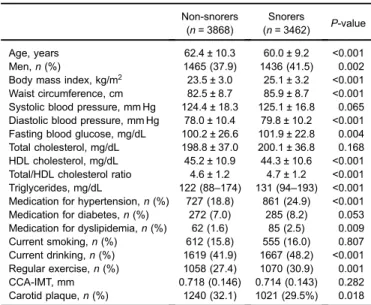
Baseline characteristics of the study population The baseline characteristics of the study population according to self-reported snoring status are shown in Table 1. Of the 7330 subjects analyzed, 3462 (47.2%) were snorers and 3868 (52.8%) were non-snorers. The mean age of snorers and non- snorers was 60.0 ± 9.2 and 62.4 ± 10.3 years (P < 0.001), respectively. Compared to the non-snorers, snorers had significantly higher BMI, waist circumference, diastolic blood pressure, fasting blood glucose, and triglycerides, as well as lower HDL cholesterol. The prevalences of being male, medication for hypertension and dyslipidemia, current drinking, and regular exercise were signi ficantly higher in snorers than in non-snorers (Table 1). Distributions of self- reported snoring frequency were as follows: 17.4% (19.3% in men, 16.2% in women) reported snoring ≥4 days per week, 14.9% (16.6% in men, 13.8% in women) reported snoring 1–3 days per week, 14.9% (13.5% in men, 15.8% in women) reported snoring <1 day per week, and 52.8% (50.5% in men, 54.3% in women) reported no snoring (data not shown).
No significant differences in CCA-IMT between snorers and non-snorers (0.714 vs 0.718 mm; P = 0.282) were identified. However, after adjusting for age and gender, snorers had significantly greater CCA-IMT values than non- snorers (0.726 vs 0.713 mm; P < 0.001; data not shown).
Snorers had a lower prevalence of carotid plaque than non- snorers in unadjusted analysis (29.5% vs 32.1%; P = 0.018) (Table 1).
Association between snoring and carotid IMT The relationship between snoring and an increased IMT is shown in Table 2. The ORs for high CCA-IMT (fifth quintile,
≥0.823 mm) among snorers were significantly higher than those among non-snorers in age- and gender-adjusted analysis (OR 1.31, 95% CI 1.16–1.49) and multivariate-adjusted analysis (OR 1.25, 95% CI 1.10–1.42). Compared to non- snorers, the ORs for high CCA-IMT among snorers were significantly higher in subjects who snored 1–3 days/week (age- and gender-adjusted OR 1.40, 95% CI 1.17 –1.68;
multivariate-adjusted OR 1.36, 95% CI 1.13–1.63) and ≥4 days/week (age- and gender-adjusted OR 1.36, 95% CI 1.16–1.61; multivariate-adjusted OR 1.28, 95% CI 1.08–1.53).
Association between snoring and carotid plaques No significant relationship between snoring and carotid plaques was identi fied in age- and gender-adjusted and multivariate-adjusted analyses. In addition, compared with non-snorers, no signi ficantly higher or lower ORs were identified in subjects who snored <1 day/week, 1–3 days/
week, or ≥4 days/week (Table 3).
DISCUSSION
We evaluated the relationship between self-reported snoring and subclinical carotid atherosclerosis in community-dwelling middle-aged and older adults. Our data suggest that, after Table 1. Characteristics of the study population according to
self-reported snoring status Non-snorers
(n = 3868)
Snorers
(n = 3462) P-value
Age, years 62.4 ± 10.3 60.0 ± 9.2 <0.001
Men, n (%) 1465 (37.9) 1436 (41.5) 0.002
Body mass index, kg/m
223.5 ± 3.0 25.1 ± 3.2 <0.001 Waist circumference, cm 82.5 ± 8.7 85.9 ± 8.7 <0.001 Systolic blood pressure, mm Hg 124.4 ± 18.3 125.1 ± 16.8 0.065 Diastolic blood pressure, mm Hg 78.0 ± 10.4 79.8 ± 10.2 <0.001 Fasting blood glucose, mg/dL 100.2 ± 26.6 101.9 ± 22.8 0.004 Total cholesterol, mg/dL 198.8 ± 37.0 200.1 ± 36.8 0.168 HDL cholesterol, mg/dL 45.2 ± 10.9 44.3 ± 10.6 <0.001 Total/HDL cholesterol ratio 4.6 ± 1.2 4.7 ± 1.2 <0.001 Triglycerides, mg/dL 122 (88–174) 131 (94–193) <0.001 Medication for hypertension, n (%) 727 (18.8) 861 (24.9) <0.001 Medication for diabetes, n (%) 272 (7.0) 285 (8.2) 0.053 Medication for dyslipidemia, n (%) 62 (1.6) 85 (2.5) 0.009 Current smoking, n (%) 612 (15.8) 555 (16.0) 0.807 Current drinking, n (%) 1619 (41.9) 1667 (48.2) <0.001 Regular exercise, n (%) 1058 (27.4) 1070 (30.9) 0.001
CCA-IMT, mm 0.718 (0.146) 0.714 (0.143) 0.282
Carotid plaque, n (%) 1240 (32.1) 1021 (29.5%) 0.018 Data are presented as mean ± standard deviations, or median (interquartile range) or number (percentage).
HDL, high-density lipoprotein; CCA-IMT, common carotid artery intima-media thickness.
Table 2. Relationship between snoring and presence of high CCA-IMT
aAge- and gender-adjusted OR (95% CI)
Multivariate-adjusted
bOR (95% CI) Self-reported snoring status
Non-snorers (n = 3868) 1.00 1.00
Snorers (n = 3462) 1.31 (1.16 –1.49) 1.25 (1.10 –1.42) Self-reported snoring frequency
Non-snorers (n = 3868) 1.00 1.00
<1 day/week (n = 1092) 1.16 (0.96–1.40) 1.11 (0.91–1.34) 1 –3 days/week (n = 1093) 1.40 (1.17 –1.68) 1.36 (1.13 –1.63)
≥4 days/week (n = 1277) 1.36 (1.16 –1.61) 1.28 (1.08 –1.53) CCA-IMT, common carotid artery intima-media thickness.
a
High CCA-IMT was de fined as the fifth quintile (≥0.823 mm).
b