• 검색 결과가 없습니다.

Are There Any Ethnic Differences in Molecular Predictors of Erlotinib Efficacy in Advanced Non-Small Cell Lung Cancer?

N/A
N/A
Protected

Academic year: 2021

Share "Are There Any Ethnic Differences in Molecular Predictors of Erlotinib Efficacy in Advanced Non-Small Cell Lung Cancer?"

Copied!
8
0
0

로드 중.... (전체 텍스트 보기)

전체 글

(1)

Are There Any Ethnic Differences in Molecular Predictors of Erlotinib Efficacy in Advanced Non-Small Cell Lung Cancer?

Myung-Ju Ahn,

1

Byeong-Bae Park,

3

Jin Seok Ahn,

1

Sang We Kim,

5

Heung-Tae Kim,

9

Jong Seog Lee,

10

Jin Hyung Kang,

6

JaeYong Cho,

7

Hong Suk Song,

11

Se Hoon Park,

12

Chang Hak Sohn,

13

Sang Won Shin,

8

Jin Hyuck Choi,

14

Chang-Seok Ki,

2

Chan Keum Park,

4

Alison J. Holmes,

15

Pasi A. Ja«nne,

15

and Keunchil Park

1

Abstract Purpose: This study investigated possible molecular predictors of outcome in Korean patients with advanced non-small cell lung cancer treated with erlotinib.

Experimental Design: One hundred and twenty patients received erlotinib and were followed prospectively. Ninety-two tissue samples were analyzed for epidermal growth factor receptor (EGFR) gene mutations (exons 18, 19, and 21), 88 for EGFR gene amplification by real-time PCR, and 75 for EGFR protein expression by immunohistochemistry.

Results:The overall tumor response rate was 24.2% (complete response, 4; partial response, 25) with 56.7% of disease control rate. With a median follow-up of 23.6 months, the median time to progression (TTP) was 2.7 months and the median overall survival was 12.9 months. EGFR gene mutations were found in 26.1% (24 of 92), EGFR gene amplification in 40.9% (36 of 88), and EGFR protein expression in 72% (54 of 75). There was a strong association between EGFR gene mutations and gene amplification ( c = 0.241). Patients with EGFR gene mutations or gene ampli- fication showed both better response rate (58.3% versus 16.2%, P < 0.001; 41.7% versus 17.3%, P = 0.012) and TTP (8.6 versus 2.5 months, P = 0.003; 5.8 versus 1.8 months, P < 0.001) and overall survival (not reached versus 10.8 months, P = 0.023; not reached versus 10.1 months, P = 0.033). By multivariate analysis, EGFR gene mutation was the only significant molecular predictor for TTP (hazard ratio, 0.47; 95% confidence interval, 0.25-0.89).

Conclusions: Our findings indicate that EGFR gene mutation is a more predictive marker for im- proved TTP than EGFR gene amplification in erlotinib-treated Korean non-small cell lung cancer patients. Prospective studies from diverse ethnic backgrounds are required to determine the exact role of these molecular markers.

L ung cancer is the leading cause of cancer deaths in Korea, accounting for 20% of all cancer deaths (1). Progress in understanding the biology and molecular mechanism of cancer has allowed the development of several potential molecular targets for the treatment of non-small cell lung cancer (NSCLC).

Erlotinib (Tarceva) is a small-molecule tyrosine kinase inhibitor that inhibits the protein kinase activity of epidermal growth factor receptor (EGFR). A phase II trial of erlotinib monotherapy in previously treated NSCLC patients showed a

12.3% response rate and the agent was well tolerated (2).

Recently, BR.21 showed a survival benefit of erlotinib compared with placebo (3).

Extensive studies have revealed a positive association between somatic mutations in the EGFR tyrosine kinase domain (exons 18-21) and clinical response to erlotinib or gefitinib treatment (4 – 6) with various rates and duration of the clinical response in different studies (7 – 10). Increased EGFR gene copy number has also been reported to be significantly

Authors’ Affiliations:

1

Division of Hematology-Oncology, Department of Internal Medicine and

2

Department of Laboratory Medicine and Genetics, Samsung Medical Center, Sungkyunkwan University School of Medicine;

3

Division of Hematology-Oncology, Department of Internal Medicine and

4

Department of Pathology, Hanyang University College of Medicine;

5

Division of Oncology, Department of Internal Medicine, Asan Medical Center, University of Ulsan College of Medicine;

6

Department of Internal Medicine, Kang Nam St. Mary’s Hospital,The Catholic University;

7

Department of Internal Medicine, Yonsei University College of Medicine, Yongdong Severance Hospital;

8

Division of Hematology/Oncology, Department of Internal Medicine, Korea University Medical Center, Anam Hospital, Seoul, Korea;

9

Research Institute and Hospital, National Cancer Center, Goyang, Korea;

10

Department of Internal Medicine, Seoul National University, Bundang, Korea ;

11

Department of Internal Medicine, Keimyung University School of Medicine, Daegu, Korea;

12

Department of Hematology-Oncology, Gachun Medical School Gil Medical Center, Incheon, Korea;

13

Department of Internal Medicine, Inje University College of Medicine, Pusan, Korea;

14

Department of Hematology/

Oncology, Ajou University School of Medicine, Suwon, Korea; and

15

Department of Medical Oncology, Dana-Farber Cancer Institute, Boston, Massachusetts Received 10/11/07; revised 1/5/08; accepted 1/23/08.

Grant support: Korean Health 21R&D Project, Ministry of Health & Welfare, and Republic of Korea grant 0405-MN01-0604-0007.

The costs of publication of this article were defrayed in part by the payment of page charges. This article must therefore be hereby marked advertisement in accordance with 18 U.S.C. Section 1734 solely to indicate this fact.

Note: Presented at the 43rd Annual Meeting of the American Society of Clinical Oncology, Chicago, IL, June 1-5, 2007.

Requests for reprints: Keunchil Park, Division of Hematology-Oncology, Department of Internal Medicine, Samsung Medical Center, Sungkyunkwan University School of Medicine, Seoul, Korea. Phone: 82-2-3410-3450; Fax: 82-2- 3410-0041; E-mail: kpark

@

smc.samsung.co.kr.

F 2008 American Association for Cancer Research.

doi:10.1158/1078-0432.CCR-07-4608

(2)

associated with the EGFR gene mutations and the patients’

response to EGFR tyrosine kinase inhibitors (7, 11 – 13). Tsao et al. have recently shown that EGFR gene mutation analysis is not necessary for NSCLC patients receiving erlotinib, because mutational status had no significant association with their responsiveness or survival (13). Considerable data supporting an association between EGFR gene mutations and treatment response have been collected for gefitinib, an alternative EGFR tyrosine kinase inhibitor used in Caucasian and Asian populations, and Asian ethnicity is a well-known predictive factor of gefitinib efficacy (7 – 10, 14).

Because the BR.21 has proven a survival benefit of erlotinib compared with placebo in the salvage treatment of NSCLC patients, it is no longer justified to perform clinical study with no treatment control arm. Therefore, in this prospective single- arm study, the Korean Cancer Study Groupanalyzed the mutations in the EGFR gene, its amplification, and EGFR protein expression to investigate the possible molecular predictors of erlotinib efficacy in Korean NSCLC patients.

Patients and Methods

Clinical data. In total, 120 patients from 12 institutions in Korea were treated with erlotinib between January 2005 and February 2006 through the Expanded Access Program. Patients with histologically or cytologically confirmed stage IIIB or IV NSCLC, including recurrent or metastatic disease, with a performance status from 0 to 3, were eligible if they had received any anticancer treatment, except EGFR inhibitors, or if they were unsuitable for chemotherapy. Enrolled patients were treated with oral erlotinib at a dose of 150 mg/d until disease progression, the

development of intolerable toxicity, or patient’s refusal. Patients were evaluated 4 weeks after the first treatment and then every 8 weeks by chest X-ray and computed tomography, and the tumor response was evaluated by Response Evaluation Criteria in Solid Tumors. The protocols were reviewed and approved by the institutional review board of each participating institution and the Korean Cancer Study Group.

EGFR gene mutation analysis. Paraffin-embedded tumor blocks or at least 10 unstained slides were collected for the molecular analysis of EGFR. The tumor tissue was reviewed by a pathologist from each institution to identify the tumor cell region with cellularity of more than 50%. All slides were coded and EGFR analyses were evaluated without knowledge of the patients’ identity or clinical status. The mutational analyses of EGFR (exons 18-21) and KRAS (codons 12, 13, and 61) were done as described previously (5).

Surveyor analysis of EGFR gene mutations. Forty-seven (51%) of the tumor specimens were independently analyzed in a blinded fashion for the presence of an EGFR gene mutation using a previously established heteroduplex analysis (15). Briefly, DNA from EGFR exons 18 to 21 was amplified using exon-specific primers and the resulting PCR products were digested with the Surveyor endonuclease. The resulting products were analyzed using the WAVE HS system (Transgenomic) as described previously (15). Specimens that produced digestion products were further fractionated and sequenced using the same PCR primers.

EGFR gene amplification investigated by real-time PCR. To analyze EGFR gene amplification, quantitative real-time TaqMan duplex PCR was done using an ABI PRISM 7000 Sequence Detection System (Applied Biosystems) as reported previously (10). EGFR copy numbers were defined as decreased (<1.5 copies per cell), normal (1.5-3.0 copies per cell), moderately increased (3.0-6.0 copies per cell), and highly increased (>6.0 copies per cell).

EGFR protein expression investigated by immunohistochemistry.

EGFR protein expression was assessed by immunohistochemistry using mouse monoclonal anti-EGFR antibody (NCL-EGFR-384; Novocastra

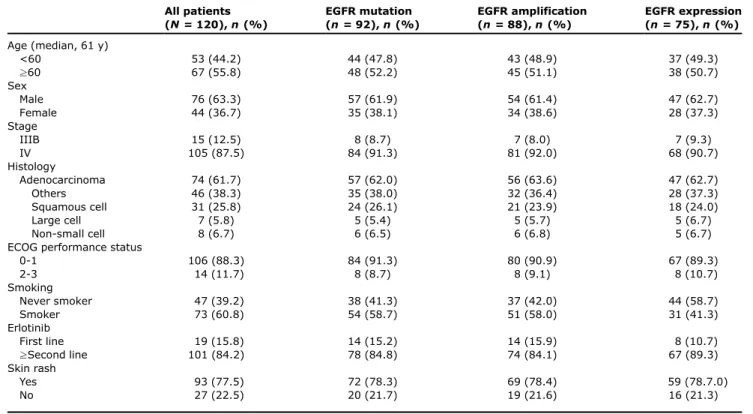
Table 1. Characteristics of the patients

All patients (N = 120), n (%)

EGFR mutation (n = 92), n (%)

EGFR amplification (n = 88), n (%)

EGFR expression (n = 75), n (%) Age (median, 61 y)

<60 53 (44.2) 44 (47.8) 43 (48.9) 37 (49.3)

z60 67 (55.8) 48(52.2) 45 (51.1) 38(50.7)

Sex

Male 76 (63.3) 57 (61.9) 54 (61.4) 47 (62.7)

Female 44 (36.7) 35 (38.1) 34 (38.6) 28 (37.3)

Stage

IIIB 15 (12.5) 8 (8.7) 7 (8.0) 7 (9.3)

IV 105 (87.5) 84 (91.3) 81 (92.0) 68 (90.7)

Histology

Adenocarcinoma 74 (61.7) 57 (62.0) 56 (63.6) 47 (62.7)

Others 46 (38.3) 35 (38.0) 32 (36.4) 28 (37.3)

Squamous cell 31 (25.8) 24 (26.1) 21 (23.9) 18 (24.0)

Large cell 7 (5.8) 5 (5.4) 5 (5.7) 5 (6.7)

Non-small cell 8(6.7) 6 (6.5) 6 (6.8) 5 (6.7)

ECOG performance status

0-1 106 (88.3) 84 (91.3) 80 (90.9) 67 (89.3)

2-3 14 (11.7) 8(8.7) 8(9.1) 8(10.7)

Smoking

Never smoker 47 (39.2) 38(41.3) 37 (42.0) 44 (58.7)

Smoker 73 (60.8) 54 (58.7) 51 (58.0) 31 (41.3)

Erlotinib

First line 19 (15.8) 14 (15.2) 14 (15.9) 8 (10.7)

zSecond line 101 (84.2) 78 (84.8) 74 (84.1) 67 (89.3)

Skin rash

Yes 93 (77.5) 72 (78.3) 69 (78.4) 59 (78.7.0)

No 27 (22.5) 20 (21.7) 19 (21.6) 16 (21.3)

Abbreviation: ECOG, Eastern Cooperative Oncology Group.

(3)

Laboratories) at a 1:100 dilution. Tumors with more than 10% of membrane staining of any intensity were considered to be positive for EGFR as described previously (13).

Statistical analysis. The Pearson m

2

test was done to determine the relationships between EGFR status such as gene mutation and amplification, protein expression, baseline clinical characteristics, and treatment outcomes of erlotinib therapy. Survival curves were calculated using the Kaplan-Meier method and compared with other prognostic variables using the log-rank test. Stepwise Cox’s regression analysis was done to identify prognostic factors for survival. In all tests, P < 0.05 was considered to be statistically significant.

Results

Clinical results. A total of 120 patients were enrolled. The median age was 61 years, and 63.3% (76 of 120) were male;

88.3% (106 of 120) had a performance status of 0 to 1;

61.7% (74 of 120) had adenocarcinomas (including 4 bronchioloalveolar carcinomas); 39.2% (47 of 120) were never smokers; 15.8% (19 of 120) were chemonaive, 50%

(60 of 120) had received one prior palliative chemotherapy regimen, and 34.1% (41 of 120) had received two or more (Table 1). With intent-to-treatment analysis, the overall tumor response rate was 24.2% (4 complete responses and 25 partial responses) and the disease control rate was 56.7%. Females,

never-smokers, and patients with adenocarcinomas achieved significantly higher response rate than males, smokers, and patients with nonadenocarcinoma histology (Table 2). Multi- variate analysis of the response rate showed that only female sex [hazard ratio (HR), 0.16; 95% confidence interval (95%

CI), 0.07-0.40; P < 0.001] was an independent predictive factor of response. With a median follow-up period of 23.6 months (range, 0.1-29), time to progression (TTP) was 2.7 months (95% CI, 2.2-3.2), the 1-year survival rate was 54.3%, and the median overall survival (OS) was 12.9 months.

Female sex, adenocarcinoma histology, never smoking, and development of skin rash were predictive of better TTP and OS. In multivariate analysis, female, good performance status, and skin rash were significantly associated with longer survival.

Clinical outcomes and EGFR gene mutations. Of 120 patients, 92 tumors were available for EGFR gene mutation analysis (Table 1). Twenty-five of 92 patients (27.1%) had EGFR gene mutations in exons 18 to 21 and the total mutation rate was 28.2% (26 of 92) because one patient had two mutations, one in exon 18 and the other in exon 19. Only one patient had a mutation in exon 20 and the remaining 24 patients had mutations in exon 18, 19, or 21. The most common type of mutation was an in-frame deletion in exon 19 Table 2. Tumor response to erlotinib according to clinical and molecular variables

Response rate Disease control rate

n (%) P n (%) P

Overall rate 29/120 (24.2) 68/120 (56.7)

Age ( n = 120)

<60 17/53 (32.1) 0.165 33/53 (62.3) 0.470

z60 14/67 (20.9) 35/67 (52.2)

Sex ( n = 120)

Male 12/76 (15.8) 0.001 31/76 (40.8) 0.001

Female 19/44 (43.2) 37/44 (84.1)

Stage ( n = 120)

IIIB 5/16 (31.3) 0.595 10/16 (62.5) 0.610

IV 26/104 (25.0) 58/104 (55.8)

Histology ( n = 120)

Adenocarcinoma 26/74 (35.1) 0.003 47/74 (63.5) 0.055

Others 5/46 (10.9) 21/46 (45.7)

ECOG performance status ( n = 120)

0-1 29/107 (27.1) 0.362 61/107 (57.0) 0.830

2-3 2/13 (15.4) 7/13 (53.8)

Smoking ( n = 120)

Never smoker 17/48(35.4) 0.041 36/48(75.0) 0.003

Smoker 14/72 (19.4) 32/72 (44.4)

Erlotinib ( n = 120)

First line 6/19 (31.6) 0.533 13/19 (68.4) 0.260

zSecond line 25/101 (24.8) 55/101 (54.5)

Skin rash ( n = 120)

Yes 28/93 (30.1) 0.047 61/93 (65.6) 0.001

No 3/27 (11.1) 7/27 (25.9)

EGFR mutation* ( n = 92)

Wild-type 11/68(16.2) <0.001 35/68(51.5) 0.045

Mutation (exon 18, 19, or 21) 14/24 (58.3) 18/24 (75.0)

EGFR amplification ( n = 8 8 )

Normal 9/52 (17.3) 0.012 24/52 (46.2) 0.015

Amplification 15/36 (41.7) 26/36 (72.2)

EGFR expression ( n = 75)

Normal 7/21 (33.3) 0.416 10/21 (47.6) 0.536

Overexpression 13/54 (24.1) 30/54 (55.6)

*Exon 18, 19, or 21.

(4)

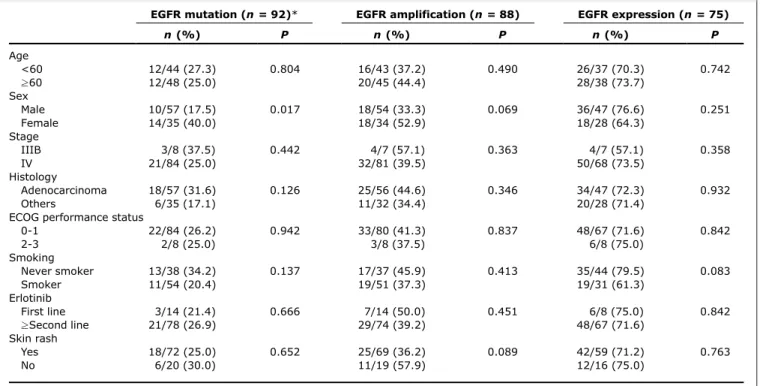
(69.0%, 18 of 26). An L858R point mutation in exon 21 was identified in 6 patients (23%, 6 of 26). A higher mutation rate was seen in females than that in males [40.0% (14 of 35) versus 17.5% (10 of 57); P = 0.017]. However, there was no significant difference in the mutation rate according to his- tology, smoking status, history of previous chemotherapy, or tumor stage (Table 3).

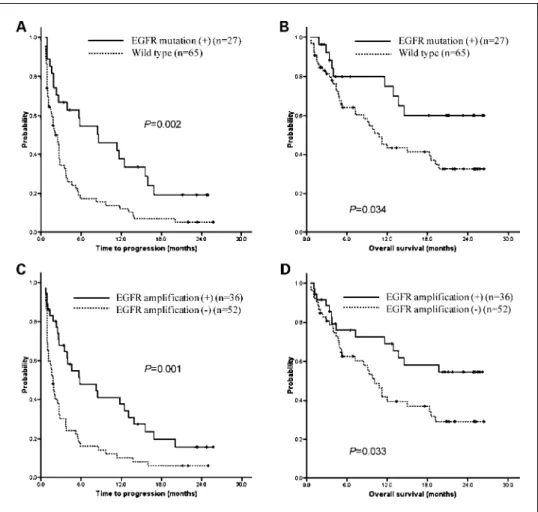
According to the intent-to-treat analysis, 25 of 92 (27.1%) patients showed a tumor response to erlotinib. A significantly higher response rate to erlotinib was noted in patients with EGFR gene mutations (exon 18, 19, or 21) compared with patients carrying wild-type EGFR [58.3% (14 of 24) versus 16.2% (11 of 68), P < 0.001; Table 3]. With a median follow-up of 23.6 months (range, 0.1-29 months), 70 patients underwent disease progression and 45 of 92 patients are alive. The median TTP for patients with an EGFR gene mutation was significantly longer than that of patients without a mutation (8.6 versus 2.5 months, P = 0.003; Table 4; Fig. 1A). The median OS was 10.8 months for patients without a mutation but was not reached for those with a mutation (P = 0.023; Table 4; Fig. 1B).

Regarding the EGFR genotype, there was no difference in TTP or OS between patients with exon 19 deletions and those with the L858R point mutation (P = 0.697 and 0.803, respectively).

The KRAS mutation was present in only 2 of the 92 patients and those 2 patients with KRAS mutation showed progressive disease on erlotinib.

Comparison of EGFR gene mutation analysis with direct sequencing and the Surveyor method. Forty-seven of 92 samples were independently analyzed for an EGFR gene mutation using either Surveyor analysis or direct DNA sequencing in a blinded fashion. Compared with direct sequencing, Surveyor analysis detected five more mutations (two in exon 18, two in exon 19,

and one in exon 21) and two of the four patients (one patient with an exon 19 deletion and another with an exon 19 deletion and L858R) achieved a partial response.

Clinical outcomes and EGFR gene amplification. We ana- lyzed the EGFR gene amplification status in 88 of 120 patients (Table 1) by a quantitative real-time PCR method (10). The EGFR gene copy number in tumor cells ranged from 1.37 to 1,269.46 per cell and 40.9% (36 of 88) of patients showed EGFR gene amplification. However, there was no correlation between EGFR gene amplification and age, sex, histology, smoking, history of previous chemotherapy, or performance status (Table 3). Patients with EGFR gene amplification showed a significantly higher tumor response than those without am- plification [41.7% (15 of 36) versus 17.3% (9 of 52), P = 0.012;

Table 2]. Patients with EGFR gene amplification had signifi- cantly longer median TTP than those without amplification (5.8 versus 1.8 months, P = 0.001; Table 4; Fig. 1C). The me- dian OS was 10.1 months in patients without amplification but was not reached in patients with amplification (P = 0.033;

Table 4; Fig. 1D).

Correlations between EGFR mutations and EGFR gene amplification. EGFR gene amplifications were observed more frequently in patients with the EGFR gene mutations than in those with wild-type EGFR [68.2% (15 of 22) versus 31.8%

(21 of 66), P = 0.003]. A positive correlation was noted between EGFR gene amplification and EGFR gene mutation (Spearman correlation coefficient = 0.241, P = 0.024).

Clinical outcomes and EGFR protein expression. Seventy-five samples were available for immunohistochemical testing for EGFR protein expression (Table 1). Fifty-four of 75 samples (72.0%) were positive for EGFR protein. No significant association between EGFR protein expression and other clinical

Table 3. Correlation between EGFR molecular analysis and clinical variables

EGFR mutation (n = 92)* EGFR amplification (n = 88) EGFR expression (n = 75)

n (%) P n (%) P n (%) P

Age

<60 12/44 (27.3) 0.804 16/43 (37.2) 0.490 26/37 (70.3) 0.742

z60 12/48(25.0) 20/45 (44.4) 28/38(73.7)

Sex

Male 10/57 (17.5) 0.017 18/54 (33.3) 0.069 36/47 (76.6) 0.251

Female 14/35 (40.0) 18/34 (52.9) 18/28 (64.3)

Stage

IIIB 3/8(37.5) 0.442 4/7 (57.1) 0.363 4/7 (57.1) 0.358

IV 21/84 (25.0) 32/81 (39.5) 50/68 (73.5)

Histology

Adenocarcinoma 18/57 (31.6) 0.126 25/56 (44.6) 0.346 34/47 (72.3) 0.932

Others 6/35 (17.1) 11/32 (34.4) 20/28(71.4)

ECOG performance status

0-1 22/84 (26.2) 0.942 33/80 (41.3) 0.837 48/67 (71.6) 0.842

2-3 2/8(25.0) 3/8(37.5) 6/8(75.0)

Smoking

Never smoker 13/38(34.2) 0.137 17/37 (45.9) 0.413 35/44 (79.5) 0.083

Smoker 11/54 (20.4) 19/51 (37.3) 19/31 (61.3)

Erlotinib

First line 3/14 (21.4) 0.666 7/14 (50.0) 0.451 6/8(75.0) 0.842

zSecond line 21/78(26.9) 29/74 (39.2) 48/67 (71.6)

Skin rash

Yes 18/72 (25.0) 0.652 25/69 (36.2) 0.089 42/59 (71.2) 0.763

No 6/20 (30.0) 11/19 (57.9) 12/16 (75.0)

*Exon 18, 19, or 21.

(5)

variables was noted (Table 3). There was no association between erlotinib responsiveness and EGFR protein expression (P = 0.416; Table 2). There was also no difference in TTP (P = 0.148) or OS (P = 0.365) between EGFR-positive and EGFR-negative groups (Table 4).

Multivariate analysis for survival. To define which variables are predictive for TTP and survival, those factors that were statistically significant in univariate analysis (sex, Eastern Cooperative Oncology Group performance status, histology, smoking status, skin rash, EGFR mutation, and EGFR gene amplification) were analyzed in a multivariate model (Table 4).

With long-term follow-up, female gender (HR, 0.39; 95% CI, 0.22-0.70, P = 0.002) and EGFR gene mutation (HR, 0.47; 95%

CI, 0.25-0.89, P = 0.020) were statistically significantly associated with better TTP, whereas female gender (HR, 0.17;

95% CI, 0.08-0.40, P < 0.001), performance status 0 to 1 (HR, 0.29; 95% CI, 0.12-0.69, P = 0.005), and skin rash (HR, 0.45;

95% CI, 0.21-0.95, P = 0.036) were independent factors associated with prolongation of OS.

Discussion

In this study, 24.2% of response rate was achieved with erlotinib monotherapy for advanced and/or metastatic NSCLC in Korean patients, most of whom had previously failed

standard chemotherapy, which is better than the response rate of 8.9% observed in the BR.21 study (3). Interestingly, the response rate was similar to that achieved in a phase II study of erlotinib monotherapy as a first-line treatment for advanced NSCLC in western patients, which was weighted toward individuals with higher chances of having EGFR gene muta- tions (16). Therefore, the higher response rate observed in the present study, even in a salvage setting, is most probably explicable by ethnic differences in the efficacy of erlotinib.

This study also shows that EGFR gene mutations were strongly associated with erlotinib responsiveness in patients with advanced NSCLC. Patients with EGFR gene mutations showed a response rate to erlotinib significantly higher than that of patients without mutation (58.3% versus 16.2%, respectively, P < 0.001). The high rate of EGFR gene mutation in this study (26.1%, 24 of 92) is a consistent finding as reported previously in individuals of East Asian descents (8, 10) compared with less than 10% of cases in North America and western Europe (7, 9, 13). Exon 19 deletions and the L858R missense mutations were identified as the two most common somatic mutations, together accounting for 92% (24 of 26) of all the mutation types observed, which is similar to the previous studies (4 – 10, 17 – 19). More importantly, an EGFR gene mutation with a higher tumor response rate did translate into prolonged TTP and OS. EGFR gene mutation is the only Table 4. Univariate and multivariate analysis of prognostic factors for survival

TTP OS

Univariate Multivariate Univariate Multivariate

Median (mo) P P [HR (95% CI)] Median (mo) P P [HR (95% CI)]

Age (y)

<60 2.6 0.656 18.3 0.293

z60 2.7 11.2

Sex

Female 8.6 <0.001 0.002 [0.39 (0.22-0.70)] NR <0.001 <0.001 [0.17 (0.08-0.40)]

Male 1.85.3

ECOG performance status

0-1 2.6 0.352 15.0 0.005 0.005 [0.29 (0.12-0.69)]

2-3 2.7 4.7

Stage

IIIB 3.80.301 11.7 0.604

IV 2.5 13.7

Histology

Adenocarcinoma 3.9 0.001 NR 0.001

Others 2.0 7.2

Smoking status

Never smoker 5.6 0.002 NR <0.001

Smoker 1.9 5.3

Erlotinib

First line 4.0 0.352 19.2 0.465

zSecond line 2.5 12.0

Skin rash after treatment

Yes 2.7 0.003 19.2 <0.001 0.036 [0.45 (0.21-0.95)]

No 1.7 4.3

EGFR mutation (exon 18, 19, or 21; n = 92)

Yes 8.6 0.003 0.020 [0.47 (0.25-0.89)] NR 0.023

No 2.5 10.8

EFGR amplification ( n = 8 8 )

Yes 5.80.001 NR 0.033

No 1.810.1

EGFR expression ( n = 75)

Yes 2.5 0.148NR 0.365

No 2.7 12.9

(6)

molecular variable associated with prolonged TTP by multivar- iate analysis. This study supports other reports that have shown a survival advantage in favor of EGFR gene mutations over wild- type EGFR in patients treated with gefitinib (8, 18). Although no direct comparison can be made because of different study designs and patient populations, our results differ from that reported by Tsao et al., which concluded that EGFR gene mutation analysis is not necessary in the selection of patients for treatment with erlotinib (13). In the BR.21 study, only 24.2% of the samples (177 of 731) were available for EGFR sequencing analysis, and a relatively small number of muta- tions were identified (n = 40). The conclusion drawn from this analysis of a very limited number of patients might not be representative and casts doubt on the generalization of the conclusion. In the present study, 76.7% of a homogeneous groupof p atients (92 of 120) treated with erlotinib was analyzed for EGFR gene mutations, allowing us to obtain more representative and reliable data. Another plausible explanation for the discrepancy may be ethnic differences in the patients studied. In the BR21 study, only 12 of the 177 available samples (6.7%) were from Asian populations. Therefore, with limited Asian samples, we must be very cautious in drawing the conclusion that the patient’s EGFR mutation status dose not affect the outcome of erlotinib treatment regardless of ethnicity. Based on our results, EGFR gene mutation status might be an important molecular predictor to be considered together with other known clinical variables such as sex, smoking status, and histology in deciding who is more likely to

benefit from erlotinib treatment, at least in the Korean population.

It is interesting that 11 of the 68 patients (16.2%) with wild- type EGFR also responded to erlotinib. One explanation for this result might be the sensitivity of the method for detecting mutations. Direct DNA sequencing has been the most commonly used method for the detection of EGFR mutations.

However, this method is a time-consuming procedure requiring a large tissue specimen and the microdissection of tumor cells from normal lung tissues by a pathologist. To overcome this problem, a new, rapid, and sensitive method using a DNA endonuclease, called Surveyor analysis, has been developed (15). This method is reported to have a positive predictive rate of 75% and a negative predictive rate of 100%. When we compared the two different methods, five more mutations in four patients were detected by Surveyor analysis, which had not been detected by the sequencing method. Furthermore, two of these four patients achieved a partial response to erlotinib, suggesting that the alternative non-sequencing-based method is more sensitive in identifying EGFR gene mutations. This new method will thus increase the detection rate of EGFR gene mutations, especially when it is used with undissected, formalin-fixed, and paraffin-embedded specimens.

Multivariate analysis suggested that increased EGFR gene amplification is another possible predictor of erlotinib respon- siveness. The response rate of patients with EGFR gene amplification was 41.7%, which was significantly higher than that of patients without amplification (17.3%, P = 0.012).

Fig. 1. TTP and OS according to EGFR

gene mutation (A and B) and gene

amplification (C and D) in patients treated

with erlotinib.

(7)

Although fluorescence in situ hybridization is by far the method most frequently used to evaluate increased EGFR gene copy number (7, 12), this method is technically labor intensive, time consuming, and only semiquantitative. Furthermore, the inter- pretation of fluorescence in situ hybridization results is apt to be subjective, leading to interobserver variability. In contrast, quantitative real-time PCR used in this study is a standardized method that is both quantitative and objective. Therefore, this method is more reproducible and better suited for clinical practice because it entails less interexperimental variability.

A direct comparison of the two detection methods is in process at the moment.

In this study, EGFR gene amplification was also associated with improved TTP and OS in patients treated with erlotinib.

The median TTP for patients with EGFR gene amplification was 5.8 months compared with 1.8 months for patients without amplification. More interestingly, the median OS has not been reached in erlotinib-treated patients with EGFR gene amplification, whereas it was 10.1 months for patients without amplification. However, multivariate analysis revealed that EGFR gene amplification was not an independent molecular predictor for prolongation of TTP or OS.

The predictive role of EGFR immunohistochemistry for the response to and survival benefit of EGFR tyrosine kinase inhibitors remains controversial (7, 13, 20, 21). We found no significant predictive value of EGFR protein expression in

patients treated with erlotinib, although 72% of patients were positive. These discordant results among the reported studies may be attributable to the different methodologies, different study populations, and variable cutoff values for EGFR posi- tivity in the studies. Therefore, a standardized method remains to be established and validated in larger series of patients in prospective studies.

In summary, our results suggest that EGFR gene mutations and EGFR gene amplification might be potential predictive molecular markers for a better response to erlotinib and are associated with better clinical outcomes in Korean patients with NSCLC. Further prospective studies with large numbers of patients from diverse ethnic backgrounds are required to determine the exact roles of these and other molecular markers in the identification of patients most likely to benefit from erlotinib treatment for NSCLC.

Disclosure of Potential Conflicts of Interest

Dr. Pasi has a major conflict with Genentech and minor conflicts with Astra-Zeneca and Genzyme.

Acknowledgments

We thank Sun-Young Yoon R.N. (Korean Cancer Study Group) for data monitor- ing and management.

References

1. Shin HR, Won YJ, Park JG, Hospitals K-a. 2002 Annual report of the Korean central cancer registry.

Cancer ResTreat 2004;36:103 ^ 14.

2. Perez-Soler R, Chachoua A, Hammond LA, et al.

Determinants of tumor response and survival with erlotinib in patients with non-small-cell lung cancer.

J Clin Oncol 2004;22:3238 ^ 47.

3. Shepherd FA, Rodrigues Pereira J, Ciuleanu T, et al.

Erlotinib in previously treated non-small-cell lung cancer. N Engl J Med 2005;353:123 ^ 32.

4. LynchTJ, Bell DW, Sordella R, et al. Activating muta- tions in the epidermal growth factor receptor underly- ing responsiveness of non-small-cell lung cancer to gefitinib. N Engl J Med 2004;350:2129 ^ 39.

5. Paez JG, Janne PA, Lee JC, et al. EGFR mutations in lung cancer: correlation with clinical response to gefi- tinib therapy. Science 2004;304:1497 ^ 500.

6. Pao W, MillerV, Zakowski M, et al. EGF receptor gene mutations are common in lung cancers from ‘‘never smokers’’and are associated with sensitivity of tumors to gefitinib and erlotinib. Proc Natl Acad Sci U S A 2004;101:13306 ^ 11.

7. Cappuzzo F, Hirsch FR, Rossi E, et al. Epidermal growth factor receptor gene and protein and gefitinib sensitivity in non-small-cell lung cancer. J Natl Cancer Inst 2005;97:643 ^ 55.

8. Han SW, Kim TY, Hwang PG, et al. Predictive and prognostic impact of epidermal growth factor receptor mutation in non-small-cell lung cancer patients treated with gefitinib. J Clin Oncol 2005;23:2493 ^ 501.

9. Janne PA, Johnson BE. Effect of epidermal growth

factor receptor tyrosine kinase domain mutations on the outcome of patients with non-small cell lung cancer treated with epidermal growth factor receptor tyrosine kinase inhibitors. Clin Cancer Res 2006;12:

4416 ^ 20s.

10. Takano T, Ohe Y , Sakamoto H, et al. Epidermal growth factor receptor gene mutations and increased copy numbers predict gefitinib sensitivity in patients with recurrent non-small-cell lung cancer. J Clin Oncol 2005;23:6829 ^ 37.

11. Dziadziuszko R, Witta SE, Cappuzzo F, et al. Epi- dermal growth factor receptor messenger RNA expression, gene dosage, and gefitinib sensitivity in non-small cell lung cancer. Clin Cancer Res 2006;12:

3078 ^ 84.

12. Hirsch FR, Varella-Garcia M, McCoy J, et al. In- creased epidermal growth factor receptor gene copy number detected by fluorescence in situ hybridization associates with increased sensitivity to gefitinib in patients with bronchioloalveolar carcinoma subtypes:

a Southwest Oncology Group Study. J Clin Oncol 2005;23:6838 ^ 45.

13. Tsao MS, Sakurada A, Cutz JC, et al. Erlotinib in lung cancerMmolecular and clinical predictors of outcome.

N Engl J Med 2005;353:133 ^ 44.

14. Han SW, Kim TY, Jeon Y K, et al. Optimization of patient selection for gefitinib in non-small cell lung cancer by combined analysis of epidermal growth factor receptor mutation, K-ras mutation, and Akt phosphorylation. Clin Cancer Res 2006;12:2538 ^ 44.

15. Janne PA, Borras AM, Kuang Y, et al. A rapid and

sensitive enzymatic method for epidermal growth factor receptor mutation screening. Clin Cancer Res 2006;12:751 ^ 8.

16. Giaccone G, Gallegos Ruiz M, Le Chevalier T, et al.

Erlotinib for frontline treatment of advanced non-small cell lung cancer: a phase II study. Clin Cancer Res 2006;12:6049 ^ 55.

17. Marchetti A, Martella C, Felicioni L, et al. EGFR mutations in non-small-cell lung cancer: analysis of a large series of cases and development of a rapid and sensitive method for diagnostic screening with poten- tial implications on pharmacologic treatment. J Clin Oncol 2005;23:857 ^ 65.

18. Mitsudomi T, KosakaT, Endoh H, et al. Mutations of the epidermal growth factor receptor gene predict prolonged survival after gefitinib treatment in patients with non-small-cell lung cancer with postoperative recurrence. J Clin Oncol 2005;23:2513 ^ 20.

19. Shigematsu H,TakahashiT, Nomura M, et al. Somatic mutations of the HER2 kinase domain in lung adeno- carcinomas. Cancer Res 2005;65:1642 ^ 6.

20. Bailey LR KM, Wolf M, et al. Tummor EGFR mem- brane staining is not clinically relevant for predicting response in patients receiving gefitinib monotherapy for pretreated advanced non-small cell lung cancer:

IDEAL1 and 2. Proc Am Assoc Cancer Res 2003;44:

1362.

21. Hirsch FR, Varella-Garcia M, Bunn PA, Jr., et al.

Molecular predictors of outcome with gefitinib in a

phase III placebo-controlled study in advanced non-

small-cell lung cancer. JClin Oncol 2006;24:5034 ^ 42.

(8)

2008;14:3860-3866.

Clin Cancer Res

Myung-Ju Ahn, Byeong-Bae Park, Jin Seok Ahn, et al.

Erlotinib Efficacy in Advanced Non-Small Cell Lung Cancer?

Updated version

http://clincancerres.aacrjournals.org/content/14/12/3860 Access the most recent version of this article at:

Cited articles

http://clincancerres.aacrjournals.org/content/14/12/3860.full.html#ref-list-1 This article cites 21 articles, 15 of which you can access for free at:

Citing articles

http://clincancerres.aacrjournals.org/content/14/12/3860.full.html#related-urls This article has been cited by 8 HighWire-hosted articles. Access the articles at:

E-mail alerts Sign up to receive free email-alerts related to this article or journal.

Subscriptions

Reprints and

. [email protected] Department at

To order reprints of this article or to subscribe to the journal, contact the AACR Publications

Permissions

. [email protected] Department at

To request permission to re-use all or part of this article, contact the AACR Publications

수치

Table 1. Characteristics of the patients
Table 3. Correlation between EGFR molecular analysis and clinical variables
Fig. 1. TTP and OS according to EGFR gene mutation (A and B) and gene amplification (C and D) in patients treated with erlotinib.

참조

관련 문서

Therefore, this study aims to investigate the relationship between explicit grammar instruction and English speaking of lower-grade students in third-grade

The purpose of this study is to investigate changes in listening, reading achievement, and learning attitudes of Korean elementary students who enrolled in

In this study, the expression profiles of miRNAs were compared and analyzed for establishment of miRNAs related cancer cell growth inhibition in normal human oral

In this study, to investigate how applying a critical pathway to stomach cancer patients affects their recovery and treatment, the clinical effect of the critical

다양한 번역 작품과 번역에 관한 책을 읽는 것은 단순히 다른 시대와 언어, 문화의 교류를 넘어 지구촌이 서로 이해하고 하나가

The index is calculated with the latest 5-year auction data of 400 selected Classic, Modern, and Contemporary Chinese painting artists from major auction houses..

a prospective analysis of 50 cases. Preoperative staging of non-small-cell lung cancer with positron-emission tomography. Staging of non- small-cell lung cancer

Patients with breast cancer; ovarian cancer; renal cell carcinoma; pancreatic neuroendocrine cancer; colorectal cancer; head and neck cancer; non-small cell lung