Print ISSN: 2288-4637 / Online ISSN 2288-4645 doi:10.13106/jafeb.2021.vol8.no2.0231
The Effect of Spiritual Marketing and Entrepreneurship Orientation on Determining Sustainable Competitive Advantage
Ahmad BAMBANG
1, Andriani KUSUMAWATI
2, Umar NIMRAN
3, Suharyono SUHARYONO
4Received: September 30, 2020 Revised: November 30, 2020 Accepted: January 08, 2021
Abstract
The purpose of this study is to apply Structural equation modeling (SEM) analysis with Generalized Structured Component Analysis (GSCA) and translate the effect of Spiritual Marketing and Entrepreneurial Orientation on Sustainable Competitive Advantage with Marketing Capabilities as Mediation, especially for General BBM marketing at PT. Pertamina (Persero). The quantitative approach in this study uses a survey method by taking samples from the population. The survey was conducted by distributing questionnaires to respondents.
Data analysis was performed using SEM and analyzed using the GSCA model. The population of this study consisted of 3,207 workers in central and regional marketing offices (Marketing Operation Region (MOR) spread throughout Indonesia. Therefore, a sample of 356 respondents was taken according to the Slovin formula. Spiritual marketing and entrepreneurial orientation directly influence the ability to improve Innovation which directly influences sustainable competitive advantage. Therefore, to develop a sustainable competitive advantage in marketing Pertamina’s General BBM, it is necessary to implement spiritual marketing and improve entrepreneurial orientation. The novelty in this study lies in the unprecedented research on the role and position of spiritual marketing towards marketing capabilities and sustainable competitive advantage, combined with entrepreneurial orientation variables.
Keywords: Spiritual Marketing, Entrepreneurial Orientation, Marketing Capability, Sustainable Competitive Advantage, PT Pertamina (Persero)
JEL Classification Code: M31, Z33, L30
handled by Pertamina as stipulated in Act number. 8 of 1971.
The stipulation of Act number. 22 of 2001 has allowed the retail oil and gas distribution and marketing to be open for the public, with a transition period of 5 years. Therefore, since 2006, several domestic and foreign capital companies have started to penetrate the business, including retail and corporate fuels (industrial, marine, and Aviation).
Pertamina currently operates more than 109 fuel Terminals, 21 LPG Terminals, and 62 Aircraft Filling Depots (DPPU) to store fuel & LPG. The company also owns more than 5,350 gas stations, mostly privately-owned, 1,250 APMS, 12,250 LPG agents, and more than 122,500 LPG bases. Pertamina also has more than 250 ships, 5 units of aircraft, 6 series of trains, 1,624 Km of fuel pipes (natural gas pipes are excluded), and 3,000 tankers (not including LPG transport trucks/pickups to agents and bases) to distribute fuel and LPG. The increasingly fierce competition in this field (retail and corporate) has reduced the market share of Pertamina, causing the profitability to continue shrinking significantly since 2017 for the general fuel sector.
1
First Author and Corresponding Author. Faculty of Administrative Science, Brawijaya University, Indonesia [Postal Address: Jl.
Veteran, Ketawanggede, Kec. Lowokwaru, Kota Malang, Jawa Timur 65145, Indonesia] Email: [email protected]
2
Faculty of Administrative Science, Brawijaya University, Indonesia.
Email: [email protected]
3
Faculty of Administrative Science, Brawijaya University, Indonesia.
Email: [email protected]
4
Faculty of Administrative Science, Brawijaya University, Indonesia.
Email: [email protected]
© Copyright: The Author(s)
This is an Open Access article distributed under the terms of the Creative Commons Attribution Non-Commercial License (https://creativecommons.org/licenses/by-nc/4.0/) which permits unrestricted non-commercial use, distribution, and reproduction in any medium, provided the original work is properly cited.
1. Introduction
PT. Pertamina (Persero) is a state-owned enterprise
that runs enterprises in the field of oil and gas mining in
Indonesia. The company processes and distributes fuel and
gas including LPG all over the nation. The distribution and
marketing of fuel and LPG in Indonesia had been exclusively
Fortune, a popular magazine that publishes the annual ranking of the top 500 corporations worldwide as measured by revenue, issued the list of 500 largest global companies in July 2013. For the first time, the Indonesian state-owned energy company, PT. Pertamina (Persero), was on the list and ranked 122. Pertamina is the only Indonesian company listed in the Fortune 500 list. Currently, Pertamina’s rank in the Fortune Global 500 has also shrunk to 175. Super intense local, national, and global competitions require companies to build competent and competitive business strategies. These strategies relate to the ability to innovate (marketing) and entrepreneurial orientation (entrepreneurship). Both of these are key to building sustainable competitive advantage.
Most companies are generally established with a competitive advantage or certain criteria and standards are applied to develop a competitive advantage. Developing competitive advantage is often done by applying business efficiency. After developing a clear competitive advantage, a company should offer what other companies cannot offer.
For a sustainable competitive advantage, a company must be able to create innovations or make exclusive products.
After identifying the potential competitive advantages, research should be conducted to determine the proper strategy to achieve the desired targets quickly, precisely, and accordingly. In this case, competitive advantage is usually only accessible through certain target markets with certain products or services or certain locations. Such a business strategy is expected to help a company figure out high demand products and consumer targets for both short and long term goals.
More importantly, if an ongoing business has competitive resources and advantages over its competitors, as long as proper strategies are applied and various resources and capabilities are exploited effectively, the business will likely stay competitive. Competitive advantage can be maintained by taking into account durability, replicability, and feasibility. Some indicators are used to measure competitive advantage including uniqueness, exclusiveness, replicability, irreplaceability, and competitive prices. The uniqueness of a product relates to the value of art that goes with customers’ preferences. Competitive price refers to the ability of companies to adjust the price of their products to the average prices on the market. Irreplaceability is related to how a product can stay exclusive. Replicability deals with how a product cannot be perfectly imitated. Irreplaceability shows that no other similar products can replace certain products.
Spiritual marketing as explained by Alifahmi (2006) is a marketing strategy and is the ability to understand and meet the needs, desires, and expectations of others (customers, employees, and other clients, and all those related) and based on values taught by the God (morality, ethics, honesty,
responsibility, fairness, togetherness, etc). Similarly, Tresnati et al. (2011) said that spiritual marketing employs the language of the heart to determine the best direction. The focus of spiritual marketing is not merely on profit (profit- oriented), but also on worship values, such as sympathetic marketing, heart-touching teachings, and morality as forms of worship to God. Spiritual marketing does not only influence a company’s marketing strategy but also affects employees’ ways of thinking.
Entrepreneurship orientation according to Drucker (1985) is an ability to create something new and different. Schumpeter (1951) supported the opinion that entrepreneurship is the main factor driving national development with its marketing function. Entrepreneurs are innovators instead of merely inventors. An entrepreneur is a person who regulates the allocation of resources in making inventions that may have been existing before. Entrepreneurs create new combinations of factors influencing production.
There are at least 5 types of innovations an entrepreneur can do: (1) Introducing a new product, or improving the existing products, (2) Introducing new production methods, (3) Opening new markets, especially export markets (4) Enhancing the use and procurement of new raw or semi- finished material supplies, and (5) Implementing new industrial organization system.
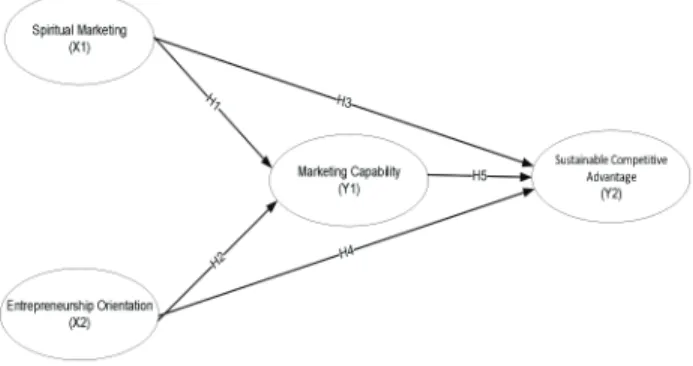
Spiritual marketing and entrepreneurial orientation directly influence company innovation capabilities which also directly affect sustainable competitive advantage.
Therefore, the sustainable competitive advantage of Pertamina’s general fuel marketing should be done based on spiritual marketing and its entrepreneurial orientation should be improved. In this study, SEM analysis in the form of GSCA was performed and the effect of spiritual marketing and entrepreneurial orientation on sustainable competitive advantage with innovation capabilities as the intervening variable was elaborated concerning the marketing of general fuel of PT. Pertamina (Persero). Business strategies are applied to develop company sustainability through investment and innovation funded by the company profit.
However, sustainability is not enough as companies must bring meaning and benefit to humans and their environment (beneficially). This need underlie the emergence of spiritual marketing.
This study analyzed in-depth the condition of Pertamina’s general fuel marketing. The concepts and theories of sustainable competitive advantage were developed according to the condition of Pertamina’s general fuel marketing. This study is a follow up of prior studies done on entrepreneurship and marketing orientation since there is still a research gap.
Some types of research have found significant positive
influence between entrepreneurship and marketing, yet
information about the role and position of spiritual marketing
and how innovation affects competitive advantage including profitability and competencies in the company have not been explored. The novelty in this study lies in the unprecedented research on the role and position of spiritual marketing toward marketing competency and sustainable competitive advantage that include entrepreneurial orientation.
2. Literature Review
The concept in this study includes spiritual marketing (spiritual marketing), entrepreneurship orientation, and marketing capability related to sustainable competitive advantages. This study presents a theoretical review and empirical review. The theoretical review explains the meaning, definition, and concept of each h variable based on brandmark theory. Furthermore, the presentation of the relationship between variables based on empirical research is derived from the results of prior relevant studies. The following is a more detailed explanation of each variable and its theoretical concept.
2.1. Sustainable Competitive Advantage
Sustainable competitive advantage shows a company’s ability to develop better business performance than competitors in the same industry by utilizing its assets and competencies. There are two theories on competitive strategies that can influence competitive advantage, one of which was conveyed by Porter (1998), called positioning theory which is based on the concept that there are five forces that determine the competitive intensity and attractiveness of an industry. The strategy covers selecting the proper position, creating mild competitive pressure, or adopting certain actions to compete with other companies to gain maximum profit. Another view was introduced by Wernerfelt (1984) and emphasized by Prahalad and Hamel (1994) in which a company’s competencies are divided into core and non-core competencies. They proposed that competitive advantage must be built based on competencies adjusted to the tangible and intangible resources. Companies that have strong entrepreneurial characteristics are agile in investigating the markets and are likely to respond faster than other competitors (Lee & Hsieh, 2010).
2.2. Marketing Capability
Drucker (1985) considers the ability to innovate (marketing capability) as the ability to provide resources in the form of new abilities to gain more profit by turning it into a productive factor. Marketing capability can be developed through training and research as it does not automatically develop. Innovation is characterized by two stages, namely, discovery and commercialization. Porter argues that the
innovation process cannot be separated from business strategies and competitive environment (Afuah, 1998). In other words, innovation is what drives an organization to integrate technology, organization, and market changes to maintain its market expansion (Tidd et al., 1997).
Innovations can be distinguished based on different standards, for example, administrative and technological innovation; product and process innovation; and radical and incremental innovation. Among these categorizations, administrative and technological innovation are appealing.
These types of innovation include social and technological structural factors (Downs & Mohr, 1976; Knight, 1967;
Rowe & Boise, 1974; Damanpour, 1991). Furthermore, Weerawardena (2003) considers that a company needs to develop technological innovations as well as non- technological innovations simultaneously. Researchers categorize marketing capabilities into product innovation, process innovation, managerial innovation, and marketing innovation (Lee & Hsieh, 2010). Innovation is a tangible manifestation and key to the success of a sustainable business (Shmelev et al., 2018; Chamidah et al., 2020).
2.3. Spiritual Marketing
Spiritual marketing focuses primarily on fulfilling God’s will. God wants humans to meet the needs and desires of his creatures. This means the products and services that are sold should be beneficial to the community. God also does not want to harm any creature, thus spiritual marketers need to sell products that do not harm others. This concept is clearly God-oriented. It is important to believe that everyone will get something in return from God in the fairest way.
2.4. Entrepreneurship Orientation
Entrepreneurship is a concept of independence that has
been widely studied by previous researchers. Leibenstein
(1968, 1979) proposed entrepreneurship as the activities
needed to create or carry on an enterprise where not all
the markets are well established or clearly defined and in
which the relevant parts of the production function are not
completely known. Bygrave (1993) defined entrepreneurial
activity as an activity that includes the identification of
opportunities in the economic system. Bull and Willard
(1993) stated that an entrepreneur always tries to predict and
respond to market changes. Hence, entrepreneurs have to be
capable of dealing with uncertainty in a dynamic market. An
entrepreneur must be able to carry out managerial functions
such as supervision and providing direction. A study on
entrepreneurship and entrepreneurial satisfaction found that
a CEO’s entrepreneurship must be high to improve enterprise
satisfaction (Lee & Kim, 2019).
Entrepreneurship is an important factor that influences a sustainable competitive advantage. This is also an important factor in marketing which depends on the level of marketing ability of entrepreneurs (Weerawardena & O’Cass, 2004).
Market orientation as the initial step for marketing and planned marketing capabilities is an important means for entrepreneurs because it can change the environment related to the feasibility to open up new businesses and/or services (Drucker, 1985).
3. Methodology
This research was conducted using a positive (quantitative) approach. Quantitative research employs deductive thinking in formulating research hypotheses.
This study employed a survey method, in which samples were selected from a large population. The unit of analysis of this research was employees of PT Pertamina (Persero).
The research population included employees and leaders who worked in central and regional marketing offices (MOR) across Indonesia. A restricted probability sampling technique was administered to select research samples.
Restricted probability sampling is a technique of selecting units with equal probability, allowing one unit to be selected for samples more than once (Sekaran, 2003). To determine the number of samples (sample size), the researchers used the Slovin formula as cited by Umar (2003) as follows:
n N
= Ne
+ =
+ =
1
3 207 1 3 207 0 0025
3 207
2