Print ISSN: 2288-4637 / Online ISSN 2288-4645 doi:10.13106/jafeb.2021.vol8.no5.1011
Critical Factors Affecting Masks Purchasing Intention of Consumers During COVID-19 Pandemic: An Empirical Study in Vietnam
Toan Khanh Pham TRAN
1Received: February 10, 2021 Revised: April 05, 2021 Accepted: April 15, 2021
Abstract
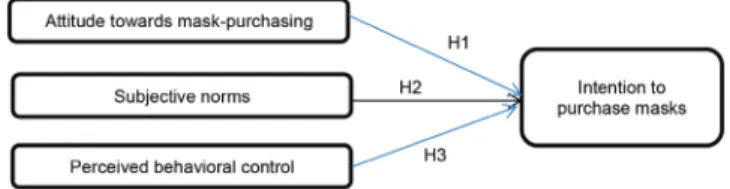
An effective measure to prevent the spread of COVID-19 is wearing masks in public places. This solution is highly recommended in many countries all over the world. The objective of this study is to identify the antecedents of citizens’ intention to purchase masks during the COVID-19 pandemic. Based on the theory of planned behavior (TPB), the current study analyzes attitudes toward mask-purchasing, subjective norms, and perceived behavioral control, to assess their impact on intention to purchase masks. In total, six variables are examined: attitude toward mask-wearing, subjective norms, perceived behavioral control, perceived severity, perceived susceptibility, and the intention to wear masks. Data are collected from 243 respondents in Ho Chi Minh City, Vietnam. They were processed through by factor analysis and multiple regressions. The results report that all three factors positively affect citizens’ intention to buy masks in the following ascending order: Attitude toward mask-purchasing, subjective norms, and perceived behavioral control. Our study is the first research that applies TPB to investigate citizens’ intention to purchase masks to during the COVID-19 pandemic. Moreover, this study provides guidelines to the Vietnamese public managers to combat COVID-19 through the purchase of masks. Shopkeepers would be well advised to observe the intentions of consumers toward masks.
Keywords: Mask, Purchasing Intention, Attitudes, Subjective Norms, Perceived Behavioral Control COVID-19 Pandemic JEL Classification Code: C12, C38, M30, M38, L84
to analysts of behavior (Chandon et al., 2005). It is related to an “individual’s subjective likelihood of performing some particular behavior” (Fishbein & Ajzen, 1975).
Besides, attitudes toward behavior are also predicted by different factors such as personal control, opinions, and beliefs (Soomro & Shah, 2015). Being an important concepts, there is a dire need to explore its status during the COVID-19 pandemic.
Until March 15, 2021, the COVID-19 disease has spread throughout 221 countries and territories with confirmed cases and death tolls of over 120 million and nearly 2.7 million, respectively (Worldometer, 2021). The number of confirmed cases and the death toll is rising every minute around the world. Apart from increasing the unprecedented deaths and cases, COVID-19 has caused chaos in social, economic, security, and other sectors. Vietnam shares a border with China as the epicenter of the COVID-19 disease.
A huge influx of travelers from China through land, sea, and air puts Vietnam at the amplified risk of more spread of the virus from China. In Vietnam, as of March 15, 2021, there have been 2557 cases of infection, 2115 cases cured,
1
First Author and Corresponding Author. Ph.D. Student, Graduate School, Ho Chi Minh City Open University, Vietnam [Postal Address:
97 Vo Van Tan Street, District 3, Ho Chi Minh City, 700000, Vietnam]
Email: [email protected]; [email protected]
© Copyright: The Author(s)
This is an Open Access article distributed under the terms of the Creative Commons Attribution Non-Commercial License (https://creativecommons.org/licenses/by-nc/4.0/) which permits unrestricted non-commercial use, distribution, and reproduction in any medium, provided the original work is properly cited.