Print ISSN: 2288-4637 / Online ISSN 2288-4645 doi:10.13106/jafeb.2021.vol8.no5.1155
Determinant Factors of Donation Intention and the Role of Religiosity: A Case Study in Indonesia
Agus SUSANTO
1, Suharyono SUHARYONO
2, Mochammad Al MUSADIEQ
3, Mochammad IQBAL
4Received: August 10, 2020 Revised: March 21, 2021 Accepted: April 15, 2021
Abstract
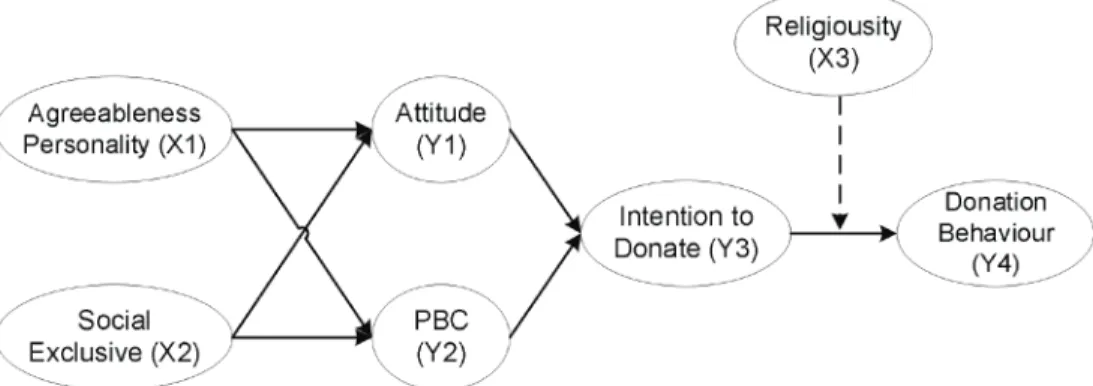
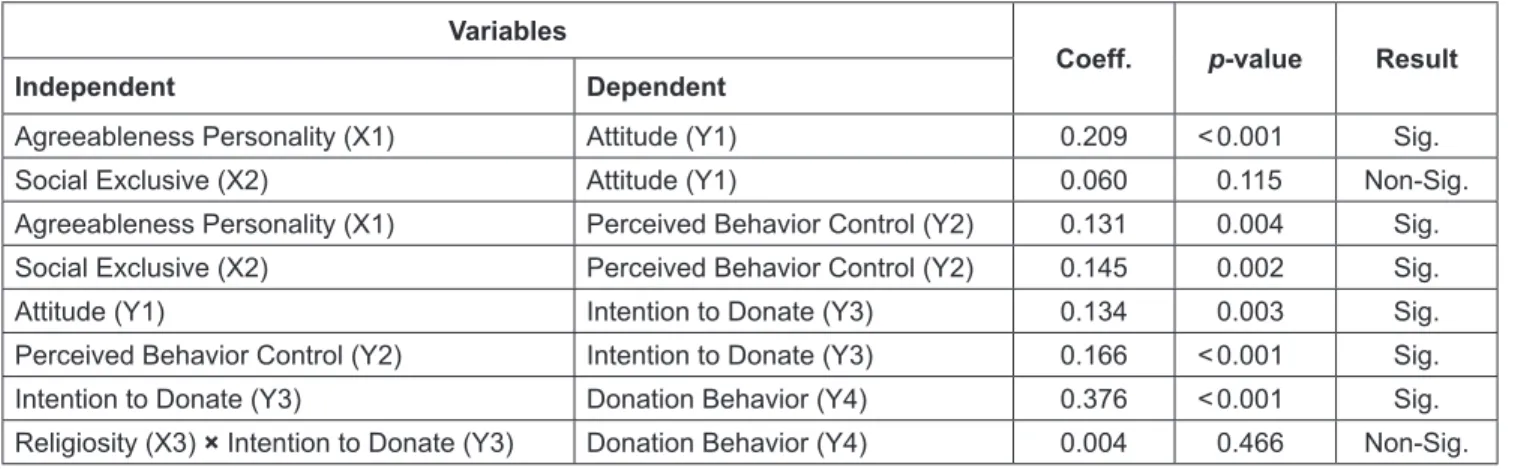
This study will explain the determinants factors that can increase donation behavior in public funding. The originality of this study is the use of Agreeableness Personality and Social Exclusive as predictors in Theory of Planned Behavior. Besides that, this study involves Attitude, Perceived Behavioral Control, Religiosity, Intention to Donate, and Donation Behavior. The population of this research is all people registered as active participants of BPJAMSOSTEK in East Java Province, of which 400 people are used as samples. The data analysis method used to test the hypothesis is SEM, which was conducted by utilizing the WarpPLS 6.0 software. The study found that Agreeableness Personality significantly had a positive effect on Attitude and Perceived Behavior Control, while Social Exclusive only significantly had a positive effect on Perceived Behavior Control. Attitude and Perceived Behavior Control influence the Intention to Donate positively, then consequently had a positive effect on Donation Behavior. Religiosity tends to strengthen the influence of the Intention to Donate to Donation Behavior. To improve donation behavior in the general public, BPJAMSOSTEK must organize a form of labor protection efforts to bring prosperity to all workers in Indonesia.
Keywords: Agreeableness Personality, Social Exclusive, Donation Behavior, Religiosity JEL Classification Code: E44, F31, F37, G15
for social transformation and progress. Social security is the security that society furnishes, through appropriate organization, against certain risks to which its members are exposed. Social security can help overcome some of the risks that arise at work, for example, workplace accidents that cause someone to be no longer able to work. The benefits of social security can even be felt if workers who are social security participants have retired or died. Thus, social security, in general, can bring a sense of calm for workers to increase work productivity.
Social security for workers in Indonesia is organized by the Social Security Employment Agency called BPJAMSOSTEK. BPJAMSOSTEK carries out its work as a result of the transformation of PT Worker Social Security (JAMSOSTEK). To be a participant in the BPJAMSOSTEK social security program, a person must work no later than six months in Indonesia and have paid several contributions.
Contributions can be paid regularly by the participants them- selves, employers, or the government. These contributions are the assets of the BPJAMSOSTEK social security fund.
The Government is held responsible for and obliged to
1
First Author and Corresponding Author. Faculty of Administrative Sciences, Brawijaya University, Indonesia [Postal Address: Veteran Street, Lowokwaru, Malang City, East Java, 65145, Indonesia]
Email: [email protected]
2
Lecturer, Faculty of Administrative Sciences, Brawijaya University, Indonesia. Email: [email protected]
3
Lecturer, Faculty of Administrative Sciences, Brawijaya University, Indonesia. Email: [email protected]
4
Lecturer, Faculty of Administrative Sciences, Brawijaya University, Indonesia. Email: [email protected]
© Copyright: The Author(s)
This is an Open Access article distributed under the terms of the Creative Commons Attribution Non-Commercial License (https://creativecommons.org/licenses/by-nc/4.0/) which permits unrestricted non-commercial use, distribution, and reproduction in any medium, provided the original work is properly cited.