Print ISSN: 2288-4637 / Online ISSN 2288-4645 doi:10.13106/jafeb.2021.vol8.no9.0053
The Impact of Perceived Transparency, Trust and Skepticism towards Banks on the Adoption of IFRS 9 in Malaysia
Suaad JASSEM
1, Mohammad Rezaur RAZZAK
2, Karima SAYARI
3Received: May 15, 2021 Revised: July 24, 2021 Accepted: August 02, 2021
Abstract
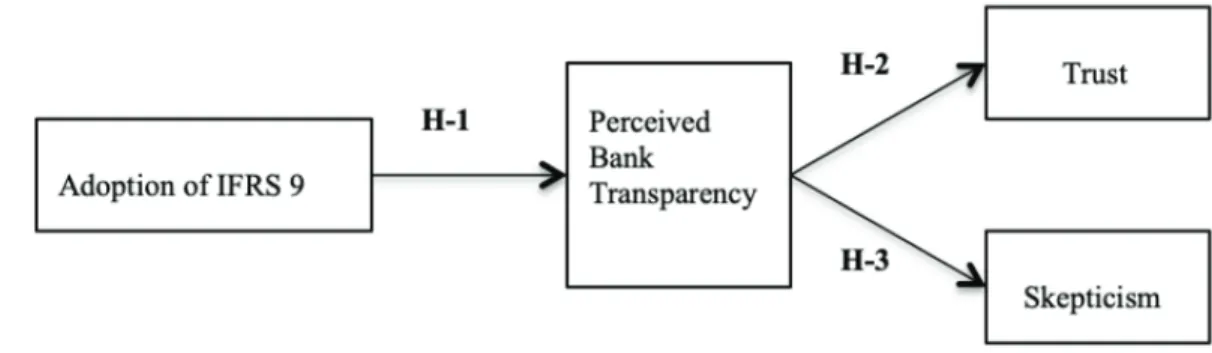
The global financial crisis in 2008 eroded trust towards the banking industry overall. To make such institutions more transparent, the International Accounting Standard Board developed the International Financial Reporting Standard 9 (IFRS 9). After the announcement of IFRS 9, academic research has primarily focused on examining the stability of banks due to early loan-loss recognition guidelines under the new system. There appears to be a lack of understanding of how IFRS 9 has influenced institutional depositors’ opinions of bank trustworthiness. Hence the goal of this study is to determine how the adoption of IFRS 9 by banks has impacted perceptions of transparency, trust, and skepticism, from the perspective of large institutional depositors. This research was conducted in the context of Malaysian banks that follow the IFRS 9 guidelines. A framework is proposed using the signaling theory, leading to the development of a set of hypotheses.
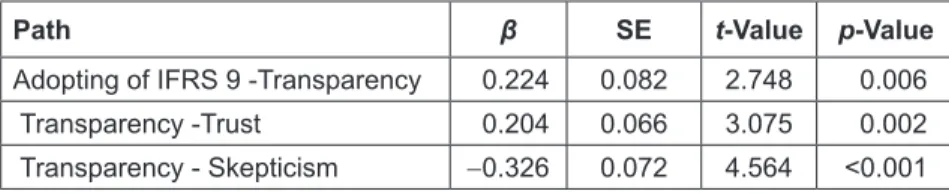
The hypotheses are tested with data collected from 654 financial analysts working in Malaysian companies that are large institutional depositors. The results indicate that the adoption of IFRS 9 has led to higher levels of perceptions of bank transparency and trust, and lower levels of skepticism towards such banks.
Keywords: IFRS 9, Banks, Banking Industry, Transparency, Trust, Skepticism JEL Classification Code: M40, M41, M48, M49
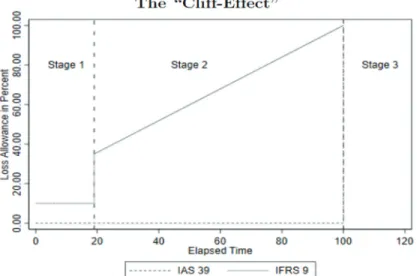
IFRS 9 specifies how an entity should classify and measure financial assets, financial liabilities, and some contracts to buy or sell non-financial items. Accordingly, from 2018 onwards, all major banks in Malaysia have switched from the IAS 39 regime to IFRS 9 (Deloitte Report, 2020).
The adoption of the new accounting system necessitates early credit loss recognition that must be provisioned by banks and reflected in the public disclosure of their financial statements (Hameedi et al., 2021). Since the adoption of the new system, several studies have been undertaken globally as well as in Malaysia to determine how it impacts the stability of the banks (Hartmann- Wendels & Imanto, 2019). Most of these studies attempt to measure the stability of banks from the perspective of bank regulatory bodies such as the central bank in Malaysia (Bank Negara) (Hasnan, 2019). However, little is known about the perspective of large institutional depositors, after the adoption of IFRS 9, in terms of their perceptions about transparency, trust, and skepticism regarding such banks when they decide to place large deposits.
The focus on transparency, trust, and skepticism towards financial institutions came to the forefront particularly after the 2008 global financial crisis where many local and
1
First Author and Corresponding Author. Assistant Professor, Department of Managerial and Financial Sciences, Al-Zahra College for Women, Muscat, Oman [Postal Address: Muscat, Sultanate of Oman] Email: [email protected]
2
Assistant Professor, Department of Management, College of Economics & Political Science, Sultan Qaboos University, Muscat, Oman. Email: [email protected]
3
Assistant Professor, Department of Managerial and Financial Sciences, Al-Zahra College for Women, Muscat, Oman.
Email: [email protected]
© Copyright: The Author(s)
This is an Open Access article distributed under the terms of the Creative Commons Attribution Non-Commercial License (https://creativecommons.org/licenses/by-nc/4.0/) which permits unrestricted non-commercial use, distribution, and reproduction in any medium, provided the original work is properly cited.