Abstract
BACKGROUND: Biochar-based fertilizers delay the nutrient release and feature a slow release effect for agricultural and environmental advantages. This experiment was conducted to evaluate agro-environmental effects of different application ratios of modified biochar pellets supplemented.
METHODS AND RESULTS: The treatments consisted of the control, 40% N, 60% N and 60% N (0.07M MgO) of modified supplemented biochar pellets (MSBP), which were based on recommended ratio of nitrogen for rice cultivation.
For the paddy water, the NH4-N and NO3-N concentrations in whole treatments rapidly increased at 84 days and 40 days after transplanting, respectively. The PO4-P concentrations in the MSBP were generally lower than those of the control. For the paddy soil, NH4-N concentrations in the MSBP were higher than those of the control at 5 days after transplanting, while NO3-N concentrations were not significantly different
in the treatments through rice cultivation. P2O5 concentrations in the control were higher than those of the MSBP until 40 days after transplanting while K2O concentrations were not significantly different among the treatment. The highest carbon sequestration was 970 kg ha-1 in the 60% N (0.07M MgO), and the potential carbon storage in the 60% N (0.07M MgO) was higher at 222 kg ha-1 than the control during rice cultivation. It shown that the rice yield in the control was not significantly different from the 40% N and 60% N (0.07M MgO) application plots.
CONCLUSION: Application of MSBP for rice cultivation was effective for carbon sequestration and agro-environmental effects even though nitrogen application ratio was reduced at 40% based on recommended application ratio of fertilizer.
Key words: Agro-environmental effect, Carbon sequestration, Modified blended biochar pellet, Rice cultivation
서 론
선진국 중심으로 온실가스 감축 의무가 부여되는 기후체 제에서 개도국을 포함한 유엔 가입국 모두 온실가스 감축 의 무가 부여된 신기후체제가 출범하게 됨에 따라서 기후변화를
*Corresponding author: JoungDu Shin Phone: +82-63-238-2494; Fax: +82-63-238-3823;
E-mail: [email protected]
Korean J Environ Agric. 2020;39(2):114-121. Korean Online ISSN: 2233-4173
Published online 2020 June 23. https://doi.org/10.5338/KJEA.2020.39.2.15 Print ISSN: 1225-3537
벼 재배 시 바이오차 펠렛 시용 수준에 따른 농업 환경 영향 및 토양 탄소격리 평가
신중두1*, 박도균1, 김희선1, 이선일1, 홍승길2
1농촌진흥청 국립농업과학원 농업환경부 기후변화생태과, 2농촌진흥청 기술협력국 국외농업기술과
Evaluation of Agro- Environmental Effect and Soil Carbon Sequestration to different Application Ratios of Supplemented Biochar Pellet in the Paddy during Rice
Cultivation
JoungDu Shin1*, Dogyun Park1, Huiseon Kim1, SunIl Lee1 and SeungGil Hong2 (1Climate Change & Agroecology Division, Department of Agricultural Environment, National Institute of Agricultural Sciences, Rural Development Administration, Wanju 55365, Korea, 2Division for Korea Program for International Cooperation in Agricultural Technology, Technology Cooperation Bureau, Rural Development Administration, Jeonju 54875, Korea)
Received: 1 June 2020/ Revised: 12 June 2020/ Accepted: 16 June 2020 Copyright ⓒ 2020 The Korean Society of Environmental Agriculture
This is an Open-Access article distributed under the terms of the Creative Commons Attribution Non-Commercial License (http://creativecommons.org/licenses/by-nc/3.0) which permits unrestricted non-commercial use, distribution, and reproduction in any medium, provided the original work is properly cited.
ORCID JoungDu Shin
https://orcid.org/0000-0002-5941-3438
SeungGil Hong
https://orcid.org/0000-0002-5214-8061
114
Research Article Open Access
완화할 수 있는 온실가스 감축 기술 개발이 더욱 필요하게 되었 다. 농업 부문도 효율적이고 체계적인 온실가스 감축 기술 개발 이 필요한 시점에 도달하게 되었다. 우리나라는 2030년까지 온 실가스 배출전망치(BAU; Business As Usual) 대비 37% 감 축 목표를 설정하였으며, 농축산부문은 BAU 대비 7.9% 감축 량이 할당되었다.
최근에 바이오차와 같은 탄소가 풍부한 바이오매스 전환 산물은 농업 생태계로부터 온실가스를 완화하는 좋은 소재로 주목받고 있다[1]. 다양한 목적으로 이용할 수 있는 바이오차 는 산소가 없는 조건에서 바이오매스 전환 기술을 통하여 생 산된 다공성 탄소 소재이다[2]. 바이오차의 구성 물질은 원료 와 열분해 조건에 좌우된다고 하였다[3-5]. 농업 부산물로부 터 생산된 바이오차는 100년 동안 미생물에 의해 분해되지 않는 탄소 이중 고리와 방향족으로 구성되어있다[6]. 바이오 차를 시용한 논 토양에서 NH3 휘산으로 인해 논 표면수의 NH4-N 농도가 증가하였으며, 벼 수량은 증수되었다[7]. 반 면에 농업 생태계에서 바이오차 시용의 효과는 양분을 흡착 하거나 보유하는 능력이 있다고 제안하였다[8]. 바이오차를 농경지에 시용함으로서 돈분 퇴비 및 녹비에 포함된 질소 이 동에 관여한다[9-11]. 또한, 바이오차를 시용함으로서 논 토양 에서 CO2 발생량을 줄이며[12], 콩 재배지에서 N2O 배출량 의 50%를 줄이는 효과가 있는 것으로 발표되었다. 돈분 및 바 이오차 펠렛을 시용한 논 표면수의 NH4-N와 NO3-N의 농도 는 시판되고 있는 완효성 비료 보다 1.6배 낮았으며, 토양에서 의 NH4-N의 농도는 높게 관측되었다[13].
단기간 탄소격리는 토양에서 유기물이 분해되는 과정에서 발생하는 CO2 배출량을 줄이는 것을 말하며, 반면 장기간 탄소격리는 열 전환 물질인 바이오차로서 저장되는 것을 말 한다. 왕겨나 옥수숫대로부터 전환된 바이오차는 토양에서 장기간 탄소를 격리하는 효과가 있다[14]. 바이오차 펠렛을 시용한 논 토양에서 탄소격리량은 2.94 tonnes ha-1로 산정 되었다[13].
그러므로 기후변화 대응 농업 분야 온실가스 배출권 거래 제 확대 방안의 하나로 탄소격리가 대두되었으나 농촌 현장에 서 바이오차의 투입 시 미세분진이 형성되어 실제로 농경지 살포에 어려움이 있어 바이오차 공급 및 농경지 살포 방법 개 선이 필요하였다. 따라서 일 회 시용으로 탄소격리, 지력 증진, 생력 효과 등 다양한 효과를 얻을 수 있는 바이오차 및 가축분 뇨를 이용한 펠렛 형태의 완효성 비료를 제조하였다. 본 연구 는 벼 재배 시 바이오차 펠렛 시용량에 따른 논물과 토양 중의 화학성 평가, 토양 탄소격리량 평가 및 벼 생육 특성을 고려한 농업 환경 영향 평가를 수행하였다.
재료 및 방법
바이오차 펠렛 조제
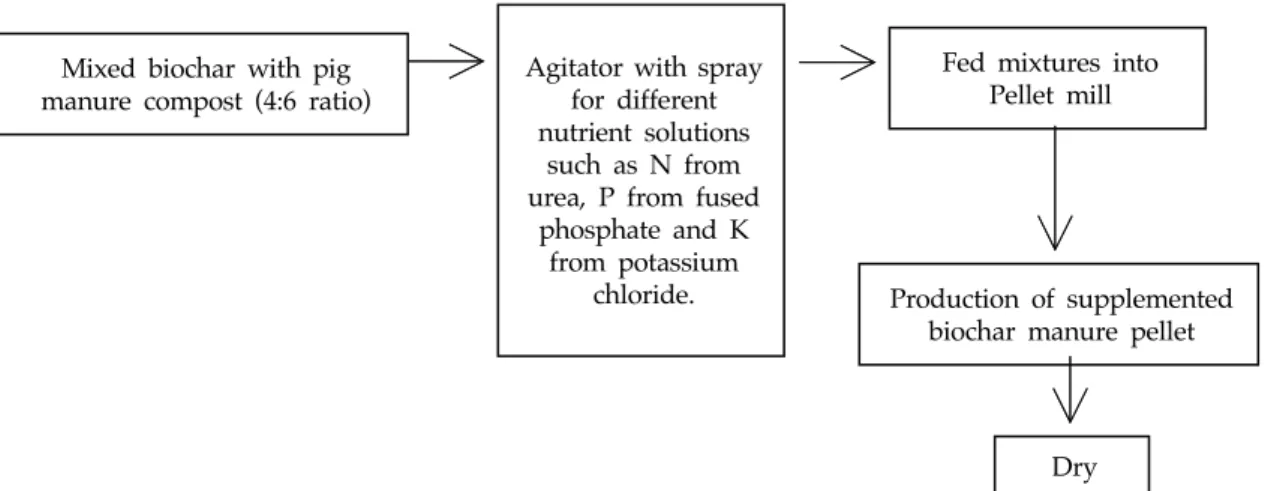
돈분 퇴비와 개량 왕겨 바이오차를 6 : 4로 혼합하여 N-P-K 용액을 분사한 후 펠렛 형태로 조제하였다(Fig. 1). 바이오차 펠 렛 제조 공정에 이용된 원료 물질에 대한 화학성분 함량은 Table 1에 나타내었다.
Mixed biochar with pig manure compost (4:6 ratio)
Agitator with spray for different nutrient solutions
such as N from urea, P from fused
phosphate and K from potassium
chloride.
Fed mixtures into Pellet mill
Production of supplemented biochar manure pellet
Dry
Fig. 1. Diagram of processing the supplemented biochar manure pellets with different types of fertilizer.
Materials Used pH EC TC TOC TIC TN
(dS m−1) ---g kg−1---
Biochar 9.67 (1:10) 1.4 566 533 33.5 2.0
Pig manure compost 8.77 (1:5) 3.4 289 259 30.2 29.1
a)EC; Electric conductivity, TC; Total carbon, TOC; Total organic carbon, TIC; Total inorganic carbon, and TN; Total nitrogen.
Table 1. Chemical properties of biochar and pig manure compost useda)
바이오차 펠렛 및 돈분 퇴비의 총질소 함량은 Table 2에 나타내었으며, 바이오차 펠렛의 총질소 함량은 각각 68.7과 69.4 g kg-1을 함유하고 있었으며, 돈분 퇴비는 30.2 g kg-1 이었다.
벼 재배 관리
본 연구는 국립농업과학원 논 시험포(위도, 35° 49.510´N;
경도, 127° 2.536´E)에서 수행되었으며, 본 실험에 이용한 벼 품종은 신동진으로, 재식거리는 30cm × 60cm이었다. 대조구 는 농촌진흥청의 벼 재배 시 표준비료사용량(N-P-K, 9-4.5-5.7 kg 10a-1)과 돈분 퇴비(260 kg 10a-1)를 기준으로 질소와 가 리는 기비와 추비로 나누어 2회에 걸쳐 분할 시용하였으며, 돈 분 퇴비와 인산은 전량 기비로 시용하였다. 바이오차 펠렛형 완효성 비료는 각각 대조구의 질소 시용량 기준 40% (40%
N), 60% (60% N) 수준 및 질소 60% 수준에 0.07M MgO 를 반응시켜(60% N + 0.07M MgO), 3수준 모두 전량 기비 로 시용하였다. 시험구 배치는 3 반복 세구배치법으로 수행하 였다. 시험 전 토양에 대한 이화학성 성분을 각각 Table 3에 나타내었다. 시험 포장의 토양은 pH 6.0으로 중성이며, 질소 함량이 낮은 식양토이었다.
벼 재배 관리는 농촌진흥청 표준 재배법에 따랐다. 처리 간에 벼 생육을 비교하기 위해 초장과 분얼수를 조사하였으 며, 조곡 수량 및 볏짚 무게는 재배 면적 중 1×1 m를 조사하 여 산정하였다.
토양 화학 성분 분석
논의 물 시료는 이앙 후 5일, 9일, 19일, 40일 및 84일에 시료 를 채취하였고, 토양 시료는 논 표면 수 시료와 같이 연이어 117 일까지 확장하여 시료 채취한 후, 풍건하여 2 mm체에 걸러 화 학성분 분석에 이용하였다. 논 표면수는 여과지(Whatman #4) 에 여과 후 NH4-N 및 NO3-N은 UV Spectrophotometer를 사용하여 측정용 키트(C-Mac, Korea)로 당일 분석한 후, 나 머지 물 시료는 4℃에 냉장 보관하였다. 그 후 PO4-P와 K는 UV Spectrophotometer를 사용하여 측정용 키트로 분석하였다.
논 토양의 pH와 EC는 (1:10)으로 100 mL삼각플라스크에 체 거름한 건조한 토양 5g과 증류수 50 ml를 가하여 항온 진 탕기(JP/NTS-3000 Eyela Japan)에서 30분간 200 rpm으로 진탕한 후, pH, EC meter (Orion 4 star, Themo scientific, USA)로 측정하였다. 2M KCl 침출액은 EPA Method 350.2 에 따라 UV Spectrophotometer 측정용 키트로 NH4-N과 NO3-N의 농도를 측정하였다. 토양 중의 PO4-P와 K의 농도 는 Mehlich Ⅲ 분석 방법 [15]에 따라 100 mL 삼각플라스크 에 채 거름한 토양 4g과 Mehlich Ⅲ 추출액 40mL를 넣고 항온진탕기(JP/NTS-3000 Eyela Japan)로 5분간 200 rpm 으로 진탕한 후 여과지(Whatman No.2)로 여과한 침출액을 UV Spectrophotometer를 사용하여 측정용 키트로 분석한 후 변환 수식을 이용하여 계산하였다. TN (Total Nitrogen)과 TC (Total Carbon)은 체 거름 한 건조 토양을 원소분석기(Vario EL II, Elementar, Germany)를 이용하여 측정하였다.
토양 탄소격리 산정
바이오차 완효성 비료 시용에 따른 토양 탄소격리량 산정 은 이앙 직후와 수확 후 토양의 탄소 함량을 수식 1을 이용하 여 산정하였다[13].
=
× (1)는 토양의 잠재 탄소 격리(kg 10a-1), 는 바이오차 펠렛 처리구, 는 대조구, 는 시료 채취 시기별 토양 탄 소 함량(g kg-1), 와 는 초기와 수확 후 토양 탄소 함량(g kg-1), 그리고 는 토양 비중을 고려한 작토층 10 cm의 토 양 무게(kg 10a-1)를 말한다.
통계처리
실험 자료에 대한 통계 분석은 Excel 2016 version을 이 용 하였으며, 처리 간에 논물과 토양에 대한 화학성분 비교를 위해 표준편차를 이용하였다.
Biochar pellets TNa) (g kg-1)
Supplemented biochar pellet 69.4
Supplemented biochar pellet catalyzed 0.07M MgO 68.7
Pig manure compost 30.2
a)TN; Total nitrogen
Table 2. Total nitrogen contents of supplemented biochar pellets and pig manure compost
Characteristics Soil texture pH ECa) TNb) TCc) P2O5 K2O
uScm-1 ---g kg-1 --- ---mg kg-1---
Soil Clay loam 6.0 0.56 7.7 9.2 64.3 70.3
a)EC: Electrical conductivity, b)TN: Total nitrogen, c)TC: Total carbon Table 3. Physicochemical properties of soil used in this study
탄소격리량 및 작물 생육 특성에 대한 처리간 유의성 검정 은 SAS version 9.2 Software (SAS, Inc., Cary, NC, USA) 를 사용하여 ANOVA검정을 하였다.
결과 및 고찰
바이오차 펠렛 처리에 따른 논 표면수 수질 평가 벼 재배 시 바이오차 펠렛 시용 수준에 따른 논 표면수의 NH4-N 및 NO3-N 농도 분석 결과는 Fig. 2와 같다. 시용된 요소비료 시용은 NH4+ 이온과 OH- 이온으로 가수 분해되 기 때문에 암모늄 이온의 주요한 공급원(Source)이다. 전반 적으로 논물에서 이앙 후 짧은 기간 내에 NH4-N의 농도가 증가하였으며, 논 표면수의 질소 함량 변화는 처리와 관계없 이 NH4-N 농도는 이앙 후 40일까지 2 mg L-1 이하였으며, NO3-N농도는 이앙 후 15일까지 1 mg L-1 이하로 낮게 지 속하였다. 볏짚과 바이오차를 각각 6과 2 tonnes ha-1를 처 리한 구에서 NH4-N의 농도는 증가하였다고 보고하였다 [16]. 또한, NH4-N은 이앙 후 84일 그리고 NO3-N은 이앙 후 40일에 갑자기 증가하였다. 이는 바이오차가 NH4-N을 흡착하고 있어 초기에 용출이 거의 이루어지지 않다가 84일 이후에 용출되어 나온다는 [13]의 연구 결과와도 일치하는 것이다.
Fig. 2. Effects of different application rates of modified supplemented biochar pellets on NH4-N and NO3-N concentrations in paddy water during rice cultivation.
The values were average of three replications, and error bars displayed standard deviation (p<0.05).
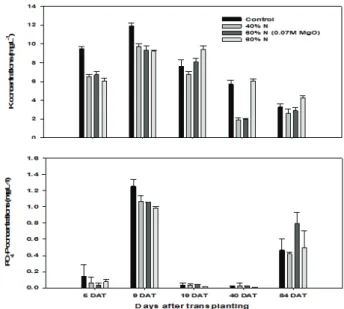
벼 재배 시 바이오차 펠렛 완효성 비료 처리에 따른 논 표면수의 PO4-P 및 K 함량 변화를 Fig. 3에 나타내었다. 논 표면수의 PO4-P의 함량은 이앙 후 9일째 모든 처리구에서 1 mg L-1 이상 높게 나타났으며, 대조구의 1.25 mg L-1와 비 교하여 처리구에서 전반적으로 낮게 나타났다. 또한, 대조구 의 K의 농도는 벼 재배 기간에 N 60% 처리구의 이앙 후 84 일을 제외하고는 모든 바이오차 펠렛 처리구 보다 높게 나타 났다.
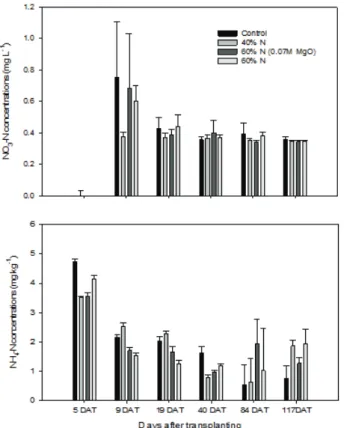
바이오차 펠렛 처리에 따른 논 토양 화학성 평가 벼 재배 시 바이오차 펠렛 완효성 비료 처리에 따른 논 토 양 중의 NH4-N 및 NO3-N 함량 변화는 Fig. 4에 나타내었 다. 토양 중에 질소 순환은 유기태 질소로부터 질소 무기화 과 정을 거치게 되면 NH4-N로 변환되며, 질산화 과정을 거치게 되면 NO3-N으로 최종적으로 (NO)x로 변환되어 탈질과 휘산 에 관여하게 된다는 사실은 일반적으로 잘 알려진 질소 순환 사이클이다. 토양 중에 NH4-N 농도는 이앙 후 5일까지는 대 조구가 바이오차 펠렛 처리구 보다 높게 나타났으며, 벼 생육 시기가 지남에 따라, 바이오차 펠렛 처리구에서 NH4-N 농도 가 높게 나타났다. 이러한 현상은 NH4-N을 흡착한 바이오차 [17]에서 벼 생육에 필요한 암모늄태 질소 성분이 지속적으로 공급되고 있는 것으로 판단된다. 그리고 NO3-N의 농도는 처 리구간에 유의차를 보이지 않았다.
벼 재배 시 바이오차 펠렛 완효성 비료 처리에 따른 논 토 양 중의 P2O5 및 K2O 함량 변화는 Fig. 5에 나타내었다. 토양 중의 P2O5의 농도는 이앙 후 40일까지는 대조구가 바이오차 펠렛 처리구 보다 높았으며, K2O 함량은 처리 간에 유의차가 없었다. 하지만, 벼 재배하는 동안 바이오차를 혼용한 토양은
Fig. 3. Effects of different application rates of modified supplemented biochar pellets on PO4-P and K concentrations in paddy water during rice cultivation. The values were average of three replications, and error bars displayed standard deviation (p<0.05).
Fig. 4. Effects of different application rates of modified supplemented biochar pellets on NH4+-N and NO3--N concentrations in paddy soil during rice cultivation. The values were average of three replications, and error bars displayed standard deviation (p<0.05).
Fig. 5. Effects of different application rates of modified supplemented biochar pellets on P2O5 and K2O concentrations in paddy soil during rice cultivation. The values were average of three replications, and error bars displayed standard deviation (p<0.05).
바이오차의 높은 함량 때문에 벼의 K+ 이용성을 증가시킨다 는 보고도 있다[18].
바이오차 펠렛 처리에 따른 토양 탄소 함량 변화 벼 재배 시 바이오차 펠렛 완효성 비료 처리에 따른 이앙 직후와 수확 후 논 토양 중의 총 탄소 함량 변화는 Table 4 에 나타내었다. 벼 이앙 직후와 수확 후 토양의 총 탄소 함량 은 대조구가 각각 6.53 g kg-1과 11.87 g kg-1으로 가장 높았 으며, 바이오차 펠렛 N 60%처리구가 3.77 g kg-1와 9.50 g kg-1으로 가장 낮게 나타났다. 하지만 순 탄소 증가율을 보면 대조구는 약 89% 증가했지만 40% N에서는 123%, 60% N (0.07M MgO)에서는 170%, 60% N에서는 152% 각각 증가 한 것으로 나타나 대조구 대비 34~81% 높게 나타났다. 이는 논에 바이오차를 29.6 tonnes ha-1 시용 했을 때 대조구와 비 교하여 총 탄소 함량이 약 58%가 증가하였다는 결과와 유사 하였다[19].
바이오차 펠렛 처리에 따른 탄소격리량은 수식 1에 의해 산정 되었다(Table 5). 잠재 토양 탄소 격리량은 대조구에 비 해 60% N (0.07M MgO)처리구가 222 kg 10a-1으로 가장 높게 나타났다.
[13]은 벼 재배하는 동안 바이오차 펠렛 처리에 따른 탄소 격리량은 1.65 tonnes ha-1라고 발표하였는데, 본 연구에서는 60% N (0.07M MgO) 처리구에서는 2.2 tonnes ha-1로 약 0.55 tonnes ha-1 더 많게 산정되었다.
바이오차 펠렛 처리에 따른 벼 생육 특성 및 수량 바이오차 펠렛 시용에 따른 벼 생육 반응은 Table 6에 나 타내었다. 대조구의 초장은 바이오차 펠렛 처리구에 비해 1.2 배 높았으며, 벼 조곡 수량은 대조구의 650 kg 10a-1에 비해 질소 추천 시비량인, 바이오차 펠렛 40% N 처리구와 60% N + 0.07M MgO 처리구간에는 유의차(P>0.05)가 인정되지 않 았다. 볏짚 무게는 대조구와 40% N, 60% N + 0.07M MgO 사이에는 유의차가 인정되지 않았지만, 60% N 처리구는 768 kg 10a-1로서 가장 낮았다. 목재 바이오차 혼용 퇴비 펠렛을 시용함으로서 조곡 수량이 대조구와 비교하여 16.1%-36.3%
증가 하였다고 발표하였다[20]. 바이오차를 시용한 포장의 벼 수량이 대조구에 비해 약 8.8%~22% 범위로 증수하였다고 발 표한 결과도 있으나[21, 22], 본 연구의 결과는 바이오차 펠렛 처리구와 대조구 사이에 벼 수량에 유의차가 없는 것으로 나 타나 기존 결과와 유사하였다[13].
결 론
벼 재배 시 바이오차 펠렛의 시용에 따른 논물과 토양에서 환경영향 평가를 수행하였다. 논 표면수의 질소 함량 변화는 처리와 관계없이, NH4-N 농도는 이앙 후 40일까지 그리고 NO3-N 농도는 이앙 후 15일까지 낮은 농도를 유지하였다.
PO4-P 및 K의 농도는 대조구와 비교하여 바이오차 펠렛 처리 구에서 전반적으로 낮게 나타났다. 토양 중에 NH4-N 농도
Treatmentsa) 1st day of transplanting Days after harvesting
Control 6.56±1.01 11.87±0.18
40% N 4.53±0.05 10.10±0.15
60% N (0.07M MgO) 3.89±0.06 10.53±0.25
60% N 3.77±0.01 9.50±0.11
a)Control; Recommended application amounts of fertilizers and pig manure compost, 40% N, 60% N and 60% N (0.07M MgO) of modified supplemented pellets (MSBP) which were based on 40% N, 60% N and 60% N of recommended rate of nitrogen and 60% N (0.07M MgO) reacted with major nutrient solution and 0.07M MgO for rice cultivation. The values were average of three replications with standard deviations.
Table 4. Total carbon contents to different application rates of modified supplemented biochar pellets in paddy soil during rice cultivation
Treatments Carbon sequestration (kg ha-1) Potential carbon sequestration (kg ha-1)
Control 748 -
40% N 819 71
60% N (0.07M MgO) 970 222
60% N 876 128
F-value 555.06 -
Pr>F <0.01 -
a)Mean values followed by different letters, which indicate significant differences (p < 0.05) among treatments with One way ANOVA by the mean comparison for all pairs using Tukey-Kramer HSD analysis for carbon sequestration.
Table 5. Evaluation of potential carbon sequestration to different application rates of modified supplemented biochar pellets during rice cultivationa)
Treatments Plant height
(cm) Number of Tiller Grain yield (kg ha-1)
Straw yield
(kg ha-1) Harvest index
Control 105±11.9 13±4.5 650±78.0 968±178.5 0.67
40% N 83±1.7 14±2.8 593±27.7 985±112.8 0.62
60% N (0.07M MgO) 84±2.8 11±2.1 644±14.4 888±127.2 0.73
60% N 86±4.2 14±1.3 535±37.6 768± 61.0 0.70
F-vallue 3.69 2.45 36.8 630.3 -
Pr>F <0.053 <0.13 <0.01 <0.05
Table 6. Rice growth components to different application rates of modified supplemented biochar pellets during rice cultivation
는 벼 생육기간이 지남에 따라 바이오차 펠렛 처리구의 농도 가 높게 나타남에 따라, 벼 생육에 필요한 암모늄태 질소 성분 이 지속적으로 공급되고 있다고 판단되었다. 그리고 잠재 토양 탄소격리량은 대조구에 비해 60% N (0.07M MgO) 처리구 가 222 kg 10a-1으로 가장 높게 나타났다. 벼 정조 수량은 대 조구의 650 kg 10a-1에 비해 질소 추천 시비량인 바이오차 펠 렛 40% N 처리구와 60% N (0.07M MgO) 처리구 간에는 유의차가 인정되지 않았다. 따라서 벼 재배 시 개량한 바이오 차 펠렛의 가장 적절한 시용량은 60% N (0.07M MgO)로 나 타났으며, 바이오차 펠렛 시용은 기후변화 대응 탄소격리뿐만
아니라 논 표면수 및 토양에서의 환경 영향을 줄일 수 있는 완 효성 비료로서 적합하다고 판단된다.
Note
The authors declare no conflict of interest.
Acknowledgement
This work was supported by the National Institute of
Agricultural Sciences, Rural Development Administration, Republic of Korea [project no. PJ 01381401].
References
1. Liu X, Zhou J, Chi Z, Zheng J, Li L, Zhang X, Zheng J, Cheng K, Bian R, Pan G (2019) Biochar provided limited benefits for rice yield and greenhouse gas mitigation six year following an amendment in a rice paddy. Catena 179, 20-28.
https://doi.org/10.1016/j.catena.2019.03.033.
2. Zhang X, Zhang L, Li A (2017) Hydrothermal co-carbonization of sewage sludge and pinewood sawdust for nutrient-rich hydrochar production: Synergistic effects and products characterization. Journal of Environmental Management, 201, 52–62.
https://doi.org/10.1016/j.jenvman.2017.06.018.
3. Subedi R, Bertora C, Zavattaro L, Grignani C (2017) Crop response to soils amended with biochar: expected benefits and unintended risks. Italian Journal of Agronomy, 12, 161–173.
4. Domene X, Enders A, Hanley K, Lehmann J (2015).
Eco-toxicological characterization of biochars: role of feedstock and pyrolysis temperature. Science of The Total Environment, 512-513, 552–561.
https://doi.org/10.1016/j.scitotenv.2014.12.035.
5. Genesio L, Miglietta F, Baronti S, Vaccari FP (2015) Biochar increases vineyard productivity without affecting grape quality: results from a four years field experiment in Tuscany. Agriculture, Ecosystems and Environment, 201, 20–25.
https://doi.org/10.1016/j.agee.2014.11.021
6. Liu WJ, Jiang H, Yu HQ (2015) Development of biochar-based functional materials: toward a sustainable platform carbon material. Chemical Reviews, 115(22), 12251–12285.
https://doi.org/10.1021/acs.chemrev.5b00195
7. Sun X, Zhong T, Zhang L, Zhang K, Wu W (2019) Reducing ammonia volatilization from paddy field with rice straw derived biochar. Science of The Total Environment, 660, 512–518.
https://doi.org/10.1016/j.scitotenv.2018.12.450
8. Ding Y, Liu Y, Liu S, Li Z, Tan X, Huang X, Zeng G, Zhou L, Zheng B (2016). Biochar to improve soil fertility.
A review. Agronomy for Sustainable Development, 36, 1-18. https://doi.org/10.1007/s13593-016-0372-z 9. Clough TJ, Bertram JE, Ray JL, Condron LM, O’Callaghan
M, Sherlock RR, Wells NS (2010) Unweathered wood bio-char impact on nitrous oxide emissions from a
bovine-urine amended pasture soil. Soil Science Society of America Journal, 74(3), 852-860.
https://doi.org/10.2136/sssaj2009.0185|
10. Laird D, Fleming P, Wang B, Horton R, Karlen D (2010) Biochar impact on nutrient leaching from a Midwestern agricultural soil. Geoderma, 158(3-4), 436-442.
https://doi.org/10.1016/j.geoderma.2010.05.012 11. Knowles OA, Robinson BH, Contangelo A, Clucas L
(2011) Biochar for the mitigation of nitrate leaching from soil amended with biosolids. Science of The Total Environment, 409(17), 3206-3210.
https://doi.org/10.1016/j.scitotenv.2011.05.011.
12. Zhang A, Cui L, Pa G, Li L, Hussain Q, Zhang X, Zheng J, Crowley D (2010) Effect of biochar amendment on yield and methane and nitrous oxide emissions from a rice paddy from Tai Lake plain, China. Agriculture, Ecosystems and Environment, 139(4), 469–475.
https://doi.org/10.1016/j.agee.2010.09.003.
13. Shin J, Jang E, Park S, Ravindran B, Chang S (2019) Agro-environmental impacts, carbon sequestration and profit analysis of blended biochar pellet application in the paddy soil-water system. Journal of Environmental Management, 244, 92-98.
https://doi.org/10.1016/j.jenvman.2019.04.099.
14. Mohan D, Abhishek K, Sarswat A, Patel M, Singh P, Pittman CU (2018) Biochar production and applications in soil fertility and carbon sequestration–a sustainable solution to crop-residue burning in India. Royal Society of Chemistry Advances, 8(1), 508-520.
https://doi.org/10.1039/C7RA10353K.
15. Mehlich A (1984) Mehlich 3 soil test extractant: A modification of Mehlich 2 extractant. Communications in Soil Science and Plant Analysis, 15(12), 1409-1416.
https://doi.org/10.1080/00103628409367568.
16. CUI YF, Meng J, WANG QX, ZHANG WM, CHENG XY, CHEN WF (2017) Effects of straw and biochar addition on soil nitrogen, carbon, and super rice yield in cold waterlogged paddy soils of North China.
Journal of Integrative Agriculture, 16(5), 1064-1074.
https://doi.org/10.1016/S2095-3119(16)61578-2.
17. Choi YS, Kim SC, Shin JD (2015) Adsorption characteristics and kinetic models of ammonium nitrogen using biochar from rice hull in sandy loam soil. Korean Journal of Soil Science and Fertilizer 48(5), 413-420.
18. Lai WY, Lai CM, Ke GR, Chung RS, Chen CT, Cheng CH, Pai CW, Chen SY, Chen CC (2013) The effects of woodchip biochar application on crop yield, carbon sequestration and greenhouse gas emissions from
soils planted with rice or leaf beet. Journal of the Taiwan Institute of Chemical Engineers, 44(6), 1039-1044. https://doi.org/10.1016/j.jtice.2013.06.028.
19. Sui Y, Gao J, Liu C, Zhang W, Lan Y, Li S, Meng J, Xu Z, Tang L (2016) Interactive effects of straw- derived biochar and N fertilization on soil C storage and rice productivity in rice paddies of Northeast China. Science of The Total Environment, 544, 203-210.
https://doi.org/10.1016/j.scitotenv.2015.11.079.
20. Pokharel P, Chang SX (2019) Manure pellet, Wood chip and their biochars differently affect wheat yield and carbon dioxide emission from bulk and rhizosphere
soils. Science of The Total Environment, 659, 463–472.
https://doi.org/10.1016/j.scitotenv.2018.12.380.
21. Wang J, Pan X, Liu Y, Zhang X, Xiong Z (2012) Effects of biochar amendment in two soils on greenhouse gas emissions and crop production. Plant and Soil.
360, 287-298.
22. Zhang A, Bian R, Pan G, Hussain Q, Li L, Zheng L, Zhang X, Han X, Yu X (2012) Effects of biochar amendment on soil quality, crop yield and greenhouse gas emissions in Chinese rice paddy: a field study of 2 consecutive rice growing cycles. Field Crops Research, 127, 153–160. https://doi.org/10.1016/j.fcr.2011.11.020.