ORIGINAL ARTICLE
Trade Scale, Property Types, and Location Environment of Vacation Houses: Examples from Central Japan
Byung-Chuel Shin
*, Gu-Won Park
1)Department of Environmental Landscape Architecture, Joongbu University, Keumsan 32713, Korea
1)
Department of Tourism Management, Cheongju University, Cheongju 28503, Korea
Abstract
This study is a basic investigation of the contents and services relevant to the domestic vacation house business. In which, the trade scale, types of housing, and environmental conditions of various property locations were analyzed. The characteristics of properties listed on the Japanese website that conducts the greatest volume of vacation house trade in Japan were examined, and the following results were obtained: Villa areas, villas, and resort condos (resort mansions) are the three basic types of properties handled in the vacation house trade. In this market, sales per unit in villa areas and per spaces in resort condos accounted for the highest volume of trade, followed by that of villas (individual houses). In terms of land area, floor area, and sales price per house type, the relatively cheaper small and medium-sized vacation houses are more frequently traded, than expensive large-scale villas. In particular, small multi-family type villas (such as in resort condos) are the most popular. Land and floor area, and sales prices all show considerable variation depending on the type of property considered.
Therefore, a business initiative to provide a more detailed classification of properties is required. In terms of the environment of vacation properties, most are located on coasts, plateaus, or inland mountains, and are generally within three-hours’
traveling distance of large cities.
Key words : Vacation house, Villa (house), Villa area, Resort condos (mansion), Location environment, Tokyu resort
1) 1. Introduction
In Korea, there is recently a growing demand for vacation houses. In terms of residential development, the concept of the rural town house is rapidly spreading, contributing to the establishment of construction of vacation-house-type residences as a new model for residential space (Kim and Lee, 2010;
Lee and Kim, 2009; Park, 2010). In terms of resort business, the business of vacation house sales is developing further as a new business area as the
needs for vacation stays become more diverse (Oh, 2012a; Park, 2015).
Korea has a short history in this field, and there is a critical lack of information and business guidelines concerning vacation houses. There are no domestic laws or guidelines provided in regard to vacation houses, and organizations or companies specializing in vacation houses are few. The results from searches for papers available on websites such as research information service system (RISS) give further evidence of the situation. Research related to
Received 16 November, 2016; Revised 20 December, 2016;
Accepted 23 December, 2016
*
Corresponding author : Byung-Chuel Shin, Department of Environ -mental Landscape Architecture, Joongbu University, Keumsan 32713, Korea
Phone: +82-41-750-6718 E-mail: [email protected]
ⓒ The Korean Environmental Sciences Society. All rights reserved.
This is an Open-Access article distributed under the terms of the Creative Commons Attribution Non-Commercial License (http://
creativecommons.org/licenses/by-nc/3.0) which permits unrestricted
non-commercial use, distribution, and reproduction in any medium,
provided the original work is properly cited.
townhouses has recently showed a dramatic increase (Kim, 2012; Kim and Cho, 2011; Oh, 2012b; Suk et al., 2011), whereas those on vacation houses are rare.
There was only a single work available, and it was written in 1998 (Park, 1998).
This is a basic investigation of the trend in the domestic vacation house business. Using actual examples in Japan, the trade scale, house type, and environmental conditions at the location of vacation houses were analyzed, and the characteristics of these properties examined.
2. Materials and Methods
2.1. The vacation house as business and its handling A vacation house, or villa, is a house built for personal rest or vacation use, therefore its concept involves a high level of privacy. In Korea, vacation houses called Byeolseo were developed by the Sadaebu class (scholar-officials) during the Joseon Dynasty and by a small group of the ruling class and the wealthy, after independence.
Recently, vacation houses are gaining growing popularity following development of the concept called ‘collective possession’, including such as condos in conjunction with resort businesses. In South Korea, condo-type resort businesses started growing in the 1980s. However, vacation-house-type resorts with individual vacation houses have been under rapid development only since 2000. Recently, those designing resort complexes are developing vacation-house-type lodging products (Park, 2015).
Furthermore, there has recently been a great increase in cooperative housing, and many vacation-house areas are being constructed in the form of small complexes (Kim et al., 2010; Park, 2009). A national survey on public opinion concerning forest ownership in 2007 suggested that, given that they owned property in mountain areas, most of the demand for vacation houses was for locations in
mountainous areas (Park, 2015).
There must be a variety of types and forms of vacation houses, but the most important factors are probably the forms of trade (type, scale, and price) involved in buying and selling them. This is because the type, scale, and price of vacation houses are the most fundamental and important factors, both for individuals who want to own or use vacation houses, and for developers and investors who develop, sell, and manage them for business. Particularly in terms of business, houses are developed for sales by unit and general sales; thus, the development usually takes the form of a single complex or a district.
Likewise, from the business perspective, the trade scale, price, and environment at the location of vacation houses, are tremendously important factors.
In order to understand the reality of vacation houses, it is essential to examine the actual scale and form of the trade, and to identify the environmental characteristics of a location, which have a great influence on vacation house projects. However, there are only a few companies or organizations specialized in the development and sales of vacation houses in South Korea, which makes it difficult to gain practical understanding of the characteristics of the vacation house business there. For this reason, this study was focused on actual cases in Japan, where vacation houses are found in their most developed forms.
2.2. Study methods 2.2.1. Subject of study
In Japan, vacation house projects have been highly
developed since the 1960s. Therefore, the country has
accumulated an enormous amount of know-how in
the matter of vacation houses, and special trading
companies and intermediate agencies have been well
developed. In this study, the properties traded at
Tokyu Resort, which handles the greatest volume of
business for vacation-house-type resorts in Japan,
Region
Number (piece) Weight (%)
Villa
area Villa Resort
Mansion Total Villa
area Villa Resort
Mansion Total
Kantou 243 147 230 620 29.0 26.4 19.8 24.2
Koushinetsu 325 204 477 1,006 38.8 36.6 41.0 39.3
Chuubu 200 169 279 648 23.9 30.3 24.0 25.3
Kinki 50 17 149 216 6.0 3.1 12.8 8.4
Okinawa 19 20 28 67 2.3 3.6 2.4 2.6
Total 837 557 1,163 2,557 100.0 100.0 100.0 100.0
Weight 32.7 21.8 45.5 100.0
Source: Tokyu Resort (2014a, 2016a)
Note: Villa = Villa styled house, Villa area = housing site to build villa, Resort Mansion = Common villa styled condominium
Table 1. Type of vacation house and trade weight by type were investigated.
Tokyu Resort is a real estate company founded in 1978 specializing in resorts. It has a very long history and expertise in development and sales of vacation house type resorts, and the greatest volume of trade.
Currently, Tokyu Resort has 14 offices, and is in charge of managing and operating over 2,500 vacation houses across the country. These 2,500 properties were investigated in this study by analysis of the trade types of each property and the environment at the locations of vacation-house areas where the properties were most concentrated.
2.2.2. Study methods
The website of Tokyu Resort (2016a) assigns an identification number to, and records a detailed description of each property. The website also offers organized information on the characteristics of each area where the vacation houses are located. In this study, the information provided by Tokyu Resort was utilized for analysis. First, for the form of trade, the detailed information about each property displayed (property type, area, land area, floor area, price, and maintenance cost) was organized in a MS Excel spreadsheet. The trade scale and price were analyzed to examine their characteristics. Second, for the
environmental conditions at the location, the information available for each area on the website was used to analyze the location, weather, and conditions of the areas where the vacation houses were located, and the resulting characteristics were compiled.
3. Results
3.1. Types of vacation house and scale of trade 3.1.1. Types of vacation house and weight per type
Types of vacation house
Table 1 shows the types and number of vacation
houses managed and operated by Tokyu Resort. The
data show that vacation houses are largely
categorized into villa areas, villas, and resort
mansions. ‘Villa area’ refers to land where villas
could be constructed, that is, properties for sale to
businesses. Both villas and resort mansions are
vacation houses where individuals can lodge, and
villas are the properties that account for the majority
of vacation house sales. A villa is an independent
space consisting of a building with some external
space, whereas a resort mansion is a vacation house
constructed in the form of a mansion, and usually
multiple families share the property.
Type of
Vacation House unit Land Size (㎡)
Building Size (㎡)
Price (10,000 JPY)
Maintenance Cost (JPY/month)
Villa Area
avg 801 - 1,285.9 5,155.2
max 145 - 20 300
mix 6,241 39,800 65,000
Villa
avg 877 138.8 2,815.8 14,233.6
max 73 33 250 500
mix 7,234 1,457 45,000 94,563
Resort Mansion
avg 61.9 858.1 33,311.5
max 21 15 6,500
mix 314 8,000 298,222
Table 2. Land size and building size, price, and maintenance cost by type Trade volume per type
There were 2557 vacation houses available for sale on the Tokyu Resort website at the time the research was conducted. By type, these could be categorized into 837 villa areas (32.7%), 557 villas (21.8%), and 1163 resort mansions (45.5%). The number and trade volume of villa areas were greater than those of villas. The number and trade volume of resort mansions exceeded those of villas and villa areas (more than twice the trade volume of villas), and was the greatest among the three types. This result shows that the villa areas and resort mansions accounted for a good deal more of the vacation house business than did villas.
By area, the Kantou, Koushinetsu, and Chuubu areas near Tokyo contain 89% of the total vacation properties for trade.
3.1.2. Land area, floor area, and trade price per vacation house type
Table 2 shows the analysis of average land area and floor area, and sales price per vacation house type, based on the detailed description of each property provided on the Tokyu Resort website.
Land and floor areas
The average land area was 801.5 m
2for villa area, and 877.2 m
2for villa. The average floor area was
138.8 m
2for villa, and 61.9 m
2for resort mansion. In case of land area, both villa and villa area did not show a large difference, and most of them was about 825 m
2in size. The floor area was 138.8 m
2for villa, while resort mansions usually had a smaller size of about 62.7 m
2. In terms of land and floor areas, the majority was of small and medium-sized areas rather than large area. In case of resort mansion, properties of 66 m
2or smaller in size were mainly traded. Villas usually consist of two stories, thus, this appears to refer to 66 m
2.
Trade price
The average trade price of villas was 12,859,000 JPY for villa areas, 28,158,000 JPY for villas, and 8,582,000 JPY for space inside a resort mansion. In terms of price, the resort mansion space cost a third of the price of villa, thus the former is relatively cheaper than the latter. In terms of the price gap between villas and villa areas, the cost for land purchase accounted for half of the price of a villa, and the construction cost for the remaining half.
Overall, less expensive, small resort mansion spaces, and small to medium-sized villas and villa areas were mainly traded.
Deviation of trade scale and price
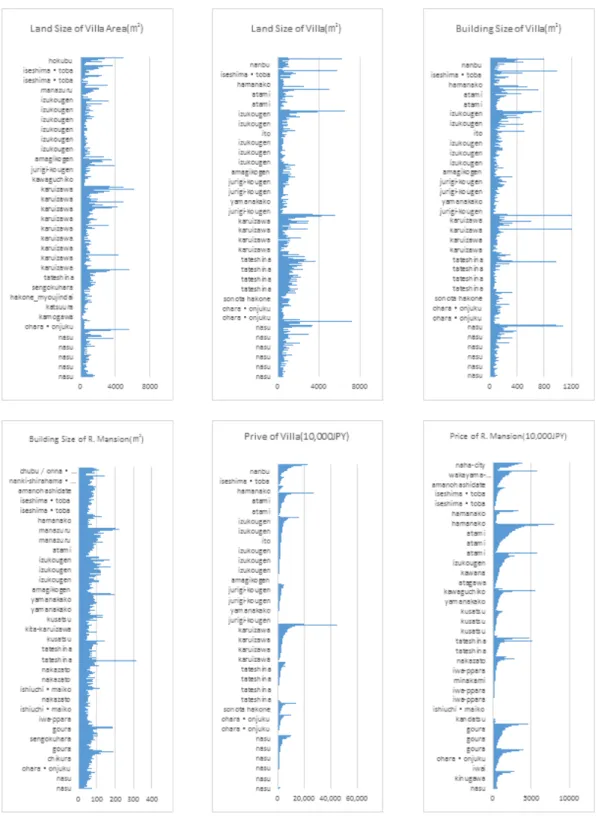
The trade scale and price of vacation houses varied
Fig. 1. Composition of land and building size and trade price on each object.
Classification Contents Configuration Classification Contents Configuration
Area
Hokkaido
Land Size
300 ㎡ under
Touhoku 300~599 ㎡
Nasu Kinugawa 600~999 ㎡
Boso 1000~1499 ㎡
Hakone 1500~1999 ㎡
Yamanakako Kawaguchi Fuji 2000 ㎡~
Kamakura Zushi Hayama
Building Size (exclusive use)
40 ㎡ under
Izu 40~49 ㎡
Atami Yugawara 50~59 ㎡
Hamanako 60~69 ㎡
Gifu Minamichita 70~79 ㎡
Yuzawa 80~89 ㎡
Tateshina Yatsukatake 90~99 ㎡
Miyoko Madarao 100~199 ㎡
Karuizawa 200 ㎡~
Kusatsu
Room Component 1R
Hokuriku 1K
Kansai 1DK
Iseshima Toba 1LDK
Wakayama Amanohashitate 2K
Shikoku 2DK
Tsugoko 2LDK
Kyushu 3K
Okinawa 4K
Foreign Country (Hawaii) 5K
Budget (Cost)
200 JPY under
Useable Facilities
Spa/Great Bath Place
200~299 JPY Great Bath Place(except in Spa)
300~399 JPY
Restaurant 400~499 JPY
500~999 JPY Pool 1000 ~1499 JPY Golf 1500 ~1999 JPY Ski
2000 ~2499 JPY Tennis
2500 ~2999 JPY Fitness
3000 ~3499 JPY
Bed (Possibility) 3500 ~3999 JPY
Type
Villa area 4000 ~4499 JPY
Villa 4500 ~4999 JPY
5000 ~7999 JPY
Resort Mansion 8000 ~9999 JPY
Rest & Recreation Center 100000 JPY ~
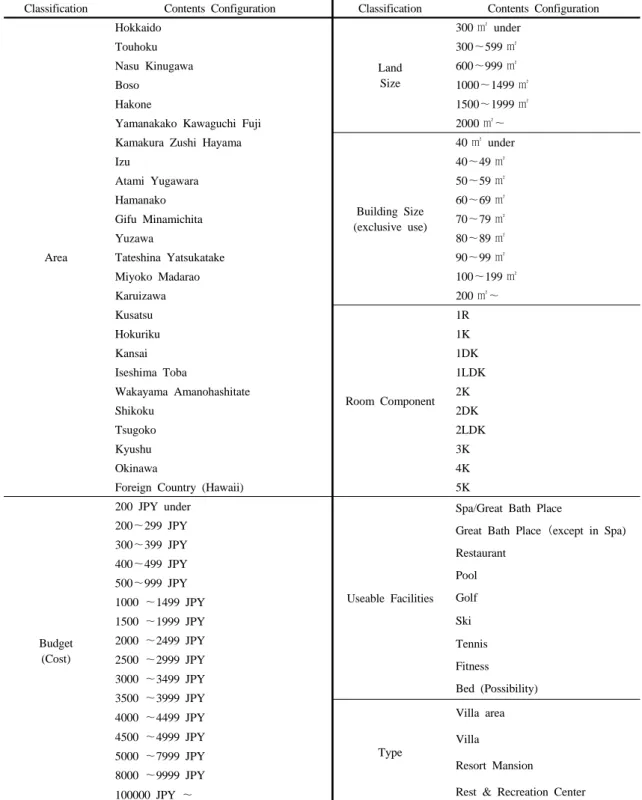
Source: Tokyu Resort (2016a)
Table 3. Component or screen criteria for sorting vacation houses
Business Part Contents and Service Note
Want to buy
• New ㆍ Newly Built villa and mansion
Smart trade guarantee
+ Safe residence
(Karte) + Resort Life Style (information
provided)
• Real rights (villa, mansion, and land)
• Merchant real rights (RE-WORTH: a revitalization plan of villas by Tokyu resort )
• LAXAGE (a new vacation house plan by Tokyu resort)
• Membership resort hotel (Tokyu Harvest Club: the joy of owning a vacation house with the ease of hotel)
• Hotel condominium (from owning a resort to enjoying a resort) Want to sell • Request for Brokerage and sale (Consultation and free Adjustment)
Other businesses and services
• Use of corporate assets (hotel ・ inn ・ day care center, sales of big properties, individuals who want barter)
• Consignment sale system (support from the land available exploration to sale for legal entities considering resort business)
• Overseas business (provide information on desired overseas resort area)
• resort rental (provide consultation, tour, and renting activity to individuals looking for a resort)
Source: Tokyu Resort (2014b, 2016a)
Table 4. Business part and service system of providing Tokyu Resort connected with vacation houses widely depending on the property. Fig. 1 shows the
variation in the size and price of each property. The land area ranged from 73 m
2for a small property to 7,234 m
2for big one, and the floor area from 33 m
2for the smallest one to 1,457 m
2for the largest. Sales prices ranged from the cheapest at 3,500,000 JPY, to a pricey one at 450,000,000 JPY. This implies diverse demand with consumer classes, not only in terms of the types of vacation houses, but also in terms of the size and price per property.
3.2. Forms of vacation house trade 3.2.1. Trade and handling of properties
Trade and handling of properties offers a very detailed set of categories for each property. Table 3 shows the categorization for each item for trade, and sales of each vacation house on the Tokyu Resort website. Based on this, the composition of a property not only includes the size of land and type of construction, but also further categorizes options depending on budget, unit arrangements, and
facilities.
3.2.2. General contents and services of the vacation house business
Table 4 shows a general description of the
business conducted by the Tokyu Resort and their
relationship with the vacation house business, which
had been organized in order to examine the general
contents and services of the business. In sum, the
vacation house business is being implemented in a
systematic association with the resort business, and it
offers quite elaborate support services for sales and
purchase of vacation houses. In general, the business
consists of three elements used in systematic
association with the resort business: a guarantee for
properties, a site inspection record (Karte) that
ensures the quality of life in villa areas, and Resort
Life Style information necessary to enjoy the life at
those sites. For sales of villas, the Tokyu Resort
business model is characterized not only by offers of
new and used villas, but also by other items including
sellers, new villa plans, membership-based resort
Area Number of Vacation House
Location & Lead Time Theme and Key word of Each Area
K A N A T O U
Nasu - Kinugawa
265
Inland-plateau 2 hours from
Tokyo
Resort for adult offers a historic hot spring in nature surrounded by a clear stream on a plateau
Mountain, hot spring, plateau, ranch, golf, museum, gallery, shopping, soba noodles, theme park, Kinugawa river, hiking, autumn leaves, and cafe
Boso 139
Coast-peninsula 1 hour from
Tokyo
Beautiful coastline of gleaming waves and fluttering blossom petals, and a warm vacation milieu in a mild climate of Guro-Shio
Blossoms, ocean, beach, seafood (whale/shrimp/abalone), drive, fishing, view of the ocean, fruit, flower, morning market , gold, and residence
Hakone 165
Inland- mountain 1 hour from
Tokyo
Resort surrounded by the lush green of Fuji. Indulge yourself in the charm of a hot spring
Hot spring, lake, plateau, Tram, hot spring street, long-standing old inn, ropeway, gallery and museum, mountain, plain, and Yosegi Workmanship
K O U S H I N E T S U
Yuzawa 180
Inland 1-2 hours from
Tokyo
The rich nature and hot spring full of emotions are the gem of this place, the holy land of winter sports and outdoor activity
Hot spring, ski, winter sports, trekking, mountain, Japanese Rice-Sake, golf
Tateshina _ Yatsugatake
239
Inland- plateau
2 hours from Tokyo
Great panorama of picturesque Yatsugatake and its plateau, graceful moment at the lakeside of
Tateshina Lake
Plateau, South Alps, Tateshina Lake, ski, resort hotel, trekking, activity (soba ㆍ horse riding ㆍ paragliding), and golf Table 5. Location environment and area in the vacation house district
hotels run by Tokyu Harvest Club, and hotel condominiums associated with the respective businesses.
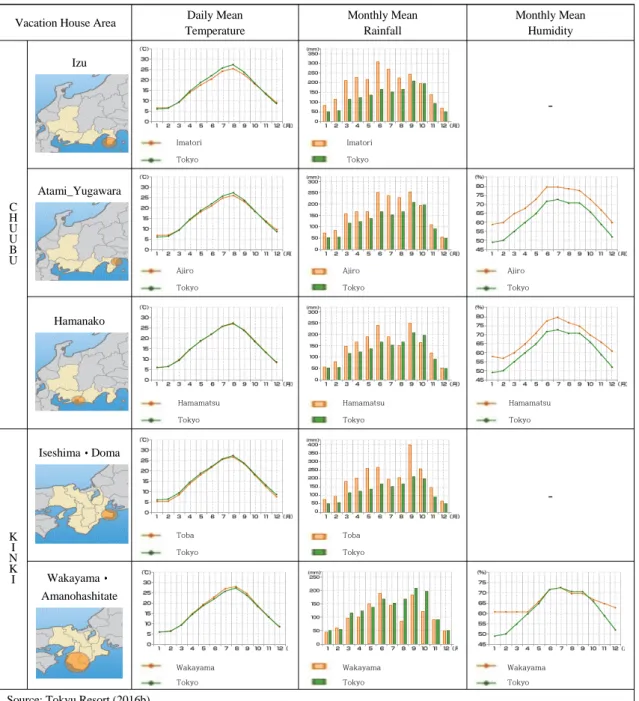
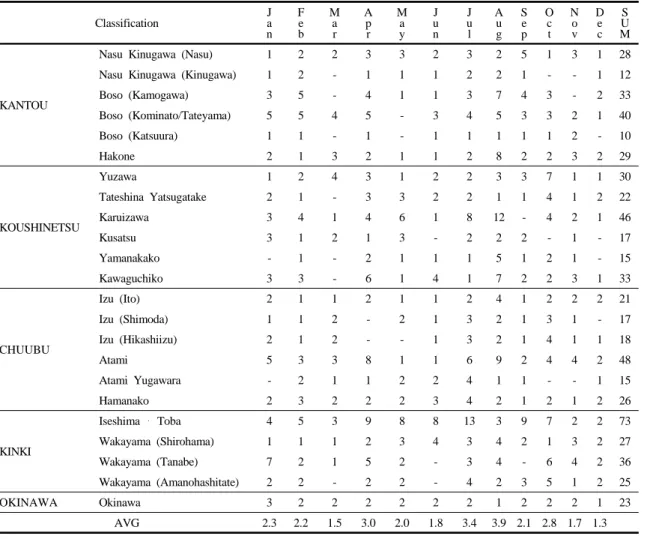
3.3. Environmental conditions at the villa area locations
In selecting a villa area, various factors are taken into consideration such as purpose of use, price, location, management, and safety. When selecting or deciding on a villa area, therefore, certain guidelines are useful for making a more systematic choice. In regard to location and location environment, three factors are mainly considered.
Distance: as close to residential area as possible Natural environment: pleasant natural environment
and view (particularly water and hot springs, in Japan)
Social environment: diverse amenities (facilities for leisure, and market)
In the real trade and sales of villa areas, what characteristics are considered important for location and location environment? In this study, the characteristics were examined based on the villa areas managed and run by Tokyu Resort.
3.3.1. Characteristics of location for villa area
Table 5 shows the number, location, theme, and
keywords of the villas in each area, based on the villa
areas that are actually managed and run by Tokyu
Resort.
Area Number of Vacation House
Location & Lead Time Theme and Key word of Each Area
K O U S H I N E T S U
Karuizawa - Kusatsu
483
Inland-mountain 1-2 hours from
Tokyo
A great vacation place of the old and new Karuizawa and Spring Kusatsu
Plateau, hot spring, outlet, old Karuizawa station, Kinza, old Mikasa hotel, Asama mountain, waterfall, golf, and ski
Yamanakako _ Kawaguchiko
218
Inland-mountain 1-2 hours from
Tokyo
Easy accessibility, only 90 minutes by car from urban Area, a life by the grand mountain Fuji and a beautiful lake Fuji Mountain & lake, hot spring, blossom, plateau, Minami -Fuji, walking and trekking, marine sports, fishing, golf, and theme park
C H U U B U
Izu 273
Coast- peninsula 1-2 hours from
Tokyo and Osaka
Have a healing time with the hot spring tour and flower tour at our resort full of sunlight, sea, mountain, and green
Sea, mountain, plateau, hot spring, hot spring and flower tour, gallery, and pottery
Atami _ Yugawara
182
Coast - peninsula 1-2 hours from
Tokyo and Osaka
Sea-side resort for sub-tropic leisure time, feel the movement of the four seasons at our historic hot spring resort
Hot spring, sea, beach, cruising, hana-bi, diving, surfing, golf, festival and event, spa, night view, and historic walk
Hamanako 58
Coast 1-2 hours from
Tokyo
Just one hour and a half by tram from Tokyo ・ Osaka lakeside resort surrounded by the taste of the ocean Hamanako Lake, eel, blowfish, marine sports, yacht, fishing, hot spring, temple, theme park, golf, Benten island, Tezutsu fireworks
K I N K I
Iseshima 118
Coast- peninsula 1-2 hours from
Tokyo and Osaka
Beautiful and dynamic seashore shaped by nature, a region where you can come in contact with the history and grace of the Ise Shrine
Ise Shrine, sea, Ago Matsubara, Goukan, fishing, marine sports, Kashiko Shima, Shima Spain Village, aquarium, drive, and pearl
Wakayama - Amanohashitate
40
Coast 1-2 hours from
Tokyo and Osaka
Theme park, Ichiba, resort complex with hot spring, and Shirohama renowned for the beach full of sea bream from the south
Hot spring, scenic attractions, fort Europe, ocean view, world heritage (Kumano Godo), fishing, Bintyou charcoal, and Marina
Source: Tokyu Resort (2016b)
Note: Listed here are only the villa areas located in the main island. Okinawa is excluded
Table 5. Continued.
Vacation House Area Daily Mean Temperature
Monthly Mean Rainfall
Monthly Mean Humidity
K A N T O U
Nasu_Kinugawa
-
Nasu Nasu
Tokyo Tokyo
Boso
-
Boso Boso
Tokyo Tokyo
K O U S H I N E T S U
Yuzawa
-
Yuzawa Yuzawa
Tokyo Tokyo
Tateshina_
Yatsugatake
-
Haramura Haramura
Tokyo Tokyo
Karuizawa- Kusatsu
-
Karuizawa Karuizawa
Tokyo Tokyo
Yamanakako_
Kawaguchiko
-
Yamanaka Yamanaka
Tokyo Tokyo
Fig. 2. Weather conditions in vacation house districts or areas.
Vacation House Area Daily Mean Temperature
Monthly Mean Rainfall
Monthly Mean Humidity
C H U U B U
Izu
-
Imatori Imatori
Tokyo Tokyo
Atami_Yugawara
Ajiro Ajiro Ajiro
Tokyo Tokyo Tokyo
Hamanako
Hamamatsu Hamamatsu Hamamatsu
Tokyo Tokyo Tokyo
K N I K I
Iseshima Doma
-
Toba Toba
Tokyo Tokyo
Wakayama Amanohashitate
Wakayama Wakayama Wakayama
Tokyo Tokyo Tokyo