Print ISSN: 2288-4637 / Online ISSN 2288-4645 doi:10.13106/jafeb.2020.vol7.no3.41
The Effect of Corporate Governance Disclosure on Banking Performance:
Empirical Evidence from Iran, Saudi Arabia and Malaysia
Khanifah KHANIFAH
*, Pancawati HARDININGSIH
**, Asri DARMARYANTIKO
***, Iryantika IRYANTIK
****, Udin UDIN
*****Received: December 19, 2019 Revised: January 31, 2020 Accepted: February 06, 2020.
Abstract
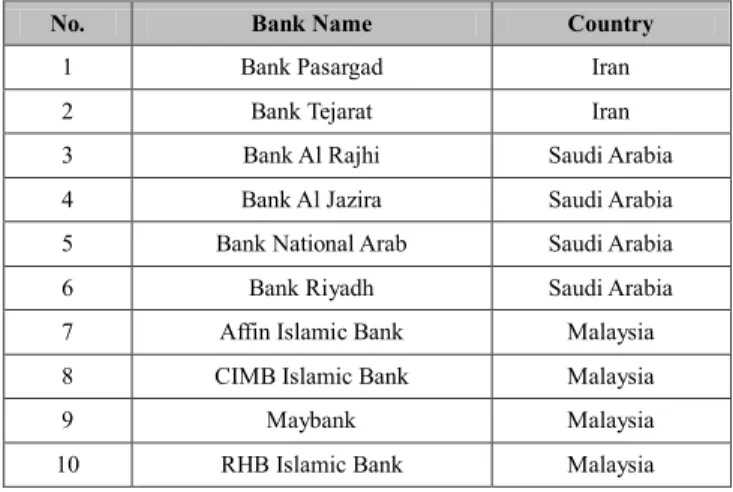
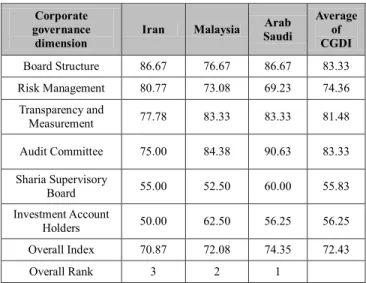
A series of corporate failures and financial crises have raised attention to organizational governance issues, especially for financial institutions. In the banking system, corporate governance further plays a unique role because of the uniqueness of the banking organizations. Therefore, this study aims to examine the effect of corporate governance disclosure on bank performance by building a corporate governance disclosure index (CGDI) for 10 Islamic banks operating in Iran, Saudi Arabia and Malaysia. The data used in this study are secondary data taken from annual reports and sourced from the official websites of each banks include Iran Exchange, Stock Market Quotes and Financial News, and Bursa Malaysia. This study uses content analysis of the annual bank report within five years (2014-2018). The results show that Islamic banks comply with 72.4% of the attributes discussed in the CGDI. The most frequently reported and disclosed elements are board structure and audit committee. The regression results provide evidence that Islamic banks with a higher level of corporate governance disclosure reported high operating performance measured by ROA. In contrast to the expectation, the financial performance of ROE and Tobins'q are not significantly related to the disclosure of sharia bank governance.
Keywords: Corporate Governance Disclosure, Sharia Bank, Performance JEL Classification: E44, M14, Q56
1. Introduction 7
8A series of corporate failures and financial crises have raised attention to organizational governance issues, especially for financial institutions. In the banking system, corporate governance plays a unique role because of the uniqueness of this banking organization. These specificities, such as high pressure, heavy regulation, and government intervention, require different analyses of corporate
*First Author. Universitas Wahid Hasyim, Indonesia.
**Universitas Stikubank, Indonesia
***Master Scholar of Universitas 17 Agustus 1945 Semarang, Indonesia
****Universitas Wahid Hasyim, Indonesia
*****Corresponding Author. Business and Economic Faculty, Universitas Muhammadiyah Yogyakarta, Indonesia [Postal Address:
Jl. Brawijaya, Tamantirto, Kec. Kasihan, Yogyakarta, 55183, Indonesia] Tel: +62 85343709228
Email: [email protected]
© Copyright: The Author(s)
This is an Open Access article distributed under the terms of the Creative Commons Attribution Non- Commercial License (https://creativecommons.org/licenses/by-nc/4.0/) which permits unrestricted non- commercial use, distribution, and reproduction in any medium, provided the original work is properly cited.