ISSN (print) 1226-8496 ISSN (online) 2288-3819
Neutral Electrolyzed Water for Prevention of Dental Caries
Kyam Lee
Department of Physics, College of Natural Science, Dankook University
Gargle solution has typically been used for the prevention of oral infectious disease such as dental caries and periodontitis. However, the use of most gargle solutions is controversial in application for children because some gargle solutions have harmful side effects. Electrolyzed water is generated by passed an electric current and has antimicrobial activity. The purpose of this study was to investigate and compare the efficacy of electrolyzed wa- ter in various conditions for eliminating cariogenic bacteria.
Electrolyzed water was generated by a platinum electrode in the presence of sodium chloride at various con- centrations. Streptococcus mutans and Streptococcus sobrinus were cultivated into a brain heart infusion broth.
After harvesting planktonic bacteria, the pellets were treated with the electrolyzed water and commercial gargle solutions and plated on a mitis-salivarius agar plate. Also, the anti-biofilm activity of the electrolyzed water and commercial gargle solutions was investigated after biofilm formation of S. mutans and S. sobrinus. The bacteria in the biofilm were plated onto a mitis-salivarius agar plate. The plates were incubated, and the colony forming unit was measured.
The electrolyzed water containing sodium chloride showed significant antibacterial activity against S. mutans and S. sobrinus as well as some gargle solutions. Furthermore, the electrolyzed water had more disruptive effect on the biofilm of S. mutans and S. sobrinus and killed more bacteria in the biofilm than commercial gargle solutions.
The results demonstrate that electrolyzed water may be a useful gargle solution for prevention of dental caries.
Key words :Anti-cariogenic effects, Electrolyzed water, Streptococcus mutans, Streptococcus sobrinus, Biofilm
Abstract
Ⅰ. Introduction
The characteristics of Streptococcus mutans and S. so- brinus are acid production and aciduricity1,2). Since this characteristics, they play a central role in the induction of dental caries3), and S. mutans and S. sobrinus have been called cariogenic bacteria. Especially, compared to planktonic bacteria, their biofilm is associated more with
dental caries due to acid production in limited space4). Also, the biofilm of S. mutans and S. sobrinus is more resistant for antimicrobial agents than planktonic bacte- ria because of glucan5). Glucan is an exopolysaccharide of S. mutans and S. sobrinus and plays a barrier role in cariogenic biofilm6). Therefore, glucan inhibits the pene- tration of antimicrobial agents into biofilm. Chemical gargle solutions are used to prevent infectious diseases
Corresponding author : Kyam Lee
Department of Physics, College of Natural Science, Dankook University, 119 Dandae-ro, Dongnam-gu, Cheonan, 31116, Republic of Korea Tel: +82-41-550-3423 / E-mail: [email protected]
Received July 19, 2016 / Revised August 3, 2016 / Accepted August 3, 2016
※This research was supported by the research fund of Dankook University in 2015.
such as caries and periodontitis in oral cavity7,8). Since some gargle solutions contain alcohol, their use in oral health has been controversial9-11). Therefore, dental gar- gle solution for the prevention of caries is not recom- mended for children.
Electrolyzed water (EW) is generated by the decom- position of water (H2O) into oxygen (O2) and hydrogen gas (H2) by an electric current being passed through the water. The characteristics of EW was differ according to the type of electrodes, such as silver and platinum, and the type of molecules added such as citric acid and sodi- um chloride. Also, the physical properties of EW vary according to the presence or absence of a membrane in the chamber12). Several types of EW such as acidic, ba- sic, and neutral water have been used in many fields such as industry, agriculture, and food because of its disinfecting effects12,13). Recently, neutral electrolyzed wa- ter (NEW) was tried to apply to the medical and dental areas, as it is harmless to biological tissues14-16). Also, NEW has anti-cancer, anti-oxidative and anti-bacterial effects17-19). Acidic electrolyzed water has bactericidal ef- fect on Listeria monocytogenes and Escherichia coli13). Basic electrolyzed water affects oral hygiene including bactericidal activity, biofilm removal and bacterial growth inhibition19). However, acidic and basic elec- trolyzed water were not sure of harmfulness due to their acidic and basic condition.
The purpose of this study was to investigate the an- timicrobial effects of NEW on cariogenic bacteria and their biofilm, and to compare the antimicrobial activity of NEW and commercial gargle solutions.
Ⅱ. Materials and Methods 1. Bacterial species and cultivation
S. mutans ATCC 25175 and S. sobrinus ATCC 33478 were used in this study and cultivated by brain heart in- fusion broth (BHI)(BD bioscience, Sparks, MD, USA).
In order to form biofilm, S. mutans and S. sobrinus were cultivated in BHI broth containing 2% sucrose according to the methods of Lee et al.3).
2. Production of electrolyzed water
Two types of EW were used in this study and in order to investigate its antibacterial activity. EW was generat- ed from an electrolyzing distilled water containing 0.05%
and 0.15% sodium chloride in an undivided anode chamber and cathode chamber. Also, the platinum elec- trodes were placed in the chamber horizontally. The pH and oxidation reduction potential (ORP) level of the EW was measured by a pH meter (Thermo Fisher Scientific, Waltham, MA, USA). The free available chlorine species (HClO and ClO-) were determined using N,N-diethyl-p- phenylenediamine (Sigma-Aldrich Co. St. Louis, MO, USA)20). The free chlorine, pH and ORP of the EW were analyzed within 10 min after electrolysis.
3. Antimicrobial efficacy of the EW against cario- genic bacteria
S. mutans and S. sobrinus were cultivated in BHI broth for 36 h and counted by a bacterial counting chamber (Marienfeld, Lauda-Konigshofen, Germany).
The bacterial density was adjusted to 1 × 10⁷ cells/mL with BHI broth. Each bacterial suspensions (1 mL) was harvested by centrifugation at 4,000 × g for 10 min and then washed by phosphate buffered saline (PBS). The bacterial pellets were treated with 1 mL of the EW and commercial gargle solutions (alcohol- or fluoride-contain- ing gargle) for 30 sec or 1 min, and then immediately added to 1 mL of BHI broth. The samples were diluted serially 10 fold to 105, each diluted suspension was spread on an agar plate and incubated at 37℃ until the colonies could be counted.
4. Comparison of biofilm biomass and viable bacteria
For biofilm formation, a plastic coverslip (SPL bio- science, Gyoengi-do) was coated with saliva according to the methods of Lee et al.21). S. mutans and S. sobrinus were inoculated into BHI broth including 2% sucrose and dispensed on the saliva-coated cover slip in a 12- well polystyrene plate (SPL bioscience). The plates were incubated at 37℃ for 72 h, and the media were changed with fresh BHI broth including 2% sucrose each day.
The biofilms were washed twice with PBS to remove planktonic bacteria and treated with the EW or commer- cial gargle solutions for various durations. The EW and commercial gargle solution were immediately aspirated by suction pump. Each biofilm was stained with 0.5%
crystal violet and washed three times with PBS.
Absolute alcohol was added to dissolve the crystal violet on the bacteria in biofilm, and the supernatant was transferred into a 96-well polystyrene plate (SPL bio-
science). The optical density of the supernatant was measured at a wavelength of 590 nm by a microplate reader (Biotek. Winooski, VT, USA). In order to analyze the viable bacteria in the biofilm, electrolyzed water- treated biofilms were disrupted mechanically, and weak sonication was performed (output 3W) to homogenize the bacteria. The bacterial suspensions were serially di- luted from 103 to 106 with BHI broth, and the diluted suspensions (50 μL) were plated on Mitis-salivarius agar (BD bioscience). The plates were incubated at 37℃ for 48 h, and the colony forming units of each bacteria on each plate were counted.
5. Statistical analysis
The differences between the control and the samples were analyzed by Krusical-wallis and Mann-Whitney test using SPSS 21 (IBM, Armonk, NY, USA). P-values less than 0.05 were considered statistically significant.
Ⅲ. Results
1. Physical property of the electrolyzed water
When distilled water in the presence or absence of sodium chloride at the concentration of 0.05% and
0.15% was by an passed electric current through the platinum electrode, the level of pH was neutral, and did not change. However, the concentration of free chlorine was increased in a dose-dependent manner (Table 1).
The concentration of free chlorine indicated hypochlorous acid (HOCl) and hypochlorite ion (OCl-).
2. Antimicrobial activity of the electrolyzed water
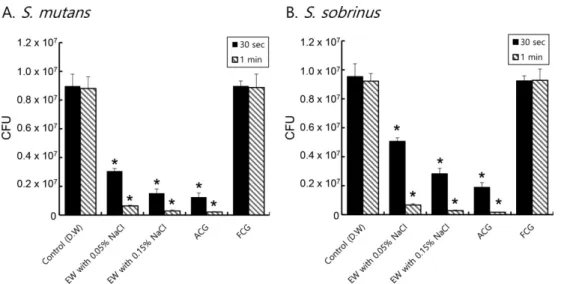
The antimicrobial activity of the generated EW was compared with two commercial gargle solutions, includ- ing an alcohol-containing gargle for adults and a fluo- ride-containing gargle for children. The EW from the wa- ter including sodium chloride showed significant antimi- crobial activity against S. mutans and S. sobrinus (Fig.
1). Furthermore, the sodium chloride-containing EW has more antimicrobial activity compared to the gargle solu- tion for children.
Fig. 1. Investigation of antimicrobial activity against S. mutans and S. sobrinus. The bacteria (1 × 10⁷CFU/ml) were harvested by centrifugation after culti- vation in BHI broth and treated with alcohol-containing gargle (ACG), fluoride-containing gargle (FCG) and the EW from distilled water including 0.05%
or 0.15% NaCl for 30 sec and 1 min. The count of S. mutans (A) and S. sobrinus were plated on mitis-salivarius agar and counted colonies. The tests were performed duplicate in three independent experiments.
Table 1. Physicochemical properties of the electrolyzed water
Electrodes pH ORP Free Chlorine
(mV) (ppm)
Distilled water 7.32 ± 0.07 342 ± 16 0 or N.D
0.05% NaCl 7.21 ± 0.16 764 ± 26 163 ± 21
0.15% NaCl 7.43 ± 0.23 752 ± 34 389 ± 37
3. Effect of the electrolyzed water on biofilm of S.
mutans and S. sobrinus
Mature biofilm of S. mutans and S. sobrinus was formed and treated with the EW and commercial gargle solutions. Fluoride-containing gargle as a gargle for chil- dren did not affect the biofilm of S. mutans and S. sobri- nus. However, the EW from the water including sodium
chloride and the alcohol-containing gargle significantly disrupted the biofilm (Fig. 2). Furthermore, the count of S. mutans and S. sobrinus in the biofilm was decreased by both the EW and the alcohol-containing gargle (Fig.
3). Interestingly, the EW disrupted more the biofilm and killed more the cariogenic bacteria in the biofilm than the alcohol-containing gargle.
Fig. 2. Disruptive effect of the electrolyzed water on S. mutans and S. sobrinus biofilm. The biofilm was formed on saliva-coated plastic slip using BHI broth supplemented with 2% sucrose and treated with alcohol-containing gargle (ACG), fluoride-containing gargle (FCG) and the electrolyzed water from distilled water including 0.05% or 0.15% NaCl for 30 sec and 1 min. After removing the supernatants, the biofilm was stained with crystal violet and washed with PBS. The biofilm was detained with alcohol, and the optical density of destained supernatant was measured at a wavelength of 590 nm by a microplate reader. The tests were performed duplicate in three independent experiments.
Fig. 3. Analysis of live bacteria in the biofilm. S. mutans and S. sobrinus biofilm were formed on 12-well polystyrene plate using BHI broth including sucrose for 72h. The biofilm was treated with alcohol-containing gargle (ACG), fluoride-containing gargle (FCG) and the EW from distilled water includ- ing 0.05% or 0.15% NaCl for 30 sec and 1 min. After suction of the supernatant, the biofilm was disrupted mechanically by a scraper and homogenized.
The suspension of biofilm was plated on MS agar and the colony forming unit was counted. The examination were carried out duplicate in three indepen- dent experiments.
Ⅳ. Discussion
Dental caries as tooth decay is the most prevalent in- fectious disease in children and is associated with S.
mutans and S. sobrinus22). Gargle solutions have been used to prevent caries in daily life. However, general gargle solutions contain chemicals including alcohol to kill oral bacteria. Therefore, the use of gargle solutions for oral health has been controversial because of their harmful side effects23,24). Eventually, the gargle solution is reluctant to use in children. In this study, EW was in- vestigated antimicrobial activity against S. mutans and S. sobrinus and compared with the conventional gargle solutions. Also, the EW was evaluated for its potential to replace conventional gargle solutions.
The EW was generated by an electric current by pass- ing through it platinum electrodes in the presence of sodium chloride. This EW showed neutral pH and con- tained free chlorines such as hypochlorous acid (HOCl) and hypochlorite ion (OCl-). When the EW was generat- ed using silver electrodes, the level of pH was neutral.
However, the level of free chlorines was barely detected.
The free chlorines in aqueous solution have antimicrobial activity25). The bactericidal mechanisms of free chlorines are to react with the bacteria surface components and to impair intracellular components. In current study, these characteristics of the EW from NaCl-containing water was examined antimicrobial and anti-biofilm activity against S. mutans and S. sobrinus. Although the an- timicrobial activity of the EW was weaker than a com- mercial gargle solution with alcohol, it showed stronger antimicrobial activity compared to the gargle solution for children.
Interestingly, although the EW exhibited weaker an- timicrobial effect on planktonic S. mutans and S. sobri- nus than the commercial gargle solution, it was more ef- fective in destroying the biofilm of S. mutans and S. so- brinus than the commercial gargle solution. On the basis of biofilm disruption, the EW destroys the surface barri- er of the biofilm, penetrates into the biofilm, and then reacts with each bacterium. Since the ability of commer- cial gargle solution to destroy the biofilm is weak, the solution might not penetrate deeply into the biofilm. S.
mutans and S. sobrinus produce abundant glucan from sucrose, and the glucan is a barrier of biofilm, protecting the bacteria in the biofilm and forming limited space26,27). Finally, the level of pH was rapidly decreased in the biofilm because S. mutans and S. sobrinus can produce
lactic acid in a limited space and under conventional conditions. Therefore, dental caries is related more to the biofilm of cariogenic bacteria than to planktonic bac- teria21).
The NEW is effective in removing cariogenic biofilm as thoroughly as the commercial gargle solutions and showed antimicrobial activity against S. mutans and S.
sobrinus. Furthermore, no harmful effects have been re- ported with the use of neutral EW. Therefore, the neu- tral EW from NaCl-containing water may be a candidate for the prevention of dental caries.
References
1. Loesche WJ : Role of Streptococcus mutans in human dental decay. Microbiol Rev, 50:353-380.
1986
2. Pandit S, Chang KW, Jeon JG : Effects of Withania somnifera on the growth and virulence properties of Streptococcus mutans and Streptococcus sobrinus at sub-MIC levels. Anaerobe, 19:1-8, 2013
3. Lee SH, Choi BK, Kim YJ : The cariogenic charac- ters of xylitol-resistant and xylitol-sensitive Streptococcus mutans in biofilm formation with sali- vary bacteria. Arch Oral Biol, 57:697-703, 2012 4. Neves PA, Ribeiro CC, Cury JA, et al. :
Breastfeeding, Dental Biofilm Acidogenicity, and Early Childhood Caries. Caries Res, 50:319-324, 2016
5. Savas S, Kucukyilmaz E, Celik EU, Ates M : Effects of different antibacterial agents on enamel in a biofilm caries model. J Oral Sci, 57:367-372, 2015 6. Monchois V, Willemot RM, Monsan P :
Glucansucrases: mechanism of action and structure- function relationships. FEMS Microbiol Rev, 23:
131-151, 1999
7. Baker K : Mouthrinses in the prevention and treat- ment of periodontal disease. Curr Opin Periodontol, 1:89-96, 1993
8. Rapani E : Mouthrinses in the prevention of dental caries. Riv Odontostomatol Implantoprotesi, 92:89- 90, 1985
9. Reidy JT, McHugh EE, Stassen LF : A review of the role of alcohol in the pathogenesis of oral cancer and the link between alcohol-containing mouthrinses and oral cancer. J Ir Dent Assoc, 57:200-202, 2011 10. McCullough MJ, Farah CS : The role of alcohol in
oral carcinogenesis with particular reference to alco-
hol-containing mouthwashes. Aust Dent J, 53:302- 305, 2008.
11. Chevalier M, Sakarovitch C, Precheur I, Lamure J, Pouyssegur-Rougier V : Antiseptic mouthwashes could worsen xerostomia in patients taking polypharmacy. Acta Odontol Scand, 73:267-273, 2015.
12. Hricova D, Stephan R, Zweifel C : Electrolyzed water and its application in the food industry. J Food Prot, 71:1934-1947, 2008.
13. Prado-Silva L, Cadavez V, Gonzales-Barron U, Rezende AC, Sant'Ana AS : Meta-analysis of the effects of sanitizing treatments on Salmonella, Escherichia coli O157:H7, and Listeria monocyto- genes inactivation in fresh produce. Appl Environ Microbiol, 81:8008-8021, 2015.
14. Boyce JM : Modern technologies for improving cleaning and disinfection of environmental surfaces in hospitals. Antimicrob Resist Infect Control, 5:1- 10, 2016.
15. Nagamatsu Y, Chen KK, Nagamatsu H, Kozono Y, Shimizu H : Application of neutral electrolyzed water to disinfection of alginate impression. Dent Mater J, 35:270-277, 2016.
16. Horiba N, Hiratsuka K, Nakamura H, et al. : Bactericidal effect of electrolyzed neutral water on bacteria isolated from infected root canals. Oral Surg Oral Med Oral Pathol Oral Radiol Endod, 87:83-87, 1999.
17. Kato S, Saitoh Y, Iwai K, Miwa N : Hydrogen-rich electrolyzed warm water represses wrinkle formation against UVA ray together with type-I collagen pro- duction and oxidative-stress diminishment in fibrob- lasts and cell-injury prevention in keratinocytes. J Photochem Photobiol B, 106:24-33, 2012.
18. Ye J, Li Y, shirahata S, et al. : Inhibitory effect of electrolyzed reduced water on tumor angiogenesis.
Biological & pharmaceutical bulletin, 31:19-26,
2008.
19. Lee SH, Choi BK : Antibacterial effect of elec- trolyzed water on oral bacteria. J Microbiol, 44:417- 422, 2006.
20. Moberg L, Karlberg B : An improved N,N'-diethyl- p-phenylenediamine (DPD) method for the determi- nation of free chlorine based on multiple wavelength detection. Analytica Chimica Acta, 407:127-134, 2000.
21. Lee SH, Kim YJ : A comparative study of the effect of probiotics on cariogenic biofilm model for prevent- ing dental caries. Arch Microbiol, 196:601-609, 2014.
22. Beighton, D., et al., Associations between salivary levels of Streptococcus mutans, Streptococcus sobri- nus, lactobacilli, and caries experience in Kenyan adolescents. J Dent Res, 68:1242-1246, 1989.
23. Miranzadeh S, Adib-Hajbaghery M, Soleymanpoor L, Ehsani M : A New mouthwash for Chemotherapy Induced Stomatitis. Nurs Midwifery Stud, 3:e20249, 2014.
24. Potting CM, Uitterhoeve R, Op Reimer WS, Van Achterberg T : The effectiveness of commonly used mouthwashes for the prevention of chemotherapy- induced oral mucositis: a systematic review. Eur J Cancer Care, 15:431-439, 2006.
25. Cho M, Kim J, Kim JY, Yoon J, Kim JH : Mechanisms of Escherichia coli inactivation by sev- eral disinfectants. Water Res, 44:3410-3418, 2010.
26. Choi EJ, Lee SH, Kim YJ : Quantitative real-time polymerase chain reaction for Streptococcus mutans and Streptococcus sobrinus in dental plaque samples and its association with early childhood caries. Int J Paediatr Dent, 19:141-147, 2009.
27. Kreth J, Zhu L, Merritt J, Shi W, Qi F : Role of sucrose in the fitness of Streptococcus mutans. Oral Microbiol Immunol, 23:213-219, 2008.
기존 구강청결제를 대체할 수 있는 치아우식 예방을 위한 전기분해수
이기암
단국대학교 자연과학대학 물리학과
치아우식은Streptococcus mutans와 S. sobrinus가 주요 원인균이며, 이를 예방하기 위해서 구강 청결제를 사용한다.
그러나 구강청결제의 부작용 및 해로움으로 인하여 소아에게 권장하기에 주위를 요한다. 전기 분해수는 물을 전극을 통해서 전류를 흘려주어 생성되는 용액으로 항균력을 갖는다. 본 연구에서는 전기 분해수를 구강 청결제 대용으로 사용하기 위해서 치아 우식원성 세균 및 바이오 필름에 대한 항균력을 조사하였다.
염화나트륨이 포함된 증류수를 백금전극을 이용하여 전기 분해수를 생성하였다. 전기분해 수소수의 물리화학적 성분을 분 석하고S. mutans 및 S. sobrinus 배양액을 원심분리하여 세균을 얻고 전기 분해수, 알코올 및 불소가 포함된 구강 청결제 를 처리하고 살아있는 세균 수를 배양을 통해서 조사하였다. 또한 치아우식균의 바이오 필름을 형성시킨 후, 전기 분해수 및 구강 청결제를 처리하여 바이오 필름 제거능을 크리스탈 바이올렛 염색을 이용하여 분석하고, 바이오 필름 내 살아있는 세균 수의 양은 배양을 통하여 분석하였다.
전기분해수는 높은 농도의 자유염소 (free chlorine)을 포함하고 중성 페하를 보였다. 전기 분해수는 유의하게S. mutans 및S. sobrinus에 대해서 항균력을 보였으며, 이 세균들의 바이오 필름 제거능 및 바이오 필름 내 세균에 대해서도 항균력을 보였다. 전기 분해수는 부유세균에 대해서 알코올이 포함된 구강청결제보다 약한 항균력을 보였지만, 바이오 필름 세균에 대 해서는 더 강한 항균력을 나타냈다.
이러한 결과를 바탕으로 중성 전기 분해수는 치아우식 예방을 위한 기존 구강 청결제의 대체 용액으로 사용이 가능할 것으 로 사료된다.
주요어: 항우식 효과, 전기분해수, Streptococcus mutans, Streptococcus sobrinus, 바이오필름 국문초록