J Agric Med Community Health 2020;45(2):79∼88
지역사회 치면열구전색사업의 치아우식예방효과:
3년간 후향적 코호트 연구*
전매숙1), 김창숙2), 이경수3), 남인숙4)
김천시 보건소 건강증진과1), 울산과학대학교 치위생학과2), 영남대학교 의과대학 예방의학교실3), 구미대학교 치위생과4)
The Effects of Community-based Sealant Program for Preventing Dental Caries in the Permanent Teeth:
3 year Retrospective Cohort Study
Mae-Sook Jeon1), Chang-Suk Kim2), Kyeong-Soo Lee3), In-Suk Nam4)
Division of Health Promotion, Gimcheon Health Center, Gimcheon, Korea
1),
Department of Dental Hygiene, Ulsan College, Ulsan, Korea
2),
Department of Preventive Medicine and Public Health, Yeungnam University, Daegu, Korea
3), Department of Dental Hygiene, Gumi University, Gumi, Korea
4)= Abstract =
연구목적: 이 연구는 지역사회 치면열구전색 사업의 치아우식 예방효과를 평가하고자 시행되었다.
연구방법: 연구 대상자는 2005년부터 2008년까지 김천시에 소재한 34개 초등학교에 재학 중인 9,001명 중 2005년 최초 구강검사 당시 상·하악 제1대구치에 치아우식이 없는 치아와 학생 4,768명을 최종 대 상자로 선정하였다. 2005년도에 치면열구전색을 실시한 1,478명에 대해 3년간 추적조사가 이루어졌고, 2006년에 치면열구전색을 실시한 999명에 대해 2년간 추적조사를 하였으며, 2007년에 치면열구전색을 실시한 458명에 대해 1년간 추적조사 후 기술통계 및 교차분석을 시행하였다.
연구결과: 치면열구전색 실시군의 DMFT rate는 1년 추적 후 1.4%에서 3년 추적 후 4.1%, DMFT index는 1년 추적 후 0.18개에서 3년 추적 후 0.70개로 추적기간이 길어질수록 높게 나타났다. 1일 평균 칫솔질 횟수는 DMFT rate와 DMFT index에 영향을 미쳤다. 즉 치면열구전색을 실시한 대상자라도 1일 평균 칫솔질 횟수가 적으면 DMFT rate와 DMFT index는 높게 나타났다.
결론: 치면열구전색을 실시한 대상자에서도 올바른 칫솔질에 대한 구강보건교육이 선행되어야 한다.
Key words: Dental caries, Oral examination, Oral health, Pit and fissure sealant
* Received May 3, 2020; Revised May 25, 2020; Accepted June 11, 2020.
* Corresponding author: 김창숙, 44022 울산광역시 동구 봉수로 101 울산과학대학교 3대학관 S204호
Chang-Suk, Kim, Department of Dental Hygiene, Ulsan College, Ulsan, Korea, 101, Bongsu-ro, Dong-gu, Ulsan, 44022, Korea
Tel: +82-52-230-0793, Fax: +82-52-230-0790, E-mail: [email protected]
Introduction
To effectively manage oral health to prevent dental caries, four methods such as plaque control, dietary control, fluoride application, and sealant are conjugated in combination 4 stage prevention of dental caries [1]. The fissure is filled with synthetic resin on the occlusal surface, buccal surface and lingual surface where the caries is frequent, pit and fissure caries decreased 78-87% after one year of operation [2, 3], but it is known to fall to 33-60% after more than two years of operation [2-4].
In Korea, the pit and fissure sealant has been implemented since 2005 as part of the national dental health project [5]. The purpose of this study is to prevent dental caries and preserve healthy permanent teeth by applying a fissure to the teeth before preschool children or elementary school students. The subjects were the first and second grade elementary students of the children who were recognized by the head of the health department and the principal of the school, and they were selected with the low income congested area after completing the consent form from the children’s parents. The practice was placed under the request to the medical institution or performed it at the health center [6].
Although this project is very active and achieved the target of the project’s goal, there is no guideline on maintenance through follow up management of the tooth which performed the dental sealant project.
In previous studies, it has been reported on the effect of dental sealant [2], survival rate (=maintenance rate) [7], and cost effectiveness [8], but there is a lack of papers presenting epidemiological indicators of the community.
This purpose of this study was to evaluate the effect of the program on sealant dental caries, percentage of permanent teeht affected with dental caries or missing or filled (DMFT rate) in accordance with number of brushing and number of dental caries or missing or filled permanent teeth(DMFT index), and it is to explore the epidemiological factors.
Materials and Methods
1. Research subjects
The purpose of this study was to investigate the relationship between the teeth and the teeth of the first molar (6thtooth) of maxillary and mandibular permanent teeth among the 9,001 students who attended 34 elementary schools in Gimcheon City from 2005 to 2008.
After selecting only the teeth and students who have no dental caries, 4,768 students of the final study were reconstructed by individual units for 1-3 years. Of the 4,768 subjects, 1,478 who underwent a dental sealant in 2005 were followed up for 3 years.
Nine hundred ninety-nine people who underwent a dental sealant were followed up for 2 years in 2006 and 458 people were followed up for one year in 2007.
From 2005, 1,496 students were in first year students, 1,644 second grade students and 1,628 of third grade students were surveyed.
In the oral examination records prepared in 2008, using the oral examination data conducted every year from 2005 to the first year to the fourth grade, the second grade to the fifth grade, and the third grade to the sixth grade for three years(YUMC2019-06-017). In 2008, retrospective cohort data were constructed and analyzed for subjects without dental caries in the first molar as of 2005.
Research subjects (n=4,768)
2005 year
with the sealants (n=1,478)
without the sealants (n=3,290)
2006 year
with the sealants (n=999)
without the sealants (n=2,291)
1 year follow-up
2007 year 2 year follow-up
3 year follow-up
with the sealants(n=458)
without the sealnats (n=1,833)
▪DMFT rate and DMFT index by daily tooth brushing frequency and sealant ▪DMFT rate
▪DMFT index
2008 year
Figure 1. Subjects of fissure sealants
The dental sealant was performed on students who received parental consent whereas for those who had already had a dental sealant before 2005 were excluded from the study.
2. Research method
1) Oral examinationOral examinations were carried out by six public health dentists. In order to standardize the method of oral examinations, each year, researcher training was conducted before oral examinations. Oral examinations were performed under the natural lighting conditions under the guidelines of Oral Examination Guidelines [9]
for Epidemiologic Investigations of WHO, using a tooth, a probe, and a penlight. The subject was examined near the window where the examinee was sitting in front of or behind the chair to have the enough natural light.
The number of brushing times was recorded in the oral examination record at the 2008
examination.
2) Test result criteria
According to the WHO recommendation [10], the teeth of the occlusal surface and the fissure are filled with enamel material, or the circumference is rounded or flame-shaped, was recorded as a dental sealant. When a caries on the tooth was present in a transplanted tooth, the tooth was identified as a carious tooth. To determine the teeth, refer to the Guidelines for Oral Examination [5] of Oral Health at the elementary school in the contents of the Oral Health Guide of the Ministry of Health and Welfare.
3) Analysis of data
The SPSS 18.0 statistical program was used for the analysis this study. The analysis method was descriptive statistics, and relative risk was calculated.
The analysis of individual and dental unit was compared with the DMFT index, which is an index of oral health. The dental caries rate was analyzed according to whether the dental sealant was applied or not, and the DMFT index was analyzed according to the number of toothbrushes and the presence of dental sealant. The relative risk was calculated according to the presence or absence of the dental sealant.
The DMFT index according to the presence or absence of the dental sealant was defined as the ‘practitioner’ who applied the dentifrices to all four molars, and the subjects who did not apply to all four molars were classified as
‘non-practitioner’ respectively.
Results
1. Status on the number of dental sealant teeth performed
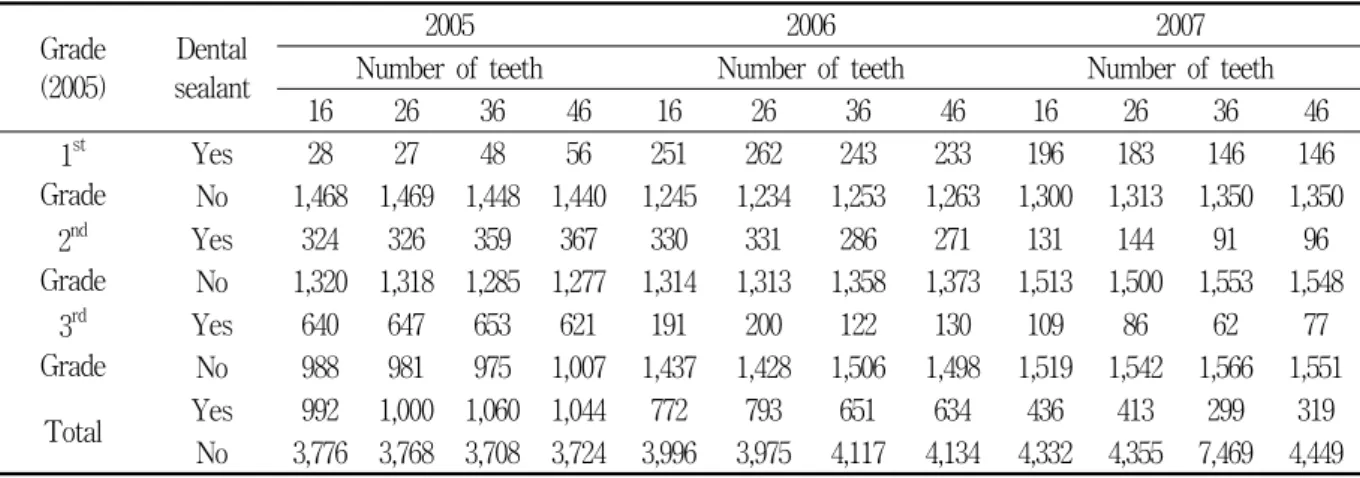
In 2005, there were 992, 1,000, 1,060, and 1,044 teeth in 16th, 26th, 36th and 46th teeth, in 2006, 772, 793, 651, and 634 teeth, and in 2007, 436, 413, 299, and 319 teeth were performed with dental sealant respectively. For the first grade students in 2005, 48 teeth on 36th tooth, 56 teeth on 46th tooth were performed, in
2006, 262 teeth on 26th tooth, and in 2007, 196 teeth on 16th tooth were performed. In the second year students, 367 teeth on 46th tooth in 2005, 331 teeth on 26th tooth in 2006, 144 teeth on 26th tooth in 2007 were performed. In the third year students, 653 teeth on 36th tooth in 2005, 200 teeth on 26th tooth in 2006, and 109 teeth on 16th tooth in 2007 were performed<Table 1>.
2. Three year follow up DMFT rate whether the dental sealant was performed or not
The result of analysis of the DMFT rate according to the follow up period of 3 years after dental sealant were 5.2%, 8.2%, and 5.8% on 16th tooth, 5.1%, 8.6%, and 6.1% on 26th tooth, 9.2%, 14.7%, and 12.0% on 36th tooth, and 8.4%, 12.3%, and 9.3% on 46th tooth after 1st, 2nd, and 3rd years respectively. The result of the dental caries rates was analyzed by those teeth that did not have a dental sealant for the 1st, 2nd and 3rd years of the period from 2005 to 2007 showed as follows:25.4%, 15.1% and 12.7% on the 16th tooth, 26.2%, 14.2% and 13.6% on the 26th tooth, 46.0%, 27.1% and 21.4% on the 36th tooth, 48.8%, 30.8% and 26.3% on the 46th tooth respectively.
Table 1. Total number of sealed teeth by number of teeth Unit: N Grade
(2005)
Dental sealant
2005 2006 2007
Number of teeth Number of teeth Number of teeth
16 26 36 46 16 26 36 46 16 26 36 46
1st Grade
Yes 28 27 48 56 251 262 243 233 196 183 146 146
No 1,468 1,469 1,448 1,440 1,245 1,234 1,253 1,263 1,300 1,313 1,350 1,350 2nd
Grade
Yes 324 326 359 367 330 331 286 271 131 144 91 96
No 1,320 1,318 1,285 1,277 1,314 1,313 1,358 1,373 1,513 1,500 1,553 1,548 3rd
Grade
Yes 640 647 653 621 191 200 122 130 109 86 62 77
No 988 981 975 1,007 1,437 1,428 1,506 1,498 1,519 1,542 1,566 1,551
Total Yes 992 1,000 1,060 1,044 772 793 651 634 436 413 299 319
No 3,776 3,768 3,708 3,724 3,996 3,975 4,117 4,134 4,332 4,355 7,469 4,449
The relative risk for the year on the 16th tooth was 0.206 after 1st year, 0.543 after 2nd year, 0.456 after 3rd year, on the 26th tooth was 0.194 after 1st year, 0.609 after 2nd year, 0.447 after 3rd year, on the 36th tooth was 0.199 after 1st year, 0.541 after 2nd year, 0.560 after 3rd year, on the 46th tooth was 0.171 after 1st year, 0.400 after 2nd year, 0.353 after 3rd year respectively<Table 2>.
3. DMFT rate and DMFT index whether the dental sealant was performed or not and follow up period
The DMFT rates were compared and analyzed by reclassifying the subjects who performed the dental sealant in all four of the first molar group as ‘practitioner’ and for
those who did not perform the dental sealant were classified as ‘non-practitioner’ respectively.
The DMFT rate with the ‘practitioner’ group was 1.4% after 1 year of follow up, 2.7%
after 2 years of follow up, and 4.1% after 3 years of follow up. The DMFT rate with the ‘non-practitioner’ group was 34.0% after 1 year of follow up, 47.4% after 2 years of follow up, and 56.6% of 3 years of the follow up. The DMFT index according to the dental sealant application group (‘practitioner’) were 0.18 after first year, 0.42 after second year, and 0.70 after third year whereas the non-dental sealant group (‘non-practitioner’) were 1.36 after first year, 1.89 after second year, and 2.25 after the third year<Table 3>.
Table 2. DMFT rate of follow up period by dental sealant Unit: N (%) Number of
teeth Dental sealant Follow-up period
1 year 2 years 3 years
16
Yes (N=2,200)
115 (5.2)
(N=1,674) 137 (8.2)
(N=896) 52 (5.8)
No (N=2,329)
591 (25.4)
(N=1,738) 262 (15.1)
(N=1,476) 188 (12.7)
Relative Risk 0.206 0.543 0.456
95% CI 0.170-0.249 0.447-0.660 0.339-0.612
26
Yes (N=2,206)
112 (5.1)
(N=1,705) 147 (8.6)
(N=920) 56 (6.1)
No (N=2,317)
607 (26.2)
(N=1,710) 242 (14.2)
(N=1,468) 200 (13.6)
Relative Risk 0.194 0.609 0.447
95% CI 0.160-0.235 0.502-0.739 0.336-0.594
36
Yes (N=2,010)
184 (9.2)
(N=1,560) 229 (14.7)
(N=868) 104 (12.0)
No (N=2,553)
1,174 (46.0)
(N=1,379) 374 (27.1)
(N=1,005) 215 (21.4)
Relative Risk 0.199 0.541 0.560
95% CI 0.172-0.230 0.467-0.627 0.451-0.695
46
Yes (N=1,997)
167 (8.4)
(N=1,551) 191 (12.3)
(N=884) 82 (9.3)
No (N=2,393)
1,168 (48.8)
(N=1,225) 377 (30.8)
(N=848) 223 (26.3)
Relative Risk 0.171 0.400 0.353
95% CI 0.147-0.199 0.342-0.468 0.279-0.446
CI: Confidence interval
Table 3. DMFT rate and DMFT index by dental sealant and follow up period Follow-
up period Year
DMFT rate (%) DMFT index (N)
Yes* (N=599)
No**
(N=1,555)
Yes* (N=599)
No**
(N=1,555)
1st year 2006 1.4 34.0 0.18 1.36
2nd year 2007 2.7 47.4 0.42 1.89
3rd year 2008 4.1 56.5 0.70 2.25
*Sealed of all first molars
**Unsealed of all first molars
4. DMFT rate and DMFT index according to whether performed the dental sealant or not and the number of toothbrushes
Analysis of the DMFT rate in the
‘practitioner’ group showed for those who performed brushing once a day that 2.1%
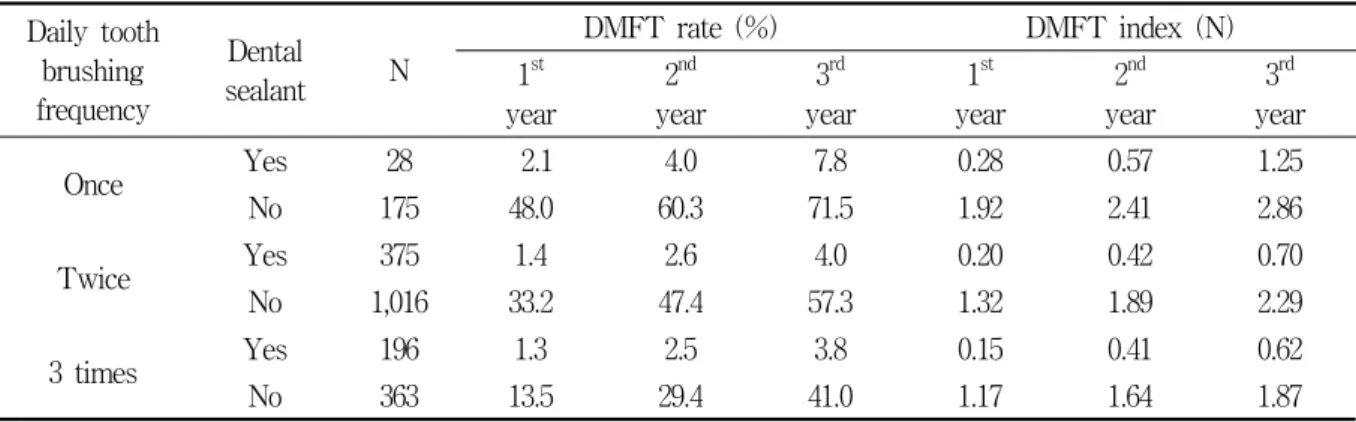
after first year, 4.0% after second year, and 7.8% after third year, for those who performed brushing twice a day showed that 1.4% after first year, 2.6% after second year, and 4.9% after third year, and for those who performed brushing three times a day showed 1.3% after first year, 2.5% after second year, and 3.8% after third year. ‘Non-practitioner’
group’s DMFT rate was as follows: for those who performed brushing once a day showed 48.0% after first year, 60.3% after second year, and 71.5% after third year, for those who performed brushing twice a day showed 33.2% after first year, 47.4% after second year, and 57.3% after third year, and for those who performed brushing three times a day showed 13.5% after first year, 29.4% after second year, and 41.0% after third year.
The results of analysis of the DMFT index according to the number of time of brushing were as follows: for those who performed brushing once a day showed 0.28 after first year, 0.57 after second year, and 1.25 after third year, for those who performed brushing twice a day showed 0.20 after first year, 0.42
after second year, and 0.70 after third year, and for those who performed brushing three times a day showed 0.15 after first year, 0.41 after second year, and 0.62 after third year.
The results of DMFT index analysis of the
‘non-practitioner’ group according to the number of brushing times was as follows: for those who performed brushing once a day showed 1.92 after first year, 2.41 after second year, 2.86 after third year, for those who performed brushing twice a day showed 1.32 after first year, 1.89 after second year, and 2.29 after third year, and for those who performed three times a day showed 1.17 after first year, 1.64 after second year, and 1.87 after third year<Table 4>.
Discussion
Follow up studies are effective to establish the development pattern of dental caries after dental sealant. The purpose of this study was to understand the actual condition through comparative evaluation on the effect of dental caries according to the follow up period after the dental sealant.
At the time in the 2005 survey on the oral health and dental sealant, only the students who did not have the dental sealant were retrospectively investigated, but the comparison was good for analyzing the dental caries due to follow up observation.
Table 4. DMFT rate and DMFT index by daily tooth brushing frequency and dental sealant Daily tooth
brushing frequency
Dental
sealant N
DMFT rate (%) DMFT index (N)
1st year
2nd year
3rd year
1st year
2nd year
3rd year
Once Yes 28 2.1 4.0 7.8 0.28 0.57 1.25
No 175 48.0 60.3 71.5 1.92 2.41 2.86
Twice Yes 375 1.4 2.6 4.0 0.20 0.42 0.70
No 1,016 33.2 47.4 57.3 1.32 1.89 2.29
3 times Yes 196 1.3 2.5 3.8 0.15 0.41 0.62
No 363 13.5 29.4 41.0 1.17 1.64 1.87
As a result of the study, 61.5% of the total investigators performed the dental sealant and the average number of dental sealant teeth per person was 2.8. This was higher than 0.38 in 8-year-olds, 0.39 in 10-year-olds, and 0.33 in 12-year-olds in Lee and Han’s[11]
study. This result can be inferred that the increase of the home-filling business promoted as part of oral health business as well as the increased number of students who have the dental sealant may be due to the improvement of the economic situation.
The DMFT rate is from 16 times in the third year to 24 times in the first year between ‘practitioner’ and ‘non-practitioner’
group, although the ratio decreases with the passage of time. The DMFT index was 0.18 after first year, 0.42 after second year, and 0.70 after third year within the ‘practitioner’
group, whereas 1.36 after first year, 1.89 after second year, and 2.25 after third year within the ‘non-practitioner’ group which showed a big difference. This finding is consistent with the finding of Kim et al. [12] reported 8-year-olds children with 1.04 and 12-year-olds children with 2.86 in 2000, and DMFT index of children at 8, 10, and 12 years old in 2010 were 0.6, 1.2, and 2.1 respectively compared with the contents of the Ministry of Health
and Welfare [13] reported, ‘practitioner’ group was much lower and ‘non-practitioner’ group was similar. The World Health Organization (WHO) reported [14] that the DMFT index of 12-year-old children in major OECD countries surveyed in the 1990s and 2000s was below 2.0 in most cases. Na reported [15] also found that sealants were effective in reducing the prevalence of caries in s study of the effects of sealant programs on caries in Laos children. This suggests that it is necessary to pursue the continuous carry out on dental sealant in the future.
The DMFT rate was significantly lower in the group of ‘practitioner’ group than in
‘non-practitioner’ group in comparison with the group of subjects who were divided according to the number of brushing, DMFT rate and DMFT index after three years of follow up were more than 2 times different within the ‘practitioner’ group. The DMFT rate was also about twice that of the follow up period, and the DMFT rate after third year follow up was more than 10% according to the number of times of brushing, and the DMFT index showed a difference of more than 50%. ‘Chang’ supports the findings of this study by correlating the incidence of dental caries and frequency of brushing in
children [16]. Therefore, it is necessary to emphasize the importance of brushing. Even if a tooth with a dental sealant is applied, it is possible to reduce the occurrence of dental caries in the teeth when the children’s oral care education and practice by the parents are performed simultaneously. According to the National Oral Health Survey [13] in 2010, the average number of brushings for a day was 2.7 in 10-year-olds and 2.6 in 12-year-olds.
The distribution of brushing time was 33.9%, after lunch, 60.9% right before the bed time in 10-year-olds, and 21.7% after lunch, 67.1%
just before sleep in 12-year-olds children. It was found that the post-lunch time in the school showed lower percentage of brushing tooth can be assumed that there was a problem with the contents and methods of oral health in the school and the school group brushing project was not implemented after the school lunch. On the other hand, although the brushing tooth classroom is operated, it is still insufficient. In the elementary school without an oral health center, if the children’s brushing habit is strengthened, it will increase the effect of dental sealant, and it will also slow down the increase of the DMFT rate of children with dental sealant.
In the case of Japan, the school dental system is operated under the School Health Law, and students have regular dental examination every year, and in case of dental caries, they must receive treatment and notify the result [17]. In Korea, elementary schools are expected to have good operation of oral health center and education for student.
Especially, brushing teeth and the results of dental hygiene on the annual oral examinations are communicated to parents and students, it is necessary to provide a method
of providing the information according to the student’s dental status.
DMFT rate and DMFT index increased steeply after 2-3 years after the application of dental sealant so that a more thorough management is needed by providing a post management system after then dental sealant.
In other words, regular oral examinations are required every year after the application of dental sealant, and oral health education for parents is also necessary. Joyson reported [18]
that oral hygiene in rural children aged 5 to 15 years was not improved compared to urban areas. Therefore, we suggest the need for follow-up studies on the comparison of sealant program effects in urban and rural areas.
This limitation of this study is that there is a limit to represent Korea because the sample is selected from one city. However, since the size of the sample is large, it is considered that there is no problem to utilize it as a basis of dental caries preventive effect by dental sealant business. There is also a limitation that there may be differences by the examiner because six public health doctors have performed oral examinations. The number of tooth brushing is limited to the fact that it did not accurately reflect the brushing habits until 2005-2007 because it was obtained through questioning students during oral examination in 2008. In the subsequent studies, it is necessary to examine the dental caries in detail, because it is mostly performed on the dental sealant. This study is a dental unit survey, but it is also necessary to study the tooth surface.
In order to overcome these limitations, prospective studies should be conducted to investigate and analyze more detailed information
about the subject and oral health management behavior, which would subjugate the limitations of this study and suggest a more precise preventive effect and follow up measure.
Conclusion
The aim of the present study was to evaluate the effects of fissure sealants on the occlusal fissures of permanent first molar for three years in schoolchildren by comparing the dental caries incidence rates, DMFT rate and DMFT index by time of each tooth between two groups, with fissure sealant and without fissure sealant. In 2005-2008, 4,768 students from 34 elementary schools located in Gimcheon city analyzed the results:
1. As for the DMFT rate depending on whether placing the fissure sealants, the teeth with the fissure sealants showed 1.4% in 1 year follow-up, 2.7% in 2 year follow-up and 4.1% in 3 year follow-up. When it comes to the teeth without the fissure sealants, it was 34.0% in 1 year follow-up, 47.4% in 2 year follow-up and 56.5% in 3 year follow-up, which showed that DMFT rate of the teeth with the fissure sealants was very low.
2. DMFT index depending on whether placing the fissure sealants were 0.18 in 1 year follow-up, 0.42 in 2 year follow-up and 0.70 in 3 year follow-up in the group with fissure sealant and 1.36 in 1 year follow-up, 1.89 in 2 year follow-up, 2.25 in 3 year follow-up, which showed lower dental caries rates in the group with fissure sealants.
These results indicated that the fissure sealants excelled at preventing the dental
caries, but if the brushing was not properly carried out, the effects wore off enough to offsetting the effectiveness of the fissure sealants.
REFERENCES
1. Kim JB, Choi YJ, Baek DI, Shin SC, Jang GW Preventive dentistry. Seoul, Komoonsa, 2004, pp.185
2. Llodra JC, Bravo M, Delgado-Rodriguez M, Baca P, Galvez R. Factors influencing the effectiveness of sealants—a meta-analysis.
Community Dent Oral Epidemiol 1993;21(5):
261-268
3. Ahovuo-Saloranta A, Hiiri A, Nordblad A, Makela M, Worthington HV. Pit and fissure sealants for preventing dental decay in the permanent teeth of children and adolescents. Cochrane Database Syst Rev 2008;(4):CD001830
4. Mejare I, Lingstrom P, Petersson LG, Holm AK, Twetman S, Kallestal C, et al.
Caries-preventive effect of fissure sealants:
a systematic review. Acta Odontol Scand 2003;61(6):321-330
5. Ministry of Health and Welfare. 2005 Oral health project guide. Sejong: Ministry of Health and Welfare; 2005: 6-14, 105-109 6. Ministry of Health and Welfare. 2008 Basic
plan of oral health project. Sejong: Ministry of Health and Welfare; 2007: 4, 38-39 7. Bravo M, Montero J, Bravo JJ, Baca P,
Llodra JC. Sealant and fluoride varnish in caries: a randomized trial. J Dent Res 2005;84(12):1138-1143
8. Werner CW, Pereira AC, Eklund SA.
Cost-effectiveness study of a school-based sealant program.
ASDC J Dent Child
2000;67(2):93-979. World Health Organization. Oral health survey method. Seoul, Komoonsa, 2000, pp.
27-65
10. World Health Organization. Oral health survey-basic methods. Geneva, WHO, 2013 11. Lee HJ, Han DH. Exploring the determinants
of secular decreases in dental caries among Korean children. Community Dent
Oral Epidemiol 2015;43(4):357-365
12. Kim HN, Han DH, Jun EJ, Kim SY, Jeong SH, Kim JB. The decline in dental caries among Korean children aged 8 and 12 years from 2000 to 2012 focusing SiC Index and DMFT. BMC Oral Health 2016;16:38
13. Ministry of Health and Welfare. 2010 National oral health survey. Seoul: Ministry of Health and Welfare; 2010
14. World Health Organization. WHO Oral Health Country/Area Profile Programme [Internet]. 2018; World Health Organization.
[cited 2018 April 18]. Available from:
http://www.who.int/oral_health/databases/
malmo/en/
15. Na EJ, Lim JH, Park WR, Cho JW. The effect of 2 years pit and fissure sealant program on Laos children. Int J Clin
Prev Dent 2015;11(4):225-232
16. Chang YS, Park EJ, Kim HJ. Cor-relation co-efficient between the toothbrushing frequency or caries activity and the dental caries of periodontal state. Int J Clin
Prev Dent 2013;9(4):225-230
17. Miyazaki H, Morimoto M. Changes in caries prevalence in Japan. Eur J Oral
Sci 1996;104(4(Pt2)):452-458
18. Joyson M, Deepa G, Rangeeth BN.
Prevalence of dental caries, socio-economic status and treatment needs among 5 to 15 year old school going children of chidambaram. JCDR 2011;5(1):146-150