https://doi.org/10.14405/kjvr.2020.60.2.79
79 ORIGINAL ARTICLE
Fenbendazole의 항암활성에서 활성산소종의 관련성
한 용1·주홍구1,2*
1제주대학교 수의과대학 수의약리학실, 2제주대학교 수의과학연구소
Involvement of reactive oxygen species in the anti-cancer activity of fenbendazole, a benzimidazole anthelmintic
Yong Han
1, Hong-Gu Joo
1,2*
1Laboratory of Veterinary Pharmacology, College of Veterinary Medicine,
2Veterinary Medical Research Institute, Jeju National University, Jeju 63243, Korea
Abstract: Fenbendazole (FBZ) is a benzimidazole anthelmintic that has been widely used in treatments for gastrointestinal parasites including pinworms and roundworms in animals. Recently, some studies demonstrated that FBZ has anti-cancer effects related to disruption of microtubule polymerization. In this study, we investigated whether FBZ has anti-cancer activity in HL-60 cells, a human leukemia cell line, and assessed its relationship with the production of reactive oxygen species (ROS). FBZ treatment at 0.25–1 μM significantly decreased the metabolic activity of HL-60 cells. The mitochondrial membrane potential of FBZ-treated HL-60 cells decreased in a concentration-dependent manner. Apoptosis analysis using annexin V-FITC/propidium iodide staining demonstrated that 1 μM FBZ increased the percentages of cells in apoptosis and necrosis. In addition, Hoechst 33342 staining showed the presence of broken nuclei in HL-60 cells treated with 0.5 and 1 μM FBZ. To investigate the anti-cancer mechanism of FBZ, HL-60 cells were treated with FBZ in the absence or presence of N-acetyl cysteine (NAC), an inhibitor of ROS production. NAC significantly recovered the decreased metabolic activity of HL-60 induced by 0.5 and 1 μM FBZ treatments. This study provides evidence that FBZ has anti-cancer activity in HL-60 cells provided, in part, via ROS production.
Keywords: fenbendazole, anti-cancer activity, HL-60 cells, reactive oxygen species, N-acetyl cysteine
서 론
Fenbendazole (FBZ)은 시중에 유통되고 있는 동물용 항기생충제이며, 요충 증을 포함한 다양한 기생충 감염의 치료에 사용되고 있는 약물이다[1-4]. 최 근 FBZ의 항암효과가 발견되어 항암제로서의 사용가능성이 연구되고 있다 [5-8]. 현재 알려진 FBZ의 항암작용기전은 암세포의 microtubule 중합을 억 제하는 anti-tubulin effect를 통해 세포분열을 억제하여 항암효과를 나타내는 것으로 보고되고 있다.
산소는 체내에 존재하며 반응성이 매우 높은 기체로서, 산화적 대사 (oxidative metabolism)에 의해 생성되는 자유 전자(free electron)와 쉽게 반 응하며, 세포 내에서 superoxide anion (O2−) hydroxyl radical (·O), H2O2와 같은 활성산소(reactive oxygen species, ROS)를 생성한다[9]. ROS의 생산과 항산화물질 작용의 불균형으로 인해 세포 내 ROS가 증가하게 되면 oxidative stress가 발생하며, ROS는 DNA, 단백질 등과 반응하여 손상시키고 cell death를 유발한다[10]. 반면 항암제에 의한 ROS 생산으로 암세포의 사 멸을 유도할 수 있다[11,12].
FBZ는 현재 알려진 anti-tubulin effect 이외에 다른 기전을 통하여 항암작 용을 갖는 지에 대해서는 연구가 미흡하다. 이에 본 연구에서는 사람 백혈병 세포의 일종인 HL-60세포에 FBZ를 처리하여 ROS와 연관된 항암효과가 유 발되는 지 알아보았다.
*Corresponding author Hong-Gu Joo
College of Veterinary Medicine, Veterinary Medical Research Institute, Jeju National University, Jeju 63243, Korea
Tel: +82-64-754-3379 Fax: +82-64-756-3354 E-mail: [email protected] ORCID:
Yong Han
https://orcid.org/0000-0002-5728-4716 Hong-Gu Joo
https://orcid.org/0000-0002-1505-8761 Conflict of Interest
The authors declare no conflicts of interest.
Received: February 24, 2020
Revised : May 19, 2020
Accepted: May 20, 2020
대사활성도 측정
HL-60 세포를 96-well culture plate에 1 × 10⁵cells/mL의 농도로 넣은 후, FBZ를 처리하였다. 5% CO2와 37oC의 조 건에서 배양한 후 3-(4,5-dimethylthiazol-2-yl)-2,5-diphenyl- tetrazoliumbromide (MTT, Sigma) assay를 실시하였다[13].
MTT 시약을 well당 0.5 mg/mL의 농도로 4시간 처리한 후 10% sodium dodesyl sulfate 용액을 100 μL/well씩 2시간 동안 처리하여 살아있는 세포에 의해 생긴 crystal violet을 녹였다. 이후 microplate reader (Thermo Fisher scientific, USA)를 이용하여 570 nm에서 흡광도를 측정하였다. 또한 FBZ가 처리된 HL-60세포에서 ROS에 대한 영향을 확인하기 위해, ROS inhibitor인 N-acetyl-L-cysteine (NAC, Sigma) 을 3 mM 농도로 처리한 후 MTT assay로 분석하였다.
유세포 분석
세포의 미토콘드리아 막전위(mitochondrial membrane potential, MMP)와 세포사(cell death), ROS를 측정하기 위 해 유세포분석을 실시하였다. 세 가지 분석에서 HL-60세포 를 24-well culture plate에 1 × 10⁵cells/mL의 농도로 넣고 FBZ를 농도 별로 처리하였다. MMP를 측정하기 위해 FACS staining solution으로 세척한 뒤 rhodamine 123 (Sigma) 용액을 1 μg/mL의 농도로 처리하여 상온, 암실의 조건에서 30분간 반응시킨 후 분석하였다. 세포사를 측정하 기 위해 annexin V-FITC/propidium iodide (PI) 염색을 실 시하였다[14]. Annexin V binding buffer (Thermo Fisher scientific)로 세척한 뒤 annex in V-FITC (BD Bioscience)를 1 μg/mL의 농도로 처리한 후 상온, 암실의 조건에서 30분간 반응시켰다. 유세포분석 전에 PI 용액을 0.25 μg/mL의 농도 로 세포용액에 넣은 뒤 분석을 하였다. ROS분석을 위해 인 산완충액으로 세척한 HL-60세포에 2',7'-dichlorofluorescin diacetate (DCFDA, Sigma) 용액을 10 mM 농도로 30분간 처리하였다. 유세포분석을 위해 염색한 모든 세포는 CytoFLEX® flow cytometer와 CytEx pert® software를 이용 하여 분석하였다.
세포의 핵 염색
세포의 핵을 염색하기 위해 Hoechst 33342 용액을 1.25 μg/mL 농도로 처리하여 37oC에서 10분간 염색하였다. 염색 된 세포는 형광현미경(ZOETM Fluorescent Cell Imager; BIO-
RAD, USA)을 이용해 관찰하고 사진촬영을 했다.
통계분석
Fig. 1과 5는샘플 당 4개 well의 평균 ± 표준편차를 표기 하였으며, ANOVA 분석 후 Tukey-Kramer multiple com- parison test로 유의성을 확인하였다. 0.05 미만의 p value를 갖는 경우 유의한 것으로 판단하였다.
결 과
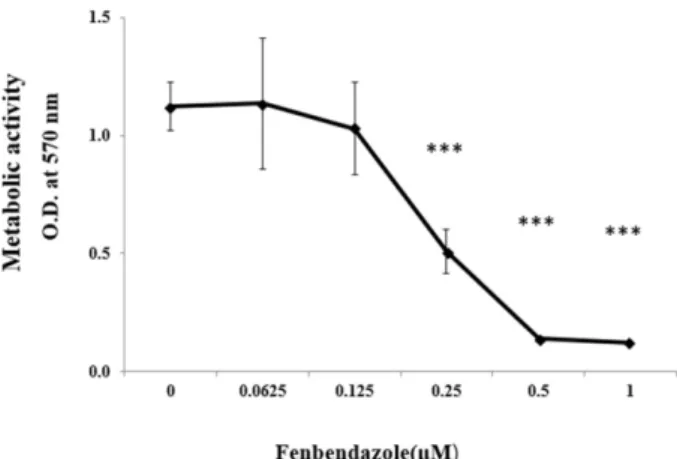
FBZ처리에 따른 HL-60세포의 대사활성도 변화 MTT assay는 세포의 대사활성도를 측정할 수 있는 분석 실험이다. MTT 시약의 성분인 tetrazolium이 세포의 대사작 용에 의해 보라색의 formazan으로 전환되며 570 nm에서 보 라색의 흡광도를 측정함으로써 세포의 대사활성도의 정도를 알 수 있다. HL-60세포에 FBZ를 0-1 μM의 농도로 처리한 결과 0.25-1 μM 처리군에서 세포의 대사활성도가 유의하게 감소하였다(Fig. 1).
FBZ처리에 따른 MMP와 cell death의 변화
FBZ가 처리된 HL-60 세포의 미토콘드리아 막전위 변화를 알아보기 위해 rhodamine 123 염색을 실시한 후 유세포분석 을 실시했다. FBZ의 농도 별로 처리된 HL-60 세포를 분석 한 결과 처리농도가 증가함에 따라 MMP 측정값은 감소하 는 사실을 확인하였다(Fig. 2). MMP는 미토콘드리아의 integrity를 반영하는 지표이며, 감소할 경우 세포의 죽음과 관련이 깊다. 따라서 FBZ에 의해 HL-60세포의 세포사(cell death)가 유도되는 지 알아보기 위해 annexin V-FITC/PI 염 색을 한 후 유세포분석을 하였다. FBZ 0.25 μM 처리군은 대조군과 비교하여 차이가 없었지만 FBZ 0.5 μM 처리군에 Fig. 1. Fenbendazole decreases the metabolic activity of HL- 60 cells. Cells were treated with FBZ (0–1 µM, at 2-fold dilution) for 3 d. MTT assays were performed to measure cellular metabolic activity. Data are presented as mean ± SD from four individual wells, and *** indicates p < 0.001 compared to the control treatment (0 μM).
서는 살아있는 세포의 비율이 7%감소하였고, 1 μM 처리군 에서는 살아있는 세포의 비율이 30% 이상 감소한 것을 확 인했다. 또한 late apoptosis 와 necrosis된 세포의 비율이 대조군에 비해 각각 17%, 18% 증가하였다(Fig. 3).
FBZ처리에 따른 HL-60 세포의 핵 변화
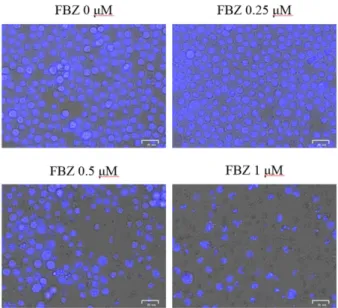
FBZ에 의한 HL-60 세포의 생존율 변화를 시각적으로 확 인하기 위하여 세포 핵을 관찰하였다. FBZ가 처리된 세포를 Hoechst 33342 용액으로 염색을 실시한 후 현미경으로 관찰 하였다. FBZ 0.25 μM 처리군은 대조군과 비교하여 눈에 띄 는 차이가 없었으나 0.5 μM, 1 μM 처리군은 세포의 핵이 깨진 세포들을 확인하였다(Fig. 4).
ROS inhibitor 처리에 의한 FBZ의 항암효과 변화 FBZ의 HL-60세포에 대한 항암효과가 ROS생산과 연관이 있는 지 알아보기 위해 세포 내에서 ROS를 감지할 수 있는 시약인 DCFDA를 HL-60세포에 처리한 후 유세포분석을 하 였다. 하지만 반복된 실험에도 FBZ에 의한 ROS 생산은 감 지할 수 없었다(data not shown). 반면 ROS inhibitor인 NAC 를 FBZ와 함께 HL-60세포에 처리하였을 때 FBZ 0.5 μM
Fig. 2. FBZ decreases the MMP of HL-60. Cells were treated with FBZ for 2 d and stained with rhodamine 123 solution to determine the MMP. Stained cells were examined by using a flow cytometer. The numbers in the histograms indicate the mean fluorescence intensity of the FITC channel (FL1). FBZ, fenbendazole; MMP, mitochondrial membrane potential.
Fig. 3. FBZ increases cell death of HL-60 cells. Cells were treated with FBZ for 3 d and stained with annexin V-FITC and PI solution to determine cell death. The quadrants of each dot plot indicate live cells (annexin V/PI), as well as cells in early apoptosis (annexin V+/PI), late apoptosis (annexin V+/PI+), and necrosis (annexin V/PI+). FBZ, fenbendazole; PI, propidium iodide.
Fig. 4. FBZ damages the nuclei of HL-60 cells. Cells were treated with FBZ and stained with Hoechst 33342 solution to observe nuclear morphology. Broken nuclei were observed in HL-60 cells treated with FBZ at 0.5 and 1 μM. The image was obtained using ZOETM Fluorescent Cell Imager. FBZ, fen- bendazole. Bar, 25 μm.
과 1 μM 농도에서 세포활성도가 유의하게 증가한 것을 확인 하였다(Fig. 5).
고 찰
본 연구에서는 동물용 항기생충제이며, 최근 항암효과가 있는 것으로 알려진 FBZ의 항암효과 여부와 ROS 관련 작 용기전을 알아보기 위해 연구를 진행하였다. 사람의 백혈병 암 세포주(cell line)인 HL-60 세포에 FBZ를 처리한 결과 0.5 μM 이상 처리군에서 미토콘드리아 막전위와 세포활성도 가 감소하는 것을 확인하여 FBZ의 항암효과를 확인하였다.
또한 annexin V-FITC/PI 염색을 통해 cell death를 측정한 결과에서도 1 μM 처리군에서 살아있는 세포의 비율이 대조 군에 비해 30% 이상 감소하여 FBZ의 항암효과를 재차 확 인하였다.
ROS의 생산은 다양한 내부적, 외부적 요인에 의해 시작된 다[15]. 암세포는 미토콘드리아의 산화대사가 결핍되어 있어 정상세포에 비해 ROS수준이 높아져 있다[16]. 세포에서의 ROS는 단백질, 지질, 유전자에 영향을 미치므로, 높아진 ROS 수준은 암세포의 성장촉진에 관여한다. 특히 DNA 손 상에 의해 종양유전자의 활성과 종양억제유전자의 억제로 발 암을 촉진할 수 있다. 그와 반면에 ROS는 간암세포에서 P- glycoprotein (P-gp)의 발현을 촉진시켜 항암제에 대한 저항 성을 증가시킨다[17,18]. 실제 항암제 투여 시 폐암과 유방암 세포에서 ROS 생산을 증가시켜 암세포의 세포자멸사를 촉 진시키는 사실이 확인되었다[19,20].
ROS에 의한 영향을 확인하기 위해 ROS inhibitor의 일종 인 NAC를 사용하였다[21]. FBZ와 NAC를 세포에 처리한 뒤 세포활성도를 측정하였다. 측정 결과 FBZ 0.5 μM 농도 부터 NAC 처리군의 세포활성도가 유의하게 증가하였다. 이
정도를 측정하는 분석을 시도할 필요가 있다.
임상에서 많이 사용되는 항암제 중, 미세소관의 형성을 억제하여 암세포의 성장을 막는 항암제에는 paclitaxel, vincristine, vinblastine등이 있다. HL-60 세포를 이용한 in vitro실험에서 paclitaxel은 3.0 nM, vincristine은 4.1 nM, vinblastine은 5.3 nM의 IC50를 보여 강력한 항암효과를 나타 냈다[22,23]. 이번 연구에서 FBZ의 IC50는 0.23 μM이었다 (Fig. 1). FBZ은 다른 항암제에 비해 약한 항암효과를 보여 주고 있지만, 상대적으로 부작용이 적은 것을 감안하면 단독 투여 또는 기존의 항암제와의 병용투여에 대한 심화된 연구 가 필요하다.
본 연구를 통해 항기생충제의 일종인 fenbendazole이 항암 효과를 가지고 있으며, ROS가 작용기전의 일부인 것을 확인 했다. Fenbendazole이 현재 항기생충제로 사용되고 있어 항 암제로서의 용도를 추가하는 것은 신약개발에 비해 상대적 으로 용이할 것으로 판단된다. 이번 연구를 통해 얻은 fenbendazole에 대한 정보는 기초과학 또는 임상 분야에서 유용하게 사용될 수 있을 것으로 사료된다.
감사의 글
이 논문은 2020학년도 제주대학교 교원성과지원사업에 의 하여 연구되었음.
References
1. Pritchett KR, Johnston NA. A review of treatments for the eradication of pinworm infections from laboratory rodent colonies. Contemp Top Lab Anim Sci 2002;41:36-46.
2. Zajac AM. Developments in the treatment of gastrointestinal parasites of small animals. Vet Clin North Am Small Anim Pract 1993;23:671-681.
3. Muser RK, Paul JW. Safety of fenbendazole use in cattle. Mod Vet Pract 1984;65:371-374.
4. Hayes RH, Oehme FW, Leipold H. Safety of fenbendazole in swine. Am J Vet Res 1983;44:1112-1116.
5. Duan Q, Liu Y, Rockwell S. Fenbendazole as a potential anticancer drug. Anticancer Res 2013;33:355-362.
6. Duan Q, Liu Y, Booth CJ, Rockwell S. Use of fenbendazole- containing therapeutic diets for mice in experimental cancer therapy studies. J Am Assoc Lab Anim Sci 2012;51:224-230.
7. Dogra N, Kumar A, Mukhopadhyay T. Fenbendazole acts as a moderate microtubule destabilizing agent and causes cancer cell
Fig. 5. NAC recovers the metabolic activity of HL-60 cellsdecreased by FBZ. HL-60 cells were treated with FBZ (0–
1 μM, at 2-fold dilution) in the absence or presence of NAC (3 mM) for 3 d. MTT assays were performed to measure the metabolic activity of HL-60 cells. ** indicates p < 0.01 between with and without NAC at the same concentration of FBZ.
NAC, N-acetyl cysteine; FBZ, fenbendazole.