DOI : http://dx.doi.org/10.5394/KINPR.2013.37.3.315
A Study on the Floating Building as a New Paradigm of Architecture
†Chang-Ho Moon
†Department of Architecture and Building Engineering, Kunsan National University, Kunsan 573-701, Republic. of Korea
Abstract : According to climate change, deficiency of usable land, large water portion of the Earth surface, and improvement of income level, floating architecture is emerging as a strong & attractive alternative. The aim of this study is to suggest some related applying ways for new building projects around waterside. New paradigm of architecture can be described as a new model and/or system of architecture with new concept and Zeitgeist like sustainability and green building. Floating building is already a new paradigm of architecture comparing with the preconception of building only on the land and current building regulations. New paradigm features from the sample projects can be summarized as new concepts of building, application of various renewable energy resources(water, solar, wind), modular construction, use of local raw material, dual purpose usage, long term and relocatable usage, and special building materials for green building.
Key words :Floating building, Water friendly building, New paradigm, Sustainability, Climate change
†Corresponding author, [email protected] 063)469-4782
Note) This paper was presented on the subject of "Floating Building as a New Paradigm of Architecture" in the 9th International Symposium on Architectural Interchanges in Asia(KDJ Convention Center, Gwangju, Korea, 22nd-25th October, 2012) and has been revised and developed.
1. Introduction
Owing to climate change like global warming, the water level of sea and river has been rising. The 70% of the Earth is covered with the water. Meanwhile people want to live and enjoy leisure activities near or on the water according to the increase of economic income level.
Therefore, water friendly building will be strong alternative architecture and needed more and more in the future.
People have thought that buildings should be constructed only on land. Usually building regulation permits the building design only on land. But for example, the Dutch has lived on houseboat for a long time. And immigrants in Seattle have started to live on the floating homes made of wood raft and wood structures.
The aim of this study is to investigate the new paradigm features of floating building through planned and realized projects, and to suggest the applicable item and way for the new building projects on water.
Research methods include the review of the related literatures to set the framework of new paradigm concept, the navigation of floating building related homepages, and the site-visits of some floating buildings in Europe & USA.
Sample buildings of realized and planned projects are sele cted through the search on internet like Google(https://ww w.google.com/) and the related articles of online architectur
al magazine like Inhabitat(http://inhabitat.com/) and ArchDa ily(http://www.archdaily.com/).
As conclusion, the advantageous and new respects of floating building comparing ordinary building on land are to be suggested for new building project and architectural paradigm shift.
2. Concept of floating building and new paradigm
According to the British Columbia Float Home Standards(Office of Housing and Construction Standards, Ministry of Energy and Mines, British Columbia, Canada, 2012), float home means a structure incorporating a floatation system, intended for use or being used or occupied for residential purposes, containing one dwelling unit only, not primarily intended for, or usable in navigation and does not include a watercraft designed or intended for navigation(Moon, C., 2012).
New paradigm of architecture can be described as a new model or system of architecture with new concept and Zeitgeist like sustainability and green building(The Free Dictionary, 2012).
In this paper, sample floating buildings are to be analyzed
and new paradigm features are suggested in terms of new
concept, sustainability(focused on renewable energy) and green building concept.
Floating building itself is already a new type of architecture and there are a lot of possibilities in terms of sustainability and green building. Therefore floating building can be a good example in new paradigm of architecture.
3. Outline of sample floating buildings
3.1 Realized Projects
1) IBA dock
- Region: Hamburg, Germany - Completion time: 2009
- Story & floor area: 3 story, 1,623㎡
- Date of visit: 2011.8.6
This building was the headquarters of the IBA (international building exhibition) Hamburg GmbH as well as an information and event center for the IBA. Now the building is being used for Urban and Architecture information center in Hamburg(see Fig. 1).
Fig. 1 Overview and interior of IBA dock
This floating building is a steel-construction on concrete substructure pontoon. The superstructure of building was made in a prefabricated modular construction, and it also used a ready-made heating and cooling ceiling elements in the entire building.
This building was planned that air conditioning might be possible without conventional energy sources such as oil and gas. Several measures were reviewed to provide energy supply for the IBA dock from the water temperatures of the Elbe, solar heat panel, and solar photovoltaic cells (Immosolar, 2013).
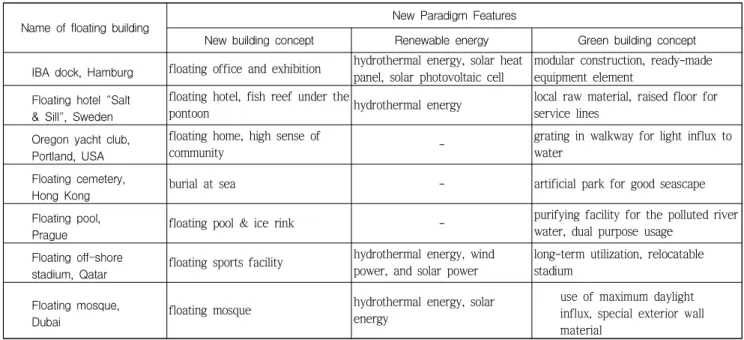
New paradigm features from this building can be summarized as new concept of office and exhibition building, application of various renewable energy system, and adoption of modular construction.
2) Floating hotel "Salt & Sill"
- Region: Island of Klädesholmen, Sweden - Completion time: 2008
- Story & no. of rooms: 2 story, 23 rooms(46 beds) - Date of visit: 2011.8.9
This floating hotel is located near the famous seafood restaurant "Salt & Sill". The hotel consists of six two-story wooden buildings on floating concrete pontoon(see Fig. 2).
The hotel is very popular even though it is located in rural & coastal area. So there are many visitors all the year over.
Fig. 2 Overview and interior of Salt and Sill The hotel was designed with the mind of environmental sustainability as heating energy is generated from the warm sea water underneath the hotel in winter.
The building used local raw materials such as the pine wood from Swedish forests, and environmentally friendly paint. They have even used the left over quarrying stone to build a new lobster reef under the pontoon(Voyatzis, C., 2008). And the raised floor system was applied for easy installation & maintenance of service lines.
New paradigm features from this building can be pointed out as new concept of hotel and consideration of sea life, adoption of hydrothermal energy in winter, and use of local material & raised floor for easy maintenance.
3) Oregon yacht club
- Region: Portland, Oregon, USA - Completion time: 2009
- No. of homes & area of water property: 38 homes, 8 acres
- Date of visit: 2012.8.19.
Fig. 3 Google satellite map and walkway of OYC
Fig. 5 Overview of floating pool The Oregon yacht club(OYC) is a floating home
community located on the Willamette River in Portland. It is close to downtown with a pastoral setting, so became one of the premier floating home moorage(see Fig. 3).
The OYC has more than 100 years’ history. The original purpose was to foster and encourage yachting. After 1910, OYC started allowing houseboat living in summer, eventually evolved to the year-round homes of today.
OYC is now a modern houseboat community, with a predominance of two-story buildings replacing the traditional one-story residences. The club is currently comprised of 38 floating homes that are permanently situated on the moorage and the walkway.
There are gratings in walkway for light influx to the water. This is a kind of consideration for the eco-system under the floating home. The community also has great interesting in conserving the natural environment like restoration of wild birds, clean marine program, watershed re-vegetation program, and others.
New paradigm features from this floating home community can be suggested as high sense of community and environmental conservation like grating installation in walkway for light influx and related activities for natural environments.
3.2 Planned Projects
1) Floating cemetery - Region: Hong Kong - Design time: 2010 - Story & floor area: -
Fig. 4 Overview and interior of floating cemetery (Source : LaBarre, S., 2010)
This floating cemetery gives totally new concept of burial at sea. It is really difficult to find a place in Hong Kong for cemetery(see Fig. 4). As burial grounds are very limited, private cemetery space is extremely expensive and there is a long waiting list for public burial site.
According to Buddhist tradition, people wants to provide good resting places for dead ancestors. There are some debates whether to build a multi-story columbarium or develop the land for cemetery.
So the architect proposed a floating cemetery near harbor.
Visitors can go to the columbarium by boat and keep the ashes in a designated niche or scatter them over the sea.
There should be quite different atmosphere comparing with the existing cemetery on the land. This structure can be a sort of artificial park and provide good seascape to the prayers(LaBarre, S., 2010).
New paradigm features from this project can be summarized as new concept of cemetery and provision of artificial park for good seascape.
2) Floating pool
- Region: Vltava river, Prague - Design time: 2012
- Story & floor area: 1 story, 810㎡
Fig. 6 Summer and winter view (Source: Meinhold, B., 2012)
This floating circular pool project came from the idea to clean the polluted river water and also to offer the recreational facility for the residents(see Fig. 5 & 6).
The historic Vltava was a popular swimming and skating place before industrialization. The circular pool structure will function like a giant floating strainer to filter its contaminated water, so that the residents can swim and skate there as before.
The architects proposed to create several floating
recreational islands with the purifying facility of textile
membrane. Users can access by boat and/or floating
pedestrian bridge.
The pool is located in the center of the building and is surrounded by subsidiary facilities like a bar, private cabins, changing rooms, rest rooms, shower & sauna rooms, and mechanical room. A small and shallow pool is also provided for younger kids.
The river water can be filtered through a textile membrane on the bottom of the pool. In the winter, the pool can be converted into an ice rink for continued use all the year round(Meinhold, B., 2012).
New paradigm features from this project can be suggested as new concept of recreational facility (swimming and skating), installation of purifying facility for the polluted river and dual purpose usage by different seasons.
3) Floating off-shore stadium - Region: Worldwide
- Design time: 2010/2011
- Floor area & no. of seats: 260,000㎡, 65,000seats
Fig. 7 Overview & Sectional View (Source: Sebastian, J., 2011)
This stadium was developed by the German architects
“Stadiumconcept” for the FIFA World Cup 2022(see Fig 7).
The floating off-shore stadium can be relocated to seaside place across the oceans(Sebastian, J., 2011). Therefore this stadium can be used by more effectively than usual on-shore stadium.
The stadium can be operated by divers renewable energy resources such as hydrothermal use of water, wind power and solar energy. As floating structures are located on the sea or lake and there is no obstacles, wind and solar power is easy to obtain. And sea water can be used as cooling material in summer in the Middle East region.
Its global mobility, long-term utilization and various economic efficiency show great advantages and so can be a new model for 21st century sports facility. Once a big sports event such as World Cup or Olympic Games was completed, operation and maintenance of the stadium raises economic problems due to low utilization.
Almost all the countries of the world have access to the sea. This unique floating stadium can be one of the most
innovative and sustainable facility worldwide due to economic efficiency and long-term utilization.
New paradigm features from this project can be summarized as new concept of mobile sports facility, adoption of various renewable energy system (hydrothermal, solar energy and wind power) and long-term usage by different relocations by different people in need.
4) Floating mosque
- Region: Palm Jebel Ali, Dubai, UAE - Design time: 2007
- Story & floor area: 1 story, -
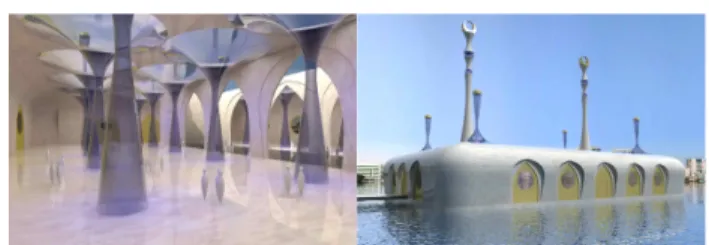
This floating mosque has traditional Islamic arches and two rows of transparent plastic columns that support the roof and give daylight through the prayer hall. The mosque could be floating by the large pontoons made of concrete & styrofoam(see Fig. 8) and self-supporting as possible in terms of energy.
Fig. 8 Perspective & interior of floating mosque (Source: Reinl, J., 2007)
Roof and columns are made transparent by composite material. Sea water is purified and pumped from outside through the building components like floor, wall & roof, and it flows out again over the roof via the columns. A transport controller ensures that the transparent columns always keep the water in full, to give continuously visual attraction(Olthuis, K. and Keuning D., 2010).
And the floating mosques are also eco-friendly, pumping water from the sea through a vein-like system cools down the building by 15 degree Celsius, in other words, saving air conditioning cost by as much as around 40 percentage.
The roof and walls could not absorb the heat because of porous exterior material, consisting of a spongelike ceramic substance with highly low density. The fat external walls have a high accumulative volume due to their extraordinary density and great size(
Reinl, J., 2007).
New paradigm features from this project can be
suggested as new concept of mosque with light on water,
adoption of renewable energy system(hydrothermal energy
usage and solar panel system in cooling), and application of
maximum daylight influx & special exterior wall material.
Name of floating building New Paradigm Features
New building concept Renewable energy Green building concept IBA dock, Hamburg floating office and exhibition hydrothermal energy, solar heat
panel, solar photovoltaic cell
modular construction, ready-made equipment element
Floating hotel "Salt
& Sill", Sweden
floating hotel, fish reef under the
pontoon hydrothermal energy local raw material, raised floor for service lines
Oregon yacht club, Portland, USA
floating home, high sense of
community - grating in walkway for light influx to
water Floating cemetery,
Hong Kong burial at sea - artificial park for good seascape
Floating pool,
Prague floating pool & ice rink - purifying facility for the polluted river
water, dual purpose usage Floating off-shore
stadium, Qatar floating sports facility hydrothermal energy, wind power, and solar power
long-term utilization, relocatable stadium
Floating mosque,
Dubai floating mosque hydrothermal energy, solar
energy
use of maximum daylight influx, special exterior wall material