A Study on Control and Monitoring System for Building Energy Management System
Jin-Seok Oh†․Soo-Young Bae1
(Received November 1, 2010; Revised December 23, 2010; Accepted January 6, 2011)
Abstract:Building energy saving is one of the most important issues in these days. Control algorithm for energy saving should be designed properly to reduce power consumption in building. Recently, building energy system consists of hybrid energy system coupling with RE (Renewable Energy) source. In this paper, an optimum control algorithm for building energy saving is applied to BEMS (Building Energy Management System) by using an outdoor air temperature prediction strategy. BEMS coupling with renewable energy can control HVAC (Heating, Ventilating and Air-Conditioning) system effectively. In order to verify the effectiveness of building energy saving, BEMS was tested for several months at a laboratorial chamber with an air conditioner, fan and heater. To this end BEMS embedded control algorithm has been tested successfully.
Key words:Energy Saving, Building Energy Management System, Renewable Energy, Control Algorithm, Hybrid Energy System
†Corresponding Author(Division of Marine Engineering, Korea Maritime University, Email: [email protected], Tel: 051-410-4283) 1 Division of Mechatronics Engineering, Korea Maritime University.
Note) This paper was presented on the subject of "Experimental Study on Control Algorithm for A Building Energy Management System Coupling with Renewable Technologies" World Renewable Energy Congress XI 29th September 2010, Abu Dhabi, UAE.
1. Introduction
Buildings nowadays are increasingly expected to meet higher and potentially more complex levels of performance. They should be sustainable, use zero-net energy, be healthy and comfortable, grid-friendly, yet economical to build and maintain[1]. It implies that the energy demand for heating and electrical power is reduced, and this reduced demand is met on an annual basis from a renewable energy supply.
Low carbon policy aims not only to increase the number of renewable energy installations, but also demonstrate a significant reduction in the maintenance costs in order that low carbon energy strategies are feasible at both individual building
and community scales.
With maintaining a living comfort level, reduction of energy consumption at the building can be implemented by applying the control algorithm to BEMS. BEMS provides control, managing and monitoring of buildings' heating, ventilating and air-conditioning systems. It enables efficient control of building environments and reduces energy consumption. Meanwhile, due to the low carbon energy policy in many countries, the number of the installation of building integrated renewable energy systems increases. As a result, energy supply systems for buildings get diverse and complex in terms of monitoring and control.
In real time operation of a BEMS, a coupling
mechanism of the energy production and energy requirements can yield significant benefits such as the energy saving, reduced investment costs for building energy system. The objective of a BEMS is not only to minimise the energy consumption of the building, but also to design a building that balances energy requirements with renewable technologies.
This paper describes a control algorithm for BEMS which was tested at a laboratorial chamber equipped with a BEMS.
2. Experimental Method
2.1 Infrastructure
Design concept of BEMS is a progression from an energy saving concept coupling with renewable energy system such as PV and wind turbine.
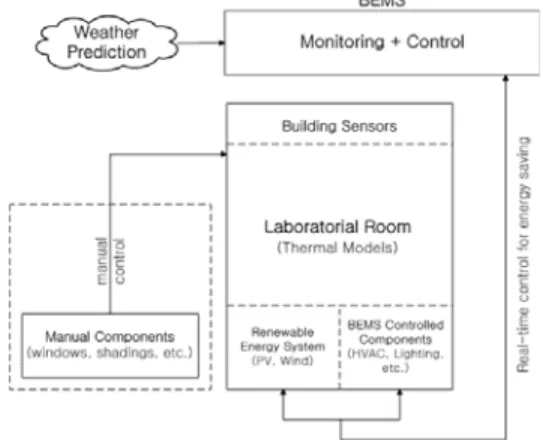
Buildings are complex system therefore designed algorithm is needed to take into account the climate data, geometry, HVAC-systems, energy generation systems, ventilation, user behaviour, etc. Figure 1 shows the components of BEMS coupling with renewable energy. Nowadays, buildings and their energy performance are estimated based on calculation using simplified physical models and taking a largely static view of the building and its operation[1]. Manually controlled components in Figure 1 are windows and shadings which interface with building occupants.
Figure 1: Components of BEMS coupling with renewable energy
Energy production components in the laboratorial room are PV and wind turbine. BEMS in Figure 1 controls not only the energy production system but HVAC and lighting to reduce the energy consumption. Temperatures at laboratorial chamber are controlled by operating HVAC system on the basis of difference between outdoor air temperature and setting temperature. Figure 2 shows the infrastructure of BEMS coupling with renewable energy. Power output from renewable energy source, PV and wind turbine, is controlled by hybrid power controller via MPPT controller.
BEMS operation in a production and consumption approach requires communication between many systems and elements that are of different type, serve different purposes, have been developed by different designer and based on different design philosophies. This is clearly depicted in Figure 2 which is divided into two parts as energy production and consumption.
Figure 2: Schematic diagram of infrastructure of BEMS coupling with renewable energy
2.2 Algorithm
The operation of an efficient BEMS may requires that new monitoring and control elements should be added after the initial system deployment.
In this paper, the laboratorial chamber for BEMS testing in Figure 3 is designed as an area within the office building and coupled with the renewable energy like solar and wind energy for reducing the cooling and heating power consumption. The specification of the laboratorial chamber for testing BEMS is shown in Figure 3 (b). The laboratorial chamber is assumed as an office room where indoor temperature is controlled by an air conditioner and a fan. The electricity consumpted to the air-conditioner and the fan in the room is supplied from both of grid and renewable energy systems, i.e. PV and a wind turbine, installed on the roof of building.
(a) Laboratorial chamber
List Values
Window ratio 20 [%]
Bearing Southern exposure
PV capacity 2 [kW ]
Wind turbine capacity 1 [kW ] Air conditioner capacity 3 [kW ] Desired room temperature 25 [℃]
Predicted mean vote -0.5~0.5 Desired operating times 6AM-6PM
(b) Details of the test bed
Figure 3: The specification of the laboratorial chamber for testing BEMS
The fan is only operated when outdoor temperature gives an advantage of saving energy.
For example, while heating is required and outdoor temperature is higher than indoor temperature, indoor temperature can be raised by using ventilation fan.
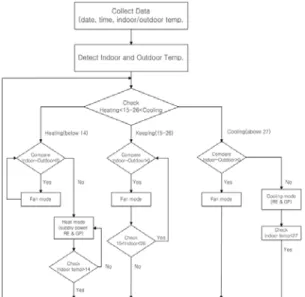
In the control algorithm, the main aim is to maximise the utilisation of renewable energy supply and minimise the use of grid power. If the output electricity from renewable energy is sufficient to meet the demand for heating or cooling, this renewable energy is used. If it is not sufficient to meet the electricity demand, grid power is imported to compensate insufficient amount of electricity to meet the electricity demand. Figure 4 shows the flowchart of the control algorithm of BEMS.
Figure 4: Flowchart of control algorithm in BEMS
We have to consider the building capacity “C”
and the heat loss coefficient “H” [2]. These characteristics are defined as follows:
(1)
(2)
Where, the internal surface area , the external surface area , the heat conductivity , the specific heat capacity , the density of internal walls , the thermal transmission coefficient , the air change , room volume , the specific heat capacity , is the air density. Additional information is given in reference[5].
3. Test and results
3.1 Monitoring network
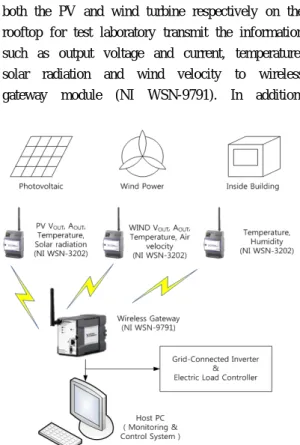
Figure 5 illustrates the developed monitoring system using wireless sensor network to manage the energy use in a laboratorial chamber [3].
Wireless modules(NI WSN-3202) mounted on both the PV and wind turbine respectively on the rooftop for test laboratory transmit the information such as output voltage and current, temperature, solar radiation and wind velocity to wireless gateway module (NI WSN-9791). In addition,
Figure 5: Schematic diagram of the wireless sensor network system
wireless gateway also collects indoor information such as room temperature and humidity through wireless module mounted inside the laboratorial chamber.
Table 1 shows the specification of wireless modules used in laboratorial test. All collected data by gateway module are transmitted to host PC via Ethernet to monitor and control BEMS in real time by using the proposed energy saving algorithm.
Table 1: The specification of the wireless sensor module
N I W SN -9791
National Instruments
Wireless Sensor Network Ethernet Gateway 2.4GHz, IEEE 802.15.4 radio
Outdoor range up to 300m 10/100 Ethernet
N I W SN -3202
National Instruments
Wireless Sensor Network Measurement Nodes 2.4GHz, IEEE 802.15.4 radio
Outdoor range up to 300m Measuring Time 1Hz
3.2 Results
The experimental test of the performance of the BEMS was carried out during the periods of March to July in 2010. Figure 6 represents power generation from renewable energy source and grid power consumption at laboratorial chamber from 6AM to 6PM for a typical day.
In Figure 6, the RE-generation curve, sum of produced energy from PV and wind turbine, depends on the locational circumstance as well as weather conditions. The consumption curve means consumed energy in air-conditioner and ventilation fan to maintain the setting temperature.
(a) RE-generation and consumption curve in BEMS control condition on sunny day
(b) RE-generation and consumption curve in no-control condition on sunny day
(c) RE-generation and consumption curve in BEMS control condition on windy day
(d) RE-generation and consumption curve in no-control condition on windy day Figure 6: Test result of BEMS control
The clear reduction of grid power consumption is given in Figure 6 (a) and (c). To show the effectiveness of the proposed control algorithm, RE-generation and consumption curve at no-control condition are depicted in Figure 6 (b) and (d).
Please note that RE-generation curves are same in both case, control and no-control condition. Also grid power consumption is certainly reduced under the BEMS control condition as shown in Figure 6 (a) and (c). Temperature curves, outdoor and indoor temperature 6AM to 6PM, on test day are depicted in Figure 7 for reference.
(a) Temperature curve on sunny day (22.Aug.2010)
(b) Temperature curve on windy day (13.Dec.2010) Figure 7: Temperature curve on test day
4. Conclusions
A control algorithm for building energy saving in BEMS has been proposed. The main idea of the proposed system algorithm is based on the continuous check of deviation between indoor and outdoor temperature. According to the laboratorial test, the performance of the proposed system was
remarkably demonstrated showing that about 20%-30% reduction of grid power use was made.
High reduction rate of grid power consumption is possible when the energy demand is met by the energy supply from renewable energy source. It implies that in order to maximise the utilisation rate of renewable energy the reduction of grid power use is a crucial measure as well as increasing the capacity of renewable energy source such as PV and wind turbine. A control algorithm in BEMS coupling with renewable energy has been working in a variety of conditions.
Furthermore the proposed system can be applied to special condition such as offshore plant and special ship for their energy saving.
Acknowledgments
This work is the outcome of a Development of Hybrid Power Generation System for Ocean Facility and Manpower Development for Marine Energy by the Ministry of Land, Transport and Maritime Affairs(MLTM). Also, This study was partly supported by the basic research program of Wave Power Generation System with the Function of a Breakwater by the Ministry of Educational Science and Technology.
References
[1] D. Kolokotsa et al. “A roadmap towards intelligent net zero- and positive- energy buildings”, Solar Energy 2010.
[2] Jens Pfafferott et al. “Design, monitoring and evaluation of a low energy office building with passive cooling by night ventilation”, Energy and Buildings, vol. 36, p455-465, 2004.
[3] Chang-Gyu Seong, Keel-Soo Rhyu et al. “A environment data monitoring system using wireless sensor”, Journal of the Korea Society of Marine Engineering 2006 Spring conference, pp. 89-90, 2006
Author Profile
Jin-Seok Oh
He received the M.Eng. and Ph.D.
degrees from Korea Maritime University in 1989 and 1996, respectively. He was a researcher in Agency for Defense Development(ADD) from 1989 to 1992.
From 1992 to 1996, he was an assistant professor in the Department of Industrial Safety Engineering at Yangsan Junior College. Also, he received Ph.D. degree from Kyushu University in 2009. Since 1996, he has been a professor of Division of Mechatronics Engineering at Korea Maritime University.
Soo-Young Bae
She is a PhD student at the Department of Mechatronics Engineering and received the M.Eng degree in 2010 from Korea Maritime University. Her research interests are renewable energy, smart grid and its applications.