DOI : http://dx.doi.org/10.5394/KINPR.2012.36.2.113
A Study on the Sustainable Features of Realized and Planned Floating Buildings
†Chang-Ho Moon
†Department of Architecture and Building Engineering, Kunsan National University, Kunsan 573-701, Republic. of Korea
Abstract : According to the climate change and the improvement of income level, floating building on water has been emerging as a strong alternative. This study was intended to suggest some reference materials of sustainabilility for new floating building projects. The concept of sustainability and floating building was investigated, and 3 realized projects and 3 planned projects were reviewed in terms of sustainability. Sustainable features of the sample projects can be summarized as recycled and relocatable usage, adoption of various renewable energy techniques, installation of self-supporting plant, application of modular system and others like new material & open layout. Sustainable features need to be developed more and more in detail and applied to many types of floating buildings.
Key words : Floating Building, Sustainable Feature, Marine Building, Water Front, Green Building
† Corresponding author, [email protected] 063)469-4782
Note) This paper was mainly presented on the subject of "Sustainable Characteristics of Floating Architecture" in IAPS International Network Symposium 2011 Proceedings (Daegu Korea, 10th-14th October, 2011) and has been revised & developed since the symposium.
1. Introduction
Climate change like global warming will bring a rise in sea and river level. Usable land in urban area will be more scarce due to continuous expanding development.
Reclamation method for land supply is regarded as environmentally negative and very hard to proceed in the future. People like to live and enjoy leisure activities near or on water according to the improvement of income level. As there are few obstacles on the lake or sea, floating building can use solar energy, wind power and temperature of water with easy. Therefore floating building on water has been emerging as a feasible and strong alternative.
The aim of this study is to review the concept of sustainability & floating building, to investigate the sustainable features through realized and planned floating architectures, and to suggest some reference materials for new building projects around waterside.
Research method includes the navigation of floating building related homepages, the review of reference documents and literatures, and the study visit of some projects and interview with designer.
As research subjects for analysis, various types of floating buildings such as hotel, exhibition center, mosque, building for disaster relief, and others are to be taken into consideration. 3 realized and 3 planned floating projects which have significant features of sustainability were selected from the existing floating buildings and suggested
floating building designs in the reference materials..
2. Concept of sustainability and floating building
Sustainability is the capacity to endure. For humans, sustainability is the potential for long-term maintenance of well being, which has environmental, economic, and social dimensions. According to the Brundtland Commission of the United Nations on March 20, 1987, sustainable development is a development that meets the needs of the present without compromising the ability of future generations to meet their own needs(Sustainability Recycling, 2012).
A universally accepted definition of sustainability is elusive because it is expected to achieve many things. On the one hand it needs to be factual and scientific, a clear statement of a specific “destination”. The simple definition
"sustainability is improving the quality of human life while living within the carrying capacity of supporting eco-systems", though vague, conveys the idea of sustainability having quantifiable limits(Wikipedia, 2012).
Sustainable building is a general term that describes environmentally conscious design techniques in the field of architecture. Sustainable building is framed by the larger discussion of sustainability and the pressing economic and political issues of our world. In the broad context, sustainable building seeks to minimize the negative environmental impact of buildings by enhancing efficiency and moderation in the use of materials, energy, and development space. Most
simply, the idea of sustainability, or ecological design, is to ensure that our actions and decisions today do not inhibit the opportunities of future generations. This term can be used to describe an energy and ecologically conscious approach to the design of the built environment(Wikipedia, 2012)(see Table 1).
Item Sustainable factors
Energy
- geothermal use of sea/river water - use of solar energy
- use of wind enery - daylight influx
- energy efficient wall material
Ecology
- long term usage - self-supporting facility - protection of the environment - use of local raw materials - use of new material
- modular construction & open layout Table 1 Concept of sustainability
Meanwhile, According to the British Columbia Float Home Standards, float home means a structure incorporating a floatation system, intended for use or being used or occupied for residential purposes, containing one dwelling unit only, not primarily intended for, or usable in navigation and does not include a water craft designed or intended for navigation.
So floating architecture can be defined a building for living/working space on floatation system without navigation tool(Office of Housing and Construction Standard, Ministry of Energy and Mines, British Columbia, 2012).
Therefore sustainability of floating building can be interpreted as an energy and ecologically conscious approach to a building for living/working space on floatation system without navigation tool.
3. Realized floating building
3.1 Four seasons hotel, Australia
- Location: Great Barrier Reef area in Queensland, Australia - Year of completion: 1988
- Size & scale: 5 story, 140 double rooms and 34 luxury suites, 29,000㎥
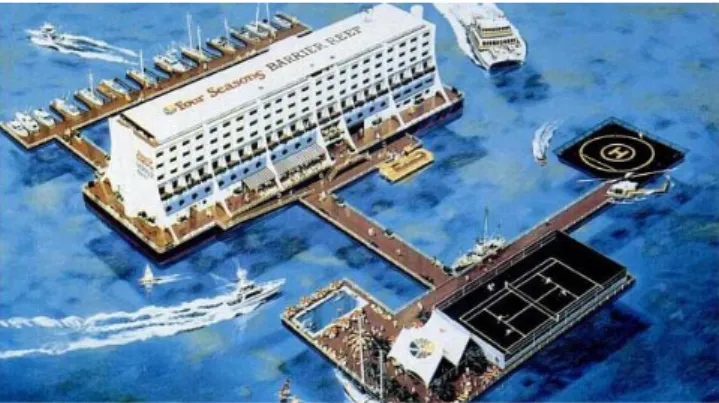
The world's first offshore floating hotel, four seasons hotel(see Fig. 1) had been installed adjacent to Australia's Great Barrier Reef(GBR) in March, 1988. The idea of a floating hotel came from the geography of the GBR which lies some considerable distance and travelling time from the
mainland port. Tour companies estimated that visitation could be significantly increased with shorter or faster trip, or through the provision of onsite fixed offshore accommodation.
Fig. 1 Design of four seasons hotel complex
This hotel was designed and developed by Swedish naval architect Sten Sjostrand and was constructed by Consafe Engineering in Singapore. After the construction, the engineers guided a half-submerged, heavy-lift carrier vessel under the floating hotel structure and then pumped the carrier dry, raising the building out of the water. The ship brought the hotel to the lagoon and reversed the loading process. Work crews connected the hotel building with pontoons that carry tennis court, marina and the rest of the complex.
The hotel was a self-supporting floating building and so had a desalination plant for fresh water, on-board sewage and waste treatment. And the hotel had an underwater observatory and a semi-submersible vehicle for coral-reef cruises, as well as the usual luxury hotel amenities. The mooring system for the whole resort is originally developed for oil supertankers. The hotel's power plant, according to the developers, will operate at almost noiseless levels so as not to disrupt the reef's delicate ecosystem(Popular Mechanics, 1988).
Several accidents occurred during the early stage of the project. The catamaran designed to carry 400 passengers was destroyed by the fire before first service. The hotel was hit by a cyclone and some of the peripheral structures including the floating tennis court were damaged before official opening. And the hotel had been operated for less than a year until the turn of the century when finance troubles. The hotel had to be put on the international market for sale in September 1988.
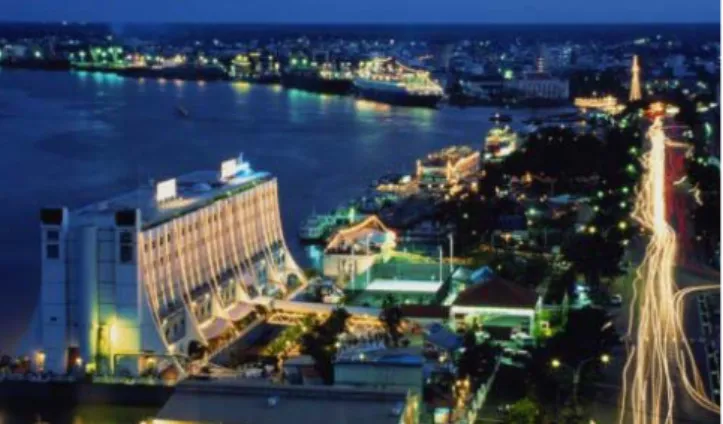
After being taken over by Japanese enterprises in April 1989, the floating hotel moved to Ho Chi Mihn City on the Mekong River, Vietnam in August 1989 to mitigate the
shortage of quality hotel.
Fig. 2 Saigon floating hotel
The hotel, newly named as Saigon floating hotel(SFH)(see Fig. 2), was officially opened in December 1989. The hotel was the first obvious sign that "doi moi" had finally arrived in Vietnam, it was the only place in Ho Chi Minh City where foreigners could meet and socialize(Flicker, 2012).
Its operation ended in August 1996 over 6 glorious years’
business for unspecified reasons from the government. SFH was sold for decomposition in Singapore and left Bach Dang quay on April 1st 1997(Saigon Floating Hotel, 2012).
Fig. 3 Hotel Haekumgang
This hotel in Singapore was bought by Hyundai Group of Korea in November 1998, moved to Kosung port, North Korea and opened as a tourist hotel, named of hotel Haekumgang(see Fig. 3 & 4), for Mt. Kumgang trip in October 2000. Since then, a lot of tourists from South Korea stayed in this hotel, and also the hotel was used as an official meeting place of separated family members from South and North part of Korea in national holidays. The interior of the hotel was remodeled in early 2006(Hyundai Asan, 2012).
Fig. 4 Typical floor plan of hotel Haekumgang
As relationship between South and North Korea got worse, the hotel was bound as frozen property by North Korea and has stopped in operation since April 2010. Several ideas including moving library for 5 islands of West Sea after remodeling have been proposed.
Sustainable features of the hotel can be summarized as the long term usage by relocation of various regions, a self-supporting facility with desalination plant, sewage &
waste treatment system, and a power plant with at almost noiseless level.
3.2 Floating hotel "Salt & Sill", Sweden
- Location: Island of Klädesholmen, near Gothenburg, Sweden
- Year of completion: 2008
- Size & scale: 2 story, 23 rooms(46 beds) - Date of visit: August 8th-9th, 2011
In October 2008, Sweden’s first floating hotel(see Fig 5 &
6), designed by Mats & Arne Arkitektkontor AB, Sweden, opened alongside the famous restaurant "Salt & Sill". The hotel consists of six two-story buildings on floating pontoon.
The hotel has 23 rooms with 46 beds, and all the rooms have their own entrance and access to an outdoor seating area.
Especially 1 suit room for honeymoon couple is prepared and very popular even though the hotel is located in rural &
coastal area. People can feel a cozy & personal atmosphere and a style characterized by modern Scandinavian simplicity.
The owner has always been interested in the environment.
During the construction of the floating hotel, protecting the environment was obviously top priority. The facility should have a positive impact on outdoor activities, and should have little effect on the living environment, safety or communications. It should not cause any significant pollution of noise, air and water.
The design of the hotel was also done with the environment sustainability in mind as heating energy for the hotel is actually generated through geothermal wheels from underneath the hotel, at the bottom of the sea. The owner used local raw materials such as the wood from Swedish
pine forests, environmentally friendly paints and have even used the left over quarrying stone to build a new lobster reef under the pontoon. The sea life was increased by creating a perfect habitat for shells and mussels(Anouk van den Eijnde, 2010; Costas Voyatzis, 2008)
Fig. 5 Floating hotel “Salt & Sill”
Fig. 6 Floor plan of floating hotel “Salt & Sill”
Sustainable features of the hotel can be summarized as protection of the environment, the use of local raw materials, the geothermal use of sea water, the habitat creation for marine life by using the left over stone.
3.3 IBA Dock
- Location: Hamburg, Germany - Year of completion: 2009 - Size & scale: 3 story, 1,623㎡
- Date of visit: August 6th, 2011
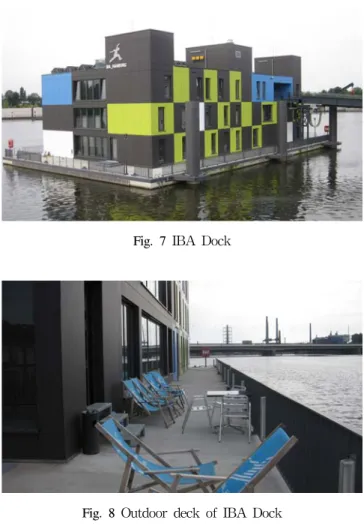
The IBA Dock(see Fig. 7 & 8), designed by Prof. Han Slawik, Hannover, was the headquarters of the IBA corporation, IBA Hamburg GmbH, as well as an information and event centre for the IBA. The building is centrally located, easily accessible for Hamburg's tourists, but most of all, for the many visitors to IBA. Now the building is being used for Urban and Architecture information center in
Hamburg.
Fig. 7 IBA Dock
Fig. 8 Outdoor deck of IBA Dock
This is a steel-constructed floating building with concrete pontoon. In terms of static and weight requirements, the superstructures are to be made in a modular construction and assembled on the pontoon. This also influences the choice of outgoing heat systems. The better choice is the usage of ready-made heating and cooling ceiling elements to be installed in the entire building.
This floating building made the type of energy supply a challenge for engineers, geologists and the responsible authorities. Multiple possibilities were reviewed in cooperation to provide an energy supply for the IBA Dock from the water temperatures of the Elbe combined with solar thermics. The energy source is a heat exchanger built into the pontoon in the form of meander-like extended pipes. The choice of the heat source depends on the quality of the water and the biological conditions of the Elbe. In this case a water-water heat pump would lead to the iron clogging of the filter and the presence of multiple algae and mussel growth in the suction tubes. The low temperatures of the Elbe in winter would also have a negative effect on the yearly performance of the heat pump.
The use of solar warmth for heating support is realized by means of solar collectors on the roof. An angle of 50° in a southern direction was chosen for the positioning of the collectors. The steep position helps to maximize the solar yield, especially during the transitory months, thus increasing the efficiency of the entire facility.
The usage of green electricity for all electrical loads emphasizes the hidden goal. The photovoltaic unit is located on the roof terrace level and is positioned at an angle of 30°
facing south. The system achieves a delivery rate of 14.8 kW. The technical room is being made accessible so that the energy supply is clear for the interested visitor, and in this manner it is being integrated into the exhibition(Immosolar, 2012).
Sustainable features of the building can be summarized as the modular construction, the geothermal use of the Elbe, the use of solar collector, and the installation of photovoltaic
4. Planned floating building
4.1 Floating mosque, Dubai
- Location: Palm Jebel Ali, Dubai, UAE - Year of design: 2007
- Size & scale: 1 story
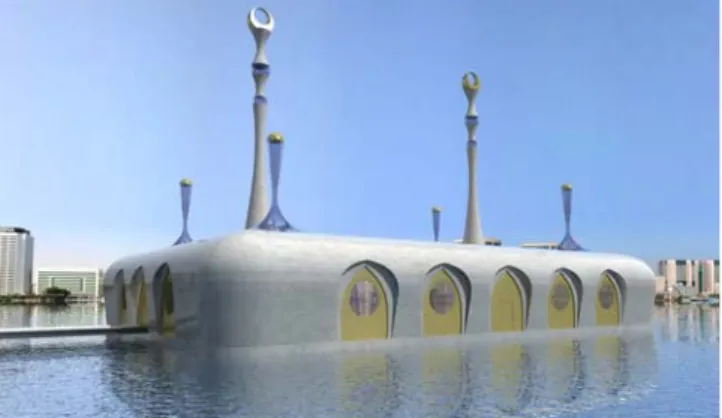
The flat-roofed floating mosque(see Fig. 9 & 10), designed by Koen Olthuis of Waterstudio, the Netherlands, has minarets, traditional Islamic arches, and two rows of 12m high transparent plastic columns that do not only support the roof but also give daylight through the prayer hall. The building would be kept afloat by giant pontoons of a mixture of concrete and foam and self-supporting as possible in terms of energy.
In the pray hall, the glass roof is supported by five columns representing the pillars of Islam. Roof and columns are made transparent by using composite acrylic material.
This material is usually used for large sea aquariums. Sea water is led from outside via the filter through the floor and walls to the roof, and it leaves the building again over the glass roof via the columns. A transport regulator ensures that the columns are always sufficiently full, to give them a visually attractive appearance( Koen Olthuis & David Keuning, 2010).
And the floating mosque is also environmentally friendly, pumping water from the Arabian Gulf through a vein-like system cools the building down by 15 degree Celsius(from 4 5℃ to 30℃), reducing air conditioning cost by as much as 40 percentage(James Reinl, 2007). Air conditioning from solar
related energy brings the temperature down even further to 21℃. Electricity from solar energy is also required for the pumping equipment.
Fig. 9 Perspective of floating mosque
Fig. 10 Interior of floating mosque
The roof and walls absorb little heat because of porous external cladding, consisting of a sponge-like ceramic material with extremely low density. The thick external walls have a high accumulative capacity due to their high density and large size. Therefore, water cooling system can be more effective.
The core philosophy of engineering company, the Dutch Docklands, is the idea that this revolutionary architecture could be a potential solution for current environmental issues such as rising sea levels and sustainability. Sustainability on water is even more important than on land because emission has to be zero and power plants must be self-supporting and sustainable using solar, wind or wave energy.
Sustainable features of the floating mosque can be summarized as abundant daylight influx through transparent roof and columns, the water cooling system by circulating the sea water through the floor, wall & roof, high accumulative thick wall with extremely low density cladding,
and the use of solar energy.
4.2 The Ark - Location: -
- Year of design: 2010
- Size & scale: Living space 14,000㎡
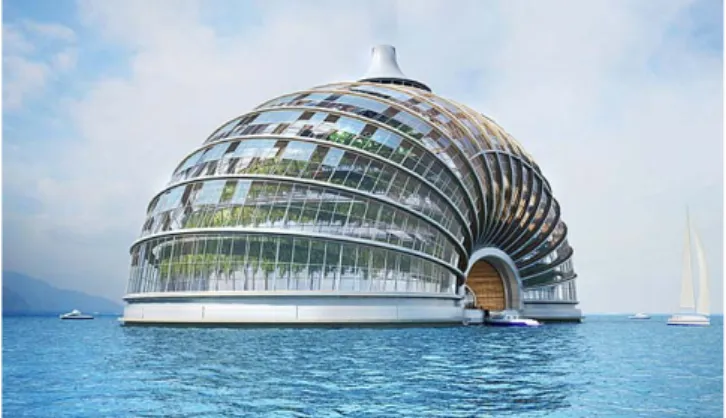
A massive hotel concept, the Ark(see Fig. 11 & 12), designed by Russian architect Remistudio is proposed to endure extreme floods. The arch-shaped building has a structure that enables it to float safely and stay autonomously on the surface of the water. The Ark was also designed to be a bioclimatic building with independent life-supporting systems, including elements ensuring a closed-functioning cycle(Anastasia Vdovenko, 2010).
The building has an optimal relationship between its volume and its outer surface, significantly saving materials and providing energy efficiency. Its shape is convenient for installing solar photovoltaic cells at an optimal angle toward the sun and wind turbine on the roof.
The cupola, in the upper part, collects warm air which is gathered in seasonal heat accumulator to provide an uninterrupted energy supply for the whole building complex independently from outer climate conditions in winter. The heat energy from the surrounding environment - the outer air, water or ground - is also used.
A plenty of daylight penetrates through the transparent roof area to illuminate the inner rooms as well. The tiered balconies can serve as social & recreational areas and the Ark has an open layout that can easily be changed to different functions over time.
The structural solidity is provided by compression of timber arches and tension of steel cables. The framework is covered by a special foil made of ethyltetrafluoroethylene (ETFE). It is a strong, highly transparent foil that is self-cleaning, recyclable, and more durable, cost-efficient and lighter than glass. The foil itself is affixed to the framework by special metal profiles, which serve as solar energy collectors for heating water and as gutters for collecting rainwater from the roof.
The Ark concept, designed with the Union of International Architects’ program “Architecture for Disaster Relief,” could be realized in various climates and especially in seismically dangerous regions because its basement is a shell structure without any ledges or angles. A load-bearing system of arches and cables allows weight redistribution along the entire corpus in case of an earthquake. And also Its prefabricated frame can allow for fast construction.
Fig. 11 Perspective of the Ark
Fig. 12 Section diagram of the Ark
Sustainable features of the Ark can be summarized as a bioclimatic building with independent life-support system, use of solar photovoltaic cells/energy collector and wind turbine, enough daylight penetration through transparent roof, open layout to adapt different functions over time, new material "ETFE" for covering, and prefabricated frame for fast construction.
4.3 Maya hotel
- Location: Cancun, Mexico - Year of design: 2007 - Size & scale: 350 rooms
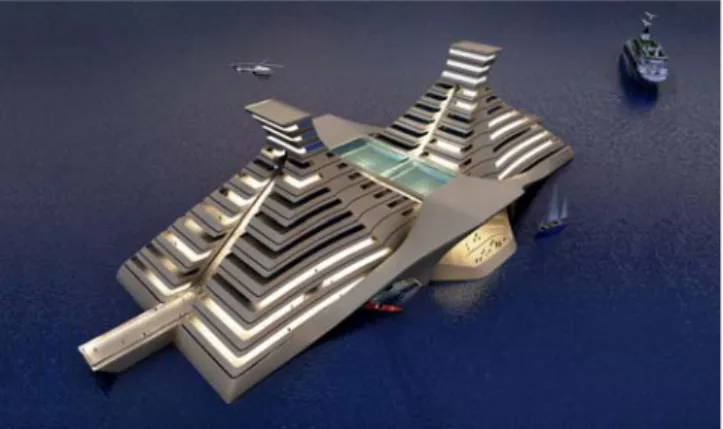
The Maya hotel(see Fig. 13 & 14), a vast floating pyramidal resort, is designed by Oceanic Creations, Sweden.
The secret factor for the project is an unique plastic composite material which offers built-in insulation that makes the construction suitable for all climate, from the freezing cold to extreme hot. This remarkable material is reportedly up to 6 times lighter and 10 times stronger than steel (depending on the reinforcement material used). It is also claimed that it reduces maintenance costs by 30 to 40 percent. The material was formerly used only by the
Name of
building Sustainable features
Four seasons hotel
- long term usage by relocation of various areas
- self-supporting facility with desalination plant, sewage & waste treatment system - power plant with at almost noiseless
levels.
Floating hotel "Salt
& Sill"
- protection of the environment - use of local raw materials - geothermal use of sea water
- habitat creation of marine life by left over stone.
IBA Dock
- geothermal use of the Elbe - use of solar collector - installation of photovoltaic - modular construction
Table 2 Sustainable features of the sample buildings Swedish Military but after the cold war it was allowed for
this kind of private company to use.
Fig. 13 Perspective of Maya hotel
Fig. 14 Site plan of Maya hotel
According to the international marketing manager of Oceanic Creations, this material will prove very cost-effective for places like Dubai where they need a lot of landscaping and concrete works to build, and don't have a real solution with water(Bill Christensen, 2007).
The hotel is supposed to be 220m long, 70m wide, and over 70m high. Due to its large size, it would have no problem of withstanding storms. The floating hotel will have an underwater marina and be completely self-supporting in terms of electricity and water by having power plant generating 30MW and a desalination plant with a capacity of 150,000 ton of water per day. It will accommodate 350 bedrooms as well as restaurants, conference halls, a nightclub and other amenities.
The project was going to be finished by 2010-2011, but failed due to financial problems. The hotel is shaped as a double Maya pyramid floating building on pontoons. The hotel itself will be 4 meters above sea level.
Sustainable features of the hotel can be summarized as the use of unique plastic composite material with characteristics
of lighter, stronger, and economical to maintain, and self-supporting system in terms of electricity & water.
5. Sustainable features from the sample projects
Sustainable features of the sample floating buildings can be summarized as followings(see Table 2);
- Recycled and relocatable usage: Four Seasons Hotel showed good example of long term usage by relocation of 3 different areas. Floating building can be moved to different locations and used by different people for a long time.
- Adoption of renewable energy: Most floating building adopts various renewable energy systems such as geothermal use of water, solar energy, and wind power.
Renewable energy on water is easier to get than land because there are no obstacles.
- Self-supporting plant: Large floating buildings have self-contained system in terms of electricity, water and sewage treatment because connecting and maintaining the service lines far from the land is not easy.
- Modular and prefabrication system: Some planned floating buildings suggest prefabricated module. Construction waste can be discharged to the minimum and the building might be very fast to construct as well as easy and economical to maintain.
- Others: New materials such as ETFE covering and plastic composite material instead of glass and steel &
concrete respectively, and open layout to adapt different functions over time are introduced.
Floating mosque
- daylight influx through transparent roof and columns
- water cooling system by circulating the sea water through the floor, wall & roof - energy efficient wall material
- use of solar energy
The Ark
- bioclimatic building with independent life-support system
- installation of solar cell/collector & wind turbine
- abundant daylight penetration through transparent roof
- open layout to adapt different functions over time
- new material "ETFE" for covering - pre-fabricated frame for fast construction.
Maya hotel
- plastic composite material with characteristics of lighter, stronger, and economical to maintain
- self-supporting system in terms of electricity & water.
6. Conclusion
According to climate change and improvement of income level, floating building on water has been emerging as a strong alternative. The aim of this study is to suggest some reference materials of sustainability for new building projects around waterside. The concept of sustainability and floating building was investigated, and 3 realized projects and 3 planned projects were reviewed in terms of sustainability.
Sustainability of floating building can be defined as an energy and ecologically conscious approach to a building for living/working space on floatation system without navigation tool.
Sustainable features of floating building from the sample projects can be summarized as followings: recycled and relocatable usage, adoption of various renewable energy techniques, installation of self-supporting plant, application of modular system, and others like new material & open layout.
Sustainable features need to be developed more and more in detail and applied to many types of floating buildings.
With the development of pontoon, mooring and related floating technologies, the introduction of floating building will be expanded and contribute enormously to enhance the sustainability of the earth in the future.
Acknowledgment
This research was supported by a grant(10 RTIP B01)
from Regional Technology Innovation Program funded by Ministry of Land, Transport and Maritime Affairs of Korean government.
References
[ 1 ] Anastasia Vdovenko(2010), Remistudio’s Floating Ark Concept Battles Rising Tides, http://inhabitat.com/remist udios-massive-ark-building-can-save-residents-from-fl ood/
[2] Anouk van den Eijnde(2010), Review of Salt & Sill Hote l, West Sweden, http://www.greentraveller.co.uk/blog/flo ating-hotel-west-sweden
[3] Bill Christensen(2007), Maya Hotel Floating Pyramid Isla nd In Caribbean Sea, http://www.technovelgy.com/ct/Sci ence-Fiction-News.asp?NewsNum=984
[5] Costas Voyatzis,(2008), The first floating hotel in Sweden, http://www.yatzer.com/The-first-floating-hotel-in-Swe den
[6] Flicker(2012), In Memory of Saigon Floating Hotel, http:/
/www.flickr.com/photos/nguyen_ngoc_chinh/4217381552/
[7] Hyundai Asan(2012), http://www.hyundai-asan.com/touri st/kumgang_tour04_s0101.jsp?navi=020101
[8] Immosolar(2012), IBA DOCK: The floating climatic hous e", http://www.immosolar.com/en/home/news/iba-dock-t he-floating-climatic-house
[9] James Reinl(2007), Floating Mosques for Palm & Creatin g a Modern Place to Worship, Emirates Today(2007.11.
1), p.1 & p.18.
[10] Koen Olthuis & David Keuning(2010), Float! Building on Water to Combat Urban Congestion and Climate Chang e, Frame Publishers, p.219.
[11] Office of Housing and Construction Standard, Ministry o f Energy and Mines, British Columbia(2012), British Col umbia Float Home Standards, http://housing.gov.bc.ca/p ub/htmldocs/floathome.htm
[12] Popular Mechanics(1988), Floating Hotel Near Australia' s Great Barrier Reef, http://books.google.co.kr/books?id=
IuQDAAAAMBAJ&pg=PA86&lpg=PA86&dq=floating+ho tel+great+barrier+Reef&source=bl&ots=we5xnooT_9&sig
=pB3yFrRnOMGOTT6oM7ERhxzAkso&hl=en&ei=yVjPT I2vC8GclgfVxfGWBg&sa=X&oi=book_result&ct=result&r esnum=2&ved=0CCEQ6AEwATgK#v=onepage&q=floatin g%20hotel%20great%20barrier%20Reef&f=false
[13] SAIGON FLOATING HOTEL(2012), http://saigonfloatin ghotel.com/index.php?lang=en
[14] Sustainability Recycling(2012), Sustainability, http://www.
sustainabilityrecycling.com/waste-stream-management/
[15] Wikipedia(2012), Sustainability, http://en.wikipedia.org/wi ki/Sustainability
[16] Wikipedia(2012), Sustainable architecture, http://en.wikip edia.org/wiki/Sustainable_architecture
Received 7 February 2012 Revised 22 February 2012 Accepted 23 February 2012