1. INTRODUCTION
Oil palm is an abundant source of biomass in Indonesia. In 2013, oil palm plantation has reached a total area of 6.2 million hectares or an increase of 16% from that of the 2010 (BPS 2014). Productivity of oil palm decrease at the age of 20 to 25 years (Kosugi et al., 2010;
Prawitwong et al., 2012) and after felling the
trunk is wasted or burnt at site (Yamada et al., 2010). Oil palm is generally planted with the planting density of 128 to 148 plants/ha (Lamaming et al., 2014) and with the average diameter of 40 cm and the stem length of 10 m, the amount of biomass produced will be ap- proximately of 160-185 m3/ha. Therefore, an enormous biomass potential is available and possibly useful for the production of various
Original Article
Effect of Bark Content and Densification Temperature on The Properties of Oil Palm Trunk-Based Pellets
1Nyoman J Wistara 2,†⋅Moh Arif Rohmatullah2⋅Fauzi Febrianto2⋅ Gustan Pari3⋅Seung-Hwan Lee4⋅Nam-Hun Kim 4,†
ABSTRACT
Oil palm trunk (OPT) is a potential source of biomass for the production of biopellet. In the present research, biopellet were prepared from the meristem part of 25 years old OPT with various percentages of its bark (0, 10, and 30%). The highest biopellet durability was found for biopellet produced at 130℃ of pelletizing temper- ature with 30% bark content. Scanning electron microscopy (SEM) of biopellet showed the weak of particle bonding due to the low pelletizing pressure. The moisture content, unit density, ash content, and caloric value of OPT-based pellets were 3.55-5.35%, 525.56-855.23 kg/m3, 2.76-3.44%, and 17.89-19.14 MJ/kg, respectively.
The combustion profiles obtained by thermogravimetric analysis (TGA) seemed to be unaffected by the bark content on. Differential thermal analysis of TGA curve indicated different pyrolysis characteristic of hemi- cellulose, cellulose, and lignin.
Keywords : oil palm trunk, biopellet, durability, pyrolysis
1Date Received June 27, 2017, Date Accepted July 5, 2017
2Department of Forest Products, Faculty of Forestry, Bogor Agricultural University (IPB), Kampus IPB Darmaga, Bogor 16680, Indonesia
3Forest Research and Development Agency, Gunung Batu, Bogor, Indonesia
4College of Forest & Environmental Sciences, Kangwon National University, Chuncheon 24341, Republic of Korea
† Corresponding author: Nyoman J Wistara (e-mail: [email protected], ORCID: 0000-0002-7093-9385)
† Corresponding author: Nam-Hun Kim (e-mail: [email protected], ORCID: 0000-0002-4416-0554)
valuable bio-products.
Oil palm stem retains low dimension stability and various types of defects such as raise grain, warping, and collapse after drying process that demands appropriate modification to improve its usefulness (Dungani et al., 2013). Production of biopellet is possibly another potential utilization of oil palm biomass. Successful conversion of the biomass into biopellet will contribute to the new renewable source of green energy.
Pellet utilization and technology has gained popularity in developed countries. The advan- tages of converting biomass into biopellet in- clude the reduction of ash emission, storage convenience, and increasing biomass density (Carroll and Finnan, 2012).
Density (unit density or bulk density), moisture content, durability, and ash content are considered as important parameters for biopellet as the source of green energy (Theerarattananoon et al., 2011). Low density biopellet can increase transportation cost and storage capacity. Ash content will influence the formation of slag, bring about an inhomoge- neous combustion, and be deposited after com- bustion process (Obernberger and Thek, 2004;
Temmerman et al., 2006). An 11-50% decrease in durability is known to be occurred during storage when the moisture content of biopellet is over 10% (Tabil, 1996).
Durability is an important pellet parameter (Carroll and Finnan, 2012; Lee et al., 2013;
Temmerman et al., 2006). Kaliyan and Morey (2009b) defined pellet durability as the capa- bility of pellet to withstand the effect of shock,
pressure, and friction during pellet handling and transportation. It is influenced by raw material factors (chemical component, moisture content, particle size, and raw material formulation), preconditioning factors (preheating and adhe- sives), pelletizer, and post pelleting condition.
The contribution of raw material formulation, particle size, steam conditioning, die pellet mill, and cooling on pellet durability were 40, 20, 20, 15, and 5%, respectively (Thomas et al., 1997). Inter-particle bonding in pellet due to temperature and pressure (Filbakk et al., 2011;
Lee et al., 2013), raw material crystallization, chemical reaction, and adhesive or lignin hard- ening after densification (Kaliyan and Morey, 2010) plays an important role in the durability of pellet.
Chemical components other than lignin, such as extractives, starches, and sugars also influ- ence the characteristics of pellet. Extractives de- crease the compressive strength (Stelte et al., 2011), but increase the calorific value of pellet (Telmo and Lousada, 2011). Starches (Lehmann et al., 2012) and sugars (Lamaming et al., 2014) can function as adhesive that improves the inter-particle adhering of pellet.
The present work was intended to investigate the effect of chemical components and bark content on OPT-based pellet prepared at various pelleting temperature and pressure. The dura- bility, moisture content, density, ash content, and calorific value of the resulted OPT-based pellet were measured.
2. MATERIALS AND METHODS
2.1. Raw Material PreparationA 25 years old oil palm stem was divided in- to its bottom, middle and upper divisions. All divisions were debarked and chipped. The chips were then refined with Wiley mill and sieved to result in powder of 20-40 mesh and 40-60 mesh. The powder of 40-60 mesh was used for chemical analysis following the standard proce- dures of TAPPI T 257 om-85, and the powder of 20-40 mesh with adjusted moisture content to 8-10% was used for pellet preparation fol- lowing the work of Kaliyan and Morey (2009a).
2.2. Chemical Component Analysis
The content of extractives, holocellulose, Klason lignin, α-cellulose, and ash of the oil palm trunk was analyzed in accordance with the standard procedures explained in TAPPI T 204 om-88, Browning (1967), Dence (1992), TAPPI T 203 os-94, and TAPPI T 211 om-93, respectively. Hemicellulose content was calcu- lated by subtracting α-cellulose content from holocellulose.
2.3. Densification and Quality Determination of Pellet
Densification of oil palm biomass was carried out using a pellet mill (plane diameter of 1.6 cm) with densification pressure of 10.3 MPa.
Bark content and densification temperature of
the prepared pellet were varied. Bark content was at 0, 10, and 30% of the total weight of pellet and densification was carried out at 130, 160, and 190℃. Total densification time was 6 min consisting of 3 min preheating and 3 min densification in accordance with that carried out by Kaliyan and Morey (2009a) and Lee et al.
(2013).
The moisture content of pellet was de- termined by oven drying method at 103 + 2℃, and pellet density was determined in the basis of displacement method previously applied by Rabier et al. (2006). The ash content of pellet was determined in accordance with the standard procedures of TAPPI T 211 om-93 and its du- rability was measured in accordance with ASABE standard (2003) (Fasina, 2008). The calorific value of pellet was measured with Bomb Calorimeter LECO UK AC-500.
Visual information of interparticle bonding was procured by scanning electron microscopy (SEM, JSM-6510LV, JEOL USA) with 50x and 500x magnification. Thermal properties of pellet with 0% and 30% bark content were de- termined by TG-50 (ZG-127, Shimadzu). In the thermal analysis, 3-6 g of samples were ana- lyzed in the range of 30-600℃ at heating rate of 10℃/min. Alumina (α-Al2O3) powder was used as control.
The resulted data of the present research were analyzed with factorial complete random design with two factors, i.e. bark content and densification temperature. The data were pro- cured in triplicate. Further Duncan’s multiple range test was also carried out for the data.
3. RESULTS AND DISCUSSION
3.1. Chemical Composition of Oil PalmStem and Bark
Table 1 indicates the chemical composition of oil palm stem. Holocellulose, lignin, and ash content were not significantly different in bot- tom, middle, and upper divisions of oil palm meristem. However, they were different from those of its bark. The content of holocellulose of the oil palm meristem was higher than that of its bark. Lignin content of oil palm stem was lower than that of its bark, similar to the finding of Chow et al. (2008) for the guayule wood. Oil palm meristem and bark contained similar amount of extractives, showing 7.63-9.25%. Extractives generally have an op- posing effect on biopellet quality. Its element tends to bring about increasing calorific value of pellet (Filbakk et al., 2011) but hinders the satisfying formation of inter-particle bonding (Stelte et al., 2011), resulting in a commonly less durable pellet. The ash content of meristem was significantly lower than that in its bark.
The main minerals are considered to be Cl, Ca,
Mg, and Na (Kosugi et al., 2010).
3.2. Durability of OPT-based pellet
Fig. 1 shows the effect of bark content and densification temperature on the durability of OPT-based pellet. Compared to the requirement of DIN EN 14961-2 A2 standard, the durability was very lower, showing less than 50%. This value is significantly lower than a minimum value (97.5%) required by the standard. Bark content increased the durability, but the dura- bility was increased with increasing densifica- tion temperature. Factors such as particle size, raw material compositions, densification temper- ature and pressure are known to influence the durability of pellet. Lee et al. (2013) produced
Chemical component (%) Stem
Bottom Middle Upper Bark
Holocellulose 72.92 73.85 72.41 64.98
Hemicellulose 22.55 23.78 18.46 15.80
α-Cellulose 50.37 50.07 53.95 49.18
Lignin 25.78 24.73 21.56 33.61
Extractives 8.39 9.25 7.63 9.22
Ash 2.52 2.52 3.16 6.05
Table 1. Chemical composition of oil palm stem and bark
Fig. 1. Effect of bark content and densification tem- perature on the durability of OPT-based pellet.
Larix kaempferi wood-based pellets with high durability (> 97.80%) using only densification pressure of 1.5 MPa.
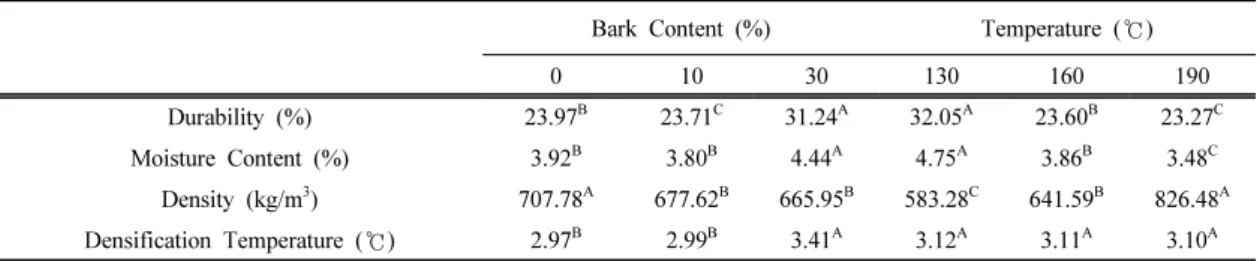
Table 2 Duncan’s multiple range tests for the effect of bark content on the durability, mois- ture content, density and densification temper- ature of OPT-based pellet. Bark content influ- enced pellet durability (p < 0.05). Duncan’s multiple range tests indicates that bark content resulted in different pellet durability. Pellet with 30% bark content had the highest durability.
The increasing amount of lignin due to bark ad- dition was possibly the cause of increasing pel- let durability. The influence of lignin on pellet durability has been reported by Lee et al.
(2013). They found that the durability of Larix kaempferi wood pellet with 32% lignin content was higher than that of Liriodendron tulipifera wood pellet with lignin content of 22%. Pellet prepared at 130℃ resulted in the highest durability. The durability of pellet decreased with further increasing of densification temperature. Similar influence of densification temperature on durability of the pellet from corn stover and switch grass was previously reported by Kaliyan and More (2009c). Glass transition
temperature (Tg) of lignin is considered critical for an appropriate densification temperature.
Several different Tg of lignin has been reported, i.e. in the range of 52-117℃ (Kaliyan and More, 2009c), ∼130℃ (Basu, 2010), and 100- 144℃ (Tejado et al., 2007). Densification at temperature close to Tg of lignin will increase the distribution of natural adhesives such as lig- nin, starch, protein, and fat in pellet (Kaliyan and More, 2009c). However, lignin starts to decompose at temperature of above 140℃ (Stefanidis et al., 2014, Kim et al., 2014).
Therefore, binding capability of lignin will be possibly decreased when densification of pellet is carried out at more than 140℃.
Extractives are known to impede the for- mation of interparticle hydrogen bond in pellet (Stelte et al., 2011). According to Samuelsson et al. (2012), at more than 2.5% concentration of extractives, pellet durability decrease to low- er than 95%. Therefore, high extractives con- centration of 7.63-9.25% was thought to impair the durability of the resulted pellet.
Fig. 2 indicates the SEM micrograph of the surface of OPT-based pellet. The interparticle interlocking was shown even in pellet with
Bark Content (%) Temperature (℃)
0 10 30 130 160 190
Durability (%) 23.97B 23.71C 31.24A 32.05A 23.60B 23.27C
Moisture Content (%) 3.92B 3.80B 4.44A 4.75A 3.86B 3.48C
Density (kg/m3) 707.78A 677.62B 665.95B 583.28C 641.59B 826.48A Densification Temperature (℃) 2.97B 2.99B 3.41A 3.12A 3.11A 3.10A
* different letter indicates the value is significantly difference at 5% confidence level
Table 2. Duncan’s multiple range tests for the effect of bark content on the durability, moisture content, density and densification temperature of OPT-based pellet
higher durability (0% and 30% bark content at densification temperature of 130℃), indicating many gaps between particles. Low interparticle bonding was assumed to bring about low pellet durability. As reported by Kaliyan and Morey (2009a), the increase of pressing load could in- crease pellet durability, showing that densifica- tion pressure of 100-150 MPa is for a good pellet durability.
3.3. Moisture Content of OPT-based Pellet
Fig. 3 shows the effect of bark content and densification temperature on moisture content of OPT-based pellet. The average moisture content
of OPT-based pellet was of 3.55-5.35%. Table 2 indicates that the influence of bark content on moisture content is significant after the addition of 30% bark in pellet. The moisture content of the resulted pellet was in accordance with the requirement of DIN EN 14961-2 A2 standard, i.e. < 10%. Moisture content of pellet will in- fluence its durability. According to Tabil (1996), the increase of moisture content above 10% during storage decreased pellet durability of 11-50%. In Table 2, pellet with higher bark content retained higher moisture content and the increase of densification temperature decreased the moisture content of the pellet (Fig. 3).
Moisture content of pellet is known to be influ- enced by densification temperature and the moisture content of its raw material (Kaliyan and Morey, 2009c). The present finding also in- dicates that increase of moisture content in the raw materials increased the moisture content of Fig. 2. SEM images of the surface of OPT-based
pellet.
Notes : a and b pellet with 0% bark content densified at 190℃;
c and d pellet with 30% bark content densified at 190℃
Scale bar: a and c (500 µm), b and d (50 µm) Bark content (%)
Phase I Phase II Temperature of
Constant Weight (℃) Temperature (℃) Weight loss (%) Temperature (℃) Weight loss (%)
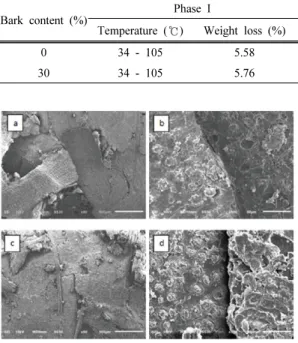
0 34 - 105 5.58 210 - 450 90.87 > 470
30 34 - 105 5.76 210 - 450 86.84 > 470
Table 3. Weight loss of OPT-based pellet depending on temperature
Fig. 3. Effect of bark content and densification tem- perature on moisture content of OPT-based pellet.
pellet. The average moisture content of the raw material for the presently produced pellet was of 8.45%, 8.54%, and 9.24% for pellet with bark content of 0, 10, and 30%, respectively.
3.4. Density
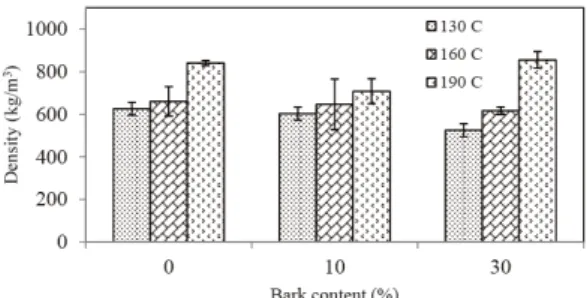
Fig. 4 shows the effect of bark content and densification temperature on density of OPT-based pellet. The obtained density was rel- atively low. Pellet density was influenced by bark content and densification temperature. A significant increase of density was resulted with increasing densification temperature. The aver- age density of pellet produced in the present works was in the range of 525.56-855.23 kg/m3. A good pellet should has a density of more than 1000 kg/m3 (Obernberger and Thek, 2004).
Duncan multiple range test of pellet density (Table 2) indicates that the presence of bark in pellet reduced its density. Extractives will in- crease the calorific value of pellet. However, they hinder interparticle bonding in pellet (Stelte et al., 2011). This might be the reason of reducing pellet density with the addition of bark in pellet preparation. Interparticle bonding
can be also promoted by lignin flowing oc- curred at elevated densification temperature. As shown in Table 2 and Fig. 4, pellet density in- creased with increasing densification temper- ature, which is similar to the finding of Kaliyan and Morey (2010).
3.5. Ash Content
Pellet with high ash content is not acceptable for industrial use. Ash in pellet disturbs com- bustion system, bringing about slag formation and deposit, which needs to be frequently cleaned from combustion furnace (Obernberger and Thek, 2004). Fig. 5 shows the effect of bark content and densification temperature on ash content of OPT-based pellet. The average of ash content of the resulted pellet was very high compared, for example, with the require- ment of DIN EN 14961-2 A2 standard. This standard requires ash content of 1.5% or below.
A significantly higher ash content of pellet was found with the addition of 30% bark content (Table 2). The increase of ash content with in- creasing bark content certainly was brought about by the higher ash content of the bark Fig. 4. Effect of bark content and densification tem-
perature on density of OPT-based pellet.
Fig. 5. Effect of bark content and densification tem- perature on ash content of OPT-based pellet.
than that of the oil palm trunk meristem. A similar effect on increasing bark content in pine wood pellet has been reported by Filbakk et al.
(2011). Densification temperature did not change the ash content of pellet. This might be due to the inorganic component of biomass is more resistant to heat than that of its organic components.
3.6. Calorific Value
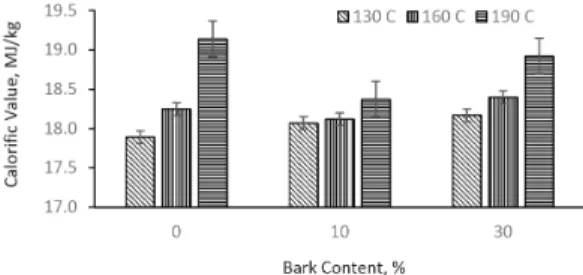
Fig. 6 show the effect of bark content and densification temperature on calorific value of OPT-based pellet. Calorific values of the re- sulted pellet were in the range of 17.89 - 19.14 MJ/kg. Therefore, the calorific value can be considered high as compared for example with the calorific value required by DIN 14961-2 A2 standard (16.3-19 MJ/kg). In average, increasing densification temperature tended to increase the calorific value. However, increasing bark content did not seem to increase the calorific value. Even though bark contains higher amount of lignin and extractives that are benefi- cial for the calorific value of pellet (Fillbakk et al., 2011, Ferre et al., 2014), its high ash con- tent could impede the beneficial effect of lignin
and extractive on the calorific value.
3.7. Thermal behavior
TG-DTA analysis was carried out for OPT-based pellet with 0% and 30% bark con- tent (Fig. 7), indicating three stages of thermal degradation. Weight loss of oil palm trunk in each decomposition phase is summarized in Table 3. In the first phase, weight loss of about 5% occurred at 105℃, which is due to the loss of water (Yang et al., 2007, Pasangulapati et al., 2012). Weight loss (86-91%) was occurred Fig. 6. Effect of bark content and densification tem-
perature on calorific value of OPT-based pellet.
(a)
(b)
Fig. 7. TG-DTA curves of OPT-based pellet with 0% bark content (a) and 30% bark content (b).
in second phase, which may be due to the deg- radation of cellulose, hemicelluloses and lignin
The DTA curve of pellet with 0% bark con- tent indicates 3 exothermic reactions, i.e. at 243-272℃, 317-349℃, and 453-512℃. These exothermic reactions indicate the dominant de- composition of hemicellulose, cellulose, and lig- nin, respectively (Basu, 2010, Parthasarathy et al., 2013). For pellet with 30% bark content, endothermic and exothermic reaction occurred at 217-251℃ and 333-354℃, respectively.
Different endothermic and exothermic reaction temperature between pellet with 0% and 30%
bark content possibly would be due to differ- ences in the composition of their chemical components. Residual combustion proceeded at temperature over 470℃. A slightly higher re- sidual combustion for the pellet with 30% bark content may be due to higher amount of ash in bark. Residual combustion is known to be in- fluenced by the inorganic content of raw mate- rials (Parthasarathy et al., 2013). The results of Fig. 7 also indicate that densification should be done at below 200℃ to avoid mass loss during pellet preparation. Degradation of hemicellulose, cellulose and lignin could change many pellet properties. Pellet durability can be affected by hemicellulose, starch and lignin (Kaliyan and More, 2009c).
4. CONCLUSIONS
The durability of pellet was increased with increasing bark content and at densification temperature near Tg of lignin. Densification
pressure of 10 MPa was not enough to develop a good interparticle bonding, resulting in poor durability. Addition of 30% bark increased the calorific value of pellet. It was found that den- sification should be done at below 200℃ to avoid significant mass loss during pellet preparation.
ACKNOWLEDGEMENT
This study was carried out with the support of ‘Forest Science & Technology Projects (S121214L150110) provided by Korea Forest Service. And part of this research was funded by Friend of the Earth Pertamina Foundation and BPDP Sawit (Project No. PRJ - 27/DPKS/2015). The authors would like to thank the Laboratory of SEM of the Faculty of Mathematic and Natural Sciences of the Bandung Institute of Technology, Bandung, INDONESIA. The lab was kindly allowing us to use their SEM instrumentation for the present research.
REFERENCES
[ASABE] American Society of Agricultural and Biological Engineers Standards. 2003. Cubes, Pellets, and Crumbles - Definitions and Methods for Determining Density, Durability, and Moisture Content. American Society of Agricultural and Biological Engineers, St. Joseph, USA.
Basu, R. 2010. Biomass gasification and pyrolysis practical design. Elsevier Inc., New York, USA.
[BPS] Badan Pusat Statistik. 2014. Luas Tanaman Perkebunan Besar Menurut Jenis Tanaman, Indonesia (000 Ha), 1995 - 2013 [Internet] [referred:
2014 September 22]. http://www.bps.go.id/tab_sub/
view.php?tabel=1&daftar=1&id_ subyek=54.
Browning, B.L.1967. Methods of wood chemistry
vol1. Interscience Publisher, New York, USA.
Carroll, J.P., Finnan, J. 2012. Physical and chem- ical properties of pellets from energy crops and cereal straws. Biosystems Engineering 112:
151∼159.
Chow, P., Nakayama, F.S., Blahnik, B., Youngquist, J.A., Coffelt, T.A. 2008. Chemical constituents and physical properties of guayule wood and bark. Industrial Crops and Products 28: 303∼308.
Dence, C.W. 1992. The determination of lignin. In:
Lin, S.Y., Dence, C.W., eds. Methods of Lignin Chemistry. Springer-Verlag, New York, USA.
[DIN EN] Deutsches Institut fur Normung European standards 14961-2. 2012. Solid biofuels - Fuel specification and classes - Part 2: Wood pellets for non-industrial use. Deutsches Institut fur Normung, Germany.
Dungani, R., Jawaid, M., Khalil, H.P.S.A., Jasni, Aprilia, S., Hakeem, K.R., Hartati, S., Islam, M.N. 2013. A review on quality enhancement of oil palm trunk waste by resin impregnation: fu- ture materials. BioResources 8(2): 3136∼3156.
Fasina, O.O. 2008. Physical properties of peanut hull pellets. Bioresource Technology 99: 1259∼1266.
Ferre, A.J.C., Sanchez, J.C.S., Medina, F.J.S., Alonso, J.P., Marti, B.V. 2014. Prediction mod- els for higher heating value based on the struc- tural analysis of the biomass of plant remains from the greenhouses of Almería (Spain). Fuel 166: 377∼387.
Filbakk, T., Jirjis, R., Nurmi, J., Hoibo, O. 2011.
The effect of bark content on quality parameters of Scots pine (Pinus sylvestris L.) pellets.
Biomass and Bioenergy 35: 3342∼3349.
Kaliyan, N., Morey, R.V. 2009a. A review of fac- tors affecting strength and durability of densi- fied biomass products. Biomass and Bioenergy 33: 337∼359.
Kaliyan, N., Morey, R.V. 2009b. Constitutive model
for densification of corn stover and switchgrass.
Biosystems Engineering 104: 47∼63.
Kaliyan, N., Morey, R.V. 2009c. Densification char- acteristics of corn stover and switchgrass.
Transactions of the ASABE. 52(3): 907∼920.
Kaliyan, N., Morey, R.V. 2010. Natural binders and solid bridge type binding mechanisms in briquettes and pellets made from corn stover and switchgrass. Bioresource Technology 10:
1082∼1090.
Kim, J.Y., Hwang, H., Oh, S., Kim, Y.S., Kim, U.J., Choi, J.W. 2014. Investigation of structural modification and thermal characteristics of lig- nin after heat treatment. International Journal of Biological Macromolecules 66: 57∼65.
Kosugi, A., Tanaka, R., Magara, K., Murata, Y., Arai, T., Sulaiman, O., Hashim, R., Hamid, Z.A.A., Yahya, M.K.A., Yusof, M.N.H., Ibrahim, W.A., Mori, Y. 2010. Ethanol and lactic acid production using sap squeezed from old oil palm trunks felled for replanting. Journal of Bioscience and Bioengineering 10 (3): 322∼325.
Lamaming, J., Hashim, R., Sulaiman, O., Sugimoto, T., Sato, M., Hiziroglu, S. 2014. Measurement of some properties of binderless particleboards made from young and old oil palm trunks.
Measurement 47: 813∼819.
Lee, S.M., Ahn, B.J., Choi, D.H., Han, G.S., Jeong, H.S., Ahn, S.H., Yang I. 2013. Effects of densi- fication variables on the durability of wood pe- lets fabricated with Larix kaempferi C. And Liriodendron tulipifera L. sawdust. Biomass and Bioenergy 48: 1∼9.
Lehmann, B., Schroder, H.W., Wollenberg, R., Repke, J.U. 2012. Effect of miscanthus addition and different grinding processes on the quality of wood pellets. Biomass and Bioenergy 44:
150∼159.
Obernberger, I., Thek, G. 2004. Physical character-
ization and chemical composition of densified biomass fuels with regard to their combustion behavior. Biomass and Bioenergy 27: 653∼669.
Parthasarathy, P., Narayanan, K.S., Arockiam, L.
2013. Study on kinetic parameters of different biomass samples using thermo-gravimetric analysis. Biomass and Bioenergy 58: 58∼66.
Pasangulapati, V., Ramachandriya, K.D., Kumar, A., Wilkins, M.R., Jones, C.L., Huhnke, R.L. 2012.
Effects of cellulose, hemicellulose and lignin on thermochemical conversion characteristics of selected biomass. Bioresource Technology 114:
663∼669.
Prawitwong, P., Kosugi, A., Arai, T., Deng, L., Lee, K.C., Ibrahim, D., Murata, Y., Sulaiman, O., Hashim, R., Sudesh, K., Ibrahim, W.A.B, Saito, M., Mori, Y. 2012. Efficient ethanol production from separated parenchyma and vascular bundle of oil palm trunk. Bioresource Technology 125:
37∼42.
Rabier, F., Temmerman, M., Bohm, T., Hartmann, H., Jensen, P.D., Rathbauer, J., Carrasco, J., Fernandez, M. 2006. Particle density determi- nation of pellets and briquettes. Biomass and Bioenergy 30: 954∼963.
Samuelsson, R., Larsson, S.H., Thyrel, M., Lestander, T.A. 2012. Moisture content and storage time in- fluence the binding mechanisms in biofuel wood pellets. Applied Energy 99: 109∼115.
Stefanidis, S.D., Kalogiannis, K.S., Iliopoulou, E.F., Michailof, C.M., Pilvachi, P.A., Lappas, A.A.
2014. A study of lignocellulosic biomass pyrolysis via the pyrolysis of cellulose, hemicellulose and lignin. Journal of Analytical and Applied Pyrolysis 105: 143∼150.
Stelte, W., Holm, J., Sanadi, A., Barsberg, S., Ahrenfeldt, J., Henriksen, U.B. 2011. A study of bonding and failure mechanisms in fuel pellets from different biomass resources. Biomass and
Bioenergy 35: 910∼918.
Tabil, L.G. 1996. Binding and pelleting character- istics of alfalfa [tesis]. Canada (US): University of Saskatchewan.
[TAPPI] Technical Association of Pulp and Paper Industry. 1998. TAPPI Test Methods. Tappi Press, Atlanta, USA.
Tejado, A., Pena, C., Labidi, J., Echeverria, J.M., Mondragon, I. 2007. Physico-chemical character- ization of lignin from different sources for use in phenol–formaldehyde resin synthesis.
Bioresource Technology 98: 1655∼1663.
Telmo, C., Lousada, J. 2011. Heating values of wood pellets from different species. Biomass and Bioenergy 35: 2634∼2639.
Temmerman, M., Rabier, F., Jensen, P.D., Hartmann, H., Bohm, T. 2006. Comparative study of dura- bility test methods for pellets and briquettes.
Biomass and Bioenergy 30: 964∼972.
Theerarattananoon, K., Xu, F., Wilson, J., Ballard, R., Mckinney, L., Staggenborg, S., Vadlani, P., Pei, Z.J., Wang D. 2011. Physical properties of pellets made from sorghum stalk, corn stover, wheat straw, and big bluestem. Industrial Crops and Products 33: 325∼332.
Thomas, M., Zuilichem, D.G., Poel, A.F.B. 1997.
Physical quality of pelleted animal feed. 2.
Contribution of processes and its conditions.
Animal Feed Science and Technology 64: 173∼192.
Yang, H., Yan, R., Chen, H., Lee, D.H., Zheng, C.
2007. Characteristics of hemicellulose, cellulose and lignin pyrolysis. Fuel 86: 1781∼1788.
Yamada, H., Tanaka, R., Sulaiman, O., Hashim, R., Hamid, Z.A.A., Yahya, M.K.A., Kosugi, A., Arai, T., Murata, Y., Nirasawa, S., Yamamoto, K., Ohara, S., Yusof, M.H.M., Ibrahim, W.A., Mori, Y. 2010. Old oil palm trunk: A promising source of sugars for bioethanol production.
Biomass and Bioenergy 34: 1608∼1613.