1. Introduction
A working knowledges of the safe handling, storage and transportation of the flammable substances are probable as necessary to fire and explosion safety in chemical industries. The fire and explosion properties necessary of flammable substances in chemical industries are flash point, lower explosion limits(LEL), upper explosion limits(UEL), fire point, AIT(auto ignition temperature) etc. 1) .
The flash point and the fire point are relevant to safety.
The flash point is one of the most important combustible characteristics that are used in risk assessments in the chemical plants. The flash point of a liquid is the lowest temperature at which sufficient vapor is evolved to form a flammable mixture in air at standard atmospheric pressure. There are several flash point test methods, and flash points may vary for the same material depending on
the method used. The fire point of a fuel is the temperature at which the vapour produced by that given fuel will continue to burn for at least 5 seconds after ignition by a pilot flame. The fire point is a temperature, usually about 5 to 10℃ above the flash point. The fire point of a lubricant is the point at which vapors are released rapidly enough to support combustion 1) .
The explosion limits are used to classify flammable liquids according to their relative flammability. The concentration of vapor and air mixture is generally given in percent by volume. For some substances, the vapor evolved may be flammable over a certain range of concentrations defined by the UEL and the LEL respectively. The explosion limits may be used to specify operating, storage, and materials handling procedures for a material 2) .
The autoignition temperature (AIT) of a substance is the lowest temperature at which the material will spontaneously
노말노난의 화재 및 폭발 특성치의 측정 및 예측
하동명 †
세명대학교 보건안전공학과 (2016. 5. 11. 접수 / 2016. 7. 19. 채택)
The Measurement and Prediction of Fire and Explosion Properties of n-Nonane
Dong-Myeong Ha †
Department of Occupational Health and Safety Engineering, Semyung University (Received March 11, 2016 / Accepted July 19, 2016)
Abstract : The usage of the correct combustion properties of the treated substance for the safety of the process is critical. For the safe
handling of n-nonane being used in various ways in the chemical industry, the flash point and the autoignition temperature(AIT) of n-nonane was experimented. And, the explosion limit of n-nonane was calculated by using the flash point obtained in the experiment. The flash points of n-nonane by using the Setaflash and Pensky-Martens closed-cup testers measured 31℃ and 34℃, respectively. The flash points of n-nonane by using the Tag and Cleveland open cup testers are measured 37℃ and 42℃. The AIT of n-nonane by ASTM 659E tester was measured as 210℃. The lower explosion limit by the measured flash point 31℃ was calculated as 0.87 vol%. And the upper explosion limit by the measured upper flash point 53℃ was calculated as 2.78 vol%. It was possible to predict lower explosion limit by using the experimental flash point or flash point in the literature.Key Words : combustion properties, n-nonane, flash point, explosion limit, fire point, autoignition temperature(AIT)
†
Corresponding Author : Dong-Myeong Ha , Tel : +82-43-649-1321, E-mail : [email protected],
ignite in the absence of an external ignition source, such as a spark or flame. The autoignition temperature may be used to specify operating, storage, and materials handling procedures for a material 3) .
The flash point values of n-decane, n-undecane, n-tetradecane and n-hexadecane by using ASTM D92 (Cleveland Open Cup Tester) and ASTM D93(Pensky- Martens Closed-cup Tester) were obtained 4) . Recently, the flash points and the autoignition temperature of n-undecane, n-dodecane, n-tridecane, n-tetradecane, n-pentadecane and n-hexadecane using various combustion test methods were obtained 5) .
In this study, n-nonane is a linear alkane hydrocarbon.
It is a colorless, flammable liquid, occurring primarily in the component of the petroleum distillate fraction commonly called kerosene, which is used as a heating and jet fuel. We measured flash points, fire points and AIT for n-nonane. Predictive explosion limits based on measured flash point proposed as process safety data. These presented data and the prediction methods are typically used as process safety, MSDS update, petroleum tank fire extinguishment index, resemble petroleums distinct etc..
2. Background of the Theory
2.1 Physical and Combustible Properties of n-Nonane
2.1.1 Physical Properties of n-Nonane
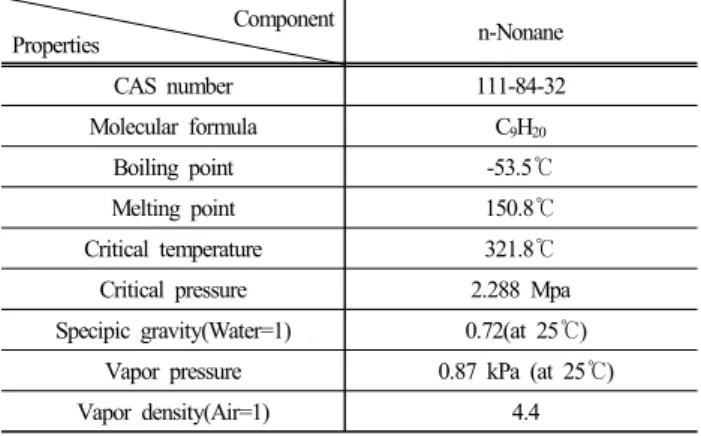
Several nations provide on MSDS for safety handling, transportation, storage and treatment of hazardous materials using the workplace. A lot of handbooks and articles appear to combustion characteristics of flammable substances. The physical Properties of n-nonane summerized in Table 1 6,7) .
Table 1. Physical properties of n-nonane
ComponentProperties n-Nonane
CAS number 111-84-32
Molecular formula C9H20
Boiling point -53.5
℃
Melting point 150.8
℃
Critical temperature 321.8
℃
Critical pressure 2.288 Mpa
Specipic gravity(Water=1) 0.72(at 25
℃
) Vapor pressure 0.87 kPa (at 25℃
)Vapor density(Air=1) 4.4
2.1.2 Reaction Characteristics of n-Nonane
The n-nonane is the second oils of fourth of hazardous materials in Hazardous Materials Safety Management Act.
The n-nonane is the Catagory 3(flash point 23∼60℃) of the flammable liquid for the GHS(Globally Harmonized System of Classification and Labelling of Chemicals).
Also this material is working environment measurement and harmful material for adminstration in Industrial Safety and Occupational Act. The n-nonane is colorless liquid. It can not dissolve into water, and it can dissolve into ethanol, ether and acetone. The n-nonane is also used as a solvent, distillation chaser, fuel additive, and a component in biodegradable detergents. The ignition sources of flee condition of the n-nonane are hot heat, flame, spark and other ignition sources. The escape of the n-nonane vapor can spread in a moment to ignite from ignition sources because the weight of the n-nonane vapor is more than weight of air.
The fire extinguishing media of the n-nonane use alcohol form, dry chemical or carbon dioxide (water may be ineffective). This material stores in the cool and dry places.
2.2 The Analysis of Combustible Propertries of n-Nonane
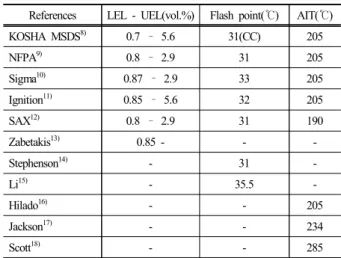
The combustible properties of n-nonane suggested by literatures are summarized in Table 2 8-18) .
The flash point provides a simple, convenient index for assessing the flammability of a wide variety of materials.
There are a range of procedures outlined in the standard methods for measuring flash point and they have differing cup dimensions, liquid quantity, headspace volume, rate of heating, stirring speed, etc., The AIT is dependent upon many factors, namely, ignition delay, ambient pressure, configuration, fuel/air stoichiometry, oxygen concentration, vessel size, flow condition, initial temperature, catalytic material, impurity etc. 3) . Also, the LEL and the UEL are dependent upon many factors, namely, ignition sources, catalyst, flame propagation direction, ambient pressure and configuration etc. 3) .
The the several authoritative sources(NFPA and SAX)
reported the LEL of n-nonane as 0.8 vol% and the LEL
of KOSHA MSDS reported as 0.7 vol%. Also, the several
sources(NFPA and SAX etc.) reported the UEL of n-nonane
as 2.9 vol%. The UEL of KOSHA MSDS and Ignition
Table 2. Comparison of explosion limit, flash point and AIT of n-nonane by several references
References LEL - UEL(vol.%) Flash point(
℃
) AIT(℃
)KOSHA MSDS8) 0.7
–
5.6 31(CC) 205NFPA9) 0.8
–
2.9 31 205Sigma10) 0.87
–
2.9 33 205Ignition11) 0.85
–
5.6 32 205SAX12) 0.8
–
2.9 31 190Zabetakis13) 0.85 - - -
Stephenson14) - 31 -
Li15) - 35.5 -
Hilado16) - - 205
Jackson17) - - 234
Scott18) - - 285
reported as 5.6 vol%. According to prior articles, the LEL of n-nonane reported from 0.7 vol% to 0.87 vol%. The UEL of n-nonane reported from 2.9 vol% to 5.6 vol%.
The several authoritative references reported the flash points of n-nonane as 31℃. Therefore, recently Li reported as 35.5℃. According to prior articles, the flash points of n-nonane reported from 31℃ to 35.5℃.
The several authoritative references reported the AIT of n-nonane as about 205℃. The AIT of Lange and SAX reported as 190℃. The Scott reported as 285℃. And Jackson reported as 234℃. According to prior articles, the AIT of n-nonane reported from 190℃ to 285℃by several references.
3. Experimental Apparatus of Combustible Characteristics
3.1 Experimental Material
The n-nonane was purchased from Alfa Aesar(UK, 99%), with a minimum purity of 99.0%. This chemical were used directly without any purification.
3.2 Experimental Apparatus 3.2.1 Flash Point Apparatus
Some of the parameters that affect flash points can be briefly considered tester configuration, ignition sources, temperature control, sample quantity, sample homogeneity, ambient pressure, operator bias etc. 5) .
In this study, the components for Pensky-Martens closed-cup, Setaflash closed-cup, Tag open cup and Cleveland open cup testers introduce briefly 5,6) . These testers manufactured by Koehler Instrument Co..
The Setaflash closed-cup tester(ASTM D3278) consists of a sample cup, time controller, test flame device, thermometer and temperature controller. The Setaflash closed cup tester is operated according to the standard test method.
The Pensky-Martens closed-cup tester(ASTM D93) consists of a test cup, cover and stove. The volume of the test cup is 100 ml and was made of brass. The flange is equipped with devices for locating the position of the test cup in the stove. The cover consists of cover proper, shutter, flame-exposure device, pilot flame and stirring device. Heat is supplied to the cup by means of the stove. The stove consists of an air bath and a top plate. The pure components is added by mass and the test cup is filled with the mixture (65ml). The flash point(±0.1K) is the lowest temperature at which application of the test flame causes the vapor above the mixture to ignite.
The Tag open cup tester(ASTM D1310) consists of a sample cup, water bath, test flame device, level gauge, electrical heater, overflow path, thermometer and temperature controller. The pure components is added by mass and the sample cup(70 ml) was filled with the mixture. A test flame is passed at a uniform rate across the sample cup at specific interval, 0.5 K until a flash occurs.
The Cleveland open cup tester(ASTM D92) consists of
Test methods Test vessel
diameter(cm) Test vessel
depth(cm) Test vessel
volume(ml) Heating method ASTM
designation
Setaflash closed-cup 5.0 1.0 2 or 4 Sample cup is electrically heated or chilled and
sample temperature is kept constant ASTM D3278
Pensky-Martens closed-cup 5.085 5.6 100 For odinary liquids, the temperature of the
specimen is increased at 5-6
℃
/min ASTM D93Tag open cup 5.3 5.0 70 The temperature of the specimen is increased at
1±0.25
℃
/min. ASTM D1310Cleveland open cup 6.4 3.4 80 The temperature of the specimen is increased at
5-6
℃
/min ASTM D92Table 3. Comparison of several flash point test methods
test flame applicator, brass test cup, thermometer support, heating plate and electric heater. Applicator is precisely aligned per specifications and pivots for the test flame application at specified temperature intervals. Hinged thermometer support raises to facilitate placement and removal of test cup.
Some of the parameters of the standard flash point test methods are summarized in Table 3 5) .
3.2.2 Autoignition Temperature Apparatus(ASTM E659) This test method covers the determination of hot flame and cool flame autoignition temperatures of a liquid chemical in air at atmospheric pressure in a uniformly heated vessel. AIT tests are conducted according to ASTM E659(Standard Test Method for Auto-ignition Temperature of Liquid Chemicals). This tester consists of furnace, temperature controller, thermocouple, test flask, hypodermic syringe, mirror, and air gun.
The test procedure employs a 500 ml flask that is uniformly heated in a special purpose furnace. A fine thermocouple in the flask is used to monitor temperature changes that occur upon injection of a small quantity(0.1ml) of fuel into the flask. The test temperature is progressively lowered until ignition does not occur within 10 minutes at any fuel concentration 5) .
4. Results and Discussion
4.1 Prediction of Explosion Limits by Means of Measured Flash Point and Fire Point of n-Nonane
The closed cup type test is used most frequently for regulatory purposes. The open cup(O.C.) flash points are generally somewhat higher than the closed-cup(C.C.) flash points for same materials.
From the definition of flash point, the flash point of a flammable liquid is defined as that temperature at which the vapor pressure of the specified liquid is such as to
produce a concentration of vapor in the air that corresponds to the lower flammable limit.
In this study, the flash point of n-nonane measured by Setaflash closed-cup, Pensky-Martens closed-cup, Tag open cup and Cleveland open cup testers. The fire point of n-nonane measured by using Tag and Cleveland open cup testers.
The explosion limits of n-nonane predicted by using the measured flash points and fire points. An equation for the saturated vapor pressure, P f , is needed to predict the explosion limits. One of the most common correlation is the Antoine equation 19) :
log
(1)
where, P f is saturated vapor pressure(mmHg), t is flash point temperature(℃).
In this study, it is summarized estimated explosion limits values by equation (1) with experimental flash points and fire point by using five testers for n-nonane in Table 4. The calculated LEL by the lower flash point 3 1℃ of Setaflash tester for n-nonane was about 0.82 vol.%. And the calculated UEL by the upper flash point 53℃ of Setaflash tester for n-nonane was about 2.78 vol.%. The proposed LEL and ULE can use efficiently in the fire and explosion protection equipment.
4.2 Propriety Investigation of Measured Flash Point of n-Nonane
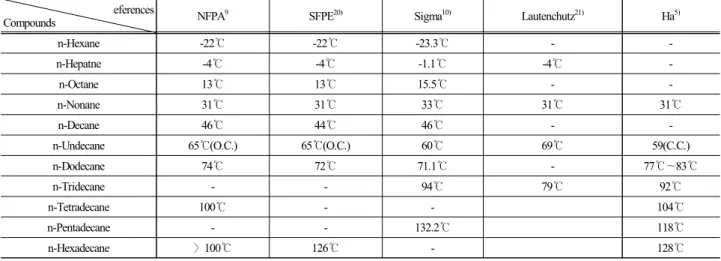
The flash points of n-noanne are scarcely literatures but in the industrially important material. In order to review validity of measured flash points for n-nonane, we compared with several sources(NFPA, SFPE, Sigma, Lautenchutz and Ha) in Table 5.
Also, in order to investigate validity of flash points for n-nonane, we are plotted for the flash points from
Testers Experimental (
℃
) Estimated(LEL) (Vol%)Lower flash points Upper flash point Fire points by Lower flash points by Upper flash point by Fire points
Setaflash 31 53 - 0.82 2.78 -
Pensky-Martens 34 - - 0.98 - -
Tag 37 - 40 1.16 - 1.39
Cleveland(Manual) 42 - 42 1.55 - 1.55
Table 4. Comparison of calculated explosion limits by experimental flash points and fire point for n-nonane
Fig. 1. A comparison between NFPA and experimental lower flash points for n-alkanes.
n-hexane to n-hexadecane of NFPA literature and measured flash points from n-nonane to n-hexadecane by Ha literature 5) in Figure 1.
In plotting results, the lower flash point of n-nonane which measured this study was similar trend the flash points of several established literatures and flash points by using Setaflash tester of Ha literature 5) . Therefore, the measured flash points for n-nonane in this study was accorded with the existing literatures.
4.3 Investigation of Autoignition Temperature for n-Nonane
The autoignition temperature(AIT) of a substance is the temperature at which a material
will autoignite when it contacts a surface at that temperature. The autoignition temperature may be used to
specify operating, storage, and materials handling procedures for a material.
According to prior articles, the AIT of n-nonane reported from 190℃ to 285℃ by Table 2. We have searched the several handbooks and references in order to investigate validity the measured AIT for n-nonane. Therefore, we proposed experimental data which obtained in this study.
In this study, the initial temperature of autoignition for n-nonane set up to 170℃ based on the AIT of hydrocarbon compounds, however n-nonane do not ignited in this temperature. When temperature of autoignition set up to 20 0℃, n-nonane do not ignited in this temperature. When temperature of autoignition set up to 220℃, a rise 20℃.
The n-nonane ignited in 52.87 second. We are found AIT 210℃ to turn down 2 ∼ 5℃ based on 220℃. The ignition delay time of AIT 210℃ is ignited 116.24 second. And the ignition delay time of the ignition temperature 290℃ to increase 5 ∼10℃ based on the AIT 210℃ is ignited 1.94 second. The relationship between the ignition temperature and the ignition delay time for n-nonane are summarized in Table 6.
In the case of most combustible materials. the relationship between the ignition temperature and the ignition delay time may be approximated within finite limits by the equation
ln
(2)
where τ is the ignition delay time, T is the ignition temperature[K], and A and B are constant.
The coefficients of optimized equation by regression analysis is following.
eferences
Compounds NFPA9 SFPE20) Sigma10) Lautenchutz21) Ha5)
n-Hexane -22
℃
-22℃
-23.3℃
- -n-Hepatne -4
℃
-4℃
-1.1℃
-4℃
-n-Octane 13
℃
13℃
15.5℃
- -n-Nonane 31
℃
31℃
33℃
31℃
31℃
n-Decane 46
℃
44℃
46℃
- -n-Undecane 65
℃
(O.C.) 65℃
(O.C.) 60℃
69℃
59(C.C.)n-Dodecane 74
℃
72℃
71.1℃
- 77℃∼
83℃
n-Tridecane - - 94
℃
79℃
92℃
n-Tetradecane 100
℃
- - 104℃
n-Pentadecane - - 132.2
℃
118℃
n-Hexadecane
〉
100℃
126℃
- 128℃
Table 5. Comparison of lower flash points of several references for n-nonane
ln
(3)
The equation (3) are presented in equation (4) by the relationship between logτ and
.
log
(4)
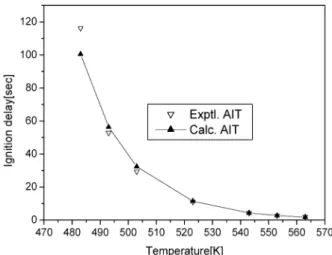
The comparison of experimental and calculated ignition delay time by the AIT for n-nonane are illustrated Table 6 and Figure 2.
It is another index, replacing average absolute deviations (A.A.D.) in situation when an accurate quantitative comparison between the reported value and the estimated value are attempted. The average absolute deviations (A.A.D.) 22) is :
∑
exp
(5)
where the A.A.D. is a measure of agreement between the experimental data and the calculated values.
The predicted ignition delay times by Equation (3) are in agreement with the experimental ignition delay times, and A.A.D. is 3.27 second and the coefficient of determination(r 2 ) is 0.97.
The activation energy can calculate by using Semenov equation 23) . Semenov related several variables by the equation
log
(6)
where τ is ignition delay(s), E is activation energy (kJ/mol) and B is constant.
Table 6. Comparison of experimental and calculated ignition delay time by the AIT for n-nonane
No. T[K]
τ
exp.[s] lnτ
exp.τ
est..(Eq. 2)1 483.15 116.24 4.75566 100.46
2 493.15 52.87 3.96784 56.34
3 503.15 29.41 3.38133 32.33
4 523.15 11.03 2.40062 11.38
5 543.15 4.19 1.43270 4.30
6 553.15 2.62 0.96317 2.72
7 563.15 1.94 0.66269 1.75
A.A.D. - - - 3.27