한국산 둥근전복,
Haliotis discus discus
의 생식주기김재원, 이병욱1, 강주찬2, 민은영3, 원승환4, 임한규5, 강승완6, 전미애7, 이정식7
강원도립대학 해양생명과학과, 1부경대학교 해양생물학과, 2부경대학교 수산생명의학과,
3부경대학교 수산과학연구소, 4제주특별자치도 해양수산연구원, 5국립목포대학교 해양수산자원학과,
6경상남도 수산자원연구소, 7전남대학교 수산생명의학과
Reproductive Cycle of the Abalone, Haliotis discus discus Collected from Jeju Island of Korea
Jae Won Kim, Byeong Wook Lee1, Ju-Chan Kang2, Eun Young Min3, Seung-Hwan Won4, Han Gyu Lim5, Seung Wan Kang6, Mi Ae Jeon7 and Jung Sick Lee7
Gangwon Provincial College, Department of Marine Life Science, Gangneung 210-804, Korea
1Department of Marine Biology, Pukyong National University, Busan, 608-739, Korea,
2Department of Aquatic Life Medicine, Pukyong National University, Busan, 608-737, Korea
3Institute of Fisheries Science, Pukyong National University, Busan 608-737, Korea
4Jeju Special Self-Governing Province Fisheries Resources Institute, Jeju Special Self-Governing 699-915, Korea
5Marine and Fisheries Resources, Mokpo National University, Jeonnam, 534-729, Korea
6Gyeongsangnam-do Fisheries Resources Research Institute, Tongyeong 615-118, Korea
7Department of Aqualife Medicine, Chonnam National University, Yeosu 550-749, Korea
ABSTRACT
This study histologically describes the gonadal development and reproductive cycle of the abalone, Haliotis discus discus inhabiting Jeju Island of Korea. Gonads displayed histologically definitive seasonal changes. The gonad index (GI) of both females and males was the highest (3.2 and 3.3) in September and was the lowest (1.7 and 1.4) in January and February. Egg diameter increase from early stage in March and reach about 180 μm to ripe stage in August. The condition index (CI) was highest in July and lowest in May. The pattern of changes in the GI, egg diameter and CI were similar to the pattern of seasonal changes in gonadal tissues. The female ratio (F/F + M) was 59% (n = 182:127). The reproductive cycle was divided into an inactive stage (January-February), early active stage (March-April), late active stage (May–July), ripe stage (August–October) and spent and degenerative stage (November-January). The main spawning period of H. discus discus was August to October at Jeju Island in 2014.
Keywords: Haliotis discus discus, reproductive cycle, main spawning period
서 론
한국에서 전복류는 둥근전복속 (Haliotis) 에 2종 및 2아종 (왕전복, H. madaka; 말전복, H. gigantea; 둥근전복, H.
discus discus; 북방전복, H. discus hannai) 과 오분자기속 (Sulculus) 에 2아종 (마대오분자기, S. diversicolor diversicolor; 오분자기, S. diversicolor supertexta) 이 보고 되고 있다 (Lee and Min, 2002).
둥근전복은 복족강 (Gastropoda), 원시복족목 (Archaeogastropoda), 전복과 (Haliotidae) 에 속하는 식용 복족류로서 조간대에서 수심 20 m의 바위지역에 서식한다고 알려져 있고, 한국, 일본, 중국, 대만 등에 분포하는 고부가가 치 양식대상종이다 (Lee et al., 2014).
전복류의 성성숙, 산란 및 생식주기와 같은 생식에 관한 보 고는 주로 기초 생물학적 연구, 자원증식 및 양식기술 개발을 위한 자료를 지원하기 위하여 조사되었다. 전복류의 생식생물 Received: February 27, 2015; Revised: March 23, 2015;
Accepted: March 30, 2015
Corresponding author : Mi Ae Jeon
Tel: +82 (61) 659-7172 e-mail: [email protected] 1225-3480/24562
This is an Open Access article distributed under the terms of the Creative Commons Attribution Non-Commercial License with permits unrestricted non-commercial use, distribution, and reproducibility in any medium, provided the original work is properly cited.
학적 측면에서의 연구는 북방전복의 난소 성숙 (Tomita, 1967) 과 정소 성숙 (Tomita, 1968), 전복의 증식에 관한 연 구 (Pyen, 1970), 전복류의 생식세포형성과정 및 생식주기 (Lee, 1974), 여수연근해와 진도의 북방전복, H. discus hannai의 산란기 (Rho and Park, 1975) 와 생식주기에 관 한 연구 (Park et al., 2014) 등이 있으나 둥근전복의 생식생 태를 충분히 이해할 수 있는 정보는 거의 없는 실정이다.
따라서, 본 연구는 한국 제주도의 둥근전복을 대상으로 이들 의 생식소 발달, 생식소지수, 난경조성, 비만도, 주 산란기 및 생식주기 등에 관한 기초정보를 얻고자 하였다.
재료 및 방법
1. 재료
본 연구에서는 한국 제주도의 구좌읍 근해지역에서 2013년 11월부터 2014년 10월까지 채집한 평균 각장 65.25-238.65 mm의 둥근전복 309 개체를 분석하였다.
2. 환경자료
채집지역의 월별 수온 및 염분농도 자료는 국립해양조사원 (KHOA, 2014) 에서 인용하였다.
3. 조직학적 분석
채집한 전복은 냉장용기에 담아 연구실로 옮겨 개체별 각장, 각고, 전중량, 육중량을 측정한 후, 월별 각장 및 육중량을 조사 하였고, 조직학적 관찰을 위해 생식소를 절단하였다. 실험 개체 들은 각장 및 전중량 등의 계측형질을 측정한 다음, 생식소가 포 함되어 있는 내장낭 부위를 Bouin's solution에 24시간 고정한 후, 흐르는 물로 36-48시간 동안 수세하였다. 그 후, 알코올 탈 수과정을 거쳐 파라핀에 포매하였다. 파라핀에 포매된 조직은 마이크로톰을 이용하여 두께 4-6 μm의 횡단면과 종단면으로 연속절편을 제작하였다. 제작된 조직절편은 Mayer's hematoxylin- eosin (H-E) 염색을 실시하여 광학현미경으로 분석하였다.
4. 생식소 발달단계
생식소 발달단계는 Lee (1974), Sobhon (1999) 와 Park et al. (2014) 의 방법을 기초로 암컷과 수컷 모두 비활성기 (inactive stage, In), 초기활성기 (early active stage, Ea), 후기활성기 (late active stage, La), 완숙기 (ripe stage, R), 방출기 (spent stage, Sp)와 퇴화기 (degenerative stage, D) 6단계로 구분하였다.
5. 생식소지수 (gonad index, GI)
GI는 아래와 같이 생식소 발달단계별로 상수 (In = 1, Ea
= 2, La = 3, R = 4, Sp = 3, D = 2) 를 곱한 전체의 합을 개체수로 나누어 나타냈다.
GI =
(N of In × 1) + (N of Ea × 2) + (N of La × 3) + (N of R × 4) + (N of Sp × 3) + (N of D × 2)
Total N observed monthly
6. 난경 조성의 월 변화 (egg diameter)
난모세포의 난경은 현미경화상분석장치 (IMT-VT Image analysis, IMT Inc., USA) 를 사용하여 측정하였다.
7. 비만도 (condition index, CI)
CI = Body weight (g) × 1000 Shell length (mm)3
8. 성비
성비는 조직표본을 검경하여 다음과 같이 계산하였다.
Female (%) = [Female/Female + Male] × 100
9. 통계학적 분석
성비는 SPSS 통계 프로그램을 이용하여 χ2 (Chi squared) t-test를 하여 유의성 여부를 판정하였다.
결 과
1. 환경조건
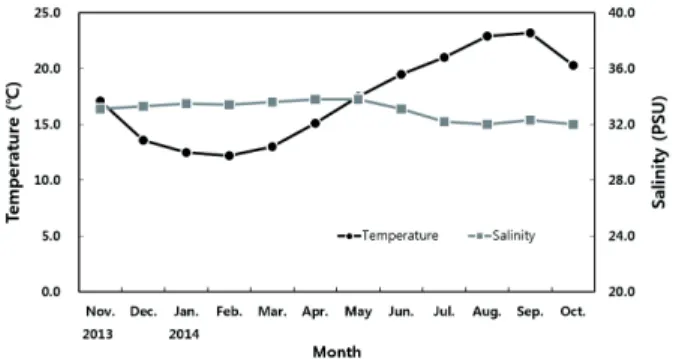
둥근전복 채집지역의 채집기간 (2013년 11월-2014년 10 월) 동안 평균 수온은 17.6℃였다. 2월에 최저수온을 나타냈 고, 9월에 최고수온을 나타냈다. 평균 염분농도는 32.9 psu 였 으며, 32.0-33.8 psu의 범위를 보였다 (Fig. 1).
Fig. 1. Monthly variations of water temperature and salinity in the sampling area.
2. 생식소 발달단계의 월별 출현율
둥근전복의 생식소 발달단계를 살펴본 결과, 암컷은 2014년 8월부터, 수컷은 9월부터 방출기가 관찰되었다. 암컷은 2014년 2월과 7월까지 초기활성기의 개체가 대부분을 차지하였으며, 8 월에 완숙기가 관찰되었고 10월까지 방란하는 개체들을 볼 수 있었다. 수컷은 2014년 8월부터 완숙기의 개체들이 관찰되었으 며, 11월까지 방정하는 개체들을 관찰할 수 있었다 (Fig. 2).
3. 생식소지수의 월 변화
둥근전복의 채집기간 동안 암컷의 평균 생식소지수는 2.3으 로 나타났다. 2014년 1월에 가장 낮은 값 (1.7) 을 보이다가 4 월까지 점차 증가하였다. 5월과 6월에 감소한 이후 계속 증가 하면서 2014년 8-10월에 높은 값을 보였다. 정소의 평균 생식 소지수는 2.3으로 나타났으며 생식소지수의 변화는 암컷과 비 슷한 경향을 보였으며 2014년 9월 (3.3)에 가장 높은 값을 나 타내었다 (Fig. 3).
4. 난경 조성의 월 변화
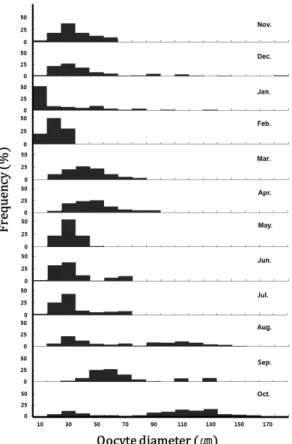
생식소발달에 따른 생식상태를 조사하기 위하여 둥근전복의 월별 난경을 측정하고, 이 값을 여러 크기의 단계별 구간을 설
정하여 상대적 출현빈도로서 나타낸 결과는 Fig. 4와 같다.
둥근전복의 난소 내 난경의 월별 크기변화는 2013년 11월, 12월 및 2014년 1월에 부분방란 흔적을 보이는 완숙난모세포 가 보였으며 대부분 3-30 μm의 난모세포를 가진 비활성기의 개체와 성장 중인 난모세포가 주로 나타났다. 4월부터 7월까지 40-60 μm 내외의 난모세포가 대부분을 차지하였으며, 180 μm 내외의 난모세포가 관찰되는 8월에서 10월에 본격적인 방란 시기임을 알 수 있었다.
5. 비만도의 월 변화
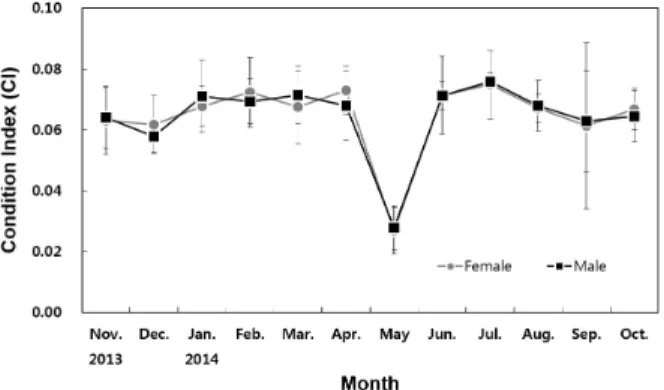
비만도는 암, 수 모두 2014년 7월 (0.0748, 0.0760) 로 가 장 높았으며 2013년 10월부터 2014년 1월까지 점차적으로 증가한 후 2014년 4월까지 비슷한 수준을 유지하였다. 2014 년 5월은 비만도가 암, 수 모두 가장 낮게 나타났으며 (0.0268, 0.0278), 2014년 6월은 2014년 4월보다 높게 나타 났고 이후 감소하는 경향을 보였다 (Fig. 5).
6. 성비
2013년 11월부터 2014년 10월까지 채집된 총 309 개체 중 암컷은 182 개체, 수컷은 127 개체로 전복의 성비는 각장 구 Fig. 2. Monthly variations in gonadal development frequency
in Haliotis discus discus. In: inactive stage, Ea: early active stage, La: late active stage, R: ripe stage, Sp:
spent stage, D: degenerative stage.
Fig. 3. Monthly variations of gonad index (GI) in Haliotis discus discus.
Fig. 4. Monthly variations of egg diameter in Haliotis discus discus.
간에 따라 다소의 차이는 보였으나 전체적으로 암컷의 비율이 59%로 수컷 비율보다 높았다 (Table 1).
고 찰
일반적으로 수서동물의 생식주기 및 성 성숙은 외인성 요인 과 내인성 요인의 영향을 받는다. 외인성 요인은 수온, 빛, 조 석주기, 수심, 먹이, 밀도, 기생충 및 질병, 염분도 및 기질 등 이 있으며, 수온은 이러한 여러 요인들 가운데 가장 중요한 요 인이다 (Mackie, 1984; Grubert and Ritar, 2004). 전복류 는 수온이 7℃ 이하로 내려가면 섭이활동을 멈추고 성장이 저 하되는데 (Sakai, 1962a, b), 본 연구 기간의 수온은 7℃ 이상 으로 생식소 조직은 모두 활동적인 것으로 나타났다.
많은 복족류와 이매패류의 생식소는 다수의 생식세포형성 소낭 (gametogenic follicle) 으로 구성되며, 각각의 소낭 내 에서 생식세포의 분화 및 발달이 진행된다. 각 소낭 내에서 생 식세포들의 발달은 비동시적으로 진행되며, 계절적으로 뚜렷한 변화를 보인다 (Mackie, 1984; Eversole, 2001; Jung et al., 2007a, b; Marroquin-Mora and Rice, 2008; Peredo et al., 2010). 이러한 구조적 특징은 Haliotis iris and H.
australis (Wilson and Schiel, 1995), H. asinina (Capinpin et al., 1998; Sobhon et al., 1999), H. varia (Najmudeen and Victor, 2004), H. midae (Visser-Roux, 2011), H. discus hannai (Park et al., 2014) 와 본 연구의 둥근전복 생식소에서도 확인되었다.
본 연구에서 둥근전복의 생식소는 조직학적으로 비활성기 (2월), 초기활성기 (3월-4월), 후기활성기 (5월-7월), 완숙기 (8 월-10월), 방출 및 퇴화기 (11월-1월) 의 계절적인 변화를 보였 다. 생식소지수는 암, 수 모두 8월에 최고값을 보였으며, 1월에 최저값을 나타내었고, 난경조성변화에 있어서 4월에 80-100 μm 크기의 난모세포가 존재하다가 5월 들어 이들 세포는 보 이지 않았고 이 현상은 7월까지 계속되었는데, 이때 외형적으 로 생식소의 크기가 줄어드는 것이 관찰되었다. 이것은 수온 때문에 생식소의 성숙이 억제되는 것으로 판단된다. 이후, 8-10월에 180 μm 이상의 대형난모세포군이 관찰되는 것으 로 보아 생식소지수와 난경조성변화는 생식소조직의 계절적 변화와 유사한 양상을 나타내 둥근전복의 성 성숙 및 생식주기 역시 수온의 영향을 반영하는 것으로 생각된다.
연체동물의 산란 습성은 연중 1회 산란하는 종과 다회 산란 하는 종으로 구분할 수 있으며, 계절에 따라 연중산란형 (year-around breeders), 늦가을부터 이듬해 초봄 사이에 산 란하는 동계산란형 (winter breeders) 그리고 늦봄부터 초가 을 사이에 산란하는 하계산란형 (summer breeders) 으로 구 분된다 (Boolootian et al., 1962; Capinpin et al., 1998).
본 연구 결과, 2014년 제주도에서 둥근전복의 주산란기는 8 월-10월로 조사되어 이들은 하계산란형에 속하는 것으로 나타 났다.
이매패류의 경우 비만도의 변화는 생식주기 및 먹이조건과 연관성을 보이지만 전복류의 경우에는 이들의 연관성에 관한 보고는 거의 없었다. 본 연구에서 둥근전복의 비만도 변화는 생식지수의 변화와 유사한 경향을 나타냄으로서 생식주기와 연관성이 있는 것으로 추측되며, 이후 다각적인 각도에서 연관 성을 조사하는 것이 필요할 것으로 생각된다.
Fig. 5. Monthly variations of condition index (CI) in Haliotis discus discus. Vertical bars indicate standard deviation.
Shell length (mm) Total Female Male Sex ratio (F/F + M) Chi-square p value
60.1-80.0 27 17 10 0.63 1.815 0.178
80.1-100.0 105 54 51 0.51 0.086 0.770
100.1-120.0 102 59 43 0.58 2.510 0.113
120.1-140.0 41 30 11 0.73 8.805 0.003
140.1-160.0 18 11 7 0.61 0.889 0.346
160.1-240.0 16 11 5 0.69 2.250 0.134
Total 309 182 127 0.59 9.790 0.002
Table 1. Sex ratio of Haliotis discus discus collected from Jeju Island
전복류는 자웅이체로서 체외방출 수정종에 속하며 (Lee, 1974), 자연집단에 있어 성비는 1:1로 보고되고 있지만 (Webber and Giese, 1969; Young, 1970; Capinpin et al., 1998; Najmudeen and Victor, 2004), 자웅이체인 연체동물 의 경우 암컷의 수가 많은 것이 일반적인 현상이다 (Fretter and Graham, 1964).
Park et al. (2014) 의 연구에서 암컷의 비율은 57%
(1:0.76; n = 154:117) 로 수컷 비율보다 높았으며, 본 연구에 서도 암컷의 비율이 59% (1:0.70; n = 182:127) 로 높은 것 으로 나타났다. 연체동물의 경우에 성비의 변화 및 성결정은 유전적 요인과 수온, 먹이 등의 환경적 요인이 작용하는 것으 로 보고되고 있으나 (Yusa 2007; Chávez-Villalba et al.
2011), 향후 성비 차이에 관하여 여러 요인들에 대한 세부적인 연구가 필요할 것으로 생각된다.
요 약
본 연구에서는 한국 제주도에 서식하는 둥근전복의 생식소 발달과 생식주기를 조직학적으로 기재하였다. 생식소는 조직학 적으로 계절적인 변화를 보였다. 암컷의 비율은 59% (n = 182/309) 로 조사되었다. 생식소지수는 암, 수 모두 9월에 최 고값 (3.2, 3.3) 을 보였으며, 1월과 2월에 최저값 (1.7, 1.4) 을 보여주었다. 난경 조성 변화는 3월의 초기성장기부터 점차 증가하기 시작하여 완숙기인 8월에 180 μm 전후의 난경을 나타냈다. 비만도는 암,수 모두 7월에 최고값 (0.0748, 0.0760) 을 보였으며, 5월에 최저값 (0.0268, 0.0278) 을 나 타냈다. 생식소지수, 난경 및 비만도는 생식소조직의 계절적 변화와 유사한 양상을 나타냈다. 생식주기는 비활성기 (11월 -12월), 초기활성기 (1월-3월), 후기활성기 (3월-4월), 완숙기 (5월-6월), 방출 및 퇴화기 (7월-10월) 로 구분할 수 있다.
2014년 제주도에서 둥근전복의 주산란기는 8월-10월 이었다.
사 사
본 연구는 농림축산식품부, 해양수산부, 농촌진흥청, 산림청 Golden Seed 프로젝트 사업에 의해 이루어졌습니다.
REFERENCES
Boolootian, R.A., Farmanfarmaian, A. and Giese, A.C.
(1962) On the reproductive cycle and breeding habits of two western species of Haliotis. Biological Bulletin, 122: 183-193.
Capinpin, E.C. Jr., Encena II, V.C. and Bayona, N.C.
(1998) Studies on the reproductive biology of the Donkey`s ear abalone, Haliotis asinina Linné.
Aquaculture, 166: 141-150.
Chávez-Villalba, J., Soyez, C., Huvet, A., Gueguen, Y., Lo, C. and Le Moullac, G. (2011) Determination of gender in the pearl oyster Pinctada margaritifera.
Journal of Shellfish Research, 30: 231-240.
Eversole, A.G. (2001) Reproduction in Mercenaria mercenaria. In: Biology of the Hard Clam. (ed. by Kraeuter, J.N. and Castagna, M.), Elsevier, New York. pp. 221-260.
Fretter, V. and Graham, A. (1964) Reproduction. In:
Physiology of Mollusca, Vol. 1. (ed. by Wilbur, K.M.
and Yonge, C.M.), Academic Press, New York. pp.
473.
Grubert, M.A. and Ritar, A.J. (2004) Temperature effects on the dynamics of gonad and oocyte development in captive wild-caught blacktip (Haliotis rubra) and greenlip (H. laevigata) abalone. Invertebrate Reproduction Development, 45: 185-196.
Jung, G.K., Park, J.J., Ju, S.M., Jin, Y.G. and Lee, J.S.
(2007a) Ovarian structure and oogenesis of the spiny top shell, Batillus cornutus (Lightfoot, 1786) (Gastropoda: Turbinidae). The Korean Journal of Malacology, 23: 209-216.
Jung, G.K., Park, J.J., Lee, J.W. and Lee, J.S. (2007b) Spermatogenesis of the spiny top shell, Batillus cornutus (Lightfoot, 1786) (Gastropoda: Turbinidae).
Development and Reproduction, 11: 97-104.
KHOA (2014) Real time coastal data; Jeju island.
[Online] Available from: http://sms.khoa.go.kr/koofs/kor/
observation/obs_past_search_statistic.asp Accessed October 25, 2014.
Lee, J.S. and Min, D.K. (2002) A catalogue of molluscan fauna in Korea. The Korean Journal of Malacology, 18: 93-217.
Lee, J.S., Won, S.H., Kim, S.K., Lim, H.K. and Lee, J.S.
(2014) Classification and description of Genus Nordotis (Gastropoda: Vestigastropoda) from Korea.
The Korean Journal of Malacology, 30: 79-86.
Lee, T.Y. (1974) Gametogenesis and reproductive cycle of abalones. Publications of the Marine Laboratory Busan Fisheries College, 7: 21-50.
Mackie, G.L. (1984) Bivalves. In: The Mollusca, Vol. 7.
Reproduction. (ed. by Tompa, A.S., Verdonk, N.H.
and van den Biggelaar, J.A.M.), Academic Press, New York. pp. 351-418.
Marroquin-Mora, D.C. and Rice, M.A. (2008) Gonadal cycle of northern quahogs, Mercenaria mercenaria (Linne, 1758), from fished and non-fished subpopulations in Narragansett Bay. Journal of Shellfish Research, 27: 643–652.
Najmudeen, T.M. and Victor, A.C.C. (2004) Reproductive biology of the tropical abalone Haliotis varia from Gulf of Mannar. The Marine Biological Association of India, 46: 154-161.
Peredo, S., Jara-Seguel, P., Parada, E. and Brand, E.V.
(2010). Gonadal organization and gametogenesis in Musculium argentinum (Veneroida: Sphaeriidae) from a population in southern Chile. Journal of Shellfish
Research, 29: 989–993.
Park, M.W., Kim, H., Kim, B.H., Son, M.H., Choi, J.S.
and Lee, J.S. (2014) Reproductive cycle of the abalone, Haliotis discus hannai collected from Jindo of Korea. The Korean Journal of Malacology, 30:
243-248.
Pyen, C.K. (1970) Studies on the propagation of abalone.
Bulletin of the Korea Fisheries Society, 3: 177-186.
Rho, S. and Park, C.K. (1975) Studies on the propagation of the abalone. II. The spawning season of Haliotis discus hannai Ino in the adjacent areas of Yeosu. Bulletin of the Korea Fisheries Society, 8:
234-241.
Sakai, S. (1962a) Ecological studies on the abalone, Haliotis discus hannai INO-Ⅰ. Experimental studies on the food habit. Bulletin of the Japanese Society of Scientific Fisheries, 28: 766-779.
Sakai, S. (1962b) Ecological studies on the abalone, Haliotis discus hannai INO-Ⅱ. Mutuality among the colored shell area, growth of the abalone and algal vegetation. Bulletin of the Japanese Society of Scientific Fisheries, 28: 780-783.
Sobhon, P., Apisawetakan, S., Chanpoo, M., Wanichanon, C., Linthong, V., Thongkukiatkui, A., Jarayabhand, P., Kruatrachue, M., Upatham, S.E. and Poomthong, T. (1999) Classification of germ cells, reproductive cycle and maturation of gonads in Haliotis asinina Linnaeus. Science Asia, 25: 3-21.
Tomita, K. (1967) The maturation of the ovaries of the abalone, Haliotis discus hannai INO in Rebun island, Hokkaido. Japanese Science reports of Hokkaido fisheries experimental station, 7: 1-7.
Tomita, K. (1968) The maturation of the testes of the abalone, Haliotis discus hannai INO in Rebun island, Hokkaido. Japanese Science reports of Hokkaido fisheries experimental station, 9: 56-61.
Visser-Roux, A. (2011) Reproduction of the South African abalone, Haliotis midae. Ph.D. Dissertation, University of Stellenbosch. pp. 88.
Webber, H.H. and Giese, A.G. (1969) Reproductive cycle and gametogenesis in the black abalone, Haliotis cracheroidii (Gastropoda: Prosobranchiata). Marine Biology, 4: 152-159.
Wilson, N.H.F. and Schiel, D.R. (1995) Reproduction in two species of abalone (Haliotis iris and H. australis) in Southern New Zealand. Marine and Freshwater Research, 46: 629-637.
Young, J.S. (1970) The reproductive cycle, gonadal histology and gametogenesis of the red abalone Haliotis rufescens (Swaison). California Fish and Game, 56: 298-309.
Yusa, Y. (2007) Causes of variation in sex ratio and modes of sex determination in the Mollusca - an overview. American Malacological Bulletin, 23: 89-98.