우리나라 전복 양식장의 패각 천공성 다모류 감염현황
원경미⋅김병학⋅진영국⋅박영진*⋅손맹현⋅조미영**⋅박명애**⋅박민우†2) 국립수산과학원 남서해수산연구소, 전남 해양수산과학원*, 국립수산과학원 수산생물방역과**
Infestation of the Abalone, Haliotis Discus Hannai, by the Polydora under Intensive Culture Conditions in Korea
Kyoung-Mi Won, Byeng-Hak Kim, Young-Guk Jin, Young-Jin Park*, Maeng-Hyun Son, Mi-Young Cho**, Myoung-Ae Park**, Min-Woo Park†
Southwest Sea Fisheries Research Institute, National Fisheries Research and Development Institute, Yeosu 556-823,Korea
*Jeollanam-do Fisheries Research and Development Institute, Wando 537-801, Korea
**Aquatic life disease control division, National Fisheries Research and Development Institute, Busan 619-902, Korea
The genus Polydora(Polychaeta, Spionidae) includes many species well known for their activity as borers. They often become harmful invaders by reducing the growth rate and meat yield of, or inducing the mortality of commercially important mollusck, abalone, Haiotis discus hannai. In 2012, the frequency of the Polydora was observed with 5∼99% in live abalone and 5.3∼70.3% in dead abalone shells of abalone sea-caged aquaculture system, Korea. There are many nacreous blister in the ventral margin and inner of the infestated abalone by abalone in response to the Polydora. A worm bored two holes in the shell and come in and out for ingestion the organic matters. They are more than 40 mm in length and had outstanding palps with black bars, disc form pygidium and 4 eyespots. This is the first record for the statue of Polydora infestation of sea-caged cultured abalone, Haliotis discus hannai in Korea.
Key words :Abalone, Haliotis discus hannai, Polydora, Prevalence, Mortality, Infestation
환형동물문(Annelida), 다모강(Polychaeta), 얼굴갯 지렁이과(Spionidae)의 Polydora 속은 부드러운 진흙 에서 딱딱한 석회질 기질까지 전세계의 다양한 기질 에 폭넓게 서식하며(Blake, 1996), 이들 중 일부 종은 패각을 천공하는 것으로 잘 알려져 있다. Polydora는 종종 상업적으로 중요한 패류의 패각에 천공하여 성 장저해, 폐사율 증가, 상품가치 저하 등의 피해를 일 으킨다. 그러므로 상업적으로 중요한 품종에 감염되
†Corresponding author: Min-Woo Park
Tel: 061-690-8984, Fax: 061-685-9073, E-mail: [email protected]
었을 경우, 양식업에 심각한 문제를 일으키는 것으로 간주된다(Okoshi and Sato-Okoshi, 1996; Martin and Britayev, 1998). 전복(Simon et al., 2006; Sato-Okoshi et al., 2008), 굴(Handley and Bergquist, 1997), 진주조 개(Mohammad, 1972), 홍합(Kent, 1979) 및 바지락 (Rossella B. and Otello G., 2002)과 같은 다양한 패류 에서 Polydora의 감염이 오래전부터 보고되어져 왔 다. 1995-1997년, 호주 타스마니아 지역의 전복, Haliotis rubra 양식장에 천공성 다모류에 의한 감염 이 발생하여, 폐사율 50% 이상의 피해를 입었으며
한 양어장에서는 폐사율이 95% 달했다는 보고도 있 다(Lleonart et al., 2003).
Polydora에 의한 전복의 피해 및 감염률에 대한 연구는 자연산 전복류의 경우, Shepherd(1973), Kojima and Imajima(1982), Horne(1996) 및 Grindley et al.(1998)에 의해 보고되었으나, 양식 전복에 대한 연구는 매우 드물다. 최근 칠레의 양식 전복(H. discus hannai)에 감염된 Polydora uncinata(Radashevsky and Olivares, 2005)와 호주의 양식 전복(H. rubra and H.
laevigata)에 감염된 P. hoplura와 Boccardia knoxi에 관한 보고가 있으나, 그 정보가 매우 제한적이다.
우리나라에서는 서해안에서 채집된 전복(H. discus discus)에서 P. haswelli와 P. aura가 관찰되었다는 연 구(Sato-Okoshi et al., 2012)가 유일하며, 양식산 전복 에 대한 조사는 까막전복의 육상수조식 양식시험 중
관찰된 사례가 보고된 정도이다(목포지방해양수산
청, 2005). 따라서, 본 연구에서는 처음으로 우리나라 전복 가두리 양식장의 패각 천공성 다모류의 특성 및 감염현황을 조사하여 패각 천공성 다모류에 의한 양 식전복의 피해대책 마련의 기틀을 마련하고자 하였다.
재료 및 방법
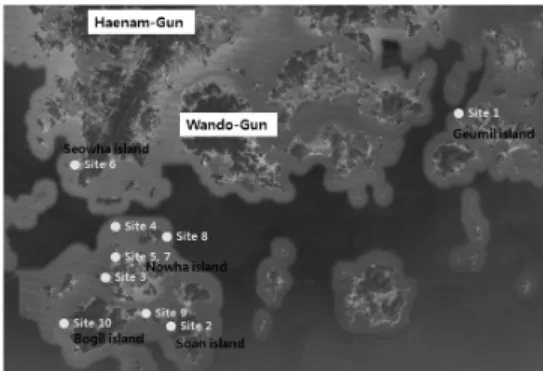
패각 천공성 다모류(Polydora) 감염현황 조사 2012년 완도군 소재의 10개 해상 가두리 전복 양식 장을 대상으로 Polydora 감염현황을 조사하였다(site 1∼10, Fig. 1). 조사는 각 양식장의 출하작업이 이루 어지는 동안 진행하였으며, Polydora 감염현황과 함 께 전복의 양식 생산성(칸당 생산량, kg/cage) 및 생존 률(%)을 조사하였다. Polydora 감염은 활전복과 죽은 전복 패각으로 나누어 실시하였다. 활전복은 각 site 마다 100마리씩 조사하였으며, 죽은 전복 패각은 각 양식장마다 가두리 3칸 당 죽어 있는 패각을 모두 수거하여 조사하였다.
Fig. 1. Map of sampling sites in Korea.
패각 천공성 다모류(Polydora) 관찰
Polydora의 관찰은 전복 표면의 패각 변형부위를 롱노즈로 조심스럽게 부러뜨려 분리하였으며, 분리 된 Polydora는 실체현미경(Stemi 2000-C, Zeiss)으로 즉시 관찰하거나, 10% 중성 포르말린으로 고정하여 보관하였다. Polydora species의 동정은 Rainer(1973), Read(1975) 및 Blake and Kudenov(1978)의 분류법에 따라, prostomium(전구엽), pygidium(항문상판)의 형 태, eyespots(안점) 및 palps(촉수)의 형태에 따라 판별 하였다.
결 과
패각 천공성 다모류(Polydora) 감염현황 조사 2012년 전라남도 완도군 소재 10개 전복 가두리양 식장을 조사한 결과, Polydora의 감염률은 활전복에 서 5∼99%, 죽은 패각에서 5.3∼70.3%로 나타나 (Table 1), 가두리 양식장에 따라 다양한 결과를 보였다.
조사한 전복의 평균 각장은 57.00±3.5∼98.10±7.48 mm였으며, 전복의 양식생산량은 18.4∼76.3 kg/cage, 가두리 입식 후 생존률은 14.8∼96.6%로 나타났다.
Polydora 감염률은 죽은 전복 패각보다 활전복이 다 소 높거나 유사한 경향을 보였다.
Site Area Abalone size(mm)
Abalone productivity(Kg/cage)
Abalone survival rate(%)
Polydora Infestation Live shell(%) Dead Shell(%) 1 Geum-il island
iljeong-ri 57.00±3.5 58.7 67.483) 66/1001) (66)
593/10862) (54.6) 2 So-an island
Maengseon-ri 82.13±9.7 50.6 71.80 41/100
(41)
182/916 (19.9) 3 No-wha island
Dangsan-ri 75.63±6.04 35.0 54.57 99/100
(99)
1516/2157 (70.3) 4 Masac island
sinrang-ri 80.08±8.59 33.2 61.23 65/100 (65)
820/1798 (45.6) 5 No-wha island
Mira-ri 77.34±5.35 49.6 76.86 44/100
(44)
199/594 (33.5) 6 Seo-wha island
Dangin-ri 98.10±7.48 76.3 96.6 21/100
(21)
48/499 (9.6) 7 No-wha island
Mira-ri 68.02±5.87 42.1 75.57 69/100
(69)
575/983 (58.5) 8 Wheong-gan island
Wheonggan-ri 93.46±6.65 44.3 41.87 30/100 (30)
134/774 (17.3) 9 Bo-gil island
Baekdo-ri 76.67±7.71 30.3 43.13 5/100
(5)
17/319 (5.3) 10 Bo-gil island
Jeongja-ri 65.6±8.7 18.4 14.80 58/100
(58)
368/625 (58.9)
1) Infestated abalone/Observated abalone
2) All of the dead abalone shells in three cage of a site
3) Survival rate for the duration from input day in the sea case of 3cm abalone to output day for sale Table 1. Abalone productivity, survival rate and frequency of Polydora infestation in Abalone, 2012
패각 천공성 다모류(Polydora) 관찰
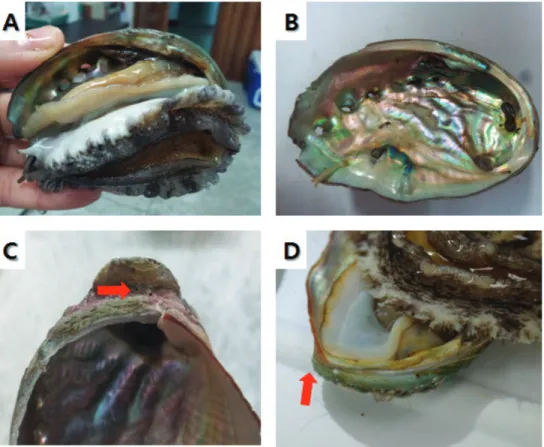
Polydora에 감염된 전복은 패각의 측면 및 내면에 형성된 blister로 인해 패각 변형이 일어났으며(Fig.
2-A and B), 중감염의 경우 패각이 쉽게 부러졌다.
이들 Polydora는 패각 외측에 2개의 구멍을 뚫어 내⋅
외부를 왕래하면서 유기물을 섭취하며(Fig. 2-C), 활 전복을 해수에 순치시켜 관찰하는 동안 Polydora의 palps가 바깥으로 나와 있는 모습이 확인되었다(Fig. 2-D).
Fig. 2. Infestation of the Abalone, Haliotis discus hannai by Polydora of Korea. A, Abalone infestated by Polydora. B, Nacreous blister produced by abalone in response to the Polydora. C, Two holes of burrow(→) in the margin of abalone by Polydora. D, Ventral margin of an abalone, showing palps of Polydora protruding from their burrows(→).
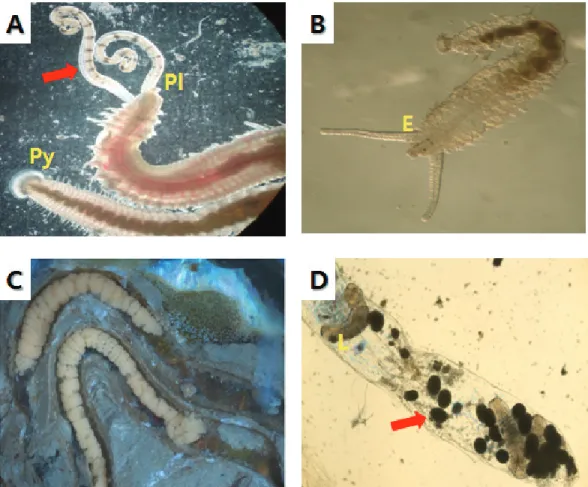
Polydora에 감염된 전복에서 분리된 Polydora는 길이 40 mm 이상의 중⋅대형 종으로 도드라지지 않은 prostomium, 검은 줄무늬를 가진 palps, 4개의 eyespots, 등쪽으로 넓은 원반형의 끝이 갈라진 형태 의 pygidium을 기준으로 Polydora uncinata로 동정하 였다(Fig. 3-A and B). 또한 Sato-Okoshi and Abe(2012) 의 연구에서 밝힌 주요 양식생물 피해 천공성 다모류 의 분류표(Table 2)의 기준을 충족시켰다. 생태학적 관찰을 통해, Polydora 성체의 체강에서 배출된 난낭 (egg capsule)이 길게 연결되고(Fig. 3-C), 이 속에는 발달 중인 유충(larvae)과 영양체로 사용되는 nurse egg와 함께 관찰되는 것을 확인하였다(Fig. 3-D).
고 찰
양식업의 관점에서 볼 때, 패각 천공성 다모류에 의한 패류의 손상은 매우 심각한 문제이다. 패각 바깥 표면에 점액질과 진흙으로 tube를 만들어 도관 (burrow) 입구를 돌출시키고, 패각 내부는 Polydora가 접한 부위의 추가적인 침입을 막기 위한 물리적 장벽 으로 검은 유기물, 석회질 및 진주 성분으로 이루어진 얇은 층을 분비하여 수포(blister)를 형성한다(Stephen, 1978). 그럼에도 불구하고 일부 Polydora는 얇고 약한 패각을 지속적으로 천공하여, 패류로 하여금 이들 물질을 지속적으로 분비하게 하여 전복으로 하여금,
Fig. 3. Polydora isolated in the abalone, Haliotis discus hannai. A, Live Polydora with palps(Pl) which of having the black bars(→) and pygidium(Py). B, Larvae of the Polydora with four eye spots(E). C, Egg string divided into many capsules on the inner surface of abalone. D, Egg capsule containing developed larvae(L) and nurse eggs(→).
Species Body color
Pigmentation
Occipital tentacle
Notocaetae on chaetiger5
Special notochaetae in posterior chaetigers
Palps Prostomi um
Interchaeti gers
Pygidiu m P.
uncinata Tan Black bars
Black or absent
Black or
absent Absent Present Present Recurved hook accompanying capillaries
P. haswelli Tan Black bars
Black or absent
Black or
absent Absent Absent Present Absent P. aura Orange
to tan Abse
nt Absent Absent Absent Present Absent Tight cylindrical bundles of short needles accompanying capillaries P.
brevipalpa Tan Black
bars Absent Absent Absent
or black Absent Absent Absent
Table 2. Comparison of morphological characteristics among four harmful shell boring species, Polydora brevipalpa, Polydora uncinata, Polydora haswelli, and Polydora aura. Bold shows distinguishable key characters of the species(Sato-Okoshi and Abe, 2012)
성장과 산란에 필요한 에너지를 Polydora 침입을 막 는데 모두 쓰게 하여 숙주의 장기적인 건강에 큰 영향 을 미치는 결과를 가져오게 되는 것이다(Bower, 1994); Kent, 1979). Polydora 감염은 항상 양식 패류의 직접적인 폐사 원인이 되는 것이 아니라, 패각의 성장 과 육중량을 감소시키고, 생식소와 인접하여 형성된 경우는 생식세포 생산을 방해하기도 한다 (Bower et al., 1994). 더욱이 Polydora 감염기간 동안의 스트레 스로 인해, 불리한 환경변화에 더 민감하고 결국은 폐사율을 증가시킨다. 중국의 전복 양식장의 경우, Polydora spp.에 의한 직접적인 피해 뿐 아니라 천공 부위가 전복의 내장과 닿아 있는 경우 복부파열 질환 (Ruptured abdominal disease)이 발생하며, Vibrio spp.
에 의한 2차 감염을 야기하여 폐사를 가중시켰다는 보고가 있다(Nie and Wang, 2004). 또한 이들 분비물 의 지속적인 축적은 패각의 외형을 상하게 하여 상품 가치를 떨어뜨린다(Kent, 1979, 1981). 이러한 패각 천공은 3가지 기작에 의해 이루어지는 것으로 밝혀 졌다(Blake and Evans, 1973). 첫째는 기질을 녹이기 위한 산성 물질을 특수 소화선에서 분비하는 화학적 기작, 둘째는 발달된 15번째 강모에 의한 물리적 기 작, 그리고 마지막은 이 두 가지가 함께 작용하는 복합적 기작이다. 이 천공 기작은 패각 안쪽에 도달하 게 하여 전복이 탄산칼슘 성분과 콘치올린 층을 분비 하게 하여 Polydora와 격리된 blister를 형성한다. 이 로 인해 이들 Polydora는 “mudworms” 혹은 blister worms”(Laucker, 1983)이라고도 불린다. 본 연구에서 양식 활전복의 Polydora 감염비율이 5∼99%로 매우 다양하게 나타났는데, 감염률이 가장 낮은 보길도 백도리(5%) 지역과 감염률이 가장 높은 노화도 당산 리(99%) 지역의 양식생산성 및 폐사율 차이는 없었 다. 이는 천공성 다모류 감염으로 인해 양식생산량이 감소하고 폐사율이 증가한다는 기존의 연구와 상반 되나(Lleonart et al., 2003), Polydora가 10마리 이상 감염된 중감염 전복에서만 육중량이 감소한다는 연
구(Kojima and Imajima, 1982)에서와 같이, 본 시료의 대부분이 경감염된 사실과 관계가 있을 것으로 생각 된다. 그러나, 이들 지역이 특히 낮은 Polydora 감염률 을 보이는 것에 대한 지리적, 환경적 분석은 추후 진행되어야 할 것으로 사료된다.
패류의 패각에 천공하는 Polydoras는 최근까지 재 분리 및 정비가 이루어지고 있어(Blake, 1996), 분류가 매우 까다롭다. 실제로 1838년 Polydora Cf. ciliata로 동정된 시료가 최근 Isozyme pattern 분석을 통해 유사 한 2종이 섞여 있음이 판명되기도 하였다(Manchenko and Radashevsky, 1998). 그러나 최근, 아열대 해역의 타이완에서 서식하는 Polydora 속의 5종에 대한 분류 검색표가 발표되고(Radashevsky and Hsieh, 2000), 일 본과 한국의 패각 천공 다모류의 분류에 관한 연구가 이루어져(Sato-Okoshi et al., 2012; Sato-Okoshi and Abe, 2012), Poridora spp.에 대한 형태학적⋅생태학적 이해가 넓어지고 있다. 본 연구에서 전복에서 분리된 패각 천공성 다모류는 형태학적 관찰을 통해, Polydora uncinata로 동정되었다. P. uncinata는 비교적 최근에 기술된 종으로, 1998년 일본의 굴, Crassostrea gigas에 심각한 피해를 입히는 것으로 보고된 후 연구 가 이루어지기 시작하였다(Sato-Okoshi, 1998). 2005 년에는 칠레의 양식 전복, H. discus hannai에 피해를 입히는 것으로 보고되었는데, 이 보고에는 일본의 굴 이 칠레로 유입되면서 P. uncinata가 함께 유입되었을 가능성이 있다고 하였다(Radashevsky and Olivares, 2005). 우리나라의 경우, 2012년 굴에서 P. uncinata를 확인한 사례가 있어(Sato-Okoshi et al., 2012), 본 연구 에서 동정된 P. uncinata에 대한 분자생물학적 분석 후 확정 동정을 실시하여 최근 수년간 급격히 증가한 전복의 패각 천공성 다모류 감염에 대한 원인을 밝힐 필요가 있을 것으로 생각된다.
패각 천공성 다모류의 감염에 영향을 주는 인자들 로는 계절, 수온, 오염, 패류의 건강도, 나이 등 다양한 요인이 제시되고 있다. 일반적으로 패류의 크기 및
나이에 비례하여 Polydora 감염빈도 및 감염강도가 증가하는데, Yanai et al.(1995)는 전복의 크기가 커질 수록 감염빈도가 증가하며, 개체당 10마리 이상 감염 될 경우 전복 연체부의 중량이 유의하게 감소한다고 하였다. 그러나 본 연구에서는 전복 크기와 Polydora 감염률과의 상관성은 확인되지 않아, 다른 요인들에 대한 조사가 필요할 것으로 사료된다. 이 외에도 Simon et al.(2004)는 남아프리카공화국의 양식 전복, H.
midae에 감염된 sabellid, Terebrasabella heterouncinata를 조사한 결과, 전복의 성장과 감염빈도 및 감염강도는 무관하다고 하였으며, 천공하는 기질과 해류 조건보 다는 감염된 패류와의 co-habitation이 큰 영향을 미친 다는 보고도 있다(Tinoco-Orta and Caceres-Martinez, 2003).
이들 패각 천공성 다모류가 양식업에 미치는 영향 은 매우 커서, 구제방법에 관한 연구가 매우 절실한 현실이다. 몇몇 연구자들이 저온수 처리, 고온수 처 리, 건조법 및 유기물을 섭취하는 Polydora의 생태를 이용한 microcapsules법 등이 검토되었으나(Handley and Bergquist, 1997; Diggles et al., 2002; Simon et al., 2010), 현장 적용 가능한 방법은 아직 찾지 못하고 있다.
앞으로 우리나라 전복 양식장에 감염되는 Polydora sp.의 확정 동정과 산란주기 및 감염 특성에 관한 연구가 진행되어야 할 것으로 사료된다.
요 약
패각 및 석회기질을 천공하는 것으로 잘 알려져 있는 Polydora 속(Polychaeta, Spionidae) 다모류는 종 종 전복을 포함한, 상업적으로 중요한 패류에 침입하 여 성장률 및 육중량 감소와 상품가치를 하락시키다. 2012년 우리나라 전복 가두리 양식장 10개소를 대상 으로 패각 천공성 다모류의 감염현황을 조사한 결과, 활전복에서는 5∼99%, 죽은 전복 패각에서는 5.3∼
70.3%의 감염률을 보였다. 이들 전복은 진주층으로 덮힌 blister 및 패각변형이 일어났으며 패각 표면에
는 Polydora가 서식하는 도관(burrow)으로 연결된 2 개의 구멍이 확인되었다. 여기에서 분리된 Polydora 는 성체의 길이가 40mm 이상으로 검은 띠가 있는 두드러진 palps, 꼬리 말단부위의 원반형 pygidium 및 4개의 eyespots을 가지는 것이 특징적이었다. 본 연구는 우리나라 전복 가두리 양식장의 패각 천공성 다모류 감염현황에 대한 첫 보고이다.
감사의 글
전복 패각 천공성 다모류의 형태학적 분류에 도움 을 주신 Dr. Radashevsky V.I.에게 감사드립니다. 본
연구는 국립수산과학원의 지원(전복가두리 양식생
산성 향상 및 표준화 연구, RP-2013-AQ-185)으로 운 영되었습니다.
참고문헌
Blake, J.A.: Family Spionidae Grube, 1850. (The Annelida, Part 3) In: Blake, J.A., Hibig, B., Scott, P.H.(eds.), Taxonomic atlas of the benthic fauna of the Santa Maria Basin and Western Santa Barbara Channel 6. Santa Barbara Muserum of Natural History. California, pp. 81-224, 1996.
Blake, J.A. and Evans, J.W.: Polydora and related genera as borers in mollusc shell and other calcareous substrates (Polychaeta; Spionidae). Veliger, 15:235-249, 1973.
Blake, J.A. and Kudenov, J.D.: The spionidae(polychaeta) from southeastern Australia and adjacent areas with a revision of the genera. Memoirs of the National Museum of Victoria, 39:171-280, 1978.
Bower, S.M., McGladdery, S.E. and Price, I.M.: Synopsis of infectious diseases and parasites of
commercially exploited shellfish. Ann. Rev.
Fish Dis., 4:1-199, 1994.
Clavier, J.: Infestationof Haliotis tuberculata shells by Cliona celata and Polydora species. In:
Shepherd, s.A., Tegner, M.J., Guzman del Proo, S.A.(Eds), Abalone of the world, biology, Fisheries and Culture-Supplementary Papers.
Proceedings of the 1st International Symposium on Abalone, La Pez, Mexico, 21-25 November, pp. 16-20, 1989.
Diggles, B.K., Hine, P.M., Handly, S.J. and Boustead, N.C.: A handbook of diseases of importance to aquaculture in New Zealand. NIWA Sci.
& Tech. Ser., 49:1-200, 2002.
Grindley, R.M., Keogh, J.A. and Friedman, C.S.: Shell lesions in New Zealand Haliotis sp.(Mollusca, Gatropoda). J. shellfish Res., 17:805-811, 1998.
Handley, S.J. and Bergquist, P.R.: Spionid polychaete infestations of intertidal pacific oysters Crassostrea gigas (Thunberg), Mahurangi Harbour, northern New Zealand. Aquaculture 153:191-205, 1997.
Kent, R.M.L.: The influence of heavy infestations of Polydora ciliata on the flesh content of Mytilus edulis. J. Mar. Biol. Assoc. UK., 59:289-297, 1979.
Kent, R.M.L.: the effect of Polydora ciliata on the shell strength of Mytilus edulis. J. du Conseil Int.
pour l’Exploration de la Mer., 39:252-255, 1981.
Kojima, H. and Imajima, M.: Burrowing polychaetes in the shells of abalone Haliotis diversicolor aquatilis chiefly on the species of Polydora.
Bull. Jap. Soc. Sci. Fish., 48:31-35, 1982 (In Japanese with English summary).
Lauckner, G.: Diseases of mollusca bivalvia. In: Kinne, O.(Ed.), Diseases Marine Animals, vol. Ⅱ.
Biologische Anstalt Helgoland, Hamburg, pp.
477-1038, 1983.
Lleonart, M., Handlinger, J. and Powell, M.: Spionid mudworm infestation of farmed abalone (Haliotis spp.). Aquaculture, 221:85-96, 2003.
Manchenko, G.P. and Radashevsky, V.I.: Genetic evidence for two sibling species within Polydora cf. ciliata(Polychaeta: Spionidae) from the Sea of Japan. Mar. Biol., 131:489-495, 1998.
Martin, D. and Britayev, T.A.: Symbiotic polychaetes:
review of known species. In A.D. Ansell et al.(eds.), Oceanogra. & mar. biol.: an annual review, vol. 36. London: University College London Press, pp. 217-340, 1998.
Mohammad, M.-B.M.: Infestation of the pearl oyster Pinctada margaritifera (Linne) by a new species of Polydora in Kuwait, Arabian Gulf.
Hydrobiologia, 39:463-477, 1972.
Nie, Z. and Wang, S.: The status of abalone culture in China. J. shellfish Res., 23:941-945, 2004.
Okoshi, K. and Sato-Kokoshi, W.: Biomineralization in molluscan aquaculture-growth and disease. Bull.
l’Ins. Oceanogr., Monaco, 14:151-169, 1996.
Radashevsky, V.I. and Hsieh, H.L.: Polydora(Polychaeta:
Spionidae) species from Taiwan. Zool. Stud., 39: 203-217, 2000.
Radashevsky, V.I. and Olivares, C.: Polydora uncinata (Polychaeta: Spionidae) in chile: an accidental transportation across the Pacific. Biol. Inv., 7:489-496, 2005.
Rainer, S.: Polydora and related genera(Polychaeta:
Spionidae) from Otago waters. J. proc. Roy.
Soc. New Zealand, 3:545-564, 1973.
Read, G.B.: Systematics and biology of polydorid species(Polychaeta: Spionidae) from Wellington Harbour. J. Proc. Roy. Soc. New Zealand, 5:395-419, 1975.
Rossella, B. and Otello, G.: Polydora ciliata shell infestation in Tapes philippinarum Manila clam held out ouf the substrate in the Adriatic sea, Italy. J. Invert. pathol., 79:197-198, 2002.
Sato-Okoshi, W.: Three new species of polydorids (Polychaeta, Spionidae) from Japan. Species Diversity, 3:277-288, 1998.
Sato-Okoshi, W. and Abe, H.: morphological and molecular sequence analysis of the harmful shell boring species of Polydora(Polychaeta: Spionidae) from Japan and Australia. Aquaculture, 368-369:40-47, 2012.
Sato-Okoshi, W., Okoshi, K., Koh, B.S., kim, Y.H. and Hong, J.S.: Polydorid species(Polychaeta:
Spionidae)associated with commercially important mollusk shells in Korean waters. Aquaculture, 350-353, 82-90, 2012.
Sato-Okoshi, W., Okoshi, K. and Shaw, J.: Polydorid species (Polychaeta, Spionidae) in southwestern Qustralian waters with special reference to Polydora uncinata and Boccardia knoxi. J. Mar.
Biol. Asso.(UK), 88:491-51, 2008.
Shepherd, S.A.: Studies on southern Australian abalone(genus Haliotis): 1. Ecology of five sympatric species. Australian J. Mar. Freshwater
Res., 24:217-257, 1973.
Simon, C.A., Bentley, M.G. and Caldwell, G.S.:
2,4-Decadienal: exploring a novel approach for the control of polychaete pests on cultured abalone. Aquaculture, 310:52-60, 2010.
Simon, C.A., Kaiser, H. and Britz, P.J.: Infestation of the abalone, Haliotis midae, by the sabellid, Terebrasabella heterouncinata, under intensive culture conditions, and the influence of infestation on abalone growth. Aquaculture, 232:29-40, 2004.
Simon, C.A., Ludford, A. and Wynne, S.: Spionid polychaetes infesting cultured abalone, Haliotis midae, in South Africa. African J. Mar. Sci., 28:167-171, 2006.
Stephen, D.: Mud blister formation by Polydora ciliata in the Indian backwater oyster Crassostrea madrasensis(Preston). Aquaculture, 13:347-350, 1978.
Tinoco-Orta, G.D. and Caceres-Martinez, J.: Infestation of the clam Chione fluctifraga by the burrowing worm Polydora sp. nov. in laboratory conditions.
J. Invert. Pathol., 83:196-205, 2003
Yanai, T., Takagi, H. and Nihira, Akira.: Infestation of the Japanese Abalone Haliotis discus hannai INO by the Boring Polychaetes, Polydora, in the coast of Ibaraki Prefecture, East Japan. 茨城 水試硏報, 33:119-125, 1995.
목포지방해양수산청: 난류계 까막전복 육상수조식 양식시험보고서. ISBN 89-90801-20-6, p56, 2005.
Manuscript Received : October 10, 2013 Revised : December 03, 2013 Accepted : December 04, 2013