북방전복 (
Haliotis discus hannai
) 의 선발육종 연구를 위한 microsatellite multiplex PCR법 개발박철지, 남원식, 이명석, 강지윤, 김경길 국립수산과학원 육종연구센터
Microsatellite multiplex PCR method for selective breeding studies in Pacific abalone (Haliotis discus hannai)
Choul Ji Park, Won Shik Nam, Myeong Seok Lee, Ji-Yun Kang and Kyung Kil Kim Genetics and Breeding Research Center, NFRDI, Gyeongsangnam-do Geoje, 656-842, Korea
ABSTRACT
The multiplex PCR system including six microsatellites from Haliotis discus hannai, consisting of dinucleotide and trinucleotide repeat units, is developed. The six loci were coamplified in a single reaction employing dye-labeled primers. Alleles from these loci were sized using an internal standard by automated sample processing in an ABI3100 Genetic Analyser. Amplified alleles in profiles containing selected microsatellites were typed clearly, providing easily interpretable results. In this results suggest that the presented multiplex PCR system may be a useful tool in a selective breeding program of H. discus hannai in which genetic identification will allow different genotypes to be reared together from fertilization. This should have a great impact as it will make selective breeding more efficient. Moreover, it will be useful in a variety of applications, including strain and hybrid identification, parentage assignment, pedigree reconstruction, estimating genetic diversity and/or inbreeding.
Keywords: Abalone, Selective breeding, Microsatellite DNA marker, Multiplex PCR
서 론
선발육종 기술은 양식생물의 생산성 향상을 위한 가장 일반 적이고 효과적인 접근 방법으로써 이 기술을 이용하여 생산성 을 향상시킨 많은 연구 사례가 보고되고 있다 (Gjedrem, 1983, 1997, 2000; Argue et al., 2002; Gjerde et al., 2004; Lucas et al., 2006; Zheng et al., 2006). 특히, 전복 류는 성장속도가 느려 출하 상품 크기까지 장기간의 양성 기간 을 필요로 하는 생물로써 전복 양식산업 발전을 위해서는 전복 의 성장률 향상을 위한 육종연구가 필수적이다. 이에 전복의 성장률 향상을 위한 다양한 육종연구가 국내외적으로 수행되
고 있다 (Hara and Kikuchi, 1992; Vinna, 2002; Park et al., 2012). 일반적으로 전복을 포함한 패류 등은 후대 자손수 가 많아 육상동물보다 선발육종 효과가 크다고 보고되고 있다 (Olesen et al., 2003). Hara (1990) 는 북방전복 (Haliotis discus hannai) 의 선발육종을 위한 기초연구를 통하여 전복 의 성장형질은 모패의 유전형질과 깊은 관계를 가지고 있다고 보고하였으며, Hara and Kikuchi (1992) 는 선발 2세대 18 개월째 성장의 경우 대조구와 비교하여 2배 이상으로 성장이 향상되었다고 보고하였다. 이와 같이 북방전복은 선발을 통한 성장개선 효과가 높은 것으로 나타나 선발육종을 통하여 유전 적으로 개량된 양식품종개발을 기대할 수 있다.
이러한 선발육종 연구를 체계적이며 과학적으로 수행하기 위해서는 가능한 동일한 환경에서 생물 사육관리가 이루어져 환경적 효과를 최소화하는 것이 필요하다. 그러므로 최근 선발 육종 연구에서는 가능한 생물 초기단계인 수정난 또는 유생단 계부터 혼합사육하여 환경적 효과를 최소화 하고 있으며, DNA를 이용한 친자확인기술을 통하여 가계 및 개체를 식별하 여 유전능력평가를 실시하고 있다. 이러한 선발육종 방법은 개 체 및 가계 식별이 불가능하여 가계 분리사육을 통해 유전능력 Received: November 24, 2014; Revised: December 20,
2014; Accepted: December 26, 2014 Corresponding author : Choul Ji Park
Tel: +82 (55) 639-5812 e-mail: [email protected] 1225-3480/24550
This is an Open Access article distributed under the terms of the Creative Commons Attribution Non-Commercial License with permits unrestricted non-commercial use, distribution, and reproducibility in any medium, provided the original work is properly cited.
평가를 실시했던 기존의 결과보다 정확하여 높은 육종효율의 결과를 얻을 수 있으며 높은 선발강도를 제공할 수 있다.
혼합사육을 통한 선발육종 연구는 가계 및 개체식별이 가능 한 고변이 유전표식을 많이 필요로 한다. 그중 microsatellite DNA는 높은 변이를 나타내는 유전표식으로서 유전자지도, 개 체식별 및 친자확인, 집단유전학 등의 많은 연구에 유용하게 활용하고 있다. Microsatellite 유전표식은 전복류에 있어 H.
discus hannai (Li et al., 2002, Sekino et al., 2005, 2006; Hara and Sekino, 2005; Sekino and Hara, 2007;
Sun et al., 2007), H. kamtschatkana (Miller et al., 2001), H. rubra (Huang and Hanna, 1998; Evans et al., 2000), H. asinina (Selvamani et al., 2000), H.
diversicolor (Ren et al., 2008) 등과 같이 주요 양식전복 종 을 대상으로 개발되어 많은 유전학적 연구에 활용하고 있다.
또한 보다 정확한 유전학적 연구 및 유전자지도 작성 등의 연 구를 위하여 많은 수의 microsatellite 유전표식을 지속적으로 개발하고 있다. 그러나 이렇게 많은 수의 microsatellite 유전 표식을 이용하여 유전학적 분석을 하기 위해서는 비싼 실험비 용과 많은 시간을 필요로 한다.
본 연구에서는 북방전복의 유전학적 연구의 효율적인 분석 을 위하여 한번의 PCR (Polymerase Chain Reaction) 증폭 으로 다수의 microsatellite 유전표식에 대한 다중분석을 가능 하게 하는 multiplex PCR법을 개발하여 실험비용 절감 및 시 간절약을 목적으로 하였다.
재료 및 방법
1. 실험재료 및 Genomic DNA 추출
Multiplex PCR법 개발을 위하여 사용한 북방전복 시료는 2009년 9월 경남 거제도 남부면 다포리 어촌계 해녀들이 채취 한 자연산 전복으로 총 77마리이며 평균 각장 88.91 mm, 평 균 각폭 60.72 mm, 평균 중량 77.45 g 이다. 개발한 multiplex PCR 방법에 따른 친자확인 유용성을 확인하기 위 하여 2010년 1:1 인공수정으로 20가계를 생산하여 유생단계 부터 12개월간 혼합 사육관리한 북방전복 치패 500마리 (평균 각장 : 41.5 mm) 를 무작위로 선택하여 분석에 사용하였다.
시료의 total genomic DNA는 전복 외투막의 조직 일부를 절제하여 킬레이팅 수지법 (chelating resin method; Walsh et al., 1991; Suenaga and Nakamura, 2005) 을 이용하여 추출하였다.
2. Microsatellite locus의 증폭 범위확인
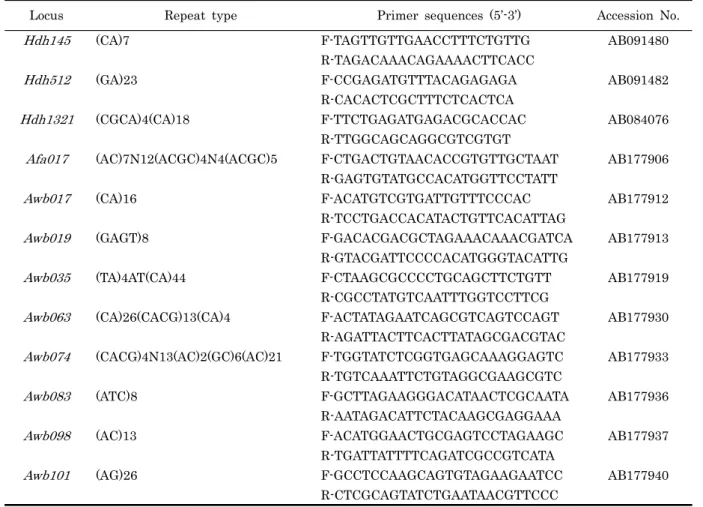
Multiplex PCR 디자인을 위하여 Table 1에 나타낸 12개 microsatellite locus (Park et al., 2003; Li et al., 2002;
Sekino et al., 2005) 를 선택하였다. 12 microsatellite locus에 대한 PCR 증폭은 킬레이팅 수지법으로 얻어진 DNA 시료 10 ng, 10 mM Tris-Hcl (pH 8.8), 0.1% Triton X-100, 50 mM KCl, 1.5 mM MgCl2, 0.2 mM dNTP, 0.5 U f-Taq DNA polymerase (Solgent), 0.5 pmol microsatellite primer pairs를 혼합하여 사용하였으며, PTC-200 Thermocylcer (MJ Research, Waltham, MA, USA) 를 이용하여 95℃에서 10분간 initial denaturation 시킨 후, 95℃에 20초, 55℃에 30초, 72℃에 1분으로 35 cycle 반응시킨 다음 72℃에 30분간 final extension시켜 PCR 반응을 마쳤다.
PCR에 의해 증폭된 microsatellite DNA 단편은 size standard로 GeneScan 400HD ROX (ABI, USA), HiDi formamide와 혼합한 후 유전자형 분석기 (3100 genetic analyzer; ABI, USA) 를 통하여 분석을 하였으며 분석 후에 나타난 피크 정보를 GeneMapper v3.7 software를 이용하여 유전자형을 분석하여 각 microsatellite locus의 증폭범위를 확인하였다.
3. Multiplex design
12개의 microsatellite locus의 증폭범위를 확인하고 증폭 범위의 중복유무에 따라 Applied Biosystems (ABI) 의 3가 지 형광표식 (6-FAM, HEX and NED) 을 붙였다.
multiplex design을 위하여 기본적으로 증폭범위가 중복되지 않은 locus는 같은 fluorescent dye를 사용하였으며, 반면에 같은 증폭범위를 나타낸 locus는 서로 다른 fluorescent dye 를 사용하여 실험하였다.
최적의 multiplex PCR 조건의 검토를 위하여 서로 다른 증폭범위의 microsatellite locus를 기준으로 8개의 primer pairs를 혼합하여 PCR 조건을 검토하였으며, 조건검토 시 증 폭이 불안정하거나 증폭하지 않는 것은 제거하고 같은 증폭범 위의 다른 primer pairs를 추가하여 분석하는 크로스체킹 방 법으로 실험을 실시하였다. 또한 PCR 증폭온도, 각 primer pairs 간의 상호작용에 따른 정량조절을 실시하였다.
4. Multiplex PCR 법의 유용성
multiplex PCR의 유용성을 검토하기 위하여 20가계를 부 화유생단계에서 10개월간 혼합사육한 북방전복 치패 500마리 를 대상으로 친자확인 및 가계분석을 실시하였다. 친자확인은 개발된 multiplex PCR을 이용하여 얻어진 유전자형을 PAPA 2.0 (Package for the Analysis of Parental Allocation) 프로그램을 이용하여 결과를 얻었으며, 가계분석 은 멘델의 분리비에 따른 관찰치와 기대치 간에 χ2-test에 의 한 유의차의 유무로 검토하였다.
결과 및 고찰
1. Multiplex design
최적의 multiplex PCR 조건을 찾기 위하여 12개 microsatellite locus를 이용하여 각각의 증폭범위 및 유전적 특성을 확인하였다. 그 결과 Table 2에 나타낸 것과 같이 증폭 범위의 경우 Hdh145는 132-142 bp, Hdh512는 87-139 bp, Hdh1321는 261-371 bp, Afa017는 161-247 bp, Awb017 는 205-249 bp, Awb019는 174-258 bp, Awb035는 153-217 bp, Awb063는 140-272 bp, Awb074는 154-260 bp, Awb083는 213-255 bp, Awb098는 167-189 bp, Awb101는 113-211 bp로 나타났으며, 대립유전자수는 Hdh1321이 35개로 가장 많았으며 Hdh145 및 Awb083이 7 개로 가장 적은 것으로 나타났다. 12개 locus에 대한 관찰치 이형접합율 (observed heterozygosity) 의 범위는 0.219-0.915이며, 기대치 이형접합율 (expected heterozygosity) 의 범위는 0.696-0.961로 높게 나타났다.
이중 다른 locus의 증폭범위와 중복되지 않고 가장 낮은 사
이즈를 나타낸 것은 Hdh512였으며 가장 큰 사이즈를 나타낸 것은 Hdh1321이었다. 이렇게 중복되지 않은 2개의 locus를 기준으로 multiplex design 작업을 수행 하였다. 우선, 12개 locus 증폭범위의 중복유무에 따라 Table 2에 나타낸 것과 같 이 3가지의 fluorescent dye (HEX, 6-FAM, NED) 를 붙였 다. 즉, 증폭범위가 중복되지 않는 것을 기준으로 Hdh145, Hdh074, Awb083는 HEX fluorescent dye를 붙였으며, Hdh512, Afa017, Awb017, Awb063는 6-FAM fluorescent dye를 붙였고, Hdh1321, Awb019, Awb035, Awb098, Awb101는 NED fluorescent dye를 붙였다.
Multiplex PCR 조건검토는 12개 locus의 크로스체킹 방법으 로 실시하였다. 그 결과 12개 후보 microsatellite locus 중 6 개 locus Hdh145, Hdh512, Hdh1321, Awb017, Awb083 및 Awb098의 조합이 최적 조건임을 확인하였다. 나머지 6개 locus Afa017, Awb019, Awb035, Awb063, Awb074 및 Awb101은 증폭이 불안정하거나 다른 locus의 증폭에 상호간 섭 등의 영향으로 제외하였다.
6개 locus의 mutiplex PCR 반응액은 DNA 시료 10 ng,
Locus Repeat type Primer sequences (5’-3’) Accession No.
Hdh145 (CA)7 F-TAGTTGTTGAACCTTTCTGTTG AB091480
R-TAGACAAACAGAAAACTTCACC
Hdh512 (GA)23 F-CCGAGATGTTTACAGAGAGA AB091482
R-CACACTCGCTTTCTCACTCA
Hdh1321 (CGCA)4(CA)18 F-TTCTGAGATGAGACGCACCAC AB084076 R-TTGGCAGCAGGCGTCGTGT
Afa017 (AC)7N12(ACGC)4N4(ACGC)5 F-CTGACTGTAACACCGTGTTGCTAAT AB177906 R-GAGTGTATGCCACATGGTTCCTATT
Awb017 (CA)16 F-ACATGTCGTGATTGTTTCCCAC AB177912
R-TCCTGACCACATACTGTTCACATTAG
Awb019 (GAGT)8 F-GACACGACGCTAGAAACAAACGATCA AB177913 R-GTACGATTCCCCACATGGGTACATTG
Awb035 (TA)4AT(CA)44 F-CTAAGCGCCCCTGCAGCTTCTGTT AB177919 R-CGCCTATGTCAATTTGGTCCTTCG
Awb063 (CA)26(CACG)13(CA)4 F-ACTATAGAATCAGCGTCAGTCCAGT AB177930 R-AGATTACTTCACTTATAGCGACGTAC
Awb074 (CACG)4N13(AC)2(GC)6(AC)21 F-TGGTATCTCGGTGAGCAAAGGAGTC AB177933 R-TGTCAAATTCTGTAGGCGAAGCGTC
Awb083 (ATC)8 F-GCTTAGAAGGGACATAACTCGCAATA AB177936
R-AATAGACATTCTACAAGCGAGGAAA
Awb098 (AC)13 F-ACATGGAACTGCGAGTCCTAGAAGC AB177937
R-TGATTATTTTCAGATCGCCGTCATA
Awb101 (AG)26 F-GCCTCCAAGCAGTGTAGAAGAATCC AB177940
R-CTCGCAGTATCTGAATAACGTTCCC
Table 1. 12 microsatellite markers for multiplex design
10 mM Tris-Hcl (pH 8.8), 0.1% Triton X-100, 50 mM KCl, 1.5 mM MgCl2, 0.2 mM dNTP, 0.5 U f-Taq DNA polymerase (Solgent) 에 Hdh512, Hdh083 및 Awb098의 primer 농도를 0.3 µM, Hdh145의 primer 농도를 0.5 µM, Hdh1321 및 Awb017는 0.2 µM로 만들어 졌으며, PCR 증 폭은 PTC-200 Thermocylcer (MJ Research, Waltham, MA, USA) 를 이용하여 95℃에서 10분간 initial denaturation 시킨 후, 95℃에 20초, 55℃에 30초, 72℃에 1 분으로 35 cycle 반응시킨 다음 72℃에 30분간 final extension으로 시행하였다.
2. Multiplex PCR을 이용한 친자확인 및 가계분석
6개의 microsatellite locus를 이용한 multiplex PCR의 유용성을 검토하기 위하여 20가계를 부화유생단계부터 10개 월간 혼합사육한 북방전복 치패 500마리에 대한 친자확인 및 가계분석을 실시하였다. 그 결과 Table 3에 나타낸 것과 같이
각 유전표식에 따른 친자확인 성공률은 Hdh1321 25.7%, Hdh512 19.4%, Awb017 11.4%, Hdh145 5.5%, Awb098 6.3%, Awb083의 2.5% 순으로 나타났다. 또한 높은 친자확인 성공률 순으로 유전표식을 조합하여 분석한 결과 Hdh1321와 Hdh512의 2개조합은 45.5%, 3개 조합 (Hdh1321, Hdh512, Awb017) 의 경우 78.2%, 4개조합 (Hdh1321, Hdh512, Awb017, Hdh145) 의 경우 88.9%, 5개조합 (Hdh1321, Hdh512, Awb017, Hdh145, Awb098) 의 경우 99.4%, 6개조합 (Hdh1321, Hdh512, Awb017, Hdh145, Awb098, Awb083) 의 경우 100%의 친자확인 성공률을 나타 내었다. 또한 20가계에 대한 가계분석을 위하여 6개의 microsatellite locus에 대한 멘델의 분리비를 분석한 결과, 대부분의 가계는 어미의 유전자형에 대한 관찰치와 기대치가 일치하였다 (Appendix I). 일부 χ2-test에 의한 유의차를 나 타내는 가계가 존재하였으나 가계당 분석개체수가 50개체 미 만으로 분석개체 수에 따른 유출오차로 추정된다.
Locus Allele Size Range
(bp) Number of alleles Observed
heterozygosity Expected
heterozygosity Dye label
Hdh145 132 - 142 7 0.400 0.696 HEX
Hdh512 87 - 139 19 0.219 0.930 6-FAM
Hdh1321 261 - 371 35 0.853 0.957 NED
Afa017 161 - 247 10 0.833 0.840 6-FAM
Awb017 205 - 249 12 0.880 0.845 6-FAM
Awb019 174 - 258 16 0.825 0.912 NED
Awb035 153 - 217 30 0.718 0.959 NED
Awb063 140 - 272 27 0.525 0.961 6-FAM
Awb074 154 - 260 17 0.800 0.844 HEX
Awb083 213 - 255 7 0.700 0.644 HEX
Awb098 167 - 189 9 0.783 0.816 NED
Awb101 113 - 211 30 0.915 0.948 NED
Table 2. Genetic characterization and dye label of 12 microsatellite markers
Marker No. Locus Success rate Marker combinations (success rate)
1 Hdh1321 25.7% 1 (25.7%)
2 Hdh512 19.4% 1 + 2 (45.5%)
3 Awb017 11.4% 1 + 2 + 3 (78.5%)
4 Hdh145 5.5% 1 + 2 + 3 + 4 (88.9%)
5 Awb098 6.3% 1 + 2 + 3 + 4 + 5 (99.4%)
6 Awb083 2.5% 1 + 2 + 3 + 4 + 5 + 6 (100%)
Table 3. Percentages of offspring assigned to the correct parental pair in 20 families
3. Multiplex PCR법 평가
양식생물의 사육관리 및 혈통에 대한 평가를 위하여 필요한 친자확인 및 가계추적 등에 가장 적합한 유전표식으로 microsatellite DNA가 알려져 있다 (Goldstein and Schlotterer, 1999). 본 연구에서 북방전복의 육종연구 및 유 전학적 연구를 위하여 6개의 microsatellite multiplex PCR 법 개발과 그 유용성을 검토하였다. 그 결과 microsatellite multiplex PCR 기술은 시간절약 및 비용 절감뿐만 아니라 대 량의 샘플을 처리할 경우 실험과정의 간소화가 가능하여 handling errors를 줄일 수 있었다. 또한, 선택된 6개의 microsatellite locus는 multiplex PCR로 genotyping 분석 시에 명확한 대립유전자 pattern을 나타내고 있어 친자확인 분석시 높은 성공률을 나타내었으며, 가계분석에 있어서도 6개 locus 모두 멘델의 분리법칙을 따르고 있었다. 따라서 본 연구 에서 개발된 multiplex PCR법은 북방전복의 선발육종을 위 한 친자확인 및 가계 분석에 매우 유용한 기술이며, 더욱이 집 단유전학 및 계통분류학 분석에도 유용하게 사용할 수 있을 것 이라 생각된다.
요 약
북방전복 선발육종에 필요한 친자확인 및 가계분석을 효율 적으로 실험하기 위하여 microsatellite multiplex PCR 기 술을 개발하였다. 개발한 mutiplex PCR 기술은 6개 microsatellite locus Hdh145, Hdh512, Hdh1321, Awb017, Awb083 및 Awb098을 한번의 PCR 증폭으로 다 중분석이 가능하다. 이 기술은 높은 친자확인 성공률과 가계분 석에 있어서도 모두 멘델의 분리법칙을 따르고 있다. 더욱이 대량의 시료처리를 필요로 하는 경우에 있어서도 시간절약 및 비용 절감뿐만 아니라 샘플 처리과정의 간소화가 가능하여 handling errors를 줄일 수 있다. 따라서 본 연구에서 개발된 multiplex PCR은 친자확인, 가계분석, 집단유전학 및 계통분 류학 분석에 유용하게 사용할 수 있을 것이라 생각된다.
사 사
본 연구는 국립수산과학원 (RP-2014-BT-052) 의 지원에 의해 연구 되었습니다.
REFERENCES
Argue, B.J., Arce, S.M., Lotz, J.M. and Moss, S.M.
(2002) Selective breeding of pacific white shrimp (Litopenaeus vannamei) for growth and resistance to taura syndrome virus. Aquaculture, 204: 447-460.
Evans, B., White, R.W.G., Elliott, N.G. (2000) Characterization of microsatellite loci in Austrailian blacklip abalone (Haliotis rubra, Leach). Molecular Ecology, 9: 1183-1184.
Gjedrem, T. (1983) Genetic variation in quantitative traits and selective breeding in fish and shellfish.
Aquaculture, 33: 51-72.
Gjedrem, T. (1997) Selective breeding to improve aquaculture production. World Aquaculture, 28:
33-45.
Gjedrem, T. (2000) Generic improvement of cold-water species. Aquaculture Research, 31: 25-33.
Gjerde, B., Terjesen, B.F., Barr, Y., Lein, I., Thorland, I.
(2004) Genetic variation for juvenile growth and survival in Atlantic cod (Gadus morhua).
Aquaculture, 236: 167-177.
Goldstein, D.B. and Schlotterer, C. (1999) Microsatellites:
Evolution and Application. Oxford University Press.
New York.
Hara, M. (1990) The effect of genetics on growth in three groups of abalone seeds. Bulletin of the TohoKu National Fisheries Research Institute, 52:
73-77
Hara, M. and Kikuchi, S. (1992) Increasing growth rate of abalone, Haliotis discus hannai, using selection techniques. NOAA Technical report, 106: 21-26.
Hara, M. and Sekino, M. (2005) Genetic difference between Ezo-awabi Haliotis discus hannai and Kuro-awabi Haliotis discus discus population:
microsatellite-based population analysis in Japanese abalone. Fisheries Science, 71: 754-766.
Hunang, B. and Hannna, P.J. (1998) Identification of three polymorphic microsatellite loci in blacklip abalone, Haliotis rubra (Leach) and detection in other abalone species. Journal of Shellfish Research, 17: 795-799.
Li, Q., Park, C., Kijima, A. (2002) Isolation and characterization of microsatellite loci in the Pacific abalone, Haliotis discus hannai. Journal of Shellfish Research, 21: 811-815.
Lucas, T., Macbeth, M., Degnan, S.M., Knibb, W. and Degnan, B.M. (2006) Heritability estimates for growth in the tropical abalone Haliotis asinina using microsatellites to assign parentage. Aquaculture, 259:
146-152.
Miller, K.M., Laberee, K., Kaukinen, K.H., Li, S., Withler, R.E. (2001) Development of microsatellite loci in pinto abalone (Haliotis kamtschatkana).
Molecular Ecology Notes, 1: 315-317.
Olesen, I., Gjedrem, T., Bentsen, H.B., Gjerde, B. and Rye, M. (2003) Breeding programs for sustainable aquaculture. Journal of Applied Aquaculture, 13:
179-204.
Park, C.J., Li, Q., Kobayashi, T., Kijima, A. (2003) Characterization novel microsatellite DNA marker in the Pacific abalone, Haliotis discus hannai. Fish genetics and Breeding science, 33: 19-24.
Park, C.J., Lee, J.H., Noh, J.K., Kim, H.C., Park, J.W.,
Hwang, I.J. and Kim, S.Y. (2012) Growth of Pacific abalone, Haliotis discus hannai, using selection breeding techniques. The Korean Journal Malacology, 28(4): 343-347.
Ren, P., Wang, Z., Yao, C., Liu, Y., Ke, C. (2008) Development of 11 polymorphic microsatellite loci in the small abalone (Haliotis diversicolor Reeve).
Molecular Ecology Resources, 8: 1390-1392
Sekino, M., Saido, T., Fujita, T., Kobayashi, T., Takami, H. (2005) Microsatellite DNA markers of Ezo abalone (Haliotis discus hannai): a preliminary assessment of natural populations sampled from heavily stocked areas. Aquaculture, 243: 33-47.
Sekino, M., Kobayashi, T., Hara, M. (2006) Segregation and Linkage Analysis of 75 Novel Microsatellite DNA markers in Pair Crosses of Japnaese Abalone (Haliotis discus hannai) Using the 5`-Tailed Primer Method. Marine Biotechnology, 8: 453-466.
Sekino M. and Hara M. (2007) Individual assignment tests proved genetic boundaries in a species complex of Pacific abalone (genus Haliotis). Conservation Genetics, 8: 823-841.
Selvamani, M.J.P., Degnan, S.M., Paetkau, D., Degnan, B.M. (2000) Highly polymorphic microsatellite loci in the Heron Reep population of the tropical abalone, Haliotis asinina. Molecular Ecology, 9: 1184-1185.
Suenaga, E. and Nakamura, H. (2005) Evolution of tree methods for effective extraction of DNA from human hair. Journal of chromatography B, 820: 137-141.
Sun X.Q., Zhen M.G., Yang G.P. (2007) Development of 15 polymorphic genic microsatellite DNA markers of Pacific abalone Haliotis discus hannai. Moleculer Ecology Notes, 7: 604-606.
Viana, M.T. (2002) Abalone Aquaculture, An overview.
World Aquaculture, pp. 34-39.
Walsh, P.S., Metzger, D.A., Higuchi, R. (1991) Chelex 100 as a medium for simple extraction of DNA for PCR-based typing from forensic material.
Biotechniques, 10: 506-513.
Zheng, H., Zhang, G., Liu, X. and Guo, X. (2006) Sustained response to selection in an introduced population of the hermaphroditic bay scallop Argopecten irradians irradians Lamarck (1819).
Aquaculture, 255: 579-585.
Family
(No.individuals)
Locus Genotypic in offspring
Number of offspring observed in each family (Expexted number)
Hdh145 Hdh512 Hdh1321
1(27) 136136 136140 096098 096116 098136 116136 301301 301311 301321 311321
16(13.5) 11(13.5) 7(6.75) 4(6.75) 8(6.75) 8(6.75) 8(6.75) 9(6.75) 4(6.75) 6(6.75)
2(10) 132136 098112 112116 116116 098116 289301 289311 301321 311321
10(10) 3(2.5) 3(2.5) 4(2.5) 0(2.5) 5(2.5) 3(2.5) 2(2.5) 0(2.5)
3(18) 136136 136142 098098 098104 098116 104116 301311 301323 311311 311323
7(9) 11(9) 5(4.5) 3(4.5) 5(4.5) 5(4.5) 5(4.5) 5(4.5) 5(4.5) 3(4.5)
4(21) 136136 136142 098112 098116 112116 116116 301301 301311 301327 311327
7(10.5) 14(10.5) 10(5.25) 3(5.25) 4(5.25) 4(5.25) 4(5.25) 3(5.25) 4(5.25) 10(5.25)
5(29) 136136 136142 142142 112112 112116 112136 116136 301301 301327 301349 327349
15(7.25) 7(14.5) 7(7.25) 8(7.25) 6(7.25) 9(7.25) 6(7.25) 6(7.25) 9(7.25) 6(7.25) 8(7.25)
6(29) 136136 136140 140140 100108 100116 108136 116136 301301 301303 303303
8(7.25) 10(14.5) 11(7.25) 6(7.25) 9(7.25) 5(7.25) 9(7.25) 14(7.25) 9(14.5) 6(7.25)
7(26) 132136 132140 136136 136140 100100 100112 100136 112136 289301 289303 301321 303321
10(6.5) 4(6.5) 4(6.5) 8(6.5) 7(6.5) 4(6.5) 8(6.5) 7(6.5) 7(6.5) 4(6.5) 7(6.5) 8(6.5)
8(22) 132132 104112 104136 112112 112136 289323 289327 301323 301327
22(22) 5(5.5) 4(5.5) 6(5.5) 7(5.5) 5(5.5) 6(5.5) 4(5.5) 7(5.5)
9(25) 132136 100104 100112 104136 112136 301323 301327 303323 303327
25(25) 5(6.25) 7(6.25) 4(6.25) 9(6.25) 3(6.25) 10(6.25) 5(6.25) 7(6.25)
10(31) 136136 136140 136142 140142 102112 102116 112116 116116 283301 283327 299301 299327
6(7.75) 10(7.75) 8(7.75) 7(7.75) 5(7.75) 7(7.75) 9(7.75) 10(7.75) 6(7.75) 6(7.75) 10(7.75) 9(7.75)
11(37) 132136 132140 136136 136140 112112 112116 116116 301301 301327 301341 327341
7(9.25) 10(9.25) 9(9.25) 11(9.25) 14(9.25) 9(18.5) 14(9.25) 6(9.25) 11(9.25) 8(9.25) 12(9.25)
12(38) 132136 132140 136136 136140 112112 112116 116116 301301 301327 301349 327349
6(9.5) 14(9.5) 6(9.5) 12(9.5) 7(9.5) 11(19) 20(9.5) 9(9.5) 12(9.5) 10(9.5) 7(9.5)
13(38) 136136 136140 140140 112112 112116 112136 116136 301301 301321 301327 321327
7(9.5) 22(19) 9(9.5) 9(9.5) 11(9.5) 14(9.5) 4(9.5) 5(9.5) 11(9.5) 11(9.5) 11(9.5)
14(17) 132140 136140 092112 112116 116116 092116 301327 301341 321327 321341
10(8.5) 7(8.5) 7(4.25) 4(4.25) 6(4.25) 0(4.25) 3(4.25) 7(4.25) 5(4.25) 2(4.25)
15(18) 136136 136140 100100 100116 116116 301301 303303 301303
8(9) 10(9) 8(4.5) 1(9) 9(4.5) 9(4.5) 9(4.5) 0(9)
16(23) 132132 132136 112112 112136 136136 289289 289301 301321 238321
18(11.5) 5(11.5) 7(5.75) 8(11.5) 8(5.75) 7(5.75) 8(5.75) 8(5.75) 0(5.75)
17(22) 136136 136142 142142 098108 098136 104108 104136 301311 301323 311349 323349
13(5.5) 3(11) 6(5.5) 6(5.5) 8(5.5) 7(5.5) 1(5.5) 7(5.5) 1(5.5) 7(5.5) 7(5.5)
18(19) 132132 132140 136140 132136 108112 108124 112136 124136 289301 289359 301315 315359
6(4.75) 6(4.75) 7(4.75) 0(4.75) 4(4.75) 4(4.75) 4(4.75) 7(4.75) 4(4.75) 4(4.75) 7(4.75) 4(4.75)
19(38) 136140 138140 116116 116136 136136 301301 301311
18(19) 20(19) 14(9.5) 7(19) 17(9.5) 12(19) 26(19)
20(12) 132140 136140 112112 112136 116136 112116 301301 301321 301327 321327
9(6) 3(6) 4(3) 4(3) 4(3) 0(3) 4(3) 1(3) 3(3) 4(3)
Appendix I. Mendelian segregation of 6 microsatellite markers in 20 families
Family
(No.individuals)
Locus Genotypic in offspring
Number of offspring observed in each family (Expexted number)
Awb017 Awb083 Awb098
1(27) 209211 211213 235235 235238 235253 238253 171173 171185 173181 181185
13(13.5) 14(13.5) 10(6.75) 6(6.75) 5(6.75) 6(6.75) 9(6.75) 6(6.75) 6(6.75) 6(6.75)
2(10) 209211 209219 211213 213219 235238 238238 167173 167185 171173 171185
3(2.5) 3(2.5) 3(2.5) 1(2.5) 6(5) 4(5) 3(2.5) 3(2.5) 4(2.5) 0(2.5)
3(18) 209213 211213 213213 209213 235238 235241 238238 238241 167173 167185 173181 181185
5(4.5) 5(4.5) 8(4.5) 0(4.5) 5(4.5) 2(4.5) 3(4.5) 8(4.5) 6(4.5) 7(4.5) 3(4.5) 2(4.5)
4(21) 209209 209213 213213 235235 235238 235250 238250 173173 173179 173185 179185
4(5.25) 12(10.5) 5(5.25) 4(5.25) 4(5.25) 9(5.25) 4(5.25) 7(5.25) 5(5.25) 5(5.25) 4(5.25)
5(29) 209213 213213 235235 235238 235250 238250 173173 173179 179179
16(14.5) 13(14.5) 7(7.25) 9(7.25) 7(7.25) 6(7.25) 6(7.25) 17(14.5) 6(7.25)
6(29) 211211 211213 213213 235235 235238 173173 173179 179179
8(7.25) 14(14.5) 7(7.25) 17(14.5) 12(14.5) 8(7.25) 14(14.5) 7(7.25)
7(26) 211211 211213 211249 213249 235238 171173 171179 173181 179181
5(6.5) 7(6.5) 8(6.5) 6(6.5) 26(26) 9(6.5) 5(6.5) 9(6.5) 3(6.5)
8(22) 211211 211249 235238 167173 167181 171173 171181
11(11) 11(11) 22(22) 6(5.5) 5(5.5) 8(5.5) 3(5.5)
9(25) 209211 211213 235238 235241 167173 167183 171173 171183
13(12.5) 12(12.5) 12(12.5) 13(12.5) 5(6.25) 6(6.25) 9(6.25) 5(6.25)
10(31) 209217 217227 235235 235238 235250 238250 167167 167181
14(15.5) 17(15.5) 9(7.75) 11(7.75) 5(7.75) 6(7.75) 17(15.5) 14(15.5)
11(37) 217217 217219 235235 235238 235250 238250 167181 181181
20(18.5) 17(18.5) 8(9.25) 14(9.25) 8(9.25) 7(9.25) 17(18.5) 20(18.5)
12(38) 211217 217217 235235 235238 235250 238250 167173 173181
24(19) 14(19) 14(9.5) 10(9.5) 5(9.5) 9(9.5) 28(19) 10(19)
13(38) 211217 213217 235235 235250 167173 167181 173181 181181
19(19) 19(19) 22(19) 16(19) 9(9.5) 11(9.5) 6(9.5) 12(9.5)
14(17) 213213 213217 213221 217221 235235 235238 173181 181181
6(4.25) 5(4.25) 2(4.25) 4(4.25) 13(8.5) 4(8.5) 8(8.5) 9(8.5)
15(18) 209217 209219 213217 213219 235238 238238 171173 171183 173179 179183
6(4.5) 1(4.5) 3(4.5) 8(4.5) 6(9) 12(9) 1(4.5) 3(4.5) 10(4.5) 4(4.5)
16(23) 211213 213219 235238 238238 167173 167179 171173 171179
16(11.5) 7(11.5) 10(11.5) 13(11.5) 9(5.75) 5(5.75) 4(5.75) 5(5.75)
17(22) 211213 213213 235238 235241 238238 238241 167173 167179 173181 179181
7(11) 15(11) 6(5.5) 5(5.5) 6(5.5) 5(5.5) 6(5.5) 3(5.5) 6(5.5) 7(5.5)
18(19) 211217 211219 213217 213219 235238 238238 171173 171181 173179 179181
6(4.75) 6(4.75) 4(4.75) 3(4.75) 12(9.5) 7(9.5) 2(4.75) 4(4.75) 7(4.75) 6(4.75)
19(38) 209213 209217 211213 211217 235235 235238 173173 173181 173185 181185
11(19) 11(19) 7(19) 9(19) 22(19) 16(19) 7(9.5) 7(9.5) 12(9.5) 12(9.5)
20(12) 211211 211213 235235 235238 238238 173181 181181
4(6) 8(6) 3(3) 5(6) 4(3) 9(6) 3(6)
Appendix I. (Continued)