한국표면공학회지 J. Kor. Inst. Surf. Eng.
Vol. 46, No. 5, 2013.
http://dx.doi.org/10.5695/JKISE.2013.46.5.187
<연구논문>
Characteristics of NbN Films Deposited on AISI 304 Using Inductively Coupled Plasma Assisted DC Magnetron Sputtering Method
Shinhee Jun
a, Junho Kim
b, Sunkwang Kim
a, Yong zoo You
a, Byungchul Cha
b*a
School of Materials Science and Engineering, University of Ulsan, Ulsan 680-749, Korea
b
Advanced Hybrid Production Technology Center, Korea Institute of Industrial Technology, Yangsan 626-821, Korea
(Received October 2, 2013 ; revised October 24, 2013 ; accepted October 25, 2013)
Abstract
Niobium nitride (NbN) films were deposited on AISI 304 stainless steels by inductively coupled plasma (ICP) assisted dc magnetron sputtering method at different ICP powers, and the effects of ICP power on the phase formation, mechanical and chemical properties of the films were investigated. X-ray diffraction analysis (XRD) and field emission scanning electron microscopy (FESEM) were used to analyze the crystal structure and micro-knoop hardness was used to measure the hardness of the films. Also, 3-D mechanical profiler and a ball-on-disk wear tester were used to measure the thickness of the films and to estimate wear characteristics, respectively. The thickness of the films decreased but their hardness increased with increasing ICP power, and it was confirmed that only cubic δ-NbN(200) remained at high ICP power. At lower ICP powers, a mixture of the hexagonal δ'-NbN and cubic δ-NbN phases was obtained in the films and the hardness decreased. The corrosion potential value increased gradually with increasing ICP power, but the changes of ICP power did not significantly influence the overall corrosion resistance.
Keywords : NbN thin films, Inductively coupled plasma (ICP), Reactive magnetron sputtering
1. Introduction
Transition metal nitrides coatings have many potential applications in instruments, molds, cars and vessels, thanks to their great mechanical properties, chemical stabilities and good corrosion resistance. Niobium nitride (NbN), as a transition metal nitride, is a very attractive material because of its high hardness, melting point, wear resistance, chemical inertness and super- conducting properties. NbN thin films have good mechanical properties and high temperature stability.
These films are used in semiconductors and electronic devices because they have superconducting properties in the temperature of 16-17 K with NaCl structure
1). NbN coating films have been produced by various deposition techniques such as magnetron sputtering
2), hybrid sputtering
3,4), and vacuum arc
5,6). Until now, most of the study on NbN was related to its super-
conducting properties rather than its mechanical properties. The different characteristics of NbN films produced by various deposition apparatus are well explained in Benkahoul et al.
7)An inductively coupled plasma (ICP) assisted sputtering is considered as a very efficient technique for the deposition of high quality coating at low temperatures due to its many beneficial properties. Especially, it is possible to form high-density plasma at the region between a target and a substrate in a chamber if an ICP is added to a conventional magnetron sputtering system
8-14).
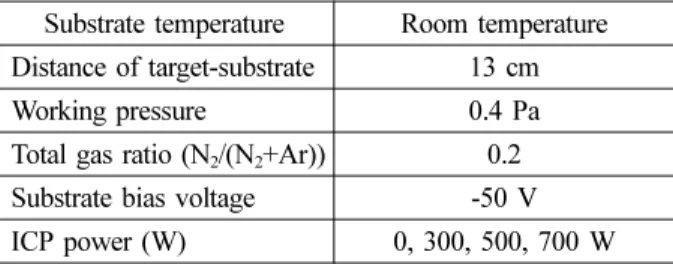
In this work, NbN thin films are deposited on AISI 304 austenitic stainless steel in order to understand the influences of various ICP powers on the charac- teristics of the films, when a tube-shaped ICP source is added to a conventional magnetron sputtering chamber. Little studies have been reported on the mechanical and corrosion characteristics of the films compared with its superconducting properties. The present study aims to evaluate the mechanical properties
*