*준회원, 울산대학교 전기전자정보시스템공학부
**정회원, 울산대학교 전기전자정보시스템공학부 (교신저자) 접수일자 2009.10.15, 수정일자 2009.11.13
논문 2009-6-5
무선인지시스템을 위한 효율적인 채널 선택 알고리즘
An Efficient Stochastic Channel Selection Algorithm for Cognitive Radio Networks
팜티홍츄*, 구인수**
Thi Hong Chau Pham, In-Soo Koo
요 약 본 논문에서는 무선인지네트워크를 위한 효율적인 채널 선택 알고리즘을 제안하고 그 성능을 비교․분석한다. 제안된 알고리즘에서는 다중의 가용한 채널들 중 최적 채널 선택을 위해 히스토리 윈도우 범위에서 각 채널의 기 (primary) 사용자에 의한 채널 사용률 및 성능, 현 채널 품질 그리고 기 사용자의 통계적 트래픽 활동 특성을 고려한 다. 시뮬레이션을 통해 무선인지(secondary)사용자들이 제안된 알고리즘을 통하여 다중의 채널들중 데이터 전송을 위 한 최적의 채널을 선택할 수 있음을 보였다.
Abstract
An efficient stochastic channel selection algorithm for cognitive radio networks is proposed and analyzed in this paper. With the new algorithm utilizing quality of channels, the stationary level of the channels in idle state and history performance, we can find the best channel for secondary users to transmit data.Moreover, this method not only restricts channel switching of secondary users but also adapts to random resource environment of cognitive radio network. The advantages of the proposed algorithm are demonstrated clearly through computer simulation.
Key Words :
Cognitive radio, channel selection, quality of channelsⅠ. Introduction
Wireless communications have been developing very fast. Each wireless network demands on the specific spectrum band. This leads to the spectrum lack.
Moreover, the licensed spectrum is utilized in an inefficient way [3][7]. Thus, new communication paradigm is necessary to exploit the best available spectrum bands. Recently, Cognitive Radio (CR) which enables opportunistic access to unused licensed bands has been proposed as a promising technology to improve spectrum utilization [6].
In CR network, secondary users (SUs) share spectrum that primary users (PUs) do not use. But a prerequisite of SU access is no interference to PUs.
Due to the random characteristics of PUs in the CR networks, SUs need to switch the channel being used adaptively and consistently. But inefficient channel switching may cause the packet loss problem to CRs.
Therefore, appropriate channel switching selection
mechanisms should be proposed in place in order to
guarantee QoS constraints of CRs on the activities of
PUs. With respect to SUs, the channel selection
strategy is invented to solve the above problem of CR
networks. Finding the optimal channel for SUs not only
reduces channel switching, but also increases
throughput of SUs. With suitable channel selection
strategy for SUs, further PUs also avoids interference caused by SUs such that the activity of PUs can be guaranteed well. There are some literatures that have mentioned the channel selection algorithm for SUs in CR networks. For example, dynamic channel selection for multiuser video streaming is proposed in [4].
Multi-user video streaming (with various video traffic characteristics and QoS requirements) requires efficient dynamic channel selection schemes to exploit available spectrum resources. To do this, a wireless user needs to effectively model the dynamic wireless environment and estimate the delay of video packet transmission when selecting a specific frequency channel. The problem of optimal channel selection for spectrum agile low-powered wireless networks in unlicensed bands was given in [2]. They derived the optimal selection rules by formulating the channel selection problem as a multiarmed bandit problem. The model assumptions about the interfering traffic that motivates this formulation are also validated through 802.11 traffic measurements as an example of a packet switched network. Spectrum-agile users can benefit from the agility by ideally using the least congested channel.
A novel stochastic channel selection algorithm for SUs based on learning automata, is presented [7]. This algorithm adjusts the probability of selecting each available channel and converges to the є-optimal solution asymptotically, in the sense that the probability of successful transmissions is maximized. A learning automata algorithm is expected to determine a strategy of selecting actions at a stage given the past actions and corresponding outputs. Determining the channel for SUs to transmit only based on historical performance of each channel may cause a lot of disadvantages. It takes a long time to find out the optimal channel. The current state of channels is unknown by SUs. SUs can use channels while they are occupied by PUs.
Throughput of both PUs and SUs will be reduced result of the collision between PUs and SUs.
Focusing on QoS requirements defined as the optimal channel selection which maximizes the
probability of successful transmissions for the secondary users, rather than restricting channels switching , in the paper we propose an efficient channel selection algorithm based on quality of channel, channel state transition and historical performance when the behaviors of primary users is random. This algorithm adjusts the real probability of selecting each available channel. The quality of channels is also considered, SUs can know that channels are in idle or busy state. If channels are idle, SUs will compare the probability of channel state transition and the real probability among the idle channels continuously. After that, each SU selects the best channel to access. If having two or more SUs choose the same channel, we use the backoff function to determine which SU can access the channel firstly. This algorithm is expected to give more advantages than ever. The effect of the algorithm which is mentioned here, will be showed clearly in simulation results.
The rest of this paper is organized as follows: The system model is used in this paper is showed in Section II. In Section III, we present an overview of the energy-based spectrum sensing. The stochastic channel selection algorithm is provided in Section IV.
Simulation results are showed in Section V. Finally, this paper is concluded in Section VI.
Ⅱ. SYSTEM MODEL
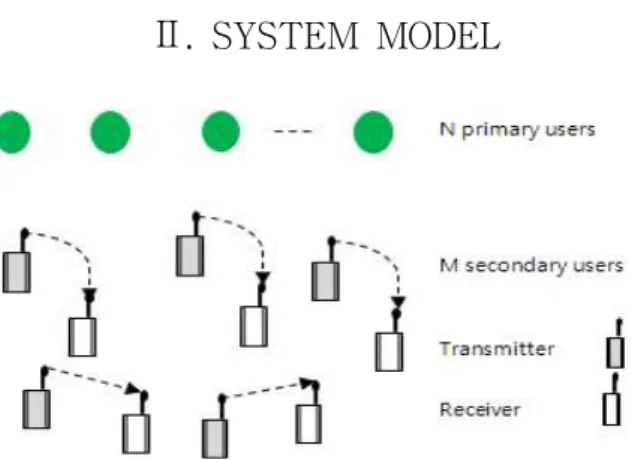
Fig. 1. Topology of the cognitive radio network.
In this paper, we consider stationary cognitive radio
network, shown in Figure 1 where N primary users
and Msecondary users coexist. The proposed model is time slotted. Multiple M PUs have different frequencies and each SU has a pair of transmitter and receiver which are both cognitive radios. PUs can use the assigned channels to transmit data whenever they have packets. On the other hand, SUs are allowed to operate at the idle channels in which PUs are absent.
The SUs also exit the using channel immediately if the primary comes back to that channel.
A. Traffic model for primary users
The considered primary network has an licensed spectrum that is consisted of N channels, each with bandwidth B
i( i
=1,...,N ). SUs should not share a channel if they interfere with each other. PUs do not need to know the presence of SUs and they can access their licensed spectrum whenever they want.
We assume that the traffic processes of PUs over different channels are independent identical distributed (i.i.d.). As illustrated in Fig. 2, channel states are represented by busy and idle. A channel is in a busy state if it is occupied by PU and in an idle state otherwise. We use Poisson process to describe the traffic of PUs. In the most traffic processes, we can assume that durations of both idle and busy states are exponentially distributed. We denote the Interrupted parameters in exponential distribution of idle and busy states as
μ0and
μ1, respectively. The expected durations of idle and busy states are also
μ-10and
μ-11
respectively.
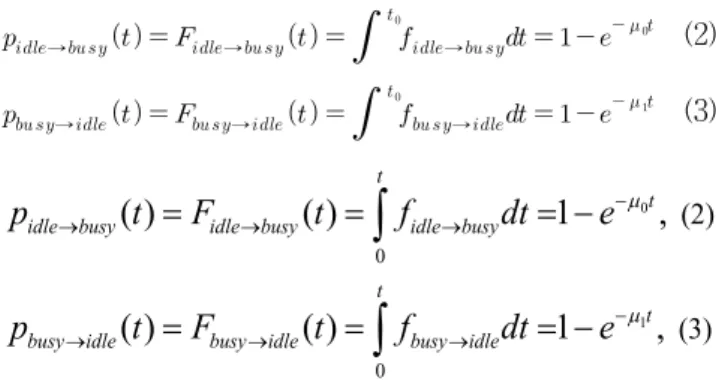
The traffic model is a Markov chain. During a period time t, the probability density function that the channel switches from idle state to busy state, and that from busy state to idle state are given as:
→
→
(1)The transition probabilities from idle state to busy state and that from busy state to idle state are respectively given as:
→ →
→ (2)
→ →
→ (3)
0
1
0
0
(2)
(3)
( ) ( ) 1 ,
( ) ( ) 1 ,
t
t
idle busy idle busy idle busy
t
t
busy idle busy idle busy idle
p t F t f dt e
p t F t f dt e
m
m -
® ® ®
-
® ® ®
= = = -
= = = -
ò ò
After that, we can get the probability that the channel preserves idle state during a time period t as follows:
→
→
(4)
The channel which keeps intact idle state, means that the PUs do not come back the channel during a period time t, and the channel state is non-transition.
Fig. 2. The Markov channel model.
B. The access model of secondary users In the beginning of each time slot, each SU should sense all channels. After the idle channel is found, SU can use the idle channel to transmit packets. If PU comes back the channels, SUs have to vacate the channels and sense the channels in the next time slot.
We also consider the interferences to be made by the interaction among SUs. If two or more SUs select the same channel, SUs should access to channels in the different time interval with backoff function.
Ⅲ. THE ENERGY-BASED SPECTRUM SENSING
In [1] [5], the simple model of the energy-based
spectrum sensing is described. To measure the signal
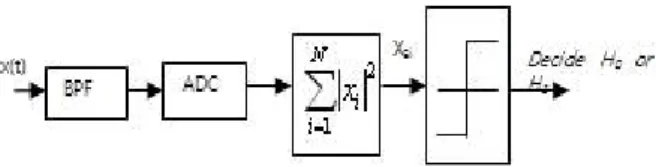
power in particular frequency region in time domain, a band-pass filter is applied to the received signal and the power of signal samples is then measured at CU.
To do this, the energy detector includes a band pass filter that selects the centre frequency, f
s, and bandwidth of interest, W. Continuously, a analogue - digital convertor device followed by a square summation block which determines the sampling observation interval, N. The output of the summation block, X
Ei, is compared with a threshold λ, to decide whether the signal is present.
Fig. 3. Block diagram of an energy detector.
The detection is a test of the two hypotheses as follows:
x(t)= { n(t) H
0(white-space) hs(t)+n(t) H
1(occupied) (4) where x(t) is the signal received by secondary user, s(t) is the primary users’s transmitted signal, n(t) is the additive white Gaussian noise (AWGN), and h is the amplitude gain of the channel.
Base on the hypotheses above, the SUs can determine the channel state. Each channel has two states: idle or busy. If the channel is idle, SUs can access channels and transmit data. On contrary, SUs sense the channels to find out the unoccupied channels in the next available time slot.
Ⅳ. STOCHASTIC CHANNEL SELECTION ALGORITHM
In this paper, we consider a cognitive radio network with N primary users and M secondary users.
Assuming that the random environment is stationary, we propose an algorithm to select the optimal channel
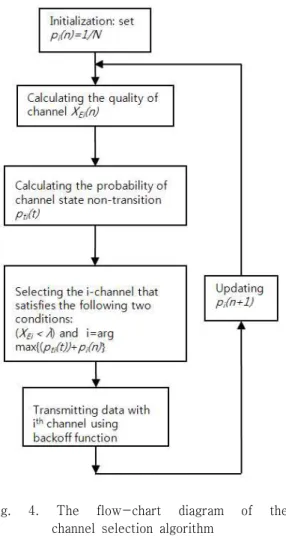
for secondary users. The proposed algorithm can track the optimal solution with slow statistic-varying environment, and can be described as follows:
In the first step, SUs set some parameters, i.e., the initial real probability.
Secondly, we calculate channels’s quality X
Ei(n)and probability of channel state non-transition p
ti(n).
Basing on these values, each SU find out the channel that has the maximum probability of successful transmission among idle channels. We also assume that the collision among SUs is occurred when two or more SUs choose the same channel to transmit data. We use Backoff function to determine which SU be allowed to access the channel first to avoid the collision, which will be described later.
After that, we update the real probability. Then, the new loop is continued. The way to update the real probability of SUs as follows:
•The procedures to update the real probability of the SUs
Each SU can find the channel to transmit and also can switch among N channels. PUs do not need to know the presence of SUs and can access the corresponding assigned channel freely. For simplicity, we assume that each secondary user has a fixed transmission rate. The traffic that generated at the transmitter of the h
thsecondary user, is transmitted to the receiver in consequent time slots. The algorithm executed in the h
thsecondary users to update the real probability of SU is provided in detail as follows:
Step 1.: Initialization
-The user h sets p
i(n)=[p
1;⋯;p
N] where p
i=1/N for all 1≤i≤N.
-Initializes D(0)=[D
1;⋯;D
N] where
D
i=S
i(0)/C
i(0).
Fig. 4. The flow-chart diagram of the channel selection algorithm
Step 2: Updating the probability vector P
i(n) according to the following equations:
min
max
≦
(6)
≠
(7)where
H(n) : The number of channels which have higher values in the estimation vector D than the current selected channel.
δ : The step size of adjusting the probability vector and δ=1/R.
S
i(n): The number of slots where the transmissions with the channel i are successful, up to
T
n.
C
i(n): The number of slots where the channel i is chosen to transmit packets, up to T
n.
Step 3: After T
n, the secondary user adjusts the running estimation of the successful transmission possibility, i.e., D
i, by
(8) where β = 1 if the transmission is successful and β =0 otherwise.
• Backoff function
In the channel selection algorithm, the collision between SUs should be considered. SUs can choose the same channel, and at that time the channel occurs colliding. Therefore, the backoff function should be considered to solve this problem. Fig. 5 shows the backoff function used in the proposed algorithm. Each secondary user accesses the channel at different time instants. Time instants are determined by Backoff function. X
E1, and X
E2are the measure of the quality of channel of SU
1and SU
2, respectively. τ
1, and τ
2are the time instants at which SU
1and SU
2are allowed to access the channel.
Fig. 5. Backoff function is used for SUs to select channel.
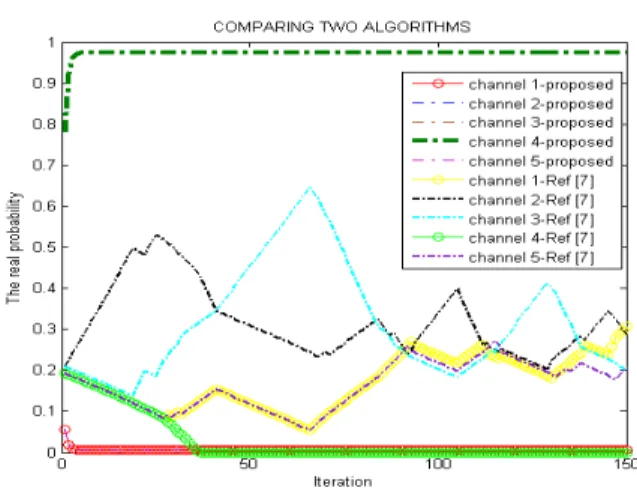
Fig. 6. The probability updating history.
Fig. 7. The throughput of secondary user
Ⅳ. SIMULATION RESULTS
In this section, simulation results are presented to evaluate the performance of the proposed channel selection algorithm. The simulation parameters are summarized as follows:
R : The resolution parameter is set to R=50.
N : There are five primary users, i.e., N=5.
M : There is a single secondary user, i.e., M=1.
δ : The step size is set to δ=1/R=0.02.
µ
0,µ
1: The interrupted parameters vector in exponential distribution of idle state and busy state, respectively. Here we let μ
0=μ
1=[0.01 0.015 0.02 0.009 0.022];
Fig.6 shows the channel selection probabilities of the
proposed algorithm and the algorithm proposed in [7].
The ‘channel 1-proposed’ to ‘channel 5-proposed’
indicate the channel selection probability of each channel in the proposed scheme. The ‘channel 1-Ref [7]’ to ‘channel 5-Ref [7]’ indicate that of each channel in the algorithm [7]. Using the proposed algorithm, we obtained the channel 4 as the optimal channel of which probability of successful transmission is maximized.
Clearly, the new algorithm has better performance than the old algorithm [7]. With the new algorithm, we can easily select the optimal channel for SUs. Through the Fig.7, throughput of secondary user is showed clearly.
The proposed scheme gives the greater throughput than the algorithm which was presented in [7].
Ⅴ. CONCLUSIONS
In this paper, we concentrate on proposing a algorithm to find out the optimal channel for secondary users. This algorithm bases on quality of channel, the channel state probability and historical performance of each channel. The probability of selecting each available channel is adjusted by this method. Numerical results show clearly the efficiency of the proposed method.
REFERENCES
[1] A.Ghasemi and S.Sousa, “Optimization of spectrum sensing for opportunistic spectrum access in cognitive radio networks” in IEEE Consumer Communications and Networking Conference, pp.1022-1026, Jan, 2007.
[2] A.Motamedi and A.Bahai, “Optimal channel selection for spectrum-agile low-power wireless packet switched networks in unlicensed band”, EURASIP Journal on Wireless Communications and Networking, vol.
2008, Article ID 896420, 10 pages, 2008.
※ This work was supported in part by the Ministry of Commerce, Industry, and Energy and in part by Ulsan Metropolitan City through the Network-based Automation Research Center at the University of Ulsan
저자 소개 팜 티 홍 츄 (주회원)
∙2005년 Hanoi University of Technology 졸업(학사)
∙2008년~현재 울산대학교 전기전자정 보시스템공학부 석사과정
<관심분야 : 차세대 이동통신, 자원할당 및 다중접속 알고리즘>
구 인 수 (정회원)
∙1996년 건국대학교 전자공학과 졸업 (학사)
∙1998년 광주과학기술원 정보통신공학 과 졸업(석사)
∙2002년 광주과학기술원 정보통신공학 과 졸업(박사)
∙2005년~현재 울산대학교 전기전자정 보시스템공학부 부교수
<주관심분야 : 차세대 이동통신, 무선 센서네트워크>